Pocket Billiards

Ashok13


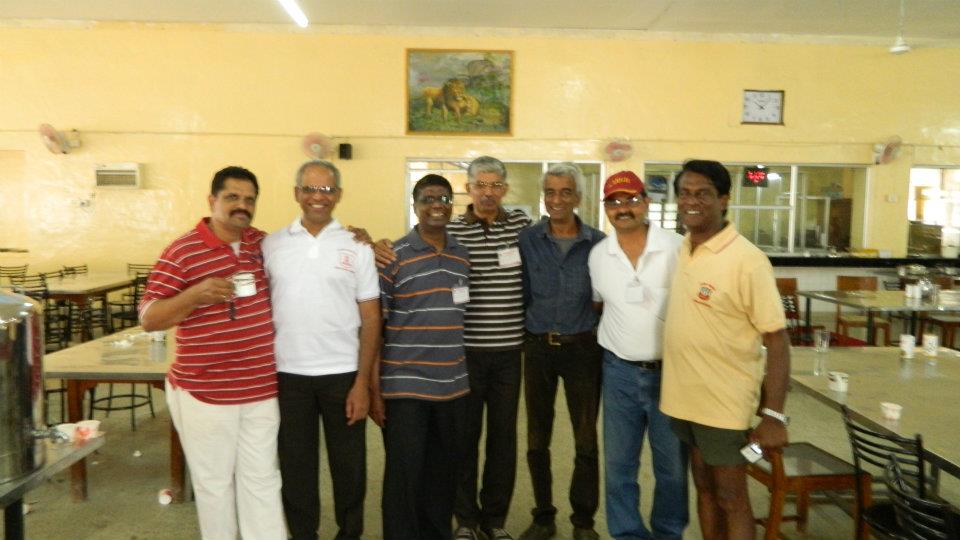
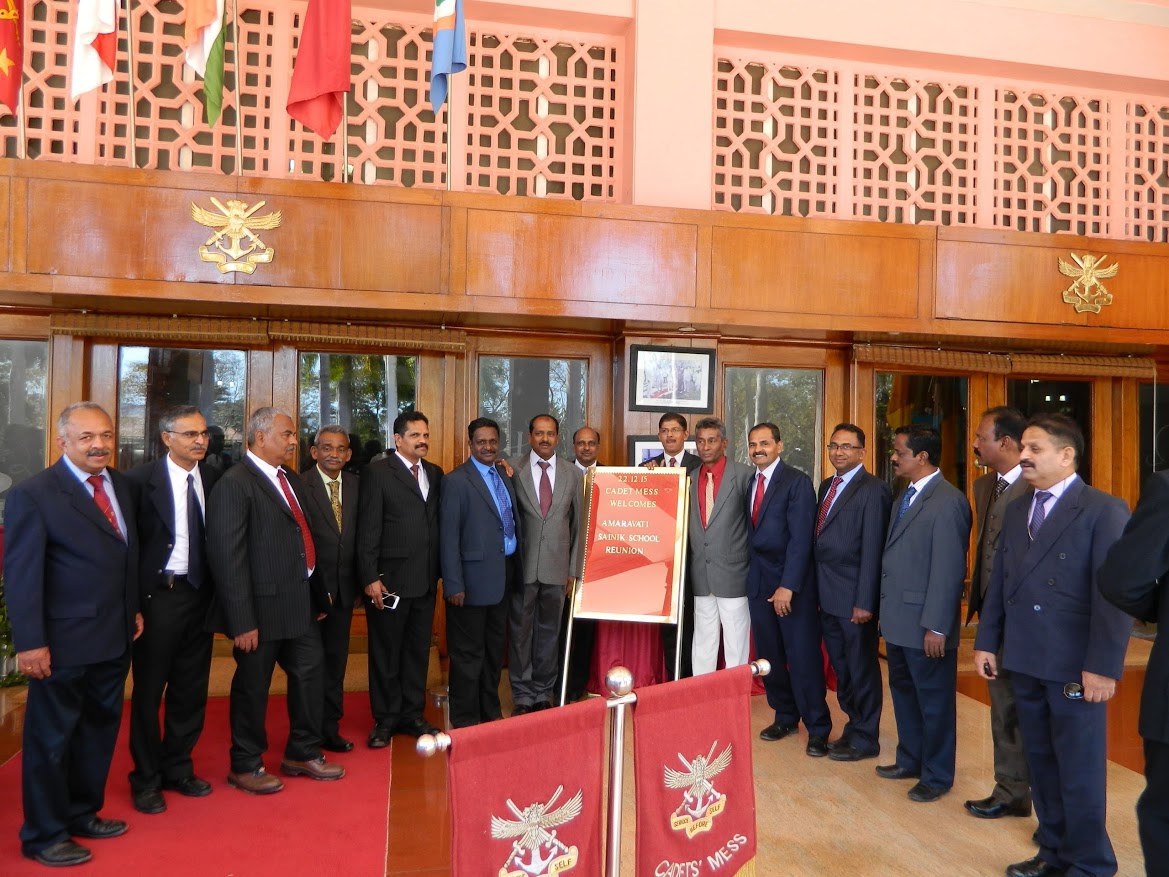
The above is an image of our classmates from Sainik School Amaravathinagar, in front of the Cadets’ Mess at the National Defence Academy (NDA) during our reunion in December 2015.  The reunion was hosted by Vice Admiral Ashok Kumar, AVSM, VSM, then Commandant, NDA.  Everyone is standing with their hands off their pockets, a rarity in such images of today.  Most images one receives on the social media have men standing with their hands deep down their pant pockets.

My mind went back to our school days-from 1971 to 1979, to the times when a cadet with his hands in pockets, was taunted supposedly for playing Pocket Billiards.  At times they were queried as to which ball is winning – the Right or the Left one.  Owing to this rigorous discipline instilled during the formative years, even after 37 years since our graduation,   mere thought of putting one’s hands in pockets will never occur to our classmates; even in their wildest of dreams.

A detailed report on the reunion appears on my blog (Please Click here to read).   If you study all the photographs taken both at formal and informal events, you will hardly observe anyone playing ‘Pocket Billiards’.  It could all be courtesy the taunts our classmates received.  We did not even spare our teachers – especially the new entrants- from similar taunts.

Pocket Billiards is mostly a men’s problem.  This is not a sexist view point but a factual one.  Women rarely put their hands in their pockets, except perhaps on a cold, chilly day.  They generally do not enjoy the liberty of putting their hands in pockets mostly because their attire, even while wearing pants. Women’s pants generally come without pockets and even when they do, the pockets are too shallow to accommodate a whole hand.  Women’s pants or jeans are often tight, thereby making it uncomfortable to shove their hands in.  Thus it remains mostly a masculine issue.

Why do men put their hands in pockets? Body language experts and psychologists have different takes on the issue. Is it that they are obsessed with their family treasures? Some experts opine that that there is a subconscious male urge to perpetually hold on to one’s genitals.   But holding on to one’s genitals in public is an indecent social display.  It could be that they are scared that their family treasures might fall off or someone might steal them!

Pocket Billiards by a speaker on a podium is sure to distract and also put off the audience.  Such speakers do not know what to do with their hands and try to find places to hide them and this leads to Pocket Billiards. This body language theory is sometimes contradicted by some world famous orators who can hold the audience spell bound, with one of their hands remaining in their pocket.  It becomes somewhat obscene when Pocket Billiards is accompanied with a posture of legs wide apart and hips thrust forward. Even so, some psychologists opine that this combination is a confident gesture of the dominant male who wants to tell others around who the boss is. Whatever the theory, it is not a pleasant sight to behold!

One of the most evolved part of human anatomy is our hand – with the wrist, palm and the five fingers.  The relationship between our hands and our brain has been well established by scientists.  In fact, our hands have become another communication tool.

We salute when we meet a superior officer in the military and we shake hands when we meet someone.  All these greetings are done with the open palm and has been associated with truth, honesty, allegiance and submission.  Many oaths are still taken with the palm over the heart, or over a holy book.  In the olden days, it was to show that you are unarmed and therefore not a threat and from there evolved various salutes and handshakes.

Most common body language theory is that hiding our hands is an instinctive reaction to nervousness while keeping our hands out in the open indicates confidence and also that we have nothing to hide.  Pocket Billiards tends to encourage slouching and that is why the militaries around the world have strictly forbidden it, even while off-parade.

Many men feel that they project a cool and confident look with their hands in their pockets without realising that the converse is the truth. More often than not, they project a nervous look, without knowing what to do with their hands.  Some psychologists suggest that the habit also demonstrates unwillingness, mistrust and reluctance and is often associated with liars. Be careful, everyone with hands in their pockets need not necessarily be a liar. It may just be a biological need to ward off the cold. Some experts also feel that pocket billiards is merely indicative of a person’s desire to listen rather than speak. Some even differentiate between one hand and both hands in the pocket. Theories abound but the general consensus is that the habit is one of negative body language and needs to be got over.

How to get over the Pocket Billiards syndrome? Like most good habits and bad ones too, they all begin at home.  Children take on to it seeing their parents or other adults doing it.  By putting your hands in the pockets, you are surely setting a bad example for your children.  In case you observe a child putting his hands in pockets, it is best to explain and make him understand that with his hands in the open, he would look smarter and more confident than otherwise.  Teachers at schools also have a similar role to ensure that their students do not end up playing Pocket Billiards. Friends and peers are the best to help you out of this dreadful habit.  Our classmates, both in the military and civil life, are a sure testimony to this.  Another option is to stitch down your front pockets or pin it close.  You can always use the back pockets to store your wallet or cell phone.

One needs to pay attention to one’s hands and ensure that they are clean, hygienic and presentable.  Make sure to rub a cream or lotion and also a sanitizer on your hands prior to meeting anyone or while going to a gathering.  Ensure that you consciously use gestures that will get your message across to those that will help you build alliances and influence people.  With your hands in your pockets, you would mostly end up as an ugly duckling.

Soldiers’ Gods

sg

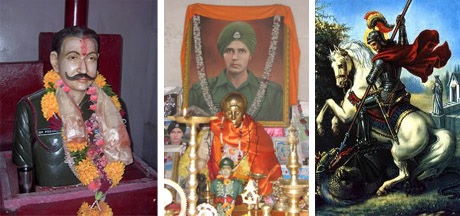
There are many soldier Gods in different border areas where the Indian Army operates. Most of the shrines dedicated to these Gods are situated in inhospitable terrain and mostly placed out of bounds to the civilians. There are no hymns or keertans sang on behalf of these Gods, they do not have ashrams, they do not ride in luxurious sedans, they do not hug devotees, they do not run charitable institutions, and they do not give darshans, and so on. They are soldiers who sacrificed their lives in service of their motherland and now regarded as patron saints guarding the areas where they achieved Martyrdom.


On my first assignment to the Kashmir Valley as a young Captain in 1987, my belief in  God Almighty was rekindled mainly because of the inhospitable terrain, sub-zero temperatures, heavy snow-falls, avalanches, thin air with deficiency of Oxygen, high-altitudes above 10,000 feet, and the drive through the mountain roads where one could slip off the road, down the gorges, and no trace would be left of the vehicle or the passengers.


I was attached to a Punjab Battalion as Artillery Observer. The Battalion had soldiers mainly from Punjab, Himachal and Jammu, consisting of Hindus and Sikhs. As per the norms of the Army, the battalion had a Mandir with a Hindu Pundit and a Gurudwara with a Sikh Granthi. On Sundays or on important religious days we attended both Mandir Parade and Gurudwara Parade. These being Parades, it was mandatory for all officers and soldiers to attend.

On the way to the battalion headquarters, there was a Muslim Peer Baba and every man, irrespective of their rank or position, used to stop and pay their respects to the Peer Baba before proceeding to the battalion. The belief among the soldiers, passed down over many decades of army deployment was that the Peer Baba took care of the soldiers and in case anyone failed to stop and pay respect, he will meet with some tragedy. Being a Christian by birth, I said the Lord’s prayer in the mornings and evenings, a ritual embedded in me by our father.


This was the place I understood the meaning of secularism and realised that all Gods were the same. I was never sure as to who saw me through my first Kashmir tenure, the Gods in the Temple, the Gurudwara, Peer Baba or Jesus. During my later years of field service in Sikkim and in Siachen Glacier, I came across two Soldier Gods.

OP Baba, Siachen Glacier, c/o 56 APO
BabaOP

Siachen Glacier, a disputed territory between India and Pakistan, highest battlefield of the world, is well known for its inhospitable and treacherous terrain, freezing cold at minus 40 degrees Celsius, crevasses and avalanches and lastly enemy action. Statistics reveal that more lives have been lost to the weather than to the enemy action since 1984, when Indian Army first occupied Siachen glacier. Hypoxia, High Altitude Pulmonary Edema (‘high-altitude sickness’ or HAPE), bone-chilling winds, sun burns, chill blains, frost bites, the thin air and sub-zero temperatures inducing acute depression, are  some of the weather factors affecting our soldiers. Most of the soldiers serving in such areas become very religious and the trust in their Gods really multiplies.

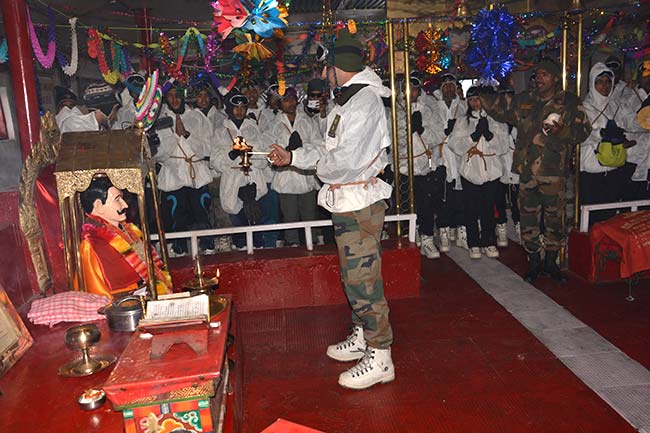
There are many a myths and legends about the Siachen Glacier like any other battlefields.  Legend has it that OP (Om Prakash) Baba, deeply revered by troops posted in these glacial heights, was an army soldier who fought valiantly to preserve Indian frontiers from Pakistani intruders in most adverse situations. Belief in the Soldier Saint is so strong that a formal report is given to OP Baba before induction of a soldier party on the glacier and after successful accomplishment of any mission. Any officer moving into the area reports his arrival to the Baba by visiting the shrine and paying his respects.


Faith in the legend of OP Baba is so strong that all troops give up consumption of alcohol and tobacco during their stay on the glacier as the Baba is believed to have been a strict disciplinarian and expects the same from fellow soldiers who come here to guard the frontier. Every battalion or company before taking position begins with a prayer at Baba’s shrine. The company commander gives a detailed briefing to Baba before tying a brass bell in the complex, taking a vow to keep away from cigarettes and intoxicants and fight the enemy till the last breath. Soldiers keep this promise till the last day of their tenure in the glacier and is strongly believed that any deviation is met with instant punishment from the legend himself.

It is believed that a night before any imminent danger, Baba comes in the dreams of soldiers and warns them of such eventuality. Baba has always been with the soldiers and protects every soldier and warns them of any impending danger in the Glacier.

Baba Harbhajan Singh, Sikkim, c/o 99 APO

BabaHarbhajan
Baba Harbhajan Singh has defeated death. Believe it or not but it is true, one of its kind of story in the world- a man from an Indian Army in  Nathula border in Sikkim, is still doing his duty even after his death some three decades ago. 60km from Gangtok towards the Nathula Pass lies the valley of Kupup.  Here is the shrine of Baba Harbhajan popularly known as Baba Mandir. Baba Harbhajan has been guarding the international boundary of the two Asian giants, China and India over the last three decades. But believe me he does it alone. The Baba warns about the dangerous activities on the border through the dreams of fellow soldiers. Legend has it that even the Chinese soldiers confirm sighting a man riding a horse all alone, patrolling the border.

Born in Brondal village of Kapurthala, Punjab, Harbhajan Singh joined the 23rd Punjab Battalion on February 1966 as a Sepoy. On October 4, 1968 Sepoy Harbhajan Singh was escorting a mule caravan from his battalion headquarters and he fell into a fast flowing stream and was drowned. Search for Sepoy Harbhajan was made with no results it was on the fifth day of his missing, his Commanding Officer had a dream of Sepoy Harbhajan Singh informing him of his tragic incident and his personnel weapon being under the heap of snow. Sepoy Harbhajan Singh desired to have a Samadhi (memorial) made after him. The Commanding Officer ignored the dream as an imagination but later when the personnel weapon of Sepoy Harbhajan Singh was found at the spot where he had informed, the Commanding Officer was taken aback and to mark respect and towards his wish a samadhi was constructed there.


Here too, the belief in the soldier saint is so strong that any officer or soldiers moving into the area report their arrival to the Baba by visiting the shrine and paying his respects. On my arrival at Sikkim,  Colonel PK Ramachandran, our Commanding Officer, realising my rational stands on such issues had advised me to visit the Baba Mandir. He said that my visit to the Baba Mandir may mean nothing to me, but will go a long way in upholding the faith of the men under my command. I did as ordered without realising the implications of his words until I read a research paper by a US Army Doctor on Post-Traumatic Stress Disorder (PTSD) suffered by operationally deployed US Army troops. I realised that cases of PTSD were the least in the Indian Army despite all the operational commitments and I can attribute it only to the faith in God by our troops and the role played by the myths and legends and patron saints of different areas. This may also be the reason for increased evangelistic activities reported among the US Military personnel deployed in operational zones.

St George and the British Army
BabaStGeorge
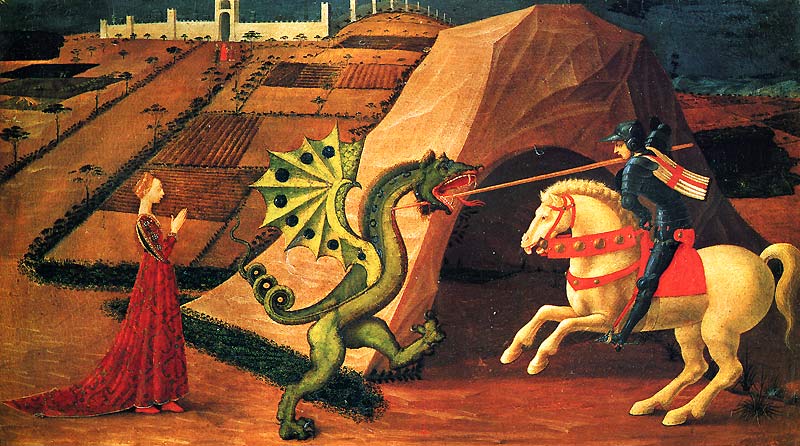
St George is patron of soldiers, cavalry and chivalry and he is the patron saint of England, Georgia, Lithuania, Portugal, Germany and Greece.  He has no biblical significance.  He held the rank of a tribune in the Roman army and was beheaded by Diocletian for protesting against the Emperor’s persecution of Christians. St George was adopted as the patron saint of soldiers after he was said to have appeared to the Crusader army at the Battle of Antioch in 1098.

He is usually represented on horseback in the act of spearing the monster which is vomiting fire.  It is based on a myth that in Sylene, a city of Libya, a lake was infested by a huge dragon, whose poisonous breath would kill anyone.  The citizens could never draw water from the lake and in order to keep the dragon away, every day a virgin was sacrificed to it.  One day the turn came for Sabra, the king’s daughter, to become its victim.  She was tied to the stake, and left to be devoured, when St. George appeared mounted on his charger and is believed to have killed the dragon.  Many similar stories were transmitted to the West by Crusaders who had heard them from Byzantine soldiers.

The banner of St George, the red cross of a martyr on a white background, was adopted for the uniform of English soldiers possibly during the reign of Richard I, and later became the flag of England and the White Ensign of the Royal Navy.

In 1940, when the civilian population of Britain was subjected to mass bombing by the Luftwaffe, King George VI instituted the George Cross for ‘acts of the greatest heroism or of the most conspicuous courage in circumstances of extreme danger’.  The award, which is second only to the Victoria Cross, is usually given to civilians.  The award consists of a silver cross.  On one side of the cross is St George slaying the dragon, with the inscription, ‘For Gallantry’; on the other appear the name of the holder and the date of the award.

After setting foot in India, British Army built its first fort in Madras (now Chennai) in 1644 and christened it Fort St George after their patron saint.


Divine Trade on Social Media

Most netizens by now must be fed up with all the images of Gods, Godmen and their preaching which bombard their in-boxes.  Generally, no one wants to show disrespect to their own Gods and also to someone else’s.  The dilemma that most netizens face is that their computer systems or smartphones generally store these images by default in one folder, irrespective of the type of divine personality.  Hence, these Godly images are cursed to coexist with the heavy volume of porn and nude images that one receives on the very same social media. 

The senders of these Godly images did not want to show any disrespect to their Gods.  Some may even be gullible enough to believe that their Gods would be happy with their actions to spread the message and image of their Gods, thereby making their Gods more saleable.  The only likely beneficiary of such actions would be the Godmen whose objective is to trade this divine merchandise.  Thankfully the internet does not reach the Gods, else He would have had a difficult time, sorting these messages out!

Further, these images take up a lot of bytes and is costly to download and store.  The prime principle of communication is brevity which ensures speedy transmission of the message.  The Generation Next have aptly taken to texting, to reduce cost and increase speed.  Here there is no place for any image unless unavoidable.  Most netizens sending such images on social media are generally new entrants and are still bitten by the social media bug.  As time passes, many are sure to overcome this thrill, thus saving everyone money and time.

Some netizens send images of their God with an accompanying story that when they forwarded the same to 10 people, some miracle happened and this person now wants you to send it to 10 more people so that you receive such favours, else some calamity may strike you.  This carrot and stick strategy again results in unwarranted traffic on the internet and sometimes it may end up as an information security risk.

Another trend observed is to publish a story about favours received by the devotees as a case of some divine intervention.  I once confronted an editor of a paper publishing such paid classified advertisements and enquired as to whether he did send a copy of the newspaper to the concerned God as well.  How else can you expect God to learn about the ‘earnest’ efforts of a staunch follower of His?

I requested the editor to educate the publishers about the futility of such efforts and instead if the wasted money can be paid to some charity, it would be of considerable help to the needy.  Such advertisements are neither needed by God nor is it of any use to anyone except the publishing house who rake in money at the cost of the foolish believer.

Let us for a minute consider that God too was a Facebook user.  Would He have approved His image or the divine article you just posted? Would He ‘like’ what you just posted?    Every God would surely like a post about Him to be True, Helpful to humanity, Inspiring, Necessary and Kind to every living creations in this world, coupled with humane love.

While posting anything divine about your God, always stop to think that there are many who do not believe or follow your brand of divinity.  There are atheists too who claim user-created religious content is offensive to them and many feel that it promotes forceful indoctrination into their belief systems.

Pope Francis on the 50th World Day of Social Communications, while welcoming Tim Cook, the CEO of Apple, to the Vatican said “It is not technology which determines whether or not communication is authentic, but rather the human heart and our capacity to use wisely the means at our disposal.  Communication, wherever and however it takes place, has opened up broader horizons for many people. This is a gift of God which involves a great responsibility. I like to refer to this power of communication as ‘closeness’.”

Social media for sure is not a creation of God and as Pope Francis said, it is a gift of God. We all have seen it evolve before our eyes.  Hence it would be the most inappropriate place for the Gods.  God is counting neither the number of ‘likes’ your post has generated nor the number of times His name is tweeted.  It is surely not a gateway to heaven, nirvana or moksha, but will merely help some Godmen and their cronies rake in the ‘moolah’.

Rather than beginning the day by posting our God’s image on the social media, we should rather begin each day with God. It is astonishing that those who indulge in this form of worship are unconscious of the pettiness of the whole concept.   God is all knowing and all powerful and the least He needs is your reaffirmation of faith in Him through the social media. 

Bosses

Working in any hierarchical and structured organisation, one always had a boss, someone to whom one is answerable and someone who always gauged your performance and guided you to achieve the best.  I too had my bosses and one always had subordinates, for whom one was the boss.  After retirement, I realised that I was not my own boss as one had to be answerable for the actions to someone or the other.

bss

Bosses under whom I worked can be classified as :-

  • Category 1.   I know most of it and I know that I know most of it.   The best boss to work under, who will only give you a few directions and believes in delegation.  The boss knows the team well and capability of each one in the team and assigns tasks accordingly.
  • Category 2.   I know bit of it and I know that I know only a bit of it.   Depends heavily on the subordinates and accepts inputs from them.  The subordinates while providing inputs need to be well aware that it may be implemented at times in full.
  • Category 3.   Knows nothing, but presumes knows everything.   Most difficult to work with as a subordinate and does not seem to have any faith in the subordinates.  You will always keep getting orders and not directions as to how to execute a task and for sure, it will keep changing from hour to hour and at times from minute to minute.

One can never select one’s boss, especially in the army and one got to accept them As Is.  I had been lucky during my service that I got a good lot of the Category 1 bosses, The distribution of the bosses were:-

  • Category 1.   52%
  • Category 2.     8%
  • Category 3.   40%

How they will perform in a given scenario is an interesting study.  Let us take the case of a senior executive (a General or a CEO) flying in from the head office or the higher headquarters and need to be briefed for about 10 minutes by the boss under consideration.

  • Category 1.  Will call the subordinates concerned, give out clear directions as to the slides to be made (at times makes it himself) and ask for any inputs from others.  The slides only if must, may undergo a few changes.  He may conduct one rehearsal and accept most inputs from the subordinates.
  • Category 2.   Will call the immediate subordinates and explain to them the task in hand and accept inputs from them.  The subordinates will have to provide the slides and the script and at times explain all that is written too.  The boss puts in extra effort to understand the contents.  There will be a few rehearsals and hardly any changes except for those where the boss finds difficulty in explaining.
  • Category 3.   You and the entire sundry in the organisation, whether connected with the briefing or not, will be summoned for a conference, which will last for at least an hour.  Some orders will be given out regarding the number of slides to be made, who will provide the data, etc.  The most important aspect covered will be the tea and snacks to be served to the executive and at times even the flower arrangements to be placed in the office.  The number of slides to be made would be around 40 and everyone knows that there would not be sufficient time, even to flash all the slides.  The slides will undergo umpteen changes and will never be finalised till the eleventh hour.  There may be many a rehearsals, but the number of changes the slides undergo will make them meaningless.

NEVER  forget to save your initial draft. At the end of the day, with all the  modifications and corrections, you will find the end product almost similar to your initial draft.

The final result you all can guess, but ultimately it is the subordinates who suffer, with all the unproductive work.

Living Life through an LCD Screen

Our niece Deepthi, and her fiancée, Dean exchanged their marriage vows at the picturesque Lake House Inn, Philadelphia, United States on 04 June 2016.  The ceremony was presided over by Dr Alan David Fox, Professor of Asian and Comparative Philosophy and Religion in the Philosophy Department at the University of Delaware.  Dr. Fox had mentored both Deepthi and Dean while at the university.

At the commencement of the ceremony, Dr. Fox requested all invitees to be seated and not to indulge in any photography.  He said that the official photographer present would post the photographs on the internet for everyone to see.  He also requested all the attendees to pay attention to the readings and the vows being exchanged and also participate in an important event in the life of the bride and the groom.  He opined that such a solemn occasion should never be viewed through the LCD screens or the viewfinder of one’s recording device.  A very profound thought.

Is there really a need to record these solemn events in one’s life?

Surely it is a once-in-a-lifetime event and it costs dearly with no upper limit.  During any wedding, a great portion of the money would be spent on things that will be gone forever the day after the wedding.  Only a few things remain – the rings, the dress, the photos and the memories.   In this digital age, the pictures will stay until eternity, perhaps stored away in a virtual cloud, unlike our marriage album – faded, distorted and moth eaten –   but the memories will fade.

Turning the pages of ones parent’s or grandparent’s wedding album is a remarkable experience. The youthful looks  of the familiar haggard persona, a sort of reverse metamorphosis; the fashions, customs, traditions and rituals of a bygone era; the  images of many close and not so close relatives, many of them no longer amongst the living.  All of this results in a plethora of emotions flooding the sensitive mind.  It is an enthralling experience to cherish.  So, why on earth should this privilege be denied to the future generations?

Our son Nikhil, during his cultural exchange programme to France was very enthusiastic to visit the Louvre Museum, mainly to see Leonardo da Vinci’s Mona Lisa.  On reaching near the famous painting, he was somewhat disappointed as he felt that the original of the much revered painting now before him in ‘flesh and blood’, looked much like a fake duplicate of the many grand prints and photographs of the same painting that he had seen.  Moreover, it was one of the smallest in the room.  He was more bothered by some over-enthusiastic tourists, many trying to photograph or ‘selfie’ the painting.  They were least bothered about others around and proved to be a real nuisance by getting in the way and sticking cameras and selfie sticks in the face of others.  These ‘enthusiasts’ were merely interested in telling the world that they were there and had the least concern for others around or for the masterpieces which they had purportedly come to see!

These days it costs a mini fortune to physically witness any major sporting event.  To make it a profitable experience,  one must simply soak in the atmosphere of the sporting arena, get emotionally involved in the sporting action and partake of every thrilling moment of the sport.    With a cell phone in hand, it appears that everyone has taken on the role of a photographer, resulting in their watching the entertaining action through LCD monitors.  They would have done well to sit in the comfort of their homes and watch the same action, inclusive of slow motion replays, on their large LCD television.  Then why make all the effort to go to a stadium to watch such a sporting event?  Here again the selfie sticks pose a major problem and many sporting arenas in North America have rightfully banned them.  These self-styled photographers should realise that all the important moments of the game have been recorded by many professional photographers with their high-resolution cameras and would be available on the websites of the newspapers and the sports organisation.  Then why miss such an opportunity?  Why not become part of the celebration and enjoy every moment of it?

Many parents see their children growing up through the camera lens.  For them, many special events in their life slip by as they have seen them only through a lens.   They do not participate with the children while on an outing or at an adventure event or at an amusement park.  They fail to see the emotions and expressions on the faces of their children.  They forget the prime importance of living the experience and capturing the image in one’s mind rather than in a memory stick. They forget to participate wholeheartedly, live the moment with the children and absorb the experience through every pore.  Holding a costly camera or cell phone, one is sure to be scared of action and water.  It would be better to take a couple of quick snapshots, then pack the camera and celebrate the occasion with one’s family.  Family photos are surely a trigger for memories, but for posterity – when you are old – your eyesight will rarely be good enough for you to appreciate them. But the memory of a cherished moment, etched in one’s mind is joy forever!

I always pity those dads who video/photograph their kid’s birthday parties.  They are busy adjusting camera angles and lights and hence do not participate in the celebrations.  It would be prudent to call for a professional photographer to cover such events or one can request a friend to do it.  Another option is to mount the camera on a tripod and get some shots with a wireless remote.

While visiting any place of interest, spend time fruitfully to learn about it.  Listen attentively to the tourist guide if present or read through the information boards posted there.  Help your children to understand what they are seeing and a few lines of explanation from the parents would enhance the kid’s learning.   In case you are very much interested in photographing the place, reserve it for a subsequent trip.

A photograph of any object would record many a details which one would have missed while seeing it live.  One may come across interesting features that the naked eye would have otherwise missed.  Sophie and Joe would bear me out.

Unlike the digital cameras of today, film photography of the good old days was a pretty costly affair and one did not see the results until the all the 36 shots were taken.  Many a time this would take over six months.  In those days, it was easier to maintain the required balance between looking through a viewfinder and experiencing life.  Today one can easily get over 200 shots in one day with hardly any effort and at no cost.

Remember that it is vitally important to maintain a right balance between viewing life through an LCD screen and experiencing it through all the senses.

Thankachan – Our Fish Vendor

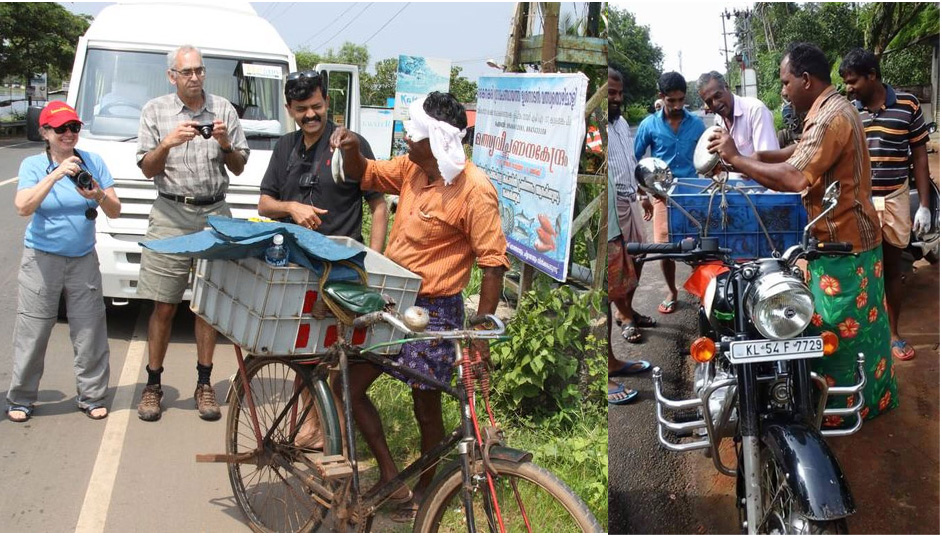
In our young days the fish vendors would come cycling down the street early morning, howling at the top of the voice മത്തിയേ മത്തി… രൂപയ്ക്കു ആറ് mathiye  mathi… roopakku aaru  (Sardines, Sardines – six for a rupee). One of the women from the household went to the street on hearing his calling and the vendor dismounted. Putting the cycle laden with the heavy fish-basket on the rear carrier gingerly on its stand commenced the procedure. It began with ascertaining the freshness of the fish, the type of fish and the price. The lady most often complained that the fish he sold last time was not all that fresh as the vendor had claimed. After exchanging a few bargaining words, the price was settled and the vendor counted out fish as demanded. Sometimes the men also went out to the road to purchase the fish.

After our eldest brother turned a teen, it became his duty every alternate morning to buy the fish. As we all grew up, everyone took turns. During my vacations from boarding school, I was entrusted the duty for the two months. Whenever I bought the fish, Amma always complimented me for the deal I clinched from the fish vendor. Our eldest brother became suspicious of my deal and one day he asked me the secret behind it. I told him that I told Amma not the actual price I paid, but half a rupee or a quarter less. He then wanted to know as to how I managed the balance change and I told him that the few coins I saved up from my pocket money at school was used for this. If I could gather a few brownie points over my brothers and above all if I could make Amma feel pleased, it was worth it, I thought.

We generally bought fish every alternate day as we all liked a day old fish curry.  It was only with the a day of ageing that the kodampuli, (Garcinia gummi-gutta) or Pot Tamarind, a specific type of tamarind from the Malabar region in Kerala, soaked into the soft flaky flesh of the fish from the backwaters of the Arabian coast… and that is also when all the spices let out their combined aromas. The day after, the fish curry with steaming hot fresh boiled rice, tastes truly like it was made for God, in his own country, none the less!

After our father’s retirement, he rose early, clear the fallen leaves in the courtyard and await the fish vendor. We never had any particular vendor, but bought fish from the one who arrived first. One day Thankachan came with the fish and our father bought some from him. After two days it was Thankachan who sold fish to our father.

Promptly, Thankachan appeared on our doorsteps the next day requesting our father to buy fish. Our father explained to him that we bought fish only on alternate days. Now Thankachan narrated his story.

Thankachan had been into the fish vending business for the past two years and not even one day he could sell off all his fish. At the end of the day he sold all the remaining fish in the basket to the Toddy Shop at half price and this always ate into his earnings. Our father was his very first customer for the two days and on both the days his basket was empty by noon. That was why he did not sell any fish to anyone on his way from the market to our home and wanted our father as his first customer, being a good omen.

From that day we bought fish every morning and Thankachan gave us a good deal, but always made sure that he received the payment only from our father. This customer relationship continued for the next ten years until Thankachan called it a day from his business of door-to-door fish vending.

Many vendors in India still feel that the business for the day depends on the first sale they execute and the day will go well only in case the first customer is a lucky person for the vendor. The vendors hate when the first customer wants credit and some even refuse such customers or in case it is unavoidable, requested them to come after an hour. With the advent of credit cards and online payments, I am unaware of the protocols followed by the merchants.

With the changing times, development and prosperity setting in Kerala, where in all the strata of the society prospered together, the fish vendors discarded their bicycles for motor-bikes. Now they do not howl at the top of their voices, but texted preferred customers the details of the type of fish and the price and the interested customers confirmed by a return text message. Once they got confirmation for their entire stock, then only they set out on their bikes from the market.

The days of the haggling fish vendor has now been confined to history.

Where to Find God

A very pertinent question being asked in today’s world, filled with evangelists from all religions and sects, standing on rooftops and on TV, shouting at the top of their voices.  Everyone it appears want to prove to the world that the Gods they sell are the best, accompanied  by miracles in various forms.  Most of these evangelists, exploiting the greed of humanity, have amassed wealth that even their Gods cannot fathom.

The city of Kottayam in Kerala, which boasts of near cent percent literacy, is better known as the city of three Ls – Latex , Letters and Liquor.  It is the trading centre of natural rubber in India and the Indian Rubber Board is also located here.  The city boasts of many educational institutions with their glorious past and also is the home for most publishing houses in Kerala with Malayala Manorama and its allied publications leading the pack.  It also set many records in liquor consumption, but of late, other smaller towns have leaped miles ahead of Kottayam.  The city boasts of many Hindu temples, Muslim mosques and Christian churches that dot the townscape.  It is the headquarters of most factions of the Syrian Christians.   

Panhandling has been banned in Kottayam since my childhood, but one can always spot a few beggars in and around the town, especially adjacent to religious places of worship.  On the  days of various festivals in these religious places, an army of beggars, mostly immigrants from the other Indian states congregate here.  It appears to be an organised racket and the way they are moved from one place to another and the methodology employed in locating them at vantage points will put any army to shame.

On a Friday morning, a  beggar, desperate to get a few bucks as he was really hungry, located himself in front of a mosque in Kottayam.  In the afternoon, everyone came for the prayers (Jummah).  (The schools in Kerala have a long recess on Fridays, extending till 2:30 PM to facilitate Muslim students to offer Jummah.).  On culmination of the prayers, everyone folded their caps, dusted and rolled their prayer mats and went home.  No one even bothered to give a glance at the hungry beggar.

On Saturday morning the beggar placed himself at the vantage point of Shiva Temple of Kottayam.    Devotees came in droves (Second Saturday of a month is a holiday for all offices and schools of Kerala) and offered Poojas, Nivedyams and Abhishekams and left and no one gave any offering to the hungry beggar.

On Sunday morning the beggar placed himself in front of the Cathedral.  He reached there well before the priest and the church manager could even open the doors.  During the Holy Mass, Gospel reading was from the Gospel According to Saint Mathews – Chapter 25 – Verses 35 to 40.  Verse 35 says  “For I was hungry and you gave me something to eat, I was thirsty and you gave me something to drink, I was a stranger and you invited me in.”  At end of the mass, priest in his sermon reminded all true followers of Christ that they must feed the hungry as it would be equivalent to any offering to God. 

The beggar was full of hope that he would surely get something, especially after the priest’s sermon.  The Clergy and the Laymen all assembled after the Holy Mass for the meeting and elected  committee for the coming year and dispersed.  No one gave anything to the beggar.

On Monday morning, by about 10′ o clock, the beggar perched in a shady corner, next to the outlet of Beverages Corporation of Kerala (liquor vent).  A queue of about 30 people had already formed, without any jostling or pushing, awaiting the auspicious time of 10 AM for the sale window to open.   The salesman at dot 10 AM opened the window and brisk sales proceeded and more people joined the queue.

God22
By about 11 AM, the beggar found his pan full of money and overjoyed with it, he prayed to God Almighty.  He wanted God to answer his query as to why He gave him His wrong address.  God appeared in front of the beggar and explained to him His reasons.

“Look! These are the real devotees.  Everyone has formed a proper and well disciplined queue which you will never find in front of any other places you had been till now.  There is no difference between rich and poor; literate and illiterate.  There is no segregation  along caste, creed or religious lines.    They stand in a queue in most decent manner, braving storms, rains or hot sun.  They respect each others privacy and ensure that they do not even touch the one in front. Now they maintain social distance norms.”

“These devotees are only asking for what they want and never for their parents, children, relatives or friends.  They never request that others should not be given what they want.  They ask what they want in minimum words, in a language everyone understands.  They neither sing praises about their brand of liquor  nor do they sermonise about evils and goodness of liquor.  Here there are no VIPs and one does not have to pay upfront at various counters and obtain a receipt for services rendered.  There are neither  any commission agents nor are there any long forms to be filled.  There is no need for any written application on a white sheet of paper.  They never try to bribe Me with their offerings in cash or in kind, without realising that if offered to the needy would be of immense help and if offered to Me would never be of any use to anyone.”

“Hence isn’t this the best place in Kottayam for the God to be?”.

On hearing the reasons given by the God, the beggar asked “Then why did You make me beg around for the past three days?”

The God replied “That is to show you beggars as to where to find God.

Bhagawan (God) Shoot

 IdliVada

Late Colonel Avinash Chandra and I joined the Regiment in January 1983.  He was a Captain then and was returning to the Regiment after a staff tenure and I was joining on commissioning as a Second Lieutenant.  He, on promotion to the rank of Major was appointed the Battery Commander of the Jat Battery – 752 Medium Battery.

All the officers – both seniors and juniors – addressed him as Guruji.  He was indeed a Guru on all matters, especially for us, the young officers of the Regiment.  For us, he was the go-to man for all our problems – military, administrative, personal, promotion examination – and all the activities we young officers indulged in.  He was always ready to help, but the only catch was that it came with a liberal dose of advice, anecdotes and stories.

It appeared to us from all his sermons that there was nothing under the sun which Guruji was unaware of and there was no activity Guruji had not indulged in.  As expected, in all his adventurous stories, he was the pivotal character.  We knew the percentage of truth in all his stories, but we all looked forward to listening to them.  Whatever may it be, he had a solution in hand for all our problems and we all did enjoy his sermons.

During the Winter of 1985, the Regiment went through a training exercise conducted by the Brigade Commander.  Next day, during the officers’ tea, Colonel Mahaveer Singh, our then Commanding Officer ordered that henceforth Major Avinash Chandra will not be addressed as Guruji, especially by his junior officers.  It was all because our Brigade Commander during the exercise was peeved at a senior Major of the Regiment being addressed by his nickname.  Guruji immediately said that he loved everyone addressing him as Guruji and if need be, he was ready to meet the Brigade Commander with this special request.  That was our Guruji for all readers.

Guruji would take on any task everyone would find uncomfortable with.  He would make such tasks appear simple and easy and conveyed an impression that he did enjoy executing it.  His body language and mannerisms always added colour to such occasions.

One such task was engaging a target with Artillery fire using the infamous Range Finder DS1,  The equipment is now obsolete and in my view should have been declared so even in those days.  Everyone was literally scared of the invisible floating diamonds and no one wanted to touch it with a barge pole.  Here now appears Guruji, full of confidence, to execute the arduous task.  I always failed to understand as to how he would have executed the task with a failing eye-sight, corrected with glasses.  Did he ever catch a glimpse of the five diamonds, mostly invisible to people with perfect eyesight?

The aim of engaging a target with artillery fire is make the shells fall on or as close to the target as possible to destroy it.  The guns are placed well behind at about 10 km or more and the Observation Officer is located with the attacking or defending infantry unit.  The Observation Post Officer (OP officer) is responsible to direct Artillery fire on to the targets, keeping in mind the safety of own troops.   The Gun Position Officer at his Command Post near the guns would calculate the bearing, distance and other technical parameters to the target, based on the coordinates passed to him by the OP  Officer  and apply corrections to compensate for the prevailing metrological conditions like wind speed and direction, temperature, etc and fire a single shell called a ranging round. If the initial shell is not ‘on target’, corrections to move the fall of shot is ordered and is applied on the guns.  This procedure called  Ranging is continued until the shell lands within 50 meters of the target. He then calls for ‘fire for effect’ by ordering six or more guns to fire in unison until the target is destroyed.

During all the Artillery firing practices, Guruji would setup the monstrous looking Range Finder well before the commencement of the practice.  When his turn to engage the target came, he would wipe his glasses clean, wear them and move to his trusted Range Finder.  He would then instruct his radio operator to pass the target coordinates and other details to the guns with an order for a single gun to fire a shell. The use of the rangefinder, supposedly, was to eliminate the ranging process to the extent possible, and directly order ‘fire for effect’, to improve what in gunnery terms is called ‘First Salvo Effectiveness’. But the problem was that the range Finder DS1 was infamously unreliable and everyone other than a handful of personnel specially trained on it, kept a safe distance from the instrument.

Five seconds before the shell was about to land, his technical assistant would cry “Stand by” and Guruji would place his spectacled eyes on to the eyepiece of the Range Finder.  After the shell exploded, he would look at it over the Range Finder and then through it.  He would then pickup his pad and write down a few calculations and would order a correction to bring the shell to fall on the target – Right 275, Add 375- with an order for six guns to fire in unison.

Captain Desh Raj, the senior most among us Captains at that time would order us to summon all our Gods to ensure that the shells landed on the target.  Believe it not, in almost all cases the shells did land on the specified target.  Was it because of Guru’s gunnery skills or our prayers?  Whatever it may be, the entire act did impress everyone present, especially the senior commanders.

After about two or three such experiences, I confronted Guruji to explain as to how he managed the show.  He explained that he neither saw the floating diamonds nor the target through the Range Finder.  He was mostly successful as he knew the firing ranges like the back of his palm.  He knew the lie of the ground and could predict accurately how the shell would move with each correction.  The most critical moment for him was when he looked over the Range Finder to catch the glimpse where the shell exploded.  He would then assess the deviation from the target and order the necessary corrections to the guns.

My question now was that even though the entire procedure was based on shear guess work, how come it succeeded every time.  Guruji with his characteristic smile on his lips replied “All because of your prayers.”

Climbing the CN Tower

CN (Canadian National) Tower is a 553.33 m-high (1,815.4 ft) concrete communications and observation tower in Toronto,  Canada.   It was completed in 1976, becoming the world’s tallest free-standing structure and world’s tallest tower at the time. It held both records for 34 years until the completion of Burj Khalifa and Canton Tower in 2010. It remains the tallest free-standing structure in the Western Hemisphere, a signature icon of Toronto’s skyline, and a symbol of Canada, attracting more than two million international visitors annually.  Its name CN originally referred to Canadian National, the railway company that built the tower, following the company’s decision to divest non-core freight railway assets.

The idea of the CN Tower originated in 1968 when the Canadian National Railway wanted to build a large TV and radio communication platform to serve the Toronto area.  As Toronto grew rapidly during the late 1960s and early 1970s, multiple skyscrapers were constructed in the downtown core and the reflective nature of the new buildings compromised the quality of broadcast signals necessitating new, higher antennas that were at least 300 m tall.  The CN Tower opened on 01 October 1976, but soon microwave communication and terrestrial TV/Radio transmissions were overtaken by satellite communication.  Now the tower is more of a tourist attraction and is raking in more money than what it was intended for.

The 1,776 steps of the CN Tower’s main stairwell are climbed by over 20,000 people annually during two fundraising stair climbs for the World Wildlife Fund (WWF) and the United Way raising well over $3 million for charity every year.  A trek up one of the tallest buildings in the world, the CN Tower Climb is one of the steepest physical challenges in the city.  Climbers face 144 flights of stairs with 1,776 steps, but the knowledge that all that hard work benefits a worthy cause like the United Way or the WWF, and with a bit of help from rest spots along the way, it’s sure to be a feat for over 10,000 climbers, who will look back on with pride.
Our family decided to undertake the feat on 21 April 2012, the day of the WWF climb.  We all practiced for a week by climbing up and down the two flights of stairs at home and going for a jog in the evening.  Our children were enthusiastic about the feat, but were a bit scared about their parents.  Appa had left the army eight years before and added a few inches around his waist and Marina, a school days Kerala State 400m winner, had been out of physical activity for a long time.  So each one decided to take along each of the parents and proving Sigmund Freud correct, our daughter Nidhi decided to accompany Appa and our Son Nikhil decided to go along with Marina.  All set we took off early morning and reached the CN Tower.  We had to shed all our jackets at the registration counter and loose objects like coins, keys, cell phones, water bottles etc are not allowed because in case anything falls off, it is sure to hurt someone climbing below.
There were thousands of people either climbing the tower or queuing up at the registration counters.  We commenced our climb after a frisking for loose objects.  Marina was bit slow to begin with and Nikhil kept company.  Nidhi and self started well with Nidhi leading the way, until about 100 flights of stairs and then realised that Appa still had it in him and I reached the top, first amongst us in about 25 minutes.  Our daughter followed a few minutes later.

The organisation enroute is worth mentioning.  There is a para-medic every four flights of stairs to take care of any medical emergencies.  There were posters made by school children, bringing out the importance of wild life conservation and also about the climb, placed at the landing area after each flight.  As we reached on top, a bottle of water was handed over to each participant.  There were climbers of all ages – from kids to grandparents, differently-able, amputees, veterans, etc.

After about 20 minutes we saw Nikhil pushing Marina out of the last step.  I asked him as to how they took 45 minutes to climb up to which he Marina said that Nikhil was all the way pushing and prodding her, and waiting with her when she took breaks and she would not have completed this climb without his assistance.  I felt really happy about his deed to take care of his mother and I asked him as to why he did not leave her and climb in good time as she would have somehow managed her way up.  To this Nikhil said that this may be the only time when Marina would climb the tower and he can do it in a shorter time later.  It was real moment of pride for all of us and I said to him that he did a great job in taking care of his mother and many teens would not have done so and I see a bright star in the sky in you.

CNTower2

On reaching home in the afternoon, an Indian family friend called us to enquire about the climb.  He asked as to how much we paid and I said that we had to pay $100 per climber as charity to WWF.  To this he said that going up the elevator costs only $25 and you pay $100 to strain yourself and climb all the way.  I did not say a word in response.

In the evening another Indian friend wanted to know as to why I took the entire family for such an ordeal (in case you are mad, you could have done it yourself), and I said that it was aimed to boost self confidence and leadership qualities in children and also to encourage charity for a cause like WWF.  To this he said that he did not understand the connection between climbing 1776 steps and leadership qualities to which I did not respond.

The Elusive Diamonds

IdliVada
Our Regiment was equipped with the Russian made 130 mm M46 Guns when I was commissioned to the Regiment in 1982.  130 mm Gun was manufactured in erstwhile Soviet Union in 1950 and entered service with the Indian Army in 1965.  The gun boasts of having achieved longest range of 27.5 km with conventional munitions.  It traces its origin back to its predecessors used in ships and coastal defence by Russians during World War II.  The gun was in the equipment list of many countries and some even produced their variants.  The gun saw action during many conflicts across the globe – from Vietnam War to the recent civil war in Syria and Iraq. 

To be fair to the Russians, it must be said that indeed the gun was good and extensively used in the 1965 and 1971 Indo-Pak Wars. The problem however was with the accessories that came with the gun. When Indian Army procured the 130 mm Guns, a plethora of accessories were supplied by the Russians.  Most appeared to be tried, tested and failed – hence the Russians wanted to somehow palm them off to others.  India must have paid a hefty sum for these accessories.  Most of them found their due place in the technical stores of the regiments, and hardly ever used

The biggest of them was the PPL Periscope – the wooden box for storage of the periscope looked more like a coffin.  The periscope must have had its origin from the gun being used as a Naval Gun.  Thankfully, no one in the regiment appeared to have even unpacked them or set them up for training or operations.  No Observation Officer would have bothered to carry it to war as it needed at least six men to lift.   On a ship, the carriage problem would not have been there and a need for a high periscope to observe the horizon was the requirement for any Observation Officer deployed on a ship in the high-seas.

The next biggest was the Range Finder DS1.  From its looks and make, it also appeared to have its origin from the days of the gun being used in its naval version.  It seems that someone in the Indian Artillery hierarchy of the 60s took a liking for this cumbersome piece that a chapter for observing and engaging targets with this monster was incorporated in the Gunnery Technical Hand Book (fortunately it has been removed  from the recent editions).

The technique of employment was that the observation post officer measured the distance to the spot where a round fell and ordered the required correction in terms of ‘ Left/Right or Add/Drop’, having already made a similar measurement to the target, to make the round hit the target.  

For measuring the distance with the DS1, one needs to manipulate a knob and make five ‘diamonds’ that appeared on the viewfinder so as to position the center one on the object to which distance is to be measured  and two each equidistant in front and behind it. This needed a high degree of practice and skill.

Whenever I tried to operate the DS1, I could either see the object or the diamonds and never both, however hard I tried.  I requested our Technical Section Commander – Subedar Bidappa – for help and he excused himself from the task owing to his poor vision.  He suggested Havildar (Sergeant) Nahar Singh of the Survey Section as he had undergone a four-week long course at School of Artillery in operating the Range Finder.  Havildar Nahar Singh agreed to transfer some of his skills and the art of manipulating the diamonds. 

On the set day, I got the Range Finder set up at the training area next to the Survey Section and Havildar Nahar Singh commenced his lessons.  We got struck at the stage where the elusive diamonds are to be manipulated –  as usual  I could either see the diamonds or the object and not both.  Havildar Nahar Singh demonstrated his skill with the range Finder and measured distances to many objects around the training area.  He read out the distances nearest to a meter and to verify it, he read the distance to a telephone pole to be 376 meters and asked me to pace it.  Great! it was indeed about 375 meters.

I felt very small about my inability and kept trying to catch the elusive diamonds.  Now came a warning from Havildar Nahar Singh – in case one operates the DS1 for a long period, one’s eyesight will deteriorate.  He padded his comment with a line that soldiers operating the DS1 in the earlier days were authorised an extra egg in their rations to compensate for the struggle their eyes went through.

 Never to accept a failure in front of the soldiers, I tried with all my efforts to catch the elusive diamonds for the next two hours despite Havildar Nahar Singh’s warning.  Seeing my resolve Havildar Nahar Singh must have felt bad and he came to me and requested me to pack up the DS1.  He now gave me his piece of wisdom.

He said that he too had never seen the elusive diamonds ever in his life.  How the hell on earth did he measure the distances to various objects so accurately?  He disclosed the secret that in the training area he knew the distance to all the visible objects as he had been conducting training for his section there.  Whenever he measured the range to an object, he would focus the Range Finder on the object and set the distance on the scale. 

How did he manage it during the training at the School of Artillery?  There too all the students carried a small notebook with the accurate distances to various objects from various training areas.  He claimed that hardly any student ever caught the glimpse of the elusive diamonds.

Guruji and Bhagawan (God) Shoot follows.  


The Mennonites

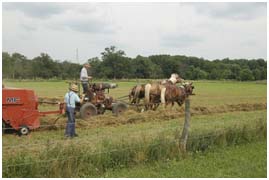
When Gulliam Le Floch, the French exchange student came to live with us in August 2014, we visited the Mennonite community in the St Jacobs Village in the Waterloo Region of Ontario. The aim of the visit was to introduce Gulliam to the Canadian culture and the people. Mennonite is a Christian group, by the name of Anabaptists, who took their name from their Dutch founder, Menno Simons. They believe that they are to follow the mission and ministry of Jesus Christ, which they held onto firmly despite being persecuted by various Roman Catholic and Protestant states. They are known as people of Peace Churches as they would rather flee a country than fight for their rights, or be forced to fight for that country, as they are committed to non-violence. Hence, they do not join the armed forces or the police. Today, there are 1,500,000 Mennonites around the world and there are congregations world-wide with large populations in Canada, the United States and Mexico.

Mennonites are recognizable by the way they live and dress, with many living the way their forefathers did. They have rejected the use of modern technology and motorised transportation and have succeeded in continuing a traditional farming style. Most use tractors and mechanized equipment, though a few very conservative Mennonites use a horse. Driver’s licenses are forbidden, though motorized transportation may be hired for longer distances.

Most Mennonites have telephones, running water and electricity and use freezers and washing machines but not dryers. The community allows for two phones per family, but without accessories on the phones. They do not use cellular phones, fax machines, computers, television, or radios. They accept neither health care nor education paid by the state. Their children are reportedly doing well in mathematics as they do not use calculators and cellphones.  They are considered hard working, thrifty and industrious, and live a rural, agricultural lifestyle and are often seen in local markets selling their home-baked pies, fresh eggs and home-grown vegetables.

The men wear plain trousers and jackets, and often a plain straw hat and women wear their hair long but covered by a prayer cap and have plain dresses, often dark navy blue, brown or black. The overall impression is one of simplicity and plainness, which is their aim.


On the roads of St Jacobs, you can find them in their horse drawn buggies as they go about their daily lives. They often choose to educate their children in schools they run themselves, as this ensures that their beliefs and values are passed on to the next generation, which is probably the reason for their continued growth and success. The Mennonite children are baptised in their late teens when they accept to live as a member of the community, accepting the Mennoite way of life. Those wishing to leave the community for better educational or career objectives are allowed to leave.

Due to their emphasis on the virtues of thrift, diligence, frugality, and humility, Mennonites learned to earn a living on the poorest soils to where persecution often drove them. They learned to improve the fertility of poor soil and experiment with new ways of farming.  Over the centuries, they developed both skills and a reputation as expert farmers.

In Canada, the Mennonites took to maple syrup production in a big way. Maple syrup is often eaten with pancakes, waffles, French toast, or oatmeal and porridge. It is also used as an ingredient in baking and as a sweetener or flavouring agent. Culinary experts have praised its unique flavour, although the chemistry responsible is not fully understood. Maple syrup is also used in specialty products such as maple butter and candies.

Canada has a large number of sugar maple trees. Canadian national arboreal emblem is the maple tree showing Canada as a world leader in sustainable forest management. The Canadian flag is red and white, with a stylized eleven-point maple leaf at its centre.

Menonites3

The sugar maple trees are tapped in the spring to extract the sap of the trees. Each fall, the maple trees shed all their leaves and also produce starch that helps protect their roots from freezing during winter. The trees then convert this stored starch into sugar. When the snow melts, water penetrates the roots and mixes with this sugar to produce sugared watery sap. During the warm spring days, this sap moves up the tree to the buds in preparation for the growing season. During the cold nights, the sap moves down to the roots to avoid freezing. The spring thaw causes the wood of the tree to expand, which puts the sap in the wood under pressure. This movement of the sap lasts for about three weeks, until the tree’s buds leaf out, generally from March to April.

Menonites2

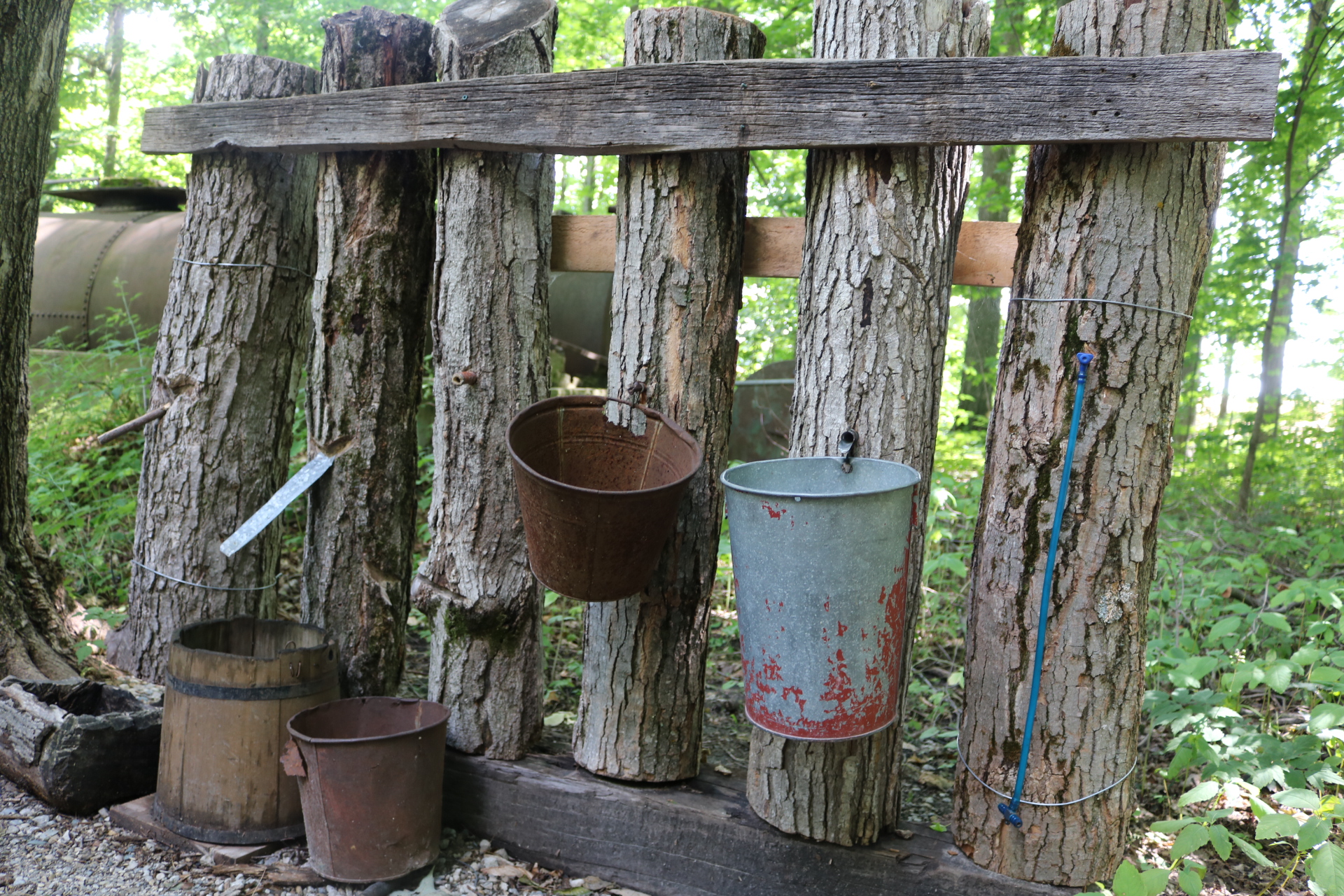
During this period of spring of warm days and cold nights, the sap is extracted through a hole drilled into the wood. The holes are connected with a pipeline ending at the collection tank. In the earlier days, buckets were used to collect the sap.  The sap is then boiled in huge boilers to produce the maple syrup. The sap has to be boiled the same day that it is harvested, so maple producers must keep steady fires going constantly to obtain good maple syrup. On average, it takes about 32 liters of maple sap to produce one liter of maple syrup.

The visit to the Mennonite community was an interesting study for all of us and to see a close-knit community in Canada still living under the age-old traditions, customs and practices.

My First Sex Education

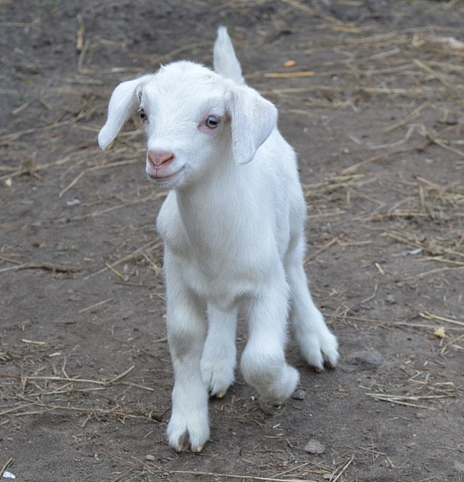
During our childhood my brother, the youngest in the family, then aged four, came up with an unusual request. He wanted someone younger to him. It was all because he was at the losing end of all the physical fights we siblings had.  At the time our parents solved the problem by getting him a kid, a goat’s kid, a female one.  That was how goat rearing commenced at our home.

In the evenings, after school, we used to take the goat out into our farmland for grazing.  We had to be on the lookout to ensure that the goat did not forage on the Tapioca (Kasava) cultivation, mainly to save the cultivation and also to save the goat from food poisoning. Little did I then know that the toxicity of the tapioca foliage was due to the presence Hydrogen Cyanide (HCN).    During the Monsoon rains, we had to cut the necessary forage from the trees which acted as support for the black pepper wines.

The kid grew real fast with all the attention and forage that we children heaped on her.  In a year she matured into a beautiful doe and was ready for a mate.  A Doe would come to heat by the end of summer and it lasts for two or three days and the cycle is repeated every three weeks.

In Kerala, the schools reopen after the summer vacations on 01 June but my Alma Mater, Sainik School Amravathinagar, reopens only by 15 June.  During my Grade 7 summer vacation, after the schools reopened for my brothers, our doe bleated one entire night.  In the morning Amma said that the doe is on heat and it is time to mate her.  That day our farm-hand did not turn up as he had pneumonia due to drenching in the monsoon showers the previous day.  I was the only one now free to take the doe for mating.

The village had a ചായക്കട (Chayakkada – teashop) run by Kuttappai.  The teashop is an integral part of urban and rural landscape of Kerala. The teashop served as the meeting place for all village elders and doubled up as a reading room.  All dailies and magazines published from Kottayam found their way there.  It also served as the village parliament‘. It was indeed a house of knowledge and doubled up as a cultural-political-social-entertainment institution, where anything and everything under the sun – from international relations to state and village politics; science to the Bible; communism to capitalism – were discussed.  Gossips too found their way in, as spicy as the narrator could make it.

Kuttappai reared a flock of goats housed in a thatched shed to the rear of the tea-shop.  He used the milk from the goats to make tea and obviously the village folk relished his special tea.  The flock was led by a majestic buck.  The buck also served as the village stud and Kuttappai charged Rs 10 for every mating.

At about 11 o’ clock, I walked our doe to Kuttappai’s tea shop, as per Amma’s advise because that was the time when the teashop would be empty of customers as people would have returned home after fiery debates and discussions.  Obviously, that was the only time Kuttappai would be free to facilitate the mating.

On reaching the teashop, Kuttappai instructed me to tie our doe closely on to a coconut tree adjacent to the goat shed.  The smell and sight of the doe in heat made the buck tied in the shed restless and his snorting and kicking increased, at times reaching a violent stage as if he would bring the entire shed down.

After 15 minutes, Kuttappai emerged from his tea-shop.  The buck was tied with a long rope and Kuttappai released him so as to make him reach the doe.  The buck went around the doe, smelled and licked her vulva and when he was about to mount her, Kuttappai pulled him back into the shed and tied him up.  That was a staged foreplay for the buck.

Now the buck had turned real violent as the frequency of his kicking multiplied and the volume of his snorts became louder.  After 10 minutes Kuttappai again released the buck and he came charging in and mounted the doe and the entire mating was completed in a few seconds.  Kuttappai now pulled the buck back into the shed and like a conqueror, the buck stood with his head high, but the tone of his snorts had changed as if to announce his accomplishment.

A doe generally gets into heat in the later part of summer and in Kerala it coincides with the onset of Monsoons (June to September).  There are certain indications the doe gives out when in heat.  Her vulva swells and become red, and she may have some vaginal discharge.    She tends to eat less and become restless because the hormones associated with fertility kick in.  A milk producing doe may decrease her milk production due to the hormonal changes.  Her frequency of tail-wagging suddenly increases and her bleats become longer, especially at night.

During the monsoons when the doe goes into heat, the buck goes into rut.  During rut the buck urinates into his mouth and on his chest, face, and beard, turning them yellow.  The scent glands near his horns become overactive.  These lead to an unbearable stink – in reality the stink is to attract a doe in heat towards him.  During rut a buck snorts, grunts and kicks its hind legs.  It tends to give a terrorising look with its upper lip curled up.

In the evening when Amma returned from school I dutifully reported to her the events of the day and posed some uncomfortable questions about the procedure and the need for it.  The School teacher in Amma responded with poise and she summarised the entire event as an act of depositing the sperm by the buck in the doe’s womb where it would fertilise an egg and would result in the formation of an embryo.  She also explained that the rooster and the hens also did the same and so did humans. Thus began my introduction to sex education.

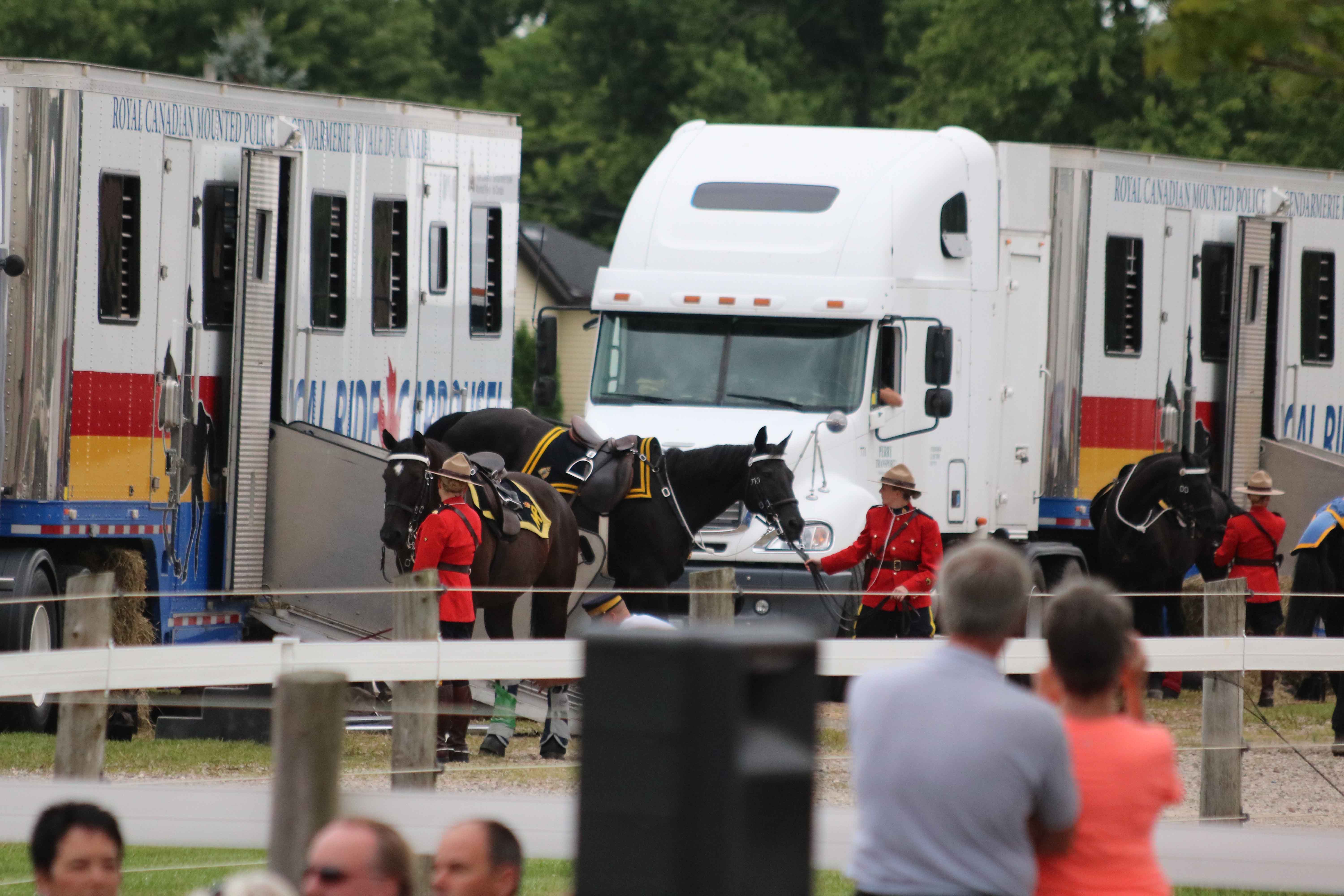
RCMP Musical Ride

RCMP001
The Tavistock Agricultural Society hosted the Royal Canadian Mounted Police (RCMP – fondly called ‘Mounties’ by Canadians) Musical Ride on August 15, 2016.  Tavistock, part of Oxford County in Ontario, is a German/Scottish community founded in 1848  by Captain Henry and is famous for its cheese production and fresh meats.   It served as a gathering place for agricultural workers and soon became equipped with taverns, flour mills, blacksmith shops and general stores.  Tavistock is also home to many Mennonite families today.

RCMP160
An RCMP Musical Ride performance is a splendor to watch. It is exciting, full of pageantry, and truly Canadian.  The ride is performed by a full troop of 32 riders and their horses. Their performance consists of intricate figures and drills choreographed to music. These movements demand utmost control, timing and coordination.  It presents a first-hand view of the precision and attention to detail for which the RCMP has become famous for.

The RCMP has become a national symbol of Canada. The courage, sacrifice and steadfast determination of its members to maintain law and order have been the source of many legends.  Many movies and over 300 fiction and non-fiction books have told the tale of the adventures and history of RCMP.  The image of RCMP members on their trusted and faithful horses finds its righteous place on Canadian stamps, coins, souvenirs, and posters.

In early 1869, the Canadian government purchased Rupert’s Land (now Alberta, Saskatchewan, Manitoba, Yukon, and Eastern Northwest Territories) from the Hudson’s Bay Company and renamed it the North-West Territories.  The Canadian Government encouraged settlements in the area to harness the agricultural potential of the fertile area.    In order to establish and maintain social order, North West Mounted Police (NWMP) was created in 1870.

RCMP180
The first officially recorded NWMP Musical Ride was performed in Regina on January 16, 1887 and the first general public display of the Musical Ride was held in 1901.  In 1902, the uniform of the NWMP changed to a more modern uniform of this day.  Two years later, prefix  of ‘Royal’ was conferred on the NWMP by His Majesty King Edward VII, in recognition of its past service.  In 1920, the name of the Force changed from the Royal Northwest Mounted Police to the Royal Canadian Mounted Police and was designated Canada’s national police force.

In the summer of 1921, the RCMP Musical Ride members performed their first public display in Ottawa.  in 1930, the Musical Ride went to England for the first time to perform at Olympia and in London.  The first Musical Ride tour to the United States was in 1934 to New York City, with a repeat performance the following year.

In 1951, a Musical Ride troop provided an escort for Princess Elizabeth and her husband Prince Philip when they visited Canada.  Two years later, when Princess Elizabeth became Queen Elizabeth II, a Musical Ride troop acted as the RCMP contingent in her coronation procession.  It was also part of Queen Elizabeth II’s Diamond Jubilee celebrations in 2012.  Queen Elizabeth II is the Honorary Commissioner of the RCMP and she takes a keen interest in horses and is and highly knowledgeable.  She has been presented with four horses as gifts from the Force.

RCMP140
In 1974, the RCMP Regulations changed to permit females to join the Force.  Six years later, the first female members were selected for the Musical Ride.  Since that time, two or more female members make up each Musical Ride.

One of the most prominent symbols of Canada is the Royal Canadian Mounted Police (RCMP) ‘Mountie’, wearing his red serge uniform and brown Stetson. The red tunic was chosen to emphasize the British nature of the NWMP, and to make it distinct from the blue American military uniforms.

RCMP221
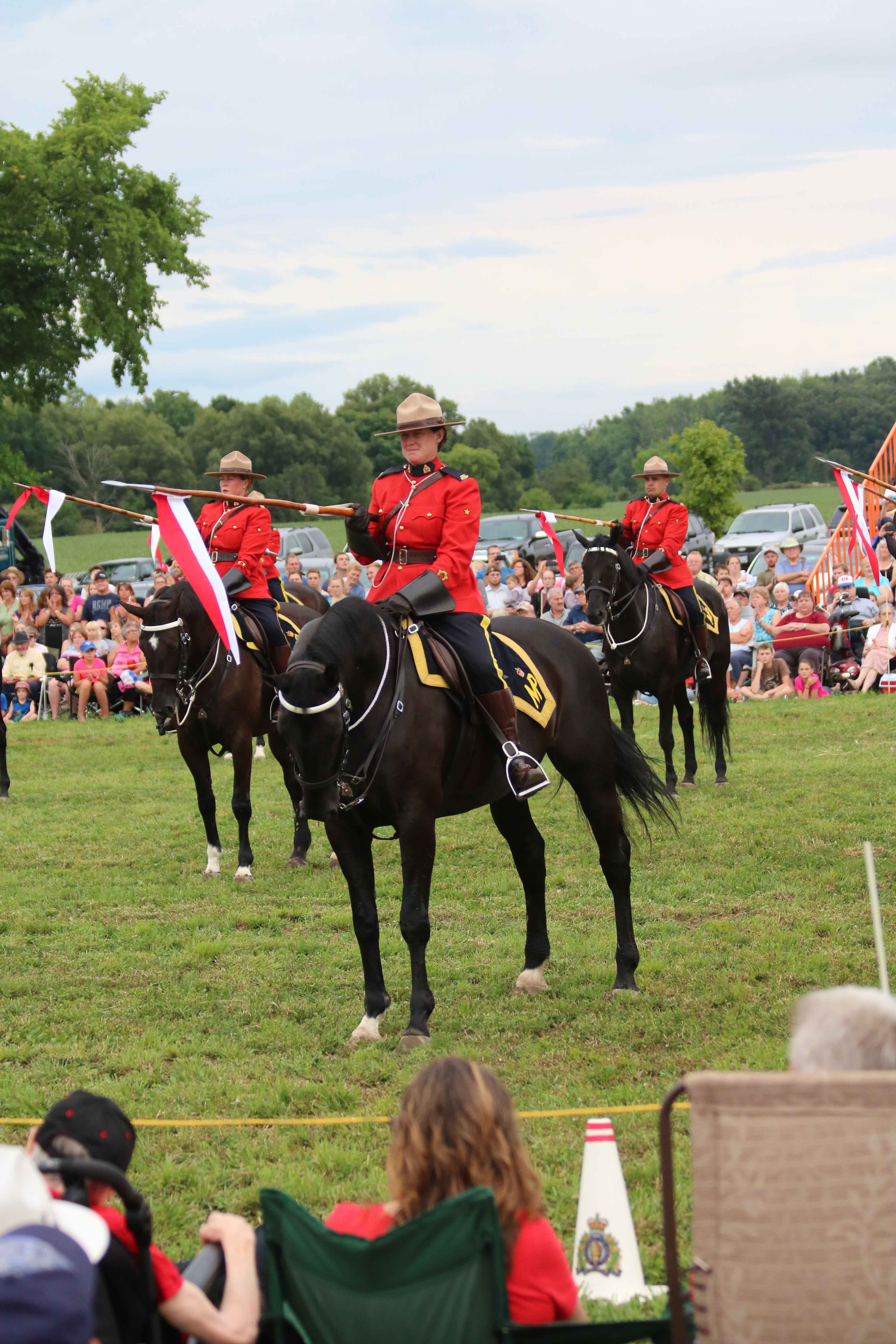
The ceremonial uniform of the RCMP and its horses is perhaps one of the most recognised in the world.  The riders wear the red serge, which consists of a high collared scarlet tunic, a Sam Browne belt with shoulder cross strap and white sidearm lanyard, dark blue breeches with a yellow stripe, brown riding boots, a brown Stetson hat with a wide, flat brim, and brown gauntlets.  It is believed that Sam Steele, one of the original NWMP, introduced the style of hat, as it was a practical item to wear while on patrol, unlike the British pith helmet.

RCMP223

The riders carry lances, while the Officer in Charge carries a sword.  The lance was carried by the men on the Long March as it was believed to be intimidating.RCMP330
The horses also wear a uniform, which consists of a double bridle with a white neck strap or ‘head rope,’ white brow-band and English style saddles.  The horse’s white head rope was used by the NWMP to tie the horses when dismounted.  The horses’ royal blue saddle blankets, called ‘Shabrack’ are emblazoned in yellow with the fused letters MP.  The horses also have a maple leaf brushed onto their rumps; this is done with a wet brush and a stencil before each performance.

in 1938, Commissioner Wood had ordered the RCMP to use only black mounts after being impressed at how the red RCMP tunics looked against black horses.  Today, the horses are bred primarily for colour, temperament, and conformation. They got to be athletic, with the stamina, substance, and conformation to be able to perform the intricate movements required in the Musical Ride performance.

RCMp440
About 200 horses are owned by the RCMP Musical Ride.  36 travel on the Ride each year.  32 take part in each performance, one is ridden by the Officer in Charge, and three extra horses act as replacements if another gets sick or lame.

RCMP550
One of the most familiar Musical Ride formations is the ‘Dome’ that once featured on the back of the Canadian fifty-dollar bill.

RCMP580
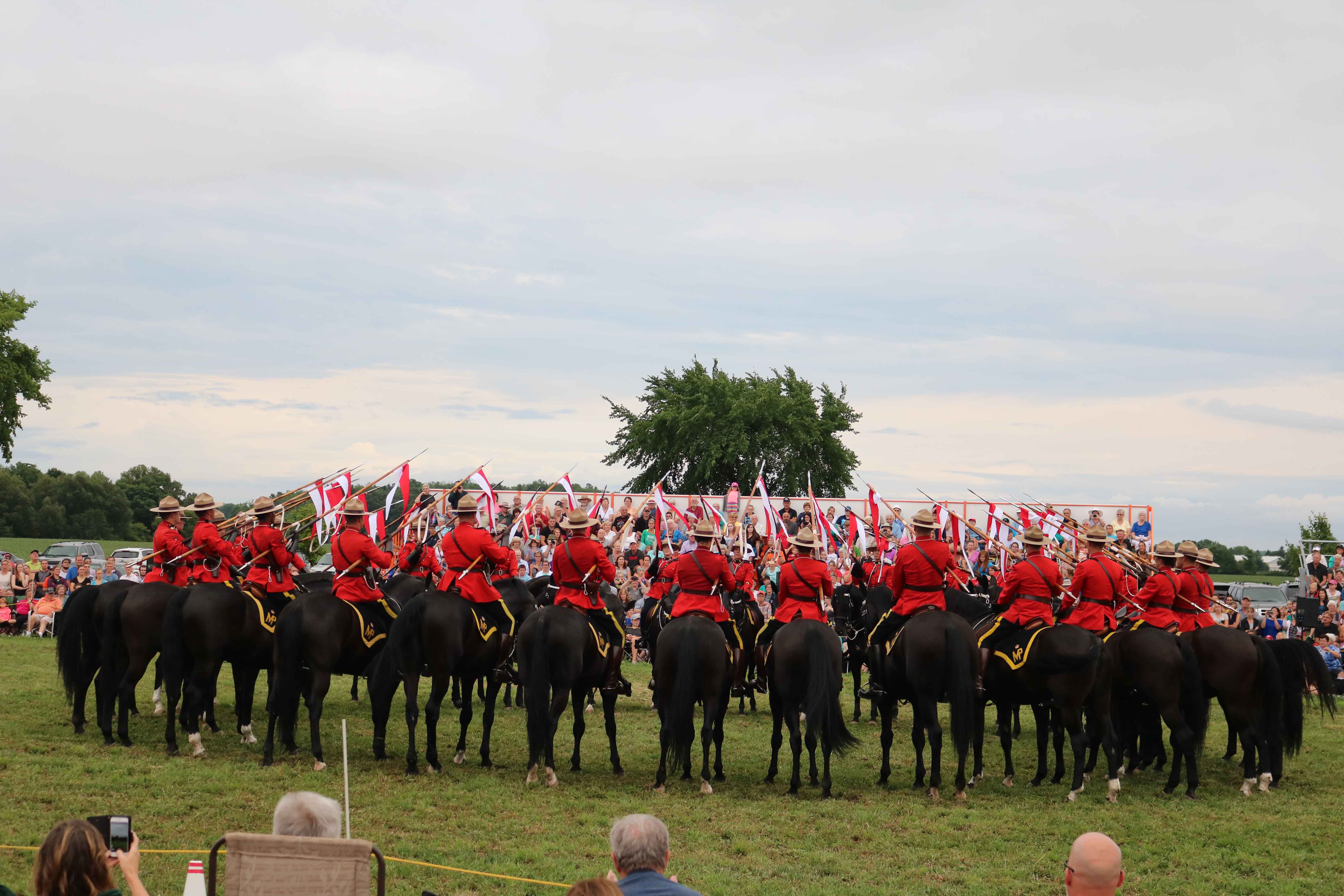
The riders demonstrated their lance drill wherein they showcased various movements with their lances.

RCMP600
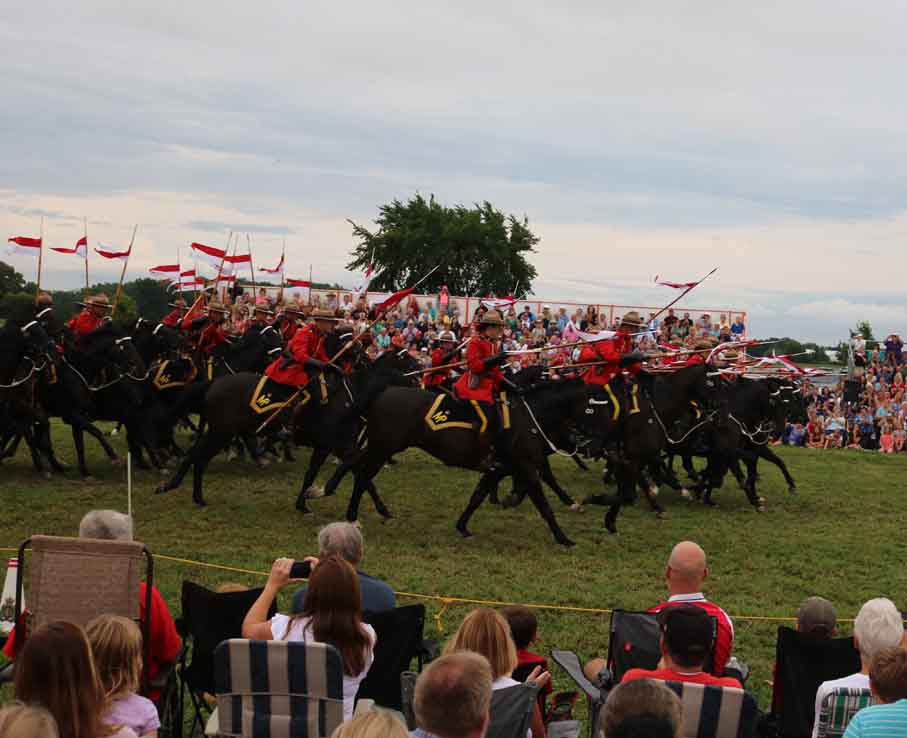
Another highlight is the ‘Charge,’ when lances, with their red and white pennons, are lowered, and the riders launch into the gallop.

RCMP610
The conclusion is the ‘March Past,’ performed to the strains of the “RCMP Regimental March”  and a salute to the guest of honour.

RCMP622
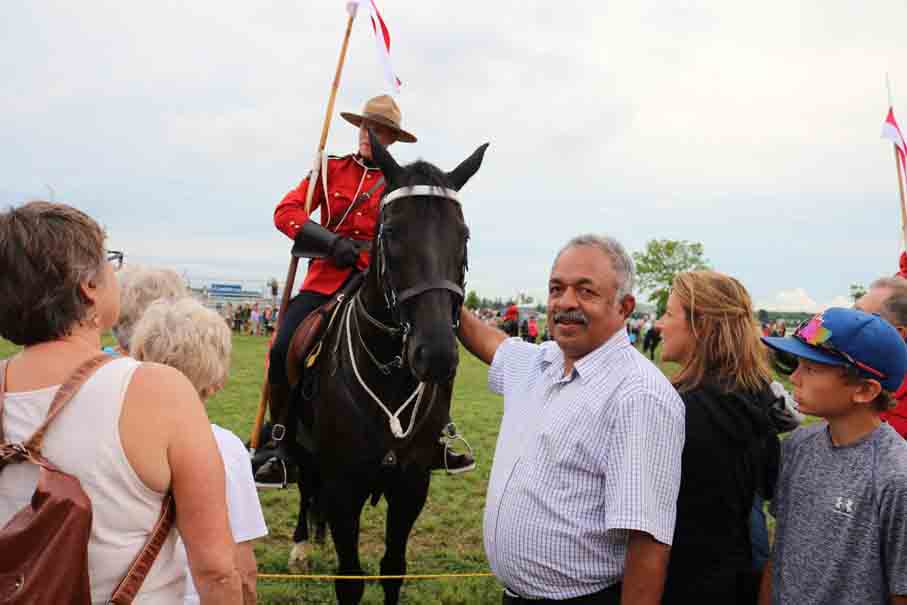
After the much-anticipated performance was over, the troops lined up facing the fence so that young and old could pet the horses and ask the riders questions about their experiences as members of the ride and as RCMP.

The RCMP Musical Ride consists of the execution of several intricate figures, with movements being formed by horses and riders in two’s, four’s and eight’s at a trot and canter.  The RCMP Musical Ride continues to provide displays of horsemanship around the world.

Bill of Fare

Many of our classmates take time off their busy schedule to attend the Alumni meeting at Sainik School Amaravathi Nagar, held during the last weekend of June.  Many undertake this pilgrimage to their Alma-Mater purely  to relive their childhood and partake of for the tea and food the school mess served.  The menu was based on a weekly ‘Bill of Fare’ which hung on the notice board of the mess.  The only variation during our entire stay at the school (1971-1979) was the date on the top and the name of the vegetable served, mostly based on seasonal availability.

CadetMessAmar

The senior cadets (Grade 8 to 12) were divided into four houses – Chera, Chozha, Pandya and Pallava- named after the ancient Thamizh Kingdoms.  We along with the teaching staff dined on tables which were also placed house-wise.  The waiters were permanent and they served us with love and affection.  They formed an integral part of each house.  They were the cheer-leaders for most of the inter-house sports competitions and slipped an extra piece of meat or an egg in case we won a competition.

The Cheras were served by Natarajan who was better known as the local banker.  He also reared cows and sold the milk to enhance his income and his banking operations.  The Chozhas were served by Vasu who was more of a neatness freak.  He realised the need for education and got his daughters through graduation who are well settled now.  The Pandyas had Venkatachalam, the most vociferous of all and also the most active.  The Pallavas had Madhavan, who despite his bout with asthma, never allowed his sickness to interfere with his job.

We were served ground pork curry with bread for dinner on the first Friday of every month.  The meat came from the Yorkshire Pigs the school farm reared.  Many cadets on joining the school were reluctant to eat pork due to religious reasons and also because they had never tasted it before.  As the school years went by, many shed their herbivorous status (other than the real hardcore ones) in favour of an omnivorous one.  The very same pork curry, with all its flavours intact, is served to the members of the Alumni and their families during the Alumni meet.  Everyone, including little children of the Alumni look forward to this dinner.

CadetMessAmar22

We were served with tea at 5:30 in the morning, before Physical Training.  During the long recess at 11′ o clock it was again tea with biscuits and in the evening before games it was tea and snacks.  The taste of this tea is beyond words, and could never be replicated.  We tried hard to analyse the secret of this addictive tea – it could be the tea leaves, could be the Amaravathi waters, could be the vessel in which it was brewed, could be the cloth used to filter it – the possibilities were endless.  It remains a mystery to all of us to date, but it attracts most alumni to the school every year and they gleefully indulge in consuming cups of this divine tea.

Breakfast for us was mostly continental with bread, butter, jam and eggs on all weekdays.  On Saturdays it was Idli-Sambar-Chutney and on Sundays it was Dosa.

The Bill of Fare began with Monday and it was the day we were served fish curry and rice for lunch and mutton curry with roti for dinner.  The dessert for dinner used to be fruit custard.

Mysore-Pak which owes its origin to the Royal Palace at Mysore, was served on Tuesdays.  It was rock-hard indeed, but it melted in the mouth sweetly.  It was a concoction of ghee, sugar and gram flour.  The sweet added colour to the drab vegetarian dinner we had on Tuesdays.

We all awaited the fried Tilapia fish served for lunch on Wednesdays.  The fish came from the catch of the day at the Amaravathi Dam, co-located with the school campus. What made it very special? Was it the way it was marinated or crispiness of the fried fish or its unique freshness? Indeed it was the very best of all fried fish – it could any day compete with my mother’s fish fry at home.

When I got married, we established our first home at Devlali, Maharashtra.  During our settling down days, Marina said she intended to make Dosa on the coming Sunday and she inquired as to what I wanted with it.  My most relished combination with Dosa was chicken masala which was served for Thursdays’ dinner at the school mess.  “What an unpalatable combination?” was Marina’s reply.  I told her that the Dosa (3 to 5 mm thick) made on a granite griddle, served with chicken masala was the best combination for Dosa that I had ever had.  She did not believe me until we relished it that Sunday evening.

Dosa, a thin pancake, is made from a batter of ground lentils and rice.  Its origin can be traced back to the Thamizh Brahmins, who are strict vegetarians.  The batter is fermented overnight and is poured over an oil-coated hot granite griddle like a crepe and turned over to cook both sides.  The modern version of the crispy, paper-thin variety is rather a deviation from its original.  Some restaurants in South India still serve the original thick Dosa and is called Kallu (Stone) Dosa.

Fish cutlet was the specialty for Friday Lunch.  The main ingredient again was the fresh Tilapia from the Amaravathi Dam.  The secret recipe for this cutlet still remains unsolved – even our classmate Vijaya Bhaskaran, Executive Chef at Le Meridian, Bangalore, has failed to replicate it.   Jalebi was the dessert for the dinner, which owes its origin to Arabia and was brought to India by Persian traders.

Saturday was the movie day and hence we were served dinner early.  It was Biryani – either chicken or mutton – but what every cadet looked forward to was the sweet dish.  It was Khaja – a delicious flaky pastry, shaped out of a layered dough and dipped in sugar syrup.

One can very well imagine the effort taken by the mess staff for ensuring that quality and taste of food served to the cadets is of a high standard and they need to be commended for their care and culinary skills. The fact that one of the key attractions for most Alumni to get back to the Alma Mater is the food being served, says it all.

Venkatachalam
Post Script
:  I dedicate this post to Mr Venkatachalam, our waiter of Pandya House, who passed away on  11 August 2016.  He will remain in the hearts of all those who were served by him, with all his love, affection and dedication, in Pandya House.  Our friends from Pandya House will remember him for ever.

Bicycle – Oh My Old Companion

Our family friend took part in this year’s Tour De Mississauga, a 30/60/100 KM cycling event. This year it attracted over 1600 cyclists of all abilities from all around the Toronto Area. Cyclists of every age or ability, on every kind of bike (including electric assist), participated. The aim of the event is to familiarise cyclist with the various cycling trails and lanes available in the city, to develop a spirit of adventure and also to encourage cycling, both as a sport and as a physical activity. The event was well organized and truly lived up to its motto ‘THIS IS NOT A RACE – THE JOURNEY IS THE DESTINATION!’

As is the case with all such community activities in Toronto area like marathons, climbing the CN Tower, parades, etc, in this activity too there were hardly any participation by immigrants from the Indian subcontinent. When will we learn to amalgamate with the Canadian society? Participating in such events will not only develop community spirit in the participants, but will also raise money for some charity. It develops leadership qualities in children and encourages the spirit of adventure in them. Preparing for the event and participation will keep everyone healthy and improve one’s confidence level. Completion of the event will give you immense pride and sense of achievement. It will prove to you that you are physically healthy to undertake such difficult ordeals.

The local governments are doing their best to encourage cycling as a daily activity. Most of the roads in the Toronto Area have either a bicycle lane or off-road cycling paths. Bicycle Lanes are typically 1.5 m to 2 m wide, and designate a space on the roadway exclusively for the use of cyclists. Motor vehicles are not allowed to drive, park or stand in the bike lane. Off-Road Paths include trails through parks and along the arterial roads. Cyclists, skaters and pedestrians often share these paths.

On arrival in Canada, I saw a something like a crash-guard which we have on the front bumpers of the cars back home on the buses in the Toronto Area. On inquiry I learnt that it is a cycle carrier to carry two cycles. Many commuters feel that cycling or taking the bus just doesn’t compete with the convenience of a car. But in Toronto Area, “biking and bussing” is easy. You can cycle to a bus stop or station and then bring your bike on the bus. By biking and bussing you’ll not only improve your health, but also help reduce gas emissions.

In Toronto, bicycles are permitted on buses, trains and subways at all times except weekdays during peak hours. Bicycle transportation is a growing activity in Toronto and throughout North America, due in part because of the many benefits cycling offers. Transportation by bicycle is the most energy efficient mode of transportation, and generates no pollution, except in its manufacture. Cycling is often the fastest mode of transportation from door to door for distances up to 10 km in urban cores. Ten bicycles can be parked in the space required for a single automobile. Short distance motor-vehicle trips are the least fuel-efficient and generate the most pollution per kilometer. These trips have the greatest potential for being replaced by cycling and walking.

BIXI – Bike Share Toronto – is designed to be a convenient way to get around the city, and is ideal for short rides and one-way trips.  The members get access to 2,000 bikes across the city. They can pick up a bike at one of 200 stations, and drop it off at any other station when done.  One need to become an Annual Member or buy a Day Pass to be able to use Bixi. An Annual Member can insert a bike key into a dock to unlock a bike. Day Pass holders will get a ride code, which when typed into the keypad on the dock, unlocks a bike.  The first 30 minutes of each ride are included in the membership or pass price. One can keep a bike out for longer, but additional usage fees will apply.

Reducing auto trips will mitigate ozone depletion, the greenhouse effect, ground level air pollution, photochemical smog, acid rain and noise pollution. Cycling contributes to personal health by enhancing fitness and providing an enjoyable, convenient and affordable means of exercise and recreation. Increased physical activity, such as walking and cycling, can reduce the risk of coronary heart disease and the cost of medical care, decrease workplace absenteeism, and maintain the independence of older adults. Cycling benefits one’s health regardless of the age at which one takes up cycling.

During our training at the National Defence Academy, Pune, cycling was the only mode of transportation for the cadets, else one had to run. The Academy campus is spread over 7000 acres and to reach various training event sites, a cadet had to cycle an average of 20 km per day. While cycling, one had to maintain proper squad discipline and pay proper respects to passing senior officers.

Any minor infringement ensured that the cycle was on you rather than you being on the cycle. Every semester begun with the cycle issue and always ended with the cycle return, after which was a month’s vacation. We used to have a weekly cycle maintenance parade to wash and repair the cycles. Thus even today, the cycle is the most ardent companion of every cadet at the academy, without which life would have been much more difficult.

Maximus Koduvath

How did Maximus join our family?

mx

In 2007, on a summer day, our children Nidhi and Nikhil approached Marina with an unusual request that they wanted another sibling.  They promised that they would take care of the newborn baby and also that they would bring up the baby. Marina explained that it was a pretty difficult proposition as she had her tubes tied on delivery of Nikhil.  She explained that it would be very difficult for someone to mother a child at her late age and may lead to complications, both for the mother and child.

The children said that in that case we should go in for an adoption.  They wanted a sibling at any cost.  I realised that there was something more to this strange request as the very subject had come up for discussion during the family dinner a year back and was then dismissed for the same reasons.

Now it was my turn and I asked them as to what they really wanted.  Out came the new proposal! “We want a dog”.

Marina and I never before had a dog while we were with the Indian Army, where all the help was available to rear one. Unlike many officers in our Regiment who had a dog or two, we did not choose to have one.

I was of the opinion that it would be difficult to take care of a dog as it has to be reared indoors because of the severe Canadian winter.  Further, having a dog meant taking it out on a walk, irrespective of the weather and cleaning up the poop would add to our routine chores.   Marina, a hygiene freak, did not like the idea of a dog shedding its hair all over the house.

They zeroed in on the breed and the breeder from whom we could obtain a black Labrador pup for $750.  The eagerness, enthusiasm and power of their pleas was overpowering. Both of us had to relent and we agreed to pick up the pup during the weekend.

We drove to a village near Windsor, about 350 km, where the breeder lived and picked up a pup.  The children had already thought of a name and christened him Maximus Koduvath, after the hero of the movie Gladiator.

My mind wandered off to our childhood when my younger brother, the youngest in the family, aged four, had then come up with a similar request.  He wanted someone younger to him.  It was all because he was at the losing end of all the physical fights, we siblings had.  At the time our parents solved the problem by getting him a kid – a goat’s kid.

The children had ready answers to resolve our concerns.  Nikhil took the dog out on a walk, vacuum-cleaned the house and cleaned the poop in the morning before going to school.  Nidhi did the same in the evenings after she returned from the university.  They both slept with the dog in the family room and train him to use the doggy-door to exit the house for defecating and urinating.

I took Maximus for morning and evening walks – a ritual for me – come rain, hail or high-water.  I started enjoying my responsibility as the days passed by and Maximus became more and more attached to me.  I couldn’t fathom how strong the emotional bond was until I went to India for three weeks, Maximus refused to eat as I was not there to feed him.  After two days there was an SOS message from our children about Maximus being on a fast unto death.  I now called up home and the call was put on the speakerphone.  I told Maximus to go and eat.  Maximus was bewildered that he could hear my voice but not see me.  Poor Maximus was obviously unaware of the technological leap that mankind had taken.  After circling around the house a few times and not finding me, he again came to the phone.  Now I repeated my order and Maximus went to his cage to eat his food.

Taking care of Maximus, I too got attached to him.  It seemed he could understand me in which ever language I spoke, be it English, Malayalam, Hindi or Thamizh.  I observed him closely and he was indeed an inspiration for me to write a few blog-posts – Crossing the Highway; Dogs and the Fire Hydrants; First, Middle and Last Name; Adaptation and Pet Emergency.

Thus, Maximus became my best friend.  It was Frederick II, King of Prussia, who coined the statement that the dog is man’s best friend.  The saying was popularised by Ogden Nash in his poem titled ‘The Dog’.

Maximus22

In the Hindu epic Mahabharata, the Pandavas along with their wife Draupadi after renouncing their Kingdom, began their journey to the heavens through the Himalayas.  Yudhisthira, the eldest of the Pandavas led the way.    At the start of the journey, a dog befriends them and keeps them company throughout.  During the journey, one by one, they fall to their deaths – the first was Draupadi, followed by Sahadeva, Nakula, Arjuna and Bhima.   Yudhishthira continued his journey and all this while the dog kept him company.  Just before it was time to ascend to the heavens, Indra, the God of Heaven said that only he, Yudhishthira, could enter the heavens and not the dog.  Yudhisthira was adamant that he would not leave his faithful companion behind and enter heaven and sat down at the gate.  He now turned and found that the dog transformed back into its real shape- the God Dharma.

Scientists have proved that dogs use similar brain mechanisms to humans to process social information.  They also found that canines’ brains are sensitive to acoustic cues of emotion, like us.  Researchers also found that when humans and dogs look into each other’s eyes, they experience a surge of oxytocin, the hormone associated with trust and love that is released.  This could be responsible for the bonding humans enjoy with dogs.

Humans in general, demand more love than they give. This behaviour lies at the root of most interpersonal conflicts. If only we humans have the capacity for unconditional love that dogs do!  The world would be so much a better place!

Why Play Chess With Your Children?

Sachin Tendulkar, one of the greatest batsmen in cricketing history recently said that he played a lot of chess with his brother, but without much good result, but he did enjoy the game.  He added that his son too took to chess first and then moved on to cricket.

What are the advantages of chess?  Why should you play chess with your children, at least on weekends?

The best habit you can help create for your child is one that encourages a bond between the two of you. If you play weekly game of chess with them, your kid will feel special.  Become your child’s chess partner and enjoy the results. Always remember that chess is not for nerds! It is for cool parents and cool kids.

Game for of All Ages. You can begin chess at any age and there is no retirement. Age is also not a factor when you are looking for an opponent –you can play with your parents, grandparents, uncles, aunts – the possibilities are endless.   Chess helps children with physical disabilities to improve their motor skills as the movement of pieces are in the left, right, forward, backward and diagonal ways.

Chess is Fun.   Unlike many of today’s video games, chess leads to interesting conversations as well as unsuspecting humour. The game causes a person to interact with another human being in an activity with endless possibilities.

Creative Game.  No chess game ever repeats itself, which means you create more and more new ideas with each game. It is never boring and repetitive. You always have something to look forward to. Every game you are the general of an army and you alone decide the destiny of your soldiers.

Cheap and Easy Entertainment. Considering the monthly bills of satellite TV, and video games, which reduces real communication between family members, chess is a real good option. The game of chess has been around for centuries, and once you begin to play it, you are sure to be immersed in it. Playing chess with your child gives you an excuse to make time for your child.

Develops Memory. The chess theory is complicated and many players memorise different opening variations. You will also learn to recognise various patterns and remember the variations.  Chess is also a game of experience. If you want to win successive games, you will have to learn from your earlier mistakes. Chess surely enhances your memory power.

Develops Logical Thinking.  The game of chess forces players to multi-task, plan ahead, and make real-time executive decisions. Chess disciplines the mind, which  is ideal for children, as they are constantly yearning for opportunities to be challenged. Chess requires some understanding of logical strategy. Mistakes are inevitable and chess is a never-ending learning process.  Chess develops the capability to predict and foresee consequences of actions.

Promotes Imagination, Concentration and Creativity. It encourages you to be inventive. There are an indefinite amount of beautiful combinations yet to be constructed.  Chess has also proven its ability to calm aggressive children. The need to sit still in one place and concentrate on the board will bring  a calming effect on children.

Self-Motivating. It encourages the search of the best move, the best plan, and the most beautiful continuation out of the endless possibilities. It encourages the everlasting aim towards progress, always steering to ignite the flame of victory.  You are forced to make important decisions influenced only by your own judgment.  The more you practice, the better you will become. You should be ready to lose and learn from your mistakes.

Chess and Psychology.  Chess is one game that teaches a child patience and willpower. It improves a child’s ability to interact with his opponent albeit in a silent way. This enhances confidence as well as self esteem and makes one a good listener. Listening can go a long way in improving interpersonal skills.  Chess tests your sportsmanship in a competitive environment.

Body Language.  An important feature one will learn in chess is the ability to judge body language. Being able to read expressions when a game is in progress is what will help one plan in advance. This, while applicable to the moves on the chess board are equally important in one’s life. Being able to anticipate issues will allow you to plan in advance and this will hold you in good stead no matter what situation you are faced with. Planning ahead has some great rewards, while lack of planning can result in a check mate

Chess and Your Child’s Grades. Chess develops the scientific and logical way of thinking. While playing, you generate numerous variations in your mind. You explore new ideas, try to predict their outcomes and interpret surprising revelations. You decide on a hypothesis, and then you make your move and test it.  Each game is different and there are several numerical possibilities to a strategy. Having to deal with this will develop a scientific way of thinking which is very essential when faced with multiple solutions to a problem. Being able to quickly analyse the effects of each move is what will enhance a child’s mental mathematical as well as analytical abilities.

When in Grade 8, being fascinated by the game, I requested my friend Aravinda Bose to teach me the game and he was all too willing to teach me and take me through my ‘Green Horn’ days.  On returning home for vacations, we procured a chess set from our father and I taught my three other siblings to play chess.  We played each other and learnt a lot from it.  Later I taught our children to play the game and now they beat me hollow. From my experience of learning and teaching the game at a young age, one of the recommended methodology to teach chess to children would be as follows.

Acquire pictures of the characters in medieval time warfare from the internet. Then introduce the child to the Pawn first and explain that persons’ role in the army. This is to help him develop a personal relationship with the piece which will give a better understanding, or feel, of that piece’s place and role. Place the chess-board on the table with the bottom right hand square as white.  As you play, engage the child in constant conversation directed at the move just made, potential next move, and so on. Explain why this move might not be such a good one, and why this move would be a good one.

Once you believe he is totally comfortable with the moves and responsibilities of the Pawn, introduce the King. After the pictures and description, add him to the board with the Pawns and continue to play. Continue in this theme introducing the other pieces to the child in this manner, taking whatever pace that child requires. Never rush them to the next thing as long as they are still struggling with what they have been doing. Watch closely for signs of boredom and be prepared to stop play and go do something else for a while. By following this methodology when you have finally arrived at a full board of players, your child will have a thorough knowledge of each one, know them like family and be prepared to move into the more complex moves.

If you are fortunate enough to see your child stick with it and learn the game, you will have set the child’s foot on the path to a much easier adjustment in school, better learning abilities and a far greater chance of succeeding in whatever the child attempts.

Psalm 91 : The Soldiers’ Psalm

SoldiersPsalm91jpg

During our childhood, we recited Psalm 91 as part of the evening Family Prayer (Click Here to Read More about it).  In those days I never realised the meaning of the words we recited and did not visualise that it will impact my life. During my first stint at the Kashmir Border, sleeping alone in my bunker, the very same words rang in my ears.  These words I realised helped me tide over the difficulties and uncertainties that lie ahead for any soldier in  high-altitude terrain, mostly snow covered icy heights, prone to avalanches and blizzards and  bone chilling cold.  I recited Psalm 91 every evening, (in Malayalam, the language in which our father taught us the Psalm,) before I retired to bed.  Psalm 91 has for ever been one of my inspirations and a prayer.

There is a story in circulation by the modern evangelists that during World War I, 91 Infantry Brigade of the American Expeditionary Force (AEF) was preparing to enter combat in Europe. Because their commander was a devout Christian, he assembled his men and gave each of them a little card on which was printed the Psalm 91, the same number Psalm as their brigade. They agreed to recite that Psalm daily. After they had begun praying the Psalm, 91 Brigade was engaged in three of the bloodiest battles of World War I – Chateau Thierry, Belle Wood and the Argonne. Other American units that fought in the same battles had up to 90 percent casualties, but 91 Brigade did not suffer a single combat-related casualty.

The truth about this story of 91 Infantry Brigade and the Psalm 91 has been cleared By Mary Jane Holt in an article ‘The truth about the 91st Psalm.‘  The article refers to a communication the author received from Mike Hanlon, Research Editor of Relevance, the Quarterly Journal of The Great War Society: “There was no 91 Brigade with the AEF in World War I. The Brigades’ highest number was 84.”  This story appears to have been churned out by an evangelist with a view to cash in on the sympathy the soldiers world over enjoy.

The Bible historians believe that Psalm 91 might have been written by Moses, even though most Psalms are authored by King David.  Moses might have written it to inspire the enslaved Israelite soldiers to fight against their Egyptian masters.  Hence, Psalm 91 is known as the Soldiers’ Psalm and is also referred to as the Psalm of Protection.

There are many testimonies of NATO soldiers keeping a card size print of Psalm 91 in their pockets and also reciting it during their deployment in Iraq and Afghanistan.  The Psalm as is, will be applicable to all soldiers irrespective of their faith or religion.

The Psalm begins by stating that there is no need to fear because of who He is. Then is a more personal relationship to God as the Almighty is referred to as ‘My refuge, My fortress, My God in whom I trust.’  Thus the personal relationship we have with our God enables us not to fear at all.  It follows with an affirmation that He will come to your rescue in case of any difficulties and that He will protect you as He will cover you under His wings like a mother bird.

Then is the declaration of guarantee by  God that He will protect you from all that a soldier may confront in a battlefield like ‘the terror of night‘,  ‘arrow that flies by day,’ ‘the pestilence that stalks in the darkness,’ and ‘the plague that destroys at midday.’  He also provides you the protection while you rest that no disaster would come near your tent.  The God vows to protect the soldier even though thousands may fall on either side.  God has commanded the angels to guard you so that you will not strike your foot against a stone.

The Psalm further says that you will tread upon the lion and the cobra; you will trample the great lion and the serpent.  This act can only be done by a soldier in a battlefield and the soldier has to move ahead facing the enemy’s bullets and nothing can stop him from carrying out his divine duty.  For God’s sake, don’t even let the thought about these actions come to anyone else’s mind or even in the mind of a soldier in peacetime, as the wild life protection laws of no nation will ever spare you and please do not expect God to come to your rescue!!

The Psalm concludes with a God’s promise to a soldier ‘He will call upon Me, and I will answer him; I will be with him in trouble; I will rescue him, and honour him.  With a long life I will satisfy him, and let him behold My salvation.’

In Bhagawad Gita, Lord Krishna exhorts Arjuna to fight by saying “O son of Kuntī, either you will be killed on the battlefield and attain the heavenly planets, or you will conquer and enjoy the earthly kingdom. Therefore get up and fight with determination.”  Here again the Lord guarantees a soldier the grand honour of the right to heaven.

Who will Play the Butcher?

In 1997 after the Technical Staff Course of 18 months, I was posted back to my parent unit 75 Medium Regiment. In those days the unit had three batteries, each with different class composition of soldiers. Now it has men from all over India, comprising of all classes. A battery is a sub-unit of an Artillery Regiment consisting of six Guns and about 125 soldiers to operate them along with vehicles, radio sets and other technical equipment.

The Regiment then had an interesting class composition. One battery was of Brahmins (other than those from the Southern and Eastern States of India), the second had Jats and the third was manned by the soldiers from the four Southern States. Management of soldiers in all the batteries differed as their reactions to various situations, their needs, their languages etc were different.

In those days, any Young Officer posted to the Regiment served with each of the batteries for one or two years in order to familiarise them with the soldiers. I too went through this rotation until I moved out for the Long Gunnery Course for 13 months. On my return from the course in 1990, I was appointed the Battery Commander (BC) of the Brahmin Battery. After two years I moved on posting to a staff appointment and returned after two years, again I was handed over the reins of the Brahmin Battery until I moved out for the Technical Staff Course.

On my return to the Regiment in 1997 after the Technical Staff Course, the unit was located in the high-altitude area (10,000 feet above Sea Level) of Sikkim, where families were not permitted to live with the soldiers or officers. After the customary ‘Dining-in’ in the evening at the Officers’ Mess, our Commanding Officer (CO) Colonel PK Ramachandran spoke welcoming me back into the fold and ordered me to be the BC of the Brahmin Battery. “Oh! Not again,” was my instant reply and the CO was a bit puzzled.  He later spoke to me in person and I requested that I need a change and I wanted to have the experience of commanding another battery. Our CO had his own logical reasoning for his decision and I did accept the same without any remorse as I too was convinced. Col Ramachandran had earlier served throughout his army career with a Regiment which had only Brahmin soldiers and I realised the he exactly knew the horse for the course.

The first week I spent at the Regimental Headquarters, carrying out the acclimatisation drills laid down for any soldier on arrival in high-altitude area. Our Battery was located about three km from the Regimental Headquarters. I luckily had two energetic and hardworking officers – Captain Samya Saurav, the Second-in-Command and Lieutenant Manish Wahi, the Gun Position Officer – both are presently Colonels, who effectively commanded their units. I delegated all my duties to the two and they did an excellent job that I hardly ever visited the battery.  Our CO wanted me to stay with the Regimental Headquarters to assist him, hence I had to delegate most duties to my junior officers.

After the week long acclimatisation, I decided to pay a visit to the Battery in the morning. When I reached the kitchen area, I found six sheep grazing there. In high-altitude area live sheep are supplied as rations in place of dressed meat. These sheep are called Meat on Hoof (MOH) but are mostly Meat on Knees as these sheep are nearly dead after traversing through the difficult mountain roads from the plains.   The soldiers fed them well for a week to bring them back to life before they are slaughtered.

On inquiry I realised the problem of the sheep – the Brahmins did not want to slaughter the animals, but like good soldiers, wanted to partake the meat. I ordered the Havildar Major (Sergeant Major) Kanti Prasad to assemble the entire battery at 12 Noon in front of the kitchen and the BC will slaughter the animal in their presence. After that I went back to my room in the Regimental Headquarters.

In my youth, our household had fowls and animals and whenever I went on vacation, my brothers entrusted me the task of slaughtering. I think I did a good job of it as Amma, a stickler regarding the way the meat is cut, was pretty happy about my job. That was why I was sure that I will do a smart job of slaughtering the animal – if my mother could not find anything wrong – I was damn sure no one on earth could.

By 11 AM, our Havildar Major knocked at my door and reported that the sheep was stewing in the pressure cooker and I need not return to the battery at 12 Noon.

Selfie Menace and Images on Social Media

The youth of today seems mesmerised by the selfie trend.  They take selfies anywhere and everywhere, without paying heed to the sentimentality and solemnity associated with the occasion.  They do not even spare funerals. 

Danish Prime Minister Helle Thorning-Schmidt selfie at the memorial service for Nelson Mandela went viral on the social media.  This image showed Thorning-Schmidt flanked by a smiling Barack Obama on one side and David Cameron squeezing in on the other.  All of them appeared to be having fun when everyone was paying their respects to the departed soul of a world leader.  The reactions it created is well imaginable.

Here is a lesson for every netizen.  The moment an image is posted, it travels at the light of speed all over the globe.  Any awkward image provides an opportunity for the netizens to post their comments and most of these comments are going to be unpalatable.  When you post an image on the social media or the Internet, you are responsible and accountable for it.  It is for you to ensure that you do not bring in shame or touch the sensibilities of others with the image.  You need to ensure that you do not hurt anyone’s career or personal life in any way.  Make sure that you have the permission to post someone’s photograph on the social media.  Copying and pasting someone else’s photo without prior permission, even with due credits, is a crime and violation of copyright. 

In today’s world, many legal cases have emerged due to such unauthorised posting of images.  Many have been charged as stalkers/ pedophiles.  This makes it all the more important to avoid taking pictures of children without permission of their parents, even at public events or social gatherings.  Some schools have banned photography in all their school functions, obviously to avoid misuse by unscrupulous elements.  Before tagging anyone on a photograph, it is your responsibility to obtain necessary permission from the person.  Many people today feel offended by such acts.

selfie222

Posting the images of your children need special attention.  Over exposure of your children on the social media is not recommended.  Ensure that the images are not likely to be misused by anyone.  Similarly, posting images with high resolution may also invite trouble.  It is prudent on your part to distort or add noise to the image before posting it.  You can use any photo-editor or use many free online photo-editing app for it.

Avoid posting disturbing images of sick people, accident victims, etc.  This leaves a bad taste in the viewer’s mind.  Selecting necessary security settings to ensure that the persons intended are only seeing the image posted is always a good idea.  In case you are comfortable with the subject of your image, you can broadcast it to the whole world. 

One got to be extra-careful while posting of images during distress or calamities.  Some of your images may spread a feeling that you are not sensitive to the situation.  Similarly, images of funerals, cremation, obituaries, etc must be minimised.  You should pay special attention to the photos you post for such melancholic occasions and remove them immediately thereafter.   

Before uploading, posting or sharing a photograph, always pause and think what potential damage your act can cause.  Consider as to how your friend’s parents, siblings or teachers might react to the photo.  There have been many instances of people losing their jobs due to such inadvertent postings by their friends.  Many companies, prior to hiring, do peruse through the prospective employee’s social media sites to look for such aberrations.  Photos of many politicians in their youth have come haunting them later and have often caused considerable embarrassment. 

selfie1111

Many netizens tend to be bold on the Internet and on social networks and do things they might otherwise not do.  Many create fake profiles and some use tagging to attract the unsuspecting netizens on to their web page or website.  Obviously, these sites are real suspect in their content.

Geo-tagging of photos is a way of letting friends and families know where you are.  At the same time you are also at risk from burglars and stalkers.   Cyber criminals on the prowl can easily find out about your routine and also know when you are away from your home.  If you are out of station and your photo posted with a location far away will be boon for the burglars as they can very well predict your likely time of return.

If you post a photo you did not shoot, you could be violating someone’s copyright.  They reserve the right to take you to court and also sue you for damages.  The Facebook Terms of Service state, “You will not post content or take any action on Facebook that infringes or violates someone else’s rights or otherwise violates the law. We can remove any content or information you post on Facebook if we believe that it violates this Statement or our policies. If you repeatedly infringe other people’s intellectual property rights, we will disable your account when appropriate.” 

If you post pictures from a concert, fair, flash mob or any public gathering, you can post those photos without specific permission of the people you captured on camera.  There is an expectation of privacy in places like a public washroom, swimming pool, courtroom or hospital.  In many schools, photography during the public functions are strictly forbidden.  In such places, obviously, you cannot shoot and will have to depend on the official photographer if any. 

It is the responsibility of every netizen to take responsibility for all the photos and images posted on the Internet.  Hence before posting “Always STOP and THINK” about the likely repercussions your innocent post may bring about.  

Over enthusiasm to shoot a selfie must be curbed, especially at public functions as you become more of an eyesore.  As per The Telegraph, more people have died in 2014 from selfies than shark attacks.  An engineering student from Thamizh Nadu, India, fell to his death while taking a selfie.  Seven Indian youths drowned while taking selfies on Mangrul Lake, Nagpur, India as they had tipped over while posing for a selfie.

Importance of Parent-Child Communication

pcc

Often heard from parents of University students that they do not listen to them. It must all be because when the very same children were young, the parents did not have time and energy to listen to them. Obviously, now one cannot expect the children to listen to the very same parents on becoming adults. Communication play a big role in Parent-child relationship, especially in the modern society.

Being an at-home father and having brought up a daughter and a son through their teenage in Canada and also having observed behaviour of many parents and children, some of the aspects that came to my mind are discussed below.

A family and a home is not a private limited company, but is a public company where the parents and children, all have equal stakes. Along with the stakes comes duties and responsibilities. It is mandatory for the parents to ensure that they do their bit and also that the children do theirs. Making the children do chores at home, making them participate in all family activities, ensuring that their academic pursuits are successful, encouraging them to pursue their hobbies and interest and also their sporting interests and above all communicating with them to achieve the aforesaid is what the parents have got to do.

The rules and ideas suggested below have worked with our family, earlier in the Indian Army environment and now in the Canadian environment. It is neither a remedy nor pill for success nor a Dummies for Good Parenting. You may accept some, modify some and reject some, based on your judgment.

Show Interest.    Convey to the child that you are interested and involved, and you are always available for help. Whenever the child speaks to you, make sure that you turn off the television or put the newspaper down. Avoid taking a telephone call however important it may be, as for most of us, nothing can be more important than your children.

Converse in Private. The best communication between you and the child will occur when others are not around. It would be good idea to take the child out for a drive or to a quiet corner in park or a coffee shop. Many a times the child would like to discuss matters in the presence of either the mother or the father or at times both. Our son opens out his mind and discusses all his thoughts and ideas while I drive him to school or for his swimming/ guitar/ tennis lessons. He never discusses these in front of his mother or sister, fearing ridicule. Our daughter identifies with her mother better.

Do Not Dictate.    Putting a child down, especially in front of others, is both embarrassing and disgusting for any child. This will lead only to resentment and hostility, never to good communication. Try to physically and mentally get down to the child’s level and then talk.

Never React.   When you hear about a behaviour or an incident which makes you angry, do not attempt communication until you regain your cool, because you cannot be objective until then. If you ever admonish the child immediately, you can be rest assured that the child will never report any such instances in the future. Always analyse the situation and try and get maximum details from the child and may be at times from the teachers and friends, and then deliver your judgment. Assist the child in planning some specific steps to the solution and along with it provide or suggest remedial actions or methodology as to how to deal with similar situations in future in a more dignified and mature manner.

Be a Patient Listener.   In case you are tired after a day’s work, you will have to make an extra effort to be an active listener. Coax and encourage your child to bring out more details. Teenagers tend to use slang and at times un-parliamentary language in their narration. Do not ever hang on to these words as the true picture will be lost immediately. You must advise the child to curb his profanity at a later time. Listen carefully and politely. Do not interrupt the child when he is trying to tell his story. Be as courteous to your child as you would be to your boss.

Preach the Least.   Preaching is never helpful in getting communication open and keeping it open. Never come out with sob stories about the difficulties and lack of facilities you had in your childhood. Avoid using the lines like “You only talk when I am done“; “I know what is best for you“; “Do What I say“; “I never spoke like this to my parents“; etc.

Reporting Procedure.  Always encourage the child to speak to you about what happened at school, at an outing for a movie with friends, a party etc. Always be informed as to where the child is going, who all are accompanying and the back-at-home time. Your questioning technique should be such that the child will inform you all these details prior to even planning an outing with friends. On return from the event, make sure that you obtain a feedback on the activity. Never ask why but always ask what happened. You really need to prod to get the teenager speak about it and what you get will always be the tip of the iceberg, rest you got to extrapolate. Your reactions should be such as to ensure that the child reports such events, without asking, in future. Nowadays when I pick up the children after an event, on entering the car, they start off with their briefing.

Encourage, Accept and Appreciate.    Show that you accept your child , regardless of what he/she has or has not done. Always appreciate the child for the 93% marks he scored than admonishing him for the 7% he lost. You got to encourage him and advise him as to how he can do better. Say a word of appreciation like “Thank you” or “You did a nice job“, when the child does any chores at home. Never use put-down words or statements like “Stupid, that makes no sense at all” or “What do you know, you are only a child“. Once when our son made a cup of coffee and brought it up to my table. I took a sip and I heard our son say “Welcome”. I realised my folly that I had failed to appreciate his effort and the least he expected was a “Thank You“. In India we take many such actions for granted and have never developed the habit of appreciating, the idea being driven in that if you appreciate, it will spoil the child.

Participative Decision Making.   Involve the children in as much decision making as possible like the colour scheme for the walls of the home, flowers to be planted in the garden, selection of the restaurant and menu for a family dinner, family summer vacation, etc. Try and accommodate all their aspirations, at times against your own interest and wish; you may not get such an opportunity later in life. During our summer vacation to Chicago, our children wanted to go sky-diving. The main point of interest being video graphed during the free fall without the helmets (wearing helmets in the State of Illinois is not mandatory, but wearing goggles are). On reaching the sky-diving center we realised that our son was not eligible to participate being below 18 years of age. So the mother and the daughter sky-dived and the father-son duo decided to undertake the adventure after our son turned 18.

Cultural and Family Barriers.   Try not to bring in any cultural and family reasons regarding the way the teenagers dress, the friends they interact with and activities they are involved in. Many parents persuade their children from wearing short dresses or going out with friends as being Against our culture. This tends to make the teenagers rebellious and many end up taking rash and illogical decisions, more to prove to their friends that they are liberated, not bound by their parent’s culture or religious beliefs. During a summer barbecue party at an Indian friend’s place, a teenage girl was surprised to find our daughter in shorts. She inquired as to whether the parents had no objection to the dress. Our daughter said that she was used to wearing shorts back home in India as she grew up in a military environment.   The teenager said that she was not permitted to wear shorts, but she always wore one inside her jeans to school and on reaching the school took off her jeans. It is not an uncommon sight around high schools where girls come in fully covered from head to toe and after a few minutes you find them at the smokers’ corner wearing the skimpiest dress.

Parent Teacher Interactions.  “How is my child doing?” is a standard question every parent asks and the standard reply by the teacher will be “very well“. Many fail to understand that it is “very well” to the effort put in by the child and the parent’s involvement. Rather, it would be more prudent to enquire about the behavioral and leaning aspect of the child and the topics being covered in future in the class. This way one can contribute to the child’s development.

Remove all Barriers to Communication.    Modern gizmos like the Cell phone, Ipod, Ipad, hand-held gaming consoles etc are always barriers to communication. Children fail to listen to what is being said and to observe what is happening around. One must lay down strict time slots for their use and never allow them to be used during any family time: during the meals, family outings, get-together, etc. The rule at our home or in the car is that when in company of any family member, no ear phones are permitted. In case music is to be played, it should be audible to all.

Sex Education.  The most difficult subject for many parents to broach with their teenage children, but once you take the first bold step towards it, it becomes easier and would always be a rewarding experience. Studies indicate that adolescents whose parents talk to them about sex tend to be less sexually active and more likely to use an effective means of contraception. Many parents are not able to provide all the information about sex that young people need. Only a few ever got a good idea from their parents that helped them talk about sexual issues with their girlfriend/ boyfriend.   Parents must be the primary source of information about sexual and reproductive health for their children and not what they learn from their friends or through media or from the internet. Our son’s favourite line being “All my thirst for sex was quenched the day I discussed it with my dad.”

We humans are a rare species when it comes to parenting. We are conflicted between excessive care and a willingness to let them loose. We are eager to be their friends, but also to set firm boundaries. We want all their problems to vanish in a blink of an eye, but we also want to prepare them to face hardships on their own. We suffer when they make mistakes, but we don’t let them see our suffering. All these paradoxical behaviors build the barriers we face when communicating with our children.

Dear Lord, make me a better parent. Teach me to understand my children, to listen patiently to what they have to say and to answer all their questions kindly. Keep me from interrupting them, talking back to them, and contradicting them. Make me as courteous to them as I would have them to be to me.” – Author: Gary Myers

The Invictus Games

Inectus01
The word ‘Invictus’ means ‘unconquered’. It showcases the fighting spirit of the injured military personnel and what these tenacious men and women can achieve, post injury. The Games harness the power of sport to support recovery and rehabilitation.  It has helped to generate a wider understanding and respect for those who serve their country.

The Invictus Games was the brainchild of Prince Harry, a former Apache helicopter pilot who served with the British armed forces in Afghanistan.  He was inspired to launch an event after seeing three young soldiers badly injured in Afghanistan in 2008.  At the time, Harry was being sent home after the news of his presence in Afghanistan as a British army officer was flashed by the media.  This endangered his fellow officers, forcing him to leave, even though he wanted to stay with his soldiers.

While sitting aboard his flight home, Harry saw a coffin of a Danish solider loaded aboard. Also on that flight were three young British soldiers on stretchers in induced comas, wrapped in plastic, with missing limbs and tubes coming out of them.

Inectus02
On a trip to the Warrior Games in the USA in 2013 he saw how the power of sport could motivate the injured soldier physically, psychologically and socially. He formed the Invictus Foundation and hosted the inaugural Invictus Games at London from 10-14 September 2014 which was attended by over 400 competitors from 13 nations.  Across four days of intense sporting action, they competed in nine sports in five venues.

Thus was born the Invictus Games, the only international adaptive sporting event for wounded and sick soldiers and veterans.

The Games started with a spectacular Opening Ceremony, with an audience of 5,000 gathering on Queen Elizabeth Olympic Park for the special military themed opening event. With a fly past from The Red Arrows, displays by The King’s Troop Royal Horse Artillery and the Queen’s Colour Squadron and performances from bands in the Royal Marines, Army and RAF, the Games kicked off with all pomp and ceremony.

Prince Harry on conclusion of the first Invictus Games said “These Games have shone a spotlight on the ‘unconquerable’ character of service men and women and their families and their ‘Invictus’ spirit. These Games have been about seeing guys sprinting for the finish line and then turning round to clap the last man in. They have been about teammates choosing to cross the line together, not wanting to come second, but not wanting the other guys to either. These Games have shown the very best of the human spirit.”

Inectus03
According to Prince Harry, the 2014 Games were just the beginning of the Invictus story. The competitors showed grit, determination and humour with an absolute refusal to be beaten or be defined by their injuries.  There the Invictus spirit was born.  He was excited to see the American public supporting these inspirational men and women at the 2016 Invictus Games.  Seeing so many men and women competing against each other with huge beaming smiles, made him realise the power of the concept behind Invictus Games.  He is of the opinion that sports can make a huge difference and help the injured soldiers fix their lives and those of others around them.

The Invictus Games 2016 was held at Orlando, USA from 08 to 12 May 2016.  The games featured 500 competitors from 15 nations: Afghanistan, Australia, Canada, Denmark, Estonia, France, Georgia, Germany, Iraq, Italy, Jordan, Netherlands, New Zealand, United Kingdom and the United States of America.  First lady Michelle Obama, Britain’s Prince Harry and Academy Award-winning actor Morgan Freeman delivered stirring speeches during the opening ceremony.

Freeman powerfully orated the Invictus Pledge to the crowd to help conclude the ceremony:
Your service sets an example
Your bravery inspires me
It is my honor now
To support and give you courage
To fight for you as you fought for us
To keep your family close beside
To take the steps you need to take
I am here for you.

President George W Bush is the Honorary Chairman of the Games.  He said “I have dedicated the rest of my life to honoring the service and sacrifice of the men and women with whom I served as Commander-in-Chief.  Those who wear their Nation’s uniform, some of whom have overcome both visible and invisible injuries, deserve our support.  I am proud to serve as honorary Chairman of the Invictus Games Orlando 2016, and to shine a spotlight on the unconquered spirit of these men and women, not just from the American team but from 15 coalition nations.”

The George W Bush Institute conducted an international symposium at Invictus Games Orlando 2016 on May 8, to discuss solutions aimed at helping returning servicemen and women improve outcomes for their transition back to civilian life.

The Invictus Games 2017 would be hosted by Toronto, Canada, from September 26­ to 30.  It coincides with the  celebrations of the 150th anniversary of its Confederation and 100th anniversary of Canada’s defining rolein the Battle of Vimy Ridge in World War I.  It will provide a unique opportunity for Canadians to commemorate and honour its injured soldiers and their families.  Ontario has committed up to $10 million in support of the Invictus Games 2017.   It is expected to feature more than 600 competitors from 16 nations.

Inectus04
The kickoff for the Invictus Games 2017 was held on 02 May 2016, by way of an exhibition sledge hockey game at Toronto.  Prince Harry joined Prime Minister Trudeau and Toronto Mayor John Tory were in attendance.

Paraplegic rehabilitation Centre (PRC), Kirkee, is a pioneer in introducing sports on wheelchair for the Indian wounded soldiers. The First National Games for disabled were also organised by PRC and were held at the Centre. Inmates of the Centre are undisputed champions in wheelchair sports at National level. At the international level, inmates from PRC have won many medals.

Will India ever hold an Invictus Games?  Will someone sponsor the Games? It is ironic that the sponsor for the Invictus Games 2014 and 2016 was none other than Indian owned Jaguar Range Rover.

Doing it Right

gp

Walking our dog in the mornings and evenings is a ritual undertaken every day. On such a walk, we came to a pedestrian crossing and the signal started to blink red. There was a mother with her two teenaged children trying to cross. The mother started crossing and was howling at the top of her voice in Punjabi, instructing the children to follow her. The children did not move and were advising the mother against her action. The mother crossed over and the children were left behind. Here the generation gap became evident both physically and mentally.  From their diction, it was evident that the mother was brought up back home in India and the children were nurtured in Canada.

On one such walks, we were accompanied by our son and I was about to take the dog across the crossing when the light had started blinking red. Our son advised me not to do it and further added that this act was very much like running over a red light while driving. Even now I do get an itch to cross over in similar situation, but I always remember our son’s advice.

One always wondered as to how come we have that itch to break a simple law – it neither saves time nor is it any way more convenient. One can attribute it to the ethos we had practiced back home and also to the denials we faced. The spirit of winning a competition by using any means and to push forward one’s agenda could have resulted in this.

The competition we faced back home always prompted us to cross-examine our children when they came home with a report card or a test result. We always wanted to know as to who got the maximum marks, where does our child stand in the class, etc. I also followed this when our daughter came home with her first report card in Canada. She said it Is indecent to ask someone their marks in Canada and the marks are confidential and is never announced in public. My mind raced back to our school days and even our army course days; where no marks were ever kept confidential and were mostly put up on a notice board. What an injustice, especially to those who did not fare well.

In Canada, the end-of-term report cards come home in a sealed envelope and there is no discussion about the student’s performance or there is no parent interview.

The parent-teacher meeting is held after six weeks into the semester. One has heard most teachers saying that the child is doing well, whether the child had scored marks or not. In one such meeting I asked the teacher as to what he meant by saying that the child is doing well. He said that the child is doing well to his ability and your effort. My mind went back to the parent-teacher meeting we had back home where it was more of a slew of complaints than any compliments.

After an important presentation of our son in high school, I inquired as to what the teacher had commented on the presentation. He said that the teachers do not make any comment in the class and all assessment aspects would be covered on the marking sheet. The marking sheet is a rubric given to student well in advance, showing all aspects that would be assessed with complete marking scheme. This leads to more objectivity and less subjectivity. During our Long Gunnery or any Army Course teaching practices, we neither had any rubric nor were aware as to how the session would be assessed. A lot of subjectivity was left for the assessor. Each session ended with a detailed commentary by the assessor, many a times touching a high level of ridicule. The said aim of such commentary was that it would bring out the lessons for others, but at what cost?

Our course-mate from the National Defence Academy, Air Vice Marshal TD Joseph, VM, VSM, visited us in June 2016.  At the end of his stay with us, I asked him as to what he is taking with him back to India.  He said that the lesson he learnt in Canada was that in case everyone did everything correctly and the best way they could, this world would be a great place to live.  He was convinced that in case everyone followed the rules and regulations, life would be much better, and breaking rules lead to corruption and chaos, causing inconvenience to one and all.    

Hen’s Egg Song

Every morning in our childhood, we were woken up by our rooster’s crowing.  The rooster crows to announce his supremacy in the territory and in the brood.  During the day, one often heard the hens crying loud “bak bak ba ko” after laying an egg. This is often referred to as the hen’s ‘egg song.’

Our house had a barn about 50 meters away from the main building.  It housed the cows and had a room to store hay, the main fodder for the cows.   The hens utilised the hay area to beat the afternoon heat or to save themselves from the heavy monsoon downpours.  The brooding hens stayed there most of the day, hardly ever going out.  Most of the hens laid their eggs too over the haystacks.  Some found their way into the house and lay their eggs in the storeroom where Amma stored the grains and other yields from the farm.  They would also use the area where old newspapers and magazines were stored to lay their eggs.

Hens often resort to ritual singing after she has laid an egg.  The hen’s song generally lasts for a minute or two and at times extend up to five minutes.  Many a times, it turned very irritable, and one wished they stopped their endless singing the earliest.  It appeared that the hens wanted to broadcast to the world that they had achieved something great.  It is a great event in the hen’s day to have laid an egg. 

But why do they do it?  Why does a hen feel the need to broadcast to the world that she has laid an egg? Would it not be sensible for them to be silent so as to protect their egg from predators and humans?

One possible explanation is that the hen is feeling proud of the achievement for laying an egg. So, in fact she must be crowing with pride about her accomplishment.  It may also be that she is feeling relieved to have it plop out.   Another possibility is that having gone off to lay her egg in private somewhere, she is calling to the rest of the flock to rejoin them.  It could also be that she is protecting her egg by moving away from it and distracting predators from the nest itself and focusing their attention to her instead to keep her egg safe.

The song could also be an invitation to the rooster for mating.  At the end of the song, the rooster often approached the hen with a dipped wing, waving his colourful tail feathers and dance around her in a circular pattern. It often culminated with a successful mating.  One mating can leave enough sperms to fertilize each egg for up to a week, hence it may not be a daily ritual.

The hens are not only vocal when they lay their eggs, they also make sounds of purring, growling, predator warnings, squawking and calling chicks to food. Certain breeds are more talkative than others and some chicken are louder or quieter depending on their breed and genetic constitution.

We also had a few ducks.  The ducks quacked all through the day and one could never fathom the reason for the ruckus they created.  There was hardly any pattern to it.  They normally laid their eggs at night and remained quite after their accomplishment.  Sometimes they laid their eggs early in the morning while being taken to the water filled paddy fields.  Mostly these eggs were lost.  Once the water was drained out from the fields to sow rice, we collected many eggs from there.

The duck’s egg is surely much bigger than hen’s.  Some claim that the duck eggs have twice the nutritional value of a hen’s egg and stay fresh for a longer period as compared a hen’s egg due to their thicker shell.    Duck’s eggs are rich with albumen, making cakes and pastries fluffier and richer, as compared to hen’s eggs.  Duck’s eggs have more Omega3 fatty acids. Omega 3 apparently prevents irregular heartbeat, reduce fatty plaques inside artery walls, decrease blood clotting, decrease triglycerides (blood fat), increase HDL (good cholesterol) and decrease inflammation.  That may the reason why the Chinese preserve duck eggs by soaking them in brine, or packing each egg in damp, salted charcoal. It is said to be a delicacy and have been known to remain edible for years.

The hens announce their accomplishment of laying an egg to the entire world around, but the duck, even though does a better job, keeps quiet after the accomplishment.  We as kids used to get into the hay stacks to look for an egg before the crows snatch it away on hearing the hen’s song.  A few times it turned out to be hoax, as some hens may sing without laying an egg.

The ducks do not brood and do not sit idle in one place, hence poor hatchers.  At our home, a brooding hen hatched the duck eggs.  The hen took care of the ducklings like her chicks.  After a week or two, the ducklings jumped into the water in the paddy fields and swam.  The poor mother-hen  ran  around crying, unable to get into water and swim and unable to get near ‘her chicks’ and protect them.  This event marked the end of the mother-chick relationship and the ducklings now went their way in a flock.

Perhaps, there is a human parallel to this comparison.  A few people execute difficult tasks and accomplish great deeds, but keep quite after all their hard work.  They do not announce it to the world and often their works are recognised many years after their death.    Galileo Galilei – a scientist, mathematician, and astronomer; Vincent van Gogh – Dutch Post-Impressionist painter; Johann Sebastian Bach –  a composer; Gregor Johann Mendel – who discovered the basic principles of genetics; and the list is endless.

Some people do announce to the world all their accomplishments and many make much noise about small feats.  Some fake it too; no job but only noise.

May be it’s better to be a hen than a duck in the present days of social media dominated world, where even the silliest activity is broadcast as a great accomplishment.

So, are you a ‘duck type’ or a ‘hen type’?

Kunjappan Chettan – Our Village Trader

bc

Mr Pothen (Peter in Malayalam) lived opposite our home across the street and everyone called him Kunjappan suffixed with ‘Chettan’ meaning an elderly man. Kunjappan Chettan was the village trader who ran his business from his home. He traded mainly in pepper, nutmeg, natural rubber, eggs and dried tapioca (cassava), which the villagers produced.

I have seen him from childhood always wearing a spotless white dhoti with a white towel which always hung from his right shoulder.  He visited the nearby village markets too to collect the merchandise he traded in. He never wore a shirt on his business trips, but wore a white shirt while going to the church on Sundays, visiting his relatives or going to Kottayam town.

Kunjappan Chettan was very popular with the women folk as bought all the eggs their hens laid – the free range ones. The ladies used the money to buy fish the next day or meat on the weekends. The entire households in the village produced their own vegetables in those days and the only purchases were limited to onions and tomatoes. Nowadays the situation in our village is that hardly anyone produces any vegetables, mainly due to non availability of labour and with the advent of rubber cultivation.

The women folk liked him for not that he provided the best price for their eggs, but that he accepted cracked eggs too, unless they were leaking. The secret behind it was that he was supplying his eggs to Mr Rozario, an Anglo-Indan who ran the best bakery in Kottayam town. Mr Razario accepted all the cracked eggs as he had to crack them anyway. Mr Rozario’s pick-up van visited Kunjappan Chettan every Fridays to pick-up the eggs he had collected the entire week.

All the spices and the rubber procured by Kunjappan Chettan  had to be transported to Kottayam market, 12 km away, to be sold to wholesale traders. Pappchan with his bullock cart provided the transportation services. Pappachan had a bullock cart, pulled by two hefty bullocks, and he always addressed them as his sons. He never hit them and always was seen talking to them. Whether the bullocks understood anything what Pappachan said, they silently stood in front of Kunjappan Chettan’s home until the cart was fully loaded on Monday evenings. After the loading was completed, Pappachan told his sons to proceed. Pappachan went off to sleep and the bullocks pulled the cart and by early morning reach the market gate. Pappachan then handed over all the merchandise to the wholesale dealer and during the day picked up stuff for the village store and any other materials anyone else had ordered. He commenced his return journey by evening and the bullocks found their way to Kunjappan Chettan’s home and reach early morning Wednesday and all the while Pappachan slept. The modern trucks have driven these bullock-carts to extinction.

Kunjappan Chettan’s family and our family had a healthy relationship. All the children went to school together, played in the evenings together and we always formed part of any celebrations in either home. This relationship has carried over to the next two generations.

In those days Mr Chackochan (Jacob in Malayalam) was the only one who owned a car in our village. The magnanimity of Chackochan ensured that his car always doubled-up as an ambulance in emergencies for the entire village. Now every household has at least one.

Chackochan belonged to the richest family of our village. He ran a coconut oil mill. The mill had a telephone and it became a village property and always carried urgent messages for the village folks. The workers in the mill doubled up as messengers who ran to the home of the recipient of the message to convey it. With the introduction of cell phones, anyone and everyone now owns a phone.

Kunjappan Chettan’s grandson used to be asthmatic during his childhood and used to get severe attacks and he had to be rushed to the hospital about 5 km away. Chackochan always came with his car to provide the ambulance service, even at midnight. While I was on summer vacation from Sainik (Military) School, the boy suffered a severe attack at midnight and I was asked to run (being the fittest) to Chackochan’s home to fetch the car.

On reaching Chackochan’s house, I opened the gate and went to the front door and rang the bell. Chackochan came out and asked me as to whether the dogs attacked me. That was when I looked behind and I saw two German Shepherds staring at me. No one ever told me that there were two German Shepherds guarding the house and one had to use the bell at the main gate to call Chackochan. The dogs must have got really confused on seeing me confidently and fearlessly opening the main gate and running up to the front door.

With the arrival of modern transportation systems, the village trader’s role diminished as the villagers could sell their produce directly to wholesalers at Kottayam and also buy and transport goods from there.  Mr Rozario became old and closed down his bakery resulting in lack of demand for eggs.  Thus Kunjappan Chettan retired, closing down his business.