This video is a great tribute to our soldiers and is worth watching, especially on the Valentine’s day. Do not be surprised, it has come from Malabar Gold, a jewellery chain in Kerala. The animation is excellent with apt scripting. It depicts how a senior army officer would advice a young officer in a situation like this. It celebrates the bonding and bonhomie among officers of the Indian Army. In fact, it is a real motivational video.
After watching this TV commercial, I reminisced about my Commanding Officer days in 2002. Our Regiment was deployed in Rajasthan sector for operations since January. After I took over command in June, I realised most young officers, especially the newly married ones had not been home to look up their wives. Leave for everyone in the army at that time was curtailed and could only be sanctioned in extreme emergencies only.
After taking over command, I had to travel to Devlali, our permanent peacetime location, to carryout documentation procedures. I was accorded permission by our higher Headquarters to move out of the sector for a week. I took this opportunity, rather misinterpreted the orders knowingly, to take our two young Captains with me as my staff officers – Adjutant and Quartermaster – to facilitate various documentation.
We three booked our tickets to travel by train from Jodhpur – Captain Subhash to Devlali as his wife was stationed there and Captain Mitra to Ahmadabad, Gujarat, which fell enroute. Mrs Mitra was living with her parents there. I was booked for Devlali as Marina had by then migrated to Canada.
The train was scheduled to stop at Ahmadabad by daybreak. Subhash called up Mrs Mitra instructing her to prepare breakfast for the Commanding Officer and him and carry it along. He also did not forget to add an advisory note that the Commanding Officer was a connoisseur of good food and so it got to be good.
Half an hour before the train was to pull into Ahmadabad Station, Mitra woke us up with a cup of hot tea and with the best smile he could portray. That was when the ‘devil‘ in me worked overtime. I asked Mitra to step out of the train – not on to the platform side, but to the opposite side. Subhash was to meet Mrs Mitra at the platform and break the ‘sad‘ news that the leave of Mitra was cancelled by the Commanding Officer on the eleventh hour due to unforeseen operational requirements. I was to walk in then to meet Mrs Mitra for the first time.
After the train came to a halt everything proceeded as planned. She was waiting on the platform next to our coach with her dad, all smiling and eager to meet her husband who was away for the past six months. The moment Subhash broke the ‘sad’ news, I walked in to meet them. I could now see the dark clouds of sadness layering over her smiling face. Rather it was as if the arc light bright face now had a fused bulb look. Her father was comforting her by reasoning out that her husband is on an important national duty and would be with her shortly.
I apologised to her that I had to cancel Mitra’s leave and he would be sent on leave home surely after two months. Mrs Mitra was surely not hearing me – she gave a dazzled blank look. Subhash now grabbed the breakfast hamper from her saying “He has not come, but we can have the breakfast. Haven’t you brought it for us?“
The train blew its whistle to indicate that it was leaving the station. We thanked them and got into the train and stood in the doorway, waving goodbye.
Wishing all the couples Happy Valentine Day.
Falling in love is like looking at the stars. If you pick one among the billions and stare at it long enough all the others will melt away.
Colonel Mahaveer Singh was the Commanding Officer (CO) under whose guidance I spent my five years as a young officer. He was a real father figure who believed that the Regiment was his family and insisted on all officers getting together for tea at 10:30 AM. All officers, especially the young officers, really enjoyed these meetings as the first five to ten minutes was official stuff where in the CO gave out a few directions and it was for us to act on them and execute them. The next 20 to 30 minutes used to be ‘story telling‘ time and we all could narrate anything and everything and all officers listened and participated in the discussion. This instilled a lot of confidence in all the young officers and they all are doing well today. Colonel Rajan Anand (now a retired Brigadier) and Colonel PK Ramachandran (now a retired Major General) were two COs who never ever held a conference or meeting. They gave their directions on the run and everybody executed them and for sure executed them really well.
All three of the above mentioned COs never ever seemed to supervise our work and believed in all of us and in delegation. They had trust in us and hence we always went an extra mile to ensure that the results were the best. The performance of the unit in all spheres spoke for itself and each and everyone, to the last soldier, took pride in being from a great Regiment and put in that extra effort to keep the Regimental flag flying high.
I have had my share of pathetic experiences also which led me to ensure that I never held a conference or meeting during the command of the Regiment, mainly because I hated them. Based on the lessons I had learnt from the above three COs, I put into practice the ethos of trust in all my subordinates and also provide them enough elbow space to execute the task with minimum directions. The performance of the Regiment at that time was there for everyone to see and the men were confident of what they did.
Why do I hate conferences / meetings?
During a short stint with our Regiment, I was called in for a conference regarding a task. Normally every soldier got into their drills and procedures, while the officers got their briefings and directions from the CO. This meeting was attended by nearly all up to the Havildars (Sergeants) and the CO’s office was overflowing and also nauseating. The meeting went on for two hours, with nothing new other than a few finger pointing by the CO and on returning to where the men were, I found no activity at all.
On inquiry I found that all the soldiers generally have their lunch and sleep off the moment this CO called for a conference as they knew how to make full use of this valuable ‘dead-time.’ The soldiers never did anything much even after the conference as they were pretty sure that this CO made them re-do or change what they did. So they felt ‘why waste effort and time.‘
A well oiled Regiment was now waiting for the CO for everything and the soldiers felt most miserable about it as they were not used to such ridiculing and lack of trust ever before. When I returned to the unit after two years, luckily the new CO had turned the clock back and I found the soldiers happier and proud of being part of a great Regiment.
What Makes these Conferences/Meetings so Resentful?
The conferences are held to show that the boss has done his job of briefing anybody and everybody, many not even remotely connected with the task in hand, thus making him ‘safe’. The boss is mostly unsure about the task in hand and who will execute it and has normally not done enough homework. Most of these conferences tend to be confrontational instead of being collaborational, especially in a hierarchical organisation like the army.
The boss tend not to get to the point quickly enough and often are with the bad attitude that the people sitting in front ‘just will not understand it.’
The listeners are mostly not the right people in the right meeting. Some do not even know as to why they were called for the conference, wondering what the meeting is all about. Even if they knew what it is about, they were not prepared to contribute to the discussion or their inputs were never asked for.
The boss holding the conference tends to lose focus and gets off track. These monologues do not to add value, but the boss feels that there have been value additions, but mostly are time wasters. These bosses do not realise that most of the attendees already know that most of what is discussed and what their jobs are and the part they got to play.
Exhaustion spreads like wild-fire. All it takes is a couple people to start squirming and a few yawns and it spreads. This is compounded by the feeling as to why they were attending the meeting – to get ready for the next meeting.
Suggestions for a Good Conference/Meeting
Never Hold One. It is very apparent that many meetings serve no purpose. The best methodology is to consider two to three days in advance whether there is any way at all of avoiding the meeting.
Keep Attendees the Least. Fewer the people who attend the meeting the more effective it will be. Many bosses love to hear their own voices and the bigger the audience the greater the need to pontificate.
Direct the Meeting. It is much easier to control a meeting that is about specific topics rather than merely held for the sake of the meeting itself. Allow all participants to give their opinions while at the same time stopping them from talking unnecessarily.
Know the Job in Hand. If you knew exactly what the job was, you would have never called for the conference; instead you would have given out clear cut instructions to your subordinates. If you know what you are trying to achieve, then it is far easier to do so.
Start on Time and End on Time. One of the most frustrating things about meetings is the long wait for a few stragglers who cannot be bothered to turn up on time. Avoid demonstrating Parkinson’s Law that work will always fill the time available to it.
Wishing you all the very best for your next conference/meeting.
On joining Sainik School, Amaravathi Nagar in 1971 at the age of nine, I underwent my first run of drill classes. The Drill Sergeant with his order for Tez Chal (Quick March) always followed it up with “Shoot your Left foot.” This Left foot first continued through the training at the Academies and during my military service.
Please identify me in this picture – Photo of our class – Grade 5 in 1971 @ Sainik School Amaravathinagar, Thamizh Nadu
While travelling on a train during my vacation from school in 1978, my co-passenger was a Veteran Sergeant who had seen action with the Royal Air Force during World War II in Burma. He spoke of a Black & White English movie, ‘The Tie.’ He described a scene where a detective and a constable are tracking a fugitive through the city roads on a foggy winter night. Only the silhouette of the fugitive is seen and suddenly it stops walking and then walks ahead. The detective says that it is a woman. The question of the Veteran was as to how the detective made out that it was a woman.
I had no clue and he explained that women generally commence walking with their Right foot first and men with their Left. That is why when we march, we are drilled to shoot our Left foot first. After this meeting, I started observing men and women and the first Right foot applied to women in about 80% cases. Perhaps the remaining 20% were taught drill by some Sergeant Majors.
Shooting the Left foot first in the military was mainly because the soldiers were mostly right-handed, and they carried their weapons the right side. So when a soldier stepped forward with a Left foot, they were in a better-balanced fighting posture, with Right foot planted and weapon up, ready for action. It was also to keep everyone on the same foot for advancing in a line. In the olden day battles, soldiers advanced together ahead in formation, so that the enemy could not break the lines. In order to do this, they used drums to keep everyone in line and together and commenced the march on the Left foot. Every time the drum struck, their Left foot hit the ground. Modern Armies across the globe follow this to keep everyone in step while marching, more to instill discipline and teamwork and for a ‘Soldierly‘ look while moving in a group.
In the military, one always walked on the left side of a superior officer. In other words, one always kept his superior on his ‘Right’ side. This was to facilitate him to return a salute with his Right arm without poking his arm into someone on his Right.
We are all familiar with the famous first words of Neil Armstrong as he stepped foot onto the moon in 1969, ‘That is one small step for man and one giant leap for mankind.’ No one was there to photograph this one small step. The second human to set foot on the moon was Buzz Aldrin and the instant was captured by Neil Armstrong. In this image (courtesy NASA,) Aldrin is seen landing on the lunar surface with his Left foot, that too in rearward motion. Perhaps, a mere coincidence or the sheer logic of the number of rungs in the ladder!
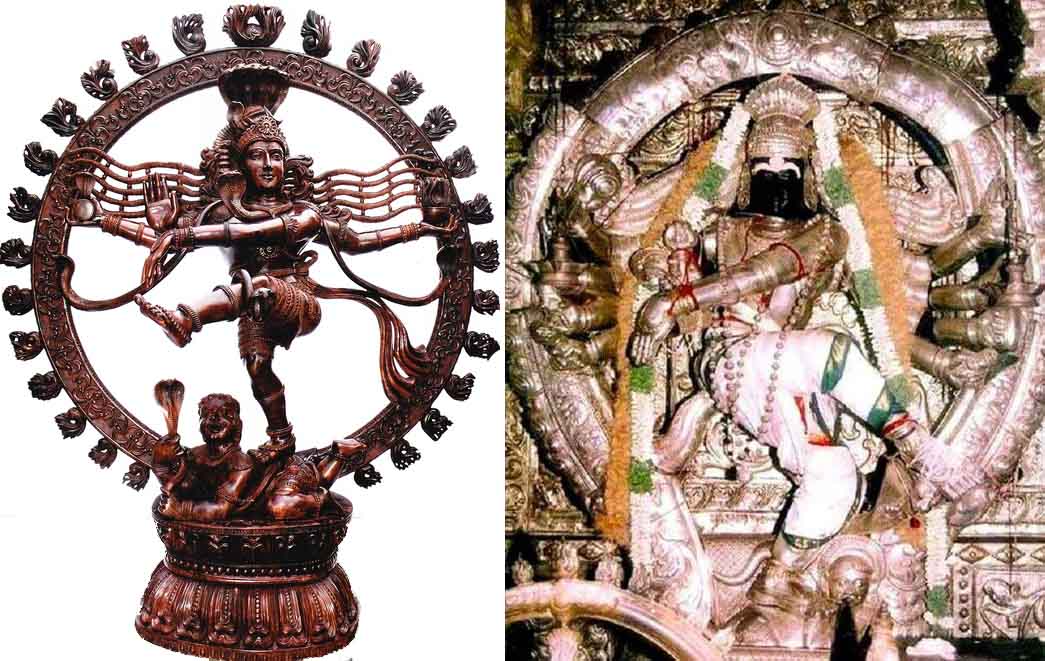
In this connection, a bit of mythology may interest the reader. Nataraja, the Hindu God Shiva as a cosmic dancer, is depicted in idol form in most temples of Kerala and Thamizh Nadu, balancing on his Right foot with his Left foot up. The only exception being the Nataraja idol at Meenakshi temple, Madurai. It is believed that the Pandya King who commissioned the temple wanted to give some relief to Natarajan’s Right leg, at least in the temple he constructed.
God Shiva with his consort Parvathi is mostly depicted sitting and in most cases, Shiva has his Left foot folded up and Parvathi her Right. As per Hindu mythology, Shiva represents the Purusha (male) and Parvathi the Prakrithi (nature or female.) Some Hindu mythological art portrays gods with both feet on together on the ground and this may be the depiction of combination of Purusha and Pakrithi.
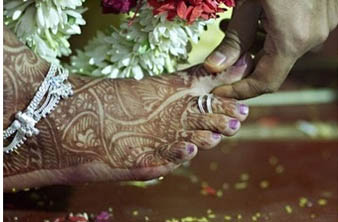
When an Indian Bride enters the home, she is advised by her mother-in-law to enter with her Right foot first, but no such instruction is ever passed to the groom. During many Hindu marriages, the groom ritually places the Right foot of the bride on a grinding stone. The mantras recited during this time advise the bride to lead a firm life like the grinding stone, to be as firm as a rock, so that the family can depend on her.
Most Hindu Goddesses are often depicted with their Right leg folded up, depicting Prakrithi.
This may explain as to why women commence their walk with their Right foot.
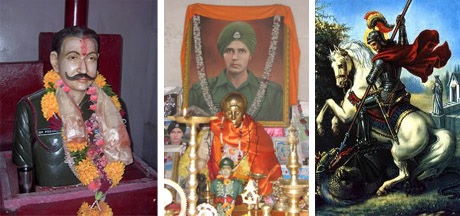
There are many soldier Gods in different border areas where the Indian Army operates. Most of the shrines dedicated to these Gods are situated in inhospitable terrain and mostly placed out of bounds to the civilians. There are no hymns or keertans sang on behalf of these Gods, they do not have ashrams, they do not ride in luxurious sedans, they do not hug devotees, they do not run charitable institutions, and they do not give darshans, and so on. They are soldiers who sacrificed their lives in service of their motherland and now regarded as patron saints guarding the areas where they achieved Martyrdom.
On my first assignment to the Kashmir Valley as a young Captain in 1987, my belief in God Almighty was rekindled mainly because of the inhospitable terrain, sub-zero temperatures, heavy snow-falls, avalanches, thin air with deficiency of Oxygen, high-altitudes above 10,000 feet, and the drive through the mountain roads where one could slip off the road, down the gorges, and no trace would be left of the vehicle or the passengers.
I was attached to a Punjab Battalion as Artillery Observer. The Battalion had soldiers mainly from Punjab, Himachal and Jammu, consisting of Hindus and Sikhs. As per the norms of the Army, the battalion had a Mandir with a Hindu Pundit and a Gurudwara with a Sikh Granthi. On Sundays or on important religious days we attended both Mandir Parade and Gurudwara Parade. These being Parades, it was mandatory for all officers and soldiers to attend.
On the way to the battalion headquarters, there was a Muslim Peer Baba and every man, irrespective of their rank or position, used to stop and pay their respects to the Peer Baba before proceeding to the battalion. The belief among the soldiers, passed down over many decades of army deployment was that the Peer Baba took care of the soldiers and in case anyone failed to stop and pay respect, he will meet with some tragedy. Being a Christian by birth, I said the Lord’s prayer in the mornings and evenings, a ritual embedded in me by our father.
This was the place I understood the meaning of secularism and realised that all Gods were the same. I was never sure as to who saw me through my first Kashmir tenure, the Gods in the Temple, the Gurudwara, Peer Baba or Jesus. During my later years of field service in Sikkim and in Siachen Glacier, I came across two Soldier Gods.
OP Baba, Siachen Glacier, c/o 56 APO
Siachen Glacier, a disputed territory between India and Pakistan, highest battlefield of the world, is well known for its inhospitable and treacherous terrain, freezing cold at minus 40 degrees Celsius, crevasses and avalanches and lastly enemy action. Statistics reveal that more lives have been lost to the weather than to the enemy action since 1984, when Indian Army first occupied Siachen glacier. Hypoxia, High Altitude Pulmonary Edema (‘high-altitude sickness’ or HAPE), bone-chilling winds, sun burns, chill blains, frost bites, the thin air and sub-zero temperatures inducing acute depression, are some of the weather factors affecting our soldiers. Most of the soldiers serving in such areas become very religious and the trust in their Gods really multiplies.
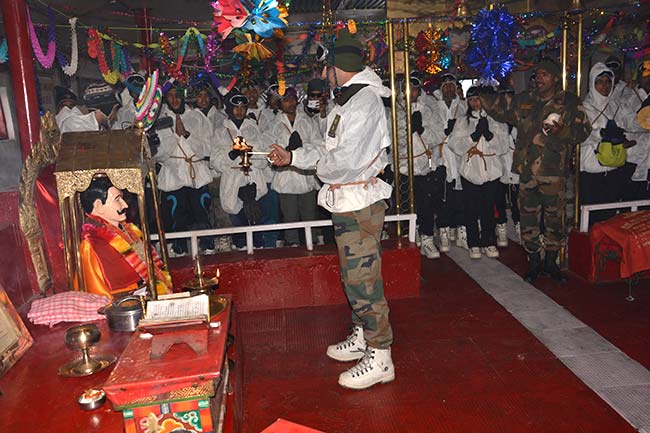
There are many a myths and legends about the Siachen Glacier like any other battlefields. Legend has it that OP (Om Prakash) Baba, deeply revered by troops posted in these glacial heights, was an army soldier who fought valiantly to preserve Indian frontiers from Pakistani intruders in most adverse situations. Belief in the Soldier Saint is so strong that a formal report is given to OP Baba before induction of a soldier party on the glacier and after successful accomplishment of any mission. Any officer moving into the area reports his arrival to the Baba by visiting the shrine and paying his respects.
Faith in the legend of OP Baba is so strong that all troops give up consumption of alcohol and tobacco during their stay on the glacier as the Baba is believed to have been a strict disciplinarian and expects the same from fellow soldiers who come here to guard the frontier. Every battalion or company before taking position begins with a prayer at Baba’s shrine. The company commander gives a detailed briefing to Baba before tying a brass bell in the complex, taking a vow to keep away from cigarettes and intoxicants and fight the enemy till the last breath. Soldiers keep this promise till the last day of their tenure in the glacier and is strongly believed that any deviation is met with instant punishment from the legend himself.
It is believed that a night before any imminent danger, Baba comes in the dreams of soldiers and warns them of such eventuality. Baba has always been with the soldiers and protects every soldier and warns them of any impending danger in the Glacier.
Baba Harbhajan Singh, Sikkim, c/o 99 APO
Baba Harbhajan Singh has defeated death. Believe it or not but it is true, one of its kind of story in the world- a man from an Indian Army in Nathula border in Sikkim, is still doing his duty even after his death some three decades ago. 60km from Gangtok towards the Nathula Pass lies the valley of Kupup. Here is the shrine of Baba Harbhajan popularly known as Baba Mandir. Baba Harbhajan has been guarding the international boundary of the two Asian giants, China and India over the last three decades. But believe me he does it alone. The Baba warns about the dangerous activities on the border through the dreams of fellow soldiers. Legend has it that even the Chinese soldiers confirm sighting a man riding a horse all alone, patrolling the border.
Born in Brondal village of Kapurthala, Punjab, Harbhajan Singh joined the 23rd Punjab Battalion on February 1966 as a Sepoy. On October 4, 1968 Sepoy Harbhajan Singh was escorting a mule caravan from his battalion headquarters and he fell into a fast flowing stream and was drowned. Search for Sepoy Harbhajan was made with no results it was on the fifth day of his missing, his Commanding Officer had a dream of Sepoy Harbhajan Singh informing him of his tragic incident and his personnel weapon being under the heap of snow. Sepoy Harbhajan Singh desired to have a Samadhi (memorial) made after him. The Commanding Officer ignored the dream as an imagination but later when the personnel weapon of Sepoy Harbhajan Singh was found at the spot where he had informed, the Commanding Officer was taken aback and to mark respect and towards his wish a samadhi was constructed there.
Here too, the belief in the soldier saint is so strong that any officer or soldiers moving into the area report their arrival to the Baba by visiting the shrine and paying his respects. On my arrival at Sikkim, Colonel PK Ramachandran, our Commanding Officer, realising my rational stands on such issues had advised me to visit the Baba Mandir. He said that my visit to the Baba Mandir may mean nothing to me, but will go a long way in upholding the faith of the men under my command. I did as ordered without realising the implications of his words until I read a research paper by a US Army Doctor on Post-Traumatic Stress Disorder (PTSD) suffered by operationally deployed US Army troops. I realised that cases of PTSD were the least in the Indian Army despite all the operational commitments and I can attribute it only to the faith in God by our troops and the role played by the myths and legends and patron saints of different areas. This may also be the reason for increased evangelistic activities reported among the US Military personnel deployed in operational zones.
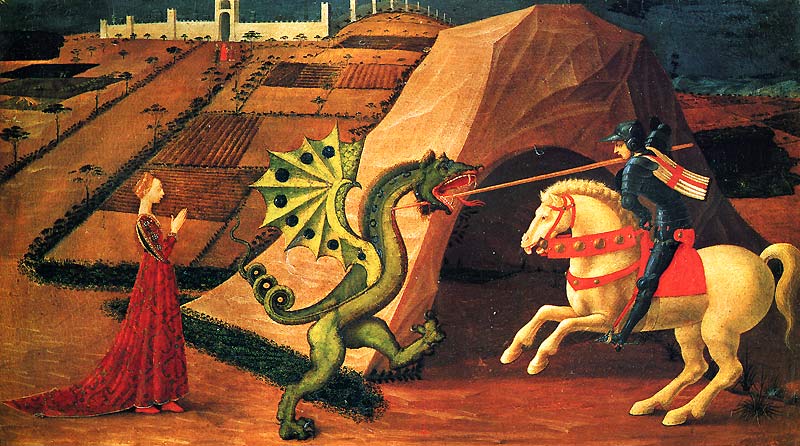
St George and the British Army St George is patron of soldiers, cavalry and chivalry and he is the patron saint of England, Georgia, Lithuania, Portugal, Germany and Greece. He has no biblical significance. He held the rank of a tribune in the Roman army and was beheaded by Diocletian for protesting against the Emperor’s persecution of Christians. St George was adopted as the patron saint of soldiers after he was said to have appeared to the Crusader army at the Battle of Antioch in 1098.
He is usually represented on horseback in the act of spearing the monster which is vomiting fire. It is based on a myth that in Sylene, a city of Libya, a lake was infested by a huge dragon, whose poisonous breath would kill anyone. The citizens could never draw water from the lake and in order to keep the dragon away, every day a virgin was sacrificed to it. One day the turn came for Sabra, the king’s daughter, to become its victim. She was tied to the stake, and left to be devoured, when St. George appeared mounted on his charger and is believed to have killed the dragon. Many similar stories were transmitted to the West by Crusaders who had heard them from Byzantine soldiers.
The banner of St George, the red cross of a martyr on a white background, was adopted for the uniform of English soldiers possibly during the reign of Richard I, and later became the flag of England and the White Ensign of the Royal Navy.
In 1940, when the civilian population of Britain was subjected to mass bombing by the Luftwaffe, King George VI instituted the George Cross for ‘acts of the greatest heroism or of the most conspicuous courage in circumstances of extreme danger’. The award, which is second only to the Victoria Cross, is usually given to civilians. The award consists of a silver cross. On one side of the cross is St George slaying the dragon, with the inscription, ‘For Gallantry’; on the other appear the name of the holder and the date of the award.
After setting foot in India, British Army built its first fort in Madras (now Chennai) in 1644 and christened it Fort St George after their patron saint.
Working in any hierarchical and structured organisation, one always had a boss, someone to whom one is answerable and someone who always gauged your performance and guided you to achieve the best. I too had my bosses and one always had subordinates, for whom one was the boss. After retirement, I realised that I was not my own boss as one had to be answerable for the actions to someone or the other.
Bosses under whom I worked can be classified as :-
Category 1. I know most of it and I know that I know most of it. The best boss to work under, who will only give you a few directions and believes in delegation. The boss knows the team well and capability of each one in the team and assigns tasks accordingly.
Category 2. I know bit of it and I know that I know only a bit of it. Depends heavily on the subordinates and accepts inputs from them. The subordinates while providing inputs need to be well aware that it may be implemented at times in full.
Category 3. Knows nothing, but presumes knows everything. Most difficult to work with as a subordinate and does not seem to have any faith in the subordinates. You will always keep getting orders and not directions as to how to execute a task and for sure, it will keep changing from hour to hour and at times from minute to minute.
One can never select one’s boss, especially in the army and one got to accept them As Is. I had been lucky during my service that I got a good lot of the Category 1 bosses, The distribution of the bosses were:-
Category 1. 52%
Category 2. 8%
Category 3. 40%
How they will perform in a given scenario is an interesting study. Let us take the case of a senior executive (a General or a CEO) flying in from the head office or the higher headquarters and need to be briefed for about 10 minutes by the boss under consideration.
Category 1. Will call the subordinates concerned, give out clear directions as to the slides to be made (at times makes it himself) and ask for any inputs from others. The slides only if must, may undergo a few changes. He may conduct one rehearsal and accept most inputs from the subordinates.
Category 2. Will call the immediate subordinates and explain to them the task in hand and accept inputs from them. The subordinates will have to provide the slides and the script and at times explain all that is written too. The boss puts in extra effort to understand the contents. There will be a few rehearsals and hardly any changes except for those where the boss finds difficulty in explaining.
Category 3. You and the entire sundry in the organisation, whether connected with the briefing or not, will be summoned for a conference, which will last for at least an hour. Some orders will be given out regarding the number of slides to be made, who will provide the data, etc. The most important aspect covered will be the tea and snacks to be served to the executive and at times even the flower arrangements to be placed in the office. The number of slides to be made would be around 40 and everyone knows that there would not be sufficient time, even to flash all the slides. The slides will undergo umpteen changes and will never be finalised till the eleventh hour. There may be many a rehearsals, but the number of changes the slides undergo will make them meaningless.
NEVER forget to save your initial draft. At the end of the day, with all the modifications and corrections, you will find the end product almost similar to your initial draft.
The final result you all can guess, but ultimately it is the subordinates who suffer, with all the unproductive work.
Late Colonel Avinash Chandra and I joined the Regiment in January 1983. He was a Captain then and was returning to the Regiment after a staff tenure and I was joining on commissioning as a Second Lieutenant. He, on promotion to the rank of Major was appointed the Battery Commander of the Jat Battery – 752 Medium Battery.
All the officers – both seniors and juniors – addressed him as Guruji. He was indeed a Guru on all matters, especially for us, the young officers of the Regiment. For us, he was the go-to man for all our problems – military, administrative, personal, promotion examination – and all the activities we young officers indulged in. He was always ready to help, but the only catch was that it came with a liberal dose of advice, anecdotes and stories.
It appeared to us from all his sermons that there was nothing under the sun which Guruji was unaware of and there was no activity Guruji had not indulged in. As expected, in all his adventurous stories, he was the pivotal character. We knew the percentage of truth in all his stories, but we all looked forward to listening to them. Whatever may it be, he had a solution in hand for all our problems and we all did enjoy his sermons.
During the Winter of 1985, the Regiment went through a training exercise conducted by the Brigade Commander. Next day, during the officers’ tea, Colonel Mahaveer Singh, our then Commanding Officer ordered that henceforth Major Avinash Chandra will not be addressed as Guruji, especially by his junior officers. It was all because our Brigade Commander during the exercise was peeved at a senior Major of the Regiment being addressed by his nickname. Guruji immediately said that he loved everyone addressing him as Guruji and if need be, he was ready to meet the Brigade Commander with this special request. That was our Guruji for all readers.
Guruji would take on any task everyone would find uncomfortable with. He would make such tasks appear simple and easy and conveyed an impression that he did enjoy executing it. His body language and mannerisms always added colour to such occasions.
One such task was engaging a target with Artillery fire using the infamous Range Finder DS1, The equipment is now obsolete and in my view should have been declared so even in those days. Everyone was literally scared of the invisible floating diamonds and no one wanted to touch it with a barge pole. Here now appears Guruji, full of confidence, to execute the arduous task. I always failed to understand as to how he would have executed the task with a failing eye-sight, corrected with glasses. Did he ever catch a glimpse of the five diamonds, mostly invisible to people with perfect eyesight?
The aim of engaging a target with artillery fire is make the shells fall on or as close to the target as possible to destroy it. The guns are placed well behind at about 10 km or more and the Observation Officer is located with the attacking or defending infantry unit. The Observation Post Officer (OP officer) is responsible to direct Artillery fire on to the targets, keeping in mind the safety of own troops. The Gun Position Officer at his Command Post near the guns would calculate the bearing, distance and other technical parameters to the target, based on the coordinates passed to him by the OP Officer and apply corrections to compensate for the prevailing metrological conditions like wind speed and direction, temperature, etc and fire a single shell called a ranging round. If the initial shell is not ‘on target’, corrections to move the fall of shot is ordered and is applied on the guns. This procedure called Ranging is continued until the shell lands within 50 meters of the target. He then calls for ‘fire for effect’ by ordering six or more guns to fire in unison until the target is destroyed.
During all the Artillery firing practices, Guruji would setup the monstrous looking Range Finder well before the commencement of the practice. When his turn to engage the target came, he would wipe his glasses clean, wear them and move to his trusted Range Finder. He would then instruct his radio operator to pass the target coordinates and other details to the guns with an order for a single gun to fire a shell. The use of the rangefinder, supposedly, was to eliminate the ranging process to the extent possible, and directly order ‘fire for effect’, to improve what in gunnery terms is called ‘First Salvo Effectiveness’. But the problem was that the range Finder DS1 was infamously unreliable and everyone other than a handful of personnel specially trained on it, kept a safe distance from the instrument.
Five seconds before the shell was about to land, his technical assistant would cry “Stand by” and Guruji would place his spectacled eyes on to the eyepiece of the Range Finder. After the shell exploded, he would look at it over the Range Finder and then through it. He would then pickup his pad and write down a few calculations and would order a correction to bring the shell to fall on the target – Right 275, Add 375- with an order for six guns to fire in unison.
Captain Desh Raj, the senior most among us Captains at that time would order us to summon all our Gods to ensure that the shells landed on the target. Believe it not, in almost all cases the shells did land on the specified target. Was it because of Guru’s gunnery skills or our prayers? Whatever it may be, the entire act did impress everyone present, especially the senior commanders.
After about two or three such experiences, I confronted Guruji to explain as to how he managed the show. He explained that he neither saw the floating diamonds nor the target through the Range Finder. He was mostly successful as he knew the firing ranges like the back of his palm. He knew the lie of the ground and could predict accurately how the shell would move with each correction. The most critical moment for him was when he looked over the Range Finder to catch the glimpse where the shell exploded. He would then assess the deviation from the target and order the necessary corrections to the guns.
My question now was that even though the entire procedure was based on shear guess work, how come it succeeded every time. Guruji with his characteristic smile on his lips replied “All because of your prayers.”
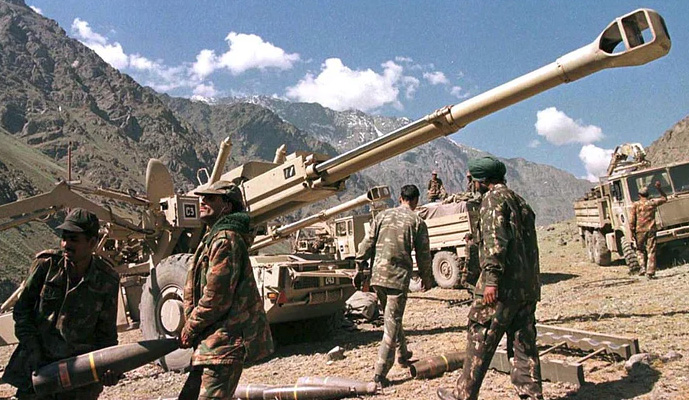
Our Regiment was equipped with the Russian made 130 mm M46 Guns when I was commissioned to the Regiment in 1982. 130 mm Gun was manufactured in erstwhile Soviet Union in 1950 and entered service with the Indian Army in 1965. The gun boasts of having achieved longest range of 27.5 km with conventional munitions. It traces its origin back to its predecessors used in ships and coastal defence by Russians during World War II. The gun was in the equipment list of many countries and some even produced their variants. The gun saw action during many conflicts across the globe – from Vietnam War to the recent civil war in Syria and Iraq.
To be fair to the Russians, it must be said that indeed the gun was good and extensively used in the 1965 and 1971 Indo-Pak Wars.The problem however was with the accessories that came with the gun. When Indian Army procured the 130 mm Guns, a plethora of accessories were supplied by the Russians. Most appeared to be tried, tested and failed – hence the Russians wanted to somehow palm them off to others. India must have paid a hefty sum for these accessories. Most of them found their due place in the technical stores of the regiments, and hardly ever used.
The biggest of them was the PPL Periscope – the wooden box for storage of the periscope looked more like a coffin. The periscope must have had its origin from the gun being used as a Naval Gun. Thankfully, no one in the regiment appeared to have even unpacked them or set them up for training or operations. No Observation Officer would have bothered to carry it to war as it needed at least six men to lift. On a ship, the carriage problem would not have been there and a need for a high periscope to observe the horizon was the requirement for any Observation Officer deployed on a ship in the high-seas.
The next biggest was the Range Finder DS1. From its looks and make, it also appeared to have its origin from the days of the gun being used in its naval version. It seems that someone in the Indian Artillery hierarchy of the 60s took a liking for this cumbersome piece that a chapter for observing and engaging targets with this monster was incorporated in the Gunnery Technical Hand Book (fortunately it has been removed from the recent editions).
The technique of employment was that the observation post officer measured the distance to the spot where a round fell and ordered the required correction in terms of ‘ Left/Right or Add/Drop’, having already made a similar measurement to the target, to make the round hit the target.
For measuring the distance with the DS1, one needs to manipulate a knob and make five ‘diamonds’ that appeared on the viewfinder so as to position the center one on the object to which distance is to be measured and two each equidistant in front and behind it. This needed a high degree of practice and skill.
Whenever I tried to operate the DS1, I could either see the object or the diamonds and never both, however hard I tried. I requested our Technical Section Commander – Subedar Bidappa – for help and he excused himself from the task owing to his poor vision. He suggested Havildar (Sergeant) Nahar Singh of the Survey Section as he had undergone a four-week long course at School of Artillery in operating the Range Finder. Havildar Nahar Singh agreed to transfer some of his skills and the art of manipulating the diamonds.
On the set day, I got the Range Finder set up at the training area next to the Survey Section and Havildar Nahar Singh commenced his lessons. We got struck at the stage where the elusive diamonds are to be manipulated – as usual I could either see the diamonds or the object and not both. Havildar Nahar Singh demonstrated his skill with the range Finder and measured distances to many objects around the training area. He read out the distances nearest to a meter and to verify it, he read the distance to a telephone pole to be 376 meters and asked me to pace it. Great! it was indeed about 375 meters.
I felt very small about my inability and kept trying to catch the elusive diamonds. Now came a warning from Havildar Nahar Singh – in case one operates the DS1 for a long period, one’s eyesight will deteriorate. He padded his comment with a line that soldiers operating the DS1 in the earlier days were authorised an extra egg in their rations to compensate for the struggle their eyes went through.
Never to accept a failure in front of the soldiers, I tried with all my efforts to catch the elusive diamonds for the next two hours despite Havildar Nahar Singh’s warning. Seeing my resolve Havildar Nahar Singh must have felt bad and he came to me and requested me to pack up the DS1. He now gave me his piece of wisdom.
He said that he too had never seen the elusive diamonds ever in his life. How the hell on earth did he measure the distances to various objects so accurately? He disclosed the secret that in the training area he knew the distance to all the visible objects as he had been conducting training for his section there. Whenever he measured the range to an object, he would focus the Range Finder on the object and set the distance on the scale.
How did he manage it during the training at the School of Artillery? There too all the students carried a small notebook with the accurate distances to various objects from various training areas. He claimed that hardly any student ever caught the glimpse of the elusive diamonds.
Our family friend took part in this year’s Tour De Mississauga, a 30/60/100 KM cycling event. This year it attracted over 1600 cyclists of all abilities from all around the Toronto Area. Cyclists of every age or ability, on every kind of bike (including electric assist), participated. The aim of the event is to familiarise cyclist with the various cycling trails and lanes available in the city, to develop a spirit of adventure and also to encourage cycling, both as a sport and as a physical activity. The event was well organized and truly lived up to its motto ‘THIS IS NOT A RACE – THE JOURNEY IS THE DESTINATION!’
As is the case with all such community activities in Toronto area like marathons, climbing the CN Tower, parades, etc, in this activity too there were hardly any participation by immigrants from the Indian subcontinent. When will we learn to amalgamate with the Canadian society? Participating in such events will not only develop community spirit in the participants, but will also raise money for some charity. It develops leadership qualities in children and encourages the spirit of adventure in them. Preparing for the event and participation will keep everyone healthy and improve one’s confidence level. Completion of the event will give you immense pride and sense of achievement. It will prove to you that you are physically healthy to undertake such difficult ordeals.
The local governments are doing their best to encourage cycling as a daily activity. Most of the roads in the Toronto Area have either a bicycle lane or off-road cycling paths. Bicycle Lanes are typically 1.5 m to 2 m wide, and designate a space on the roadway exclusively for the use of cyclists. Motor vehicles are not allowed to drive, park or stand in the bike lane. Off-Road Paths include trails through parks and along the arterial roads. Cyclists, skaters and pedestrians often share these paths.
On arrival in Canada, I saw a something like a crash-guard which we have on the front bumpers of the cars back home on the buses in the Toronto Area. On inquiry I learnt that it is a cycle carrier to carry two cycles. Many commuters feel that cycling or taking the bus just doesn’t compete with the convenience of a car. But in Toronto Area, “biking and bussing” is easy. You can cycle to a bus stop or station and then bring your bike on the bus. By biking and bussing you’ll not only improve your health, but also help reduce gas emissions.
In Toronto, bicycles are permitted on buses, trains and subways at all times except weekdays during peak hours. Bicycle transportation is a growing activity in Toronto and throughout North America, due in part because of the many benefits cycling offers. Transportation by bicycle is the most energy efficient mode of transportation, and generates no pollution, except in its manufacture. Cycling is often the fastest mode of transportation from door to door for distances up to 10 km in urban cores. Ten bicycles can be parked in the space required for a single automobile. Short distance motor-vehicle trips are the least fuel-efficient and generate the most pollution per kilometer. These trips have the greatest potential for being replaced by cycling and walking.
BIXI – Bike Share Toronto – is designed to be a convenient way to get around the city, and is ideal for short rides and one-way trips. The members get access to 2,000 bikes across the city. They can pick up a bike at one of 200 stations, and drop it off at any other station when done. One need to become an Annual Member or buy a Day Pass to be able to use Bixi. An Annual Member can insert a bike key into a dock to unlock a bike. Day Pass holders will get a ride code, which when typed into the keypad on the dock, unlocks a bike. The first 30 minutes of each ride are included in the membership or pass price. One can keep a bike out for longer, but additional usage fees will apply.
Reducing auto trips will mitigate ozone depletion, the greenhouse effect, ground level air pollution, photochemical smog, acid rain and noise pollution. Cycling contributes to personal health by enhancing fitness and providing an enjoyable, convenient and affordable means of exercise and recreation. Increased physical activity, such as walking and cycling, can reduce the risk of coronary heart disease and the cost of medical care, decrease workplace absenteeism, and maintain the independence of older adults. Cycling benefits one’s health regardless of the age at which one takes up cycling.
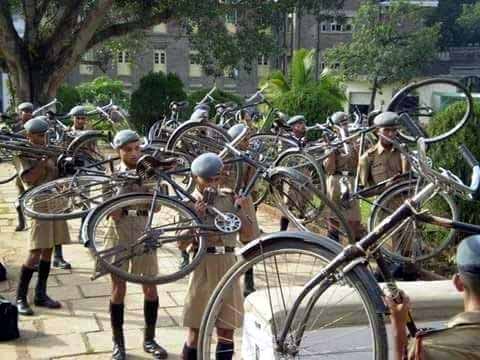
During our training at the National Defence Academy, Pune, cycling was the only mode of transportation for the cadets, else one had to run. The Academy campus is spread over 7000 acres and to reach various training event sites, a cadet had to cycle an average of 20 km per day. While cycling, one had to maintain proper squad discipline and pay proper respects to passing senior officers.
Any minor infringement ensured that the cycle was on you rather than you being on the cycle. Every semester begun with the cycle issue and always ended with the cycle return, after which was a month’s vacation. We used to have a weekly cycle maintenance parade to wash and repair the cycles. Thus even today, the cycle is the most ardent companion of every cadet at the academy, without which life would have been much more difficult.
During our childhood, we recited Psalm 91 as part of the evening Family Prayer (Click Here to Read More about it). In those days I never realised the meaning of the words we recited and did not visualise that it will impact my life. During my first stint at the Kashmir Border, sleeping alone in my bunker, the very same words rang in my ears. These words I realised helped me tide over the difficulties and uncertainties that lie ahead for any soldier in high-altitude terrain, mostly snow covered icy heights, prone to avalanches and blizzards and bone chilling cold. I recited Psalm 91 every evening, (in Malayalam, the language in which our father taught us the Psalm,) before I retired to bed. Psalm 91 has for ever been one of my inspirations and a prayer.
There is a story in circulation by the modern evangelists that during World War I, 91 Infantry Brigade of the American Expeditionary Force (AEF) was preparing to enter combat in Europe. Because their commander was a devout Christian, he assembled his men and gave each of them a little card on which was printed the Psalm 91, the same number Psalm as their brigade. They agreed to recite that Psalm daily. After they had begun praying the Psalm, 91 Brigade was engaged in three of the bloodiest battles of World War I – Chateau Thierry, Belle Wood and the Argonne. Other American units that fought in the same battles had up to 90 percent casualties, but 91 Brigade did not suffer a single combat-related casualty.
The truth about this story of 91 Infantry Brigade and the Psalm 91 has been cleared By Mary Jane Holt in an article ‘The truth about the 91st Psalm.‘ The article refers to a communication the author received from Mike Hanlon, Research Editor of Relevance, the Quarterly Journal of The Great War Society: “There was no 91 Brigade with the AEF in World War I. The Brigades’ highest number was 84.” This story appears to have been churned out by an evangelist with a view to cash in on the sympathy the soldiers world over enjoy.
The Bible historians believe that Psalm 91 might have been written by Moses, even though most Psalms are authored by King David. Moses might have written it to inspire the enslaved Israelite soldiers to fight against their Egyptian masters. Hence, Psalm 91 is known as the Soldiers’ Psalmand is also referred to as the Psalm of Protection.
There are many testimonies of NATO soldiers keeping a card size print of Psalm 91 in their pockets and also reciting it during their deployment in Iraq and Afghanistan. The Psalm as is, will be applicable to all soldiers irrespective of their faith or religion.
The Psalm begins by stating that there is no need to fear because of who He is. Then is a more personal relationship to God as the Almighty is referred to as ‘My refuge, My fortress, My God in whom I trust.’ Thus the personal relationship we have with our God enables us not to fear at all. It follows with an affirmation that He will come to your rescue in case of any difficulties and that He will protect you as He will cover you under His wings like a mother bird.
Then is the declaration of guarantee by God that He will protect you from all that a soldier may confront in a battlefield like ‘the terror of night‘, ‘arrow that flies by day,’ ‘the pestilence that stalks in the darkness,’ and ‘the plague that destroys at midday.’ He also provides you the protection while you rest that no disaster would come near your tent. The God vows to protect the soldier even though thousands may fall on either side. God has commanded the angels to guard you so that you will not strike your foot against a stone.
The Psalm further says that you will tread upon the lion and the cobra; you will trample the great lion and the serpent. This act can only be done by a soldier in a battlefield and the soldier has to move ahead facing the enemy’s bullets and nothing can stop him from carrying out his divine duty. For God’s sake, don’t even let the thought about these actions come to anyone else’s mind or even in the mind of a soldier in peacetime, as the wild life protection laws of no nation will ever spare you and please do not expect God to come to your rescue!!
The Psalm concludes with a God’s promise to a soldier ‘He will call upon Me, and I will answer him; I will be with him in trouble; I will rescue him, and honour him. With a long life I will satisfy him, and let him behold My salvation.’
In Bhagawad Gita, Lord Krishna exhorts Arjuna to fight by saying “O son of Kuntī, either you will be killed on the battlefield and attain the heavenly planets, or you will conquer and enjoy the earthly kingdom. Therefore get up and fight with determination.” Here again the Lord guarantees a soldier the grand honour of the right to heaven.
In 1997 after the Technical Staff Course of 18 months, I was posted back to my parent unit 75 Medium Regiment. In those days the unit had three batteries, each with different class composition of soldiers. Now it has men from all over India, comprising of all classes. A battery is a sub-unit of an Artillery Regiment consisting of six Guns and about 125 soldiers to operate them along with vehicles, radio sets and other technical equipment.
The Regiment then had an interesting class composition. One battery was of Brahmins (other than those from the Southern and Eastern States of India), the second had Jats and the third was manned by the soldiers from the four Southern States. Management of soldiers in all the batteries differed as their reactions to various situations, their needs, their languages etc were different.
In those days, any Young Officer posted to the Regiment served with each of the batteries for one or two years in order to familiarise them with the soldiers. I too went through this rotation until I moved out for the Long Gunnery Course for 13 months. On my return from the course in 1990, I was appointed the Battery Commander (BC) of the Brahmin Battery. After two years I moved on posting to a staff appointment and returned after two years, again I was handed over the reins of the Brahmin Battery until I moved out for the Technical Staff Course.
On my return to the Regiment in 1997 after the Technical Staff Course, the unit was located in the high-altitude area (10,000 feet above Sea Level) of Sikkim, where families were not permitted to live with the soldiers or officers. After the customary ‘Dining-in’ in the evening at the Officers’ Mess, our Commanding Officer (CO) Colonel PK Ramachandran spoke welcoming me back into the fold and ordered me to be the BC of the Brahmin Battery. “Oh! Not again,” was my instant reply and the CO was a bit puzzled. He later spoke to me in person and I requested that I need a change and I wanted to have the experience of commanding another battery. Our CO had his own logical reasoning for his decision and I did accept the same without any remorse as I too was convinced. Col Ramachandran had earlier served throughout his army career with a Regiment which had only Brahmin soldiers and I realised the he exactly knew the horse for the course.
The first week I spent at the Regimental Headquarters, carrying out the acclimatisation drills laid down for any soldier on arrival in high-altitude area. Our Battery was located about three km from the Regimental Headquarters. I luckily had two energetic and hardworking officers – Captain Samya Saurav, the Second-in-Command and Lieutenant Manish Wahi, the Gun Position Officer – both are presently Colonels, who effectively commanded their units. I delegated all my duties to the two and they did an excellent job that I hardly ever visited the battery. Our CO wanted me to stay with the Regimental Headquarters to assist him, hence I had to delegate most duties to my junior officers.
After the week long acclimatisation, I decided to pay a visit to the Battery in the morning. When I reached the kitchen area, I found six sheep grazing there. In high-altitude area live sheep are supplied as rations in place of dressed meat. These sheep are called Meat on Hoof (MOH) but are mostly Meat on Knees as these sheep are nearly dead after traversing through the difficult mountain roads from the plains. The soldiers fed them well for a week to bring them back to life before they are slaughtered.
On inquiry I realised the problem of the sheep – the Brahmins did not want to slaughter the animals, but like good soldiers, wanted to partake the meat. I ordered the Havildar Major (Sergeant Major) Kanti Prasad to assemble the entire battery at 12 Noon in front of the kitchen and the BC will slaughter the animal in their presence. After that I went back to my room in the Regimental Headquarters.
In my youth, our household had fowls and animals and whenever I went on vacation, my brothers entrusted me the task of slaughtering. I think I did a good job of it as Amma, a stickler regarding the way the meat is cut, was pretty happy about my job. That was why I was sure that I will do a smart job of slaughtering the animal – if my mother could not find anything wrong – I was damn sure no one on earth could.
By 11 AM, our Havildar Major knocked at my door and reported that the sheep was stewing in the pressure cooker and I need not return to the battery at 12 Noon.
While at school, I used to marvel at the honour boards placed at the entrance of the Academic block. It had the names of the School Captains, Best Result for National Defence Academy (NDA) and Academics and the Sportsman of the year. These boards in effect displayed all what the school stood for- to train the cadets as all-rounders and to motivate them to join the NDA.
On the School Captains board, the name of Victor Duraisamy of 1965 batch stood out for me. It could be because the name was secular – Christian sounding first-name and a Hindu last-name. Or was it because it was the longest one on the board?
I joined the school in 1971, six years after Colonel Victor Duraisamy left the school and by that time he was already a Lieutenant in the Indian Army.
I remember Mrs Sheela Cherian saying during one of her classes about the Duraisamy brothers who were all-rounders in all aspects- academic, sports, extra-curricular activities and also music. The family was indeed gifted with music running in their blood.
After joining NDA and about seven years of army life, I heard that Victor Duraisamy and his younger brother were also commissioned to the very same Regiment – Artillery – that I was also commissioned. I always knew that I would meet them somewhere in my military career.
In 1989, I was attending the Long Gunnery Staff Course at School of Artillery Devlali. After a few months we had a new neighbour moving in – it was Colonel Victor Duraisamy. As the course was very intensive, we had only limited opportunity to interact. He was then responsible for training the Regiment of Artillery Band.
During the Artillery reunion, we were all invited to a symphony orchestra performance by the Regimental Band, It was conducted by none other than Colonel Victor Duraisamy. The poise of the movements of Victor and his baton really mesmerised me. It would have surely given Zubin Mehta a run for his money. At the end of the performance I complimented him for performing such complex symphonies – that too with military musicians – most hardly matriculates.
After the symphony, we were invited to his home for dinner and that was where I met Colonel Fredric Duraisamy, his younger brother. He was then with the Air Defence Artillery. Both the brothers and their children kept us all entertained with their musical talent for over two hours.
In 1997 while serving with the Army Headquarters at Delhi, Colonel Victor Duraisamy was also posted at the Military Training Directorate (MT Dte) of Army Headquarters. He was then responsible for charting out the musical training for all the Regimental Bands of the Indian Army. He was also responsible for the conduct of the massed band display during the Beating the Retreat Ceremony at Vijay Chowk to mark the culmination of India’s Republic Day Celebrations.
The schools reopen for the new session in Kerala after the summer vacation in June every year. The school opening is marked by the commencement of the monsoon rains and in the low-lying areas of Kottayam, there would invariably be floods and the schools are often closed at least for a fortnight thereafter.
Our father was the headmaster of a school in thithereafter.qs area near Kumarakom and once I asked him “Why can’t you have an extended school session till April end and have summer vacation in May and June?”
“This idea was tried out unsuccessfully as the combination of extremely hot summer days and scarcity of drinking water posed major difficulties and hence the proposal was shelved,” he replied.
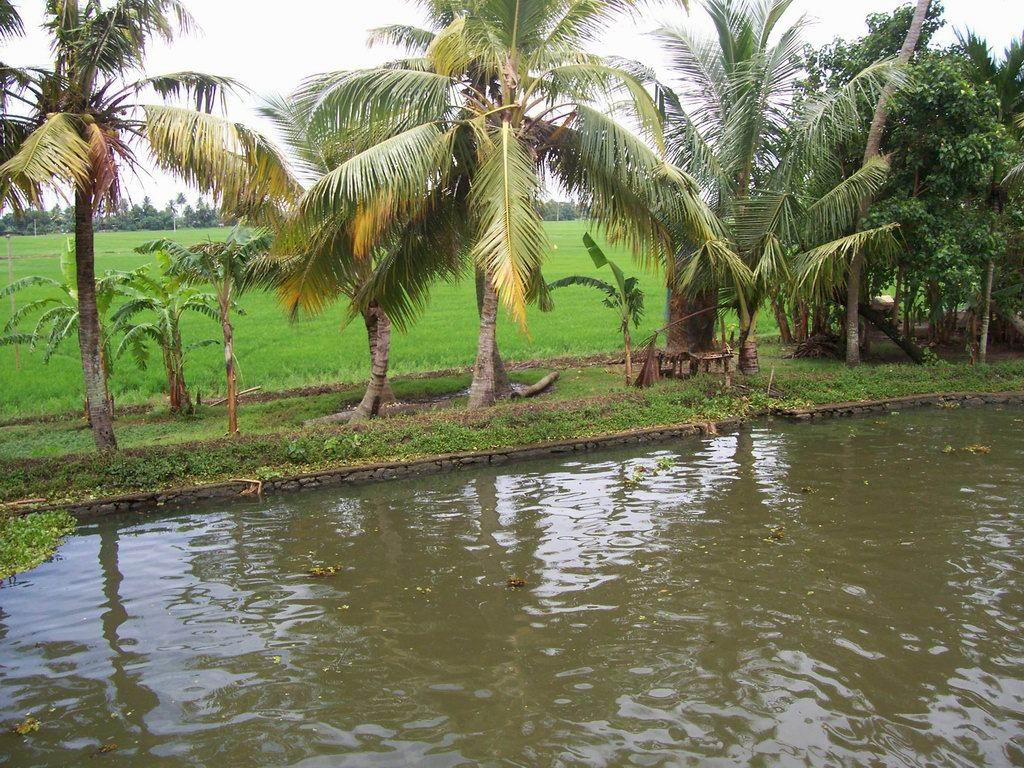
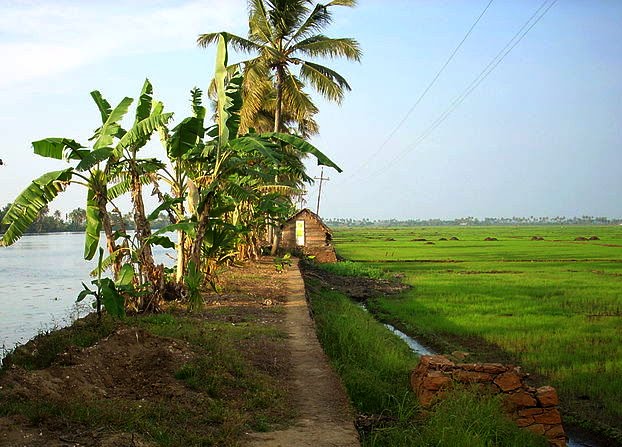
The low-lying areas of Kottayam are a part of the North Kuttanad, known as the rice bowl of Kerala. This is perhaps the only region in the world where rice farming is done at about 2.5 meter below sea level. The paddy fields are reclaimed land from the backwaters. In case one embarks on a boat ride through the backwaters, one can observe that the paddy fields are at a much lower level than the water level of the backwaters. If you carefully observe the images above or below, you can differentiate the two levels.
Kuttanad meaning ‘low lying lands’ is one of the most fertile regions of Kerala, spread over the districts of Alappuzha and Kottayam, crisscrossed by rivers, canals and waterways. The region contains the low-lying lands measuring about 25 kilometers East-West and 60 kilometers North-South on the West coast of Kerala. A major portion of this area lies 1 to 2.5 meters below the sea level. Kuttanad has 1,10,000 hectare area, of which 50 % is reclaimed and 88 % is under agriculture. The area is characterised by Dyke building in deep waters, land reclamation and maintenance and Rice-Fish rotation farming.
The dykes (bund) construction and maintenance are intricate tasks, for which an array of long and stout coconut poles are hammered deep enough into the lakebed in two rows, about two meters in width enveloping the entire area. It is then fenced with bamboo mats on either side. The channels of the bund are now filled to the desired height, first with sand, followed by twigs, interspersed with high quality clay dug from the bottom of the lake. Then water is pumped out and the land is prepared for rice cultivation.
The dykes are now mostly permanent ones built with granites and concrete. Only a few gaps are left to facilitate flowing in of water after the harvest. The gaps are filled prior to cultivation as mentioned above. In the earlier days, water was pushed out from the low lying areas manually using a waterwheel. Nowadays, the manual labour has been replaced by electric pumps.
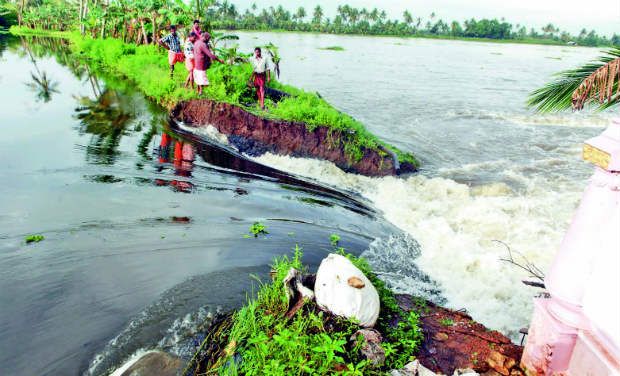
During heavy monsoons, the flood waters may breach the bunds and inundate the paddy fields, causing heavy losses to the farmers.
The freshwater environment close to rice fields and the canals provide abundance of Pearl spots (Karimeen for which Kerala is well known for), fresh water giant prawns (Attukonju) and freshwater catfish.
So much for the geography of Kuttanad and its peculiarities.
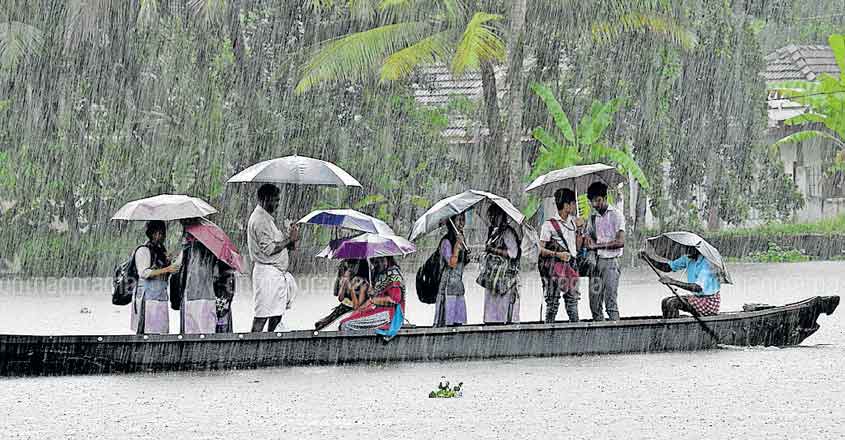
Let me now relate to a monsoon related necessity. It was customary for our father to gift all four of us with an umbrella, with our name inscribed on it, at the beginning of every school year. One either lost them or damaged them as the school year passed by. In the autumn of his life, he resumed the old habit and continued with the same gift to all his grandchildren.
In China, gifting your friend an umbrella means you want to end the relationship because umbrella sounds like San in Chinese, which means to separate. Giving a married couple an umbrella as a gift should be avoided in all cases, at least in China. The Chinese believe that if it is raining and you are worried, he or she will get wet, it’s better for both of you to huddle under one umbrella until you reach your partner’s destination.
That brings me to a personal anecdote related to the gifting of umbrellas. A few weeks after assuming command of the unit in the operational area in Rajasthan, our Second-in-Command (2IC) Late Col Suresh Babu approached me and said “There are about 100 umbrellas lying unsold in the Regimental Canteen at Devlali, Maharashtra. I propose a 50% reduction sale for them.”
I realised with the unit in the operational area, it may not be feasible to execute the sale.
After analysing the loss being incurred by the canteen and the overall cost of the umbrellas, and taking a cue from my father, I said “Let the Regiment buy all the umbrellas from the Regimental fund and let them be gifted to all children of the unit at the beginning of the academic session.”
As in Kerala, in Devlali too, the monsoons pour down heavily coinciding with the school opening, but luckily there are no floods. The gift must have impressed all the families and children, back in Devlali as they had not yet met the new Commanding Officer.
In 2009, five years after handing over command, I received a call from Subedar Ravinder Singh. His son came online and said “Sir, the umbrella you gifted to me at the time of taking over command of the unit has been preserved by me and was always a sign of encouragement for me. Thank you very much Sir and also for training all the children of our unit on computers. The introductory training to technology I received at that early age made me explore the world further and it has helped me immensely in my career. Thank you, Sir.“
Most of your deeds and actions may not matter much to you, but it matters to the one who is in the receiving end. The resultant effect will always be as to how the receiver perceives it. And, if the recipient perceives it well, he or she will replicate it in later life, in one form or the other.
Good deeds generally have a chain reaction as do bad deeds. But in case of good deeds the chain is generally much longer than in the case of bad deeds.
While our Regiment was deployed in the operational area, we received an order to move forthwith to be part of a newly raised Artillery Division. Within about six hours of receiving the orders, our unit arrived at the new location, surprising everyone in our new Divisional Headquarters as they never expected such a quick response. The move was executed real smooth as the unit was at its peak of operational preparedness, mainly due to the training and the relaxed time our soldiers had.
The Division was commanded by Major General RS Jambusarwalla and Colonel Azad Sameer (now Veteran Brigadier) was his Colonel General Staff (the main advisor and assistant to the Divisional Commander on operational matters.) Both were handpicked by the Army Headquarters for the new Artillery Division, and I had never served with either of them.
Luckily, Late Colonel Suresh Babu, our Second-in-Command, had served with both and knew both of them pretty well. Prior to the move, Colonel Babu briefed me well about both with a closing advice “when you meet them – the swords would clash, but please ensure that the sparks do not fly”.
General Jambusarwalla and Brigadier Sameer – both great human beings and real soldiers – with a very sharp and logical mind. Obviously, great teachers and orators. Both accepted any views; however they were in disagreement with, discussed them with an open mind and came to an apt decision. They did not believe in turning the pages back and always encouraged creative thinking and welcomed new ideas.
After the unit settled in its new location, the next day we attended a tactical discussion at the Divisional Headquarters, conducted by General Jambusarwalla. Colonel Babu briefed me “Please do not fire on all cylinders on the very first day. Remember that you are also the junior most Commanding Officer of the formation.“
As the discussions progressed, I could not hold on to my horses and did take off on a few issues. Whenever Colonel Babu thought that the ‘sparks would fly‘, he gestured and I backed off. This parrying continued for the next three days and often became a close circuited discussion between General Jambusarwalla, Brigadier Sameer and self.
During these discussions I used Malyalam too, especially with Brigadier Sameer being a Malayalee, I knew that he would explain the meaning to the General. One such discussion was about engaging targets in depth with the long range guns, rockets and missiles and all the commanding officers were explaining their own theories. I was mostly in disagreement with them as engaging targets in depth without employing any of our surveillance devices to observe where the shells have fallen and the damage caused, would be sheer waste of effort. Whatever I said was falling on deaf ears I thought. So I rose up and said it was like “പൊട്ടക്കണ്ണന്റെ മാവേൽ ഏർ (pottakkannante mavel er)”. My sudden unexpected outburst in Malayalam took many by surprise and immediately General Jambusarwalla wanted me to explain it to the entire audience. Three words in Malayalam meant three sentences in English, I realised then. I explained “it is like a blind man trying to throw stones at a mango tree, expecting mangoes to fall.” It killed the discussion then and there.
After we moved back to our peacetime location at Devlali from our operational deployment, General Jambusarwalla paid a visit to our unit. The unit was becoming fully automated in the administrative functioning and I was facing shortage of funds and computer hardware. General Jambusarwalla alighted from his car and ordered his driver to open the boot of the car and there he had a computer and a printer as a gift for the unit. That was General Jambusarwalla, who knew exactly what the unit needed and it was the first time in my entire military career that I saw a visit by a General beginning with a gift rather than……….
After the visit I called up Brigadier Sameer to find out about the opinion the General had about the unit. Brigadier Sameer said that the General was really pleased with everything but had only one issue. It was that I had misspelled the General’s name on a board outside the guest room with only one “L” in the “WALLA”. I immediately apologised and said, “I never realised that General Jambusarwalla’s ‘Vaal (വാൽ/ வால்)‘ had only one ‘eL (എല്ല്/ எல்லு)’”. ‘Vaal‘ in Malayalam/Thamizh means the tail and ‘el‘ means a bone. I am very sure that Brigadier Sameer must have explained it to the General and they both would have had a big laugh.
Once I wrote the above, I wanted the approval of General Jambusarwalla prior to placing these in a public domain. As a typical soldier, old habits die hard; I forwarded it to Brigadier Sameer, to seek the General’s approval. Literally “Fired it from Brigadier Sameer’s shoulders” and Brigadier Sameer did lent his shoulder and as a good old Colonel General Staff, put his initials and forwarded the same to the General.
I was least surprised by the reply I received from the General – “So he can go ahead and write whatever he feels like, especially when it pertains to padding my ego! Not to mention my boneless tail!”. This showed that the General is in good health and his sense of humour is still intact – may be it has sharpened a bit more – post retirement.
During my visit to Pune on 22 December 2015, I was staying with our friend Colonel John. In the evening General Jambusarwalla with Mrs Hufreez Jambusarwalla came to Colonel John’s place to pick me up for dinner at the Pune Turf Club. Colonel and Mrs John had to attend a formal event at their Officers’ Mess and we were all ready by 7 PM. Colonel John’s house was on the upper floor. There was a knock on the door and General Jambusarwalla was there to escort me to his car. Colonel & Mrs John were surprised to find the General walking up the stairs to pick up a Colonel.
That is General Jambusarwalla for you, a true soldier, a great General, with all the humility and a heart of gold.
The first Field Firing Exercise that I participated in as a Gun Position Officer (GPO) – Second Lieutenant – was on 28 December 1983. It was a Battery level exercise for 753 Medium Battery. Our Battery Commander was Major Ashok Sikka, with Captain Firoze Allavalli as his Second-in-Command. Captain Avinash Chandra was attached to our battery as the Observation Post officer from the Regimental Headquarters. We had four 130mm Russian Medium Guns and the exercise was to practice engagement of targets and fire planning at the Thughlakabad Field Firing Ranges.
75 Medium Regiment then had three batteries with fixed class composition. 751 Medium Battery consisted of Brahmins from North India, 752 Medium Battery had Jats and our 753 Medium Battery had South Indians.
The Thughlakabad Ranges was located South-West of Qutab Minar, North-West of Faridabad and South-East of Gurgaon. The range was closed down in 1988 as it posed hazards to the aircrafts landing at the Indira Gandhi International Airport close by and also because the area around it was being developed into residential colonies.
On 28 December we carried out tactical manoeuvres of the battery in the area around Gurgaon (then it was hardly developed as one sees it today) and by evening deployed in the Field Firing Ranges. By dusk, we practiced engagement of targets with live firing up to 8PM.
At the end of the shooting, I received a message from Major Sikka that a team of about 100 people, mainly press photographers and reporters from various print media houses, and the camera crew from Doordarshan (India’s national TV broadcaster) were scheduled to visit us in the gun area by 10AM on 29 December. They were to witness the firing of medium guns. Major Sikka also instructed me to ensure that they were well cared for as per the norms of our battery.
Subedar (Warrant Officer) Chinnappa was in charge of the administration of the gun area and I immediately summoned him. I asked Subedar Chinnappa as to how he intended to take care of the visitors and without winking an eyelid he said “We will serve them Idli(four to five inches in diameter cake made by steaming a batter of fermented de-husked black lentils and rice), Vada(spicy doughnut shaped deep fried snack made from black grams and Bengal grams), Sambar(spicy a lentil-based vegetable stew ) and Chutney(side dish made using a combination of coconut, garlic, ginger, tamarind, chili, cumin and fenugreek.)
I was surprised with Subedar Chinnappa’s answer as I knew that fermenting the batter for Idli overnight in the cold winter of Delhi was near impossible, but Subedar Chinnappa seemed pretty confident of executing it. I summoned all the soldiers and explained to them about the impending visit by press reporters next day and instructed all of them to be smartly turned out and answer all the queries with confidence.
Now I summoned my ‘Commando Team’. This team consisted of the Limber Gunners from the gun detachments – Naik (Corporal) Achuthan (very good at cooking, better than any chef), Naik Sengole, Naik Prasannan and Naik Mathukutty – and the Machine Gun Operator – Naik Gopalakrishna Pillai and driver Naik Venson. The Limber Gunner of a detachment is generally the Deputy to the Detachment Commander, one skilled in the basics of the Gunners’ trade, more especially in the care and maintenance of the gun and its ammunition. They all sported terrorising handlebar moustaches (Major Sikka had a liking for it), including Subedar Chinnappa, which would send tremors up the spine of even Veerappan, the forest brigand. They were ever ready to execute any ‘difficult’ task at any time and used many ingenious methods to achieve excellent results.
The task in hand was explained to them and they held a mini-conference among them to decide on the plan of action. Around 8:30 PM they drove to the Regimental location to grind the lentils and rice for the batter. They returned to the gun area by about 2 AM with the batter.
I still was trying to work out in my mind the difficult proposition of fermenting the batter in a cold night. It requires around 25 degrees Celsius temperature for fermentation and I had only eight hours in hand. Neither Subedar Chinnappa nor my Commando Team appeared least worried about it. They asked me to sleep for a few hours as I had to conduct the firing in the morning and also brief the visitors. They assured me not to worry about the Idli-Vada problem.
The press team consisting of about 100 people arrived at the gun area at stroke of 10 and Subdear Chinnappa with his characteristic smile received them and escorted them to the gun position. He had ensured that the members of the commando team were by then positioned around my command post.
I welcomed the visitors and before I could commence the briefing, a senior press reporter remarked that he was impressed with the turnout and smartness of the soldiers, especially their moustaches. Everyone in the crowd nodded and some added a few words of approval. Subedar Chinnappa won the first round and I glanced at him with a smile of appreciation.
Firing of guns was demonstrated and everyone took photographs and the camera crew recorded the events. They interacted with the soldiers at the guns and at the command post and were briefed well by everyone. By around 11 o’ clock, Subedar Chinnappa invited everyone for a cup of tea. They were surprised to see Idli-Vada being served in the jungles and were really appreciative of the snacks. They wanted to know as to how we made it. Many of them went on to remark that they never had eaten such soft and tasty Idli-Vada in their life.
Before bidding goodbye, the news producer of Doordarshan was really appreciative of the Idli-Vada and said that I must watch the 9 PM newscast as this event would be part of the headlines. The print media reporters said that the photographs and the news report would find a place on the front pages. I did not take them that seriously and saw them off.
Now I summoned the Commando Team to appreciate them for their special efforts. I was curious to know as to how they fermented the batter. Naik Venson was responsible for this task and he took the Team to the Regiment location in the Gun Tower – the Kraz vehicle. Kraz being of Russian origin has driver-cabin heating system. When they returned with the batter to the gun area, the Kraz’s cabin was already at about 25 degrees Celsius. Naik Venson kept the Kraz in static run mode till next morning. This ensured that the cabin temperature remained at optimum level for the batter to ferment. What an idea Sir-ji.
After the firing exercise, I returned to the Officers’ Mess by evening. I asked for a drink and sat in the TV room. In those days we had only the Doordarshan channel and the news headlines said “75 Medium Regiment conducted their field firing exercise today” and the visuals of the firing practice were shown. Next morning all the leading dailies published from Delhi carried the same news item with a photograph in their front page. The photographs and news reports were placed in the Regimental History Book.
So, the Idli-Vada did play a vital role in impressing the media persons. The story is a testimony to the versatile ingenuity of the soldiers of the Indian Army.
Front page report that appeared on the Indian Express
On reaching Devlali, our Regiment’s permanent location after the deployment in operational area for about 10 months in November 2002, I ordered the purchase of a window air-conditioner (AC). After two days the AC arrived and was placed in front of the main office complex. That day I went to the Regiment and the Subedar Major (Senior Warrant Officer) with the Regimental Havildar Major (Sergeant Major) and the Second-in-Command (2IC) Late Col Suresh Babu were waiting for me.
My question to everyone present was “Where will this AC go?” Subedar Major Thangaswamy said “As per the norms of the Indian Army, it is meant for the Commanding Officer’s office, but knowing you well, surely not to your office, sir – we need to find a place for it.” Someone suggested the Medical Inspection (MI) Room and someone else suggested the Regimental Information Room and someone pointed at the Dining Hall of the soldiers.
My contention was that one window AC will not suffice for either the Information Room or the Dining Hall and the MI Room, the Nursing Assistant will lock it up and leave early morning with the sick parade to the Military Hospital and hence no one will be able to use it. Anyhow, I told everyone to ponder over the question and come out with an answer after consulting their men, the next day.
We had a nice barber’s chair in the Barber Shop and by that time I had received the consignment consisting of a hair-washing station, blow dryers, latest electrically operated hair clippers, set of cosmetics, etc through an old colleague and dear friend from 75 Medium Regiment (my Parent Regiment) – Veteran Major GR Kaushik. After hanging up his boots, he is running a high-end hair replacement business at Delhi called “The Marchers International (http://www.marchers.in/ )”.
I took the consignment I had received from Major Kaushik along and headed straight to the barber shop with Colonel Babu. I instructed everyone about the layout of the barber shop and the usage of all the new equipment and cosmetics. The package had a high powered music system and a television too. I then pointed to the window and said that the AC will find a place there. It surprised everyone.
My logic was that it is only the barber shop that any soldier can enter at anytime without any formalities and either of the barbers would be available in the Regiment all throughout. The soldiers really enjoyed the cool air from the AC and also the haircuts with the hair-wash becoming an instant hit.
The barber shop was provided with all sorts of creams – face, skin and hair creams and also shampoo and conditioners. The SM’s contention was that the soldiers are likely to misuse it. My view was that they may misuse it once or at most twice, after which they will get used to it. The barber was instructed to refill anything and everything that ran out from the regimental Canteen and the same was to be charged off from the Regimental fund. As time progressed, the expenditure on creams and shampoos came down drastically after the initial two months.
After a year, Captain Nagaraj Shetty Jayaram was posted to the unit. He being a bachelor, moved into the Officers’ Mess and I found him ideal to be appointed the Adjutant of the unit. Adjutant is a staff officer who assists the Commanding Officer and is in charge of the organisation, administration and discipline of a unit. Adjutant has to be available at all times and is generally always on the run. Who else would fit in the role of an Adjutant better than a hardworking, enthusiastic and intelligent bachelor Captain.
After meeting me on arrival, Captain Jayaram went to his room in the Officers’ Mess. Prior to leaving the unit, he called our Barber, Naik (Corporal) Puran Singh. Puran Singh walked in smartly, saluted the new Adjutant to be told “Please report to my room at 3 PM and give me a nice soldierly haircut.”
Naik Puran Singh replied, “You must come to my ‘office’ for a haircut.”
This shocked Captain Jayaram, but he maintained his cool. Being the very first day in a new unit, he decided to visit Naik Puran Singh’s ‘office’ at the appointed time. On reaching the ‘office’ Captain Jayaram realised why Naik Puran Singh had summoned him there. Captain Jayaram had never in his life seen such a luxurious and well-equipped barber shop, even in five-star hotels he had been to.
This incident was narrated to me by Captain Jayaram two years after I reached Canada. He said that on the very first day he realised that this Regiment was something ‘different’ and all men were really motivated, confident and professionally skillful.
After I moved out of the Regiment in 2004 and immigrated to Canada, the AC moved out of the Barber Shop. You all can guess as to where it went. In the end Subedar Major Thangaswamy was proved right.
Induction of the 155mm Bofors Guns in the Indian Army in 1987 was seen as a quantum jump in using the computing power in the field of gunnery. We were till then used to the cumbersome manual procedures involving logarithmic tables, range tables, various graphical instruments and the calculator to calculate various gunnery parameters.
With the Bofors guns came the computers which could in matter of seconds compute various parameters and transmit the data electronically to the guns. A machine which eliminated the work of about five different soldiers calculating different data and the young subaltern shouting the orders to the guns, and the gunners applying these parameters on the guns. These computers made life easy at the gun position, drastically reduced response time and surely increased accuracy.
On return to the unit after the Long Gunnery Course, I took on the responsibility to train our soldiers on the computers. The soldiers were mostly from rural background in India and had the basic matriculation (Grade 10) as their educational qualification. As per the old military adage that ‘it is easier to put in a new idea into a military mind, but next to impossible to take out an old one;‘ I selected all the young soldiers to train first rather than the experienced Havildars and Naiks (Sergeants and Corporals).
The class started with full earnest and we all were eager to learn more about the computers and its by then unheard of capabilities and see it being put into real effect. Sepoy Nem Pal was also in the class, a very intelligent and fast learning soldier with nimble fingers, who always wanted to excel in what he did; an ideal candidate for learning about the computer system.
After a few days, we went into the procedure for engaging targets. I demonstrated the procedure to all and each soldier was asked to practice it there after. At that moment I was summoned by our Commanding Officer and had to leave the class. On my return to the class after fifteen minutes, I found Sepoy Nem Pal quiet worked up and came to me and said that “it is all good when you do it on the computer, but when we do it, nothing happens. What is the reason for it?” I had no logical answer to such a query, but immediately shot back “it is so because you guys do not wash your hands in the morning with soap and water and when you touch the computer with dirty hands, the computer God gets displeased with you and hence you end up unsuccessful.”
Sepoy Nem Pal went out of the class for a few minutes and came back and started trying his hand again on the computers. After fifteen minutes he came back to me and said “I did wash my hands properly with soap and water, still I do not get the desired results from the computer”.
That was the Indian military side of hand-washing; let us now discuss some serious aspect of hand-washing. When your hands come in contact with germs, you can unknowingly become infected simply by touching your eyes, nose or mouth. Once you are infected, it is usually a matter of time before the whole family comes down with the same illness. Good hand-washing is the first line of defence against the spread of many illnesses, from the common cold to more serious illnesses such as meningitis, bronchiolitis, influenza, hepatitis A, and most types of infectious diarrhea.
Hand-washing is like a ‘do-it-yourself‘ vaccine—it involves five simple and effective steps (Wet, Lather, Scrub, Rinse, Dry) you can take to reduce the spread of diarrheal and respiratory illness so you can stay healthy. Regular hand-washing, particularly before and after certain activities, is one of the best ways to remove germs, avoid getting sick, and prevent the spread of germs to others.
When should you wash your hands?
Before, during, and after preparing food
Before eating food
Before and after caring for someone who is sick
Before and after treating a cut or wound
After using the toilet
After changing diapers or cleaning up a child who has used the toilet
After blowing your nose, coughing, or sneezing
After touching an animal, animal feed, or animal waste
After handling pet food or pet treats
After touching garbage
How should you wash your hands?
Wet your hands with clean, running water (warm or cold), turn off the tap, and apply soap.
Lather your hands by rubbing them together with the soap. Be sure to lather the backs of your hands, between your fingers, and under your nails.
Scrub your hands for at least 20 seconds. Need a timer? Hum the “Happy Birthday” song from beginning to end twice.
Rinse your hands well under clean, running water.
Dry your hands using a clean towel or air dry them.
What should you do if you don’t have soap and clean, running water?
Washing hands with soap and water is the best way to reduce the number of microbes on them in most situations. If soap and water are not available, use an alcohol-based hand sanitizer that contains at least 60% alcohol. Alcohol-based hand sanitizers can quickly reduce the number of microbes on hands in some situations, but sanitizers do not eliminate all types of germs. Hand sanitizers are not as effective when hands are visibly dirty or greasy.
How do you use hand sanitizers?
Apply the product to the palm of one hand (read the label to learn the correct amount).
Rub your hands together.
Rub the product over all surfaces of your hands and fingers until your hands are dry.
Keep in good health in future by constant hand-washing and also by educating others around you about the importance of hand-washing, else, the Computer God will always remain displeased with you.
The posting order for me to take over command of 125 SATA Battery (now a Regiment) was issued on a Friday evening in June 2002 by the Military Secretary’s Branch of the Army Headquarters. The first to come to know of the posting order was our Second-in-Command (2IC) Late Colonel Suresh Babu who knew me from the Indian Military Academy (IMA). He called me up and said “Sir, please do not get this posting cancelled. This is an excellent unit and you will enjoy commanding it. We are now deployed in our operational area in Rajasthan.”
That time I was serving with the Army Headquarters and on Monday morning I was called by our boss, General Mohinder Puri. He said “Reji, it is matter of pride and a God send opportunity for you to command a unit. You must move immediately as the posting is ‘forthwith.’ Please look after the soldiers under your command. There is a lot of hype going around in our field formations.”
After that meeting I called up General Raj Mehta, (my Guru from the National Defence Academy [NDA] days and my mentor during my Army service), who was then serving with the Army Headquarters. His advice was no different and he said “The soldiers of the unit you are going to command are lucky. You should not deny them an opportunity to serve under you. You got to ease the hype and pressure the soldiers are undergoing in their operational area.”
I realised what the Generals said soon after reaching our unit in the operational area. It appeared that most Commanding Officers (CO) and Brigade Commanders were in an overdrive to prove the ‘combat readiness’ of their Battalions/ Regiments.
There was a total makeover in the Regiments – everything and anything – movable or immovable – all had a disruptive covering. Soldiers were always (24×7) dressed in their disruptive coloured combat dress. The chairs all had a disruptive coloured covering on their fine velvet tops. The dining table had a new table cloth with table mats – all disruptive coloured. The tea-cosy and the coasters – all had disruptive coloured coverings on them. Some Battalions even had their teacups and glasses covered with disruptive coloured cloth. If they could, many would have even procured disruptive coloured crockery and cutlery. The pencils and pens in the pen-holders were all disruptive coloured and the list of disruptive coloured items was endless.
Some would have even contemplated issuing their men with disruptive coloured under-wears (disruptive coloured vests were being issued). That was the height of ‘combat readiness’ in vogue at that time.
The evening after assuming command, our 2IC took me on an evening walk to familiarise me with the area around. He showed me the unit layout, neighbouring units, roads and tracks being used, various hutments of the villagers, flora and fauna, especially deer and peacock, etc. At the end of the walk at the Regimental Headquarters we saw the unit roll-call being conducted.
The roll call was being conducted by Subedar Major (SM) Thagaswamy and on seeing us, came running and reported. I asked him “Do you conduct the evening roll-call with our soldiers dressed in in disruptive combat uniform?”
“Our unit is all set to move into combat any moment. Our soldiers even sleep in combat dress,” replied SM Thangaswamy.
That was when I realised the depth of the ‘hype’ as explained to me by the Generals before I left Army Headquarters.
Out of the blue, I told our SM “After 48 hours I want to see the roll call with all ranks wearing most colourful T-Shirts and Bermuda shorts.” After I passed the order I realised that it was the first order I had passed after assuming command.
After the walk, I retired to my caravan and had a bath and took out a book to read. I could see the commotion my first command order had created. All section commanders (Havildars/ Subedars) were already closeted with their troop commanders (Captains) outside their tents, mostly discussing how to execute the order. 2IC was busy arranging transport for the men to visit the nearest city to procure the new outfit.
In the evening get-together of officers at the Officers’ Mess, I said “This evening you are all dressed in disruptive combat uniform. Tomorrow onward, we will have dinner in civvies.” Our officers wanted to know the reason for my order and I tactfully dodged all their questions on the subject. This effort by the officers continued for the next two days.
After two days, in the evening SM Thangaswamy came to my caravan wearing a yellow T-Shirt with red and blue flowers printed on it and a bright blue Bermuda shorts. He reported “Sir, the entire unit is assembled for roll-call in this dress as per your orders.”
I complimented him for his attire and said “Rajanikanth, the Thamizhmovie hero will have a run for his money on seeing you now.” SM Thangaswamy blushed.
I explained to the SM “Though my order might sound illogical, my aim is to ease the pressure and the hype.”
I further added that “In case you sleep in your combat dress, you will only have a combat dream; in case you sleep in colourful clothes, you will most likely have a colourful dream.”
SM Thangaswamy left my caravan, trying his level best to control his laughter. I achieved what I wanted, even though my first command order would sound most quixotic.
A few months into the command of our Regiment at Devlali, Maharashtra, I had an interview scheduled in the afternoon with Naik (Corporal) Ranjit Kumar. My interviews with the soldiers were mostly scheduled in the afternoons as I was a single parent, bringing up our two children aged 11 and five as my wife had already migrated to Canada. As a Commanding Officer I interviewed only those soldiers who proceeded on or returned from courses of instruction, posting in/out and those deputed on important missions.
Ranjith, an accomplished Radio Operator, was selected to undergo the Regimental Signal Instructor (RSI) course at Military College of Telecommunication Engineering (MCTE), Mhow. Now, Ranjith was sitting in front of me, at 3 PM, waiting to be spoken to by his Commanding Officer. On speaking with him, I realised that he wanted to attend Long Gunnery Staff Course and getting a good grade at an Army course would enhance his chances of getting selected for the prestigious course. Hence, he had put in a special request to be detailed for the course.
The problem I visualised for a Naik attending such course is that the solders below the rank of a Havildar (Sergeant) are given many additional tasks like area cleaning, sentry duties, etc at most Army Schools except at the School of Artillery. The common saying amongst the soldiers of our Regiment at that time was that at MCTE and Army School of Mechanical Transport (ASMT), the soldier students are issued with a broom along with their books. While doing the Regimental Signal Officers Course at MCTE in 1985, I have witnessed it as one Naik from our Regiment was attending the RSI course at the same time and in the evenings, he was often seen doing mundane tasks.
How to get over this dilemma? I looked at Ranjith for about half a minute and did not utter a word. In effect my mind went blank as I had no solution at hand. I visualised Ranjith spending more time in cleaning the area around and on sentry duties and not getting adequate time to study and do well in the course. I was literally feeling helpless.
Eureka! A brainwave stuck me suddenly and I said “Ranjith, I appoint you as an Acting Lance Haviladar. In case you return from the course with an ‘A’ grading, you can continue wearing the rank, else, on termination of the course, return to the unit as a Naik.” Lance Havildar is an appointment given to a Naik who discharges the duties of a Havildar and in the Indian Army, there is no rank or appointment called Acting Lance Havildar. It was indeed a creation of my mind. The said notional promotion had no effect on his seniority or his pay, but he would wear the rank badge of a Havildar on his right sleeve. A Havildar in the Regiment of Artillery wears a white dot – depicting a bursting shell – in addition to the standard three stripes of a Havildar. It is known among the Gunners as the three and a half stripes.
I summoned the duty clerk and ordered all documents – course nominal roll, movement order, last ration certificate etc – to be retyped showing Ranjith as a Lance Havildar. I instructed Ranjith to take all his uniforms to the Regimental tailor and affix the three and a half stripes on them.
After about two months, I got a call from our then Second-in-Command – Late Colonel Suresh Babu – at my home at about 11 AM that Havildar Ranjith has returned from his course not only with an ‘A’ grading, but also has topped the course. I immediately rushed to the office and there I found Havildar Ranjith proudly holding the best student trophy and smiling at me. I called him into my office and complimented him for his achievement. I asked him as to how he achieved such a great result.
Ranjith said that the moment he left my office after the interview, he was determined to top the course, come what may. The Havildar stripes ensured that he did not get any of the mundane duties and hence got much more time to study. He studied till late night every-day and after a few hours of sleep, he woke up to find the three and a half stripes on the uniform staring at him. This made him leave his bed and resume his studies. He did not go out of his living lines, even on weekends and never saw any movie. The only entertainment for him was watching the Television while partaking his meals in the dining hall.
He concluded his narration by saying “How could I ever let down the trust reposed in me by my Commanding Officer? Hence whenever I felt tired, I looked at the three and a half stripes and I was back in action.“
I asked Ranjith as to why he did not request for his two months annual leave at the end of the course as he would be very tired. He said that he wanted to show to everyone that he had achieved and then only would proceed on annual leave.
Ranjith set the trend and many other soldiers of the unit followed suit. In two years, six soldiers from our unit attended the prestigious Long Gunnery Staff Course.
In order to repose faith in others, whether its your children or your subordinates; you got to have faith and belief in yourself.
Drill is the bedrock of discipline and the Drill square is often compared to a potter’s yard, wherein clay of various hues and textures are shaped into commendable works of art; each piece unique in itself and yet part of a whole. Passing the Drill Square Test (DST) entitles every cadet to the two ‘Ls’ he craves for; the Lanyard and Liberty. Here the Liberty is a pass to go out of the Academy on a Sunday.
Every Defence Service Officer would always remember their Drill Instructors – the Havildar Majors (Sergeant Majors) and Subedars (Warrant Officers) – who taught them the basics of drill. These Drill Instructors have to constantly maintain a high standard of military bearing and a super intense level of performance while they are training Officer Cadets. They are always under the microscopic eye of the Cadets. They are in a competitive environment against other Drill Instructors of other Squadrons/ Companies to ensure that their Squadron/ Company emerge as champions at drill in the Academy competitions.
Above all, they take on a huge challenge to accomplish, making soldiers out of raw teenagers, coming from different parts of the country, speaking different languages (I could hardly understand Hindi when I joined the Academy,) from different family/educational backgrounds.
There is a lot of prestige associated with being a Drill Instructor at the Academy. The training to become a Drill Instructor is tough and the job has long hours and can be extremely demanding. These Instructors, mostly from the Infantry Battalions, are real go-getters and are always looking for opportunities to push themselves. It is one of the highest honours a Non-Commissioned Officer (NCO) of the Indian Army can get. Only the most qualified NCOs are chosen to attend Drill Instructor Course and from them the cream is selected to be appointed at the Academies.
The Drill Instructors train the Cadets under the watchful eyes of the Drill Subedar Major (Master Warrant Officer) and the Adjutant of the Academy has the overall responsibility for the Drill Training.
Our course-mates stationed at Mumbai organised a get together on 26 February 2016, to honour our Drill Subedar Major (SM,) now Honorary Captain Ghuman Sinh. He was the first Drill SM when we joined the Academy and he was the best Drill SM I have come across in life. As a cadet both at the National Defence Academy (NDA) and at the Indian Military Academy (IMA,) I had seen a few more, but he was easily the best. He had a roaring thunderous voice at the Drill-Square, but had the softest tone elsewhere. He had mesmerisingly penetrating blood-shot eyes at the Drill-Square, which metamorphosed into large pools of kindness when outside the square. He was surely a soldier to the hilt, perfect with his drill and above all a great Guru.
SM Ghuman Sinh never believed in punishments. At times we got late for the Drill class by virtue of previous class getting delayed and our drill instructors got into the act of punishing us for being late. SM Ghuman Sinh would reprimand these drill instructors saying “These Cadets do not deserve punishments as they are not responsible for the delay. Treat them like your sons and teach them Drill.”
One Sunday morning, cycling my way to the Church, (the route was through the Drill Instructors’ Quarters,) I met a soft-spoken, humane person, dressed in his civvies, waiting with the NDA cycle near the church. He inquired as to where I was off all alone in a hurry. I said I was off to the church and the mass was to commence in about ten minutes. This person I knew from his bearing and being with the NDA cycle was a Drill Instructor and he spoke to me with a lot of compassion, care and love (for NDA Cadets, it’s a rare experience.) At the end of the conversation, I bid goodbye to him and assuming that he might be a recently posted Drill Instructor, my last question was – “By the way who are you?” The man said “I am your Drill SM Ghuman Sinh.” I just could not believe my ears and eyes, as the man in the civvies was really humane and I had seen him only in his military uniform until then.
At the NDA, in Echo Squadron, we had Subedar Kalyan Chand from the Dogra Regiment as the chief Drill Instructor with Regimental Havildar Major Karnail Singh Chauhan from the Para Commandos as his deputy. They were really good at their job, thoroughly professional and real hard-task masters.
Two years after my Academy Training, as a Lieutenant, I was leading the Artillery Brigade Athletic team for a competition at Dehradun. On reaching the ground for the march-past, I realised that a button was about to come off my blazer and I needed a needle and thread to fasten it. I looked around and saw SM Kalyan Chand there. He, a roaring salute, me, a bear hug! I then requested him for the much needed needle and thread. The service came in no time, but SM Kalyan Chand insisted on fixing the button himself. He said that it would be a matter of honour for him to do the favours for his cadet. I was pleasantly taken aback by his kind gesture.
In 1990, our Regiment moved to Udhampur and was co-located with a Para Commando Battalion. An officer from the battalion was my neighbour and while conversing with him he said that their SM was Karnail Singh Chauhan. Next day I walked into the SM’s office and he could immediately recognise me. He introduced me to all the Havildar Majors of his battalion who had assembled there as “My Cadet at the NDA, now a Major in the neighbouring Artillery Regiment.” After that the two units developed such a great rapport that they would help each other with troops, vehicles and other resources whenever needed.
Our classmates’ from the 1979 batch of Sainik School Amaravathinagar had a reunion at the NDA on 22 December 2015. It commenced with the wreath laying ceremony at the Hut of Remembrance, to pay homage to the martyred officers, who had passed out of NDA. The solemn ceremony was an acknowledgement of the courage, valour and sacrifice of those who served the country. The ceremony had a patriotic impact on everyone present, especially the children.
The Drill Instructors (Havildar Majors) provided an excellent ceremonial guard for the occasion. At the end of the ceremony, I thanked them and spoke to them to say that the Drill Instructors at the Academies are the most blessed lot of Gurus as they are the only ones to see their wards placed above them on completion of training under them. Hence, they are doing the most divine job and must always strive to impart the best Drill education to the cadets.
Siachen Glacier region in the Eastern Karakoram Range of Himalayan Mountains has been the site of intermittent conflict between India and Pakistan for several decades. The area has come to be known as the world’s highest battlefield. Although Siachen means land of wild roses but in reality this place is barren and icy cold. It has minus 14 to minus 34 degrees temperature in summer and minus fifty degrees in winter and at these temperatures almost everything with life, and the things that sustain life simply collapse. India controls two thirds of the glaciated area and the balance has been encroached by Pakistan.
On 03 February 2016, ten brave soldiers of 19 MADRAS Regiment were trapped under a mass of snow after an avalanche hit the Sonam Post, situated at 19,000 feet on the Siachen Glacier. Nine brave soldiers made the supreme sacrifice in defence of their motherland that day.
Lance Naik Hanumanthappa survived the massive avalanche for six days. He was found during the post-disaster avalanche rescue operations by the Indian Army, six days after the disaster. He was rescued from 35 feet beneath the snow in minus 45°Celsius temperature. His health was critical but survival news gave a chance to family members and the nation to celebrate. The celebration was short-lived as he eventually died at the Army Hospital due to multiple organ failure on 11 February 2016
Under almost 30 feet of ice, all that Lance Naik Hanumanthappa had going for him was a small air pocket and a lot of grit. Outside, a group of well-trained Army men, two dogs, a small team of medical professionals and military pilots carried out a relentless, almost death-defying rescue act under the most inhospitable conditions the world can ever imagine. The rescue of Lance Naik Hanumanthappa personified the triumph of the indomitable spirit of human resilience against all odds, including the might of Mother Nature, and the determination of man to never give up on his fellow men.
The nation paid homage to these brave-hearts and military funerals with all respects was conducted at the hometowns of these martyrs.
Military funerals are solemn affairs and everyone in attendance, with the exception of the immediate family remain standing for the duration as a mark of respect to the departed soul. Everyone including non-military personnel attending the funeral are expected to wear respectable mourning attire. As per the Flag Code of India, the Indian National Flag is draped on the caskets of the military martyrs with the saffron towards the head of the coffin. The Flag is folded and with the uniform of the martyr, is handed over to the next of kin after the ceremony.
A Military Funeral is an elaborate ceremony, mainly to pay respect to the sacrifices of the martyred soldier and also to celebrate the life of the soldier. One of the key differences in a military funeral is that the uniformed mourners salute the fallen soldier at the following different points during the solemn ceremony:-
When the hearse passes.
Whenever the casket is being moved (from the place of ceremony to the hearse and from the hearse to the gravesite)
During rifle volleys.
While the bugle plays the ‘last-post’ and the ‘rouse’.
While the casket is being lowered into the grave.
Non-military people and family of the departed soldier are expected not to salute, but remove hats and such other head-wear and place it over their heart during the salute by military personnel. If they are not wearing hats, they should just fold their hands in ‘Namaste‘ or cover their heart with their right hand.
Having said so much about military funerals and the solemnity of the occasion, let me draw the reader’s attention to a common malaise observed during these ceremonies.
The image above was taken at the Begumpet Airport on 15 February 2016 when the mortal remains of Martyr Sepoy Mushtaq Ahmad reached there and was received with full military honours. The body was later taken in a special ambulance to his native village in Kurnool district.
The deplorable eyesore in the image is obvious to all. The military personnel are all standing in attention, while the pall bearers carry the casket on to the waiting ambulance. The journalists and their photographers were jostling for space to get the best shot for their media house. They paid scant regard for the martyr, the sentiments of the family members and for the sensitivity of the soldiers standing guard and performing the drill of the military funeral. In all the military funerals that I have conducted or attended while in service, these ‘jurnos’ were invariably a serious hindrance to the smooth conduct of the solemn event. So, now you well understand why one cannot blame the former Chief of the Army Staff and now a current central minister, for having chosen to collectively tag the ’jurnos’ with a rather apt appellation, to much furore.
Amateur journalists often believe that their dharma of “the best coverage possible” takes precedence over everything else. They need to be educated about the need to care for peoples’ sentiments and the required respect for such solemn occasions.
This is the image of the last rites of Martyr Lance Naik Sudheesh B at Kollam, Kerala. Here, the military funeral is being conducted in a very befitting manner. Obviously, the jurnos have kept away from the scene. The Army Officers responsible for the conduct of the funeral and the Kerala Police appear to have got their act together and kept them at a safe distance.
There is an urgent need to formulate a policy guideline for the journalists, newspapers and media houses about their actions and conduct during military funerals. The Information Ministry must initiate procedures to coordinate the efforts of various agencies for such occasions. The national broadcaster- DoorDarshan – must take on the live streaming of the event as they are best equipped for the job and also have better commentators on their rolls, as compared to the vernacular media. A single feed can be provided to all the other channels, as being done during the Republic Day Parade, thereby ensuring better quality transmission across the globe. The still images for the print media can always be provided by the military unit conducting the funeral. They can appoint an official photographer who will in turn provide the images to the various media houses.
One can only pray that in future there would be no such eyesores during similar solemn occasions.
Flying Officer MP Anil Kumar, fondly called MP by friends like us soared to the greatest heights to be with his creator, the God Almighty on 20 May 2014, at the age of 50 after battling cancer – chronic myeloid leukaemia. Marina and I, on our trip to India in February 2014, landed at Mumbai and we drove to Pune to meet MP. At that time none of us knew that such a tragedy was awaiting MP.
MP was paralysed neck below due to a motorcycle accident on his way back after night flying on June 28, 1988. The accident confined him to a wheelchair for life, and became a permanent resident of Indian Army’s Paraplegic Rehabilitation Centre at Khadki, Pune.
I had heard about the accident from my friends, but as I was busy with my own military career and could never visit him. I went to Pune in 1996 for a long course for 18 months and Colonel Raju George, a common friend and course mate of MP at the National Defence Academy, was posted at Pune. We decided to pay a visit to MP after attending the church services at Khadki – this weekly ritual continued until I was posted out from Pune.
Colonel Raju had briefed me not to show any sympathy and only be empathetic towards MP. I explained my predicament that I could never differentiate between ‘sympathy’ and ’empathy’ and that the word ’empathy’ I had heard many a times in all the beauty pageants, but never understood what it meant. Colonel Raju promptly confessed that his case was no different until he met MP. Colonel Raju did attribute it to the rigours of military life and training where we had time for neither ‘sympathy’ nor ’empathy’ and we had to move on.
On the appointed Sunday we arrived at the Paraplegic Rehabilitation Center carrying a few bars of chocolates – Col Raju, like a good army officer, had advised me to carry a few bars of chocolates as MP relished them. We entered the Paraplegic Rehabilitation Center and MP was sitting on a wheelchair in the corridor. I saw the smiling face of the same MP who used to spend his Sundays in my cabin at the National Defence Academy in 1981. The smile I thought had remained intact despite so many pitfalls and agonies he had faced. As usual I moved my hand forward for a shake hand and suddenly the reality dawned on me that he is quadriplegic and has no control over his limbs. Without showing any expressions, I managed to convert that action into a hug and I planted a kiss on his forehead. The chocolates in my hand I realised cannot be eaten by MP, but had to be fed to him. I broke off a piece and placed it in his mouth and his expressions showed that he really relished it and appreciated it. Now the meaning of the words ‘sympathy’ and ’empathy’ started to sink in my head.
In his journey of self discovery after becoming a quadraplegic, MP taught himself to write, initially by holding a pen with his teeth and subsequently on computer. MP was a prolific writer. His life story, “Airborne to Chairborne”, is part of the syllabus for Class X in Maharashtra and Kerala. In the piece he writes how he conquered the bouts of depression and began the second phase of his life in the paraplegic home, thousands of miles away from his native Chirayinkiizh in Kerala.
After about two hours of reminiscing about the good old academy days, MP wanted to be moved to his computer station in his room. Colonel Raju and I pushed the wheelchair and placed it at the earmarked place. MP asked me to pick up the stylus and he opened his mouth and I placed it between his teeth. He bit the stylus and with expertise started operating his computer, replying all emails he had received. MP was very prompt at replying to emails, and he received plenty from all his “fans”.
At that moment a few young girls walked in, flowers in their hands and greeted MP. They were the students at a local school, who were inspired by his article ‘Airborne to Chairborne’. Sometimes, we are wary of meeting people with disabilities because we don’t know where to begin and what to say to them. During any meeting with MP, one would realise that it was he who took the initiative to make you comfortable and at ease with his scintillating conversation. His positive attitude, his zest for knowledge comes forth within minutes of meeting him and anyone would be impressed with his confidence, determination and most of all, his humour and wit.
After the girls left, the attendants at the Rehabilitation Center moved MP to his bed. A neatly laid out bed and MP was tucked in. There was a board at the bedside and the day’s newspaper was clipped on to it for MP to read. After every five minutes, the attendant would come and flip the pages and re-clip them on to the board. In those days we did not have any online versions of the newspapers.
Now think of a predicament that you have to depend on others for those very little things in life, like combing your hair, scratching your head, swatting a fly sitting on your face, wear a shirt or what today’s youth do – put their hands in the pockets. Despite all these MP with his will to survive is a lesson for all of us who tend to wilt under pressure – far much lesser than what this man has undergone. He will always be a source of inspiration to all of us.
A few lines from MP’s piece Airborne to Chairborne is a proof of this ‘Believe it or not, every cloud has a silver lining. To surmount even seemingly insuperable barriers one has to shun the thought of disability and muster the remnant faculties and canalise ones energies purposefully and whole-heartedly. It isn’t just physical ability and intelligence but an insatiable appetite for success and unstinted will power that would texture the warp and woof of fabric called human destiny. Greater the difficulty, sweeter the victory.’
His friends have made a short documentary film ‘And the fight goes on’, that in 30 minutes told the tale of the real-life fighter. To obtain a copy of the DVD (English or Malayalam), please contact Cosmos Institute of Information Technology, email: AndTheFightGoesOn@gmail.com.
I would be failing in my duty if I fail to appreciate the Director and his team at the Army Paraplegic Rehabilitation Center for looking after MP. In any other place anywhere in the world, MP would have suffered bedsores, depression and pain. Paraplegic Rehabilitation Center houses about 75 paralysed soldiers. Some of the soldiers go to visit their native towns and return dejected because they feel nobody wants them, as they are no more earning any pay, but living on a meager pension. These were men who were strong and healthy once upon a time and they had sacrificed for the safety and security of their motherland. They need a lot of love and understanding. They don’t need sympathy. Just an opportunity to live like other men and that’s what Paraplegic Rehabilitation Centre provides. The aim of Paraplegic Rehabilitation Center is to ensure that paraplegics/ tetraplegics have a positive outlook in life and they should remember that “it is not their disability but ability that counts”.
Our Son Nikhil during his valedictory address to his classmates on graduating from Grade 12 in October 2015, concluded by saying “Hey! There is an individual who came up with a brilliant idea. Have you heard of him? I am going to reply with pride in my voice – and say – I know him; I went to High School with him“.
When I heard his speech, I never, ever visualised that the import of those words would come true in my life, and that too, within a short span of three months. Our classmates from the 1979 batch of Sainik School Amaravathinagar, Thamizh Nadu, were invited by Vice Admiral Ashok Kumar, AVSM, VSM, Commandant National Defence Academy (NDA) for a get-together at the NDA on 22 and 23 December 2015. That was when the meaning of our son’s words gleamed into my head and with pride I felt “I went to Sainik School with Ashok”.
It was not an occasion to be missed and so I booked my ticket for travel from Toronto, Canada to Pune, India. Apart from meeting many of my classmates, it was also a once in a lifetime event for anyone who graduated from NDA to be invited by the Commandant to be his personal guest at the NDA for two days.
The two places I looked forward to entering were the Commandant’s Office and his residence. Both the places, I never had an opportunity to venture into, either as a Cadet at the NDA or as a Major in the Indian Army attending a yearlong course at the Institute of Armament Technology across the NDA Lake.
On the evening of 21 December, about 25 of our classmates assembled at the Aquarius Resort, near NDA. Hats off to Veteran Group Captain R Chandramouli who made it for the event, ignoring his poor health. Some of us were meeting for the first time since leaving the school in 1979. For all of us, nothing much changed other than the age, marriage and children. It appeared that we were all back at the school in 1979. Everyone appeared to make the most of the time in celebrating the togetherness. Children, most of whom had known each other in their previous meetings, welcomed the new entrants into their fold and appeared to be busier than their fathers in exchanging notes.
The event commenced on 22 December, the day of the Winter Solstice, by paying homage to the martyred officers, who had passed out of NDA at the Hut of Remembrance. The solemn ceremony was an acknowledgement for the courage, valour and sacrifice of those who served the country. It kindled a thought in everyone’s mind on the sacrifices of these officers for the peace and welfare of the country. The ceremony had a patriotic impact on everyone, especially the children.
Then was the sumptuous breakfast at the Cadets’ Mess. Obviously, nothing had changed from our Cadet days in 1979. It appeared that the clock had frozen in the Cadet’s Mess. Those were the days when over 2000 cadets finished their breakfast consisting of cereal, two eggs, over a dozen toasts and coffee – all under 20 minutes flat. Possibly they still did so.
After breakfast, we moved to the Ashoka Pillar, at the main intersection opposite the Sudan Block. It was photography time for all and obviously the traffic was held-up. Luckily for us, the cadets were on vacation and we being the Commandant’s personal guests, took priority over everything at the NDA – a right normally enjoyed only by the cadets.
After that was the visit to the Salaria Square, known for its well-kept lawns, gardens with exotic plants and flowers throughout the year, fountains and war trophies in terms of captured tanks. The square is named after Captain GS Salaria, the first alumnus of NDA to be decorated with Param Vir Chakra – nation’s highest gallantry award.
Then we moved on to the Sudan Block, with its massive pink dome, the most remarkable and dominating piece of architecture in the 8000-acre campus of the NDA. Money for the building had come from a corpus donated by Sudan in recognition of the sacrifices of Indian troops in the defence of Sudan during World War II. It houses the administrative offices, non-science academic departments, the Commandant’s Office and the Deputy Commandant’s Office.
We entered the Sudan Block and headed straight to the Commandant’s Office. This was the first time in my life I entered the Commandant’s office, all courtesy Ashok. One of the ladies in the crowd wanted to know whether I had ever been to the Commandant’s Office and my reply was “I did my training at the NDA in three years“. All the defence officers laughed out loud and the civilian friends and ladies wanted an explanation. Veteran Colonel AC Cherian came to my rescue and explained that the only time a Cadet entered the Commandant’s Office was when he had to be relegated to the next course on academic, physical fitness or disciplinary grounds and such cadets ended up completing their training in over three years. Ashok was prompt to point out that I must have narrowly missed the ‘honour’ as I had over 100 restrictions (punishments) to my credit.
After a cup of tea with the Commandant and his wife Geetha, we drove off to visit the equestrian lines, the Air Force Training Team and the Naval Training Team. Then was the visit to E Squadron to see the cadets’ accommodation. E Squadron was chosen as Cherian, Veteran Commander Reginald and self had graduated from this Squadron. Here again, everything appeared to be same from the time we had left. The only notable change was the grill atop the doors of each cabin. The vertical mesh had been replaced by a diagonal one and I am sure with it the ‘Seventh Heaven‘ would have disappeared too (the ex-NDAs would understand).
We were then treated to a splendid lunch at the Cadets’ Mess, with Ashok and Geetha in attendance. In the afternoon was the visit to the Habibullah Hall (named in honor of the first Commandant of NDA) for the screening Discovery Channel Documentary ‘Revealed: National Defence Academy’. The documentary charts out the history of military leadership; and explores the journey of young cadets through the tough three-year NDA course. The documentary was to be followed by a Hollywood movie and that was when Reginald came out with the idea of a drive to the Sinhgarh Fort. Obviously, old habits die hard, that too while back at the NDA.
Sinhgarh Fort, a site of many historic battles, the most famous one being the capture by Tanaji, Shivaji’s General, in March 1670. The Fort, located about 15 km from NDA, overlooks the NDA campus and the surrounding areas. Reginald, his wife Emy and I drove off to Singarh Fort to return by evening to join the crowd for the dinner at the Commandant’s residence.
The NDA Commandant’s residence is named ‘Kondana‘. The name is derived from the earlier name of Sinhgarh Fort. It was called ‘Kondana’ after the sage Kaundinya. Geetha and Ashok were waiting at the gate to receive all of us and obviously, it was the first time ever I entered the sprawling compound. A red-carpet reception was awaiting all of us with the NDA band in attendance. Geetha took the ladies and children on a conducted tour of the residence and the surrounding garden and Ashok took the gentlemen around. After an hour into the cocktails, Ashok ‘secured’ (Naval terminology for dismissing) the band. Now Ashok took on the mic and sang songs which each one of us either sang or liked while at school, bringing in a lot of nostalgia.
On the morning of 23 December, we were dropped at the main entrance to the NDA by bus to walk three km along the picturesque periphery road. The road snakes its way through the main training area and the firing ranges to the Army Training Team’s Grandstand. We were received by Ashok at the stand and hot breakfast awaited us there. Ashok took this time to bring out as to how Sainik School Amaravathinagar changed his life, from being a rustic nine-year-old in 1971 to a teenager in 1978, who was selected to join the NDA. He paid tributes to the school, the teaching staff and all the employees of the great school who had a role in morphing each one of us into worthy citizens of the country.
After breakfast, we returned to the resort to pack our stuff and checkout. Then we moved to the Peacock Bay of NDA. Peacock Bay derives its name from the abundance of peacocks found in the area. The bay is also home to other fauna such as the deer, lion-tailed monkeys and civets. The facility at the picturesque bay is used to train the cadets in seamanship and sailing. Everyone enjoyed a boat ride in the lake and was followed by a gorgeous lunch. After lunch everyone dispersed, some on a trip to the temple town of Shirdi and some like me, to their homes in time to celebrate Christmas.
The red-carpet treatment we received at the NDA, various events we were part of, and the many places we could access at the NDA where all possible only because of Ashok. Someone in the crowd aptly summed up by saying “We all felt like Vice Admirals at the NDA during the two days.”
I take this opportunity to extend our wholehearted appreciation on behalf of all Amaravian 79ers to Ashok and Geetha for their efforts in making the event a grand success. Alex Manappurathu, V Vijayabhaskar, V Mohana Kumar and Veteran Commander VS Ranganathan need a special mention for their efforts in organising such a memorable get-together. Thanks to G Natarajan for the special T-Shirts, he designed and procured to commemorate the event.
A special ‘Thank You’ from all Amaravian 79ers for the efforts of two Amaravians posted at NDA – Flight Lieutenant Sathish Kumar (2006 Batch) and Wing Commander S Jayashankar (1982 Batch) – for their herculean efforts in making the reunion a grand success. They coordinated each and everything regarding reception, transport, meals, menus, accommodation, schedules, etc.
With pride in my voice, I would forever say “I went to Sainik School Amaravathinagar with Ashok”.
Thus ended most letters in the Indian Army. During my young officer days, I asked a senior colleague as the need for ending all official correspondence with such a line. He said that it padded up the letter and the letter will look incomplete without such an epilogue.
I never understood as to how the information could ever be kind to anyone and what was the need to send the letter in the first place in case no action was needed. Someone told me that it was to be specific as to what the person at the other end must do. If that person was ignorant of what is to be done with the letter, I never understood as to how that person could be educated about it with that very clichéd line.
“The information asked for is attached herewith as Appendix to this letter.” This is another superfluous epilogue I found in many letters written in reply to a query requesting data or information. An Appendix means an attachment and is never mailed in a separate envelop, it is always placed in the same envelop (herewith,) and always with a covering letter (to this letter.)
As a Brigade Major and as a Commanding Officer were the only two occasions when I could get the staff and subordinate officers to doing away with these epilogues. My reasoning was that it saved time, ink and paper (think of the number of trees that could have been saved.)
One clerk said that it had become an instinct and his fingers never stopped until he typed the epilogue. One clerk said the idea was great, but will only be in practice until you are around and the next officer taking over from you will insist on the epilogue and hence the reluctance.
LOL, OMG, FTWetc are commonly used abbreviations in the cyber world in the age digital communications and text messaging. These are understood by everyone across the continents and have been evolved over a period of usage and it still continues to evolve. As young officers, we were given a book of abbreviations to be used in the Army called ‘Appendix C.‘ The introductory paragraph of the book said that use of abbreviations were to reduce time and effort and assist in assimilation and it will facilitate telegraphy (old analog methodology of transmitting text).
We used to be summoned to the Adjutant’s office with the abbreviations book, to scan through every word in a document to be sent to the higher headquarters to ensure that any word that found a place in the abbreviations book had been abbreviated and in case the abbreviation used was correctly used. In case of any errors, either the entire page was retyped or else the correcting fluid was liberally used. One can imagine the amount of time spent on the task in place of the time it was meant to save.
When the entire world was using the word fax as an abbreviated form for facsimile (the current generation may not be aware of the origin of the word,),the abbreviation book called it fx. Luckily it was changed to fax. If you ask someone for a lap, it does not mean that you want to sit on their lap or rest your head on their lap, but it is understood that it is a request for their laptop computer.
There is an abbreviation DHPP and the very same Appendix C calls it as ‘Diesel High Power Point’ in place of ‘Diesel High Pour Point.’ It actually means that this type of diesel has a high pour point. The pour point of a liquid is the temperature at which it becomes semi solid and loses its flow characteristics. In diesel, the pour point is the temperature at which the paraffin in the fuel has crystallised to the point where the fuel gels and becomes resistant to flow. It is surely not a Power Point presentation the least.
World over uses left aligned format for all types of correspondence (all lines in the letter are aligned to the left.) This facilitates easier reading on the hand held PDAs (Personal Digital Assistant) and cell (cellular) phones. The Indian government for its official correspondence still continues to have subject line centered and some parts offset to the right side, the Indian Army also continues with the age-old practice. You can imagine how someone using a PDA is to read such a letter and make sense of it.
We need to change with time and cater for all the developments taking place around us in all aspects of life and official correspondence is no different.
It was an emotional farewell for Lieutenant Colonel Elambulassery Kalarikkal Niranjan, who laid down his life in the terrorist attack at the Indian Air Force base at Pathankot. He was laid to rest with full military honours at his ancestral home at Elambulasserry village in the Palakkad district of Kerala state.
The Kerala Government was represented at the cremation by Home Minister Ramesh Chennithala. The Kerala Government give a solatium of Rs 50 lakh to the family of the martyr. The State Government also decided to give a government job to the martyr’s wife and to take care of the educational expenses of their daughter.
The State Government decided to name the Industrial Training Institute at Elambilassery, the martyr’s village, after him. The stadium being built on the Palakkad Medical College campus will also be named in his honour.
The State Government also directed that at 11 AM, the time of the funeral, all the schools in the state to observe a minute’s silence in memory of the martyr. Surely, the teachers at the schools would have explained as to why a minute’s silence is being observed. It was indeed a great step to create awareness among children about the sacrifices of Lieutenant Colonel Niranjan and other soldiers defending the country. These children would indeed grow up as patriotic citizens of the nation, with respect for the soldiers in their minds.
These steps by the Kerala state need to be commended. There was hardly any mention of the event in the national print and electronic media. One hopes that other states too would take a cue from this.
As seen during all the martyrs’ funerals, the public had turned up in large numbers here too. The last rites were delayed as there was a heavy rush of people to pay their respects to the martyr. Serpentine queues were visible outside the School where the body was placed before family members conducted the final rites.
It is felt that the Central and State Governments should have ordered flying the national flag at half-mast in honour of all the martyrs of the Pathankot terror attack. Some may opine that there is no need to go into mourning every time for a fallen soldier. Please remember what French Nobel laureate Albert Camus said “Martyrs, my friend, have to choose between being forgotten, mocked or used. As for being understood: never”. The least we can all do is to pay our respect to the fallen soldier and what better way than flying the national flag at half-mast. It does not cost anything, but will surely enhance our national esteem and pride.
The image above showing flags flying at half-mast as a sign of respect for the fallen soldier, was taken in front of the McDonald’s outlet across the street from our home on 23 October 2014. Both the Canadian national flag and the McDonald’s flags are at half-mast. This was done to honour Corporal Nathan Cirillo, who fell to the bullets of a terrorist, at the National War Memorial. This brings out the real national character of the Canadians and exemplifies their regard for their soldiers.
The veterans need to be better organised, have to be present in large numbers and facilitate smooth conduct of the funeral proceedings. They were hardly visible during the live telecasts, or in case were present, they were not wearing their medals and cap and were not in any group or formation to be noticed. The only veteran I could make out was Major AK Ravindran of NSG (Sivarasan hunt fame and movie director).
The Malayalam print and electronic media gave ample coverage of the funeral with almost all the channels telecasting it live. Many a time, the camera crew were jostling for space to get the best angle. There is an immediate need for the Information Ministry to coordinate the efforts for such occasions. The national broadcaster is best equipped for the job and also have better commentators on their rolls, compared to the vernacular media. A single feed can be provided to all the channels, thereby ensuring better quality transmission across the globe.
After the funeral, Kerala Police arrested Anwar Sadhik, under Section 124A of the Indian Penal Code, for his Facebook post, seen as promoting enmity among people, insulting a martyr and undermining the Indian democracy. Claiming to be a journalist, Sadhik had posted derogatory comments about Lt Col Niranjan on Facebook. His post in Malayalam translated as “Good- there goes one more trouble. Now his wife will be given a job and financial aid. Ordinary folks get nothing. Stinking democracy!”
Section 124A of the Indian Penal Code stipulates that “Whoever, by words, either spoken or written, or by signs, or by visible representation, or otherwise, brings or attempts to bring into hatred or contempt, or excites or attempts to excite disaffection towards the Government established by law in India, shall be punished with imprisonment for life, to which fine may be added, or with imprisonment which may extend to three years, to which fine may be added, or with fine.”
In the light of the above, one needs to consider the editorial by the Indian Newspaper Telegraph, raising a question whether Martyr Niranjan’s last rites deserved state honours and thousands paying their respects to him. The writer dares to ask, “does he deserve to be honoured?” He even says “An officer like Niranjan should be taken to task even after his death, so that an example is set for others not to break discipline and risk lives.”
Now, shouldn’t the Government of India invoke Section 124A of the Indian Penal Code against The Telegraph?
When will the Government of India issue a policy guideline to the journalists, newspapers and media houses about their roles in similar situations?
Will the Government of India issue a policy regarding flying of the national flags at half-mast in honour of a fallen soldier as existing in most countries?
Will the Veteran community organise and turn up in strength to grace similar occasions in future?
Our classmates from the 1979 Batch of Sainik School Amaravathinagar, Thamizh Nadu, along with their family, were invited by Vice Admiral Ashok Kumar, AVSM, VSM, Commandant National Defence Academy (NDA) for a get together at the NDA. On 23 December 2015, during breakfast at the Army Training Area of the NDA, our classmate, Veteran Colonel AC Cherian from 16 Punjab briefed everyone about the army tactical training being imparted to the cadets. The civilian classmates and their ladies, primed with the briefing on army training, wanted a brief on the Kargil War of 1999. They appeared to associate the army training with the Kargil War as it was beamed live into their drawing rooms. They seemed mesmerised by the “Dil Maange More” (The Heart Wants More) war-cry by Param Vir Chakra recipient, Captain Vikram Batra during the war. Cherian immediately pushed me forward and said “Reji will brief you on Kargil War.”
Collecting my wits after the surprise task thrown at me, I begun by saying that I was serving at the Army Headquarters during the war and my brief talk would be based on the information I gained during interactions with the officers who participated in the war, various presentations I attended and my reading on the subject. I also said that the only association I had with the Kargil War was that I served under Veteran Lieutenant General Mohinder Puri, PVSM, UYSM, architect of Kargil War Victory, when he moved in as our boss at Army Headquarters after the war. Everyone listened attentively to my talk of about 15 minutes and at the end there were many interesting questions raised, especially by the teenagers present. It proved a point that the nation still values the heroism, valour, bravery and sacrifices of our soldiers during the Kargil War.
On return to Canada after three weeks, I sat down to write my experiences during the event for my blog. While researching about NDA, I chanced to hit upon a link to the book “Kargil – Turning the Tide” by General Puri. I immediately downloaded it and read the 200 page book.
The book is a first-hand account of the war by the General who commanded 8 Infantry Division in the war. It follows a logical pattern and discusses historical events – from the genesis of Kashmir imbroglio – leading up to the Kargil War of 1999. The book also covers in detail the hitherto unknown facet of Kargil War: the withdrawal of the enemy and restoration of the sanctity of the Line of Control (LC) upon declaration of cease fire.
The terrain analysis of the region and how it affected the conduct of the operations has been narrated in a simple and easy to understand form. I recommend the readers to familiarise with the terrain analysis prior to reading the chapters on conduct of the battle.
Similarly, while reading the accounts of various operations during the war, I recommend the readers to study the map of the operations and make a mental picture and correlate it with their reading. In case you are reading it on your computer or PDA, I would recommend you to open another window with the map and correlate as you read. Adding a chapter with explanations of various military symbols used on the maps would have surely helped better assimilation.
The book, more than being an authoritative account on the Kargil War from a military history and military doctrine point of view, I saw it more as a book on leadership. Of the many Generals under whom I served in the Indian Army, General Mohinder Puri is clearly one of the few whom I have admired as a leader and a thoroughbred professional. Over the years this respect and admiration have grown into a genuine fondness. I recommend this book as a must read for all officers and cadets of our armed forces.
General Puri, as I know him, is a very humane and compassionate General who would always give a lot of leeway to his subordinates. I have always seen him with a smiling face and a pleasant attitude. In the book he has brought out an instance when he did lose his cool. I wondered as to how he would have looked in that frame of mind and in spite of my best efforts, failed to juxtapose an expression of anger on the image of his face.
After he lost his cool, the General realised that he needed to see the problem from his subordinate’s point of view and apologised to him. He later reiterates that commanders at all levels have to have the conviction to stand up for their point of view, especially when it comes to the safety and well-being of their troops.
General Puri could easily assess the strengths and weaknesses of each of his subordinates and task them such that they would deliver optimum results. Various anecdotes during the battles clearly bring this out. He is forceful where required, but has a keen ear for the inputs and suggestions of his subordinates before he takes a critical decision. It is generally believed that a democratic leadership style in a military leader is not ideal, particularly in combat situations and at times may even be disastrous. Gen Mohinder Puri is perhaps an exception in this regard.
The General brings out a lesson that every leader has to take counsel of one’s fears and proceed with the task with a positive frame of mind. He further states that a military leader must be sensitive to casualties and must be prepared for it and that there should be no undue haste in progressing any operations.
The General throughout the book gives credit where due to all his subordinates, his superior officers and also to his wife Prita and daughter Ayesha. It brings out a lesson that it is imperative for a good leader to give credit to all those who helped him achieve glory. Further, the coverage of the operations of his neighbouring formation, 3 Infantry Division, in the book cements this trait of the General.
His respect for humanity and also for the enemy who inflicted heavy casualties on his soldiers is evident in the book. He describes the dead Pakistani soldiers of the Northern Light Infantry (NLI) whom his Division buried as gallant men who laid down their lives for their motherland. He further comments about Captain Kamal Sher, a Pakistani officer killed during the war as a soldier who fought most gallantly and was appropriately given the highest gallantry award by his country. He does not fail to give credit to the enemy for their skill in camouflage and concealment and their exceptional fire-control.
The book covers in great detail the planning and conduct of tactical battles with a micro perspective. The accounts of the operations for the capture of Tololing and Tiger Hill (which became household names, thanks to the media) and many other such battles, told the story of human endeavour, perseverance, grit and determination. The General describes the anatomy of a herculean challenge, the nuances of close quarter, hand to hand battles fought in challenging and hostile environment of extreme rugged high altitude terrain, inclement weather and an entrenched enemy. The narrative gives an idea of the values associated with the honour of one’s ‘paltan’ (battalion), the army and the nation and what it means to fight for these values. It covered the emotions of soldiers who were stepping into an arduous task knowing very well that there may be no return. It tells the story of fortitude, of agony and ecstasy, of raw courage and exemplary leadership, particularly at junior levels.
From a macro perspective, General Puri describes in great detail, constraints of undertaking the task of evicting the enemy from our positions, while sticking to the political directive of not crossing LC. It was strategic constraint which severely affected tactical operations. As the gaps in defenses were tactically impenetrable, the only remaining option was invariably frontal assaults leading to much increased level of casualties. One wonders if this political directive was sound and sensible. If our political leadership/bureaucracy had had some experience in matters military, possibly such a directive would not have been issued to the military. Did the decision makers fully understand the consequences? Had the Ministry of Defence (MoD) been adequately staffed with defense experts, would there have been a difference? Was this decision under international pressure? What purpose did it serve? Was it simply fear of escalation? Falling prey to nuclear bluff? These are indeed unanswered questions. The General however makes it amply clear that while the decision did gain some strategic brownie points, it did severely affect planning of operations and resulted in greater casualties.
The book also brings out the need of the Indian Air Force to reorient their training to operate in high-altitude areas, especially keeping in mind the need for such limited scale operations. One hopes that the Indian Air force has learnt the lessons from the Kargil War.
The General has taken a lot of effort to bring out the role played by the Arms and Services of his Division. Since the operations in Kargil were Infantry predominant, the book has a separate chapter on Infantry Operations, which immediately precedes the chapter on Supporting Arms and Services. The role played by the Engineers, Signals, Army Service Corps, Army Medical Corps, Ordnance and Aviation has been given due recognition and credit in achieving the victory.
As a Gunner Officer, I am very much impressed and also envious about the methodology used by the General in employment of Artillery, especially using the Bofors Gun in direct firing mode. I suggest that the General’s account of Artillery in the book be appended to the book on Tactical Handling of Artillery, issued to all officers at the School of Artillery.
The role played by the Media, especially Ms Barkha Dutt, in bringing the battle into the living rooms across the globe has been acknowledged in the book. The media coverage ensured that the countrymen were aware of the battles of Tololing and Tiger Hill. It also ensured that the fallen soldiers were duly honoured when their mortal remains reached their villages. The book also emphasises the need for better synergy between the armed forces and the media and the need for an institutionalised interaction between the two, both during war and peace.
I sign off with an anecdote. One day Marina wanted to go for a movie with the children and hence planned to drop me off at the office and take the car. She drove me to the foyer of our office building and stopped and at that moment I saw General Puri’s car stopping behind ours. I jumped out of the car and signaled Marina to drive off and I waited with a sheepish face. General Puri alighted from the car and with his ever smiling face said “Lucky Man – Lady Chauffeur Driven” and walked off.