Smile Knows No Barriers

Let us make one point, that we meet each other with a smile, when it is difficult to smile. Smile at each other, make time for each other in your family,” said Mother Teresa. Happiness comes from one’s heart and if you are happy on the inside, it will show on the outside, especially through a smile. You must put a smile on your face as it will not only encourage others to do the same, but you will feel good and probably have a better attitude for doing it.

smiley

While walking our dog Maximus in the morning and evening, I come across many passersby, some walking and some in stopped cars at the traffic intersections.   I make it a point to exchange a smile with most of them. Some do reciprocate and some do not.

One day in the evening during my walk, I met a lady carrying two heavy bags in her hands and walking. Many who passed by her, passed a sympathetic glance, which is for sure not going to mitigate the suffering of the lady. As I reached the lady, who appeared to be a new immigrant from South East Asia in her mid thirties, she had put down the two bags and was taking a breather. I suggested to her that I will carry one bag and she can carry the other. Very reluctantly she agreed after saying to me that it would be difficult for me to handle the dog and carry the bag.

We moved ahead with me carrying one bag and she the other. Maximus it appears had sensed the situation as he followed me meekly without his usual explorations of the fire-hydrants and the traffic signal posts. (Please refer my blog http:/rejinces.net/2014/07/15/fire-hydrants-and-the-dogs/). The lady asked me as to why I was helping her, to which I said that I thought that she deserved my assistance and my assistance will surely mitigate her agony to some extent. Then I spoke to her about Simon who carried Jesus’ cross. Simon had never heard of Jesus before and when he saw a man being abused and made to carry a cross, he went to help Him when all the Jesus’ disciples had deserted Him with Peter, supposedly the most trusted disciple, even denying that he ever knew or heard of Jesus.

After few steps, the lady asked me as to why I smiled at all the passersby and I said that it was a practise I developed mainly to mitigate my own difficulty of walking about 5 km and managing the dog and also to spread a little happiness around. The lady said that she did not smile at people as she did not know proper English. To this I said that a smile knew neither any language nor any boundaries and is the best way to spread happiness around you. You may even add a ‘Hi’ or a ‘Good Morning/ Evening’ if you wish to.

The lady said that many a times she did try to smile, but was hardly reciprocated. To this I said that in my case too it was the same. I considered anyone who did not smile back to be less luckier and less happier than what I was and that was why that person did not smile back. One should be thankful to God that one is capable of smiling, despite all the problems one has on hand. The person who did not smile back might have had a bad day at work; may have fought with someone at home or office; may be suffering immense pain or may be sick; or may have lost someone close.

After walking a kilometer, we reached the apartment building of the lady and she thanked me immensely for helping her out. She also said that she will make it a point to smile at everyone she came across. As I was about to leave, the lady said that I must become a preacher, to which I said that I do not intent to sell  any God.

I have always been fascinated by the ‘Smiley ‘ with its various avatars, especially the modern Emoticons. For sure a simple tool to spread happiness in the digital world.  The Smiley arrived in the early 1970s and it was the perfect yellow circle with a childlike depiction of a happy face of two vertical, oval eyes and a large, upturned semi-circular mouth. The yellow background colour was the colour of spring and the sun.

The origin of the design of Smiley is contested, it seems that it first appeared in 1963 in American children’s TV programme The Funny Company, which featured a crude smiley face as a kids’ club logo with a message ‘Keep Smiling’. Harvey Ross Ball, a graphic artist from Massachusetts was the first person to come up with the smiley faces . A company had employed him to come up with something that would boost the morale of its employees. The smiley face was popularized by two brothers, Bernard and Murray Spain, who were in the business of making would-be fad items. Over the period of time, small variations were made on the same idea, but it maintained its original yellow colour. Ball was paid $45 for his 10 minutes work. However, neither he nor the company copyrighted the design. A Seattle designer called David Stern later claimed authorship.

In September 1970, two brothers Bernard and Murray Spain, came up with the classic Smiley design to sell novelties. Adding the words Have a Nice Day, the Spains shipped at least 50 million Smiley badges in 1972. Later it appeared on key chains, coffee mugs, caps, badges, stickers, etc.

From the Smilies, the modern-day emoticons we use in emails, texts and instant messaging emerged. These emoticons can be traced to Scott Fahlman, a professor at Carnegie Mellon University, who is widely considered to be the father of the emoticons. Fahlman started it with a message “I propose the following character sequence for joke markers.   :- )  Read it sideways.”

Emoticons took off as instant messaging became a popular form of quick online communication. AOL’s Instant Messenger in the 1990s provided 12 emoticons. This helped users convey a wide range of emotions with a simple click of the mouse. Emoticons became much more popular with the popularity of online communications and mobile devices. They soon multiplied into a cast of thousands and the users found that they could covey much more without using any words.

So Keep Smiling and spread happiness around.

English Teacher

wren and martin book copy

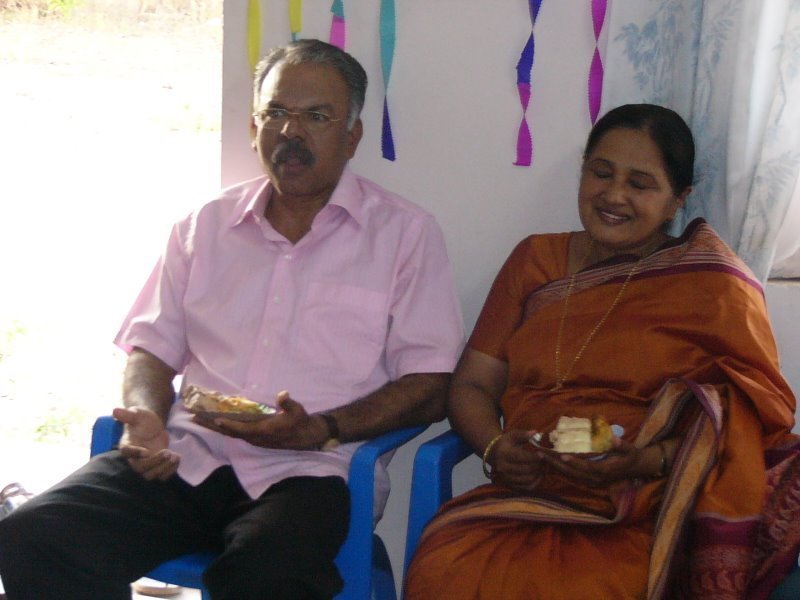
Mr George Joseph (Mr GJ – that is how everyone addressed him) taught us English in Grade 10 and 11 at Sainik School Amaravathinagar. He joined the school in the vacancy of Mr Seshadiri who left the school (with his daughter Sita from our class) in 1973. I started interacting with him at a personal level in Grade 11 when we went on a trek from Munnar to Idukki in Kerala in September 1977. That was the first time he opened up with me about his teaching experiences.

Mr GJ’s first class in our school was for the batch of David Davidar (three years senior to us), who authored The House of Blue Mangoes (2002), The Solitude of Emperors (2007) and Ithaca (2011). On the very first day, Mr KG Warrier (https://rejinces.net/2014/09/16/the-linguists/), head of the English department had forewarned him that the linguistic capability of the students was at a very high level and he had to be fully prepared to face them, let alone teach them. Mr GJ on many occasions claimed that he actually learnt English by teaching students at our school. During our school days, Mr GJ was a bachelor and hence had all the time in the world to himself. One could mostly see him spending his spare time at the library, reading up all the books which he could not during his university days.

Mr GJ was a good basketball player and coached the school basketball team. He was a good swimmer and hence joined Mr Krishnan Kutty (the crafts Master) (https://rejinces.net/2014/08/08/arts-and-crafts/) to form the nucleus of the canoeing club. He later took over the reins of the canoeing club, once he mastered the art of canoeing and could navigate through the Amaravathi Dam’s waters. He again claims that he perfected the art of canoeing by learning the same from the senior students.

During the boxing competitions at school, Mr GJ was a judge always. He once narrated that he had never seen a boxing bout in his life until he joined our school. One day when Mr CM Nair (Physical Training Instructor) (https://rejinces.net/2014/07/23/233/) while preparing the gymnasium for the boxing competition realised that he was short of a judge as Mr Venkateswaran, the biology teacher had left the school. Whether Mr CM Nair found some similarity between Mr GJ and Mr Venkateswaran in their physical appearance, or not, he summoned Mr GJ and requested him to be the boxing judge the following week. Obviously Mr GJ showed his reluctance having had no experience in the field, why even he had never witnessed a boxing bout and now he has been tasked to be a judge. Mr CM Nair conducted a detailed clinic for Mr GJ and handed him over the rule book of boxing. After the clinic, Mr GJ became very confident and every year till we left the school, he was always a boxing judge and never was his judgement ever questioned.

Once he threw the towel in to the ring to stop a bout, as he realised that the contest was really uneven and the loser of the bout might suffer an injury. This raised a few hackles then, but now looking back one realises how apt his decision was and also that his action befitted that of a seasoned boxing judge.

During our trek from Munnar to Idukki in 1977, the first day’s halt was at a village called Vellathooval. We started the trek early in the morning from Munnar and reached Vellathooval by late afternoon to be received by the Headmaster, staff and students of the Government High School there. The school organised a special assembly of the entire school to welcome us and Cadet Benoy Zachariah (now a cardiac surgeon at Boston, USA) was tasked by Mr GJ to deliver the English speech and I was tasked to deliver a speech in Malayalam, to motivate the students to join Sainik Schools and then the armed forces. That was the first motivational speech I delivered and as per Mr GJ we did a decent job of it. The preferential treatment we received at this school was because Mr GJ had arranged the same with our class mate George Paul’s father who was the Educational Officer, under whose jurisdiction this school came.

After three days of trekking we reached Idukki and then went around sightseeing for the next three days. One evening I was talking with Mr GJ and the subject was regarding the difficulties faced by the teachers while managing the students during various treks and hikes at the school. Mr GJ narrated his very first hiking experience at our school the year he had joined. Mr GJ was tasked to lead the hike to Yercaudu in Thamizh Nadu, a quiet little hill station on the Shevaroy hills of the Eastern Ghats. During the train trip to the base of Yercaudu, Cadet Appu fell off the train. Mr GJ got the entire entourage to disembark from the train at the next station and he walked about five kilometers along the track back and found Cadet Appu lying unconsciously near the rail track. Mr GJ administered first aid to Cadet Appu and carried him on his shoulders and walked back to the railway station where the rest of the entourage was waiting. They then boarded the next train and continued with the hike.

Like most classes at our school, Mr GJ’s English classes were mostly group discussions with the teacher in the lead and acting as a moderator. Among some of the memorable discussions we had, one was about opening Sainik Schools for girl cadets too. Mr GJ brought out that the boys would be better disciplined, better dressed, better behaved if girl cadets were studying along with us and the overall performance of the cadets would surely improve manifold. This discussion took place in the days when no one in India thought of opening military service for women.

Once Mr GJ opened up a discussion by his justifications for men resorting to domestic violence. As expected, all cadets in the class opposed it tooth and nail. At the end of the class Mr GJ concluded by saying that had he not put up a few arguments in support of the motion, no worthwhile discussion would have emanated. He brought home the point that to get noticed in the group discussion, at times one would have to support a cause which one is sure will have no takers. He always encouraged us to approach an issue differently; mainly to stand out and also to try out a different method or a path.

After we moved on from the school, Mr GJ moved out as the Principal of Navodaya Schools in Kerala and is now retired and has settled down at Palai, Kerala.  He can be contacted on Cell # 944 636 8276 and email gjay51045@gmail.com.

wren and martin GJ

After Action Report on Ottawa Terrorist Shooting

Parl canada

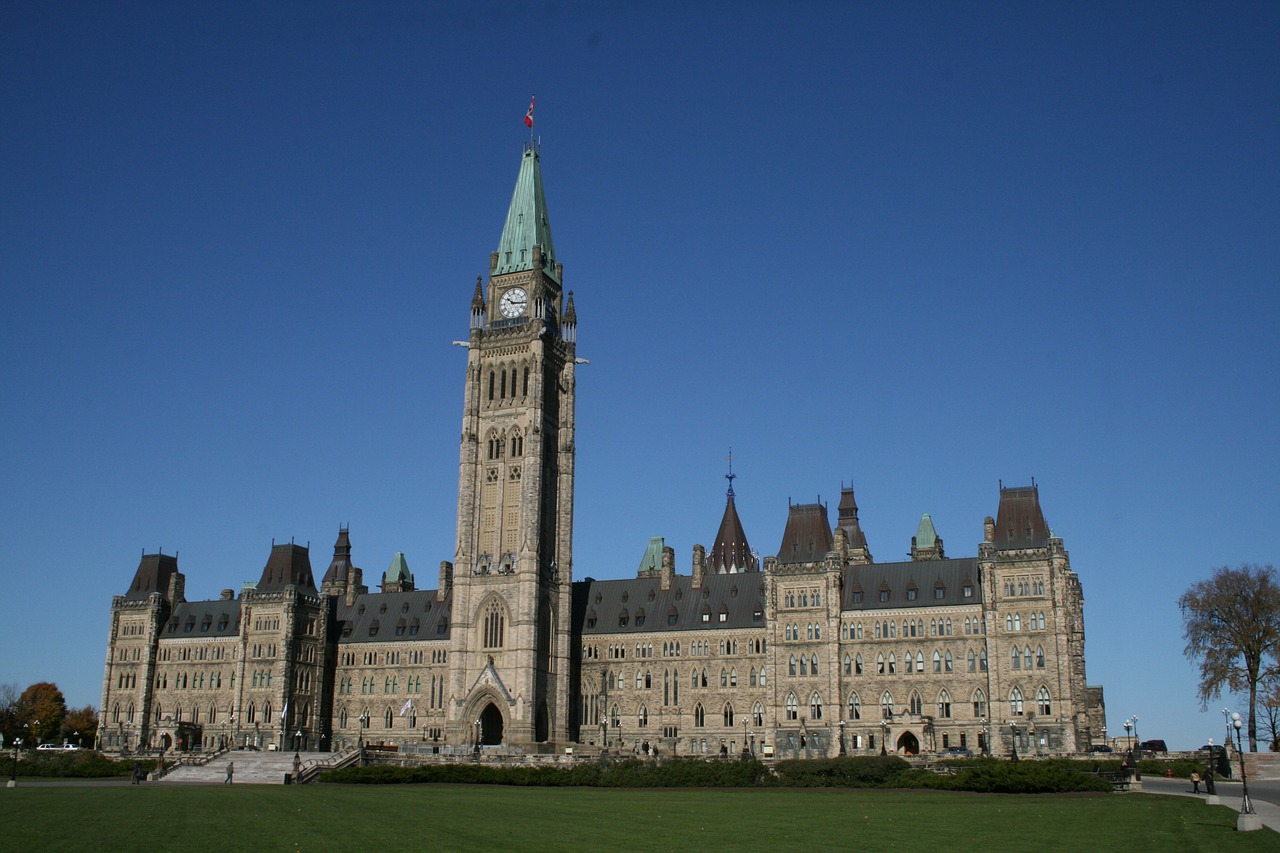
Corporal Nathan Frank Cirillo, a Canadian soldier, was shot and killed on 22 October 2014, as he stood guard at the National War Memorial. The shooter was later killed inside the Parliament buildings after firing at least 20 shots. The shooter, Michael Zehaf-Bibeau, a man in his early 30s who was known to Canadian authorities and he was refused travel documents to prevent him from travelling abroad. Zehaf-Bibeau has a record in Quebec in the early 2000s for petty crimes such as possession of drugs, credit-card forgery and robbery. He was also charged with robbery in 2011 in Vancouver. Please click here for a detailed report on the incident is on my blog https://rejinces.net/2014/10/27/o-canada-we-stand-on-guard-for-thee/

Handling of the media in such scenarios and what to cover live, rather most importantly, what not to cover live, needs to be worked out between the public relations officers of the security forces and the media crews. A total blackout of news will only lead to speculation and rumour mongering. Please refer my blog http:/rejinces.net/2015/03/24/terrorism-live/.

After Incident Report by the police authorities on the shooting has raised a few issues about handling such situations in the future. The report must be analysed by all the police forces across the globe, especially in view of the prevailing security environment. The points raised are of at most importance when deploying security personnel on counter-terrorism duties in populated areas. The need for the security forces, police, emergency services, fire force, media crew and bystanders to operate without causing hindrance to each other is of great importance.

Parl canada Police Action

Police Response

In response to the shooting, about 310 officers of the Ottawa police responded with many deploying themselves when they heard about the incident. The difficulty of controlling and commanding dozens of self-deploying officers contributed to confusion about how many suspects were involved. It was the largest reactive deployment of officers to an unplanned emergency in the Ottawa Police force’s history. The sheer unprecedented scale of the police response also contributed to the confusion.

The major challenge for the police commanders managing the force’s response was first to account for all the officers who deployed or self-deployed. It was also critical to ascertain as to where each and every officer was. The report has highlighted this challenge and the need for the police forces to device measures for ensuring better command and control of the entire force on the scene.

Police Wearing Balaclavas Caused Concern

Some of the police officers who responded to the shooting wore balaclavas to conceal their identities as they normally work in undercover units. Others were in various states of uniform and some in civilian clothes and this confused the public who, for most of the day, as they did not know how many active shooters or other suspects were involved. Many police officers not in uniform, made it difficult for the public to tell who was a police officer and who may have been an additional shooter. Police officers wearing a balaclava and with a weapon, may be perceived by the public as someone going to inflict harm, especially in a state of crisis. The report brings out the need for the officers who self-deploy to make sure they can be clearly identified as police by their dress.

Eight Hours to Confirm Only One Shooter is Involved

It took only an hour for police to determine that gunman Michael Zehaf-Bibeau was the man responsible for shooting and killing Corporal Cirillo and was killed inside Centre Block on Parliament Hill. Whereas it took Royal Canadian Mounted Police (RCMP) and Ottawa Police about eight hours to confirm that Zehaf-Bibeau was acting alone. The reason was the conflicting eyewitness reports of multiple shooters and suspects, all of which had to be checked out by investigators. Inputs from some witnesses about a second gunman who ran into bushes at the National War Memorial, caused further confusion. It was later confirmed to be the driver of a minister’s vehicle, who ran to hide after the armed Zehaf-Bibeau took command of the vehicle.

Some witnesses also reported seeing multiple people in Zehaf-Bibeau’s vehicle, and others reported seeing what they thought were two suspects with long guns running near the National War Memorial. The second person turned out to be the other sentry who was standing guard with Corporal Cirillo. There was also a 911 emergency call reporting a third shooting scene at a downtown mall, which police reported to the public and later retracted.

All of this contributed to confusion, and it takes a significant amount of time to eliminate that there are no more threats and to announce to the community that things have returned to a state of normalcy.

Communication Between Various Forces

There were communication problems between Ottawa police, RCMP and Parliament Hill security personnel at the scene as they were using different radio frequencies. The RCMP and Ottawa police tactical officers used hand signals to communicate while they were sweeping and clearing buildings on Parliament Hill.

This aspect of ‘communication gap’ between various armed forces, police forces and emergency services at such crisis situations is applicable world over and many countries are yet to device drills and procedures to close this gap.

To remedy the problem, Ottawa police have ordered new radios that will allow communication with other first responder radios during emergency operations. They have also ordered new night-vision goggles, after the force’s tactical officers found that the current goggles did not work well as they were clearing buildings on the Hill, and that there weren’t enough of them.

Parl IndiaAttk1

Terrorist Attack on Indian Parliament

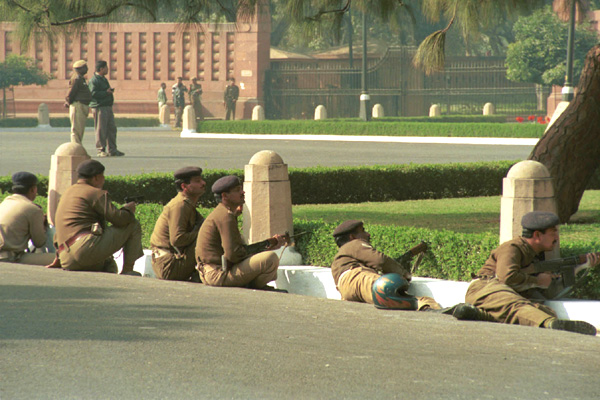
The Indian Parliament at New Delhi witnessed a similar terrorist attack on 13 December 2001. Five terrorists infiltrated the Parliament House in a car with Home Ministry and Parliament labels. The terrorists carried AK47 rifles, grenade launchers, pistols and grenades. The attack led to the deaths of five terrorists, six Delhi Police personnel, two Parliament Security Service personnel and a gardener, in total 14. Afzal Guru was convicted of conspiracy in the plot and sentenced to death by a special court in 2002 and was hanged in Feb 2013.

The events that unfolded in Ottawa in October 2014 was similar to the one that occurred in New Delhi in December 2001. The differences were the self-deploying police personnel and balaclava wearing undercover police officers. The ‘communication gap’ reported in Ottawa would have been faced by the Delhi Police, Parliament Security Service and the National Security Guard (NSG) commandos who ultimately sanitised the area. The information gap would have remained the same, especially regarding the number of terrorist involved and as to whether any terrorist is still holed up.

Despite the event being reported in the international media including live coverage of the operations, the police forces across the globe appear to have not taken any serious note of the event. Rather, they would have never expected it to happen in their own backyards.

Fools learn from their mistakes; wise ones from others’; idiots never.


Shipwrecks of Tobormory

The first long weekend after the onset of Spring is during the second weekend of May with the third Monday of May celebrated as Victoria Day. Queen Victoria was Canada’s sovereign at the time of Confederation in 1867. When Queen Victoria died in 1901, Parliament made her birthday an annual holiday to be celebrated on May 24. In 1952, the Parliament ruled that the Monday before May 24 be celebrated as Victoria Day. The weekend is known in Canada as the unofficial start of summer and is the oldest state holiday.

toborwreck3

Gardening enthusiasts like us make use of the long weekend to begin planting annual saplings in the gardens. It was a family affair as usual with Marina and children, all joining and helping to plan and layout a garden which would be treat to everyone’s eyes. We brought many plants from the local nursery, and some saplings we had grown indoors, to go with the new colour scheme we had decided. Two weeks prior we had visited the city’s recycling yard to collect compost to feed the garden as we have been practising organic farming.

We finished with planting our garden early by Saturday afternoon, and hence decided to drive to Tobermory, about 300 km North of Toronto to enjoy the rest of the long weekend.  Tobermory derives its name from Scottish dialect where in ‘Tobar Mhoire’ means the ‘well of Mary’. The name was given by Scottish fishermen after the port of Tobermory on the Island of Mull in Scotland. We reached Tobermory by 7 PM and checked into a motel there.

toborwreck311

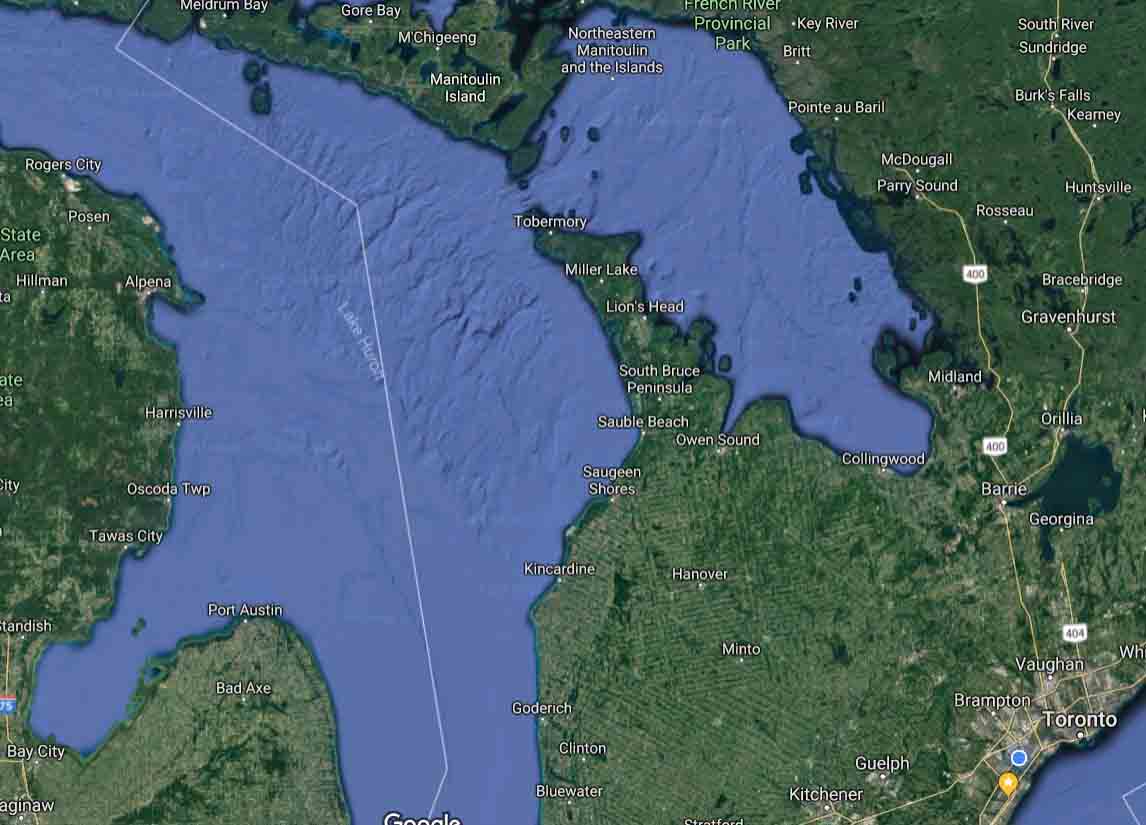
Tobermory is known as the Scuba Diving Capital of Canada and is located at the mouth of Big Tub Harbour on the Georgian Bay of Lake Huron. The area comes under Fathom Five Park, Canada’s first National Marine Park. The park is known for over 20 shipwrecks and 19 islands, notably Flowerpot Island, within its boundaries. Only two shipwrecks in the harbour are intact and visible from the water surface. The other wrecks are disintegrated and dispersed around on the lakebed in the Georgian Bay.   The deep clear water and the numerous shipwrecks attract over 8,000 divers from around the world each year. We booked for a boat cruise for Sunday morning to explore the Fathom Five Marine Park.

toborwreck1

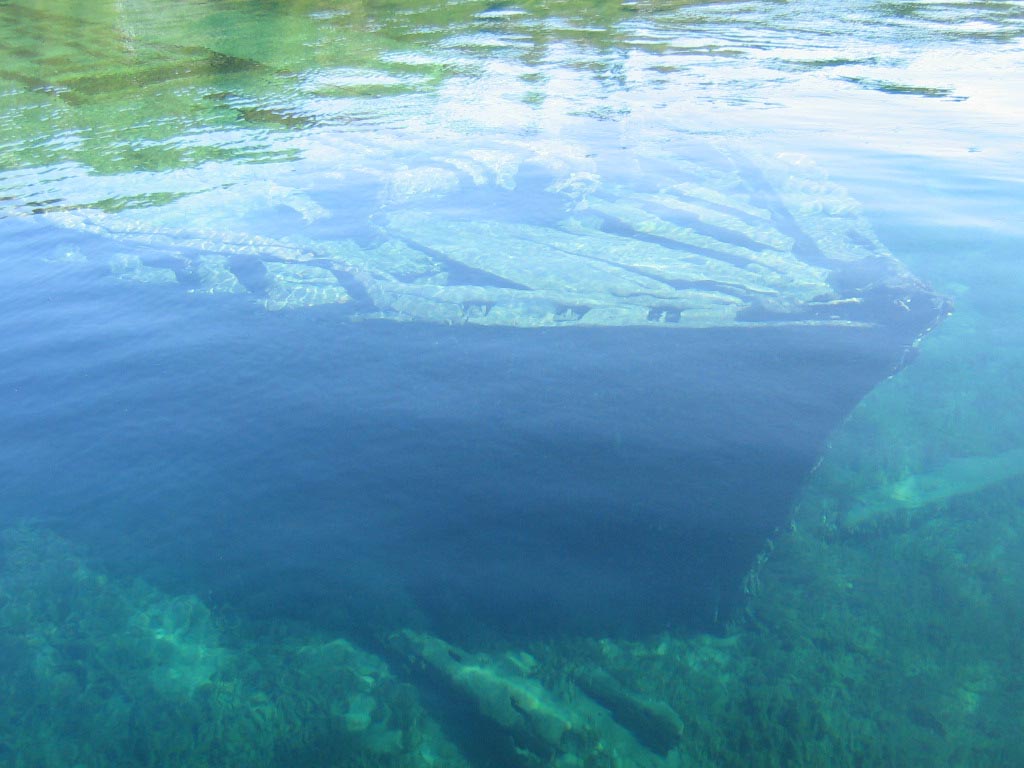
We set off on the boat with about 30 other tourists. The boat’s guide briefed everyone about the safety drills and then we took off to the Big Tub Harbour. The boat had a glass bottom, and we could see the lake’s bed clearly. The algae and lichens in the cold water and the lime stones in the lakebed ensures that the water remains crystal clear all through the year. Our first stop was atop the wreckage of The Sweepstakes, a Great Lakes Ship Built in 1867 in Burlington, Ontario. The wreckage is at a depth of about 20 feet. This double masted, 120 feet long ship was damaged while hauling coal late in the summer of 1885 and then towed to Big Tub Harbour to be repaired. In September of 1885 it was determined that the damage was too extensive to be repaired. She was stripped of anything of value before sinking where she lies today. Her hull is still intact and is considered one of the best-preserved nineteenth century great lakes ships to ever be discovered. In order to reinforce the hull and reduce further deterioration, metal bars throughout the inside of her hull have been installed by Parks Canada.

tobortwreck2

The next halt was 100 meters away at the wreckage site of a passenger ship – The City of Grand Rapids. She was an elegant a double-decked passenger steamer until it burned and sank in October 1907. Its charred remains now lie in shallow water about 15 ft deep. On the evening of October 29, 1907, fire broke out aboard the Grand Rapids while docked in the Little Tub Harbour. A tug towed the burning ship out of the harbour, and released it. The City of Grand Rapids then drifted into Big Tub Harbor. It continued to burn, and eventually came to rest at the head of the harbour, where it burned to the waterline, rolled to starboard and sank. Today, the iron-sheathed hull is intact and is filled with coal used for the boilers, as well as silt. The charred tips of the frames can be seen on both the starboard and port sides. Lying on the bottom and clearly visible mid-way along the starboard side is part of the smokestack and a metal frame from the piano that once entertained the guests on board.

toborlthouse

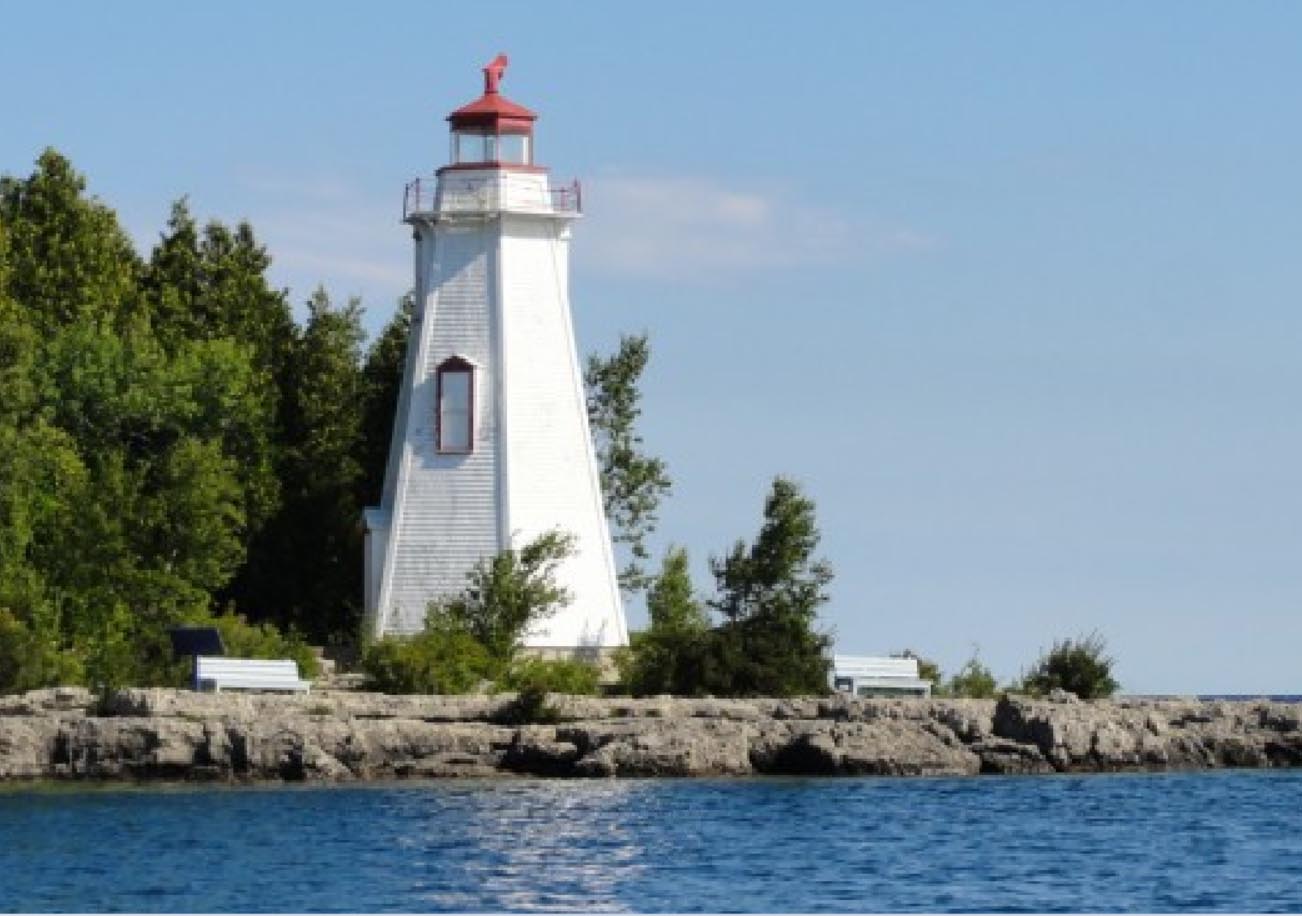
Our next stop was at the Big Tub Lighthouse. In 1871 Captain John Charles Earl settled at The Big Tub Harbour. In those days, vessels were extensively used to transport coal, lumber, fur, blubber etc as part of the trade through the Great Lakes. The perfect safety with which vessels could lie in the basin at Tobermory had made this harbour much frequented harbour of refuge. For the convenience of navigators, Captain Earl started hanging a lantern at the top of a high pole to ensure safe navigation for vessels entering the harbor from the treacherous waters of Lake Huron and Georgian Bay. The number of shipwrecks offshore testify to the dangerous waters of this area. He was remunerated for this service by various captains, they presenting him with useful house supplies, such as a bag of potatoes, flour, etc. In the course of a few years the Government acknowledged this service and paid him a salary of about $30 a year. The first lighthouse was constructed in 1885 for a cost of $675. The original structure was later replaced by the six-sided, 14-meter-high wooden lighthouse of today. The lighthouse, a fully automated one today, still guides boats through powerful currents, frequent fogs and numerous shoals to the safety of Big Tub Harbour.

From the lighthouse, the boat sped away, skimming the waters to reach the Flowerpot Island, one of Canada’s most fascinating natural attractions, about 6 km away. This is the only island in the park which has camping facilities, marked trails, caves and its namesake flowerpots.

The Flowerpots are a type of sea stack, formed over many years as wind, rain, waves and ice hammered away at the cliff that once stood alongside the water’s edge.  The softer rock eroded more quickly, leaving the harder rock remaining in the shape of Flowerpots. There are many flowerpots all along the waters on the Island.

toboflowrpot

This flowerpot’s top resembles the head of a native warrior carved in the stone, a reflection of unusual geology.

The caves on the island were formed after the ice age, approximately 12,000 years ago, when the glacial Lake Algonquin completely covered Flowerpot Island. As the lake levels fell in stages, the cliffs were exposed to the eroding effects of the lake for varying duration of time. This phenomenon caused numerous caves to form in the cliffs throughout the island.

After a well-deserved break, we returned home by evening on Sunday, to tend to the saplings we planted and for the summer months to arrive.

Tulip Festival

IMG_5786

April rains bring in May flowers’ is a common saying in Canada, especially as everyone awaits the April rains to help wash away the winter snow that had been shoveled to form little mounds around their homes. Whether the plants, especially the tulips and daffodils, whether it rained or not, by end of April they sprout out to mark the beginning of spring.

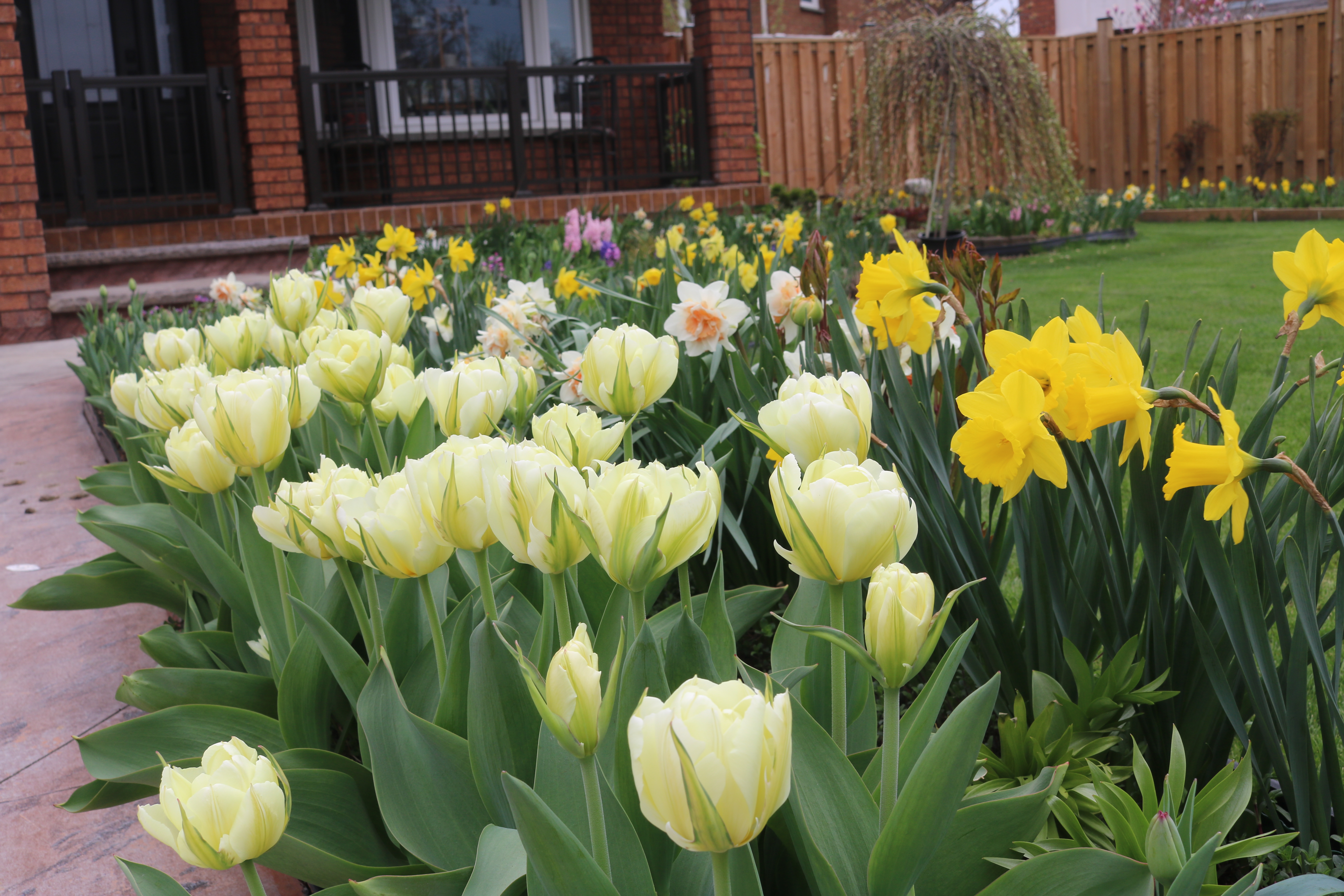
This year around we did not receive many showers in April and it did have a telling effect on the quality and size of tulip plants and flowers. In our garden too, this effect was visible (Please refer image). The tulips and daffodils did not perform too well.

Tulips Originated in Persia and Turkey and were brought to Europe in the 16th century. They got their common name from the Turkish word for gauze (with which turbans were wrapped) – reflecting the turban-like appearance of a tulip in full bloom. By the 17th century, the popularity of tulips, particularly in the Netherlands, became so great that the price of a single bulb soared to new heights, causing markets to crash and putting into motion ‘tulip-mania’. Many are even said to have sold their houses and fortresses during the ‘tulip-mania’.

Different tulip colors denotes different aspects – yellow tulips symbolizing cheerful thoughts, white conveying forgiveness and purple representing royalty. The Red Tulip became associated with love based on a Turkish legend that a prince named Farhad was love struck by a maiden named Shirin.  When Farhad learned that Shirin had been killed, he was so overcome with grief that he killed himself – riding his horse over the edge of a cliff. It is believed that a scarlet tulip sprang up from each droplet of his blood, giving the red tulip the meaning ‘perfect love’. The eleventh wedding anniversary flower is also tulip. It is said that the tulip’s velvety black center represents a lover’s heart, darkened by the heat of passion.

For all our neighbours, friends and family, our garden becomes a place of celebration and many call it ‘Tulip Festival’. Close by in Ottawa, the Capital City of Canada, the largest tulip festival in North America and is held every year in May. This festival is a celebration founded on international friendship with Netherlands, the home of tulips. It all begun in 1945 with the presentation of 100,000 tulip bulbs from Princess Juliana of the Netherlands to Ottawa, Canada’s capital, given in appreciation of the safe haven that members of Holland’s exiled royal family received during World War II in Ottawa and in recognition of the role which Canadian troops played in the liberation of the Netherlands. Since then, the tulip has become Ottawa’s official flower and, each spring, the National Capital Region blooms with magnificent tulip beds planted by the National Capital Commission, attracting hundreds of thousands of visitors. As a thank-you gift, the Netherlands sends more than a million tulips to Ottawa every year.

The Canadian Tulip Festival is also a celebration of the return of spring, with over a million tulips in 50 varieties blooming in public spaces across the National Capital Region. The highest concentration of tulips can be viewed in the flower beds of Commissioners Park, on the banks of Dow’s Lake, where 300,000 flowers bloom. During the Festival the international community adds to the pageantry and programming with cultural displays and performances reflecting the diversity of the National Capital community.

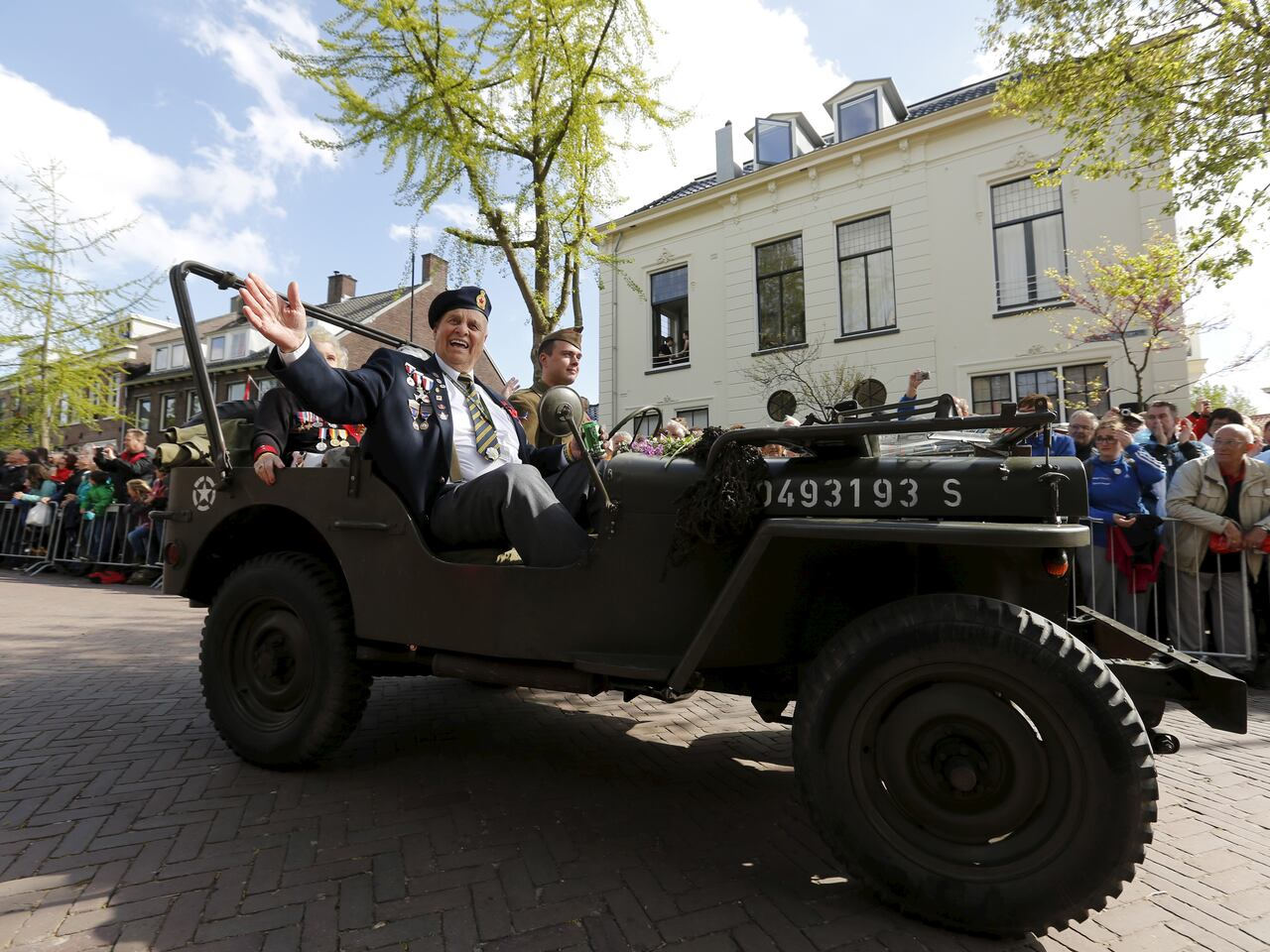
This year, during the Tulip Festival in Ottawa, an official Canadian delegation, lead by Prime Minister Stephen Harper, consisting mainly of veterans and their relatives, was in the Netherlands to attend a series of ceremonies and events honouring the sacrifices Canadian soldiers made when they liberated the Dutch from Nazi occupation 70 years ago. About a dozen veterans, 90s, and frail flew into Netherlands in a Canadian Armed Forces plane. The aircraft flew trans-Atlantic, unusually low, around 12,000 feet, to avoid a situation where a rapid cabin depressurization might irreparably harm an elderly passenger without the speed or strength to put on an oxygen mask.

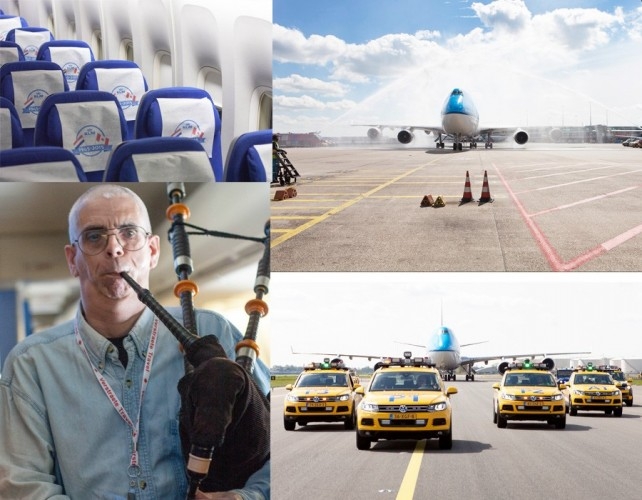
KLM Royal Dutch Airlines flew Canadian Second World War veterans and their families from the airline’s five Canadian gateways – Toronto, Montreal, Vancouver, Calgary and Edmonton – to Netherlands for the commemorative celebrations. The biggest delegation consisting of 300 participants, including some 40 veterans left from Toronto on May 1. The youngest veterans was 88 (who was 15 when he fought the war as he had forged his documents) and the oldest 97. They were greeted in the boarding area by the flight crew for a pre-departure ceremony. Inside the aircraft, the airline had personalized the seat headrests with Canadian and Dutch flags. The group was acknowledged on numerous occasions during the flight with special announcements, and the crew handed out keepsake souvenirs to the passengers.

Tulip Vet1

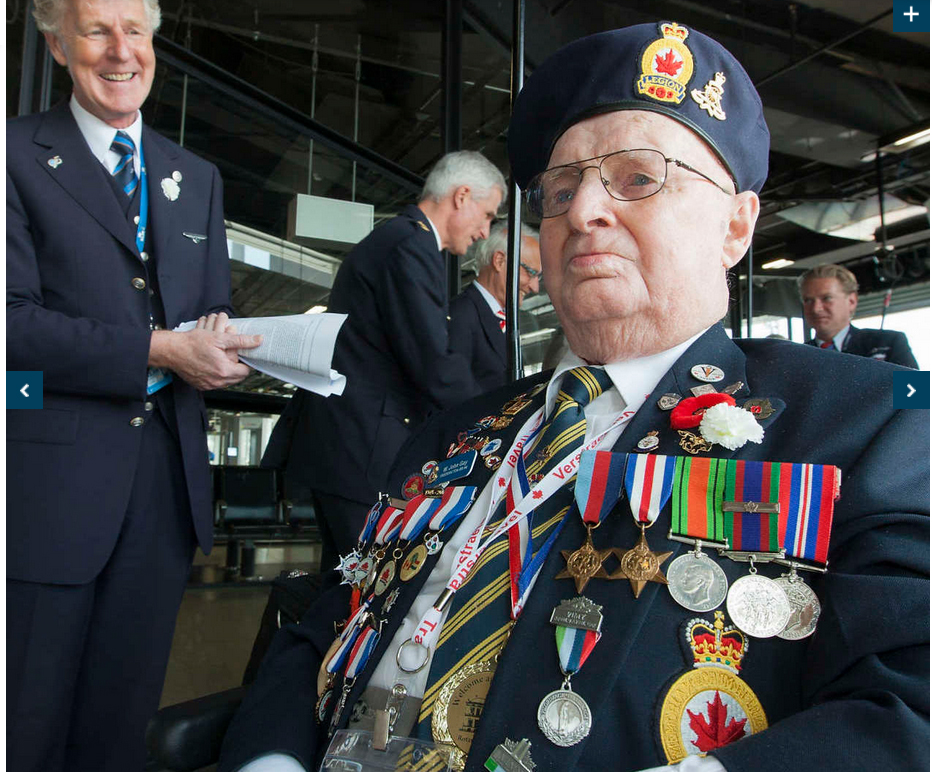
This is John Gay, ready to board the KLM flight, a cook during WWII and at 97 years old, one of the oldest veterans who participated. He was part of the artillery and helped free up the city of Caen and the Falaise Gap. He cooked for the soldiers in England and Normandy, which got harder and harder because of food supplies and he had to make do with dehydrated potatoes, dehydrated cabbage and meat called “Spam”. He could cook up 6 gallons of stew and would distribute this amongst the soldiers in cans. John is visiting the Netherlands for the 10th time this year, travelling with his son and other family members.

To make this flight extra special and show the veterans how much we appreciate and respect them, arrangements were made to honour them. There were special cakes decorated with the Dutch and Canadian flags. Flight attendants handed out and pinned on Carnation Flowers with gratitude and respect. Every veteran got a Delftsblauw salt and pepper shaker set, there were special headrest covers and when we landed at Schiphol airport, the plane was escorted to the gate and the fire brigade welcomed the veterans with a water canon salute, also known as the ‘Shower of Affection’. Just before landing, bagpipe music filled the airplane.

Tulip Vet2 copy

On Monday May 04, 2015, the delegation of veterans attended a ceremony at the Holten Canadian War Cemetery. The cemetery is the final resting place for 1,393 Commonwealth soldiers who died during the liberation campaign, many of whom were killed in the late stages of the war as the allies cleared the Netherlands and pushed into Germany. The village of Holten was liberated by Canadians on April 8, 1945 after fierce house to house fighting. Harper said that the bond was forged between Canada and the Netherlands in those dark days still endures. He recalled that each headstone on each cemetery was a stark reminder that doing the right thing often comes at a great cost — but a cost that must be paid.

Harper spoke of the great sacrifices made by the now-dwindling war-time generation, saying they understood that some things were worth fighting and dying for; a sentiment that remains today. he added that the heroes who liberated the Netherlands, like the men and women who serve our country today understood that when there arises a great evil, a threat to all the things that define our existence as a free and just people, such enemies must be confronted.

I would conclude by quoting from the speech delivered by Prime Minister Stephen Harper during the visit “When tyranny threatens the free, when cruelty torments the innocent, when desperation overwhelms the human spirit, we choose to respond, we choose the high road forward, not the easy way out. We choose risk not for reward, but for righteousness, we choose to fight for freedom, we choose to defend the innocent, we choose to bring hope to the world.

Canadians will never forget the welcome our troops received in this country as the war ended. Canadians will never cease to marvel at how this starving and scarred land so quickly became the prosperous, progressive and generous country we know today, a partner in so many things, including Iraq.”

Evolution of Sainik School Amaravathinagar Through the Biology Department

ssa

Sainik (Military) School Amaravathinagar in Thamizh Nadu state of India, where I did my schooling from grade 5 to grade 11, was established in 1962 as feeder institutes for the National Defence Academy(NDA).   There were about a dozen more such schools, one in each state, established at the same time. The aim was to attract youth from all the states of India and from all the classes of the society. The idea was mooted by Mr VK Krishna Menon, then Defence Minister of India. Sainik schools were meant to be the ordinary citizen’s public school where deserving students can get high quality education irrespective of their income or class background. These schools did achieve this aim – General Suhag, the present Army Chief is a Sainik School product.

Amaravathinagar was chosen as the site for our school as the area was on the foothills of the Western Ghats and adjacent to the Amaravathi Dam. The weather of area suited the school and the terrain provided ideal backdrop for various adventure activities. The dam ensured a constant supply of water and also a site for water sports like canoeing.

Another reason for choosing Amaravathinagar as the site was that there were many sheds, buildings, staff quarters left vacant on completion of the dam. One of the workshop buildings became the Cadet Mess, one a gymnasium. The administrative area of the dam construction became the administrative offices and the rest became class rooms. Some staff quarters, closer to the class rooms were turned into Cadets’ living and the rest became staff quarters.

Over the years, a new well equipped Cadet Mess, Academic Block, Cadet Dormitories, swimming pool and many other buildings were added. Today the schools stands out as one of best in India – both for quality of infrastructure and educational value.

When theses schools started in 1962, the teachers were paid a notch better than the UGC scale and over the years it hardly ever increased, making teaching in Sainik Schools less attractive. To compound the problem, all teachers join as teachers and retire as a teacher without any promotion in either status or appointment.

When we joined the school in 1971, the teachers were all-rounders; good at academics, sports and organising hobbies and clubs, extracurricular activities and adventure activities. We were taught sciences by Mr Venkiteswaran (Venky) in Grade 5 and Mr Raghavan in Grade 6. Mr Raghavan was better known as Mr Jiggs for his style and actions. Mr Venky taught zoology and Mr Jiggs botany and both were excellent teachers and also were very good at cricket and tennis. Mr Venky played in all sports teams of the school and was an excellent mentor cum coach for students. His afternoons began with playing French-Cricket with grade 5 students and later played football, basketball and hockey with senior students. His day ended with a round of tennis at the tennis court, mostly playing with Colonel Thamburaj, our Principal and Mr Raghavan.

As the remuneration of the teachers did not keep pace with the inflation, by 1973 many teachers of very high caliber left our school for greener pastures at various Public schools in Ooty and Kodaikanal as they offered better remuneration. That was when we bid goodbye to Mr Venky and Mr Raghavan. The only girl in our class was Sita, daughter of Mr Seshadiri, the English teacher. As Mr Seshadiri too left for similar reasons, our batch became all male.

Mr Paul Sathya Kumar and Mr AD George replaced Mr Venky and Mr Raghavan. They too had similar traits as they were not only outstanding teachers, but also great sportsmen. Mr Paul coached the school cricket team and Mr George the football team. Mr Paul was also an excellent musician who could play most instruments. He accompanted the school choir on his organ during the morning assembly and was an integral part of all plays and cultural activities the students staged.

Similarly, the exodus of teachers of 1973 affected most departments and there were many new teachers, majority of them as good or even a notch better than whom they replaced. The noteworthy exceptions were Mrs & Mr Cherian and Mr KG Warrier, for whom the call of the money would not have been all that important for obvious reasons.

The next exodus of teachers took place in 1985 after we left school. The Navodaya Schools were established in 1985 in every district of India to provide residential school level education for the common man. Most of the teachers, Mr Paul and Mr George included, moved out as principals to these schools – obviously for better pay and status. Further, the scheme being funded entirely by the centre (and states as in case of Sainik schools), most of these Navodaya schools got established with better infrastructure. Another advantage was that the children studying in their own district in most cases and the girls also get equal opportunity unlike the Sainik Schools.

Has the Sainik Schools achieved their goals? An often asked question. These schools are now deteriorating for sure, mainly because of lack of funds. The way out is for the Defence Ministry at the centre to take over these schools in entirety from selection of staff and students to providing scholarships as being done in case of the Navodaya Schools.

Another important issue that need to be addressed is of the Defence Officers posted to these schools as Principals, Headmasters and Registrars. The Army Education Corps (Navy and Air Force too) officers are normally posted and most are incapable of motivating the cadets – in any way – forget about joining the Army. Any of our batch mates from Sainik Schools will vouch for it. Today most regular officers are better qualified academically than these (un) Educated Officers and would any day be better academicians, organisers, leaders and motivators.

In case the army wishes to resuscitate these Sainik Schools, the way out is for the center government to finance the scholarships as in Navodaya Vidyalaya and also remove the Education Corps officers from the system.

Kasava/ Tapioca/ Kappa (കപ്പ)

Kappa1

Walking down the isle of a Chinese vegetable store in Mississauga, Canada, after  immigration in 2004, I was surprisingly greeted by the Kasava/ Tapioca/ Kappa (കപ്പ) placed on a rack. On Closer examination, the tag read ‘Kasava – Product of Guatemala’. Any Malayalee (Mallu) will always and forever relish Tapioca cooked with spices and grated coconut and fish curry marinated with special tamarind (Kudam Puli (കുടംപുളി) scientifically known as Garcinia Cambogia). The concoction served in Toddy (alcoholic extract from coconut trees) shops all over Kerala (Indian Province where Malayalam is the native language and the residents are called Malayalees – now Mallus), is something one can never get in any homes.

Tapioca is not a native of Kerala. Then how come it reached the shores of Kerala?.

Tapioca is said to have originated in Brazil. Portuguese distributed the crop from Brazil to countries like Indonesia, Singapore, Malaysia and Kerala in India in the 17th Century. Some believe that Vysakham Thirunal, the Travancore King (1880-1885 AD), who was also a botanist, introduced this laborer’s food in Travancore (South Kerala). By beginning of 19th Century, people from central Travancore migrated to the Malabar region (North Kerala) and they introduced tapioca to the locals.

Tapioca was promoted extensively during World War II in Kerala by Chithira Thirunal, Maharaja of Travancore and his Governor Sir CP Ramaswamy Iyer. Then rice was the staple food of the people of Kerala and was being imported from Burma and Indonesia. With Japanese Navy enforcing a blockade in the Malaccan Strait, the ships carrying rice to India were either destroyed or captured. This caused an acute shortage of rice.

A large number of people, especially the labour class, accepted the starch-rich Tapioca as a substitute to costly rice. Thus Tapioca came to be known as ‘staple food of the poor.’ Hotels refused to include Tapioca in their menu due to its working class image.

The only place that served Tapioca were the toddy shops, where the labourers turned up for relaxation after a day’s hard work. Today tapioca is a rarity in Kerala and so is a delicacy and hence all hotels including the five-star ones have tapioca with fish curry in all their menus.

During my childhood, we used to cultivate Tapioca on our land. Tapioca is a tropical crop, tolerant to drought, but cannot withstand frost. It is best grown in lower altitudes with warm humid climate with well distributed rainfall. Our land is terraced on the hill slope into 20 x 20 feet sections. Each section is held together with stone masonry retaining wall to avoid soil erosion. On top of these walls pineapple was grown to give additional strength to the retaining wall. On some of these walls a fast growing grass was planted as fodder for cows.

In the month of August, the labourers till the land and make mounds of about a foot after spreading a compost mixture of cow-dung and ash. These mounds are made about three feet apart. Tapioca is planted in June with the onset of the South-West monsoon. Stakes taken from plants of the previous year is now cut into pieces of about a foot and is planted on these mounds. After a month, all the unhealthy or weak sprouts are pinched off leaving only two sprouts to grow into stakes.

As the plants mature, underground stems called tubers enlarge with starch. This is the time when the plant is most susceptible to rodent attacks, mainly from rats. As the tubers matured, a plant was uprooted almost every evening and tubers either were boiled and eaten with chutney or cooked with grated coconut and spices and eaten with fish curry. During weekends our mother had off being a school teacher and she made thin slices of fresh tapioca tubers and fried them in coconut oil.

After about ten months, in April, tapioca is harvested. Firstly the stakes are cut off and the healthy ones are stored for cutting for next planting. Underground tubers are now pulled out manually, pulling at the base of the stakes. The tubers are cut off from their bases and carried to the peeling site.

At the peeling site, the women folk of the village sit on mats and peel the outer skin of the tubers and slice the white starch part into thin slices. The women folk were generally paid in kind at the scale of one for every ten basket of tubers sliced by them. The sliced tubers are now collected in baskets and carried by the men folk to the boiling site. Here the slices are boiled in water until semi-cooked. The slices are now drained and put on the ground to dry under the sun. Once dried, these are collected in gunny bags. Some of the dried tapioca was retained for our consumption and the remainder were sold off to Kunjappan Chettan, the trader who lived across our home. Please refer to my blog https://rejinces.net/2014/07/15/kunjappan-chettan-the-trader/

In the 1980s, labour in Kerala became very expensive and  rodent attacks on tapioca crops became severe. Most tapioca plants were infected with Gemini virus causing ‘Mosaic’ disease curling the leaves and thus reduced yield.  In this period, the price of natural rubber skyrocketed. This turned tapioca farmers to rubber cultivation. With the incoming of rubber, out went the cows first as there was not enough grass to feed them. Further, the skins of the tapioca tubers and leaves from the uprooted stakes, which were the staple diet of the cows for four months, were now unavailable.

Mr AD George, our botany teacher at school had mentioned that the Gemini virus intruded into Kerala through a sample brought in by a professor, who while on a visit to a foreign country where tapioca was cultivated, saw a plant infected by the virus. He collected a leaf to show it to his students and brought it home to Kerala. After demonstrating the specimen to his students, the professor discarded the specimen. This virus then is believed to have spread across Kerala.

The land lost all its herbal healing powers with the advent of rubber cultivation. Herbal plants like Kurumtotti (Sida Rhombifolia), Kizhukanelli (Phyllanthus Amarus), Paanal (Glycosmis Arboraea), etc, all very abundant until we cultivated tapioca, became nearly extinct. The undergrowth shown in the image above is mostly of these herbal plants. Further, the present generation is totally unaware of the existence of these herbs in our own land and uses of these herbs. The cows used to eat these herbs along with the grass they chewed off the land and hence their milk also should have had some herbal effect.

In 2002 I visited Colonel TM Natarajan, my class mate from Sainik School and he spoke about the Sago (Sabudhana[साबूदाना ] or Chavvari [ചവ്വരി/ சவ்வரிசி]) factory his family had. That was when I realised that Sago was not a seed and it was factory manufactured and tapioca is the main ingredient. As Thamizh Nadu had many Sago factories and in order to feed them with tapioca, tapioca cultivation now moved from Kerala to Thamizh Nadu. The only hitch is that it needs extensive irrigation to grow as Thamizh Nadu does not enjoy as much rainfall as Kerala is blessed with.

Why Do Soldiers Break Step On A Suspension Bridge?

SuspBridge

Our son Nikhil and I had a discussion about the phenomenon of resonance about which he had a class that day. My mind wandered back to Mr PT Cherian’s high school physics classes. Mr Cherian had a knack of explaining basic principles of physics by citing real life examples which were simple and easy to assimilate. For more about Mr Cherian, please refer my blog https://rejinces.net/2014/07/15/guru-dakshina/.

Mr Cherian explained resonance by using a simple experiment.

He had three pendulums of different lengths and two of the same length (B & D) tied to a rubber hose. He swung one of the two pendulums of equal lengths and after a few minutes, all the other pendulums begun to swing with the other pendulum of equal length swinging as much as the other. This he explained was as a result of resonance and the frequency of the two pendulums with equal lengths were same and hence they resonated.

Bridges and buildings have a natural frequency of vibration within them. A force applied to an object at the same frequency as the object’s natural frequency will amplify the vibration of the object due to mechanical resonance. Mr Cherian explained that while on a swing, one can go higher with a jerk of a bend knee or a swing of the legs and a car wobbles at a particular speed; are all examples mechanical resonance. The shattering of glass by singers with their voice is also by the same principle.

Mr Cherian then narrated an incidence which took place in 1831 when a brigade of soldiers marched in step across England’s Broughton Suspension Bridge. The marching steps of the soldiers happened to resonate with the natural frequency and the bridge broke apart, throwing dozens of men into the water. After this, the British Army issued orders that soldiers while crossing a suspension bridge must ‘break step‘ and not march in unison.

If soldiers march in unison across a,suspension bridge, they apply a force at the frequency of their step. If their frequency is closely matched to the bridge’s frequency, soldiers’ rhythmic marching will amplify the natural frequency of the bridge. If the mechanical resonance is strong enough, the bridge can vibrate until it collapses due to the movement.

A similar tragedy was averted in June 2000 when a large crowd assembled at the opening of London’s Millennium Bridge. As crowds packed the bridge, their footfalls made the bridge vibrate slightly. Many in the crowd fell spontaneously into step with the bridge’s vibrations, inadvertently amplifying them. The police swung into action to clear the crowd off the bridge. Though engineers insist the Millennium Bridge was never in danger of collapse, the bridge was closed for about a year while construction crews installed energy-dissipating dampers to minimise the vibration caused by pedestrians.

Another example of mechanical resonance was the destruction of Tacoma Narrows Bridge in Washington in 1940. Even though the bridge was designed to withstand winds of up to 200 kmph, on that fateful day the wind speed recorded was mere 60 kmph. A mechanical resonance resulted due to the wind at that particular speed hitting the bridge perpendicularly.   Continued winds increased the vibrations until the waves grew so large and violent that they broke the bridge apart.

In May 1999, two girls were drowned and 15 others injured when a suspension bridge across a river collapsed in Panathur, Kasargod in Kerala State of India. The incident occurred when a group of people taking part in a funeral procession entered the suspension bridge  The bridge tilted and collapsed, again due to mechanical resonance.

In a similar incident in February 2014, eight people died and more than 30 injured when a suspension bridge collapsed over a dry stream in the North-Western province of Lai Chau in Vietnam. The accident happened as a group of local residents walked across the bridge to bring the coffin of a local official to a graveyard. The group had walked 15 meters on the bridge when it suddenly collapsed.

What could have triggered off the mechanical resonance in the above two cases? The villagers participating in the two funerals were surely never drilled down by any Sergeant Majors.

It is felt that anyone while on a funeral procession walks slowly and is often accompanied by the drums or hymns being sung at a melancholic pace. The funeral participants tend to bunch together, mainly due to their sadness. These factors could have forced the funeral participants to march in step, without their knowledge. Another reason of marching in step could be that one does not want to step on another’s foot and the best way to avoid is to walk in step with the person in the front. In both the cases, the coffin was carried by the coffin bearers with their hands. This needed the coffin bearers to walk in unison.

In all probability, the frequency of walking of the mourners in the funeral procession could have resonated with the natural frequency of the bridge, causing the bridge to swing violently. The pandemonium that could have set out must have caused panic, resulting in the mourners rushing to get off the bridge causing a stampede.

Hence in future the rule must be that not only the soldiers need to break steps on a suspension bridge, but also a funeral procession.

Super Brats : Girls in the Forefront

Superbrats2

Sulagna Panigrahi, daughter of our coursemate Colonel Panigrahi, debuted in the leading role in the Hindi movie ‘Ek Adbhut Dakshina’. Colonel Ajay Sharma, another of our coursemates and my next room friend at the India Military Academy, his wife Ashima and their daughter Anushka Sharma (now a leading actress and celebrity) were present to encourage the young girl during a special screening of the movie.  It appears that acting, talent and confidence runs through the veins of the children of our coursemates and also all the defence personnel.

It is much more heart warming to see girls out performing the boys.  Navneet Kaur Dhillon was crowned Miss India 2013, comes from an Indian Army background and Sobhita Dhulipala adjudged the first runner-up, comes from an Indian Navy background. The list of women from defence background winning such pageants gets longer – from Sushmita Sen – (Air Force) in 1994 onwards to include Gul Panag – (Army), Priyanka Chopra – (Army), Lara Dutta – (Air Force), Celina Jaitly- (Army), Neha Dhupia – (Navy), the list goes on. These pageants are not only for the girls who are beautiful, but they also need to be intelligent, confident, well mannered and well groomed.

What gives them the edge over others? What really makes these defence children such inborn winners? These children, raised in military cantonments around the country, display a lot of grace, wit, confidence and poise – all at the same time.

The parents of these children- mostly the father (now-days both father and mother) – are serving defence officers. The selection process for these officers – with a written examination, a five-day interview which scientifically analyses each candidate’s potential, personality and intelligence tests, and a stringent medical examination has no comparison in the country, which tests one in all aspects of human development and behaviour. The selected candidates undergo a tough training where they are polished into better humans and leaders. When they select their spouses, its no surprise that they select the best to suit them – (if the spouse is a serving officer, the job has already been done by the defence). The children born to these parents have to be as good or even better than their parents. They are born in the military hospitals which provide the best of medical care and excellent hygiene conditions.   They are well natured into this world and the military society nurtures them really well to be better human beings and responsible citizens.

A typical army kid will claim to be natured in Srinagar, and nurtured in Siliguri, Coimbatore, Ferozpur, Allahabad, Bhatinda, Manipur, Imphal and Patiala. These children have grown up in small towns as well as big cities, they are used to the cold mountains of Kashmir to the hot deserts of Rajasthan, they amalgamate with Malayalee culture to Mizo culture, they learn Thamizh to Assamese during their school days.   In short they are adaptive, open-minded, a survivor and thus a winner.

The life in a typical military home for these kids is well organised and is set to the rules and standards dictated by the parents. They have to rise early, attend school and then participate in sports and cultural activities after school. In the evenings they have to attend social functions – both formal and informal. They need to welcome guests who come calling-on or to attend parties and keep everyone in good humour. Its a tough job for these kids as they must study well and obtain good grades at school and pass all entrance examinations. Hence, it is no wonder that these children develop great conversational skills and carry themselves with lot of confidence. They interact with a lot of people who belong to different age groups and cultures. They never hesitate to speak to a stranger or a new person. Ultimately, these communication skills help them to be winners.

Most of the military parents are avid readers, a habit developed mostly due to their intellect and also the loneliness of being posted in remote areas with no access to television. The mothers pickup this habit while living separately from their husbands while he is posted in remote areas or during the endless train travels – while on posting or while proceeding on vacations. The parents are also good with all aspects of communication and are capable of discussing all aspects of life – from spirituality to sports to movies. The children listen to these conversations and are active participants in many such discussions – mostly ending with the father shooing them off to bed when he has nearly lost his point of argument. Thus these children ought to have stronger personalities, and are also very disciplined and punctual. They are trained and groomed well as to — how to walk, how to sit, how to talk etc. They are taught grace and poise from an early age. It comes naturally to them

Along with every new posting of their parent – an event these children undergo once the least in three years- puts a lot of pressure on the children too. They got to adapt to a new place, a new culture, often a new language and above all to a new school. Making new friends, going to new schools make them ooze confidence. Most of these children  have seen at least half a dozen schools by the time they complete their higher secondary education.

When our son Nikhil landed in Canada in grade 1, his teacher said to him, “You may find it difficult to adapt to the Canadian culture as you are new to it.” Nikhil replied, “Until now to my grade 1, I studied in four states of India with diverse cultures, speaking three different languages.  I will quickly adapt to the Canadian culture.”

Children from the defence background are tougher, calmer, and in control of their emotions. When their parent is posted in remote areas of India, they naturally get trained to be tough survivors, adapt to new situations and people. Many children learn to be independent at a young age as their parent is posted in far-flung and inaccessible operational areas and the family has to look after themselves, with the children shouldering a lot of responsibilities.

These kids are excellent in stress management – a phenomenon unknown to the present day kids as they undergo a lot of stress in everyday life and a few succumb to these stresses and pressures. Most defence kids have seen off their parent on posting to hazardous areas and also to fight militancy – and many a times not knowing whether they will ever meet again. Every day passes with fear and uncertainties of their parent’s return and the role the mothers play to keep the household going and in bringing up the children needs to be commended.

The grooming and etiquette also come naturally to these kids, as they watch their mothers wear their clothes with grace, fathers adopt immaculate manners, the effort that goes into organising and conducting parties and get-togethers at home, etc. These kids are taught table manners and good etiquette from an early age at home.

The army cantonments provide a lot of sporting facilities like swimming, squash, tennis, golf, horse-riding etc. The children, without any sexual bias, are encouraged to participate in these activities. During these sports activities, people mingle with one another. The military stations organise summer adventure camps for the kids – from trekking to hang-gliding. These go a long way in developing physical fitness and also a sense of adventure- daily military life is by itself full of adventures for these kids.

A defence hub has a particular social culture, which becomes an integral part of the child’s personality. They pick up good etiquette and manners. They know how to talk and more importantly what to talk about. They know exactly how to avoid or get out of tricky situations. These are qualities imbibed by the children with defence upbringing of over 20 years and can never be learned over a month-long crash course. These assets help the children to stand out and win in every field of life.

Most military stations – even in the remotest places- have musical and dance schools – mostly run by the defence officers’ wives. They go a long way in nurturing the cultural aspects of these children. These children get many an opportunity to showcase their talents – both at home and also at military functions, clubs and messes. These make them very confident and they develop and master the art of presentation.

Contrary to popular belief, defence personnel are very religious and also spiritual. They celebrate all festivals and observe all religious occasions. They celebrate Holi, Onam, Pongal, Baisakhi and also Christmas, Dushera, Durga-Pooja, Eid and Guru-Purab. The kids attend all the religious functions in the station along with their parents and visit all religious places of worship – they are familiar with the rituals followed in the Mandir, Masjid, Gurudwara and the Church. It would be very common to see a Christian child singing the Arati or Slokas as fluent as they say the Lord’s prayer. They learn to respect all religions and accept everyone irrespective of their caste, creed, colour or religious beliefs. This facilitate the children to develop a multidimensional personality and hence adapt to various cultures and people with ease.

One reason attributed to the women-power in the military circles is due to the fact that the only society in the country where women are treated equally with men is the military. Many a times men complain that the women are often treated more equally than men. The General or a senior officer will always rise from their seats to receive a lady walking in though the lady may be a Lieutenant’s wife. The only place in India where the ladies are served first – whether at formal or informal or at-home functions – is in the armed forces. Even in the military’s religious places of worship, women are offered ‘prasad’ first. The officer on duty or the Captain of the Indian Navy ships will salute all ladies entering or leaving the ship irrespective of their social or military hierarchy. The ladies are always respected at home and outside by the defence service personal and the sexual discrimination is minimal in this society. That may be reason why we have defence service officers’ daughters performing extremely well in the society and winning many crowns and laurels.

The facilities like swimming, tennis, golf, libraries etc are available in all the cities of Canada at a real subsidised price or at times even free of cost. The government provides tax benefits for these activities. The need of the hour is to take time out of your schedules and take the children for these activities. The environment at home need to be upgraded to facilitate children’s development and the children must be trained to actively part-take in all the activities and chores at home. This will ensure that our next generation will turn out to be better citizens and human beings.

Pink Day

Pink Bully

Pink, as a word to identify a colour was coined in the 17th century from the flower of the same name. In North America, pink is associated with love, beauty, charm, politeness, sensitivity, tenderness, sweetness, childhood, femininity, romance, etc. By the turn of the 20th century, pink got associated with anything feminine. It was in fact the clothing manufacturers in the 1940s, who decided on pink for girls and blue for boys. Their intention being that parents would have to buy a whole new wardrobe and set of baby accessories in pink if they had a girl and blue if it was a boy, rather than reusing the one set for both as before.

The pink ribbon was first associated with breast cancer awareness in 1991. The pink ribbon represents fear of breast cancer, hope for the future, and the charitable goodness of people who support the breast cancer movement. It is also intended to evoke solidarity with women who currently have breast cancer.

On Wednesday, 08 April 2015, on seeing our son Nikhil wearing a pink shirt to go to school, I enquired the reason behind in this sudden change in his colour scheme. Nikhil said that on the second Wednesday of April is observed as Anti-Bullying Day and all the students are to wear Pink. On returning home after dropping Nikhil off at the school, I decided to research into the new piece of knowledge I gained from our son.

It all started on the first day of the new school year in September 2007 at Central Kings Rural High School, Cambridge in the Province of Nova Scotia of Canada. On this day, a Grade 9 boy wore a pink polo shirt to the school and the bullies harassed the boy, called him a homosexual for wearing pink and threatened to beat him up.

In response to Angus Reid Institute survey on bullying in school, three in four Canadian adults said they were bullied while in school. Nearly half of the parents polled said their children have been bullied at some point. Among the 24 per cent who said bullying occurred regularly, often or continuously, 37 per cent said they still think about it and 19 per cent said the events had a serious and lasting impact.

On hearing about the cowardice actions of the bullies, David Shepherd and Travis Price, two Grade 12 students decided to react against this act. They went on line, used emails, social media, and through word of mouth, conveyed their disgust and the need for the student community to raise against the menace of bullying. The two went to a nearby discount store and bought 50 pink shirts, including tank tops, to wear to school the next day.

The next day, Davis and Travis were surprised to find that they ran out of pink shirts in minutes. They had to procure another 100 immediately and some students ran home to change into pink – head to toe. Within minutes, almost the entire school was in pink, a visible statement to the bullies that they were in the minority.

The simple act helped change the dynamic at the school, which saw an end to bullying. Based on the reports of the event, The United Nations declared the official UN Anti-Bullying Day to be May 4 in 2012. The second Wednesday in April is designated the International Day of Pink and is observed in most schools in Canada.

A study by University of Guelph, Canada, on bullying found that 50 percent school children report being bullied, and 45 per cent of surveyed children feeling unsafe when they go to school in Canada. Boys typically engage in more physical forms of bullying; girls tend to do in indirect ways, such as gossiping , excluding and by using passive aggressive behaviour. Some researchers say that every seven minutes someone is bullied in Canada. Another recent survey found that cyberbullying surpassed drugs and alcohol as the top concern among Canadian parents.

Remember that all these media attention and wearing of pink by all the students all over the world, were all started by two teenagers in a remote rural school in Canada. Rather than just giving up by the usual teenage rant that why should one bother about such flimsy matters or the feeling that even if one does something, it will ever have any effect, and so on, the teenagers need to act and demonstrate. One need to make a statement that enough is enough and such acts cannot go on. If the teenagers of the world take up such issues, I am sure that the parents will take not and the world will become a better place for the new generation to live.

All the teenagers must take a leaf out of the actions of Malala Yousafzai for her single handed struggle against the suppression of children and young people and for the right of all children to education. Today she epitomises the struggle for right to education for girls in the under-developed nations and has been recognised by the world by awarding her the Nobel Peace Prize for 2014.

You Can, You Must all act to Bring in the Change.


Terrorism Live : The French Connection

terrorism

Every terrorist attack anywhere on the globe attracts media attention. Every media is vying with each other to prove that they broke the news first and had the most daring and extensive coverage of the incidence. The terrorists on the other hand are very pleased about the coverage they get and the platform from where they can further spread terror in the name of their cause. The Television at your home or workplace has in effect become another gun in the terrorists’ hands to terrorise you out of your minds. The media reporters and anchors become the magazines and their utterances in the grab of informing the people become bullets. These invisible bullets actually pierces through your mind and terrorises.

To further complicate the definitions of a terrorist, the governments across the globe and the media confuses the people with the definitions of a ‘Freedom-Fighter’ and a ‘Terrorist’. Some of the media (with the tacit support of their governments) have been spreading the idea that one person’s ‘terrorist’ is another’s ‘freedom fighter’. This idea should never be accepted by the modern world. The recent bloodbath of innocent Kenyan college students on 02 April 2015, the uprising in Yemen, inhuman actions of IS; all must be classified as acts of terrorism and in no way ever graded as a freedom struggle.

Freedom fighters never segregate people based on their religion and slaughter them like animals; they never attack the school and college students and kill them so as to ensure that the future generations are uneducated and the terrorists can easily plant seeds of terrorism ideology in young minds; they do not take innocent hostages of children and women to terrorise the population, They do all these to ensure that the people under them remain slaves to them and will never question them. This slavery ensures that there is no freedom of thought or action and the best method most of these terrorist groups have adopted is to (mis)interpret the religious beliefs to justify their violent actions. It would be incorrect to blame it on any particular religion as most religions have gone through such upheavals in the past.

During the 09 January 2015 attack on Hyper Cacher, a Paris supermarket, two days after terrorists opened fire on the offices of satirical newspaper Charlie Hebdo, an employee of the supermarket hid six people, including a three-year-old child and a one-month-old baby, in the cold room freezer located at the basement of the store. Hearing shots, these shoppers fled downstairs to the storeroom where they huddled together in near freezing temperatures. Fearing they would not escape alive, they made what they believed would be their last calls to family to tell them they loved them.

Extraordinary pictures emerged in the days after the siege showing the hostages huddled together for warmth amid cardboard boxes of food inside the freezer. One woman is seen cradling her child, while in another image a hostage sends a text message to a loved one. One man with his young son had removed his jacket and wrapped him in it as they cowered in freezer for nearly five hours before the attacker was shot dead.

The families of these hostages have filed a lawsuit against French 24-hour news channel BFMTV, arguing that the live coverage revealed information that endangered their lives. The BFMTV and other networks revealed the location of the freezer where they took refuge. The families argued that had the gunman heard the reports, the hostages would have been in grave danger.

The live coverage by the French media in real time in such situations were tantamount to goading someone to commit a crime. This coverage would have helped the handlers of the attacker to direct the terrorist to the site of hiding of these six people as had happened during the Mumbai attacks of November 2008. One can well imagine the plight of these six people had the terrorist seen the live coverage on the French TV. In all possibility the supermarket might have been streaming live news in the store. The lawsuit charges media with endangering the lives of others by deliberately ignoring security protocols, which carries a maximum penalty of a year in prison and a €15,000 fine.

Such dastardly acts are used by the terrorists to seek psychological impact on the unsuspecting population. Psychological effects include fear, intimidation, insecurity, and also deprives faith in governmental institutions like police, intelligence, etc. To optimise psychological impact, terrorists need an audience to terrorise and the media unknowingly provide this readymade for the terrorist.

The terrorists are always in a win-win situation and they achieve a high value media profile, that too at a very low expense. It takes millions of dollars worth of publicity for the soft-drink giants to market their products and squeeze into the minds of its customer base; whereas, it took Al-Qaeda a few air tickets and the cost of training half a dozen terrorists in the basic operation of a commercial jetliner to become well known all over the world. The events that followed the live coverage of the 9/11 attacks infused fear in the minds of the world population, resulting in much stricter security checks, especially at the airports. This only helped to cause extra delay for the passengers and hiking the cost of infra-structure at the airports, which in turn showed up on the air tickets.

Many people are unable to resist news coverage of terrorist attacks. As horrific as they are to watch on television and read about in newspapers and magazines, many still find it nearly impossible to turn away. It is difficult to know why the information is so hard to resist. Some say that people are hoping for information because they are fearful of future attacks and want to be prepared; others say that people are watching and reading in an effort to digest and process the event; still others say the media is intentionally creating seductive and addictive images almost like those seen in an action movie.

The way out now is for the media to impose self-regulation about coverage of terrorist attacks in future. It would be prudent to limit or even completely blackout coverage of terrorist acts. In the post event coverage, the media must make all out efforts to ensure that they do not mention the name of the individuals and organisations responsible for the act and also not to give out the goals and intentions of these organisations. The methodology suggested is to choke the terrorists the ‘oxygen’ the media provides.

Clearly the media plays a critical role in the aftermath of a disaster. The media provides needed information, makes announcements, and gives instructions regarding services that are available to victims and their families. They are a resource for the community and can provide a source of hope. However, too much trauma-related television viewing may have a negative impact on everyone.

Spring Break

SpringBreak

Marina and Nidhi, our daughter, decided to fly off to Las Vegas for the Spring Break. Our son Nikhil had his hands full for the spring break with his re-certification programme for the Lifeguard, CPR and First Aid, scheduled during the week. Further, both Nikhil and I never enjoyed the idea of throwing a few bucks at the gambling table, always sure that one is going to lose all of it. I drove Marina and Nidhi to the Toronto Airport by 5 AM and behold – there was hardly any space to even pull up the car on to the kerb at the departure terminal.

The schools in Ontario close down for a week, beginning the second Monday of March. This week is called the March Break or the Spring Break. It is called the Spring Break as it often marks the beginning of the Spring. Modern spring break owes its origin to a New York swim coach who moved his team to the warm Fort Lauderdale, Florida in the 1930s. looking for a warm place to keep his swimmers in shape over the winter. The concept took off in the 1960s with the release of the movie ‘Where the Boys Are’ and marketed using the phrase ‘Spring Break’. The subject movie was about a group of college students from the US Midwest letting loose in Fort Lauderdale.

Spring break is now one of the most popular travel times in Canada and the US with all the airports jam-packed and the Staff at the border crossings over worked. It is the time of year to shed layers of impermeable outerwear in favour of shorts, T-shirts, and sandals.

The March break is an important week for our family as Nidhi, Nikhil and I – all of us have our birthdays during the week. With the children grown up, they seem to have lost the enthusiasm to celebrate their birthdays. They just do not feel like wasting the money as they say. Please refer my blog https://rejinces.net/2014/07/18/how-did-you-manage-it/

The March break coincides with the thawing of the snow. The grass is now visible and the streams and rivers are flowing faster with the water from the melting snow. The city’s crews are busy cleaning up the parks and the walkways, collecting all the plastic that laid buried under the winter snow. They were also seen repairing the fences, the swings and playing equipment in the parks; setting up the benches and the tables, clearing the flower beds for the springing up of the tulips and daffodils.

March break also marks the beginning of the construction season. In Canada we have four seasons – winter, severe winter, winter and the followed by a six month long construction season. March break marks the beginning of the deployment of roads and bridges maintenance crew, shutting down some parts of the road, closing down a few lanes on the highways; all resulting in the vehicles either slowing down or taking a diversion.   Construction of new buildings commence at this time and most of the high-rise buildings have maintenance hanging down on steel ropes, carrying out repairs, cleaning or painting the outer side-walls or the glass windows.

The logic behind having a school break in March always eluded me. The new semester begins in February and logically in case a break is to be given, it got to be in April or May as it would mark the mid-term.

March break also marks the start of the cycling season. The cycles, all stored during the winters makes their appearances on the streets and cycling paths. The number of joggers and walkers also shows a marked increase. Most people, restricted indoors due to the snow and the cold winter now set out to enjoy and welcome the spring. The households become busy with the spring-cleaning of their front and back yards, often with the children helping their parents, to clear the yards of dead plants and shrubs.

The community centres run by the city offers day long activities for children to include swimming, skating, archery, fencing and various coaching classes for tennis, basket ball, soccer etc. There are many outdoor activities conducted for kids during the week like trekking, bird watching, cycling tours, etc. The city and various other youth organisations conduct full day and half day outdoor camps for the kids during the week aimed at learning motor and social skills, improve creativity through play, arts and cultural activities, develop intellectual capacities and concepts through play and many other life skills and above all build greater self esteem and improve their quality of life and health.

The police also utilises the March break to improve the awareness in children and pedestrians with a week-long pedestrian safety campaign called ‘March Break-March Safe.’ The event aims at increasing safety awareness in children during March Break as there are more children and youth walking around on city streets and the police want to make sure everyone stays safe. During the week the Police Officers would be focussing on drivers, cyclists and pedestrians who commit violations that could jeopardize the safety of other pedestrians.

The many museums and libraries offer special programmes for the youth and the young and also many family-friendly activities all week. The Canadian War Museum at Ottawa offers opportunity for children to play strategy board games against opponents. The Ontario science Museum offers kids (age 5-12) an opportunity to carry out exciting science experiments and enjoy exclusive access to the exhibit halls and the speciality is that no parents are allowed to accompany the kids.

When you drive on the roads in the residential areas and find children playing hockey on the roads the entire day, believe it, its March Break and the Spring is here and the warm Summer is not far away.


Terrorism Live

(Hold Fire; Advertisements of the sponsors are being aired; The nation wants to know!)

TerrorLive

Everyone must be a bit surprised to note the advisory by India’s Ministry of Information and Broadcasting asking all TV news channels not to broadcast live anti-terrorist operations to avoid any adverse impact. This advisory came in the wake of some TV channels covering live anti-terrorist operations in Jammu and Kashmir’s Kathua district on March 20, 2015, in which five lives were lost and 11 wounded.

The advisory is not to focus on location, strength, movement, strategy and other related operations being followed by security forces engaging with the terrorists so that no operations linked information reaches the terrorists and their handlers.

One presumed that during the 2008 Mumbai terror attacks, the Indian Home Ministry had issued a similar advisory to the news channels not to air the operations live as it was helping the Pakistani handlers of the terrorists. It is learnt that the home ministry wrote to the information and broadcasting ministry asking for amendments in the Cable Television Network rules, under which the private broadcasters operate in India. The home ministry cited that such live coverage not only affects the secrecy and effectiveness of the operation but also puts the safety of security forces, common people and journalists in jeopardy, official sources said.

After the 26/11 Mumbai attacks, the National Broadcaster Association put out a set of rules, including restriction on live reporting of terror situations, as part of a self-regulation exercise on the part of private broadcasters. The rules set seemed to be meant to be broken by the very same people who set it; all for a few TRPs.

Former British Prime Minister Margaret Thatcher very aptly called media publicity the ‘oxygen’ of terrorism (also for the news channels) and for good health of the news channels (higher TRPs), they need to breath in a good dose of this ‘oxygen’. Live reporting of terror attacks does provide a lot of it and hence why would any channel miss it.

The speed by which these news channels deploy their vans and crews, even in the remote towns like Kathua, appear as if the terrorists have given them prior notice before undertaking the operations. The terrorists also seen to have timed and choreographed the attacks in order to extract maximum media attention. In case had the media not covered the act, the impact would have been localised in the small town of Kathua, but now the media has helped it to be a national issue.

The timing of the attack, during the fortnight when the knockout stage of the Cricket World Cup 2015 is being played, is also very pertinent. When the entire nation and the media is gloating over the achievements of its cricket team (with Pakistan being knocked out), the terrorists struck to divert the media attention. It can be compared to the terrorist attack during the Munich Olympics in 1972, when the world and the media were focussing on the Olympic Games, the Palestinian terrorists carried out the infamous Black September attack on Israeli athletes. What followed was a hostage situation and a rescue attempt that was closely covered by all of those media, and watched by millions of people throughout the world.

The media coverage of the recent acts of terrorism – Lindt Chocolate Cafe hostage crisis in Sydney; attack on the office of Charlie Hebdo in France, the attack on the Canadian Parliament etc- were all in restrained so as to ensure that the deployment and actions of the forces were never divulged.

Another aspect of the media reporting is the sensationalising of the event and privacy of the affected parties. The coverage of the Canadian media during the funeral of Corporal Cirillo and the Indian media during the funeral of Colonel Rai; both victims of terror attacks, needs comparison. The Indian TV channels appear to have not given any space for the family members of the gallant soldier to express their grief. The entire fraternity of the news channels were more interested in cashing on the sentiments of the near and the dear ones of the hero.

Has anyone ever seen a photograph of the dead after the 9/11 World Trade Centre terror attack? Has anyone seen video clippings of the funerals of those who lost their lives in the attack? Has anyone seen how the near and dear ones of those who lost their lives reacted during the funerals? The American media seemed to have restrained itself, even though there was no media-policing.

In any democracy, the parliament is supreme and every citizen has the right to know what happens during the sessions. The proceedings inside the parliament in any country is telecast by providing only one feed to the entire media and no one seems to be questioning it. Based on it, some suggested methodology for covering terrorism based events is laid down.

  • Let there be only a single feed, which is not real-time and does not jeopardise the action of the forces.
  • Create or nominate a pool of available reporters to cover the event. The force responsible to carry out the operation must coordinate this media pool.
  • Clear guidelines about the lights and camera equipments to be used and their positioning to ensure safety of the camera crew.
  • Avoidance of interview of the commanders and troops participating in the operations to reduce additional pressures on them.
  • Providing a point of contact for the media in terms of a Public Relations Officer (PRO), who should be providing the apt information.
  • Avoidance of questioning of the PRO and commanders during the operations. The same can be done after the culmination of all events and a press conference can be organised for it.
  • Avoidance of reporting on sensational aspects of the incidents.
  • Not playing into the terrorists’ hands is also very important. All media reports must ensure that the readers/viewers are not terrorised further.
  • Ensure that the media does not become a propaganda tool in the hands of terrorists.

As per the latest directions of the Government of India, there is a blanket ban on airing live coverage of anti-terrorist operations. The broadcasters in such situations will have to restrict themselves to reporting periodic briefing given by designated officers.

It appears that terrorism is here to stay and acts of terrorism will continue to haunt us in times to come. Hence it is imperative that the media regulates itself or the governments are forced to regulate the media. It is the duty of every citizen to ensure that they do not become a propaganda tool in the hands of terrorists; meaning that what you speak about the act of terror is sure to have an impact on the listeners.

Coping up With Winter in Toronto

toronto winter

On 04 March, after an appointment with the Cardiologist in downtown Toronto, I was driving back home. The roads were slippery due to the freezing rain we had the previous day and thus the traffic was moving slow. The traffic light I came upon was not functional and the traffic was further slowed down. After a kilometer, I found the road blocked by a police cruiser and at a distance I could see two fire tenders putting out the flames on the poles that housed the transformers. I took a diversion and then pulled up on the drive-through of the coffee shop, to be welcomed with a bold sign – ‘CLOSED – Due to power failure’.

The transformer fire in the area kindled my brain cells to write about it. As if to vent the vengeance caused by the transformer fires, snarling traffic and the aborted coffee mission, on reaching home,  I decided to research the cause of the fire (which made my day awful).  Thus this article was born.

On 03 March 2015, thousands of homes in Toronto were without power until 04 March evening, after a major power outage struck the city amid a blast of winter weather. The power outage was the result of over 50 electric poles housing transformers catching fire. Pole fires generally occur once every couple of weeks in a normal winter.

What caused this sudden outburst of pole fires now? Toronto area had temperatures of around minus 10 degrees Celsius for a fortnight without any precipitation; either in the form of snow or rain. The temperature on 03 March rose to zero degrees Celsius and there was freezing rain in the afternoon. During a freezing rain, raindrops become super-cooled while passing through sub-freezing layers of air. These drops freezes on impact with any surface they encounter. The resulting ice, called glaze, accumulates to a thickness of several centimeters.

Salt is spread on the roads to melt off the snow in sub-zero temperatures. The salt crystals are powdered under the tyres of the vehicles. This salt dust rises up and gets deposited on the vehicles, poles, pavements, road-signs, etc. This salt had built up on the joints on the transformer terminals throughout the extremely cold winter fortnight. As there was no rain or snow to rinse salt off the power lines, they accumulated, especially at the joints and corroded the insulation.

Once the freezing rain hit these salt covered joints, the salt dissolved in the water, making it a good electric conductor, but the ice ensured that it got stuck to the terminal. Thus the distance between the transformer terminals and the ‘earth’ reduced. This resulted in discharges of electricity (arcing), powerful enough to set the oil-filled transformers on fire.  Normally, the air outside the solid insulator provides additional insulation.

The power outage caused the subway services to be suspended in some areas. The traffic lights in some areas did not function and a few shopping malls, restaurants and businesses closed down until the power was restored by 04 March.

The Winter of January-February 2014 brought with it the polar vortex, where in the cold winds from the North pole swept through Canada. This resulted in heavy snow and temperatures dropping to minus 40 degrees Celsius. Snow and ice weighed on power lines or snapped tree branches, which took transmission cables down with them, causing many power outages.

A freezing rain storm on March 2, 2007, resulted in a layer of ice several centimetres thick forming on the side of the 533-metre-tall CN tower and other downtown buildings. The sun thawed the ice, and winds of up to 90 km/h blew some of it away from these structures. There were fears that cars and windows of nearby buildings would be smashed by large chunks of ice. In response, police closed all the streets surrounding the CN tower. There were a few other cases of falling ice chunks reported in Toronto from the towers and high-rise buildings.

The modern buildings and towers are high-performance structures with double or triple-pane windows to reduce heat loss. The windowpane material is an efficient insulator. This results in no loss or transfer of heat to the outer side of the windowpanes causing the outer surface to be much cooler in comparison to the warmer inner surface. This causes accumulation of snow on these windowpanes. In the older buildings with less-efficient windows, enough heat escapes through the glass to melt the snow on contact. Further, protruding sun shades, end up creating ledges for snow and ice to accumulate.

Many suggestions were mooted to solve the ice-chunk problem of CN Tower – from manually chipping off to using laser or magnification of light to targeted problem areas to melt off the ice. The most practical one appears to be the one developed by Victor Petrenko, a professor at the Thayer School of Engineering at Dartmouth College. It is a thin film that uses an electric pulse to melt ice and snow in less than a second. It can be applied to any surface, including concrete and glass..   The pulse melts a thin layer of ice right as it meets the surface, forcing the ice to slide off.

The invention is already being used on the cables of the Uddevalla Bridge in Sweden, where built-up ice kept crashing down on vehicles in winter. The problem was solved by wrapping the bridge’s cables with a special stainless steel foil, which is heated with a short pulse of electricity. A transparent electrically conductive film is also being used in Russia to de-ice a huge glass dome over a mall.

The frequency of watermain breaks is greater in the winter months. The watermains are buried at about 10 feet below ground surface (much below the freezing level) to prevent the water from freezing. Low temperatures cause soil to freeze and expand, creating frost loading or force applied on the watermain. Prolonged periods of cold weather will result in an increase in the number of watermain breaks. Leaving a tap slightly open for a very thin stream of water and Insulating pipes that are outside or exposed to an uninsulated wall with foam pipe covers are some suggested methods to prevent watermain breaks. Opening kitchen, bathroom and laundry cabinet doors to allow warm air to circulate around the plumbing will also help.

Environment Canada has said that February 2015 that Toronto experienced, was the first in 75 years in which the temperature did not get above the freezing mark.

Always remember that winter is only temporary and think ahead a few months, the warmth of the Spring is on its way.

Canada and Anti-Terrorism

counterterr

Canada’s proposed anti-terrorism bill C51 passed its second reading on Monday, 23 Feb 2015 with a vote 176-87 in favour of its omnibus legislation. The act would empower law enforcing agencies to arrest somebody if they think a terrorist act ‘may be carried out’ and place them in preventive detention up to seven days. The bill recommends maximum sentence of five years in prison for any act that may promote terrorism. It further permits security officials to go online and challenge the communications sent to those suspected of becoming radicalized.

This new legislation would make it easier for police to detain suspected terrorists before they can harm Canadians. It would also assist national security agencies in preventing non-citizens who pose a threat from entering and remaining in Canada. This law would give the Canadian Security Intelligence Service (CSIS) the ability to intervene against specific terror plots. This new legislation would provide the courts with the authority to order the takedown of terrorist propaganda – to interfere with terrorists’ efforts to radicalize and recruit others. This legislation would also enable the sharing of information related to national security, across federal departments and agencies, to ensure that authorities can better identify those with terrorist links and intentions. It would also stop them from travelling by air for terrorism purposes.

The terrorists attacks of 9/11 changed the way the world viewed terrorism. The first major terrorists act Canada witnessed was the devastating tragedy of the Air India bombing by the Sikh terrorists that killed 329 people, most of them Canadians.

In Canada, the definition of terrorist activity includes an act or omission undertaken, inside or outside Canada, for a political, religious or ideological purpose that is intended to intimidate the public with respect to its security, including its economic security, or to compel a person, government or organization (whether inside or outside Canada) from doing or refraining from doing any act, and that intentionally causes one of a number of specified forms of serious harm.

The first priority of the Government is to protect Canada and the safety and security of Canadians at home and abroad. Building Resilience Against Terrorism. Canada is not immune from terrorism. A number of international and domestic extremist groups are active in Canada—some engage in terrorist activity in Canada, or support terrorism beyond Canada’s borders. Some have worked to manipulate or coerce members of Canadian society into advancing extremist causes hostile to Canada’s peace, order and good government.

Today violent Islamist extremism is the leading threat to Canada’s national security. Several Islamist extremist groups have declared Canada as one of their targets. This includes Al Qaida affiliates and ISIS from abroad to homegrown Islamist extremists posing a threat of violence within Canada.
Threats are also posed by Canadians who support violent conflicts abroad, or by foreigners in Canada interested in using Canada for refuge, financing, recruitment or other forms of support. Canada has listed under the Criminal Code more than 40 terrorist entities that are considered a threat, having either knowingly engaged in or facilitated international terrorism. These entities include the Liberation Tigers of Thamizh Eelam (LTTE), the Euskadi ta Askatasuna (ETA), the Fuerzas Armadas Revolucionarias de Colombia (FARC), Lashkar-e-Tayyiba (LeT), Hamas and Hizballah.

The Canadian laws have been shaped by a deep attachment to democracy, the rule of law, respect for human rights and pluralism. Canada is an open-minded multi-cultural society which rejects intolerance and violent extremism. Security and laws coded to ensure security of the country will depend upon a respect for these values. When these are compromised, the safety and survival of every citizen would come under threat.

Extremism has many sources – from individuals to a diverse range of groups, who either actively participate in or who support violent extremist activities. Hence there is a need for identifying and isolating such individuals and groups. To achieve this, building partnerships with groups and individuals in Canadian communities must be the first step. This would facilitate in a better understanding of the communities and foster much better confidence in the security agencies. It would facilitate in implementing preventative and intervention methods to stop the process of radicalization leading to violence.

To succeed, the Government’s counter-terrorism efforts cannot be limited to operations to contain these groups or individuals involved in terrorist activities. They must also be reinforced by preventive measures, aimed at keeping vulnerable individuals from being drawn into terrorism. These measures call for a focus on individual motivations, and other factors contributing to recruitment into terrorist activities.

To effectively counter violent extremism, a culture of openness must exist between citizens and government. This will require the Government to share knowledge with Canadians about the nature of the terrorist threat. This would ensure better understanding of the need for these actions and develop better and effective responses. Every citizen has a responsibility to act—a responsibility to work with Government and security personnel, and a responsibility to build strong and supportive local communities. Only when these tasks are shared will a truly resilient Canada be achieved.

Capturing of biometric data, such as fingerprints and photographs, in the visa issuing process will accurately verify the identity and travel documents of foreign nationals who enter Canada. This will enhance the integrity of existing immigration programs by preventing criminals from entering Canada and facilitating the processing of legitimate applicants.

It will never be possible to stop all terrorist attacks. Nevertheless, Canadians can expect that their Government will take every reasonable step to prevent individuals from turning to terrorism, to detect terrorists and their activities, to deny terrorists the means and opportunities to attack and, when attacks do occur, to respond expertly, rapidly and proportionately.

The terrorist threat has evolved over the years, and Canada now faces ever more decentralized and diverse threats. This indicates that Canada’s Strategy must be adaptable and forward-looking—not just to react to emerging threats but to identify and understand emerging trends.

Doctor-Assisted Death

In a landmark judgement, nine member bench of Supreme Court of Canada on 06 Feb 2015, voted unanimously to allow doctor-assisted death for patients suffering ‘grievous and irremediable medical conditions.’ The bench observed that the prohibition on physician-assisted dying infringes on the right to life, liberty and security of the person in a manner that is not in accordance with the principles of fundamental justice. The court suspended its ruling for 12 months to give the Canadian government, medical regulatory bodies and the provinces a chance to draft new laws and policies around assisted dying. It said doctors have the ability to address whether an individual is capable of consent, and said the intolerable suffering can be physical or psychological. In its direct effect on how Canadians are permitted by their government to die (or live); this ruling will always stand out as one of the most remarkable one by the Supreme Court of Canada.

DocAssistedDeath

It is pertinent to note that the Honourable Supreme Court had used the term ‘physician-assisted death’ and has not used the term ‘physician-assisted suicide’. This could be because suicide is a criminal offence and so is aiding or abetting a person to commit suicide.

Currently eight jurisdictions permit some form of assisted dying – Netherlands, Belgium, Luxembourg, Switzerland, Oregon, Washington, Montana and Colombia. The process of legalization began in 1994, when Oregon, as a result of a citizens’ initiative, altered its laws to permit medical aid in dying for a person suffering from a terminal disease. Colombia followed in 1997. The Dutch Parliament established a regulatory regime for assisted dying in 2002; Belgium quickly adopted a similar regime, with Luxembourg joining in 2009. Together, these regimes have produced a body of evidence about the practical and legal workings of physician-assisted death and the efficacy of safeguards for the vulnerable.

Many governments and societies base their laws regarding criminality of suicide and homicide based on a belief that human life is God gifted and no human has the right to take it away. It is a dichotomy that the most countries that legislate a death penalty does not provide for any form of form of assisted dying. It is a crime in these jurisdictions to assist another person in ending her own life. As a result, people who are grievously and irremediably ill cannot seek a physician’s assistance in dying and may be condemned to a life of severe and intolerable suffering. A person facing this prospect has two cruel options; either she can take her own life prematurely, often by violent or dangerous means, or she can suffer until she dies from natural causes. In all the jurisdictions that allow some form of form of assisted dying, the death penalty is not in vogue.

In Canada it all begun with the Rodriguez vs British Columbia case of 1993 and in the judgement, the court upheld the blanket prohibition on assisted suicide by a slim majority. The court ruled that the state’s purpose of banning assisted suicide was legitimate – to protect the sanctity of life. Ms Sue Rodriguez suffered from amyotrophic lateral sclerosis and she requested for the right to a physician’s help in ending her life. She in an affidavit said that feared she would suffocate and die struggling for air. She died of an infection in late 2012.

Despite the Court’s decision in Rodriguez case, the debate over physician‑assisted dying continued. Between 1991 and 2010, the Canadian Parliament and its committees debated on six private member’s bills seeking to decriminalize assisted suicide, but none was passed. While opponents to legalization emphasized the inadequacy of safeguards and the potential to devalue human life, a vocal minority spoke in favour of reform, highlighting the importance of dignity and autonomy and the limits of palliative care in addressing suffering. The majority expressed concerns about the risk of abuse under a permissive regime and the need for respect for life. A minority supported an exemption to the prohibition in a given exceptional circumstances.

In case of Ms Lee Carter, she took her mother Kathleen, 89, to Switzerland in 2010 for a doctor-assisted death because of a degenerative spinal condition. Kathleen said in an affidavit she did not wish to live ‘as an ironing board,’ flat on her back, unable even to read a newspaper. Ms Lee Carter said that, after her mother’s death that the entire family were elated as Kathleen got what she wanted. The case of Kathleen led to the court’s decision, which indicates that Canadians have a choice to die with dignity in their own country, surrounded by friends and family.

The timing of the judgement is considered politically explosive. It raises the very real possibility that doctor-assisted suicide could become an issue in the October federal election. The Conservatives led by the incumbent Prime Minister Stephen Harper, clearly oppose doctor-assisted suicide. Federal lawyers had argued unsuccessfully that totally banning assisted suicide shows that all lives are valued and worthy of protection. They also argued that such a ban would protect the vulnerable from being subtly encouraged to end their lives.

The Supreme Court has placed a 12-month delay on the ruling’s effect. Parliament has a year to draft a new law. If that does not happen, the decision takes over, and would allow for physician-assisted death. With the federal elections taking place in October 2015, formation of the new government after the election, all indicate that there is hardly any time with the parliament to pass any legislation. Politically too, the ruling dispensation would never like to touch such a subject during an election year, for obvious reasons.

The Canadian Supreme Court by this ruling has clearly defined the distinction between ‘right to life’ and ‘duty to live’. The ruling is a statement that the current law against doctor-assisted death breaches rights in Section 7 of the Charter of the Canadian Constitution, which protect life, liberty and the security of the person.

Organ Donation

Organ Donation

Our neighbour, a lady in her sixties, an ardent Christian from Kerala, India, called on us a few weeks back. The subject of organ donation and its importance cropped up during the discussion. Marina and I were supporting the need for organ donations and said that we have signed up for organ donation with Health-Canada and the same is reflected on our Health-Cards. The lady being a strong Christian put forth the case that as Christians, we need to be prepared for the second coming of Christ, when all will be judged, the still living and the resurrected dead. She stressed the need for being prepared, both spiritually and physically for the day. For the God to resurrect, one need to be buried with all the body parts in tact she said. I put forth the argument that God created Adam from the dust and in case the God is all too willing to resurrect me, he can do the same.

The importance of organ donation is well known to all. This act by one person can save the lives of as many as eight other people – and make a difference in the lives of many more. As per Statistics Canada, the data for 2012 showed that over 4,500 people were waiting for organ transplants, 2,124 organs transplanted and 256 people on those wait-lists died before receiving transplants. Unfortunately, only a fraction of Canadians are registered to donate. If you decide to become an organ and tissue donor, discuss it with your family and friends as they are always asked before donation happens, so it is important that they know your wishes.

The first successful living donor transplant was a kidney transplant performed in Boston in 1954 between 23-year-old identical twins.

Anyone can be considered as a potential donor. Age is less important than the health of your organs and tissues, a kidney, part of the liver, and a lobe of the lung. The only need is that you must be old enough to give consent and must be in good health.

Organ donation is not only lifesaving but life giving. As an example, a kidney transplant will prolong the recipient’s life and vastly improve the quality of that life. Suddenly, someone who was tied to a dialysis machine has the freedom to travel, the energy to do what they want and the desire to again live life fully.

It is a difficult decision to be an organ donor, especially taking into consideration many myths surrounding the act. Many find it difficult to perceive about the state of one’s body after death. Always remember that being an organ donor is a generous and worthwhile decision that will always save a life or two.

Most common myth is that the hospital staff will not strive as hard to save one’s life in case they come to know that the patient is an organ donor. Social media, movies and  rumours, all have played their role in ensuring the veracity of this myth. The focus of any doctor would be to save the patient’s life and is mostly unaware about the patient’s organ donation status. As per a Canadian study, physicians are nearly 50 percent more likely than non-physicians to register as an organ donor.

Another myth is that in case of an organ donor, there is a haste in signing death certificate to facilitate organ harvesting. Although it is a popular topic in the tabloids, it has rarely ever happened. Most hospitals carry out more tests to determine that the donor is truly dead prior to removing any organ.

Religious myths and beliefs stand in the way of organ donations. Organ donation is consistent with the beliefs of most major religions like Hinduism, Christianity, Islam, Sikhism etc. In case one is uncomfortable with one’s faith’s position on donation, it would be prudent to discuss it with the clergy.

Hindu philosophy supports organ donation to a great extent and there are many references to support the concept of organ donation in Hindu scriptures. Daan, meaning selfless giving, is one among the ten Niyam (rules) laid down by Hinduism. Bhagavad Gita chapter 2:22 says ‘As a person puts on new garments, giving up the old ones; the soul similarly accepts new material bodies giving up the old and useless ones.’ Here the mortal body and the immortal soul is described as in the relationship between clothes and a human being.

Pope Francis has called for more people to donate their organs and the Pope said that the clergy needs to explain that donating organs is a gesture of love and each of us, for example, has two kidneys, and giving one of them to a relative or a person we love is a beautiful gesture. There is a case of religious unity from Kottayam, Kerala, India, where Father Sebastian, a 41-year-old Catholic priest, in May 2013, donated one of his kidneys to Rasad Mohammed, a 30 year old Muslim. Father Sebastian said that he was inspired by the story of Father Davis Chiramel, who had donated one of his kidneys to a Hindu. He motivates everyone for organ donation by saying that in keeping with his Catholic beliefs, there is nothing more than giving one’s life to someone and God has given the opportunity to give a part of the life to a person so that he gets a new lease of life.

There is a myth that an open-casket funeral is not possible for people who have donated organs or tissues. The donor’s body is clothed for burial prior to being placed in the casket and hence there are no visible signs of organ or tissue donation. For bone donation, a rod is inserted where bone is removed and for skin donation, a very thin layer of skin is taken from the donor’s back. Because the donor is clothed and lying on their back in the casket, no one can make out any difference.

Another myth is that the organs of older people are not accepted. No one is too old for donating organs. The decision to use the organs is based on strict medical criteria, not age. Only a very few medical conditions automatically disqualify one from donating organs.  It may turn out that certain organs are not suitable for transplantation, but other organs and tissues may be fine. Allow the doctors decide at your time of death whether your organs and tissues are suitable for transplantation.

There is a myth that the rich and famous are given priority when it comes to allocating organs. It may appear so because of the amount of publicity generated when celebrities receive a transplant, but they are treated no differently from anyone else in Canada.

In case of donors under age 18, there is a need for parental consent. Children are also in need of organ transplants, and they usually need organs smaller than those an adult can provide.

Based on the above facts, being an organ donor will make a huge difference, and not just to one person. By donating your organs after your death, you can save or improve as many as 50 lives. Many families say that knowing their loved one helped save other lives helped them cope with their loss.

Malabar and Tellicherry Pepper

TellicheryPepper

Grocery stores in Canada carry Malabar and Tellichery black pepper. Malabar, one can easily associate with pepper, but how come a small town Tellicherry in Kerala, India, has been associated with this spice.

Tellicherry is the name given by the British to Thalassery. The name originates from the Malayalam word Thala (Head) and Kacheri (Office), thus Thalassery or ‘head of offices’. The Europeans nicknamed the town Paris of Kerala, as it was in close proximity to the sole French military base in Kerala in that era. Later the French abandoned Thalassery and shifted their base to Mahé.

Thalassery had a unique geographical advantage as a trading center being the nearest point from the coast to the spice growing area of Wayanad. The trading center developed mainly after the 16th century when the British got permission to set up a factory in Thalassery from the local ruler. Various conflicts with the local chieftains prompted the British to build a fort in Thalassery. The local king gave the fort and adjoining land to the British in 1708. The fort was later modified and extended by the British East India Company. The king also gave permission to the British to trade pepper in Thalassery without paying duty. After the construction of the fort, Thalassery grew into a prominent trading center and a port in British Malabar. The British won absolute administrative authority over Malabar region after annexation of the entire Malabar region from Tipu Sultan in the Battle of Sree Rangapatnam. Thalassery thus became the capital of British North Malabar.

In 1797 The British East India Company established a spice plantation in Anjarakandy near Thalassery. In 1799 it was handed over to Lord Murdoch Brown with a 99-year lease. Coffee, cinnamon, pepper and nutmeg were cultivated there. Anjarakandy cinnamon plantation was the world’s largest at that time. Construction of the Tellicherry Lighthouse in 1835 evidences the importance the British attached to the area.  The British East India Company built a new spice warehouse in 1863 and also established the first registrar office in South India at Anjarakandy in 1865, only to register the cinnamon plantation of Murdoch Brown.

Thalassery municipality was formed on 1 November 1866 according to the Madras Act of 1865 of the British Indian Empire, making it the second oldest municipality in the state. At that time the municipality was known as Thalassery Commission.

The Arab traders had monopolised pepper trade from the Malabar region from about 1500 BC. They sailed in boats through the Arabian Sea, hugging the coastline and reached Malabar and Travancore regions. From there they used the backwaters and the rivers to move inland. The Arabs sold the pepper procured from these regions in Egypt and Europe. Black peppercorns were found stuffed in the nostrils of Ramesses II, placed there as part of the mummification rituals shortly after his death in 1213 BC.

Peppr10

In order to dissuade the Europeans from sailing into the Malabar coast, the Arabs successfully spun many a stories and myths about black pepper. The most common story was that large many-headed serpents guarded the forests where pepper grew and the local people would set the forest on fire once the pepper ripened. The fire would drive away the serpents and people would gather the peppercorns before the serpents could return. The black colour of the pepper was due to burning.

Peppr01

Trade interactions between the Arabs and the local Hindus from Malabar resulted in many marital alliances. Some Arab traders settled in the Malabar region and Islam flourished there as a result. Today the region is dominated by Muslims. In Kottayam, south of Malabar, spice trade was based on the backwaters and rivers with Thazhathangady (Lower Market) and Puthenangady (New Market) as trading posts established by the Arab traders. Wherever the Arabs established trading posts, Islam also flourished there.

The Cheramaan Juma Masjid at Methala,  near Kodungallur, Thrissur District of Kerala is said to have been built in 629 AD, which makes it the oldest mosque in the Indian subcontinent which is still in use.

Peppr15

The Christians in the region believe that they were converted to Christianity from Hindus by St Thomas, one of Christ’s disciples in the first century, who might have traveled in one such ship.

Many Christians and Jews persecuted in Persia fled to Kerala in the Arab ships and settled along the coast. They were welcomed by the local Hindus with open arms. Fort Kochi area was known for its Jewish settlement and these Jews were called Malabar Jews and are the oldest group of Jews in India and settled there by the 12th century.  

Peppr05

They built synagogues in the 12th century and are known to have developed Judeo-Malayalam, a dialect of Malayalam language.

Judaism, Christianity and Islam came to Kerala through trade. but these religions elsewhere in India mostly through the sword.

Peppercorns were a much-prized trade good, often referred to as ‘black gold‘ in Europe and used as a form of commodity money. The legacy of this trade remains in some Western legal systems which recognize the term ‘peppercorn rent‘ as a form of a token payment made for something that is in fact being given. Pepper was so valuable that it was often used as collateral or even currency. In the Dutch language, ‘pepper expensive‘ is an expression for something very expensive.

Its exorbitant price during the Middle Ages was one of the inducements which led the Portuguese to seek a sea route to India. In 1498, Vasco da Gama became the first person to sail to India by circumventing Africa. Gama returned in greater numbers soon after and Portuguese by the 1494 Treaty of Tordesillas gained exclusive rights to trade in black pepper in Malabar.

Pepper’s popularity quickly spread through world cuisines once more trade routes were established. At one time it accounted for a whopping 70 percent of the international spice trade. As it became more readily available, the prices dropped, and ordinary people were able to enjoy it. Regional cuisines began incorporating pepper into their foods alongside native spices and herbs.

Whatever may be the history of black pepper. it is still sold as Malabar or Tellichery pepper even though currently Vietnam is the world’s largest producer and exporter of pepper, producing 34% of the world’s requirements.

Hindu-Arabic Numerals

Indian Numerals

The numerals in various languages interested me a lot. During our childhood, the Bible at home had chapters numbered with the Malayalam numerals and the verses with Indo-Arabic numerals. During our cadet days at the National Defence Academy, we travelled to Pune city by the municipal transit bus. The tickets were printed with the price shown with Devnagiri numerals and I had no clue of it. Once in the bus, the conductor gave me the ticket and I asked him as to what the cost was. He shot back saying that you dress in a suit and how come you cannot read. I came back and learnt the Devnagiri numerals immediately.

Our son Nikhil while in Grade 2, came home from school and asked me as to what has Hinduism to do with numerals. Taken aback, I asked him to narrate the context and he said the he was taught in the Math class that the common numerals are called Hindu-Arabic Numerals. In North America anything to deal with the country/sub-continent India is referred to as ‘Hindu’ (Hindustan) so as not to confuse with the American Aboriginals, commonly referred to as ‘Red-Indians’ or ‘Indians’.

My mind raced back to 1974, while in Grade 8 at Sainink School, Amaravathinagar, Thamizh Nadu, India, our math teacher, Mr Venkatesha Murthy had explained to us that the numerals we use every day would be known as Indo-Arabic Numerals and not as Arabic Numerals. These numerals were invented by mathematicians in India. They were later called ‘Arabic’ numerals by Europeans, because they were introduced in Europe by Arab merchants. The Europeans were intrigued by the speed at which these Arab merchants calculated mentally when the Europeans were struggling with their Roman numerals and their Abacus.

Mr Murthy also spoke to us in detail about important contributions made by mathematicians like Aryabhata, Bhaskara and Ramanujam. He also spoke to us about contributions of Indian mathematicians to the study of the concept of zero as a number, negative numbers, arithmetic, and algebra.  Mathematicians from Kerala (India) had developed trigonometric functions like sine, cosine, and tangent in the 15th century. They even had developed calculus two centuries before its invention in Europe. As usual, India being a timeless and record-less civilisation, no one formulated a systematic theory of differentiation and integration and there is no evidence of their findings being transmitted outside Kerala.

The Indian Science Conference of Jan 2015 had lectures about ancient knives so sharp they could slit a hair in two, 24-carat gold extracted from cow dung and even 7,000-year-old planes that could travel to other planets. Among other technologies, introduced at the congress there were polymers to build houses made of cactus juice, egg shells and cow dung; a cow bacteria that turns anything eaten by an animal into pure gold, and the curious procedure of an autopsy, conducted by leaving a dead body floating in water for three days. The surprising discoveries were said to be based on ancient Hindu texts, such as the Vedas and the Puranas, and were presented at a session on ‘Ancient Indian Sciences through Sanskrit’. There were some who claimed that Indians had travelled to other planets, and the helmet-shaped object found on the surface of Mars was the hair worn on the head by space travellers. These stories would not even have found a place in children’s comics. Surprisingly there were not one lecture about the mathematical contributions made by the Indians.

Providing a scientific platform in a prestigious science conference for a pseudo-science is appalling. It for the first time such a session is held in Indian Science Congress. Indian Prime Minister by saying to an audience of doctors and scientists that plastic surgery and genetic science existed and were in use thousands of years ago in ancient India and how the Hindu god Ganesh’s elephant head became attached to a human body. The Gujarat State school science books on various myths are now well known. These alarming developments happened after the change of government in Delhi. The scientific community should be seriously concerned about the infiltration of pseudoscience in science curricula with backing of the government. The accelerated pace with which it is being promoted will seriously undermine nation’s science and it will have a disastrous effect on the future generation.

With this at the back of my mind, while in India in Jan 2015, I decided to interact with my nephews and nieces, mostly engineering students. To my surprise none knew that the numerals were called Indo-Arabic and they had no clue of the achievements of Indian mathematicians. It appeared that the textbooks in Canada have been amended, but the Indian books still carried Arabic numerals.

Private Military Corporations (PMCs) and the Threats They Pose

(Nikhil’s Assignment : Grade 12 : World Affairs)

PMC

Mercenaries are a very old concept which, like all warfare, has undergone a major transformation in the twenty first century. What were once merely violent individuals employed by states against each other have now integrated themselves into modern militaries. Their lack of professionalism, regulation and respect for the law makes them an incompetent fighting force, which present several threats to the very states which hire them.

The rules of war outlined by the Geneva Convention and the United Nations (UN) are supposed to be all encompassing, and yet has gaping holes in it for the use of mercenaries. The UN 1989 mercenary convention identifies mercenaries as people “motivated to take part in the hostilities essentially by the desire for private gain”[1], but are neither a national of a party to the conflict nor a resident of territory controlled by a party to the conflict.” Modern PMCs do fit this description and so are just twenty first century mercenaries, which are outlawed by the Geneva Convention, “A mercenary shall not have the right to be a combatant or a prisoner of war”[2]. While the convention illegalizes the use of mercenaries, the modern PMCs do not have to define themselves as such. This is because the primary employers of PMCs (Canada, Great Britain, USA, China) did not sign the UN convention, and so do not call their employees mercenaries. International law is also vague on the division of responsibilities of the employer to control their PMCs, which allows the PMCs to operate unchecked. The parties that “issue the contracts are barely capable of doing much in the way of monitoring, because army officers do not want to discipline private soldiers that aren’t part of its chain of command.”[3] This lack of mandatory control has given PMCs the confidence to operate unscrupulously like they did in Nisour Sqaure in 2007 (refer Appendix A), because there will be no oversight on them. There is also the issue of the rights of employees of PMCs operating in countries that did not hire them, such as American corporation Blackwater operations in Iraq. When Blackwater operatives abused women, and children and tortured civilians as part of counter-terrorism operations in Fallujah, the Iraqi people there killed four of them. This violent reaction has ” been the only justice the employees received for their crimes.” The actions of these Iraqis was also not, strictly speaking, illegal because the PMCs were not military personnel allied with the Iraqi government.

PMCs are supposed to replace real military personnel, but their lack of training and professionalism has made them a hindrance to the militaries they are supposed to support. The modern PMCs are desperate to keep overhead costs low, and so “sources and trains private military personnel from Latin America with minimal education and no military experience”[4] and ” these agents are paid as little as $1,000 per month”4. This lack of proper training makes the individual operatives unable to cope with the intricacies of the modern battlefield, and the low pay creates frustration and lack of motivation. There is also a lack of professionalism among PMCs, because they lack reverence for the cause and organisation they are serving with. This has led to a loss of cohesiveness amongst mercenaries, who have nothing to unite them except their paychecks. The fact is PMCs can do jobs like transportation and administration, but cannot replace actual military personnel.

PMCs pose a myriad of dangers to the states that employ them, making them the double edged swords of modern warfare. The financial motivations of these companies, along with their lack of infrastructure and lack of scruples are what make PMCs so poisonous to the countries today. The PMC is a corporation, and so is driven solely by a fiduciary responsibility to its shareholders. Corporations like DynCorp make three billion dollars, paid mostly before their deployments. This guaranteed payment regardless of quality of work removes the need for self-discipline in DynCorp, this “earned the firm a trigger-happy reputation as its soldiers fought rebel groups in Columbia in the early 2000s.”[5] The other danger of PMCs is their lack of loyalty to a state or ideology, which has led to rogue PMCs conducting illegal operations abroad. There are several documented examples of mercenaries in Africa attempting government overthrows for unknown employers, one “group, led by Nick Du Toit and former SAS member Simon Mann, were planning a coup in Equatorial Guinea.”[6] (refer Appendix B) The greatest threat of PMCs are their ruthlessness when on deployment, which historically has led to several tragedies. When a crowd in Iraq(refer Appendix C) appeared to be getting agitated the PMCs used excessive violence to quiet them, and “Four Blackwater guards have been found guilty of killing 14 people and injuring 17 more in a 2007 shooting in Baghdad’s Nisour Square.”[7] This shows clear the ruthless, and inconsiderate nature of PMCs, and why they present such a problem for professional armies today.

PMCs also pose several latent dangers which, while not obvious now, have the potential to be even more devastating. The possible dangers of the continued use of mercenaries are PMCs making warfare deceptively easy, and lobbying for increased military operations. As of today 468 private contractors have died in Iraq.[8] Yet these deaths are never displayed on news networks or in newspapers, which allows states to wage wars without their citizens becoming concerned. Wars becoming easier will lead to more of them, and a disconnect between the population declaring war and the conflict itself. The second possibility is more alarming because of its inevitability, PMCs paying elected representatives to wage wars and thereby manufacture the need for PMC contracts. “The Defence Contractors, along with the PMCs, are one of the interests groups with powerful control over policy and decision making in the US Congress.”[9] This may lead to a cycle of incessant warfare, where PMCs use their wealth to lobby Congress and other governments to declare a war, and use the profits they generate from that war to lobby for more. The dangers are not obvious now, but evidence does suggest that the PMCs will make them a reality.

Private military companies are abundant today, with the industry worth over $100 billion a year. These companies have fully integrated themselves into the US military, and so have a great deal of control over when, where and why the US wages war. PMCs do reduce the costs of a deployment, so it is impossible for countries to ban their use, nor should they be banned as they serve a useful function. However the use of mercenaries must be strictly monitored, and regulated to ensure they obey the rules of engagement. It is only when these companies operate unchecked that illegal actions occur, and the UN, NATO, ICRC, and various watchdog groups must keep these “dogs of war” on a tight leash.

Footnotes

[1], Todd S. Milliard, Overcoming Post-Colonial Myopia a Call to Recognize and Regulate Private Military Companies. Diss. Judge Advocate General’s School, (United States Army Journal, 2003) 2014.
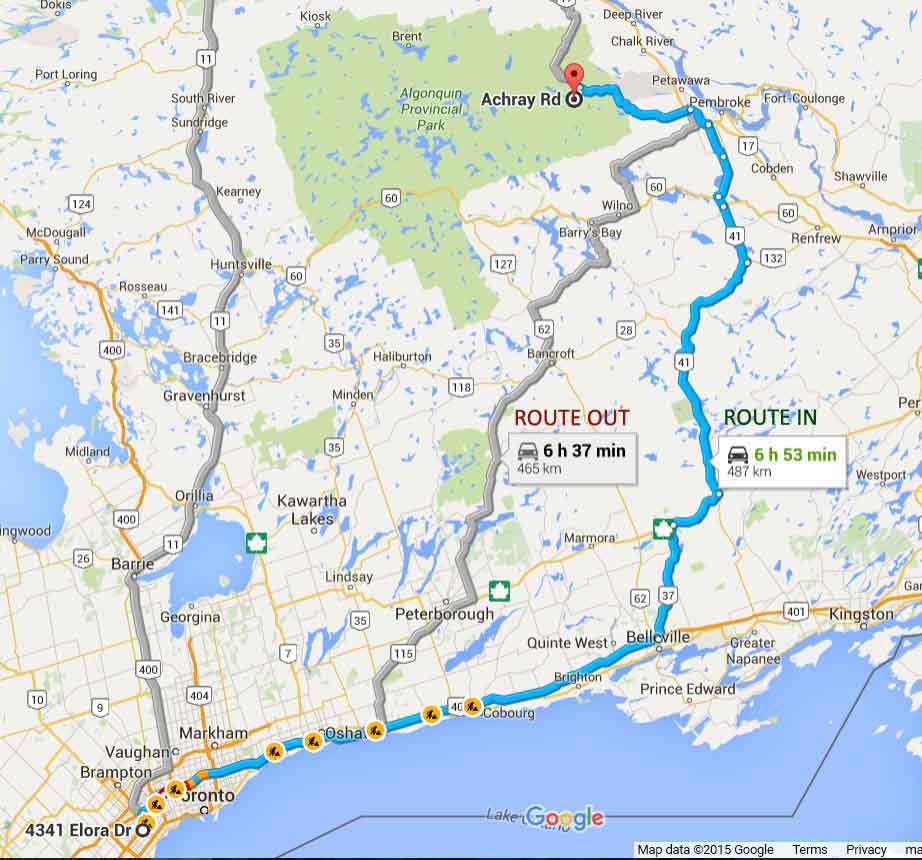
[2] Additions to Geneva Convention (ICRC, 2014).

[3] Rolf Uesseler, Servants of War: Private Military Corporations and the Profit of Conflict, trans. Jefferson Chase (Brooklyn, New York: Soft Skull Press, 2008) 146.

[4] Private Military Companies:Beyond Blackwater.(The Economist, 2013)

[5], Luke McKenna and Robert Johnson, A Look At The World’s Most Powerful Mercenary Armies (Business Insider)

[6] Adam Roberts, The Wonga Coup: The British Mercenary Plot to Seize Oil Billions in Africa (Egjustice.org, 2009)

[7] Meredith Clark, Blackwater Guards Found Guilty in Nissour Square Massacre (MSNBC ,2009)

[8] Private Military Companies: Beyond Blackwater. (The Economist, 2013)

[9] Mario Zorro, Defence Contractors and Private Military Contractors: Armourers, Mercenaries, and Politics (Mediums.com, 2011)

PMCA.png

PMCB.png

PMCC.png

Works Cited

 “Additions to Geneva Convention.” Icrc.org. ICRC, 2014. Web. 13 Nov. 2014.

Clark, Meredith. “Blackwater Guards Found Guilty in Nissour Square Massacre.” Msnbc.com. MSNBC, 22 Oct. 2014. Web. 13 Nov. 2014.

Isenberg, David. “Why Fighting Pirates Is Both Good and Bad for PSC.”The Huffington Post. TheHuffingtonPost.com, 30 Oct. 2012. Web. 17 Sept. 2014.

Johnson, Luke McKenna and Robert. “A Look At The World’s Most Powerful Mercenary Armies.” Business Insider. Business Insider, Inc, 26 Feb. 2012. Web. 17 Sep. 2014.

Milliard, Todd S. Overcoming Post-colonial Myopia a Call to Recognize and Regulate Private Military Companies. Diss. Judge Advocate General’s School, United States Army, 2003. N.p.: n.p., n.d. Print.

“Private Military Companies: Beyond Blackwater.” The Economist. The Economist Newspaper, 23 Nov. 2013. Web. 22 Sep 2014.

Roberts, Adam. “The Wonga Coup: The British Mercenary Plot to Seize Oil Billions in Africa.” Egjustice.org. EG Justice, 2009. Web. 24 Nov. 2014.

Uesseler, Rolf, and Rolf Uesseler. Servants of War: Private Military Corporations and the Profit of Conflict. Brooklyn: Soft Skull, 2008. Print.

Zorro, Mario. “Defence Contractors and Private Military Contractors: Armourers, Mercenaries, and Politics.” Mediums.com. Mediums, n.d. Web. 13 Nov. 2014.

Police

While on our trip to Ottawa, the Canadian capital city with Guillaume Le Floch,  French exchange student, we wanted to get to the National War Museum. We could not find the way. So Nikhil and Guillaume approached two police officers to find the way. A chat ensued between the police officers and the two teens and they ended up snapping photos with them.

Police

A few days later, on a long drive to visit a native aboriginal village, we wanted to stop at a coffee shop for a break. We did not spot one for a long time and hence I decided to pull off the road and search for one on the GPS. A police cruiser pulled up behind our car and an officer came to ask whether we needed any assistance. I rather sheepishly said that we were looking for a coffee shop to which the officer said that GPS will not help you as an outlet of Tim Hortons has recently opened and to reach there he advised us to turn back, drive 500 meters and turn right at the intersection. We thanked him and drove to the coffee shop for a much deserved break.

During the coffee break Guillaume said that he would never have asked a police officer in France for such an assistance. Modern police institution in France has remained an instrument of state, regardless of who happens to hold state power. During the Second World War (1940-45,) when France was occupied by Germany, the police became an instrument of suppression by the occupier. French police, from the time of the French Revolution to date have been used for handling various demonstrations by public and hence have an image of being unfriendly to the citizens. This has created a gap between the police and the people, especially the youth in France.

The first Canadian police officers recorded in the history books worked in Quebec City in 1651 and their duty was to act as night watchmen for the community. Today, policing in Canada is carried out at three levels: federal, provincial and municipal. The Royal Canadian Mounted Police (RCMP) operate at the federal level in all provinces and territories. At the provincial level, the Ontario Provincial Police, the Quebec Police and the Newfoundland Constabulary operate as provincial police services. Crime control and order maintenance are the primary role of police in which crime control activities occupy less than 25% of police time.

Community-based policing has gone a long way ahead in Canada and it involves a full partnership between the community and its police in identifying and reducing local crime. Crime prevention is the joint task of both the community and the police, and this joint effort is carried out within an interactive, cooperative and reciprocal relationship.

The increasingly multicultural nature of Canadian society is having an impact on Canadian policing. Complaints about the police by members of   visible minorities include over- policing of their communities, random stops and searches, discrimination in the use of police power, ‘blaming the victim’ when the victim is a member of a minority group and under-representation of minorities within police organisations. The governments at all levels have taken many initiatives that address police-minority relations.

One such initiative is the Youth Education Bureau of the police that works in partnership with the Health Department and the School Boards to create a positive and safe learning environment within the school system. The Officers of the Youth Education Bureau are responsible for initiating the SAFE (Schools Against Fearful Environments) programs in their individual schools. In this programme, the staff, parents and the police work together to ensure a safe environment at school and in the community. The programme ensures that the students are given a voice in their school. Any concerns raised is worked on through a focused plan of action. Each officer is assigned approximately 30 schools and they deliver various presentations and participate in special events hosted by their schools.

Project RAID (Reduce Abuse in Drugs,) is a seven-part drug education and awareness program delivered by a team of dedicated officers at all middle and high schools.  The police have established a Children’s Safety Village, which receives students on a fun educational trip in grades 1 to 5 to educate the students on road and personal safety.

The officers visit various schools and interact with the students. For Grades 1 and 2 they cover bullying, street proofing/ pedestrian safety and stranger awareness. For Grades 3, internet security is added to the above list. For Grades 4 and 5, introduction to dangers of drugs and tobacco is added. For Grades 6, 7 and 8, drug abuse prevention, youth crime, youth gangs are in addition to the above.

In addition the Neighbourhood Policing Officers work with the area high schools to maintain a presence with the youth. They work directly with teachers, parents and the community to ensure that the youth are on the right path to a great future.

There is a system of co-op placements with the police for students of Grade 12 as well as those in college or university. Co-op placements follow school semesters and are available for 15 weeks. To be eligible for the co-op placement program, students must be attending college or university and be enrolled in a co-op or work term program at their institution of learning.

Police and the Canadian Forces through Army Cadet Movement are long-time partners in developing the youth through the Cadet Organisation Police School (COPS.).The mandate of this programme is to develop the youth into leaders within the community. Many of these graduates have progressed to become active members of the Police, while others have succeeded in different areas of the community.
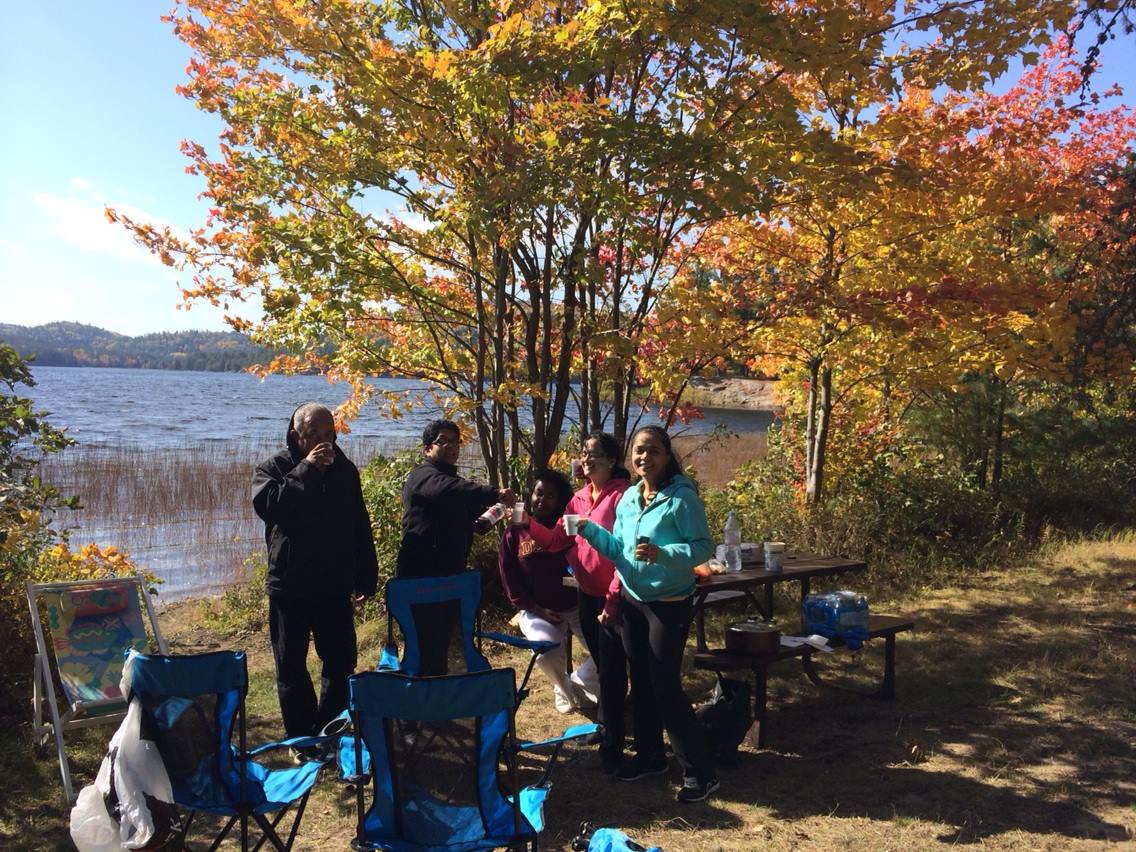
The interactions between students and the police have ensured that there exist a warm, welcoming and community-oriented relationship between the citizens and the police. The confidence built up through these programmes have ensured a high level of trust in the police.

It is common for people of all ages to seek police assistance in any eventuality, at times for routine route directions or even a help to change a flat tire. This is what every citizen of any country want their police to be.

The School Bus

Schoolbus
Driving through the residential area to work or to drop off children at the school, one got to cater for a few extra minutes to stop for school buses. The rule in Canada and US is that whether on a city street, highway or county road, and regardless of the speed limit and the number of lanes, motorists travelling in both directions must stop when approaching a stopped school bus with its upper red lights flashing. A flashing stop arm will swing out while passengers are boarding or leaving the bus. While stopping behind a school bus, the drivers got to ensure that they are at least 20 meters away. Once all passengers have boarded or disembarked, the ‘Stop’ arm will fold away. Any infringement to this rule fines ranging from $400 to $2,000. School bus drivers and other witnesses can report vehicles that have illegally passed a school bus. The modern school buses are fitted with cameras to record events inside and outside the bus.

School buses have been specifically designed and equipped to carry students. Therefore, they are one of the only vehicles on the road with their size and design that maximizes safety for children. The highly distinguishable ‘National School Bus Chrome’ colour later renamed as ‘National School Bus Glossy Yellow’ as lead was removed from the pigment.  Black markings on an yellow background is meant to attract visual attention of any driver or pedestrian.

All school buses are equipped with flashing lights and a stop arm, which swing out whenever a child is picked up or dropped off. These signals indicate to traffic approaching from both sides of the road to come to a full stop and to remain so until the indicator is deactivated. The crossing arm when deployed, ensures that the students who have to cross the road before boarding or after leaving their bus, have to go around it and thus are always at a safe distance away from the front bumper. This enables the driver to see them or locate them in the bus mirrors. School bus design includes strategically placed grid of six mirrors, three on either sides (two convex and one plain mirror), that allow the driver 360 degrees visibility.

Transport Canada, after analysis of various accidents involving school buses have decided to do away with seat belts in school buses. The current school bus design provides a high level of protection to occupants and that seat belts may trap the children on school buses in case of an accident. School buses protect passengers through “compartmentalisation”, a design that includes seats filled with energy-absorbing material and high backs seats anchored strongly and placed close together to form compartments. In case of a collision, these special compartments would absorb the impact dispersing it throughout the entire body as opposed to solely the head and neck.

Studies have shown that adding seat belts to the current seating configuration of a school bus can increase the chance of head and neck injuries. For a seat belt to be effective, it must be worn correctly, snug and on the upper thighs. Because school vehicles carry passengers from the very young to high school students, if seat belts were used, they would need to be readjusted and their use monitored. A seat belt not worn correctly may cause serious injuries.

Raised floors in the school bus ensures that in the event a vehicle collides with a school bus, that vehicle will impact beneath the seated passengers, since the school bus seats are above the crash line. Structural strength and integrity of the joints between body panels of buses ensure protection in rollover-type accidents. Burn resistance form materials are used inside the school bus.  A protective cage is provided for the fuel tank to reduce the possibility of fuel leaks. The windows are made of shatter proof glass.

Most school buses employ GPS systems to provide the exact location and speed of a school bus at any time. They also have an on-board electronic reminder system that reminds drivers to check for sleeping children before leaving the bus.

For the purposes of evacuation, school buses are equipped with a minimum of at least one emergency exit in addition to the main entry door. The rear-mounted emergency exit door is a design feature retained from when school buses were horse-drawn wagons and the entrance door was rear-mounted to avoid frightening the horses.

Many cases were reported about the clothing of students getting entangled in the handrail at the entrance, resulting in a fall or a major accident. The most common piece of clothing that can be snagged on the handrail is a jacket with a drawstring at the waist. These drawstrings commonly have a large bobble or knot at the ends that can become lodged in the handrail. However, other articles of such as scarves, long straps on backpacks, or dangling key chains can also be snagged on the handrail. The redesigned handrails minimises entanglement by filling in the gaps with rubber washers.

At the start of each day, the school bus driver has to conduct daily safety inspections, read instruments and gauges, perform routine tests, and confirm proper mirror adjustments. The inspection is recorded in a vehicle logbook to prevent and minimize mechanical breakdowns. Post-trip inspections are performed to verify that every child has exited the bus at the appropriate stop. In addition to regular mechanical maintenance and daily vehicle inspections by the driver, a Motor Vehicle Inspection Station will perform at least two mechanical inspections each year on every school bus in Ontario. School buses are also subjected to unannounced roadside safety inspections at their intended destination rather than at the roadside to avoid inconvenience to the students.

The prime need to keep our children safe at all times is a national responsibility. Redesigning the school buses to make them safer is an ongoing process and will continue to evolve to make our children safer.

110 Volt Vs 220 Volt

Electric Plugs

Travelling to Europe and India from Canada, one faces the problem of carrying adapters, plugs, converters etc, all because Canada uses 110 Volt while Europe and India operate on 220 Volt. Thankfully nowadays most electronic and electrical equipment come suitably modified to work on both the voltages.

The complicated system of plugs and sockets followed in different countries add to the vows international travellers face. Why can’t they design a system like the Universal Serial Bus (USB) used in all modern gizmos to make life easier? The switch positions as whether ‘up’ or ‘down’ is the ‘on’ position adds to the confusion. Why can’t they employ a system like Double Pull Double Throw (DPDT) switches like the ones used in computers and modern digital equipment? Why is no standard followed world over for a basic necessity?

In 1882, Thomas Edison’s General Electric Company was distributing Direct Current (DC) electricity at 110 Volt in North America. Transmission losses and generation costs led to the development of Alternating Currents (AC). Nikola Tesla was the first to devise a system of AC electricity at 220 Volt.   Most modern electronic systems like computers and cell phones all use DC. The charging systems in all these use AC as it is easy to convert AC to DC.

The original reason behind the decision to use 110 Volt was that the carbon filaments Edison used in his light bulbs lasted far longer at this voltage. As technology improved, metal filaments became more readily available for light bulbs. One of Germany’s first electric utility companies decided to up the voltage to 220 Volt. In doing so they increased their overall distribution capacity and also reduced transmission losses.

Europe too began with 110 Volt, like North America today. It was deemed necessary to increase voltage to 220 Volt to get more power with less losses and voltage drop from the same copper wire diameter. At that time the North America also wanted to change, but because of the cost involved to replace all electric appliances, they decided not to.  At that time (1950s-60s), average North American household already had a fridge, washing-machine, dishwasher, etc, but not in Europe.

In order to understand the power transmission system better, a look into the Ontario Province’s (where I live in Canada) electric supply system will benefit.

In Canada, electric supply is called ‘Hydro.’ Much of the initial electricity was generated by hydro-electric power plants. So, the term Hydro-Electric was shortened to Hydro.

Ontario’s electricity supply has a diverse mix of sources – nuclear, hydro-electric, gas, coal, wind and, to a much smaller degree, solar, wood waste and biogas.   52% of our electrical power comes from nuclear generation, 23% from hydro-electric plants, 19% from gas, four percent from wind, one percent from coal and a very small amount from other sources.

The power plant produces three different phases of AC power simultaneously. There are four wires coming out of every power plant, the three phases plus a neutral or earth (ground) – common to all three phases.

The three-phase power leaves the generator and enters a transmission substation at the power plant. This substation uses large transformers to convert the generator’s voltage (which is at the thousands of Volt level) up to extremely high voltages for long-distance transmission on the transmission grid. Typical voltages for long distance transmission are in the range of 155,000 to 765,000 Volt in order to reduce transmission losses.

This high voltage power is transmitted from the generating station to the electric sub-stations using towers with three wires for the three phases. Many towers have extra wires running along the top of the towers. These are ground wires to attract lightning.

The electric sub-stations step down the voltage from transmission to distribution levels. The sub-station is equipped with transformers that step down transmission voltages to distribution voltages (usually 7,200 Volt.) It has a ‘bus’ that can split the distribution power in multiple directions. It has circuit breakers and switches so that the substation can be disconnected from the transmission grid or separate distribution lines can be disconnected from the substation when necessary.

The 7,200 Volt power is transmitted from the electric sub-stations by power lines to the transformers outside the homes. Modern sub-divisions have underground power supply systems. Outside four or five blocks of houses, the transformers are housed in green boxes. In rural areas and in thinly populated sub-divisions, the electric poles hold a transformer in white drums.

These transformers step down the power to two phases of 110 Volt. 110 Volt cannot be transmitted over long distances without acceptable losses. This calls for more transformers; nearly one per every four to five households. The 220 Volt system saves on the transformer costs.

There are two wires running out of the transformer and a ground wire running to the house. The two wires from the transformer each carry 110 Volt in two phases. This arrangement allows usage both 110 and 220-Volt (two-phases combined) for appliances like cooking ranges, dryers etc. 110 Volt system uses two phases with a phase difference of 180 degrees to create 220 Volt and the 220 Volt system uses three phases with a phase difference of 120 degrees to create 440 Volt for use with high power domestic and industrial equipment. As the 110 Volt system uses only two phases, the AC frequency is generally at 60 Hertz as compared to 50 Hertz in the 220 Volt system which uses three phases.

Customers in Ontario are billed based on the electricity consumed and the time it is consumed. It is achieved by using ‘smart meters’ which measures power usage based on three time-of-use periods:

  • Off-peak – when energy demand is low and less expensive sources of electricity are used
  • Mid-peak – when the cost of energy and demand are moderate
  • On-peak – when demand is highest and more expensive forms of electricity production are used.

Comparison between 220 Volt over 110 Volt

  • From the safety view-point, 110 Volt having lesser voltage results in lesser shock and thus less injuries or death due to electrocution.
  • 220 Volt generate more heat across a particular fault, thus more vulnerable to fire accidents. Burnt-out sockets where a plug is loosely fitted is a testimony to it.
  • 220 Volt circuits tend to use thinner gauge wire, thus saving copper/raw materials.
  • 110 Volt systems use less costly plugs and connectors when compared to the 220 Volt systems.

Until the standardisation is achieved, electricity, plugs and sockets will all remain a troubling element for any international traveller.

Movember

Movember

The word ‘Movember‘ is derived from the combination of the word ‘mo, which is the Australian-English abbreviated form for ‘mustache‘ and ‘November,’ as the event takes place every year during the month of November. This involves growing of mustaches in order to raise awareness of different men’s health issues like prostate cancer, testicular cancer and mental health challenges. Using the mustache as a catalyst, Movember encourages men to invest in their own health by more openly talking about their health concerns and more proactively seeking necessary medical care. The idea is to bring about change and give men the opportunity and confidence to learn and talk about their health and take action when needed.

Participants of Movember are called “Mo Bros”. This year our son Nikhil decided to be a “Mo-Bro” at his high school and hence grew all facial hair for a month. At the end of it he decided not shave it off. The students did succeed in raising about the men’s health issues and also collect money during a charity event at the school.

The women taking part in Movember are called ‘Mo Sistas.‘ Mo Sistas are not necessarily encouraged to grow mustaches of their own, but to support the cause, spread the word and encourage guys to become a walking billboard for the charity.

The idea of Movember originated in 1999, when a group of men from Adelaide, Australia decided to grow their mustaches for charity during the month of November. Then the Movember foundation came into existence. The goal and motto of the foundation is to “change the face of men’s health.” The movement has gone global and today is well supported in New Zealand, the US, Canada, UK, Finland, Netherlands, Spain, South Africa and Ireland. From 30 Mo Bros in Melbourne, Australia in 2003 to 4 million Mo’s by 2013, Movember, through the power of the mustache, has become a truly global movement that is changing the face of men’s health.

Some of the celebrities who have endorsed the Movember movement are Australian World Surfing Champion Mick Fanning, 2009 F1 World Champion Jenson Button, UFC Lightweight Champion Frankie Edgar, New Zealand’s national rugby captain Richie McCaw and US actor Nick Offerman who worked on a series of videos for the movement. Indian cricketers Ravindra Jadeja and Shikhar Dhawan, and Bollywood actor Ranveer Singh have been the prominent faces of the movement in India.

The best part is that the shaving and razor supplier Schick, is one of the biggest partners of Movember.

As stated on Movember.com, the poor current state of men’s health can often be attributed more to lifestyle than biology. Some causes include:

  • Lack of awareness and understanding about men’s health issues
  • Men not openly discussing their health and how they’re feeling
  • Reluctance to take action when men don’t feel physically or mentally well
  • Men engaging in risky activities that threaten their health
  • Stigmas surrounding both physical and mental health

According to the World Health Organization’s International Agency for Research of Cancer, the number of prostate cancer cases is expected to nearly double to 1.7 million in less than 20 years. The Movember movement hopes to inspire more men around the world to better attend to their physical and psychological needs. Hence we can see an improvement on current statistics, like these:

  • 1 in 6 men will be diagnosed with prostate cancer in his lifetime.
  • Over 238,000 new cases of the disease will be diagnosed and almost 30,000 men will die of prostate cancer every year.
  • Testicular cancer is the most common cancer in males between the ages of 15 and 35.
  • Men who sit more than six hours a day have an 18 percent increased risk of dying from heart disease and a 7.8 percent increased chance of dying from diabetes compared with someone who sits for three hours or less a day.
  • Globally, 5.3 million deaths will be attributed to physical inactivity.
  • 24% of men are less likely to go to the doctor compared to women.

As a global men’s health movement, the Movember Foundation has the ambition to contribute to improving the lives of men around the world. This will be achieved through programs in the areas of – Awareness & Education, Living with Cancer, Research and Mental Health through:

  • Reduced mortality from prostate, testicular cancer and men’s suicide
  • Men living with prostate or testicular cancer being physically and mentally well
  • Men and boys understanding how to be mentally healthy and taking action when they experience mental health problems
  • Men and boys with mental health problems not being discriminated against

Some mustache trivia:-

  • An Indian man holds the record for the longest growing mustache. According to Guinness World Records, Ram Singh Chauhan has a mustache that spans 14 feet long. He has been growing it since 1982, after a friend with a 7-foot-long mustache suggested it,
  • A man spends an average of five months of his life shaving if he starts at the age of 14 – assuming that he lives until he’s 75 years old.
  • In a deck of cards the King of Hearts is the only king without a mustache.
  • Contrary to popular belief, Charlie Chaplain didn’t actually wear his mustache on a daily basis. It was removable, and he wore it only because, “Well, it’s amusing enough to add something to the routine, but it allows me to keep my facial expressions.”
  • William Taft was the first US President (1909-1913) to have a car and the last to wear a mustache in office


The Seven Books of Remembrance

BooksofRemembrance copy

We took Guillaume Le Floch, the French exchange student to visit the Canadian Parliament building at Ottawa in August 2014. During the tour we entered the Memorial Chamber in the Peace Tower. The Memorial Chamber is a small, quiet room that houses seven Books of Remembrance which record the names of the men and women who have given their lives in military service to Canada. The Memorial Chamber is a beautifully crafted room with a vaulted ceiling, stained glass windows and intricate carvings depicting Canada’s record of war.


These books contain the names of more than 118,000 Canadians who fought in wars and died either during or after them. These men and women made the ultimate sacrifice while serving the country in uniform. The Government of Canada has always been in the forefront in honouring the men and women in uniform. The seven Books of Remembrance ensures that their names are etched in the history of the country and are always well preserved and cared for.

These Books of Remembrance represent the highest expressions of modern workmanship and artistry. The craftsmanship, heraldic illumination, calligraphy, water coloring, bookbinding and leather tooling give the books a special look and quality unequalled the world over.


The first book is the largest of the Books, containing 66,655 names, of those who died in is the First World War. The second book contains 44,893 names of those who did the extreme sacrifice in the Second World War. The third is the Korean War Book of Remembrance which commemorates the 516 men and women who died during the Korean War from 1950 to 1953.

The fourth book is the South African War/Nile Expedition Book of Remembrance, containing names of nearly 300 Canadian volunteers, who gave their lives in these early campaigns in the late 1800s This book was commissioned on May 31, 1962, the anniversary of the signing of the Peace of Vereeniging, which ended the war in South Africa.

The fifth is the Merchant Navy Book of Remembrance which commemorates the men and women of the Merchant Marine who died while serving Canada at sea during both World War I and II.


The sixth is the New Foundland Book of Remembrance which honours more than 2300 men and women who sacrificed their lives in both World War I and World War II, before Newfoundland became a Canadian province in 1949.

The seventh is the In Service of Canada Book of Remembrance This book records the names of those who died since October 1947 in military service to Canada (except in the Korean War), either in Canada or abroad.

On July 1, 1917 , then Prime Minister Sir Robert Borden dedicated a site in the Centre Block of the Houses of Parliament as a memorial to the debt of our forefathers and to the valour of those Canadians who fought in the First World War. Two years later the Prince of Wales laid the corner stone of “The Tower of Victory and Peace” as it was originally known. The intention was for all the names of the Canadian soldiers to be engraved on the walls of the chamber, but it was soon realized that there would not be enough space on the walls to contain more than 66,000 names.

Thus resulted the Book of Remembrance and the design of the Tower was altered to create a chamber to accommodate the Books. The Prince of Wales on August 3, 1927 unveiled the altar; a gift from the British Government, upon which the Book of The First World War rests this day.


James Purves was the artist chosen for the creation of the first book. James Purves died in 1940, at which time only the preliminary work had been done and only one page was fully illuminated and illustrated. Alan Beddoe, an assistant of Purves, took over and completed the book in 1942. By the time the first book was completed, Canada was already in the middle of the Second World War. Today this book lies open on the Altar in the centre of the Memorial Chamber, covered by a glass case and with kneeling statuettes of praying angels at its corners.


In 1948, Beddoe was selected to create the Book of Remembrance for the Second World War. He changed the script style and included approximately 75 names per page as compared to 125 names per page in the First World War Book. He also incorporated many pages commemorating particular actions, battles, and places that were significant to Canadians during the war. The Second World War Book of Remembrance was placed in the Memorial Chamber on Remembrance Day of 1957 (November 11).

The names of those lost are inscribed in the Korean War Book of Remembrance, which includes a page decorated with the United Nations symbol surrounded by the Arms of the 17 countries which participated in the United Nations Forces. The Book was dedicated in the Memorial Chamber on November 11, 1962.

The Nile Expedition in 1884 marked the first time Canada took part in a war overseas. Four hundred volunteers skilled in river navigation served in the expedition; sixteen gave their lives. The South African War broke out on October 11, 1899. This war marked the first occasion in which large contingents of Canadian troops served abroad. More than 7,000 Canadians volunteered to fight in the South African War. Almost 300 names are listed in the South African War / Nile Expedition Book of Remembrance. The Book was dedicated and placed in the Memorial Chamber on May 31, 1962, the sixtieth anniversary of the signing of the Peace of Vereeniging, which ended the war in South Africa.


Every morning, at eleven o’clock, the pages of the Books of Remembrance are turned by a member of the House of Commons Protective Service Staff. A calendar was devised so that each page of each book is turned once a year. Some pages are left exposed for several days at a time on or near a date of the anniversary of the actions they commemorate. During the ceremony a guard in marches in front of the First World War Book, bows and salutes and then marches over to the book on the right and turn the page. This process is repeated for all of the Books of Remembrance and is done in a counter-clockwise direction around the Chamber.

The seven Books of Remembrance are testaments to the valour, sacrifice and selflessness of those Canadians who have died in military service. Any country that honours its soldiers will always go a long way ahead as Canada has proved.