Glacier Bay – Where the Birth of the World is Continuing

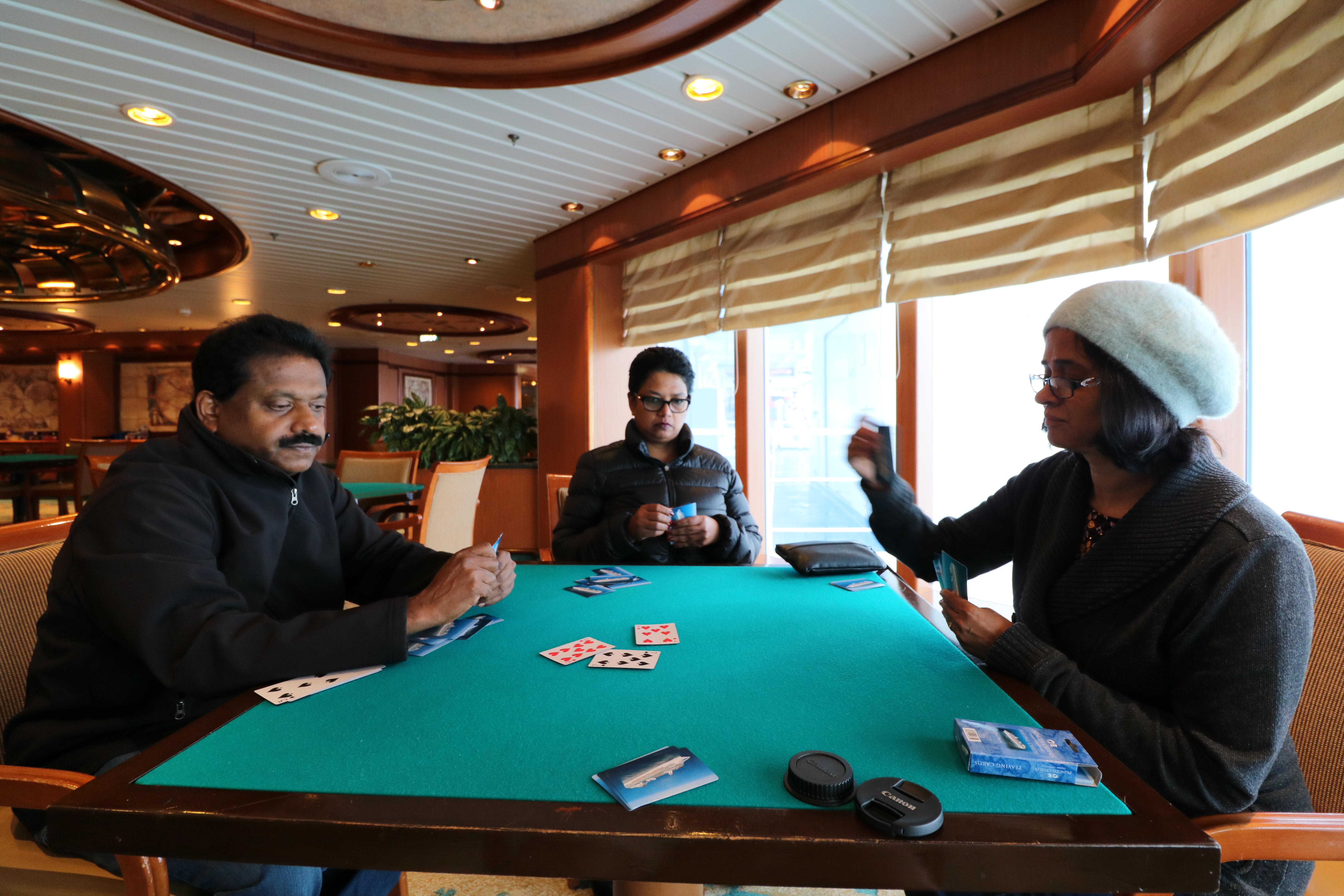
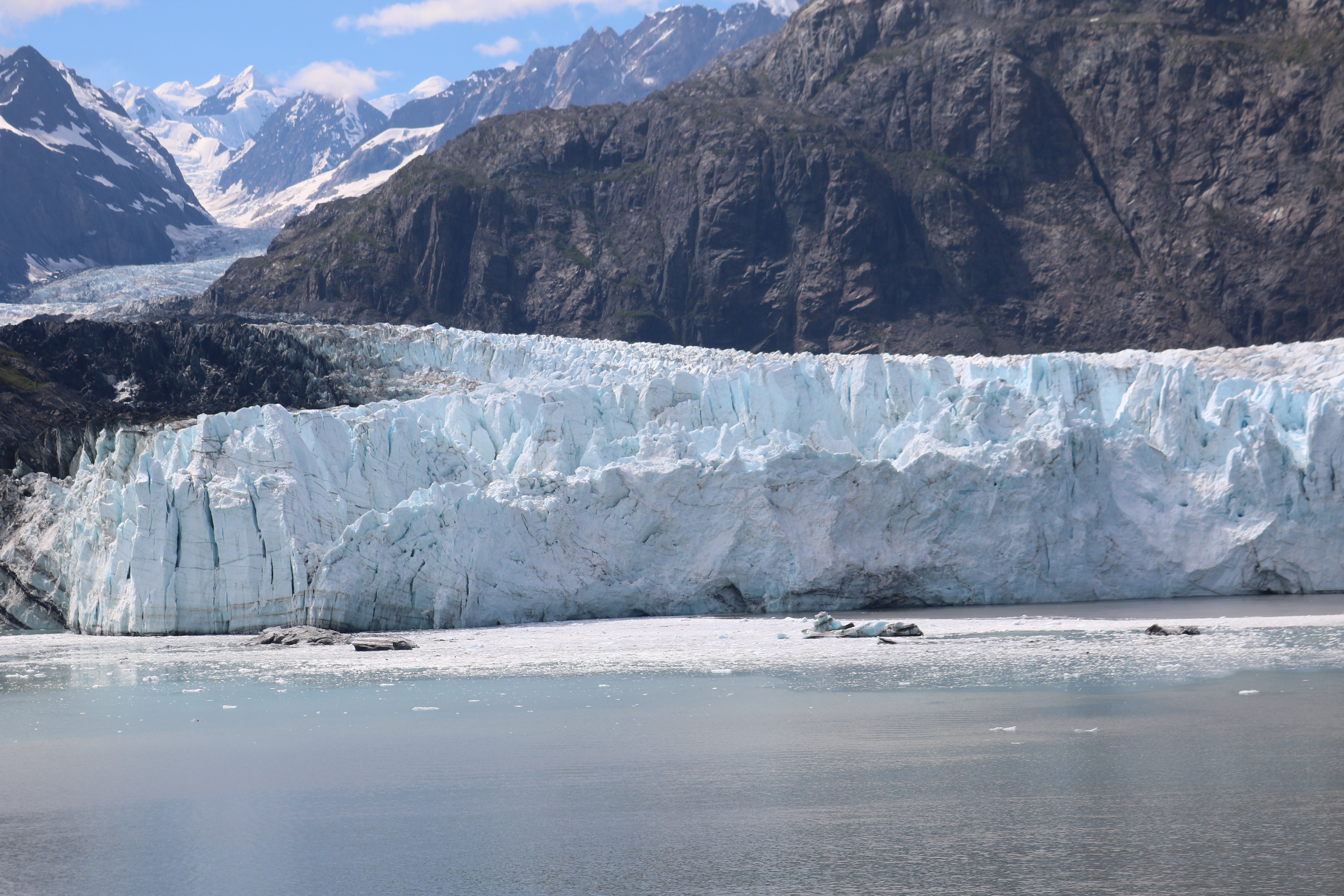
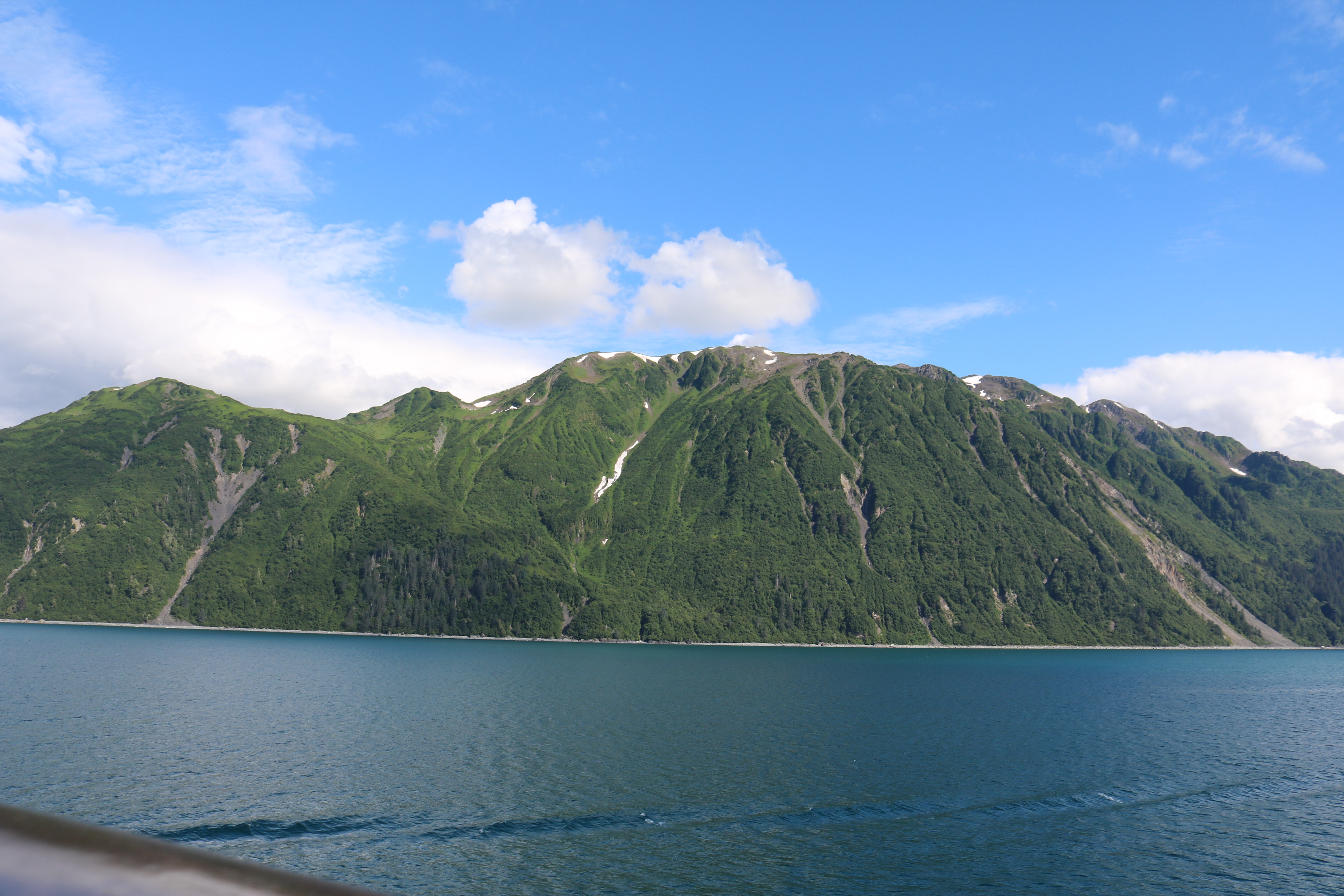
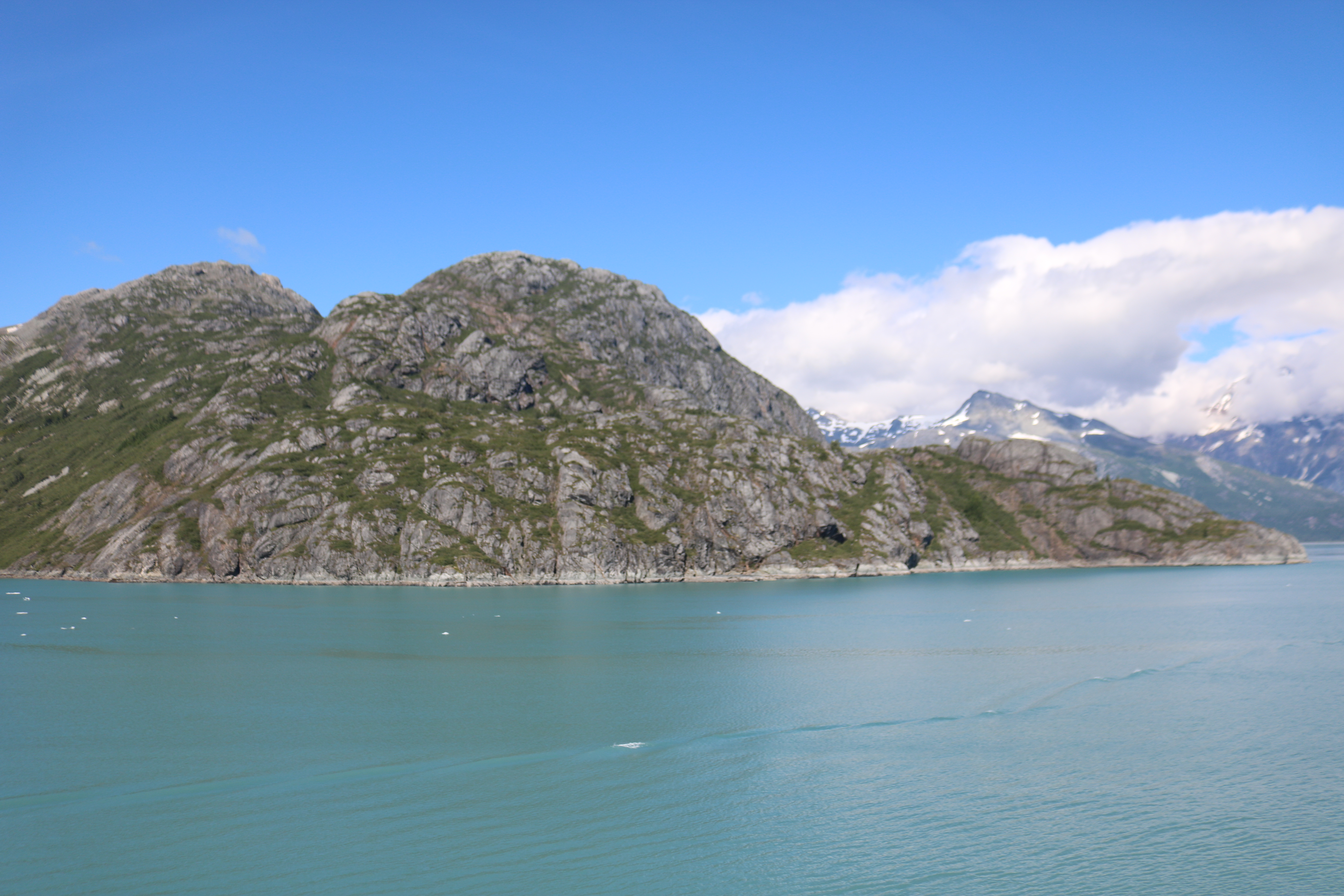
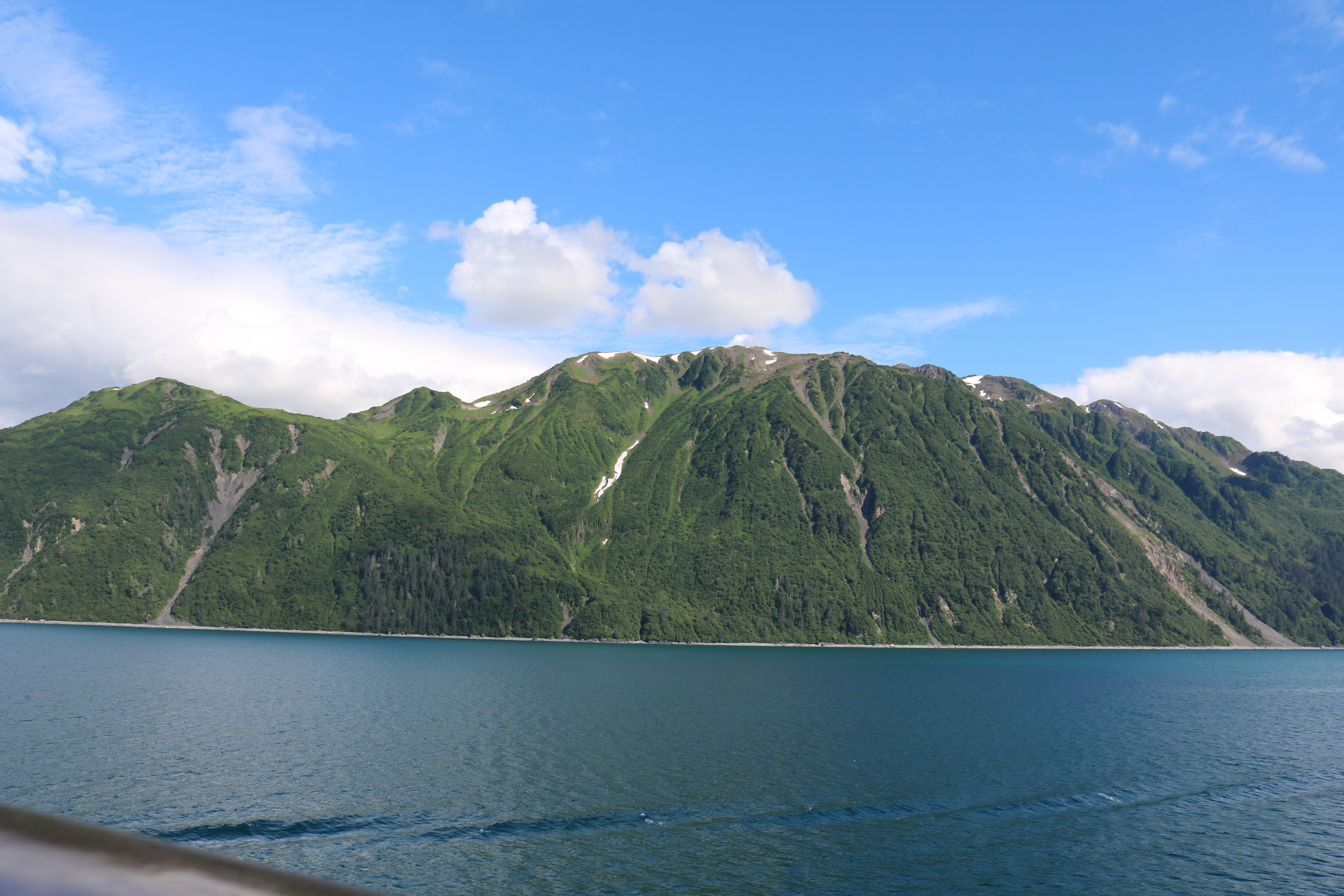
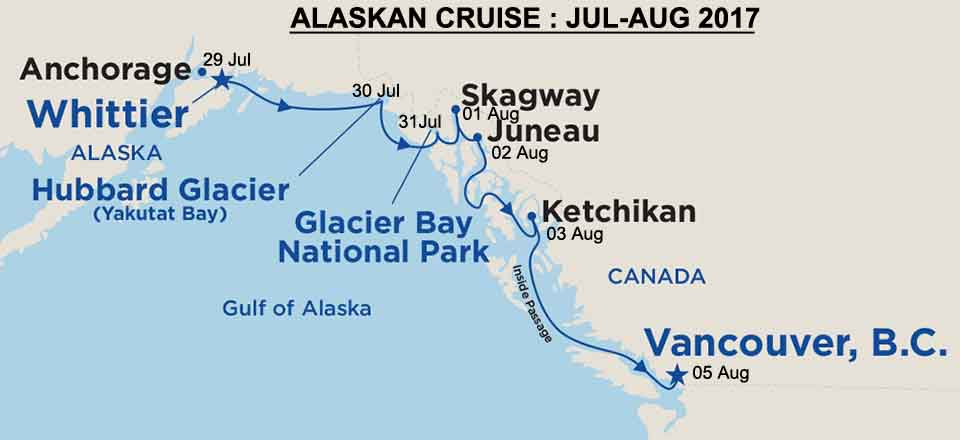
In the morning of 31 July after breakfast we played cards in the Card Room as the ship cruised its way into Glacier Bay.  Glacier Bay National Park and Preserve contains some of the world’s most impressive tidewater glaciers. The bay has experienced at least four major glacial advances and four major retreats and serves as an outdoor research laboratory.  Glacier Bay has more than 50 named glaciers, as well as two major arms: East Arm and West Arm. The cruise ships head up the West Arm, towards the Margerie Glacier as it is the most impressive glacier, which is advancing three to four meter a day and calves frequently.

The glaciers in Glacier Bay are remnants of a general ice advance—the Little Ice Age—that began about 4,000 years ago. This advance is not comparable to continental glaciation that occurred during the Wisconsin Ice Age.  By about 1750, Little Ice Age reached its maximum stage and a general recession of glaciers began.  200 years ago Glacier Bay was covered by Grand Pacific Glacier, which was more than 1,200 meter thick and about 30 km wide. Since then the ice has been retreating with Glacier Bay  now having 20 separate glaciers, of which 11 are tidewater glaciers including Margerie Glacier that calve into the bay.

Margerie Glacier is named after French geologist and geographer Emmanuel de Margerie who visited the area in 1913.  Glacier Bay was completely covered by ice in 1794 when Captain George Vancouver, a British officer of the Royal Navy, best known for his expedition which explored and charted North America’s North-Western Pacific Coast region was stopped by a wall of ice 32 km wide and 1,200 m high.  This ice wall has since retreated from the mouth of the bay and is only a remnant of the massive glacier seen by Vancouver.   Today, the ice flows have been recorded at Margerie Glacier at 610 meter per year or about 1.75 meter per day.

Like a river, the glacier flows down the mountain  choosing the path of least resistance. As it moves,  it swallows rocks into its lower layers. These  acquired rocks grind away at the bedrock, carving deep valleys in the  mountainside over the years.

When the ice reaches lower, warmer elevations, it begins to melt. Eventually the loss through melting is greater than the supply of ice flowing down the  mountain. Now the glacier ceases to make further  progress, though the body of ice is still moving  down the mountains.  The length of time it takes for a snowflake that falls in the mountains to emerge at the end, or terminus of a glacier varies, depending on the speed at which the glacier is flowing. The ice visible at the face of the park’s glaciers today  is about 200 years old.

As we entered the Glacier Bay we first sighted the South Marble Island. This small island is a  sunbathing spot of gigantic Sea Lions. They lay on the rocks  with the dominant males sitting with their back arched and head erect.

Then came up the ‘Gloomy Knob’, a well rounded, dome shaped granite feature.  Surely it would have been smoothened by the glacial activities over the years.  Grass growing on the rocks formed a grazing pasture for the Mountain Goats.

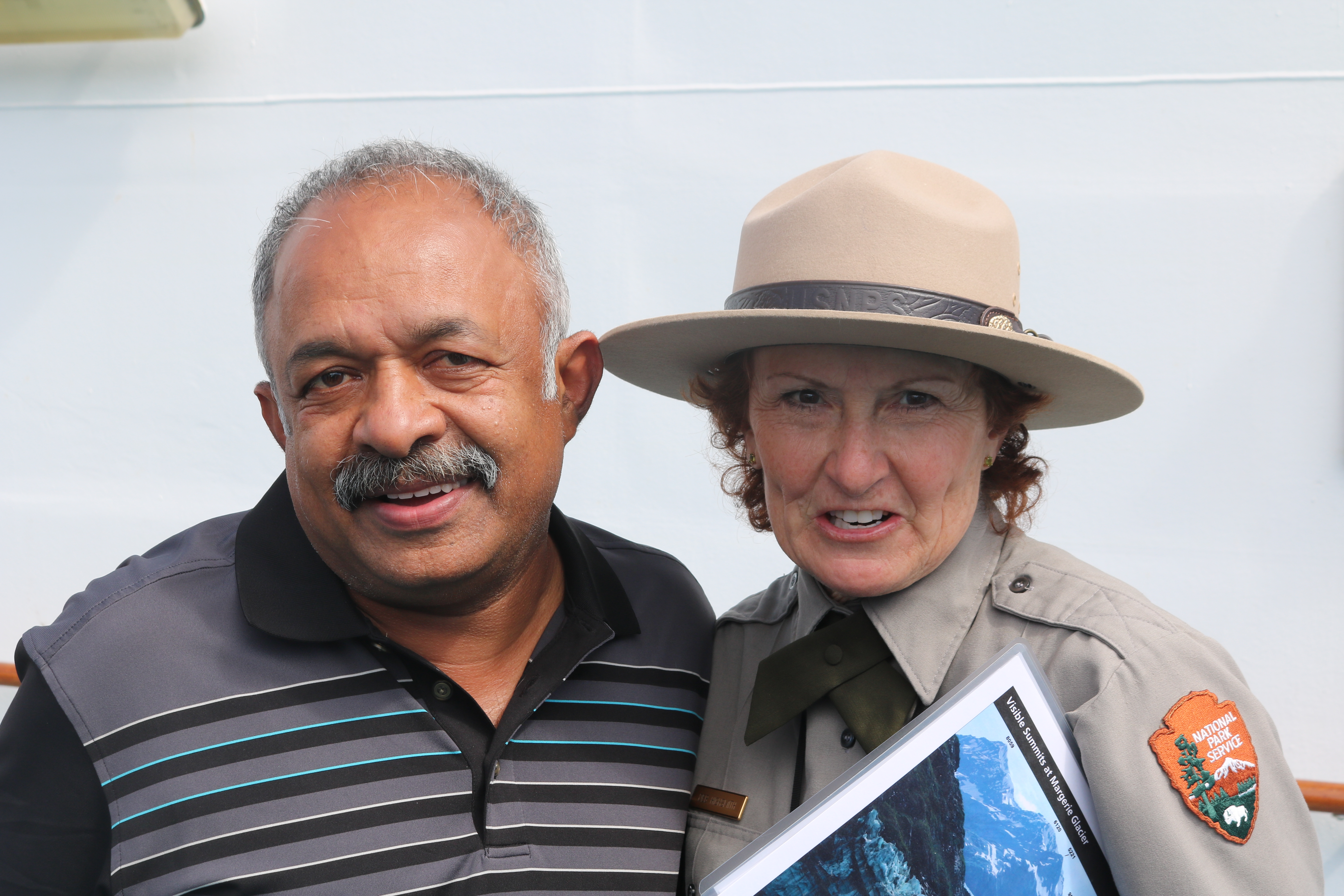
After we passed Gloomy Knob, a boat belonging to US National Park Services came alongside our ship.  Rangers from the boat boarded our ship through a rope-ladders provided by the ship’s crew.

These Rangers, lead by Ms Highsmith, the Warden,  conducted classes about the Glacier Bay, its ecology, geology, about the original inhabitants, etc.  She brought out as to how the current conservation effort has been a great success as they included local inhabitants into it, respecting their beliefs, traditions and customs.

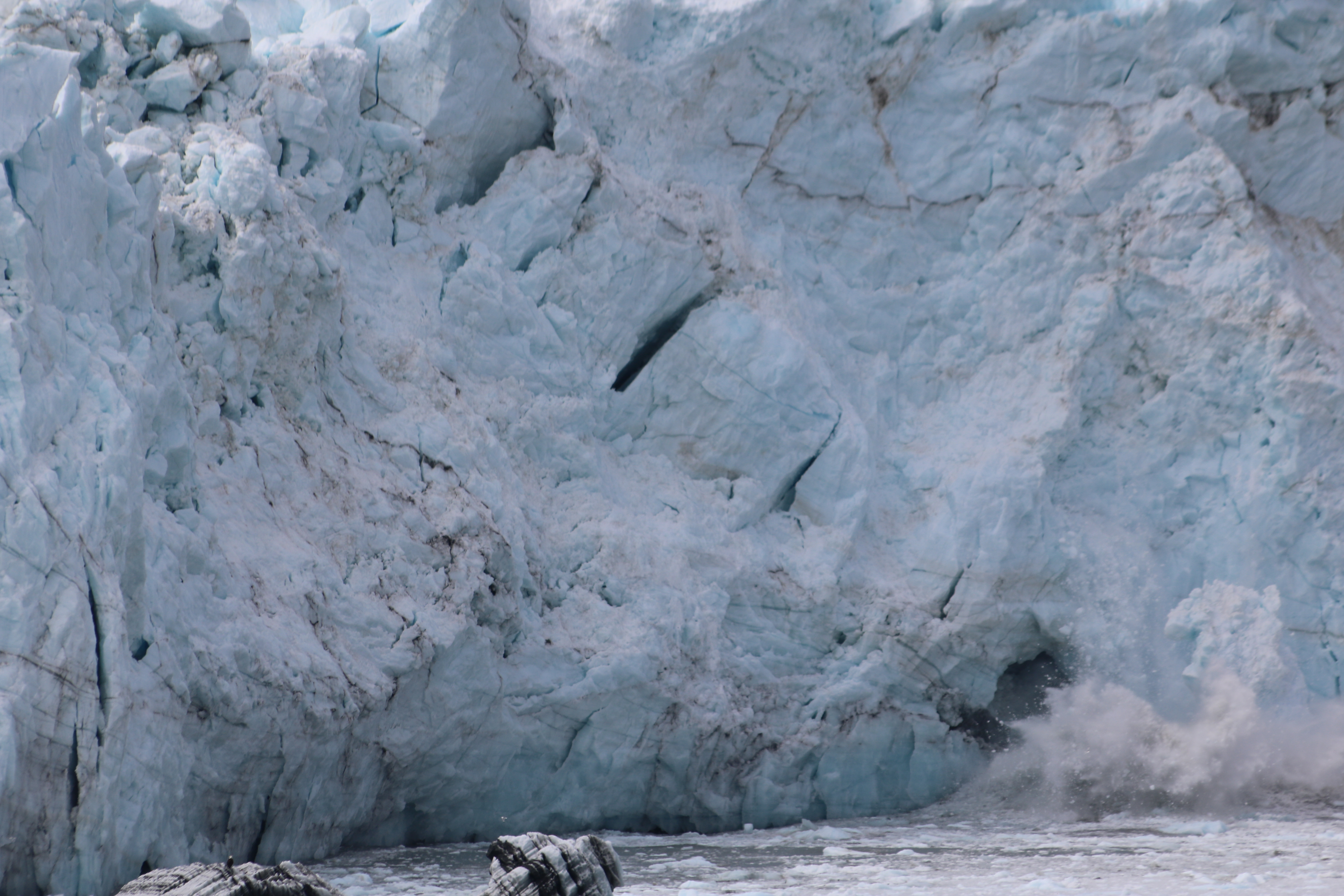
Our ship then moved closer to the Margerie Glacier, nearly a mile away, to facilitate us to view the spectacle of calving.  Cows have calves, glaciers calve icebergs, which are chunks of ice that break off glaciers and fall into water. This is caused in the glaciers of the Glacier Bay due to the forward motion of the glacier and the erosive action of the salt water of the Pacific Ocean, the tidal waves and the wind.

As we stood on the deck watching the Margerie Glacier, it calved five times, each time bringing down a heavy volume of ice, falling into water with a thunderous sound.  It was a great natural spectacle showcasing the fury of nature.

As our ship steamed off from the Glacier Bay, we all enjoyed a swim in the top deck swimming pool.

Next : Skagway – Gateway to the Klondike Gold Rush

Yakutat Bay and Hubbard Glacier


Our Ship sailed through the night after casting off from Whittier.  We had early breakfast and set out to explore the ship.


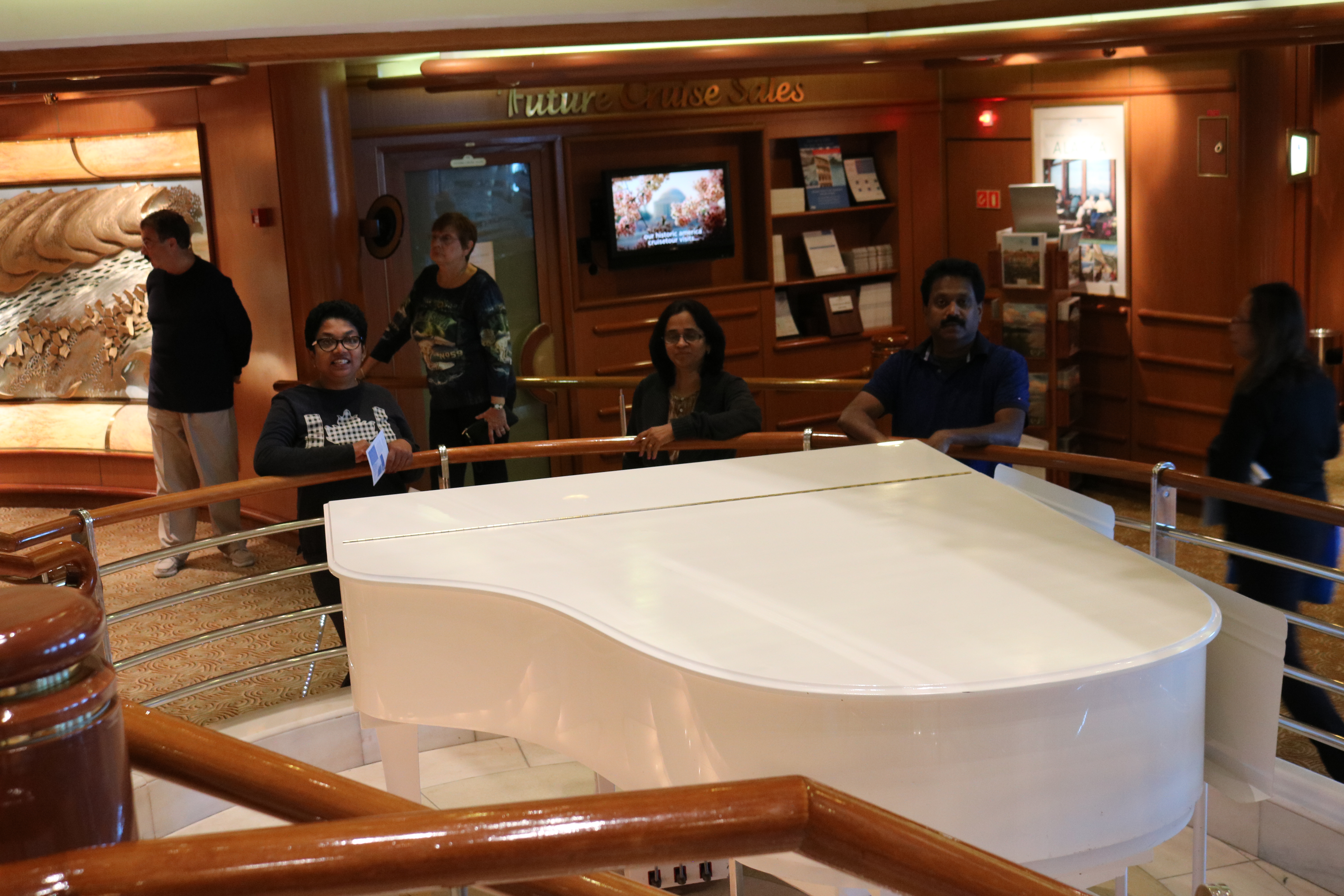
In the Mid-Ship was  lavishly decorated and well laid out Shopping Arcade with stores selling everything from Scotch Whisky to Jewellery.


Shopping Arcade covered four floors, very well done up with chandeliers, artwork, murals and et all.


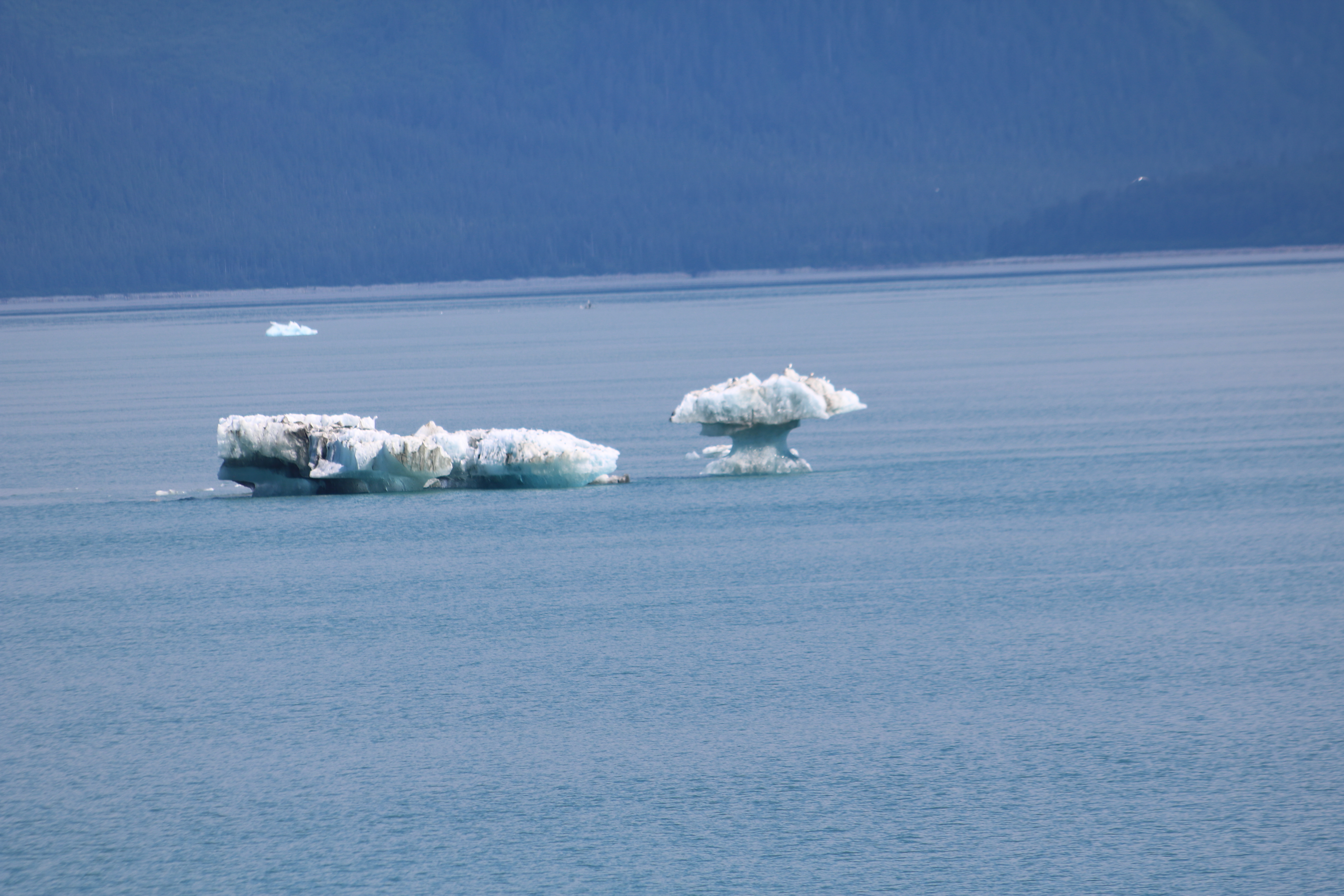
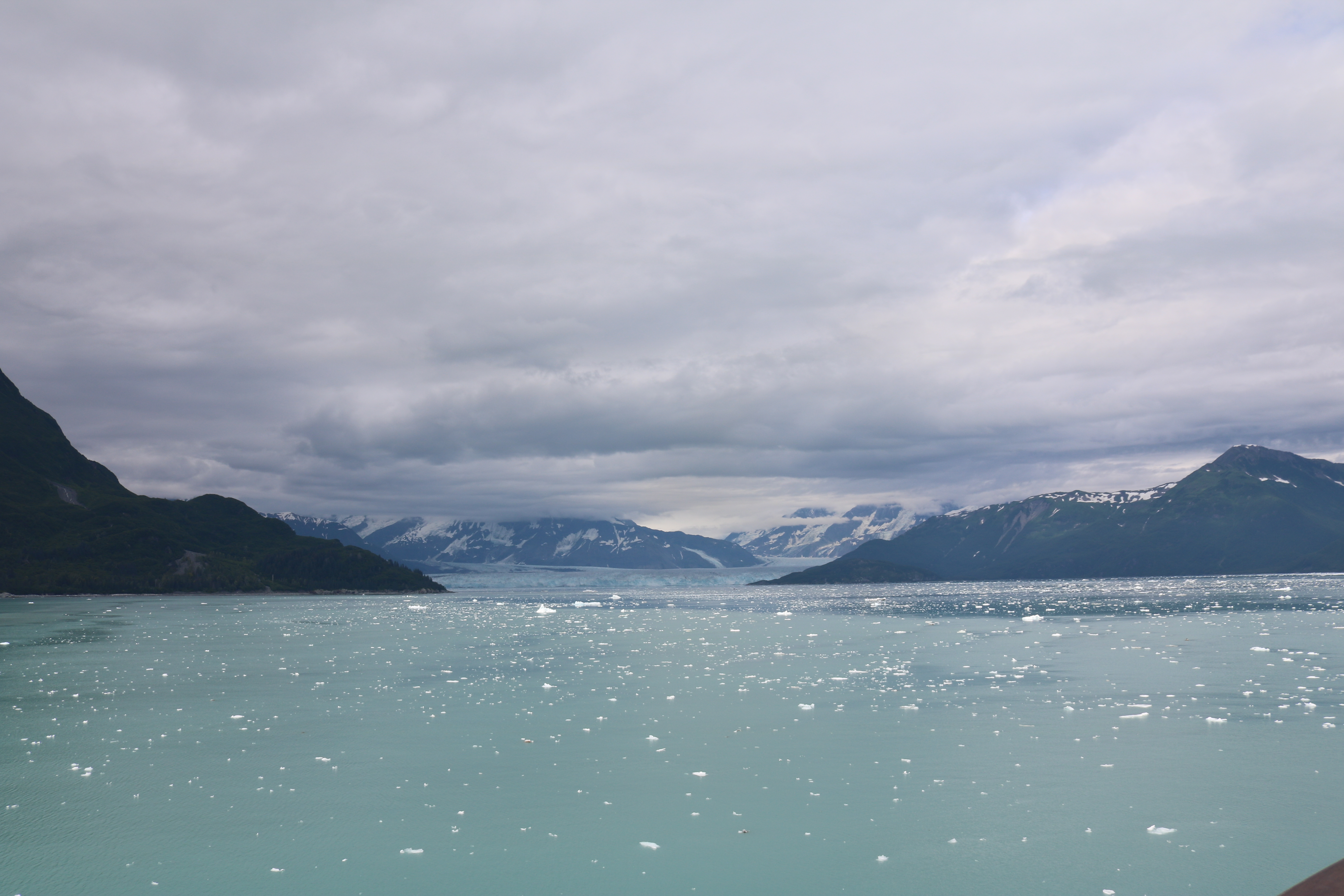
Our ship entered Yakutat Bay by 11 AM from Gulf of Alaska.  It was a breathtaking sight to see large icebergs that had calved out of the giant glaciers, floating around.


On to the West was  St Elias mountains ranges.  The mountains rise like a white pyramid to an elevation of about 6000 meter in one of the world’s most dramatic transitions from sea to summit.  The Fairweather mountain ranges lies on the Eastern side of the Bay.  These mountains are scarred by glacial activity from the Ice Ages to date.


As we sailed through the Bay, more ice bergs, both small and big, were sighted as we sailed into Disenchantment Bay.  This bay was  named Puerto del Desengano (bay of disenchantment in Spanish) by Alessandro Malaspina in 1792, when he felt ‘disenchanted’ that the bay was not the entrance to the North-West Passage.  He was in fact looking to sail through the Arctic Ocean to Europe through the North-West Passage.


(Map courtesy of the US Geological Survey)

As our ship entered Disenchantment Bay, we could see Hubbard Glacier from over 50 km. This massive glacier is a staggering 125 km  long, 10 km wide, and 400 meter deep. Its face is over 100 meter high, which is as high as a 30-40 story building.  Hubbard Glacier,  is one of the over 110,000 glaciers in Alaska and is North America’s largest tidewater glacier. Hubbard Glacier was named in 1890 in honour of Gardiner G. Hubbard, the founder of the National Geographic Society.


A Tidewater Glacier is fed by the snow that flow out of the mountains and down to the sea.  Saltwater of the sea ‘eat’ into the thick ice-wall, causing it to break off .  This process is called ‘calving’.

Hubbard Glacier has been thickening and advancing toward the Gulf of Alaska, in stark contrast with most glaciers, which have thinned and retreated during the last century. This atypical behaviour is an important example of the calving glacier cycle in which glacier advance and retreat is controlled more by the mechanics of calving than by climate fluctuations. If Hubbard Glacier continues to advance, it will close the seaward entrance of Russell Fiord and create the largest glacier-dammed lake on the North American continent as it had done in 1986 and 2002. Hubbard Glacier remains an ongoing study of calving glacier dynamics for the scientific community.


In 2002 the advancing terminus of Hubbard Glacier created a glacier lake dam which turned Russell Fiord in to a lake for about two and a half months. Rising water in the newly formed lake altered local hydrology and was a threat to nearby communities. During the two and a half months that the channel was dammed, Russell Lake rose 20 meter. In 1986 a similar scenario resulted when the glacier caused dam raised the lake level 27 meter over the course of five months. Erosion of ice dam from saltwater eventually carved a new outlet channel and restored the fiord to its previous elevation in both cases.


Our ship after being in Disenchantment Bay for over two hours turned around.  During this manoeuvre, the ship’s propellers churned out glacial deposits brought down by the calving ice bergs deposited on the ocean floor.

After sailing another two hours in Disenchantment Bay, our ship headed for the Glacier Bay.  We all were really ‘enchanted’ by the natural beauty of the hills, the bay, and the floating icebergs.  We were not at all ‘disenchanted’ as we were surely not looking for the North-West Passage to Europe.


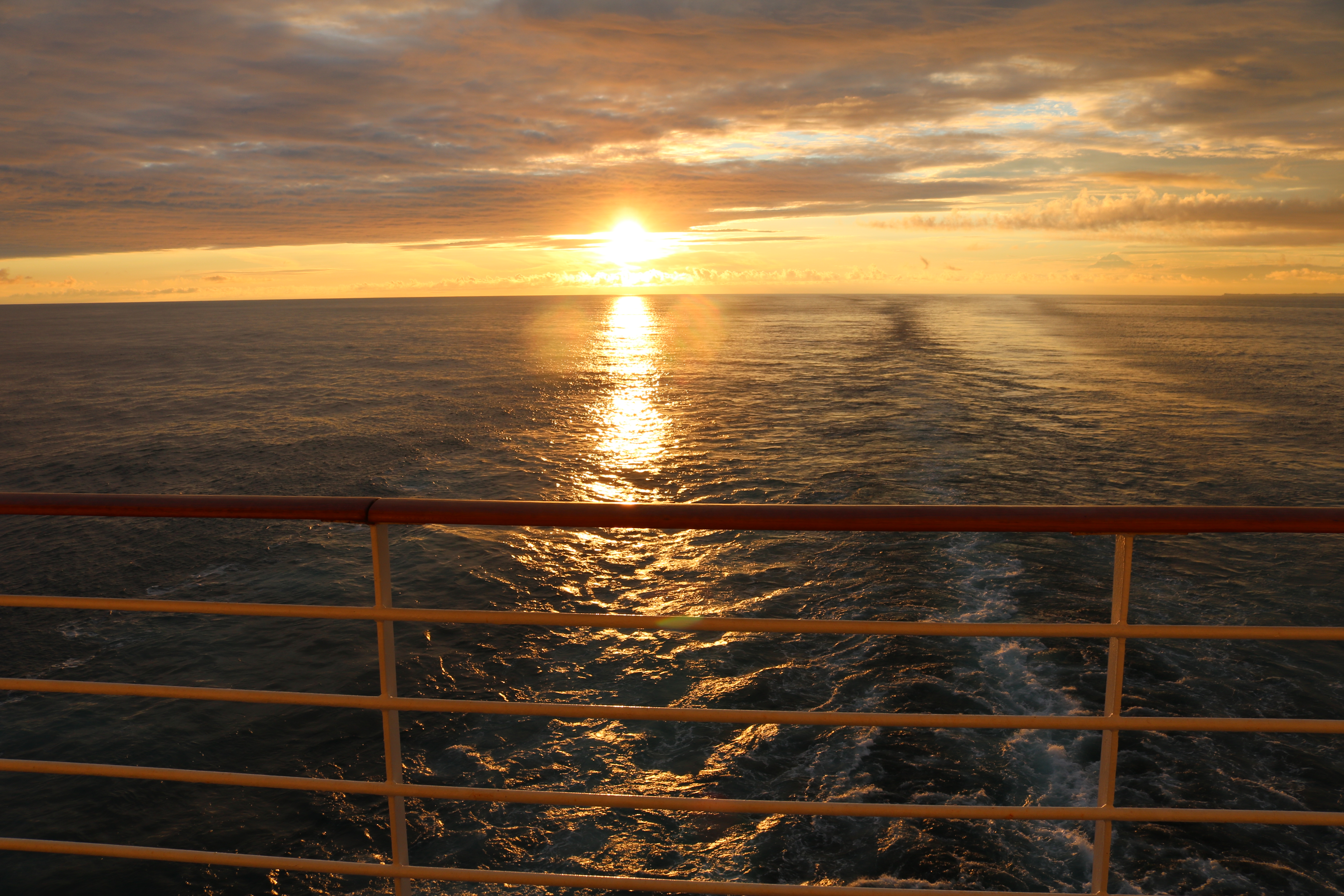
As our ship sailed ahead from the Disenchantment Bay, we watched the Sun setting into the Pacific Ocean – It was 10:45 PM.

Next :  Glacier Bay – Where the Birth of the World is Continuing

Alaska – Here We Are

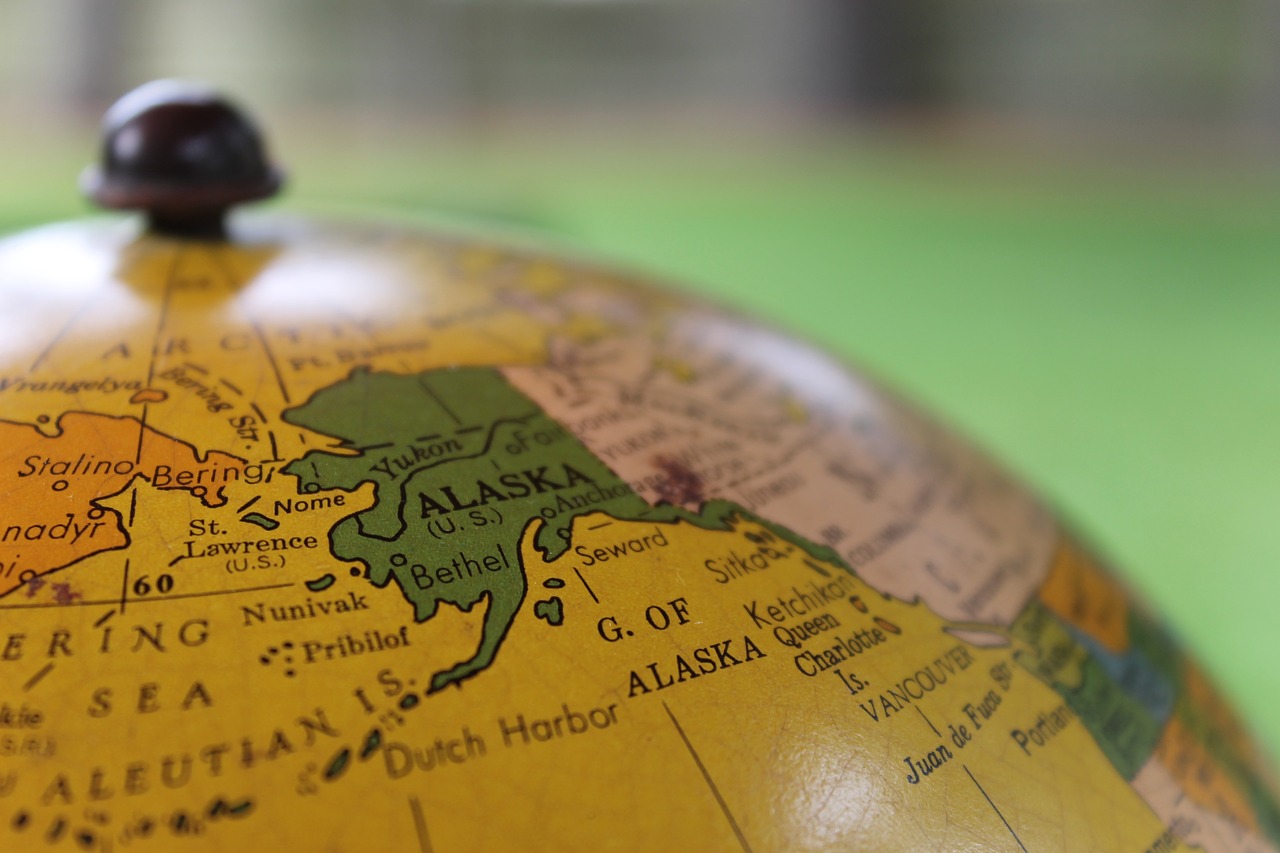
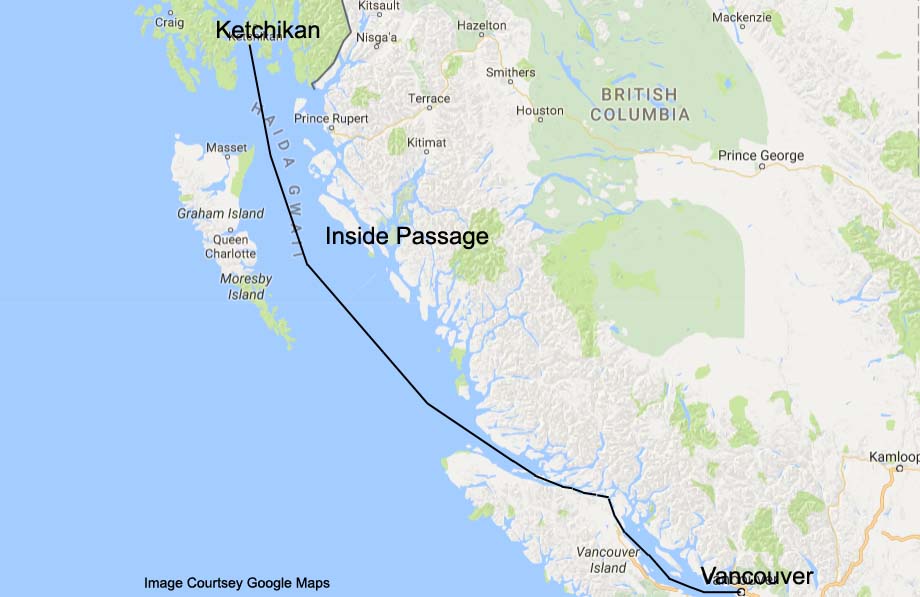
During the summer of 2017, we along with Stephens, our travel companions, booked Alaskan Cruise on Coral Princess luxury liner.  The cruise commenced from Whittier, Alaska, USA, sailing South-East and ending at Vancouver, British Columbia (BC),  Canada.

On 29 July 2017, we boarded the early morning Air Canada flight from Toronto to Vancouver on the first leg of our Alaskan Cruise.  The flight duration was of about five hours, but the clock only moved by two hours because the clock had to be set back by three hours as the time zone of Vancouver is three hours behind Toronto.

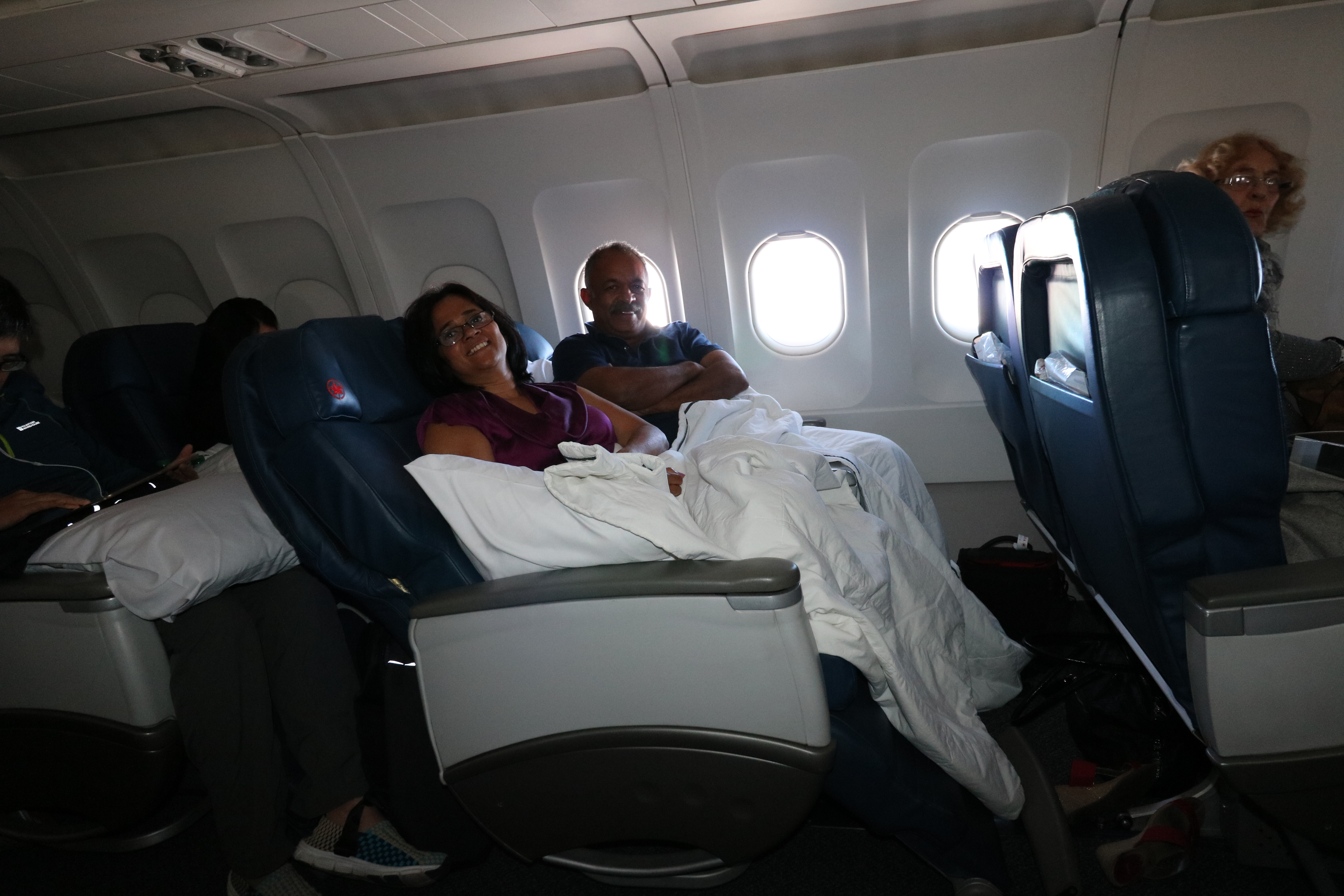
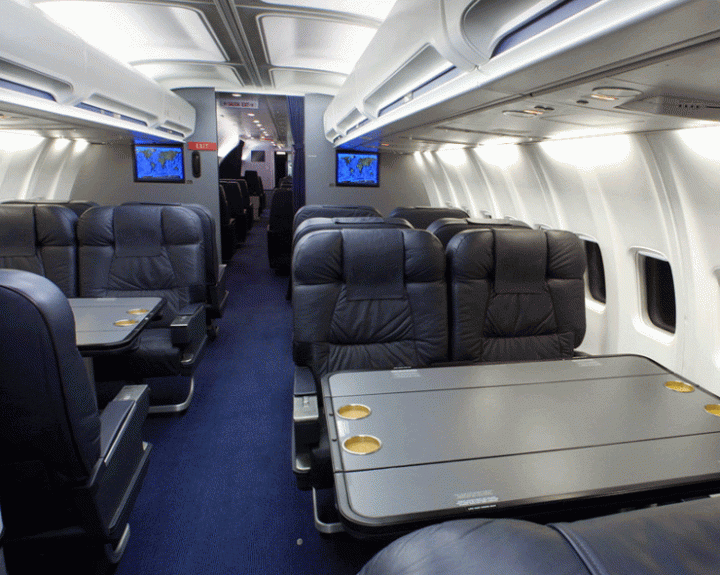
The five hours flight was made more comfortable than the regular one as the aircraft, an Airbus 319 variant deployed was the special charter plane used to fly various teams of the National Hockey League (NHL).  The aircraft had only 60 seats, that too all First Class, with all the accessories like comforters, extra legroom, LCD screens, etc.  Thank you Air Canada.

After a two hour stopover at Vancouver, we flew to Anchorage, the largest Alaskan City.  We were impressed by the Military Lounge at Anchorage Airport.  An effective way to project the power of a strong military, thus a strong nation, especially to  foreign tourists.  A country that respects its soldiers will always be powerful for sure.

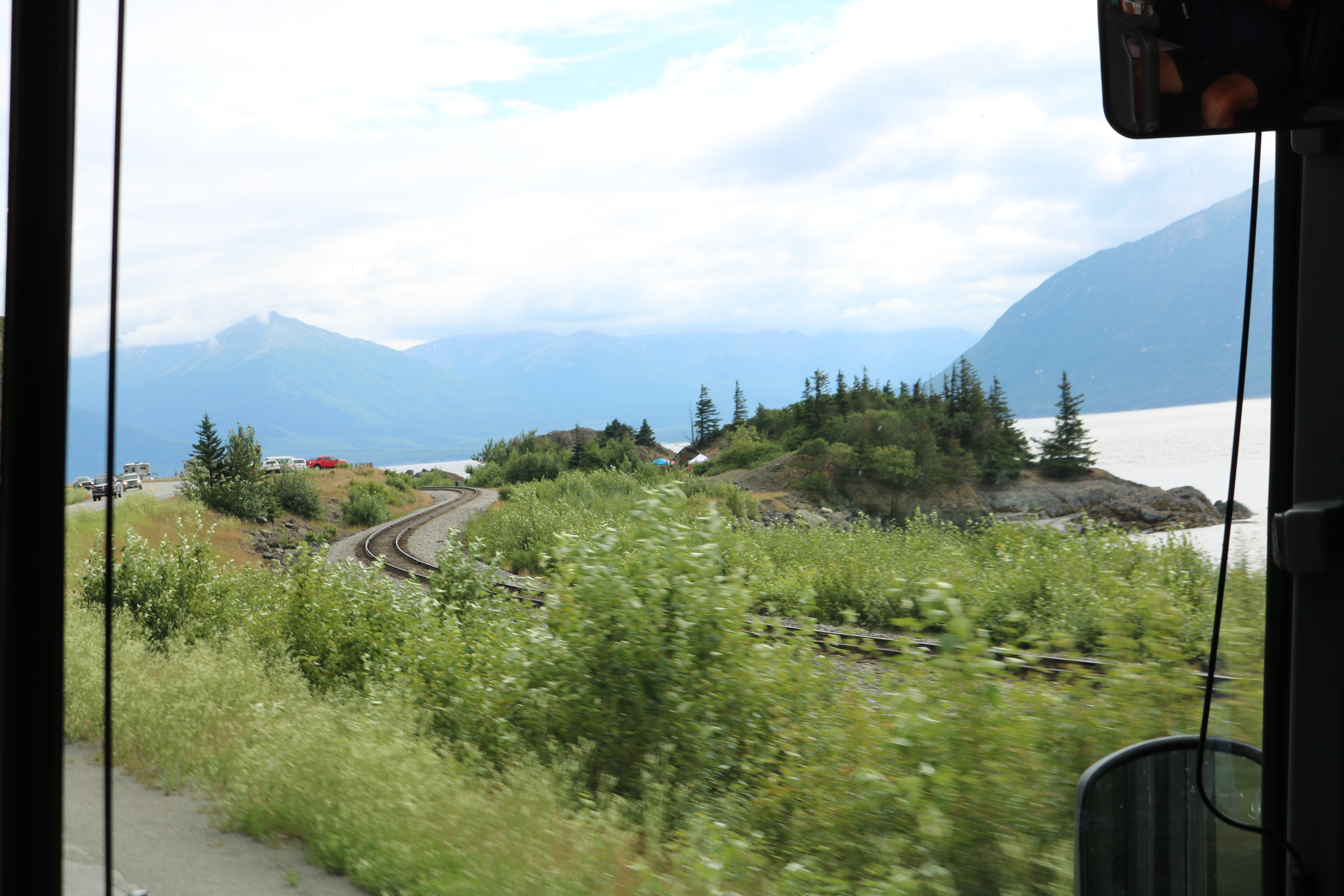
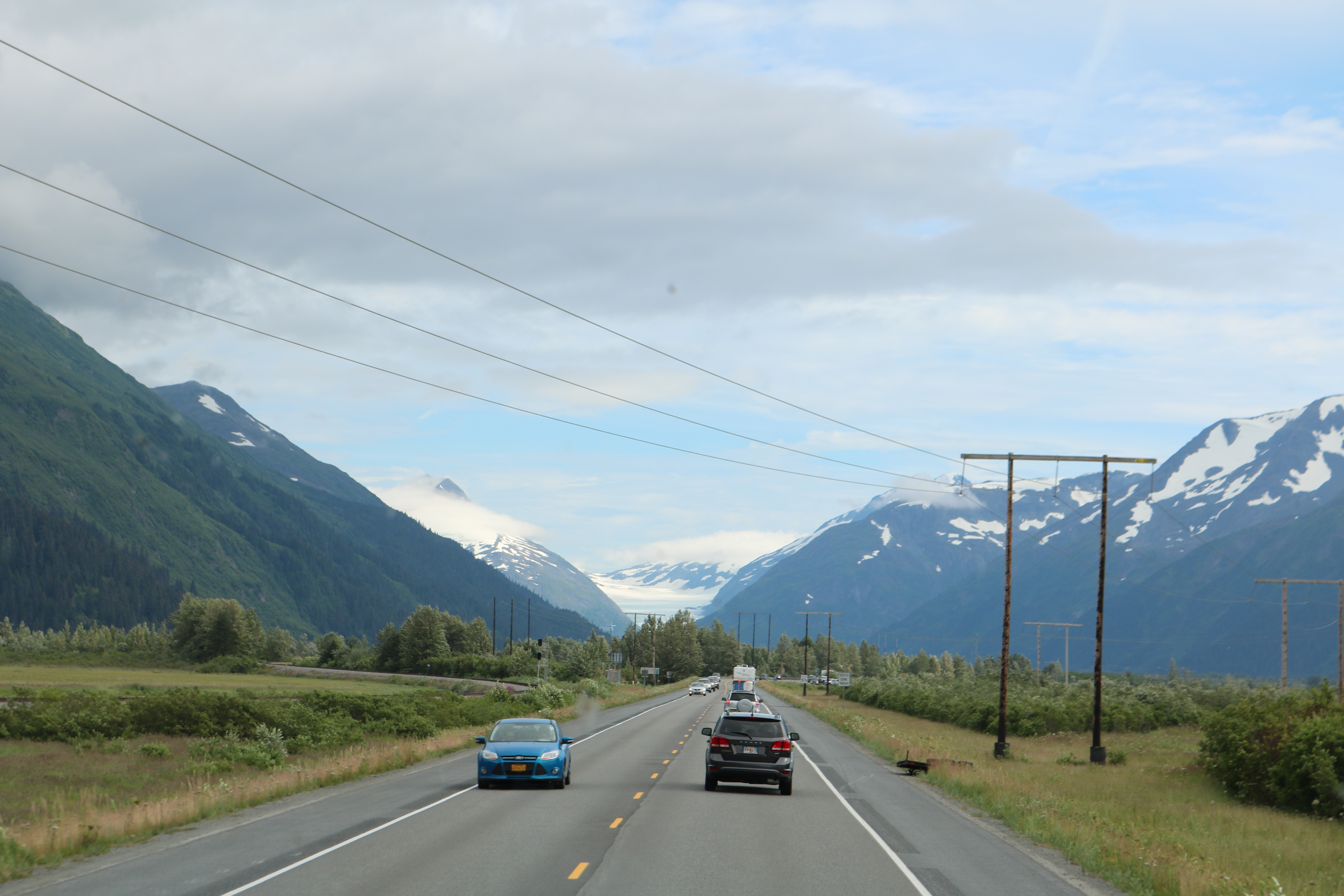
We boarded the bus for Whittier where Coral Princess, our cruise liner was anchored.  Route between Anchorage and Whittier on Portage Glacier Highway was very scenic.  The road ran parallel to the railway track, both hugging the coastline.  We passed through Anchorage Coastal Wildlife Refuge, known as Potter’s Marsh, a good place to spot migratory birds, water fowl and moose.

The road continued along Turnagain Arm, a body of water featuring the world’s second highest tides at over 30 feet.  We passed through Girdwood and Portage Glacier and the bus stopped at the entrance of Anton Anderson Memorial Tunnel, also known as Whittier Tunnel. It is a highway and railway tunnel that passes under Maynard Mountain. At 13,300 ft (4,100 m), it is the second-longest highway tunnel and longest combined rail and highway tunnel in North America.

We alighted from the bus at the banks of a lake formed by the melting Portage Glacier.  As the tunnel is one-way and is also shared by the railway, there is a schedule for traffic passing through it.  All the vehicles assembled in the staging area at the entrance of the tunnel.  At the scheduled time the convoy moved with buses leading the way.  Buses being public transport are given preference over cars.

Whittier Tunnel was constructed in 1941 to use Whittier as a rail port during World War II.  It is named after Anton Anderson (1892–1960), Chief Engineer of the Alaska Railroad Company and Mayor of City of Anchorage from 1956 to 1958.  The tunnel’s entrance portals are designed in an ‘A’ shape, with a large  door, which allows traffic in and out of the tunnel. The entrance portals are designed to withstand the force of an avalanche.

Ride through the 4 km tunnel was for about 15 minutes and surely there is light always at the other end of the tunnel.  As we emerged out of the tunnel at Whittier Port, Coral Princess, our cruise liner anchored there, came into our view for the first time.

Whittier came into prominence during World War II as it offered a shorter voyage into the Pacific Ocean and reduced exposure of ships to Japanese submarines.  It also reduced the risk of Japanese aircrafts  bombing the port facilities because of the high mountains around the port and bad weather for which Alaska is very famous for.  It pours all through the year and gets less than a month of bright sunshine every year.

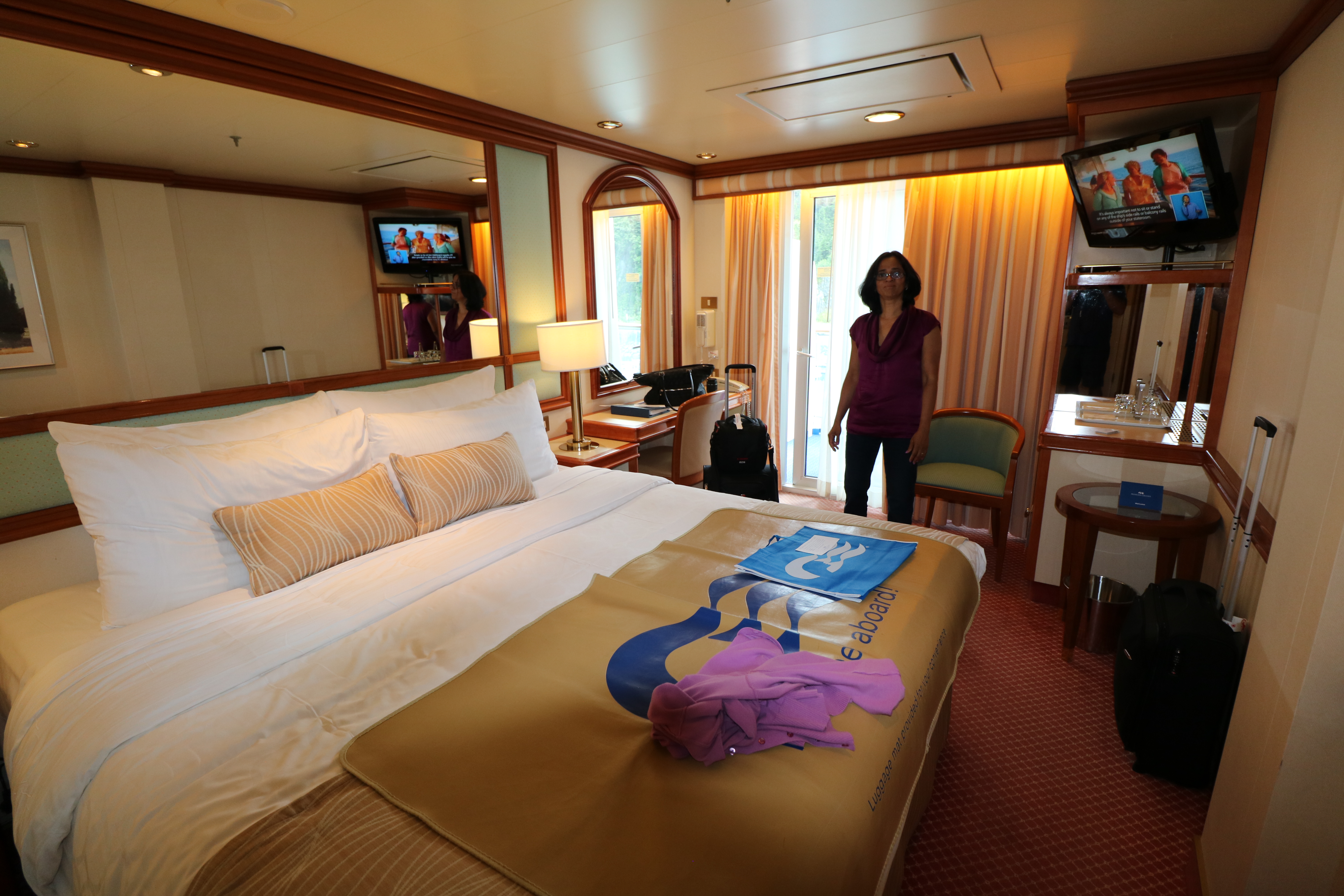
We were escorted into our cabin E731 on the eight floor of the ship.  The cabin was very spacious and comfortable with a balcony facing the ocean.

Adjacent to the port were small boats and fishing boat jetty and also the railway station where a train was waiting its schedule to cross through the tunnel.

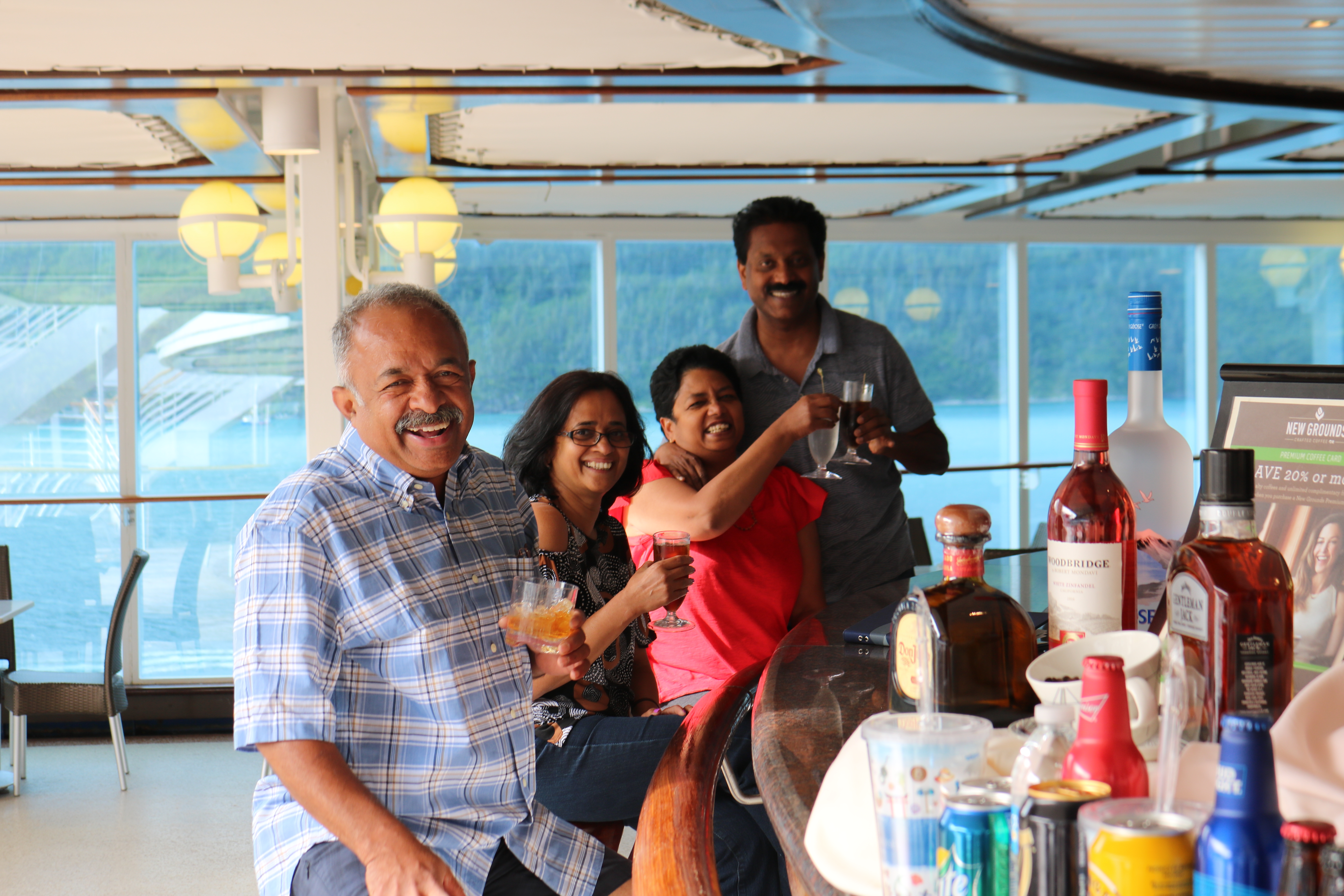
The ship casted off at 8:30 PM and we all headed straight to our watering holes for our first drink on board.

How did Alaska become the fiftieth state of the United States of America, detached from the mainland USA with Canada in between?

Russians colonised Alaska in the 17th century and exploited the local resources like fur and gold.  When Crimean War broke out in 1853, Britain, France and Turkey stood against Russia. Russia could neither supply nor defend Alaska during the war as the sea routes were controlled by the allies’ ships. There was a fear that British might blockade Alaska or even seize it.

Tensions between Moscow and London grew, while relations with the American authorities were warmer than ever. Russia offered to sell Alaska to the United States in 1859, believing the United States would off-set the designs of Russia’s greatest rival in the Pacific, Great Britain. US Civil War delayed the sale, but after the war, on March 30, 1867, US agreed to a Russian proposal to purchase Alaska for $7.2 million. The Senate approved the treaty of purchase on April 9.  President Andrew Johnson signed the treaty on May 28, and Alaska was formally transferred to the United States on October 18, 1867.

For three decades after its purchase the United States paid little attention to Alaska, which was governed under military, naval, or Treasury rule or, at times, no visible rule at all. Seeking a way to impose US mining laws, the United States constituted a civil government in 1884. Major gold deposit was discovered in the Yukon (Canada) in 1896, and Alaska became the gateway to the Klondike gold fields. Alaska became a state of US on January 3, 1959.

Next – Hubbard Glacier at Yakutat Bay

To Sir Without Love

Sir is a term for addressing males who have been given certain honours or titles (such as knights and baronets) in Commonwealth Countries and is strictly governed by law and custom. The term is also commonly used as a respectful way to address a commissioned military officer – surely not civilians. Equivalent term in the feminine gender is Madam and a young woman, girl, or unmarried woman may be addressed Miss. A knighted woman or baronetess is a Dame and a Lady, the wife of a knight or baronet.

In Kottayam, Kerala, there is a girls’ school called Baker Memorial Girls High School. The school was established by Amelia Dorothea Baker (1820-1904) of the Church Missionary Society (CMS). Miss Baker married John Johnson, another CMS missionary, who passed away in 1846. Miss Baker remained in-charge of the school in Kottayam till 1855. Her two sisters married CMS missionaries and three daughters of her brother Henry Baker Jr became teachers at the very same school. (Biographical Dictionary of Christian Missions, edited by Gerald H Anderson, Page 336)

The school today stands as a memorial to celebrate the efforts of the three generations of missionaries who dedicated their lives for the empowerment of the women of Kottayam through education.  Common folk of Kottayam until my student days called it as Miss Baker School. Remember, it was during the British Raj and everyone addressed the founder headmistress of the school, very respectfully, as Miss Baker. Today, could any student in the very same school address their teacher Miss Anita? I have often heard them addressing their teacher as Anita Miss (I could never make out as to what Miss Anita ‘missed’!)

On joining Sainik School, Amaravathi Nagar, Thamizh Nadu in Grade 5 in 1971, our first Class-Master was Mr MJ Raman, our Mathematics teacher. We were about 25 of us from Kerala and only one could understand English and the rest 24 of us knew only Malayalam. In our first class Mr Raman issued us books, stationary, etc and briefed us in English and I did not get any of what he said.

We then had English class by Mr KG Warrier. He asked us something like “Who asked you to do it?” in his Oxford accent and the Cadet who knew a bit of English promptly replied, “Raman Sir told us to do it.” Mr Warrier said “I know that Dr CV Raman was knighted but did not know that Mr MJ Raman was also knighted. You all will address your teachers as Mister or Miss followed by their surnames.” Those words were imprinted on our young minds and through all these decades until now, we have always revered our teachers but invariably addressed them as Mister or Miss, orally and in writing. Culturally, in Kerala as well as the rest of India, these modes of address have undergone mutation. Today, it is sacrilege for a college/ university student to address his professor as Mister Singh.

Please Click Here to read Blog-Posts about our teachers at Sainik School Amatavathi Nagar https://rejinces.net/category/sainik-school/

In Canadian high schools, students mostly address their teachers as Mister or Miss followed by their surnames. In universities, some professors during their introduction class specify their requirement. Some want to be addressed in the traditional manner and many with their first names or even shortened first names.

While interacting with an Indian immigrant teacher in Canada, he said he felt uncomfortable when the students addressed him as Mr George. He had taught in a college in India for over two decades and everyone addressed his as Sir and he felt that the Canadian students are disrespecting their teachers by not addressing them as Sir.

Addressing male teachers as Sir and all females irrespective of marital status as Miss shows a massive status disparity and sexism of previous years. According to Times Educational Supplement, Sir was first used in Sixteenth Century classrooms when male teachers of a lower social standing were attempting to reinforce their authority among largely upper-class boys. Miss (not anywhere near the status of Sir) is largely a Victorian era creation when women were pressurised to give up work after they married, with a number of schools only hiring single female teachers.

In the Dutch education system, children address teachers by their first name, using Juf or Juffrouw as a title for a female and Meester for a male teacher. Australians address their teachers as Mr/Mrs/Ms and surname. Sometimes if a teacher has a long or difficult-to-pronounce name, it is shortened to Mr PK, etc.

In Finland, it’s first names or even nick-names with teachers, no titles or surnames. The whole society there is very informal. French kids use the terms Maîtresse and Maître for female and male teachers respectively, meaning teacher. German students address teachers by using Herr/Frau and surname, using Sie as the polite form (Herr Schmidt, Koennen Sie…).

How do you wish to address your teachers? How do you wish your children addressed their teachers?

A Father’s Guide to Navigating Teenage Drinking

The Discovery

Bar at our Home

Our friend Joseph Kurian – Joe to those who know him – was cleaning up his daughter Meera’s room when he made a discovery: a bottle of cognac. His immediate concern was how to handle the situation. His fear was the usual one shared by most North American parents of teenagers: Going against an eighteen-year-old in America is like threading a minefield with no metal detectors.

It is very common for high school kids to consume alcohol. I found my scotch bottles near empty on several occasions and knew our son was responsible. Recently, Nikhil asked me why I never confronted him about it. My reply was straightforward: “Had it been your father, he would have poured water to maintain the level, ending up ruining the scotch. Thank God you didn’t do that.”

Nikhil’s explanation was equally candid: “Where else can high school kids get alcohol? Obviously, we take it from our dad’s bar. Otherwise, we need an adult to buy it from a store – and that costs money. So the easiest route is always the one teens resort to. Our parties cannot proceed without alcohol.

The Party Education

After his high school graduation party – complete with an after-party and an after-after-party at various friends’ homes – we picked him up the following morning at eleven. Marina asked how the party went.

Most kids didn’t know how to drink,” he said. “They threw up everywhere, and many girls ended up crying. By the end, I realised every girl was out to stab every other girl in the back. These girls are really complicated. We boys are much simpler. My group didn’t have any problems because I taught them how to drink.”

What have you learned?” Marina asked.

Nikhil explained: “Take a glass of water. Take a bite before drinking. Take your time with the first drink—don’t gulp it down. Take a bite, drink a glass of water, take a stroll through the party hall, dance to a song, release the pressure in the washroom if needed. The ritual continues throughout the night.”

Marina then asked, “Who taught you this?”

Dad!” came the instant answer.

Marina vented her frustration at me. Nikhil’s response was a lesson in itself: “You don’t teach swimming to a kid by standing on the ground. You have to put them in the water.”

Now Joe must put Meera in the water and help her navigate it. She needs an instructor, a coach to guide her through these waters—and a lifeguard. Who better than a father, all rolled into one?

The Science of Teenage Drinking

Teens have been experimenting with alcohol for generations. During adolescence, children are more vulnerable to addiction because the pleasure centre of the brain matures long before the decision-making part. Most teens, however, give up alcohol as they grow up—the thrill diminishes with age.

Statistically, children who have their first drink at age fourteen or younger are six times more likely to develop alcohol problems than those who wait until the Minimum Legal Drinking Age (MLDA).

A Global Perspective

It is interesting to note the wide variation in MLDA across countries:

  • No MLDA (19 countries): Bolivia, Cambodia, Cameroon, China, Indonesia, and others.
  • MLDA 16-17: Austria, Belgium, Cyprus, Denmark, Germany, Luxembourg, Netherlands, Portugal, Spain, Switzerland.
  • MLDA 18-19: Australia, Canada, Cuba, Czech Republic, Finland, France, Ireland, Israel, Italy, New Zealand, Philippines, Poland, Romania, Russia, South Africa, South Korea, Sweden, Ukraine, United Kingdom, Vatican City.
  • MLDA 20: Iceland, Japan, Paraguay, Thailand, Uzbekistan.
  • MLDA 21: United States, Sri Lanka.

In sixteen countries, alcohol consumption is illegal at any age: Afghanistan, Bahrain, Bangladesh, Brunei, Iran, Kuwait, Libya, Maldives, Mauritania, Pakistan, Qatar, Saudi Arabia, Somalia, Sudan, United Arab Emirates, Yemen.

In India, MLDA varies by state – from 18 in Goa to 25 in New Delhi. Realistically, enforcement is minimal, and monitoring is nearly non-existent. Most of our nephews and nieces in India, Canada, and the United States admitted to having consumed alcohol during their high school years.

Understanding Binge Drinking

Binge drinking – consuming five or more drinks at one sitting – can cause teens to pass out, feel sick, or behave abnormally. As a central nervous system depressant, alcohol consumed too quickly slows bodily functions, potentially resulting in loss of consciousness.

The Parental Role

As parents, grandparents, teachers, relatives, or friends, we have an important role to play. Interestingly, children from families where alcohol dependency or abuse is prevalent often appear to keep away from it. Preserving family rituals – established daily routines, family dinners, holiday celebrations – can make a significant difference in steering children away from alcohol abuse.

The need of the hour is open communication with teens about alcohol. Many parents are uncertain when to begin the conversation. Teens themselves are often confused about what to drink and when to start. Mostly, it becomes a group activity that devolves into a show-off scenario.

Parents must set the stage early, letting teens know they can talk about anything without the heavens coming down.

A Family’s Approach

Our nephew Joji, an engineering graduate, commented that if a situation like Meera’s had occurred in his home, he could not imagine the consequences. Marina often speaks openly with our children about her father and my younger brother – both of whom underwent alcohol de-addiction programmes. She also shares her own experiences with drinking and mine.

Practical Advice for Parents

It is crucial for parents to set a practical MLDA at home. The ultimate tool is communication with children. In awkward situations, take a deep breath, remember your own teenage years, and express your feelings positively – without finger-pointing or pontificating.

Please read my earlier Blog Post ‘Importance of Parent-Child Communication’ by clicking here.

Teenage binge drinking is a reality many families face, but it should never be dealt with lightly. Open communication and truly knowing your child will pay rich dividends in navigating these matters.

The Final Word

My conversation with Joe concluded on a lighter note: “Meera seems very classy—she chose a costly cognac bottle. Next might be a condom! So, start preparing for that. We’ll cross that bridge when we come to it. I don’t want to pre-empt you with my dose of advice.

The unspoken message was clear: parenting teenagers is a continuous journey, best navigated with honesty, humour, and unwavering support.

Legendary Lungi

For me, undoubtedly most comfortable evening home wear has always been the down to earth ‘Lungi’.  It is extremely comfortable and is an all season wear.  It is unisex – wearable by both men and women.  It is easy to wear without any hassles of zips, buttons or laces.  One got to  just tie at the waist.  Tying a Lungi at the waist is surely not any rocket science, but to ensure that it remains there is surely an art by itself.  Lungi provides free movement for the lower limbs and also air circulation, especially ideal for the hot and humid climate of Kerala.

A Lungi is a cotton sheet about 2 meter in length and over a meter in breadth and is characterised  by its plain, checkered, floral or window-curtain patterns.  By design, one-size-fits-all, both males and females and surely does not have any caste, creed or religion.  The only variation is that Muslims of Kerala wear it right to left, whereas others wear it left to right.  It is very difficult for a normal eye to make out this subtle difference.  Lungi is worn in India, Sri Lanka, Bangladesh, Pakistan, Nepal, Cambodia, Ethiopia, Myanmar and Thailand. ‘Mundu’ is its white cousin and is worn mostly outdoors in Kerala- to church, family functions and even to office.

While serving in the Indian Army, I wore a Lungi to bed, even in remote border posts – at altitudes above 10,000 feet when the mercury dipped to nearly 30 degrees below the freezing mark.  I wore it while serving in the North in Kashmir, in the West in the deserts of Rajasthan and in the humid jungles of Eastern India. It had no combat or camouflaged design or pattern as it was not an Army ‘issue’ item and did not figure in the ‘Dress Regulations for the Army.’

Once on my trip home on vacation from Sikkim, I called on Colonel Baby Mathew who was commanding an Artillery Regiment located near the airport from where I was to board the flight home.  On reaching the main gate of his regiment, the sentry on guard saluted me smartly and said, “Our CO (Commanding Officer) is waiting at his residence for your arrival” and he then gave directions to the driver about the route.  On entering Colonel Mathew’s residence, I heard his voice saying, “Head straight to my bedroom.”  There was Colonel Mathew, sitting on his bed, adorned in his favourite Lungi.  He ordered me to change into my Lungi and join him for a hot lunch of Kappa (Kasava or Tapioca) and fish curry – a Kerala Christian favourite.  While partaking the meal, Colonel Mathew said “I have placed my residence out of bounds for all ranks for the next 24 hours” – meaning no one to come near his house until I was there.  Obviously, the Commanding Officer did not want his command to see him and his friend in their Lungi.

In June 2002, I took over command of our Regiment in its operational location on the India-Pakistan border in Rajasthan.  The Regiment was mobilised from its peace location in Devlali (Maharashtra, near Mumbai) on that year’s New Year Eve.  The entire Indian Army had moved into their operational locations after the attack on the Indian Parliament building by terrorists believed to have come in from Pakistan.  The Indian Railways ensured that our Regiment, like all the other units of the Indian Army, were transported to their operational locations at super-high priority in two days.  The Military Special trains moved at speeds greater than that of many express trains and were accorded the highest priority.

The move back to Devlali from Rajasthan was the opposite.  An Army which did not even fire a single bullet, an army which did not fight a war surely  had no priorities in anyone’s mind.  The Military Special trains stopped at every possible station, even to give way to the freight trains.  Now we were the lowest priority in the eyes of the Indian Railways.  The onward move executed in less than two days now was sure to take a week.

On the day of our train’s move from Jodhpur (Rajasthan,) the soldiers loaded all the vehicles and equipment on the train.  After accomplishing the task, the Subedar Major (Master Warrant Officer) Thangaswamy had a rollcall to ensure everyone was present and also to brief the soldiers about the return journey.  As I looked out of my railway coach’s window, I saw the entire regiment standing.  I had a brain wave – Why carry all the soldiers on the train?  About a hundred of them is all what I require, mainly to ensure the security and safety of the train and the equipment.  Why not the rest of the soldiers be sent on leave as many had not met their families for a prolonged time due to the operational commitments?  Also, less of a trouble for the chefs to cook meals on a running train and less of administrative issues.

I stepped out of my coach wearing my Lungi and ordered Subedar Major Thangaswamy to only keep about a hundred soldiers and disperse the rest on leave for a week to rejoin at Devlali.  Everyone’s face suddenly brightened up but with that I was christened ‘Lungi CO.’

After moving to Canada, on a warm and sunny summer morning, I was watering the garden wearing my all time favourite Lungi.  There appeared our neighbour, Mr Win of Chinese descent and on seeing me wearing a colourful and comfortable costume enquired “Reji, what skirt are you wearing- looks really colourful.  Sometimes it is a full-skirt, sometimes half-skirt and sometimes mini-skirt.” –That was it! I discarded my favourite Lungi forever.

Jonah the Musical

On 01 July 2017, we along with Stephens, our travel companions, set out early morning to Lancaster, Pennsylvania, USA.  After eight hours of car ride from Toronto, we reached our hotel and checked-in by about 10 AM.

Lancaster is nicknamed the Garden Spot of America or Pennsylvania Dutch Country and located in South Central Pennsylvania.  The county is home to America’s oldest Amish settlement, where thousands still lead the age old lifestyle – without motor cars, without modern gadgets like cell phones, computers etc – but with their horse buggies, ploughs pulled by mules, homes without electricity etc.  It is called Dutch Country as most Amish settlers are of German (Deutsch) descend and have nothing to do with the present Netherlands.  It is called the Garden Spot because of the well drained plain farmlands which support agriculture, the mainstay of the Amish people.

In the evening we watched the Biblical Stage Show – Jonah by  Sight & Sound Theatre, a Christian faith-based, company -complete with grandiose sets, costumes befitting the time period, music and songs, use of modern technology like GPS to move various props around the huge stage – it was amazing. The center stage was very wide, and they also had props and action the left stage and the right stage.  They used the aisles in the seating area too for the actors and animals to make their entry.  They lighted up the ceiling of the theatre to immerse the audience into the ambience of day, night, storm, underwater – it was a journey into a different world.

The cast was fantastic and everyone fitted into their roles and the story being told very well.  Kudos to the technical and arts team, the changes of the sets were flawless and smooth.  In minutes one was transported from a little town to a sea port, then to a ship bumping through the storm ravaged seas to an evil town.  The props were magnificent and huge -especially the ship covering almost half the stage.  The details have been really gone into designing the ship with all its sails, masts and the most amazing was the lower deck when the hull opens to show the inside of the ship.  Truly Fantastic!

It was real technical wizardry and art on display all through the two hour show.  They have made three dimensional ancient cities come live with people and animals.  A fleet of boats sailing across the stage, and a 50 foot ship being tossed up and down in a storm at sea is amazing.  After intermission, the entire theatre is transformed to an undersea world with schools of exotic fish swimming about, beautiful iridescent jellyfish floating above our heads, sharks prowling for prey, colourful clownfish and seahorses swimming around, and a giant whale swimming over our head.

The story of Jonah has been scripted very well with a fine touch of humour.  The story has been extended to fill two hours, but will never distract the audience even for a second.  The story dates back to about 700 years before Christ where in a boy, Jonah gets a prophecy from God about the victory of the king of the Israelites.  When it comes true, he is declared a prophet and everyone waits for more prophecies.  God does not appear to Jonah thereafter, but the people of Gath-Hepher erect a heroic statue of him.

One day God ordered Jonah to go to Nineveh to declare the city’s wickedness and impending destruction.  Jonah does not want to save the people of Nineveh as his father was killed by soldiers from Nineveh and he hates the city and its people.  This forces Jonah to flee.

He goes to Joppa, a seaport and embarks on a ship sailing to Tarshish.  A storm rages and the ship is battered and tossed around by it.  Jonah, realising that the storm is God send to curtail his journey to Tarshish, orders the Captain to throw him off the ship.  Thus the storm dies down.

Jonah falls into the deep sea and the audience are transported into a serenely beautiful undersea world.  Jonah is gulped down by a huge whale and he survives this encounter for three days.  He repents and prays to God for mercy.  Now God wants Jonah to help the people of Nineveh find redemption.  God ensures that Jonah is thrown out from the whale’s stomach to land in the City of Nineveh.  Jonah keeps avoiding the people of  Nineveh as he hates his father’ killers, but ultimately understands the idea of forgiveness and redemption and saves the people.

The music and the songs in the play were apt and spectacular, especially the powerful voice of the Queen of Nineveh.   The show was supported by about 25 stage technicians who run the show and the 48 actors who star in it.  They all have done a remarkable job bringing a story alive both as a spectacle and as a Biblical message.

Some history behind the Sight & Sound Theatre.  It was founded by Glenn Eshelman who painted landscapes as a boy. As he grew up, Glenn continued to pursue his artistic interests, eventually buying a camera to take reference photos for his paintings. After marrying Shirley, Glenn sold his artwork out of the trunk of his car to make a living. In 1964 he presented a scenic photography slide-show at a local church using a slide projector, a turntable for musical underscore and a microphone for narration. This was the first unofficial “Sight & Sound” show.  By the mid-1970’s, Glenn and Shirley took their slide-shows around the United States.  They formed the Living Waters Theatre in 1976, marking the birth of  Sight & Sound Theatres.

In January 1997, a devastating fire destroyed the theatre, but the couple rebuilt it in 18 months.  The new 2000-seat, state-of-the-art theater featured a massive, 300-foot panoramic stage that wrapped around the audience, with the ability to house sets four stories tall.  They have now further enhanced the theatre by incorporating the modern technological light & sound equipment and software, coupled with other technologies like GPS and digital communication.

York-Durham Heritage Railway

On October 1, 2016, we embarked on the York-Durham Heritage Railway train on a trip around the city of Uxbridge, about an hour’s drive from Toronto.  The York-Durham Heritage Railway trains operate on the original Toronto & Nipissing (T&N) rail line, built in the late 1860’s. This line was built to allow its owner, William Gooderham, a distiller from Toronto, to carry grain to his distillery as well as lumber.

On March 4th, 1868, the Company was chartered, and construction began the following year. As it was advantageous at that time to have the rail line pass through any town, many paid handsomely for the privilege. Markham raised over $4,000 in one evening, and Unionville made a successful last-minute effort to have the line rerouted after it bought $500 worth of shares. The town of Uxbridge was chosen for the site for the railway’s shops.

We reached the Uxbridge station, with its distinctive Witches Hat roof, owned and maintained by the Township of Uxbridge for the heritage journey. Uxbridge is situated in a beautiful valley on the northern slope of the Oak Ridges Moraine, about 64km northeast of Toronto, Ontario.  The York-Durham Heritage Railway reopened the line between Uxbridge and Stouffville in 1996 and has been running on summer weekends since then. The train journey of about 90 minutes.

After we boarded the train, the Captain of the train – the Conductor – briefed the passengers about the train and its journey, what to see and do with the coach attendant watching. All the staff running the train are volunteers.

The fall had set in (01 Oct) and the leaves were changing colours – before they fall off.  This gave a kaleidoscope of colours all through the journey.

The guard’s wagon of the train called the Caboose at the rear end of the train, acted as an office and living quarters for the crew of a freight train in the old days. A viewing Cupola is built to facilitate a crew member to look forward at the train to see if anything is amiss

The Baggage Car with open doors fitted with safety barricades is the best place to view the landscape while the train is on the move.

One side of the Baggage Car is a ‘Railway Play Station’ for kids, to keep the kids engaged all through the journey.

On the other side of the Baggage Car is the Souvenir shop and a snack-bar – all manned by volunteers.

The rail-road crossings do not have barriers like those along an operational rail line as the trains operate only on weekends.  It is the duty of the drivers who cross the railway line to lookout for approaching trains and stop.

A musician, again a volunteer, entertained the passengers with his melodies. The passengers also joined him in chorus.

A volunteer ‘Clown’ was also seen entertaining kids with his tricks on board

This is a limestone quarry enroute of LaFarge Cement Company.  Ontario has large deposit of limestone which supports the large cement manufacturing industry.

The journey was very pleasant, especially with the friendly, easy – going volunteer staff.  The staff obviously loved what they did.  It is an experience worth sharing as it goes to prove that a volunteer force can run a railway and much more.

Pelee Island : The Southernmost Tip of Canada

On July 08, 2017, we along with Stephens, our travel companions, travelled from Toronto to Lemington, a four hour car drive along Highway 401.  We boarded MV Jiimaan, a vessel 200 ft)in length that transports 400 passengers and 40 vehicles on Lake Erie from Lemington to Pelee Islands.  The cruise was of  about 90 minutes.  The ferry housed a cafeteria and the view from the deck was awesome.

Pelee Island, (42 Sq Km) largest island in the Western End of Lake Erie, is the Southernmost tip of Canada.  It was leased to Thomas McKee by Ojibwa and Onawa tribes in 1788.  The island’s name is derived from a French word ‘pelee’ meaning barren.  It remained barren, true to its name until it was purchased by William McKormick in 1823.

The Pelee Island Lighthouse was built by John Scott in 1833.  William McCormick donated the land and also served as its first light-keeper till 1840.  The lighthouse used to guide sailors through the rocky Pelee Passage in Erie Lake until it went out of service in 1909.

Only other way to get on to the Pelee Island is through the International Airport with a 3,300 feet paved runway.  Regular flights operate in winter when the ferry services are closed.  It serves as the emergency pickup point. It might be the smallest International Airport in Canada – it is International as it receives flights from USA, just South of it.

The population of Pelee Island is about 140.  In summer about 100 migrant workers land on the island to support both tourism and agriculture.  The island has a Police Station manned by two personnel, obviously there is hardly any crime and the last major crime was reported in 1920.  The Emergency Services is operated by two Para-Medics with an ambulance and a Nurse Practitioner manning the Medical Clinic.  Emergency cases are airlifted to the mainland at Lemington.  The Fire Department has a fire tender operated by volunteer crew.

This is the shoe tree which has an interesting history.  The tree was given up for dead and the home owner tied a pair of shoes on to it and it is believed that it re-grew thereafter.  All the migrant workers, on leaving the island at the end of the season now tie their work-shoes on the tree to bring them good luck.  Some do it with a hope to return to the island for work next year.

The island is mainly  agricultural based with about 5,000 acres of soybeans, about 1,000 acres of wheat, 500 acres of grape cultivation.  The centre of the island was a large marsh which was drained out to form the fertile agricultural land.  Thus most cultivation is done below the Lake’s level and hence there is always fear of floods.  The houses on the island are built on stilts to save them from flooding.

After spending the day on the island, we boarded the ferry on our return voyage to Lemington and then we drove off to Toronto.

പഴങ്കഞ്ഞി (Pazhankanji)

ഉപ്പുമാങ്ങ ഭരണി  (Uppumanga Bharani)

Pazhankanji – fermented previous day’s cooked rice soaked in plain water – was served every morning at our home while we were growing up. It was mostly accompanied by a pickle or ഉപ്പുമാങ്ങ  (Uppumanga) chutney.  Uppumanga is pickled tender mangoes in  brine.  After harvesting the tender mangos, generally in March-April, they are washed clean, dried and put into a large china-clay pitcher called a ഭരണി  (Bharani) with  brine and lot of fresh green chillies.  The mangos are now left to pickle up and is used to make chutney, with or without coconut, during the monsoons (June till September).  At that time availability of vegetables from our farmland around the house depleted as new saplings were planted with the commencement of monsoons. During the monsoons, they would be growing up to yield their produce.

തവി (Thavi)

Amma made chutney with the Uppumanga and the accompanying chillies by grinding it with the small red button onions and grated coconut.  She also used it to prepare prawn curry.  I relished the brine from the Bharani which had the flavour of both the mango and the chili.  My brothers too loved it and obviously it was a strict ‘no-no’ for us to dip our hands into the Bharani as it might spoil the Uppumanga  Amma treasured.  Our hands could be dirty or wet and she did not want the mangoes to be infected with fungus.  She had a special തവി (Thavi), a large ladle made of  half shell of a coconut with a long handle made from coconut wood, to take out the mangoes.

Amma cooked every morning prior to leaving to the school where she taught and in the evening on return.  The rice for the dinner was cooked in the evening and I observed that she always cooked an extra cup of rice.  On inquiry, she said it is for the guests who might come calling on in the evening.  In those days the last trip of the bus to Kottayam town was at 7 PM and all relatives who came over had to spend the night at our home.  Our home was about 20 km from our ancestral village as our father moved there next to Amma’s school so that she could spend more time at home and with us children.

Any rice left over after dinner was placed in an earthen pot soaked in water and left to ferment overnight at room temperature.  We did not have a fridge by then and hence this was the only way to store the leftover rice.  Next morning it was served as Pazhankanji. It tasted a lot better when one had it using a spoon made out of a Jack-Fruit leaf as shown in the image above.  In case poor and hungry people came calling, were served this.   If any of it was still left, it was put in the feed for the cows we reared.

As per Ayurveda and common popular belief,  consuming Pazhankanji has the  following advantages:-

  • Rich in B6 and B12 Vitamins.
  • Easy to digest and hence the body feels less tired and one feels fresh throughout the day.
  • Beneficial bacteria get produced in abundance for the body.
  • Excessive heat retained in the body overnight is relieved .
  • Reduces constipation as this is very fibrous..
  • It is said to lower blood pressure and hypertension subsides appreciably.
  • This removes allergy induced problems and also skin-related ailments.
  • It removes all types of ulcers in the body.
  • It helps in maintaining youthful and radiant look.
  • Consuming this is believed to reduce craving for tea or coffee.

From where does the rice, known as കുത്തരി  (Kuththari), to make this divine Pazhankanji come from?

തഴപ്പായ് (Thazhappay)

Rice from our paddy field after harvesting is stocked in പത്താഴം (Pathazham), a large wooden box.  About 50 kg of this raw harvested rice it is taken out and boiled in the evening in a large copper vessel  until the husk break open a little.  This is left overnight and next morning it is drained and sun dried on a തഴപ്പായ് (Thazhappay) – a mat of 12 feet by 30 feet made from the leaves of screw pine.  We children had to be sentries for the rice being dried in the sun to ensure that the brood of fowls we reared did not feast on the rice and also to shoo away the crows.  Another task was to turn the rice over using our hands and feet to ensure exposing of the entire rice to the sun to facilitate even drying.  In case one spotted a rain bearing cloud, one had to alert every member of the household to come out to pack up the rice and the mat.  In case they got wet, fungus infection was a sure shot thing in humid Kerala.  The only other task one was permitted during this sentry duty was to read a book.

After about two to three such rounds of sun drying were complete, the rice was packed in gunny bags and had to be transported to the rice mill for de-husking operation.  Our eldest brother was the mission commander and he hired a hand cart and we siblings loaded it up and pushed the cart to the mill with our eldest brother manning the controls of the hand cart in front.  At the rice mill, the semi-polished rice emerged out through a chute, the outer husk through another and the edible Bran – തവിട് (Thavidu) through another.  We had to collect these in different gunny bags and load them up in the hand cart.  After paying up the mill owner was the return journey home.  The inedible husk was used as fuel to be burned with firewood to boil the next lot of raw rice and the bran found its way to the cows’ feed.

A part of the rice husk was burned and the residue was sieved and to the fine powder.  Salt, powdered pepper and cloves were added to this to form ഉമ്മിക്കരി (Umikkari). This was used as tooth powder by all of us.  I was least surprised by the advertisements of modern toothpaste manufacturers claiming that they have all the ingredients that made up our Ummikkari in their product.

In the earlier days, when I was a little child, prior to the establishment of the rice mill, Amma hired women folk to do the de-husking operation in an ഉരൽ (Ural).  Ural is a stone cylinder about two feet tall and two feet in diameter.  On the top surface, a hole, six inch in diameter and depth is chiseled out to hold rice.  There is a five feet tall baton made of hardwood, with a metallic cover at the base, which is lifted up and pounded on the material inside the hole.  Perfecting the art of not spilling the contents while pounding is developed over time – to start with for any learner, the speed of pounding is a bit slow, but with practice, the speed really picks up.  In my younger days I have seen two ladies doing this in tandem.  Real precision timing and coordination is required for each pounding, else it could spell disaster.

With the advent of modern household appliances like grinders, fridges. mixies, etc and availability of pre-prepared, sorted  and cleaned rice and various other products have surely reduced the workload, but the taste of the natural rice still lingers on my taste buds.  The fridges for sure have made Pazhankanji a history, even in our home.

All Creatures Great and Small

All things bright and beautiful,
All creatures great and small,
All things wise and wonderful:
The Lord God made them all.               Cecil F. Alexander

This was a hymn we sang at the morning assembly at our school.  During my vacation in Kerala in April 2017, these lines came back to my mind as I took a stroll through the farmland behind our home.  Three small but great creatures caught my attention.  They are not great because the Lord God made them all, but because they were my companions as I grew up as a child.

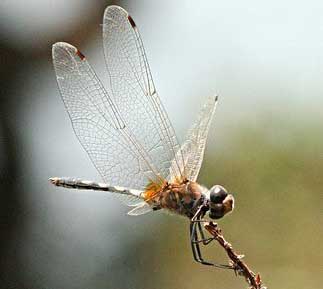
The very first is the Antlion.  It  is surely neither an ant nor a lion, else a little three year old kid could not have played with them.  The Antlion is called so because it feeds on ants and hence is like a ‘lion’ for the ants. In Malayalam it is called കുഴിയാന – Kuzhiyana – meaning an elephant in a pit.  It is surely not an elephant, but its hump looks like that of an elephant and it did live in a conical pit.  In North America, Antlions are called ‘doodlebugs’, because of the doodles they leave on the sand while looking for a suitable spot to dig its pit.  It is in fact the larval form of a dragonfly.

A fully developed Antlion is about a centimeter long, with a larval  life cycle similar to that of a caterpillar.  At the end of the larva stage, it spins a cocoon and after a few days an adult a dragonfly emerges.

Antlions like to set their pits in places where it is dry and where the soil particles are loose and small. They dig a circular, funnel-shaped pit and hide at the bottom of it. When an unsuspecting ant  falls into the pit, the Antlion grabs it with its jaws. The prey cannot escape the pit because the wall is crumbly.  As the prey tries to climb up, the grainy wall crumbles down.

Antlion with its bean-shaped body and ant like head appear to  move rearwards.  As a child, I used to locate Antlions’  pits and blow the sand away with my mouth.  As the sand blew away, exposing the Antlion, it would further dig deep down to escape until I caught it.  The Antlions caught would be stored in an empty matchbox.  After a few of these creatures were caught, I used to line them up like elephants paraded during Thrissur Pooram.  The Thrissur Pooram is held in the city of Thrissur in central Kerala (India) and is a cultural highlight that is unique in its pageantry, magnitude and participation. 30  elephants are paraded on this occasion, attired  with the traditional Nettipattam (golden headdress), decorative bells and ornaments, decorated umbrellas, palm leaves and peacock feathers, and beautifully-crafted kolam (paintings).

The Antlions grow into dragonflies and would flutter around in search of insects, their staple food.  As a kid, I chased and caught a few of them and tied a small thread to their tails so as to control them and make them take short flights.  Then I would prompt the dragonfly to pick up small pebbles and increased the size of the stones until the dragonfly could lift no more.  This sadistic game ended with the death of the dragonfly, when it severed its head from its torso.

The next creature is the dangerous  നീർ – Neer – The Red Weaver Ants .  They are found in the tropical forests of Africa, Australia and the Solomon Islands. In India I have found them only in Kerala.  All animals, insects, birds and humans are scared of them because of the painful bite they inflict.  They are very aggressive territorial ants and tend to be very aggressive and responsive to disturbance.  They have a vice like grip and tremendous strength while inflicting a painful slicing bite.  With the bite they spray formic acid into the resulting wounds.

They are seen in almost all fruit trees in our farmland, mainly the  mango and  jackfruit trees.  They are natural insect killers as they feast on the fruit flies that hover around these trees.  It takes a few minutes for a fruit fly to find a suitable spot on the mango and inject her eggs under the skin of the fruit and make the fruit rot.  The weaver ants on these trees chase them away or capture them. When other insects, squirrels or birds detect the scent of weaver ants, they prefer to stay away.

The only catch is that when one needs to climb these trees to get the fruits down.  Then one has to apply a strong insect repellent – usually kerosene – and carry a bag full of ash.  As one climbs up the tree, ash is spread all around to keep these weaver ants at bay.

These weaver ants are famous for the elaborate treetop nests they build. They are champions of cooperation when it comes to building a nest.   They build nests by stitching five to ten leaves together using larval silk.  They first find a suitable location on a treetop and then bend down the leaves and place them in a tent like shape.  Holding down such leaves demand the force of a thousand ants, each drawing down with all his might and the others fasten the joints to build a spacious nest that protects their colony from impending danger of predators.

Using precise coordination, the weaver ants create very strong ant chains by linking legs to pull and bend leaves into desired tent like positions. Then they  glue them with silk.  The silk comes from their own larvae.  The adults carry larvae in their jaws and squeeze them gently so that the larvae secrete a drop of silk on one end of the leaf edges. The ants then carry the larvae along the entire length of the leaf edges, squeezing as they go, using the larvae like living bottles of glue, until the edges of the leaves are stuck together from end to end.

Weaver ants live in a highly organized, co-operative society, where every individual has a role to play in the survival of the entire colony. Their jobs are based on their physique and they execute the tasks with utmost sincerity and discipline. Those in charge of food bring anything edible back to their colony to feed other ants.  They also have a workers army who construct the nests and repair them and very aggressively protect the nests filled with ants and their eggs.

As a child, I used to stand next to the mango tree and observe these ants at work.  I used to talk to them, reporting what all happened at home.  This time I did watch them curiously, but had nothing to talk to them.

Photographs Courtesy Sherrin Koduvath 

A Befitting War Memorial and Museum

Having visited many cenotaphs and monuments across Canada and also the War Museum at Ottawa in memory of Canadians who served around the world in the cause of peace and freedom, I was always baffled that my motherland India has only a handful of them.  Surely the Indians have a colourful military history, spanning over many centuries, covering the entire globe.  The Indian soldiers made up the majority numbers in World War I & II, but there is only the India Gate built in memory of these valiant soldiers who did the ultimate sacrifice in World War I and their names are etched on it.  There is no museum anywhere in India to celebrate the sacrifices of the soldiers and to document the military history of the land.

On 22 March 2017, I had the opportunity to visit the newly opened Punjab State War Heroes’ Memorial & Museum during my trip to the holy city of Amritsar.  It surely stands out as the very first such monument of India.  It celebrates the history of Punjab, the ten Gurus, the Sikh Kingdom, Indians in both World Wars and all the post independent military actions.

The museum is at it nascent stage, but surely takes the visitor through the ages.  The area has been aesthetically done up with its surroundings and the imposing high ‘Sword’ – it could well be the tallest such structure in the world, standing high at about 45 meters.  I was surely impressed by a line from the smart young tour guides who all said a catch line “The sword is weapon with its sharp edge facing towards Pakistan, depicting not war, but peace and prosperity”.  This spirit is what is being celebrated here – “Not war, but peace and prosperity.”

The guns, tanks, fighter aircraft, a model of India’s first aircraft carrier INS Vikrant and also two captured Pakistani tanks as war trophies; all add colour and decor to the seven acre monument.  The base of the sword with its four roaring lions and the various military equipment are all surely a delight for the ‘selfie’ mavericks.

The first gallery in the museum housed the history of the ten Guru of Sikhism and their contribution in spreading the message of love and peace.  The history of the Holy Book ‘Guru Granth Sahib’ from the first compilation of the Adi Granth to its current compiled version and the contributors of the Holy Book is very well brought out here.  It was surely a great learning for me.

The second hall depicted the military history of Punjab, mainly from the time of Maharaja Ranjith Singh.  The other galleries were dedicated to the wars fought by India post independence.  The display and layout is very impressive, especially the use of modern technology projection system to bring to life the real-near war scenario of the time depicted.  Obviously, being at a nascent stage with a hurried inauguration has left a few gaps and I am sure that the team working on the museum will do the needful to bring better authenticity to the displays.  Surely, in its present state it can stand in line with the many war museums I have visited in North America and Europe.  It not only depicts the military history of Punjab, but also ensures that it celebrates the Indian military history and bestows it the due place and recognition.  In future, I am sure that it will emerge as a centre for research and excellence in India and for the entire world.

The 7D Theatre running a show with the latest technology to tingle patriotism through all our senses, depicting India’s military history is the icing on the cake.  Having experienced a similar show at the Niagara, depicting the history of the Falls, I am sure this too will stun any visitor.  There is a bit of fine tuning required to exploit the 7D system to its hilt.

What needs to be done now?  Here are certain suggestions:-

The display rooms, especially post independent wars, could well be covered with camouflage nets to give the visitor a war ambience.  The walkways may be redesigned to depict communication trenches as seen in the Runn of Kutch, Rajasthan deserts, plains of Punjab, hills of J&K, the Eastern states, high altitudes and Siachen Glacier.  The base can be of glass and below it can be the soil of the area being depicted.  Playing of war music and songs of the relevant times will surely add to the ambience.

A gallery may be added to depict the life of our soldiers in Siachen Glacier and the high altitudes.

The museum could also arrange with the formations in Punjab to hold static equipment displays as well as a few manoeuvres, especially on weekends and holidays when the footfall would be at its peak.  The area behind the museum can be well employed for this, especially for the tracked vehicles.  This will surely go a long way in civil-military liaison and bringing our armed forces closer to the people.

Creation of an amphitheatre, keeping in mind the future plans for a light & sound show will reap rich dividends.  The theatre could also stage re-enactments and plays of various aspects being displayed in the galleries.  The same is being done in many locations in North America employing volunteer and professional artists with pyro-techniques during high footfall times and days.  The schools and colleges can be encouraged to stage their shows too.  The professional and amateur artists in and around the museum area can be contracted to come out with their versions.  This will surely boost their cultural talents and at the same time provide them with employment.

There is a need to collect and display war/ military artefacts and displaying them at appropriate places.  This may include medals, uniforms, Field Service Marching Order, First Field Dressings, shell dressings, boxes and bags, enamel plates and mugs, water bottles, flasks, crockery and cutlery – the list is endless.  It would also be worthwhile to collect war/ field literature in terms of letters, journals, diaries, note books etc used by the soldiers.  For the collection of these artefacts, there got to be a media campaign through newspapers, radio and TV.  It would be worthwhile to rope in the students too by the Education department sending circulars through schools and colleges.  Once collected, these priceless artefacts must be restored, preserved, catalogued and displayed.  This will surely be of immense help to future research scholars and will go a long way in preserving our military heritage.

Even though at its nascent stage, the landscaping of the area needs to be taken up on a war footing.  The horticulture department needs to step in with their expertise.  Water conservation with drip irrigation and such methods may be employed.  It would be prudent to create a nursery and a small green-house to ensure that the annual and seasonal plants would bloom in the area all through the year.  Surely a must for such a monument.

The sore point in many such Indian institutions is the sanitation and hygiene.  The washrooms need a thorough ‘working out.’  The janitorial staff got to clean it regularly on hourly basis the least and may be more frequently during rainy season and high footfall times.  Provision of clean and cold drinking water where the visitor is expected to spend at least one hour is mandatory.

With the dedication of the team behind the monument, one is sure that in the very near future this monument will be a world beater.  It will surely be a torchbearer for other states and the centre to follow.  This will stand out as a classical monument to remember the sacrifices made by the men and women who have served our great nation and the contributions of the daughters and sons of a great land Punjab.

March Break or ‘Breaking’ March

The schools in Ontario, Canada closed down for the March Break also known as Spring Break after Friday’s classes on March 10, 2017.  The schools will reopen only on March 20.  On Saturday/Sunday (March 11/12 night at 2 AM, the clocks are moved forward by a hour to cater for Daylight Saving Time (DST).

The Spring Breaks dates back to the 1930s when a New York swimming coach, looking for a warmer place to train his team moved them to Fort Lauderdale, Florida, USA, in the 1930s. Spring Break was made popular in the 1960s with the release of the movie ‘Where the Boys Are’  about a group of college students enjoying their Spring Break at the very same location.

In Canada, Spring Break is one of the busiest travel weeks of the year, when cross-border traffic volume increase manifold with parents and children moving to the US, obviously a warmer area, to spend the holydays.  The airports are jam-packed that weekend.  Many Canadians also use the break to escape the bitter winter cold for warmer climates like Hawaii and Mexico, leaving resorts and hotels fully booked.

Despite having the warmest February in Toronto’s history last month, it appears that March is more than making up for the reduced snowfall.  On Monday March 13, with the snowstorm, about a foot of snow is expected to blanket the area according to Environment Canada.  The storm is also expected to bring gusty winds resulting in potentially dangerous driving conditions and blowing snow. The above image shows our home at about 2 PM on 13 March.

The city has issued an extreme cold weather warning and the crews are out with their salters and snow plows to clear the snow to keep the traffic going.  Surely, it is bit of a disappointment for the children as most outdoor activities, other than snow-skiing ,is likely to be closed.  Parents are surely worried, especially those who intended to be on the roads, driving their children to various Canadian Spring Break locations. 

With the Spring Break comes the DST.  It adds one hour to standard time with the purpose of making better use of daylight and conserving energy.  Even though the Sun will rise and set as before, the clocks will show the time one hour later than the day before.  The first to use DST was Thunder Bay in Ontario, Canada In July, 1908.  Other cities and provinces followed suit by introducing DST bylaws.

The first country to introduce DST was Germany during World War I on April 30, 1916, when clocks were turned ahead one hour.  This was to minimize the use of artificial lighting in order to conserve fuel.  UK followed it up and many other countries, including France also did the same. Many countries reverted back to standard time after World War I and World War II marked the return of  DST in  Europe.

In the US, ‘Fast Time’ as it was called then, was first introduced in 1918 by President Woodrow Wilson to support the war effort during World War I. From 1945 to 1966 there were no uniform rules for DST in the US and it caused widespread confusion especially for trains, buses, and the broadcasting industry. As a result, the Uniform Time Act of 1966 was enacted which stipulated that DST would begin on the last Sunday of April and end on the last Sunday of October.

The US Congress extended DST to a period of ten months in 1974 hoping to save energy following the 1973 oil embargo. The trial period showed that DST saved the energy equivalent of 10,000 barrels of oil each day, but DST still proved to be controversial.  It was then reduced it to eight months in 1975 as many complained that the dark winter mornings endangered the lives of children going to school.

After the energy crisis, the DST schedule in the US was revised several times from 1987 to 2006. The current DST was introduced in 2007 beginning the second Sunday in March and ending on the first Sunday in November. DST is now in force in over 70 countries worldwide and affects over a billion people every year. The beginning and end dates vary from one country to another. In 1996, the European Union (EU) standardized an EU-wide DST schedule, beginning  last Sunday in March and ending  last Sunday in October.

It is believed that DST showed a decrease in road accidents by ensuring that the  roads are naturally lit during the peak traffic hours.  Studies also show that there is an increase in both heart attacks and road accidents on the days after clocks are set forward one hour in the spring.

RIP Mr KM Koshy (KMK)

When we reached Grade 8 at Sainik School Amaravathinagar, we graduated to the senior houses – Chera, Chozha, Pandya and Pallava – named after the historic Thamizh kingdoms.  The House Masters were the iconic figures of the school with Mr MV Somasundaram, the rationalist, at Chera House;  Mr M Selvaraj, the Thamizh Maestro at Chozha House; Mr PT Cherian, the man for all seasons, at Pandya House and Mr KM Koshy, the chemistry specialist, at Pallava House.  All of our classmates for sure will surely cherish what they have leant from these iconic teachers.
I have written about them in my earlier Blog Posts (Please Click on the links):-

Mr MV Somasundaram    https://rejinces.net/2015/12/20/the-atheist/

Mr M Selvaraj   https://rejinces.net/2014/09/16/the-linguists/

Mr PT Cherian   https://rejinces.net/2016/01/12/guru-dakshina/

SRamanujan Skit Gp Photo

Mr KM Koshy headed the Chemistry Department of the School till he emigrated in 1977 while we were in Grade 10.  He was an outstanding Chemistry teacher and he made the most complicated organic chemistry bonds look simple and easy to understand for us. 

He was actively involved with all the extra-curricular activities of the school and was a great actor.  The above image where Mr Koshy is standing in the middle, is of the Play on Ramanujan, directed by MrVekitesha Murthy and staged in 1977 to mark the ninetieth birthday of noted Indian Mathematician Ramanujan.  Mr Koshy essayed the role of Professor Hardy to perfection.  Please Click Here to read more about the play.  

He was passionately devoted to Chemistry and  had a rare talent for conveying his fascination to all of us.  He was a teacher who had a wonderful, compassionate way with us and a rare sense of humour that drew us to him.  He  loved Chemistry, especially Organic Chemistry and he made the subject come alive for all of us.

It is with heavy hearts that we announce the passing of Mr KM Koshy on Monday, 27 February 2017 due to cardiac arrest.  He has gone up to heaven to sit on the right hand side of the Lord, reserved for teachers of eminence .  His son Dr Rajeev Koshy was an year senior to us at School.    

Mr Koshy played a major role in our lives.  He has touched the hearts of a lot us, and the Amaravian Community will never forget him.  Rest In Peace.
Hindi Minimum or Maximum Hindi

Hindi Minimum Test, a test to assess the linguistic ability of cadets, used to be conducted  at the National Defence Academy (NDA) for all cadets in their second semester.  It was a well known fact that for most cadets who graduated from Sainik School Amaravathinagar (Thamizh Nadu) – known as Amaravians, it was a hurdle too high to clear.  So, we all had extra classes on Thursday evenings and all those Hindi Pundits at the Academy tried their level best to make us imbibe the national language.  Thus Thursday evenings became more of a school social at the NDA.  At the Indian Military Academy (IMA) the very same test was called Compulsory Hindi Test.
hindi1

The move by the Congress government at  the Centre in 1965 to impose Hindi on Thamizh population was the root cause of Congress being wiped out of Thamizh Nadu.  Rise of Dravida Munnettra Kazhakam (DMK) was also due to this imposition of Hindi.

Many argue that the agitations against Hindi have had an impact on the Thamizh psyche.  It is often claimed by the political commentators that the people from other Southern States learn Hindi along with their native language, but the Thamizh are fanatical about their language, cultivated by the Dravidian political parties.

It was bit easier for Mallus as the language Malayalam has nearly all the alphabets as the Devanagari script of Hindi Language.  Malayalam language is closer to Thamizh, but has borrowed its vocabulary and grammar from Sanskrit.  For a Thamizhan it is a nightmare to learn Hindi as Thamizh, being the oldest Indian language has limited consonants – only one ‘ka’ (க) in place of ka (क), kha (ख), ga (ग), gha (घ) and similarly for all other sets of consonants.  The Hindi Pundits never understood this very basic issue (and till date they do not seem to understand this fact or try and gloss over this fact) – else they would have to accept that Thamizh is older and more sacred than Sanskrit.  Where would the ‘Indian Nationalists’ hide their faces then?

Hindi propagated in the seventies and eighties by various governmental organisations also had its effect.  Hindi terms coined by them to replace commonly spoken English words were so confusing that even Hindi speaking population of North India would have had a run for their money.  National Television – Doordarshan – and All India Radio spewed out those tough Hindi words with venom.  This resulted in many homes in South India switching off their TV sets at 8:45 PM – on commencement of Hindi national telecast.

In the eighties,  opening up of media space for private players resulted in new channels using a medium – a mix of Hindi and English – which was better understood by everyone.

With globalisation and advancement of IT, the luck Indians rode on, mainly for maintaining English as a national language, was that many found jobs in the world market.  India ended up having a reservoir of English speaking educated mass, which attracted global players to establish business, especially in the IT field.

I do not even remember how I managed to pass the Hindi minimum test.  For using  idioms in sentences for पानी पानी होना I wrote –  जब मैं स्विमिंग पूल में गया, वहां पानी पानी हो गया and for पांचों उंगली घी में होना  I wrote –  जलेबी खाते वक़्त मेरा पांचों उंगली घी में था and the list of bloopers went on.  This was done knowing well that they were howlers, but it resulted in annoying the Pundits who tried their level best to ram Hindi down my throat and I really derived some sadistic pleasures from it.  With vengeance, (more than the keepers of the Thamizh culture, language etc as displayed during the Jallikattu demonstration) I coined new sentences and helped the Hindi Pundits in coining new words to enhance their vocabulary.  I was even successful to a great extend in creating new rules for Hindi grammar -the least it did was to put some doubt in the minds of the Hindi Pundits at  NDA.

Whatever it was, I managed to pass the Hindi Minimum Test in my Fifth Semester.  Some of the Amaravians struggled with it during their entire three year stay at the NDA and did not pass until their Final Sixth Term and special tests were conducted for them.  After three years of NDA and a year of training at the Indian Military Academy (IMA), I was commissioned to 75 Medium Regiment of Artillery.  The Regiment then had three sub-units -Batteries – manned by Jats, South Indians and North Indian Brahmins (Pundits).  For all the ‘fun‘ I had with the Hindi Pundits at the NDA, Gods must have been very unhappy with me or was it that Lieutenant Colonel AN Suryanarayanan, our then Commanding Officer (now a Veteran Brigadier) decided it wisely that I must go to the Brahmin Battery.  I ended up at the right place, I thought.  This resulted in me learning to speak proper Hindi for the first time in my life.  I learned Hindi from our soldiers and many spoke chaste Hindi.

In the Indian Army, the official publications and forms were bilingual – with English and Hindi.  It did not achieve much other than making the publications double their weight and increasing production cost.  I used to advice young officers in the Regiment to read the publication – Glossary of Military Terms –  because of the need to use and understand military terminologies is very important for a young officer, especially during training courses and also during tactical discussions.  This book was bilingual – with Hindi on the left pages and English on the right pages.  I would often suggest to the officers to read the Hindi side when they got bored of reading the English pages as they would find many of them totally out of place and some really humorous.

Nowadays, the Indian Army has done away with the Officer’s Hindi Minimum Examinations – to the delight of all Amaravians joining the NDA.


Something Special : The Indian Army Way

A Commercial That Speaks to the Heart

This video is a beautiful tribute to our soldiers – well worth watching, especially on Valentine’s Day. Do not be surprised that it comes from Malabar Gold, a jewellery chain in Kerala. The animation is exceptional, the script apt. It depicts how a senior army officer might counsel a young officer in such a situation. It celebrates the bonding and camaraderie among officers of the Indian Army. In truth, it is a real motivational video.

A Memory from 2002

Watching this television commercial, I was transported back to my Commanding Officer days in 2002. Our Regiment was deployed in the Rajasthan sector for operations since January. After I took over command in June, I noticed that most young officers – especially the newly married ones – had not been home to see their wives. Leave for everyone in the army at that time was severely curtailed, sanctioned only in extreme emergencies.

A Fortuitous Journey

After assuming command, I needed to travel to Devlali, our permanent peacetime location, to complete documentation procedures. Higher headquarters granted me permission to move out of the sector for a week. I seized this opportunity – perhaps wilfully misinterpreting the orders – and took two young Captains with me as my staff officers: the Adjutant and the Quartermaster. Their presence would facilitate the various documentation tasks.

We three booked train tickets from Jodhpur. Captain Subhash was bound for Devlali, where his wife was stationed. Captain Mitra’s destination was Ahmedabad, Gujarat, which fell en route; his wife was living with her parents there. I was headed for Devlali, as Marina had by then migrated to Canada.

The Plan Unfolds

Our train was scheduled to stop at Ahmedabad at daybreak. Subhash called Mrs Mitra with careful instructions: prepare breakfast for the Commanding Officer and himself, and bring it along. He added an advisory note – the Commanding Officer was a connoisseur of good food, so it got to be good.

Half an hour before the train was to pull into Ahmedabad station, Mitra woke us with a cup of hot tea and the brightest smile he could muster. That was when the devil in me began working overtime.

I instructed Mitra to step off the train – not onto the platform side, but the opposite. Subhash was to meet Mrs Mitra on the platform and break the sad news: her husband’s leave had been cancelled by the Commanding Officer at the eleventh hour due to unforeseen operational requirements. I would then walk in to meet Mrs Mitra for the first time.

The Moment of Truth

The train came to a halt. Everything proceeded as planned. Mrs Mitra waited on the platform next to our coach with her father, both smiling, eager to meet her husband who had been away for six months.

The moment Subhash broke the sad news, I walked in. I watched as dark clouds of sadness layered over her smiling face. Her expression shifted from radiant to dull, as if an arc light had suddenly fused. Her father comforted her with gentle reasoning: her husband was on important national duty and would be with her shortly.

I apologised sincerely for cancelling Mitra’s leave and assured her he would be sent home in two months. Mrs Mitra barely heard me. She stared with a dazed, blank expression.

Subhash reached for the breakfast hamper. “He hasn’t come, but we can have the breakfast. Haven’t you brought it for us?

The train whistle blew. We thanked them, climbed aboard, and stood in the doorway, waving goodbye.

Epilogue

Wishing all couples a Happy Valentine’s Day.

Falling in love is like looking at the stars. If you pick one among the billions and stare at it long enough, all the others will melt away.

For the soldier, love is measured in stolen moments, postponed reunions, and the quiet understanding that duty and devotion are not opposites – they are two sides of the same coin.

Canada’s War Museum

war museum

The first time we visited Ottawa, the Canadian capital, was in 2009, five years after landing in Canada. Being a soldier, I was very much impressed with the Canadian War Museum, especially as to how it serves to remind us of the sacrifices of soldiers across the globe and also sensitises us about the immense calamity any war can have on the civilisation. In 2014, Guillaume Le Floch, the French exchange student came to stay with us and we all visited the capital city and obviously we visited the War Museum once again.

Canadian War Museum was established 1880 in Ottawa to pay tributes to the men and women who endured the tests of war. Today the museum stands as a gratitude for the service and sacrifice of Canadians soldiers. The new, modern building, commissioned in 2005 on its 125th anniversary and the sixtieth anniversary of the end of WWII., emerges from the ground and rises progressively higher at its eastern end, closest to Parliament Hill. Its textured concrete walls and roof are somewhat reminiscent of a bunker, while a partially grass-covered roof is consistent with the Museum’s theme of regeneration and its environmental friendly design.

The museum also provides an evolving searchable catalogue of its collections. Types of artifacts found in the database include archaeological specimens, aboriginal arts and artifacts, folk art, furniture, war art, military objects, glass, porcelain, textiles and much more. This catalogue now contains more than 240,000 objects and is growing to include more than a million artifacts held with the museum.

Much of the Museum’s public exhibition space is devoted to its Canadian Experience Galleries. These displays underline the profound effect that war has had on Canada’s development and the significant role Canadians have played in international conflicts. Their content is a rich mixture of some 2,500 objects from war art to armoured vehicles, as well as scores of audio-visual displays and many hands-on activities.

The first gallery introduces the concept of war and its relevance to Canadians and Canada. Visitors explore the Canadian experience of conflict from aboriginal warfare and post European contact and the Northwest Resistance of 1885.

The second gallery covers the South African War (1899-1902) or, as it is also known, the Boer War, where more than 7,000 Canadians, including 12 women nurses participated. This war marked Canada’s first official dispatch of troops to an overseas war. This gallery also houses exhibits from the First World War. During World War I, Canada was a self-governing dominion of the British Empire, with its own foreign affairs. In 1910, the then Prime Minister Sir Wilfrid Laurier declared that “when Britain is at war, Canada is at war. There is no distinction.” Some 619,000 Canadians, about 7% of the population, had enlisted in the Canadian Expeditionary Force for service overseas.

The third gallery explores Canada’s fight against dictatorships overseas during the Second World War. The gallery introduces the visitor to the oppressive and aggressive dictatorships of the 1930s, and the mounting pressure for a strong response from the rest of the world. Britain’s declaration of war did not automatically commit Canada, as had been the case in World War I. The government and people were united in support of Britain and France. After Parliament debated the matter, Canada declared war on Germany on 10 September 1939. Prime Minister William Lyon Mackenzie King promised that only volunteers would serve overseas.  In the beginning Canada was unprepared for such a large scale war.  The regular army of 4500 men, augmented by 51,000 partly-trained reservists were deployed and was surely a modest beginning. The Second World War fundamentally changed Canada. Canada experienced industrial transformation and a booming economy during the war. New technologies and manufacturing principles produced enormous quantities of military supplies. By 1942, there was full employment as hundreds of thousands of Canadian men and women found work in war industries. As a result of its enormous military contribution during the war, Canada also became recognized as an important and assertive international actor, increasingly pursuing its own path in foreign policy.

The fourth gallery showcases The Cold War, Peacekeeping, and Recent Conflicts, 1945 to the present.  Canada became a respected international player through its commitments to Western defence and peacekeeping. The first Peacekeeping force consisted of Canadians to resolve the 1956 Suez Crisis.  Lester B. Pearson, the then Foreign Minister, who later became prime minister of Canada, won a Nobel Peace Prize for using the world’s first, large-scale United Nations peacekeeping force to de-escalate the situation. Since then, there was hardly a peacekeeping mission till date that did not have Canadian participation.

The LeBreton Gallery houses the Military Technology collection and is a diverse collection of vehicles, artillery and other large artifacts that tell the personal stories of war, from the eighteenth century to the present.

The Memorial Hall located in the Museum’s spacious foyer, is a space for quiet remembrance and personal contemplation. The concrete walls, grooved with large, offset rectangles, are reminiscent of the rows of white grave markers in Allied war cemeteries. The lone artifact is the headstone from the grave of Canada’s Unknown Soldier from the First World War, a simple bench the only furniture. Sunlight through the Hall’s only window directly illuminates the headstone every Remembrance Day, 11 November, at precisely 11 am, the moment the Great War ended in 1918.

The Regeneration Hall is a narrow, soaring hall with angled walls and a narrow triangular window that frames the Peace Tower on Parliament Hill. There is the Memorial Chamber in the Peace Tower that houses seven Books of Remembrance which record the names of the men and women who have given their lives in military service to Canada. (Please click to read my earlier blog). The hall is a representation of hope for a better future. High narrow windows spell out in the dots and dashes in Morse Code which stands for “Lest We Forget” and “N’oublions jamais”.

The Royal Canadian Legion Hall of Honour explores Canada’s long history of honouring individuals; how Canadians have remembered and commemorated their military past. Through personal stories, photographs, art and artifacts, this gallery shares the earliest forms of honouring through burial, painting or dance, to the erection of national monuments.

The Military History Research Centre has a comfortable main reading room. An Archives Reading Room is also available for researchers accessing archival documents, photographs and rare books. The staff is always available to assist you with research, answer any questions, and assist in accessing the collections.

“Spitfire Dance”, a dramatic musical entertainment in two acts, is staged by the War Museum. The musical is accompanied by World War II era songs, and it tells the stories of pioneer female aviators of the Royal Canadian Air Force, their courage, their daring and their frustrations. It is a memorial for all those women who dared compete in that most male of establishments of the time – aviation.

Every nation owes a debt to its fallen heroes that none can ever repay. The only way they can is to remember them, cherish them and honour their sacrifice. I conclude with the first four lines from Binyon’s poem For the Fallen, written in September 1914.

They shall grow not old, as we that are left grow old:
Age shall not weary them, nor the years condemn.
At the going down of the sun and in the morning
We will remember them.

Voice Modulation

Voice modulation is very important, especially to make any presentation or a speech impressive. The best method to achieve it is to undergo a bit of voice training and the easiest way is to attend a few lessons on vocal music, either Western, Hindustani or Carnatic. Our daughter Nidhi had undergone training in all the three and our son Nikhil was reluctant to do so. His clichéd excuse was that vocal music is not that manly. His ideas about vocal music training changed after we watched the movie The Iron Lady, a biographical movie about Ms Margaret Thatcher, the former Prime Minister of UK.

Margaret Thatcher

Ms Thatcher realised that her voice was a bit screechy and was deemed a problem when she first wanted to run for Parliament election. Women’s voices, especially shouting at the top of their voices in any parliament has always been accused for being too shrill. The movie shows her undergoing vocal training to reduce the shrillness of her voice to her optimum pitch and improve the projection of her voice. Improvement in both of these areas removed much of her shrillness and gave her voice a better projection and thus better impact.

Bingo! after the movie Nikhil enrolled for the vocal music lesson and did about a dozen classes. His voice modulation improved tremendously and after a few months he asked me as to how I knew that vocal music training would help. I said “fools learn from their mistakes, wise ones learn from others’ mistakes and idiots will never learn. Your dad was a fool and you need to be wiser.”

Here are excerpts of the Valedictory Address by Nikhil in Grade 8 (before vocal training) and Graduation Breakfast Address in Grade 12 (after vocal training.)

Decades of research have established that musical training has profound impact on the development of the brain. Many language skills, from reading to speech perception and production, rely upon phonological awareness, the explicit knowledge of the components of speech and how they can be combined.   Phonological awareness, in turn, relies upon the ability to categorise speech sound which are distinguished by small differences in timing and frequency content. Audiovisual processing is seen to be much enhanced in musicians’ brains compared to their non-musician counterparts.  Musicians are more sensitive to subtle changes in both speech and music sounds.

When children start learning music before the age of seven, they develop bigger vocabularies, a better sense of grammar and a higher verbal IQ. These advantages benefit both – development of their mother tongue and learning of foreign languages. During these crucial years, the brain is at its sensitive development phase, with 95% of the brain’s growth occurring now. Music training started during this period also boosts the brain’s ability to process subtle differences between sounds and assist in the pronunciation of languages – and this gift lasts for life.  It has been found that adults who had musical training in childhood still retain this ability to learn foreign languages quicker and more efficiently than adults who did not have early childhood music training.

How is music training going to develop one into a good speaker?

In order to get your ideas across well, captivate an audience, command or persuade your team to achieve a goal, it is important to modulate your voice to suit the occasion. In all these situations, your voice plays an important role in making a meaningful impact on your listeners.

We all like to listen to a confident and inspiring voice. A good voice is one that is easy to listen to and also command attention of the listeners, influence and inspire them. A good voice is a great tool in communicating any messages clearly, whenever or wherever one is.

Most speakers, however good they are, shy away from listening to their own voices. One got to accept one’s voice, but also realise that there is always scope for training. The aim of such training should be to develop some simple vocal skills to help you sound more confident and interesting.

Speed of the delivery of the speech, mostly too fast, causes strain to the listeners and results in loosing focus. The speed of your delivery is mostly dictated by your nervousness; more nervous you are, faster you speak. This results in loosing track of your thoughts and makes you mumble a few words and often results in a monotonous and uninspiring speech. To control the speed of your delivery, pause for a second or two after your first sentence. This allows the audience time to adjust to your voice and take in what you have just said. A good way to practise getting used to pausing is to read out aloud a from a newspaper or a book. When you get to a full stop make sure that you pause two or three seconds before moving on to the next sentence.

Most audiences get put-off by a dull and uninspiring speaker with a monotonous voice, a voice that is too quiet or a voice that lacks emphasis. You need to speak with energy and enthusiasm if you want your audience to listen to every word. If the audience cannot hear you, they will switch off very quickly. To avoid this you do not have to shout but you need to project your voice by emphasising the key words in the sentences. This will help you to project energy and passion into your voice and your voice will sound stronger and more confident. Emphasising words also tends to lift the pitch in your voice so that it is no longer monotonous but more varied and interesting to listen to. Select any text, underline the key words and read it aloud to practice emphasising these key words.

An expert voice coach can help you to discover your true voice; develop your own vocal strengths and thus communicate with greater influence in all situations. This is where the basics of classical music comes in to help you modulate your voice.

It is not too late for anyone to undergo a few vocal music lessons. The least one can do is to ensure that the generations to come are put through some vocal music lessons.

Canadian Winters with Scary Freezing Rains

Freezing Rain

While beautiful to look at, freezing rain is one of the most hazardous types of winter precipitation. Accumulations of a tenth of an inch of freezing rain may not sound significant, but is more than enough to break a few branches on the trees, bring down power lines (and cause power outages), and cause sleet on road surfaces.

During the scary freezing rain, the entire area is paved in a sheet of ice at about minus ten degrees Celsius.  This is hazardous, especially  for the morning commuters, resulting in many accidents on the roads and highways.  The drivers of the cars parked in the open find it difficult to even open their car’s doors as they either slip on the glass surfaced floor or the doors are jammed by the freezing ice.  These drivers first have to scrape off the ice from the doors and windshields and then drive on glass like roads.


The public transport is also affected as the drivers are extra cautious and driving slow on the icy roads.  It is compounded by many non-functioning traffic lights due to power outages.  The street cars (trams) are delayed due to ice forming on overhead power lines.  The trains are delayed, mostly due to failure of the signalling systems.  In effect, most people on a  freezing rain day reach their offices late.

Over a hundred flights are cancelled and many delayed due to the freezing rain.  The landing and taxiing surfaces have to be cleared of the ice regularly, causing major delays.  The de-icing activity has to be carried out on all aircrafts prior to take-off, contributing to further delay.

The problem of ice forming over the wings and tail of the aircrafts is a major concern as it adversely affects the performance of the aircraft, especially at take-off due to reduced lift. This ice has to be removed and the airports in Canada are equipped with deicers. These are vehicles that spray a mixture of a glycol and water, heated and sprayed under pressure, to remove ice and snow on the aircraft surfaces.

What causes the dreaded freezing rains?

FreezRain11

Freezing rain develops as falling snow encounters a layer of warm air deep enough for the snow to completely melt and become rain. As the rain continues to fall, it passes through a thin layer of cold air just above the surface and cools to a temperature below freezing point. However, the drops themselves do not freeze, but remain in liquid state due to a phenomena called supercooling.  When the supercooled drops strike the frozen ground (power lines, or tree branches), they instantly freeze, forming a thin film of ice.

The freezing rain drops on hitting a tree branch or a power line condenses around it as these objects are at a much lower temperature than the supercooled rain drops.  As they accumulate, the weight of the tree branch or the power line keeps increasing.  Once this weight crosses the strength of the material, it snaps and falls on the ground.  In case of a snow fall, the snowflakes even if they accumulate on trees and power lines, tend to slide off them due to their own weight.

The freezing rain leave streets under a layer of ice in the morning and results in the closure of many schools, colleges and universities.  The students are always very pleased with these ‘natural’ holidays.

Freezing Rain11111

Many customers experience power outages due to downed power lines or due to tree branches falling on power lines.  The crews of the power companies work overtime round the clock to ensure speedy restoration of power.

Police services and radio/TV channels warn motorists to slow down due to ice. It is expected of drivers to treat all lighted intersections without power as all-way stop signs.  That means any vehicle approaching a failed signal must come to a halt and the vehicle which halted first leaves first.  The emergency services always work at full efficiency to cater for many road accidents and to assist drivers who spin off the road.

Environment Canada gives sufficient warnings- generally a week – about the impending freezing rain.  Various TV and Radio News channels cover it in full details and warns the citizens to be careful and suggest preventive actions.  As soon as the rains stop, the salter trucks of the city spread salt on the roads and sidewalks to facilitate melting of the sleet that form on the surfaces.

How does salt act as an ice melter? All icy surfaces have a thin layer of water. When salt (Sodium Chloride – NaCl) applied to such surfaces, starts to dissolve. This ionises the salt into positively charged sodium and negatively charged chlorine ions. These ions, in turn, react with water molecules and form hydrated ions (charged ions joined to water molecules).

This process gives off heat, because hydrates are more stable than the individual ions. The emitted energy then melts microscopic parts of the ice surface. When an automobile drives over the ice, the pressure helps force the salt into the ice and more of this hydration occurs.

The ice-cream makers of the pre-refrigerator days employed the same principle (freezing point depression). The ice and salt mixture ensured that the temperature was well below the freezing mark (zero degrees C), even though the ice melted.  Dry Ice or solid carbon di oxide was also used as a more sophisticated alternative. That begs the question why is solid carbon-di-oxide (CO2)  called dry ice? This is because the solid carbon di oxide on being heated does not melt into liquid and instead changes directly into the gaseous state by a process called sublimation.

Canadian Snowstorm

Snowstorms result in accumulating snow on the roads resulting in hazardous driving conditions. Municipal authorities are mostly responsible for ensuring that the roadways, back lanes, sidewalks, active transportation trails and designated park pathways are cleared of snow the earliest. These are maintained in such a manner so as to provide safe and accessible operating conditions for motorists, cyclists and pedestrians; reduce the hazards of icy road conditions; and facilitate the handling of emergencies by Police, Fire and Ambulance Services during winter.

Snow Storm

Salters are sent out at the start of the storm when snowfalls do not exceed 8 cm (3″) and plows are sent to clear the roads when the snow on the roads is accumulating faster than the salt can melt it away (when snowfall exceeds 8 cm.) High traffic speed and volume roads are cleared first. Streets with less traffic volumes and lower speeds are cleared after the main roads to ensure that residents, and emergency service vehicles like fire trucks and ambulances can safely travel to hospitals, schools, work and residents can get to public transportation systems during or immediately after a snowfall.

Municipalities employ trucks for many horticultural activities during spring and summer. They are used for tree planting/ pruning/ cutting, watering (mounted with a water tank), grass cutting (mounted on a tractor), landscaping, etc. By fall, these vehicles (trucks and tractors) are fitted with a light dosser blade in the front and a salt dispenser mounted on to the body. The trucks are used for plowing the roads and the tractors for the walkways. They doze the snow away in the front while spreading salt from the back. Highway construction/ maintenance companies also modify their trucks for snow plowing. These trucks travel at about 100 kmph on the highways plowing the snow.

Approximately 150 kilogram of salt per Canadian is spread on the roads each year to make them safe for travel in winter. In Ontario the salt comes from the world’s largest salt mine located on the Eastern shore of Lake Huron in Goderich.

How does salt act as an ice melter? There is a thin layer of water on all icy surfaces. When salt (Sodium Chloride NaCl) is applied to such surfaces, salt starts to dissolve. This ionises the salt into positively charged sodium and negatively charged chlorine ions. These ions, in turn, react with water molecules and form hydrated ions (charged ions joined to water molecules.) This process gives off heat. That energy then melts microscopic parts of the ice surface. When an automobile drives over the ice, the pressure helps force the salt into the ice and more of this hydration occurs.

The ice-cream makers of the per-refrigerator era employed the same principle (freezing point depression.) The ice and salt mixture ensured that the temperature was well below the freezing mark (0 degrees C), though the ice melted.

Environment Canada has recognised that salt has adverse impacts on wildlife, plants, water and soil, and in 2001 considered adding it to the country’s list of the most toxic substances. Instead, in 2004, the government instituted a voluntary code of practices to encourage municipalities and others to use the deicer more sparingly, while maintaining highway safety. But with the vast amount of salt used, huge quantities are still polluting soil and water. It noted that after winter thaws, there were spikes in the amount of salt in streams with those taking runoff from the main highways having approximately double the concentration of the pollutant than watercourses nearby that don’t take storm water from the roads. Environment Canada says it is currently reviewing whether the voluntary practices code has led to any reduction in the amount of salt being spread on roads.

How Canada reduces use of salt for deicing?

Pre-wetting is the process of spraying the road surface with a liquid de-icing agent (salt brine) before spreading the salt on the roadway. A salt brine solution is spread on the roads before any expected freezing temperatures. The liquid starts to work before the precipitation starts to freeze. It acts like a barrier between the road and the snow/ice, so that it doesn’t stick to the road and cause slippery conditions. If no precipitation happens, brine stays on the road and last for several days. Pre-wetting results in less salt being spread, saving money and minimising threat to the environment. Wet salt clings to the road instead of bouncing off or being swept off by traffic.

A living snow fence is a barrier created by plants, shrubs and trees to reduce snow blown across roads. Planting trees and shrubs is not only more attractive and more environmentally friendly than building a wood fence, but also more convenient than putting up and taking down traditional snow fences. Snow fences force wind to go around and through the fence. This causes the wind to lose energy and speed. As the speed of the wind slows, the snow forms a drift before or behind the snow fence. How much snow a fence traps depends on the height of the fence and the amount of snow that falls. Manufactured snow fences are installed next to roadways that experience lots of blowing snow.

Another effective snow fence is standing corn in the corn fields all along the roads. Each year in late summer, participating farmers leave a swath of standing corn (six to 12 rows wide), parallel to the road and about 20 meters from the road. Farmers are compensated for this.

Delayed flights during and after a snowstorm is common in Canada. Salt can never be used on an aircraft due to its high corrosion properties. The delay is mostly due to the de-icing activity carried out on all aircraft prior to take-off.

The problem of ice or snow forming over the wings and tail of the aircraft is a major concern as it adversely affects the performance of the aircraft, especially at take-off as the lift may be reduced. This ice has to be removed and the airports in Canada are equipped with deicers. These are vehicles that spray a mixture of a glycol and water, heated and sprayed under pressure to remove ice and snow on the aircraft surfaces.

While it removes ice and snow, deicing fluid has a limited ability to prevent further ice from forming. If winter precipitation is falling, such as snow, freezing rain or sleet, anti-icing fluid is applied after the deicing process is complete. This fluid is of a higher concentration of glycol than deicing fluid. It has a freezing point well below zero degrees Celsius and therefore is able to prevent the precipitation that falls into it from freezing on the aircraft’s surface. Anti-icing fluid also has an additive that thickens it more than deicing fluid to help it stick to aircraft surfaces as it speeds down the runway during takeoff.


Canadians are fond of a good disaster, especially if it has ice, water, or snow in it. You thought the national flag was about a leaf, didn’t you? Look harder. It’s where someone got axed in the snow.” —Margaret Atwood, in Strange Things: The Malevolent North in Canadian Literature, 1995

Hats Off

In the Indian Army, everyone, irrespective of their rank are expected to salute a dead body, whether it is of a fallen soldier who may be junior in rank, a civilian – why even if he is the enemy.  This is the image taken after the Kargil War of 1999 where the Pakistani soldiers are collecting the dead bodies of their fallen soldiers.  Note that every Indian soldier is saluting the enemy fallen soldiers, even though they killed many of their comrades.

Our Regiment once had the Quarter Guard – main guard room – located near the road frequented by civilian traffic.  Whenever a funeral procession passed by, the Regimental Guard ‘Presented Arms‘ and  offered a ‘General salute‘ to honour the dead.

It is a cliché in Indian movies when the police arrive at a scene of death, the inspector on realising that someone is dead, is shown removing his cap as a mark of respect.   Does the Police manuals lay down such an act?

It is rare to see the Police personnel saluting the dead anywhere.  Why they do not even remove their caps as depicted in the movies.  From where did this ‘Cap Off’ tradition begin?

History of removing headgear as a mark of respect can be traced back to the days of the knights, wearing helmets that covered their heads.  They lifted their visors to show their faces to their monarchs. superiors and friends as a sign of respect.  They used their right hand to lift their visors to show that it did not hold a weapon as most soldiers were right handed.

This practice quickly caught on.  Later, the helmet or hat became a part of the soldier’s uniform and thus it began to be thought to be disrespectful to take it off.  It is a lot dangerous to take off a helmet in battle with gunfire and other shrapnel flying around.  The salute with the right hand now replaced the gesture of lifting the visor or removing the headgear.

By the 20th century, hats were pretty much worn by everyone in the West when they went outdoors, as it kept the sun off in the summer and kept the head warm in the winter.  In addition to this, in the cities there was an amazing amount of industrial dirt and grime and the hats were good for keeping the dirt off the head and out of the hair.

Men’s hats are easily removed, but women’s hats with ribbons, bows, flowers and other decorations can be quite a task to remove, especially if they are anchored with hatpins, messing up their hairdos. Hence, only the men were expected to remove their hats as a mark of respect.  Proper hat etiquette defines that while removing the hat, the lining should never show, for obvious reasons.  One must always hold the hat in such a way that the outside is all that is visible.

Men generally ‘tipped’ their hats, or removed them, in the presence of women as a sign of good manners and respect. This developed into removing one’s hat when indoors as a sign of respect and trust.  When entering a home or a building, a hat was generally removed immediately upon entering.

From this originated the expression ‘Hats Off’ normally used when you wish to show your admiration for someone.  Hence it was a ‘male only‘ expression.

There is another tradition regarding hats that when men put something on their hatband, it is generally placed on the left side.  Anything on a woman’s hatband is usually placed on the right side.  Is it because men generally commence walking with their left foot and women with their right?

Orators generally removed their hats while speaking–even when outdoors, for the audience to observe their facial expressions.  In theaters and while in a church, the hats are removed once the gentlemen took their seats, mainly as a consideration for those sitting behind.

Today many wear baseball caps as a fashion statement with some believing it to be cool to wear it backwards.  It is a good etiquette to remove such caps while indoors as there is absolutely no purpose to keeping it on; not even to cover up a bald spot or your badly kept hair.  So, Hats Off to all those who keep wearing their hats all the time, even while indoors.

The general rule for wearing a cap is to find one with a good fit. It should feel snug on your head to avoid falling off, but never so tight that it gives you a headache or reduces blood circulation.  Ensure that you always keep your cap clean.
Unless the visor is obstructing your view do not wear a cap backwards. Only toddlers wear it sideways.
A plain cap is any day better than a graffiti-laden lid.
In high-humidity environs or if you sweat a lot or plan on being in the sun, choose a cap made of a breathable fabric. In cold opt for warmer material such as wool or suede.

Is This a Propaganda?

dd

Great to read.  This was taking rounds in the social media and I have received it over and over from my enthusiastic friends.  Nothing wrong to feel that one’s motherland is great (I proudly proclaim that I am “Made in India”).

Like all those who proudly forwarded this image to me, I also fully believed it while in India, especially when it came from our social and religious leaders.  One always thought that the clergy would speak the truth, at least while standing in the pulpit of the church.  The case with other religions must also be the same.

My perceptions underwent a sea change after landing in Canada and especially after our daughter graduated from high school and our niece graduated from the Toronto University as a chemical engineer.

Once I heard a bishop of our church sermonising that marriages and divorce take place in the West like drinking a cup of tea.  The reality is that the bride and the groom have to bear the expenses of the wedding (cheapest I ever attended would have cost them over $50,000).  That is why they do not throw money at anything and everything like it happens in an India wedding.  Who cares, it is my dad’s money (baap ka paisa).  A divorce would also cost a similar amount or may be even more.  That must be the reasons for many a live-in relationships.

Like all other religious leaders, our bishops have a very narrow perspective about the West.  They all come here only to pocket the dollars and they go back home and tell a totally different story.  Recently I asked a 70 year old bishop from our church visiting here as to whether he is not affected by jet lag.  I have a terrible time for a week after I go through the ordeal of 16 hours of flying and resetting of my biological clock after every journey home and back.  Jet lag or no jet lag, he seemed interested only in the dollars he could extract, otherwise I do not see any reason for the frequent visits of our bishops here.  They do not want to go visiting our brethren in Nigeria or Uganda – the exchange rate is not Rs 60 to a Dollar.  They do not want to visit the soldiers defending the nation in the borders as there is hardly any money and also they are scared.

In case 38% doctors in the US are Indians, what are the Chinese doing?  Selling Chow Mein?  In October 2011, the Toronto Star reported the case of a taxi driver who performed an emergency delivery on an Air India flight from New Delhi to Toronto, turning a passenger cabin into a birthing room within minutes and improvising with makeshift instruments.  For 25 years this man worked as a paediatrician in India, treating thousands of children, saving many lives.

There are at least 7,500 internationally trained doctors in Ontario, Canada but fewer than 200 can get residency spots because they have to compete with young Canadians.  The internationally trained doctors have to re-certify and also pass the licensing examination like the Canadian graduates.  The pass percentage of Canadian graduates is pretty high and that of internationally trained doctors abysmally low, as the Canadian graduates are more familiar with the language and the system.  Similar is the case with most health related professions like the pharmacists and nurses.

My wife Marina once said that the main reason that she managed to qualify the pharmacist licensing examination here is that she accepted that she did not know the system and the language and she started to relearn from scratch.  She completed her pharmacy graduation an year after our marriage and did not work in India and this she says did not set in any practices (good or bad) in her.  Thus it was easier to restart and relearn.

I attended the graduation ceremony of our niece at the Toronto University where the top 10 graduates from each discipline was called on to the stage and were handed over the degree.  A vast majority of those who came on to the stage were of Oriental origin.  Similar was the case when our daughter graduated from her high school.

Our son attends “Gifted Children“ programme in high school where all students with a superior ability to grasp concepts and make connections are segregated and put into a separate class.  The segregation is done after they complete grade 4.  In his class also it is about 70% children with Oriental origin.  Two of our nieces who graduated from medical schools in US said that the situation there is not any different.

NASA for sure will never divulge the nationality or demography of its scientists as would be the case with ISRO – they will never give out a state-wise list of their scientists.  Racial profiling of the employees is considered unethical in North America and no company or institution will ever do it as it may attract many a legal battles.

While opening the Adobe Photoshop recently, the opening screen froze on my computer for a minute.  The screen had the names of all those who developed the software and no Indian name figured.  Either all those Indians working there are Syrian Christians with English names or Indians who adopted English names.  People of Oriental Origins have an English Adopted name as their names would be unpronounceable.

A Note that Dissonates, Once Again

backgroundscore

Our friend Suresh Nellikode invited me to watch Adoor Gopalakrishnan’s Malayalam movie ‘Pinneyum‘ on September 13, 2016 at the Toronto International Film Festival (TIFF).  I grew up watching classics of Adoor- Swayamvaram, Kodiyettam, Elipathayam and Mathilukal – which remain in my memory.  In all these movies I was impressed with the use of natural sounds with minimum background score, unlike many Indian movies.

In his latest venture ‘Pinneyum’ (Once Again), he has captured the natural sounds and used it to convey the time and the environment to the viewer.  Was it that effective like his earlier attempts?  Has Adoor done justice to the natural sounds which obviously changed with the times in Kerala’s rural background spanning a timeline of over 17 years?

The first time I left Kerala was to join Sainik School Amaravathinagar, Thamizh Nadu in 1971 at the age of nine.  Every year I came home for the summer vacations.  During this homecoming, I could not make out any changes to the ambient sounds of nature.  The wind created music, caressing the paddy fields downhill through the tapioca and pineapple cultivation uphill to our home.  A few notes changed with the swaying of the coconut trees and the tropical fruit trees – tamarind, bread fruit, jack fruit – that grew abundantly in our homestead.  The air had the aroma of the flowers in bloom or the fruits that had ripened. The road in front of our home had scant traffic with a few cars and the hourly bus service, only connection to Kottayam town.

Only one or two homes in the village, of those who could afford,  had a telephone and a car.  Obviously we could not afford either.  Even a wall clock and radio were rarities.  We had a wall clock, a mechanical pendulum one, which struck once every half hour and the number of hours at the hour.  This striking sound was a break from the sounds of nature – from the birds’ chirping and calls and the shrill cries of the crickets and the flying lizards – an evolutionary link between lizards and birds – which flew from one palm tree to another in search of insects.  Every household in the village reared cows, goats, chicken and ducks.  Their moos, bleats, rooster’s crowing and hens’ songs – filled the air all through the day.

The evenings marked prayer time and as one strolled along the road, one heard readings from the Bible, hymns and devotional songs – both from the Hindu and Christian homes.  The nocturnal music of the nature was very much different with the owls, insects and dogs pitching in with their parts.

The artificial sounds that one heard once in a while was from the Chenda (drums) of the announcer who came along the road to announce the release of a new movie in the village talkies – a thatched theater.  The temples and churches hired the Mike Set (Public Address system) and the Chenda Melam (ensemble of drums ) only on the annual festival days.  A Gramophone was a vital element of the mike set.  Luckily in those days the songs lasted only three minutes as one side of the gramophone record could only hold as much.

The early eighties brought prosperity to our village due to the increased salary of government employees, higher prices for the cash crops and spices the village produced and many seeking employment in foreign lands, mainly in the Gulf countries.  Our eldest brother moved to Sultanate of Oman.

The natural music I was used to during my annual vacations started to be corrupted by the artificial ones.  With every passing year, the changes were audible.

That was when the first Television came into our home beaming the national channel Doordarshan.  On Saturdays they telecasted a Malayalam movie and all the neighbours congregated at our home.  Our eldest brother brought in a digital electronic clock which chimed its musical notes every fifteen minutes.  Now the old mechanical clock got pushed away on to the wall of the side room and its Japanese cousin took its place of pride in the family room.  We also got a telephone connection and the metallic ringing sound of the rotor dial telephone also added to the milieu.

Exorbitant labour costs, pests and  crop diseases turned the village to rubber plantations.  Most tropical fruit trees were cut, tapioca and pineapple cultivation discarded – all to make way for the rubber trees.  The herbal plants which grew abundantly became extinct.  Many species of birds and the flying lizards disappeared as they could neither nest among the rubber trees nor could find any food.  Rice cultivation disappeared too being uneconomical.  Thus Kerala turned into a consumer state.

The traffic on the roads kept increasing manifold with new varieties of automobiles – from motorbikes to large trucks.  The Churches and Temples procured their own Mike Sets and the competition to please their Gods with highest possible decibel levels all through day and night commenced.  Thus the natural sounds now gave way for more synthetic tones.  The noise of the wind passing through the rubber trees was no more music to the ears.  Why, even the aroma in the air had disappeared.

The nineties marked the opening of the Indian economy and with it came telephones and televisions in every homes in the village.  The rotor dial telephone made way for their electronic avatars.  Cable Television came in without any government controls or regulations and in the absence of any red-tape, each and every home joined the cable yugam in a matter of few weeks.  This resulted in the many channels reaching the homes and families getting closeted indoors glued to the television.

With the turn of the century, cows, goats and fowls disappeared from the cow-sheds and pens.  Every house had a car parked in the porch.  The era of Bible reading and hymn singing evenings ended as everyone got fixated to the tear jerking serials various channels beamed with vengeance to each other and to humanity.

This aspect of changing sounds was missing in Adoors ‘Pinneyum’ with the story-line spanning about 17 years.  He, well known as a perfectionist in the art of movie making, has captured even the minutest sounds like the coconut leaf dangling in the temple rubbing the shoulders of the actors.  It is a puzzle as to how Adoor failed to capture the changing sounds to depict the timeline in his movie.

Responsible Dreaming-

martin-luther-king-jr-

The response received on the blog “Dreams, Aims and Goals” has been overwhelming and I thank all my ‘followers’ for it. Veteran Major General Raj Mehta, our instructor at the National Defence Academy (NDA), after reading the above piece, made an observation about ‘responsible dreaming’.   General Mehta remarked “I would term your take as advice for ‘responsible dreaming’ with the clear intent of achieving that dream. Failure to do so would make you irresponsible and someone not quite at ease with herself/himself. Dreams carry the liability of achievement and on a time line; so dream right”. I, to some extent, endorse General Mehta’s views on responsible dreaming.

Another interesting remark was from Deepthi, a medical student from the US. She says “Though I will say that some of my friends have become rather adrift following this ideal; and also as you get older it is hard to reconcile the reality of your experience with what you thought you were dreaming about.”

‘If wishes were horses, then beggars would ride’ goes the age old adage. This applies as well to your dreams which many a time become your wish. How does a wish differ from a dream?

A wish is generally momentary where as a dream is generally a long-term affair.  A wish may be a  fanciful thought, but a dream should be a burning desire.  A dream tends to be passionate with a sincere desire to achieve and a wish may get knocked off in a few seconds which one found an excuse to be unachievable.  Some dreams will surely turn into wishes, mostly based on parental/ environmental/ peer pressure.  Your dream would be something you want to achieve, come what may, least bothering about what one may say. The moment you give up on a dream, it has become a wish.

This in no way should deter you from dreaming. Everyone dreams, but many are reluctant to speak about them, mostly fearing rebuke from parents or out of sheer embarrassment that you may be made fun of. If Martin Luther King did not speak about his dream, you would have never heard of the world famous “I have a dream” speech.

Many  dreams are knocked out of your mind by the dream killers and idea crushers, who are in plenty around us. Let the disappointments you had from pursuing your previous dreams not deter you. Take these failures as stepping stones to success. Remember that in case you dream average, you will always get below average results. Self-confidence will always help you to achieve your dreams.

Dreams neither differentiate between sexes nor age groups. My friend CG Ramesh opined that the girls in India are more focused; they grab fleeting opportunities, have definite goals and visualize coherently how they want to achieve them. He feels that the boys generally drift along and settle for less than their potential because they do not want to stretch/sweat/toil for their dreams. I tend to disagree with this as I feel that boys generally do not discuss their dreams, perhaps because ‘Men are from Mars and Woman are from Venus’.

A dream is a seed that is planted in your mind, in a soil of imagination, which you may nurture and grow into a tree, a bush, a small plant.  Most times, the seed may not even sprout. To nurture this seed you must become aware of your own abilities and inner strengths. Then you maximise these with your talents, the environment, and people around you. This needs you to prime your body, mind and spirit towards achieving the dream. Thus a dream or a part of it becomes your aim and you divide the aim into achievable goals based on a timeline.

Our aims must be a size or two bigger, like a child’s shoe and with our abilities, like the child’s feet, the aim will grow to fit into it. In case the shoe is too over sized, one can imagine the perils. This should never limit our dreams, but selecting the aims based on our dreams should invariably be limited or restricted by our particular context and environment. Our dreams are often restricted more by fear and imagination than by reality. Everyone has the potential to define a worthwhile aim, and most have the ability to achieve it. We need to raise the bar every time and push beyond perceived barriers.

Once you have defined an aim that emerged from your dream, consider whether the aim as defined is worth pursuing. Consider the odds that may be stacked against it and also the factors that are likely to affect you achieving the aim.

Now evaluate your aim to see how good the aim is driving you to achieve it. Have your passions been kindled by your aim? Has the aim given you some extra energy to pursue it? Are you willing to pay a price in case your aim is not achieved? If the answers to these questions are positive, you have defined your aim well, else redefine your aim or wait for your next dream to define another aim. Continue with this evaluation until you achieve your aim. You may have to redefine your aim, make a few corrections in the method of the pursuit or may have to shelve it altogether. Do not worry – the experience you gained in defining and pursuing your aim will always help you with your next endeavour.

Once you have zeroed down on to your aim, go full steam ahead towards achieving it. Always evaluate your progress to ensure that you are moving closer to your aim. Avoid any distractions that come in the way and this does not mean that you must not undertake other activities. In case you are satisfied with the progress you have made, you are doing well. You can always get some feedback from your friends, peers and family.

Remember that there are responsible dreamers and real dreamers. The responsible ones will always define an aim based on their dreams and the real ones will continue dreaming.   You have your dreams, but never get ‘married’ to them as a ‘divorce’ would be painful.