Victoria – Capital City of British Columbia

Our trip to British Columbia in August 2016 concluded with a visit to Victoria Island, the capital of British Columbia (BC). Victoria is an island that offers heritage architecture, colourful gardens and traditions like afternoon tea, mixed with outdoor adventure, culinary experiences, especially fish and chips. Victoria Island is located about 100 km from Vancouver and can be reached by ferry, sea plane, tourist boats or by air.

We set sail by the 9AM from Vancouver on the ferry operated by BC Ferries and it took about 90 minutes. There were about 200 vehicles and 400 passengers (and a few dogs) on board. The ferry ride offered a deck-side view of the breathtaking scenery through the Strait of Georgia. The ferry had three restaurants with various food options and viewing platforms, both inside and outside.

Our first halt was at the Parliament building. Overlooking the harbour stood the statue of Captain James Cook, the first non-aboriginal man to set foot on Vancouver Island in 1778. Many aboriginal families lived on Victoria Island, each referring to themselves by distinct family group names. In 1843, James Douglas chose Victoria (then known as Camosack), as a Hudson Bay Company trading post. The post was eventually renamed Fort Victoria, in honour of Queen Victoria.

On July 21, 1871, BC became the sixth province of the Dominion of Canada and Victoria was proclaimed the Capital City. The Parliament building to house Legislative Assembly of BC opened in 1898. In the twentieth century, Victoria evolved as a city of government, retirement and tourism.

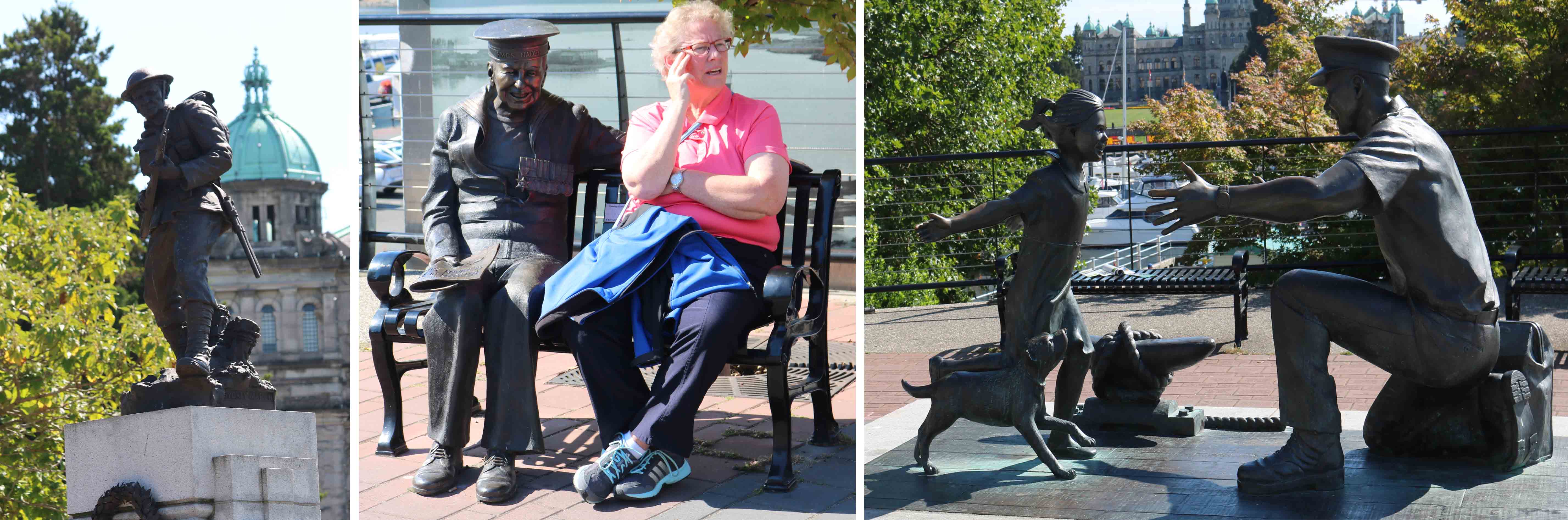
Above is a statue of homecoming of a sailor to commemorate the 100 year anniversary of the founding of the Canadian Navy, and was unveiled on 04 May 2010 at Victoria, capital of British Columbia.

We were thrilled to see the three statues located in front of the Parliament building. They would enthrall any military history enthusiast and veteran. The first was a statue of a soldier to commemorate BC’s fallen in World War I, World War II and the Korean war; then a statue of a Veteran Sailor and a statue of homecoming of a sailor to commemorate 100 years of Canadian Navy unveiled on 04 May 2010.

Our next destination was Butchart Garden, surely a place for a nature lover and a gardening enthusiast. Robert Pim Butchart, a pioneer in the North American cement industry, came to Victoria Island lured by its rich limestone deposits. In 1904 he developed a quarry and built a cement plant. His wife Jennie Butchart became the company’s chemist. Close to the quarry, the Butcharts established their family home with a small garden. As Mr Butchart exhausted limestone deposits, his enterprising wife Jennie, converted the gigantic quarry into a beautiful garden.

The renown of Mrs Butchart’s garden quickly spread. By the 1920s more than fifty thousand people visited her garden each year. The hospitable Butcharts christened their estate ‘Benvenuto’, the Italian word for ‘Welcome’. Their grandson Ian Ross was given the Gardens on his return from World War II. He made the garden self-sustaining, transforming the mostly neglected home and gardens into an internationally famous tourist destination. Each year over a million bedding plants in some 900 varieties give uninterrupted bloom from March through October. Almost a million people visit annually for spring’s colourful flowering bulbs; summer’s riot of colour and fall’s russets and golds.

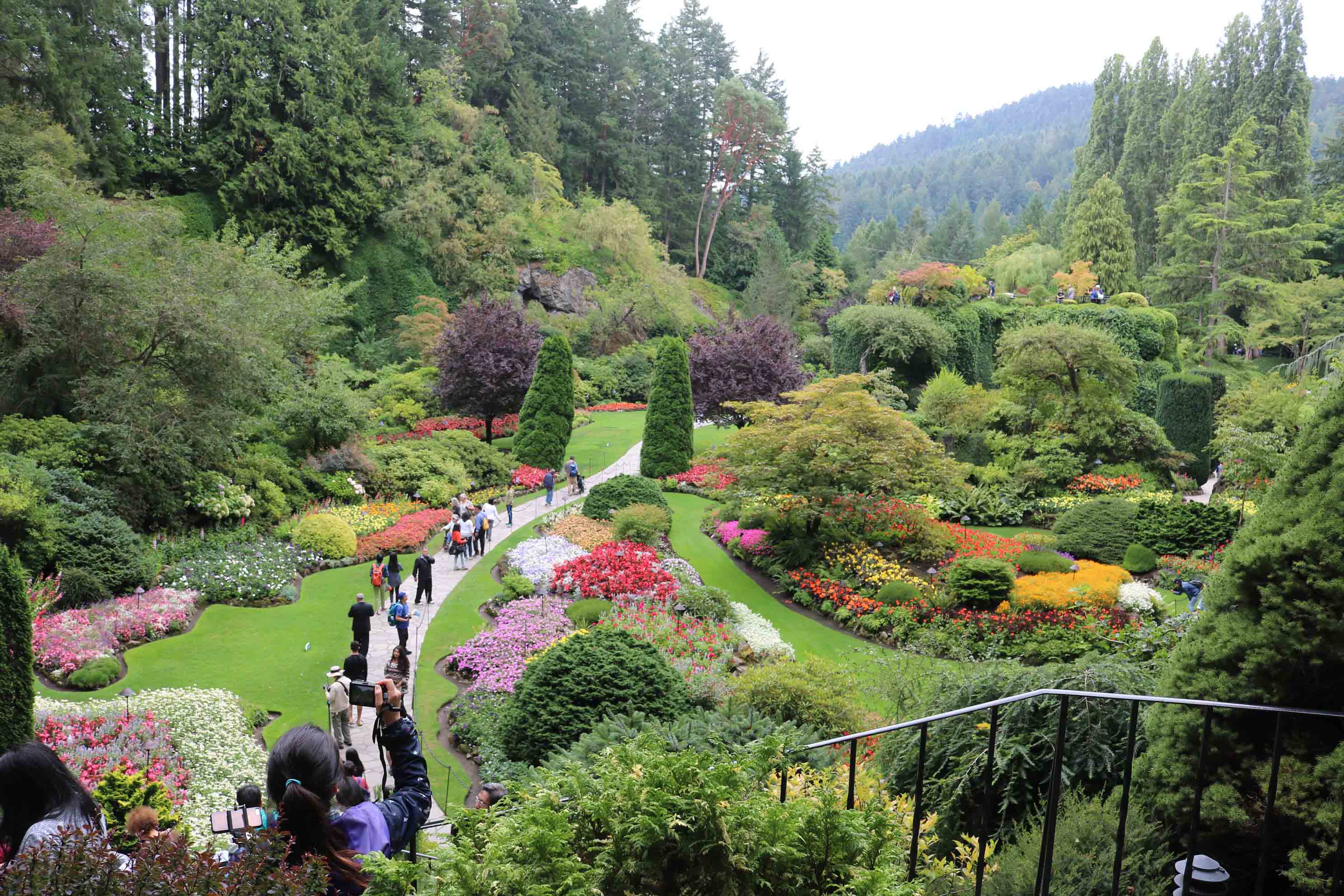
The most impressive sight was of the Sunken Garden from the lookout. The old quarry had been transformed by Jennie into a beautiful sunken garden of massive dimensions and dramatic aesthetic qualities representing exceptional creative achievement in gardening. Deep expansive walls, beds of annuals, flowering trees, unique shrubs, central rock mound and a fountain, all added variety to the uniqueness of this marvellous garden.

We were welcomed by the luscious scents of roses to the Rose Garden. The flowerbeds bordered by magnificent delphiniums had roses of many varieties and bright colours. The garden has an extensive collection of floribundas, ramblers, climbers and Hybrid Tea Roses. Each rose variety has been marked by name, origin and year registered with the American Rose Society.

A Torii gate welcomed us into the serene Japanese Garden. Walkways by the side of streams and ponds guided us through many bridges. Japanese maples and birch trees spread abundant shade on to the well manicured lawns. Jennie, with assistant Isaburo Kishida, an expert Japanese landscaper, completed this garden in 1906.

The next stop was the Italian Garden bounded by two arched entrances. This garden was originally Butchart’s tennis court. A splendid Star Pond adorned the centre of this garden. It was originally designed to house Mr Butchart’s collection of ornamental ducks as he was an enthusiastic hobbyist who collected ornamental birds from all over the world. He kept ducks in the Star Pond, peacocks on the front lawn and had many birdhouses throughout the gardens.

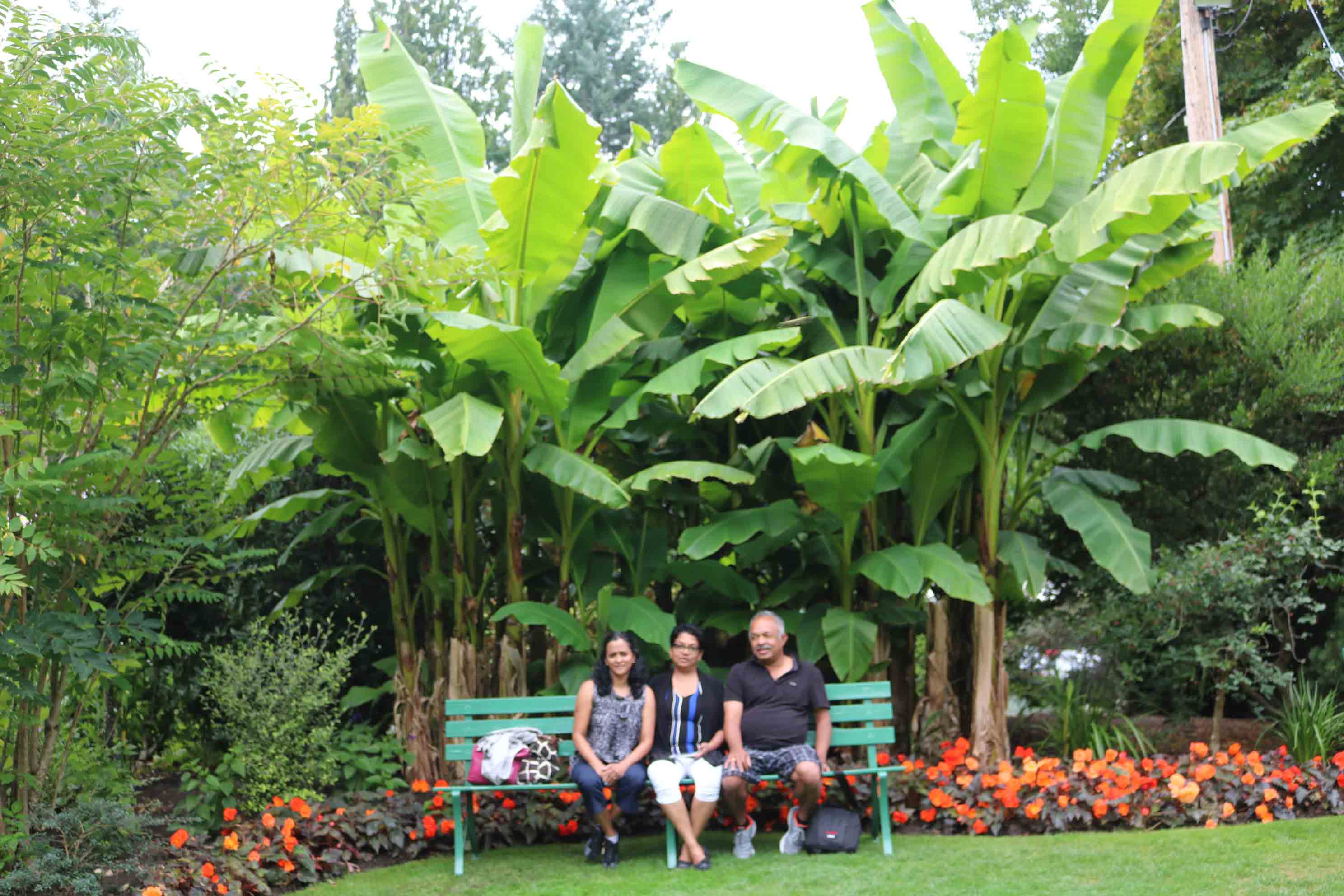
Past the Italian Garden, we entered the Mediterranean Garden. This area had an enchanting arrangement of lush, exotic plants from around the world. We were all surprised to see that even a banana grove could enhance the beauty of an enchanting world renowned garden.

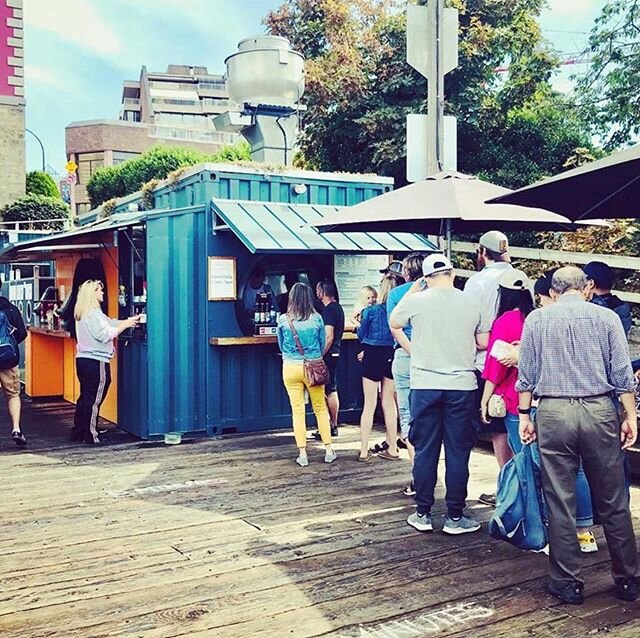
From the Butchart Garden, we headed straight to the Red Fish Blue Fish. It is an outdoor waterfront eatery in a modified cargo container, standing on a wooden pier in Victoria’s Inner Harbour. It is one of Victoria’s most cherished eateries. There was a long queue and after about half an hour in the queue, we ordered fish and chips. We relished the battered and steaming pieces of halibut, sitting on the dock overlooking the bay. Indeed it was worth the wait standing in a long queue.

Our next destination was ‘Mile 0’ which marks the start of the over 8,000 km Trans-Canada Highway that spans the entire length of Canada – from the Pacific Coast to the Atlantic. Mile 0 is also home to a statue of Terry Fox. Fox lost his right leg to cancer when he was 18 years old. He started a trans-Canada run to raise money for cancer research, beginning in Newfoundland on the East coast of Canada and was to end at the Mile 0 marker in Victoria. Unfortunately, Fox’s journey ended tragically near the halfway mark when he fell ill and passed away. Since then, hundreds of millions of dollars has been raised in his name by the Terry Fox Foundation for cancer research. With the visit to Mile 0, we culminated our exploration of Alberta and BC this time.

Now it was time for us to catch the return ferry to Vancouver and say goodbye to the beautiful Victoria Island. As we cruised through the Pacific Ocean, the sun was about to set and its rays painted the islands with different shades of gold.

Dreams, Aims & Goals

Interacting with our teenage nephews and nieces, I asked them “What is your Dream?” “To become an engineer.” “What is your Aim?” “To become an engineer.” “What is your Goal?” “To become an engineer.” In some cases the engineer was replaced by a doctor. That was when I realised that in our childhood we never even thought about our future aspirations, and planning them was a far cry. Today’s generation has something to think about, even if the thought is limited in many cases to doctors and engineers, mostly dictated by parental pressure.

Dream, Dream Dream; Dreams transform into thoughts and thoughts result in action. You have to dream before your dreams can come true. Great dreams of great dreamers are always transcended.” These are a few quotes from a great dreamer of all times Dr Adbul Kalam.

Figuratively, dreams can be defined as an idea or hope that is apparently impractical or unlikely to be ever realised in the current state of the world. That does not mean in any way that the dreams have not been realised ever.

Dreams are boundless, limitless, and timeless and are dictated by the power of imagination of the dreamer. Let your dreams float into infinity and they will germinate new ideas and visions. I do not wish to quantify your dreams, but let us take the case of a student dreaming about finding a cure for cancer. Many of us have had such a dream while reading about the sufferings cancer patients have had or seeing someone close battling it out.

In order to find a cure for a cancer, one must possibly pursue a medical career, though some inventions/discoveries have been made by people who were not even remotely connected with the concerned subject. From Dreams evolve an Aim that is achievable and real-time. In this case the aim will be to become a successful medical graduate.  The goals for achieving this aim for a high school student will likely to be to graduate high school with the requisite marks and also pass the requisite entrance examination.

To succeed in your aim, you must have a single-minded devotion to your goal.  It is like a football match where you aim to win a match and to succeed in your aim you have to score goal(s).

One needs to revisit the aims and goals, may be weekly, monthly, quarterly or half-yearly with a view  to redefine them, raise the bars, change them if needed,  and at times even discard them to find new aims and goals. One may lose interest in the aims and goals as they may not be challenging enough to motivate you or interest you.

Sometimes you may have thought of an aim, but the goals may not be what you really want to achieve. In this case you are trying to force yourself to settle for what you think you can get rather than achieve what your passions are. This is mostly due to parental and environmental pressures where everyone wants you to be either a doctor or an engineer, no more and no less.

To make your aims more challenging and a bit more interesting, set an aim that is a bit big and impressive that just thinking about it scares you a little bit and seems almost impossible, but has the potential to dramatically change your life if you were able to achieve it. Keeping this in mind you raise the bar for your goals a little by little and try and achieve them and keep raising the bar until you reach that aim which you never thought to be possible. By tapping into your creativity and resourcefulness you can amaze yourself with the results you achieve.

Once you have set your goals, break them down into smaller time-bound goals and evaluate the progress on a daily/weekly basis. You got to avoid distractions and also need to prioritise these small goals. This in no way means that you should not indulge in other activities. All work and no play will always make Jack a dull boy.

You must believe in yourself and reassure yourself that you can achieve the goals you have set for yourself, especially when the going gets tough. While undergoing the training in the Military Academies, I often reassured myself with the thought that about fifteen thousand officers have successfully gone through the tough training before me and I am in no way any less than them.

Kevin, our nephew who lives in US took up the pre-medical course in high school. Most children at that stage do not even have the faintest idea about their passions or their abilities. Anu and Johnson, the parents were in for a bit of a surprise when Kevin in his Grade 12 gave out his mind that he did not want to pursue a career in the medical field, but wanted to take up animation and graphic designing as a career. The parents being very supportive accepted Kevin’s aims and advised him to begin the procedure for admission as there was only one university offering the particular course Kevin wanted and it was very competitive. At the high school graduation ceremony, Anu and Johnson were in for another surprise – Kevin was adjudged the best student in animation and graphic designing. Kevin graduated in computer animation from The Savannah College of Art and Design, Atlanta and now works as a gaming designer with a leading gaming company.

Dream unlimited, define your aim, set your goal(s) and achieve them and success and happiness will surely be at your footsteps.

Temperate Rain Forests of British Columbia

Temp100
We visited the Stanley Park and Capilano Park during our visit to British Columbia (BC), mainly to see the temperate rain forests. 

How is the temperate rain forests different from its tropical cousin?

The term ‘rainforest’ implies forests in high rainfall area, making them very dense and green.  Tropical rainforests lie closer to the equator while temperate rainforests are found at latitudes between the two Tropics and Polar Circles.  This causes temperate rainforests to be cooler, have less precipitation, contain less biodiversity and slower decomposition than their tropical counterparts.  Canada’s rainforest falls between the Arctic Circle and the Tropic of Cancer, forming a narrow band along the coast of the Pacific Ocean from Alaska to Northern California. Other countries that have temperate rainforests are Chile, New Zealand and Norway.

Temp200
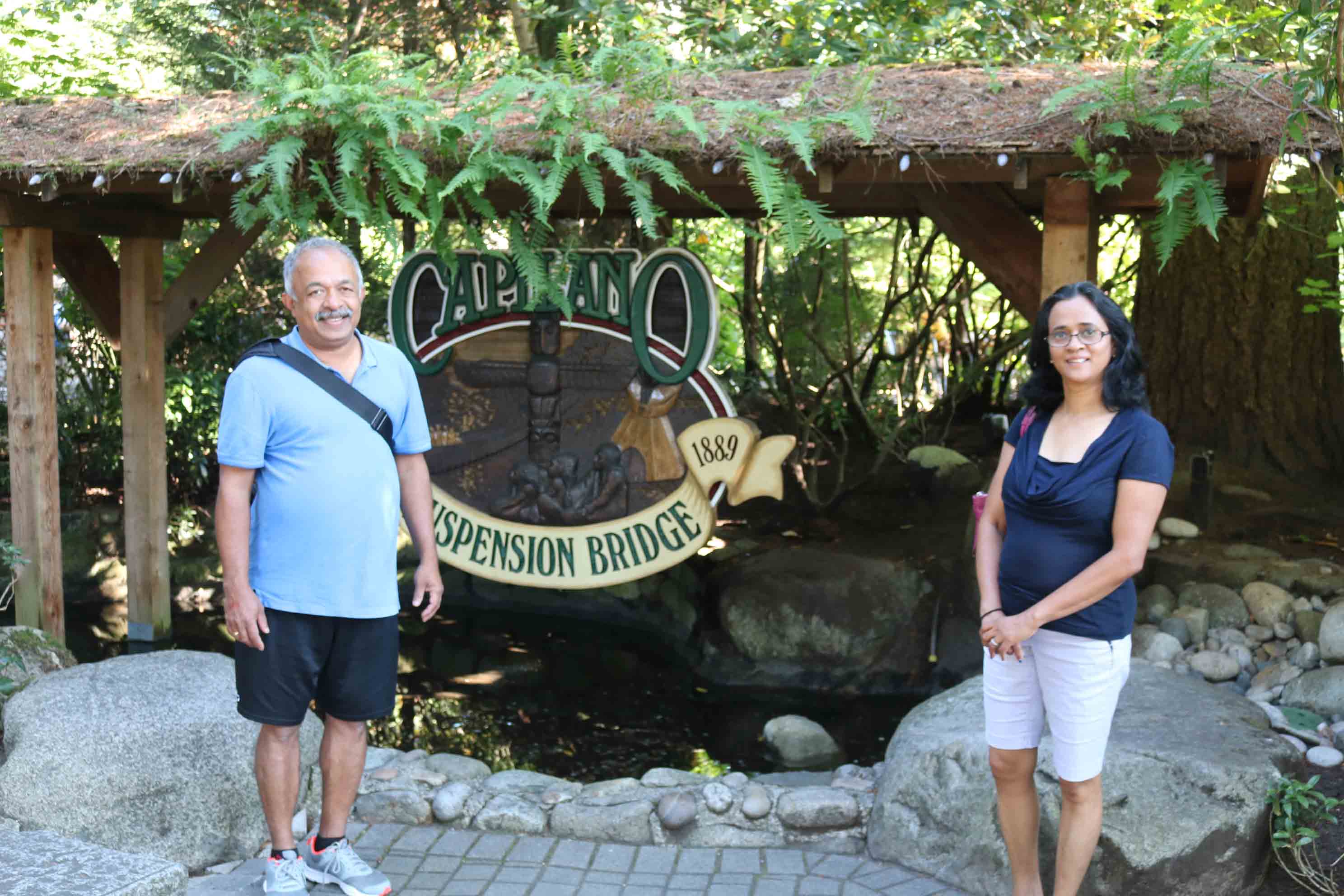
In the morning we visited the Capilano Suspension Bridge Park.  The park offers visitors a unique mix of adventure, history and culture.  The park showcases a totem pole park, North America’s largest private collection of First Nations totem poles, period decor and costumes.

Temp220
Totem pole is a monument created by Northwest Coast Aboriginal people to serve as a signboard, genealogical record and memorial.  Carved of large red cedar and painted in vibrant colours, they are usually erected to reflect the history of that lineage.  Theses poles are also erected as memorial poles, grave figures, house posts, house front poles, welcoming poles and mortuary poles.

Temp240
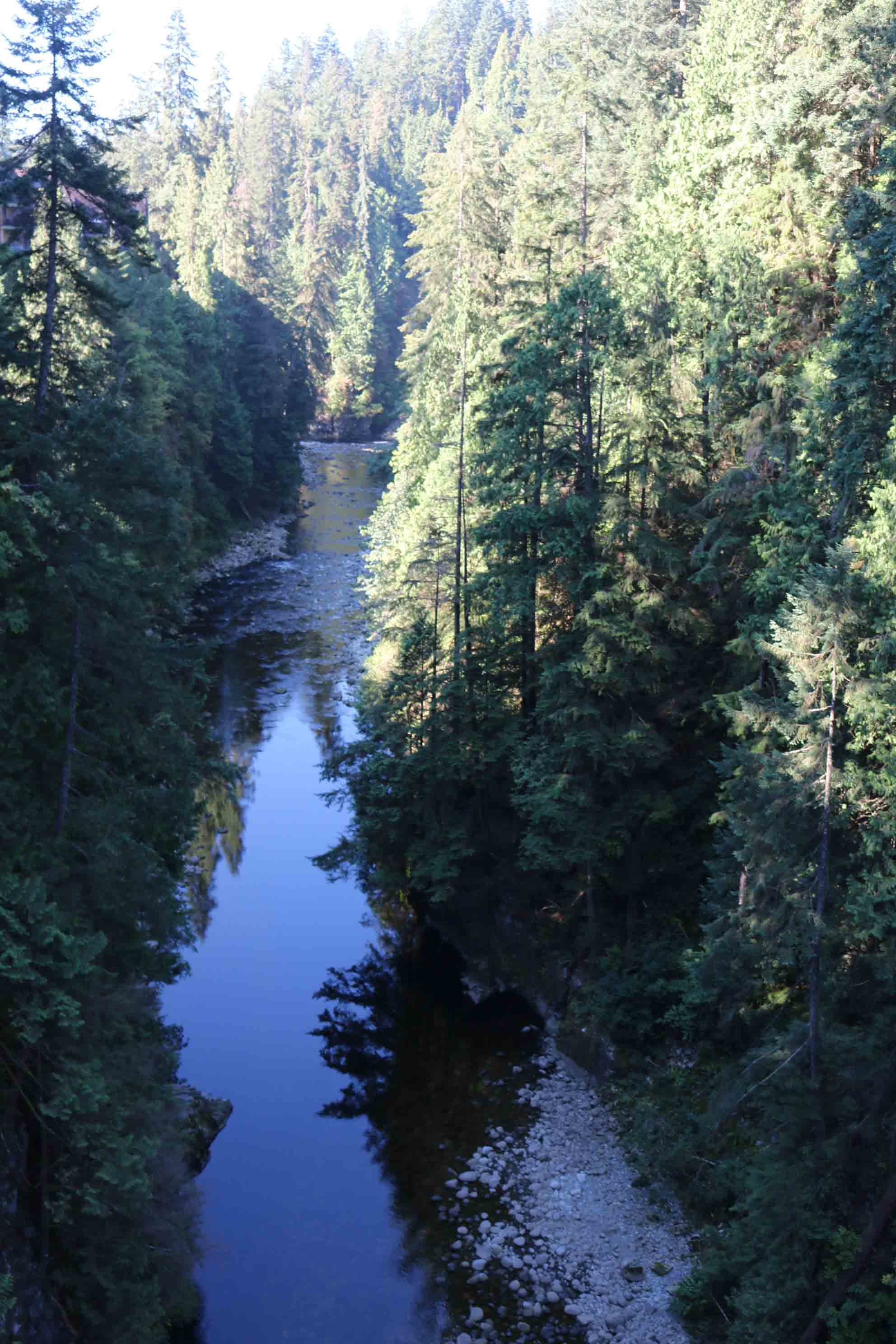
The entrance to the park as the name suggests is by way of a suspension bridge.  The bridge was originally built in 1889 of hemp ropes with cedar plank deck.  It was replaced with a wire cable bridge in 1903.  The bridge was completely rebuilt in 1956.  We enjoyed the thrill of crossing the 450-foot long swaying bridge, suspended 230 feet above Capilano River. The bridge offered a splendid view of the river and the forest below.

Temp260
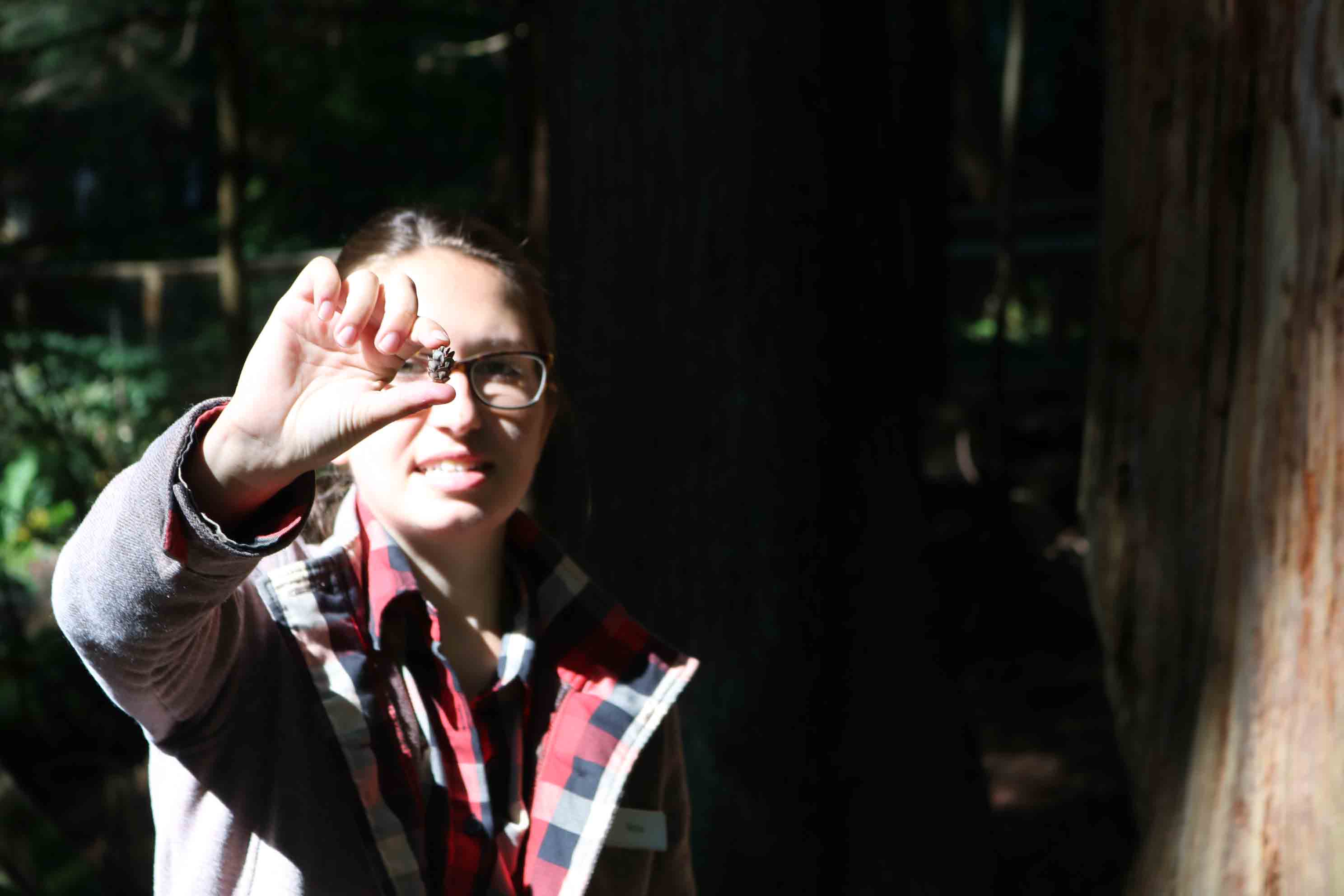
An eco-guided tour is conducted by the Park every hour, which was very informative, covering various ecological aspects of the forest in the Park.  The guide educated us about the rainforest, trees. trout ponds and the undergrowth.

Temp280
The first stop was at a banana slug.  The guide explained that there are no earthworms in these forests and these slugs contribute to the decomposition of organic matter into humus. These slugs are covered with a special slimy coating that numbs the mouth of any predator.  Racoons roll the slugs in mud to coat them and then eat them.

Temp300
We stopped next at a nurse log.  Fallen logs are called nurse logs as they help new seedling growth by creating an elevated and moist habitat.  Decomposition being comparatively slower when compared to tropical forests, results in a deep layer of decaying organic matter that forms the top layer of the forest floor.  This gives a cushioning effect while walking on it. 

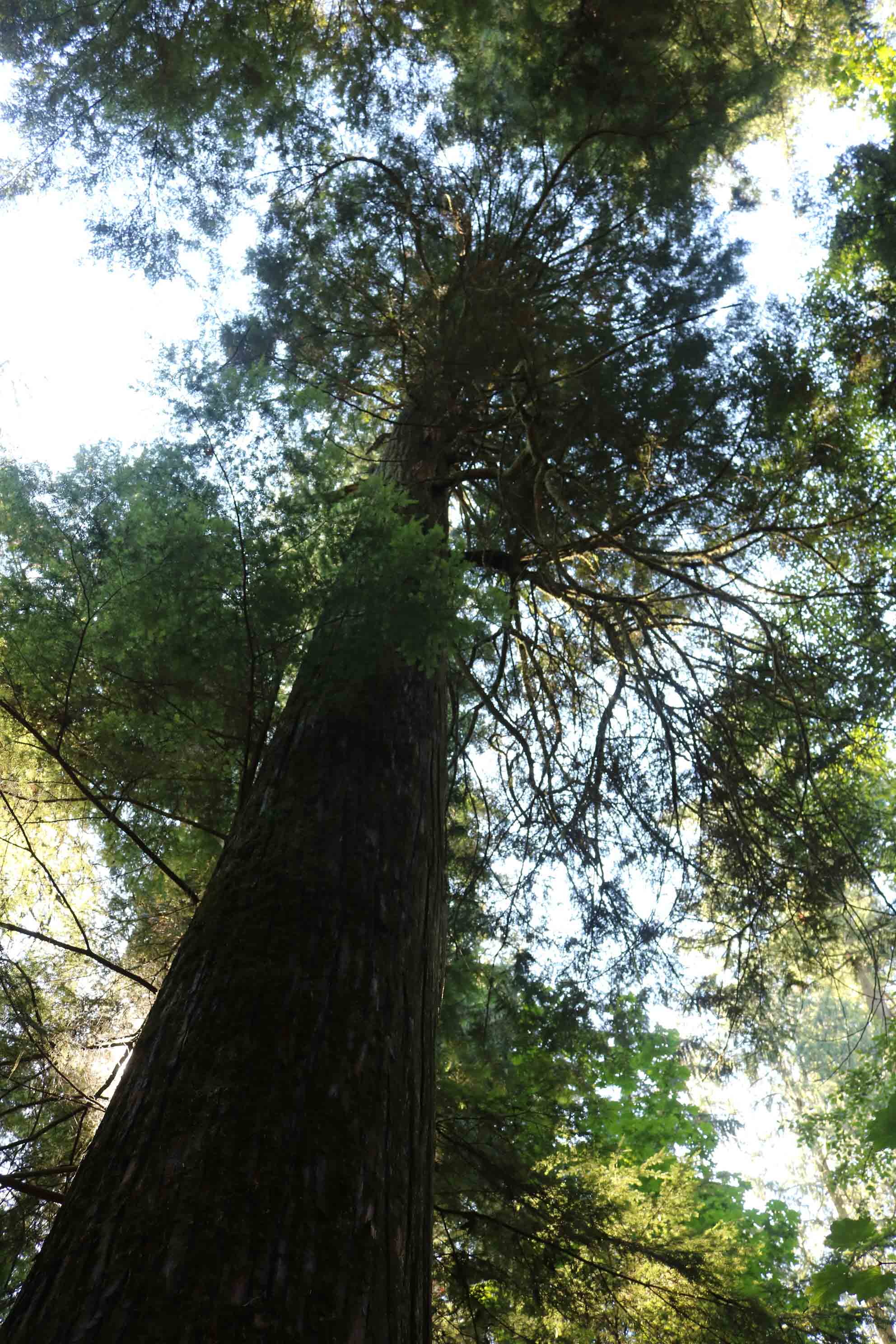
Canada’s temperate rainforest is dominated by a relatively small number of tree species because the seeds need to regenerate in the low light levels on the forest floor caused the thick canopy.  Most of the trees found in this forest are coniferous trees like the Western Hemlock, Yellow Cedar, Western Red Cedar, Douglas-fir, and Spruce.  The coniferous trees are well adapted to the temperatures and shorter daylight hours of the winter as they remain green and keep their foliage in winter which helps then to photosynthesise throughout the year.

Temp302
The thick and uneven tree canopies that cover the coastal rainforest allow little sunlight to reach the forest floor, so undergrowth must adapt accordingly.  Indeed, the ground is mostly covered by plants that do not need much sunlight, like ferns. Small trees also grow under the shade of the taller ones. In order to get sunlight, some plants grow on bark and branches of trees, where there is more sunlight than on the forest floor.

Temp304
Along lakes and rivers and gaps left by fallen trees, which lets in more sunlight in, few deciduous tree species like Bigleaf Maple, Red Alder and Black Cottonwood thrive.  

Temp320
The guide escorted us to the ‘Grandma of Capilano’ – the tallest tree in the forest.  It is a Douglas Fir, aged over 1300 years, standing tall at 76 M. 

Temp340
After the guided tour, we ascended a foot bridge for Treetops Adventure Tour – a self guided tour.  This leg consisted of seven footbridges suspended between magnificent 250-year-old Douglas Fir trees, forming a walkway up to 30 M above the forest floor.  The elevated walkway offered a woodpecker’s eye view of the forest.

Temp360
The walkway has been created without harming the trees, with no nails or bolts drilled into them.  Metallic collars hold the ends of the walkway on to trees and are moved every eight years to facilitate the tree to grow. 

 Temp380
On our way back to the parking lot was the Cliffwalk.  This heart-pounding cliff-side journey took us  through rainforest vegetation on a series of suspended walkways jutting out from the granite cliff face above Capilano River.  The Cliffwalk is high and narrow and in some sections, very strong glass is all that separated us from the canyon below. The narrow walkway has fixed handrails supported by steel beams cantilevered from 16 anchor points in the granite rock face of the canyon.  Various information boards along the walkway explained the interaction between water, granite, salmon, flora and fauna.

Temp400
We then drove to Stanley Park on the beaches of the Pacific Ocean, a green oasis in the midst of the heavily built urban landscape of Vancouver.  The 400-hectare natural West Coast rainforest offered us rare scenic views of the ocean with ships anchored, mountains, sky, and majestic trees along Stanley Park’s famous Seawall.  We walked around the park on the walking track which ran all along the beach, adjacent to a separate cycling track.

Our visit to the temperate rain forest parks were both educative and recreational.  Hermann Hesse, a German-born Swiss poet once said “Trees are sanctuaries. Whoever knows how to speak to them, whoever knows how to listen to them, can learn the truth. They do not preach learning and precepts, they preach, undeterred by particulars, the ancient law of life.”


Why I Hate Conferences and Meetings

Colonel Mahaveer Singh was the Commanding Officer (CO) under whose guidance I spent my five years as a young officer. He was a real father figure who believed that the Regiment was his family and insisted on all officers getting together for tea at 10:30 AM. All officers, especially the young officers, really enjoyed these meetings as the first five to ten minutes was official stuff where in the CO gave out a few directions and it was for us to act on them and execute them. The next 20 to 30 minutes used to be ‘story telling‘ time and we all could narrate anything and everything and all officers listened and participated in the discussion. This instilled a lot of confidence in all the young officers and they all are doing well today. Colonel Rajan Anand (now a retired Brigadier) and Colonel PK Ramachandran (now a retired Major General) were two COs who never ever held a conference or meeting. They gave their directions on the run and everybody executed them and for sure executed them really well.

meeting-monkeys

All three of the above mentioned COs never ever seemed to supervise our work and believed in all of us and in delegation. They had trust in us and hence we always went an extra mile to ensure that the results were the best. The performance of the unit in all spheres spoke for itself and each and everyone, to the last soldier, took pride in being from a great Regiment and put in that extra effort to keep the Regimental flag flying high.

I have had my share of pathetic experiences also which led me to ensure that I never held a conference or meeting during the command of the Regiment, mainly because I hated them. Based on the lessons I had learnt from the above three COs, I put into practice the ethos of trust in all my subordinates and also provide them enough elbow space to execute the task with minimum directions. The performance of the Regiment at that time was there for everyone to see and the men were confident of what they did.

Why do I hate conferences / meetings?

During a short stint with our Regiment, I was called in for a conference regarding a task. Normally every soldier got into their drills and procedures, while the officers got their briefings and directions from the CO. This meeting was attended by nearly all up to the Havildars (Sergeants) and the CO’s office was overflowing and also nauseating. The meeting went on for two hours, with nothing new other than a few finger pointing by the CO and on returning to where the men were, I found no activity at all.

On inquiry I found that all the soldiers generally have their lunch and sleep off the moment this CO called for a conference as they knew how to make full use of this valuable ‘dead-time.’ The soldiers never did anything much even after the conference as they were pretty sure that this CO made them re-do or change what they did. So they felt ‘why waste effort and time.

A well oiled Regiment was now waiting for the CO for everything and the soldiers felt most miserable about it as they were not used to such ridiculing and lack of trust ever before. When I returned to the unit after two years, luckily the new CO had turned the clock back and I found the soldiers happier and proud of being part of a great Regiment.

What Makes these Conferences/Meetings so Resentful?

The conferences are held to show that the boss has done his job of briefing anybody and everybody, many not even remotely connected with the task in hand, thus making him ‘safe’. The boss is mostly unsure about the task in hand and who will execute it and has normally not done enough homework. Most of these conferences tend to be confrontational instead of being collaborational, especially in a hierarchical organisation like the army.

The boss tend not to get to the point quickly enough and often are with the bad attitude that the people sitting in front ‘just will not understand it.’

The listeners are mostly not the right people in the right meeting. Some do not even know as to why they were called for the conference, wondering what the meeting is all about. Even if they knew what it is about, they were not prepared to contribute to the discussion or their inputs were never asked for.

The boss holding the conference tends to lose focus and gets off track. These monologues do not to add value, but the boss feels that there have been value additions, but mostly are time wasters. These bosses do not realise that most of the attendees already know that most of what is discussed and what their jobs are and the part they got to play.

Exhaustion spreads like wild-fire. All it takes is a couple people to start squirming and a few yawns and it spreads. This is compounded by the feeling as to why they were attending the meeting – to get ready for the next meeting.

Suggestions for a Good Conference/Meeting

Never Hold One.   It is very apparent that many meetings serve no purpose. The best methodology is to consider two to three days in advance whether there is any way at all of avoiding the meeting.

Keep Attendees the Least.   Fewer the people who attend the meeting the more effective it will be. Many bosses love to hear their own voices and the bigger the audience the greater the need to pontificate.

Direct the Meeting.    It is much easier to control a meeting that is about specific topics rather than merely held for the sake of the meeting itself. Allow all participants to give their opinions while at the same time stopping them from talking unnecessarily.

Know the Job in Hand. If you knew exactly what the job was, you would have never called for the conference; instead you would have given out clear cut instructions to your subordinates.  If you know what you are trying to achieve, then it is far easier to do so.

Start on Time and End on Time.    One of the most frustrating things about meetings is the long wait for a few stragglers who cannot be bothered to turn up on time. Avoid demonstrating Parkinson’s Law that work will always fill the time available to it.

Wishing you all the very best for your next conference/meeting.

Whistler : Abode of the Gods

Whi100
(Image Courtesy Whistler Blackcomb)

We halted at Whistler on our way to Vancouver in August09, 2016.  Located in the spectacular Coast Mountains of British Columbia (BC), Whistler is Canada’s favourite year-round destination.  Whistler is undoubtedly the most-visited ski resort in Canada, with over 2 million visitors a year.  There are two majestic mountains with a vibrant base Village.  The facilities in the area include skiing and snowboarding, gondolas connecting various peaks, mountain biking trails, hiking trails, golf courses, restaurants, bars and accommodation to suit every budget.  It is undoubtedly the best mountain adventure site in the world.

We headed straight to the Whistler Village Centre to buy our tickets for the Peak2Peak Gondola Ride.  The area was jostling with activity, mainly by hikers and mountain bike riders.  There were many stalls offering mountain bike rentals and training for novice mountain bikers.  The mountain bike trainees ranged in age from five to over 50 years.
Whistler Blackcomb boasts of the largest mountain bike park in North America, officially opening in May each year. With over 4,900 vertical feet and over 60 descending trails spread over three riding zones, there is something to pump up the adrenaline for each level of riders.

The gondolas of Whistler Blackcomb are inspired by the ski lifts in Switzerland.  They connect the two ridge-lines running roughly Northwest to Southeast, separated by a deep valley as shown in the diagram above.

Whistler was originally conceived as part of a Canadian bid for the 1968 Winter Olympics.  Although they lost the bid, construction started and the resort opened for the first time in January 1966.  Blackcomb mountain, originally a separate entity, opened for business in December 1980.  The two resorts underwent a period of intense rivalry through the 1980s and 90s.  Intrawest, the BC real estate firm that developed Blackcomb, purchased Whistler and fully merged their operations in 2003.

Whi110
Whistler Blackcomb offered a renewed bid for the 2010 Winter Olympics, which they won in July 2003. They hosted the men’s and women’s Olympic and Paralympic alpine skiing events.  Over the next decade, Intrawest expanded by purchasing additional ski resorts across North America, before expanding into golf and other resorts as well.

Whi200
We lined up at the Whistler Village Centre for our journey up Whistler Mountain.  The air was a bit chilly and misty.  The gondolas were enclosed, separate for persons and equipment.  Many mountain bike enthusiasts and tourists were already in queue awaiting their turns.  We boarded our gondola for the first leg and the journey up the Whistler Mountain to the Roundhouse Lodge located at about 6,000 feet.

Whi125
Enroute we had a fascinating view of the coniferous tree tops with their young cones blooming with a bluish tinge.  It was thrilling to watch mountain bikers below, negotiating the mountain trail at a very high speed, with precision and grace.  We could also see young kids being trained on mountain biking skills by their instructors.

We alighted at the Roundhouse Lodge after a thrilling 15 minutes.  From there we had a 10 minute hike through a trail to the starting point of Peak Express for our journey to Top of the World Summit.

Whi220
The trail had an explosion of colours offered by the wildflowers growing at that altitude.  They are seen for only two to three weeks in mid-summer and we were indeed blessed to catch a glimpse of these wild beauties.  Most of these flowers are poisonous to ingest, hence are not foraged on by the deer in the forest.

Whi230
The flowers we saw were the Alpine Fireweed, a bright to deep pink flower that grows from 5cm to 3 metres.  The yellow Mountain Buttercup is primarily found in deeper soils and among bunch grasses of undisturbed grasslands. The flower has a waxy sheen to it. The Sitka Valerian grows in moist alpine meadows with flowers that are pale pink to white and form a dense, sweet scented cluster.  Partridge Foot grows in wetland areas. This shrub-like perennial has cream-coloured flowers in the summer and golden seed pods in the fall.

Whi260
The Peak Express  journey was on an open gondola and the cold winds blew hard on to our faces.  As the elevation kept increasing, the landscape kept changing.  It was a fantastic experience to view the rugged beauty of the Canadian Coast Mountains.  The wildflower meadows, boulder  filled slopes and towering peaks offered a picturesque view.

Whi280
After about five minutes we landed at the summit at about 7200 feet.  From there we could catch the glimpses of lakes under distant peaks and massive glaciers, even though there was bit of mist.  We picked up cups of hot chocolate from the coffee shop and walked to giant Inukshuk.  An Inukshuk is a piled-stone marker that looks like a man. Historically it was used in the Arctic as a directional marker but has now become an icon of Canada overtaking the Mountie.

Whi300
After spending about 15 minutes at the summit, we returned to Roundhouse Lodge on the Whistler Mountain for our ride to the Rendezvous Lodge on the Blackcomb Mountain by the Peak2Peak Gondola.  This ride was for 11 minutes and the system holds the record for the highest and longest unsupported cable car span in the world of 3.024 km. It is indeed an engineering marvel – a long steel ropeway hanging between two peaks – unsupported by any pylons.

Whi320
The Peak2Peak Gondola was completed on December 12, 2008 and can transport 4,100 people per hour between the resort’s mountains.  The cars for this leg of the ride are enclosed and can seat 12 persons.  There are some glass bottom gondola cars, but their frequency is once every 15 minutes.  The ride offers spectacular views of the village, valley and surrounding mountains – a 360 degree 3D view in fact.

Whi340
From the Rendezvous Lodge we took the Solar Coaster Express and then the Wizard Express to reach the Blackcomb Base.  The open-air chairlifts on these rides offer a unique experience than what a gondola provides as you get an aerial perspective of the ground directly below.

The Whistler Olympics project took nearly four decades, but the effort taken by the Canadian government in collaboration with business partners is clearly visible.  It has helped to place Whistler as an excellent year-round adventure destination in the world and has generated employment for the local population and businesses.   The Whistler visit showed us as to how the facilities created for a major sporting event could be exploited for the betterment of the community post event.

Army Marches on Knees

Army marches on its stomach‘ is an age-old military adage attributed to both Napoleon and Frederick the Great. This saying gives out the importance of the army being well-provisioned, well –administered and well-fed. With my service of over two decades with the Indian Army, I felt that the Army marched more on its ‘knees’ more than its ‘stomach’.

Indian-army556

During a military tactical exercise, we underwent while at the National Defence Academy (NDA) in October 1981, we were led by Captain Raj Mehta, now a retired General. We were about 12 cadets, all at their zenith of physical fitness and with real razor-sharp minds, least bothered about the scratches rendered on our skins by the wild thorny bushes and who could least be worried about many falls and rolls one had to endure during such training. The sharp mind coupled with agility ensured that all the cadets stood up and continued with the task at hand as if nothing had happened, even after ten feet fall.

Captain Raj Mehta was 33 years old, but still young at mind and physique, was training us in jungle warfare on a pitch-dark new moon night in the hilly terrains of Pune, India. He ensured participation of each and every cadet, whether it was a discussion or a tactical exercise and had a knack of extracting points of view from every cadet. This instilled a lot of confidence in us and along with learning the operational concepts, he succeeded in turning us into leaders of men. Honour, trust in the subordinates, accepting wrong doings with humility, taking on failures with a lion’s heart, being true to one-self were a few traits I imbibed from him as cadet at the age of nineteen and I am sure it was the foundation stone for my army career ahead for the next twenty-two years.

Captain Mehta stood out among all our instructors in that he had a lot of trust in the cadets and many a times accepted all our fake stories and excuses with an uncanny smile. We all thought we succeeded in ‘fooling’ him, but later in life realised his magnanimity, especially after bringing up our children through their teens. I carried this aspect of trust, and it really helped me to command my unit, where in I delegated a lot of the tasks to the junior leaders and Havildars (Sergeants) as I had to look after our children being a single parent then.

On that night, Captain Mehta was with the Cadet Ajay Sharma (now a retired Colonel), appointed as the section commander with two other cadets leading the section as the points-men. We were moving downhill through the jungle in a single-file section formation.   Suddenly the section commander and Captain Mehta disappeared to be found in a ditch about 10 feet deep, with the next five falling all over them. They all came out and we continued with the exercise. At the end of the exercise at about 10 PM, Captain Mehta debriefed us and one could see a bit of discomfort on Captain Mehta’s face. The next morning, we found Captain Mehta with a bandaged knee and a plastered right hand. He had suffered a fracture of the wrist joint and was put in plaster for six weeks. He did not take a day off and he adapted to driving his Vespa with one hand. The very same knee troubled him later on too. Despite the troublesome knee, General Mehta as a Divisional Commander was known for visiting all the posts in his Division, mostly located above 10,000 feet above Mean Sea Level.

As a young Lieutenant I served under Colonel Mahaveer Singh, our Commanding Officer. Colonel Mahaveer, a Rajput and a humble man with a large heart. He looked after all the young officers as his children and many a times accepted all our pranks and (mis)adventures with a great spirit. He let the young officers take on responsibilities and encouraged and motivated us to put in our best and accomplish the impossible. No wonder that our unit was the best in the formation and young officers from other units of the formation always looked forward to getting attached to our unit and spend a few days with us. All of them were surprised to see the relationship all the young officers had with Colonel Mahaveer, how we used to play basketball with him, share a joke, narrate an incident and above all the movie stories he narrated without losing any of the expressions, especially ‘Sharabi’. Colonel Atul Mishra, Colonel Anupam Gaur, Brigadier Mike Iyer were a few I recollect enjoying these stories as young Lieutenants.

While climbing with Colonel Mahaveer to a post in the Northern Sector, located at about 12,000 feet, he found my pace a bit straining. Colonel Mahaveer was fifty years old and I was twenty-five, half his age. Colonel Mahaveer had suffered a ligament tear on his knee as a result of playing soccer. After about half an hour of climb, we sat down to rest and then Colonel Mahaveer advised me “Look after your knees, else you will suffer my plight at this age. Without a fit knee, you will be a useless soldier”. I accepted the advice, and it ensured that I kept my knee always safe and sound.

After penning down this article I decided to obtain the approval of General Raj Mehta, prior to placing it in the public domain. “While the name makes the anecdote more real you could drop the name as the message it conveys remains unaffected” was the General’s stand. I debated in my mind the General’s request of dropping his name – and at last I ruled to go ahead with the name to give the article the real “Punch” rather than talking in a general term about a real General.

Silviculture : An Aerial View

During our trip to the Rocky Mountains in Alberta and British Columbia (BC), in August 2016, we undertook a helicopter ride lasting 30 minutes over the mountain ranges and the Boreal Forests of Revelstoke, BC.  The town is located 641 km East of Vancouver, on the banks of the Columbia River.

Canada is home to 10 per cent of the world’s forest cover and 30 per cent of the world’s Boreal Forests.  About 38 per cent of Canada’s land area is forested, or about 3.4 million out of 9.1 million square  km.  92% of these forests are owned by the government and is highly regulated and monitored.  Slightly more than half of this area is classified as commercial forest capable of producing merchantable trees.  

Silvi120

Various government agencies  identify intended methods of cutting, reforesting, and managing timber resources within the defined area of responsibility. The forest management planning time frame considered is 200 years, representing two full life cycles, or ‘rotations.’

Silvi200
Despite being the lead exporter of softwood lumber, newsprint and wood pulp, Canada harvests less than 0.2 percent of its forest annually. On average, a tree must be about 80 to 100 years old before it is ready for harvesting.  In case 1% of trees are harvested each year, forests have 100 years to grow back before they are re-harvested. Every year is different, depending on several factors, including wildfire and mountain pine beetle activity, but the number of trees harvested each year is always much less than 1%.

While trees can now be chopped down with the help of machines, replanting must be done by hand, one sapling at a time.  Certain species, like aspen, regenerate naturally after harvesting. The number of trees in Canada works out to 16 trees for every person.  Canada also plants at  an average of more than 2 trees for every tree the industry harvested.

A silviculture system covers all management activities related to growing forests – from early planning through harvesting, replanting and tending the new forest.  Silviculture is the art and science of controlling the establishment, growth, composition, and quality of forest vegetation for the full range of forest resource objectives.  The policy guideline for silviculture in Canada is sustaining environmental and economic values for the future.  Canada’s forest management policies and practices are among the most stringent in the world.

Silvi300

A common method of logging in in Canada is clearcutting – harvesting and removal of an entire stand of trees. Although efficient, clearcutting poses a variety of environmental problems.  It can increase the harmful impact of wind and rain on local ecosystems; destroy valuable wildlife habitat used by pine martins, caribou, and other animals; and cause soil to become dry and overheated, which may in turn increase the risk of fire or interfere with seedling growth. Logging operations can also alter the chemical and physical makeup of nearby water-bodies and affect the health of fish and other aquatic species.

Since 1949, forest companies have been legally mandated to reforest harvested areas. Reforestation must occur within two years of harvesting. Tree planting operations must promote their survival through the winter months. Forest companies monitor trees for up to 14 years after planting.  In most cases, the logging companies are required to regrow at least two trees for every one they harvest. Sometimes companies plant five or six trees for every harvested tree so that enough will survive to replace those harvested.

Harvesting too many trees can be harmful to the forest, but with careful planning, harvesting trees can actually make the forests healthier. Clearing out old trees makes space for new trees to grow, continuing the life cycle.  Many animals like deer, moose, and elk prefer younger forests with  new vegetative growth to feed on.  The younger trees are less prone to diseases and invasive insects like the mountain pine beetle.

Silvi400

If a forest had only trees, it will be neither healthy nor diverse. In the picture above, you can see patches of forest that are at very different stages of growth. There are older trees which provide habitat for the wild animals and there are young trees too.

Forest harvesting involves cutting trees and delivering them to sawmills, pulp mills and other wood-processing plants. The operations include road construction, logging and log transportation. Years of planning go into deciding when and which parts of the forest will be harvested and how this will occur, all to ensure that these activities are carried out in a manner consistent with protecting social and environmental values. The specifics of forest harvesting will depend on the region and type of forest. 

Silvi500

The forest industry builds thousands of kilometers of logging roads each year.  All these roads require planning and surveying. They must be constructed to minimise soil erosion, protect water quality and cause the least impact on the forest growing site.

Silvi600
The lumber harvested and the timber products of the industry’s mills are transported mostly by rail or road.  Waterways are also used to move lumber by floating them downstream, tied in a raft formation or by powered barges. The trans-Canadian railway line connecting the Atlantic coast to the Pacific coast runs through this area.

Silvi700
Forest fire is the nature’s way of deforestation.  These fires help return valuable nutrients to the soil that helps a natural rebirth.  Some pine cones need high temperatures to help burst open to facilitate their seeds to disperse.  Fires help the undergrowth exposure to sunlight, making them grow better.  Such fires naturally occur in forests every 150 to 250 years. 

Regulated and dedicated efforts by various Canadian government agencies and the timber industry can only sustain the forest wealth of the country.  The efforts are in the right direction to ensure ecological balance  and also to ensure that these forests would thrive through for future generations.

Psalm 23 and Dreams

It was a ritual in our home that everyone recited the Twenty-third Psalm at the end of the evening prayer and the same was recited at our church at the end of the Holy Mass. This Psalm is applicable to one and all, irrespective of one’s religion and it reaffirms one’s faith in their God. The Twenty-third Psalm begins with “The Lord is my shepherd; I shall not want”. In the Malayalam version which we recited as children, the “I shall not want” part was translated as “എനിക്കു മുട്ടുണ്ടാകുകയില്ല” (enikku muttundakukayilla), and I always looked at my knees after reciting it, as it literarily translated in any child’s mind as “I will not have my knees”.

God will open the door only if one knocks and hence the aspect of “I shall not want” in Psalm 23 is debatable. Without the ‘wants’ humanity would have never progressed and developed to its current stature. The modern version of the Psalm has put it more aptly as “The Lord is my shepherd; I lack nothing”. These ‘wants’ always tempted me to dream about anything and everything I came across as a child, mostly to be rebuked by elders saying that I was wasting my time dreaming – even the act of dreaming was rationed in our childhood—‘Who can dream what and how much’ was somewhat a pre-decided issue!

As I grew up and came under the stewardship of Late Mr PT Cherian, our House Master at Sainik School, Amaravathinagar, Thamizh Nadu, who always encouraged us to dream – to dream big – that too King Size. As I grew older, I read the Wings of Fire by Dr APJ Abdul Kalam wherein he says that “Dream is not that which you see while sleeping it is something that does not let you sleep.” This was the predicament I always faced while dreaming that it delayed my falling asleep and the same continues to date.

Veteran Commander D Reginald was my companion to operate the public address system in the school under the guidance of Mr PT Cherian while studying in Grade 9 (1974). All the amplifiers, speakers, cables, etc were kept in Mr Cherian’s Physics Lab and on Sundays after lunch we both would go there to carry out regular maintenance. Once we were accompanied by our friend S Harikrishnan (currently Manager, State Bank of India), who was an accomplished singer. The idea was to fulfill Hari’s dream of listening to his voice duly recorded on the audio cassette recorder. Being Sunday afternoon, we knew that Mr Cherian will never be around as he always enjoyed his afternoon siesta and never ever wanted to be disturbed at that time and there would be no one to stop us from (mis)using the precious cassette recorder. We recorded Hari’s song and played back the recording. That was the first time he ever heard his own singing. Hari had the brightest and the biggest eyes amongst us and he was so excited that his eyes bulged out like search lights.

After accomplishing the mission Hari left and we were on to our maintenance tasks. Reginald was always a better dreamer than I was and continues to be so till date. Our discussion was about the possibility that one day we would be able to record what we see with the same ease as we recorded Hari’s voice. That dream has come true today and we have even gone much ahead that we are able to transmit the same across the globe in real-time. Remember that ‘What you dream today will in all likelihood become a reality tomorrow.’

We have encouraged our children to dream and the effect of it is mostly heard from the washroom. I always hear their monologues, dialogues, role-playing, singing, etc while they spend their time in the washroom – the most private time one ever gets. I was really scared of doing this while growing up on the fear of what others will think about me (mad?) and so I could never give expression to my dreams.

One must dream, that too dream unlimited. That is when one gets into a creative mood and comes out with ‘out of the box’ ideas. Imagine if Newton or Shakespeare or Ved Vyasa did not dream; the world would have been surely poorer. Some of our dreams may fructify in our lifetime like the video recording dream we had as children; some we would be able to implement ourselves as we grow up.

One such dream I always carried was that of the ‘Bara Khana’ (Party for the soldiers) in the regiment. One always saw the chefs overworked in the kitchen, many soldiers toiling it out for erecting the tents, making seating arrangements, organizing entertainment, serving food and drinks, etc. Many soldiers took it as a ‘punishment’ and not as a time to make merry. My dream was that all soldiers in the regiment should be free from all chores and commitments and be free to enjoy the party with their families and friends.

On return to our permanent location in Devlali after an yearlong operational deployment, Late Col Suresh Babu approached me with the idea of party for the entire unit with the families. That was when I gave my directions based on my dreams – everything should be contracted out – from tent pitching, decorations, entertainment, food preparation and service – each and everything and no soldier would toil for it. The only hitch which Col Babu projected was that the waiters of the contractors will not be familiar with the military protocols and hence may not serve the Commanding Officer first and so on. I was fine with it as I never had any ‘doubt’ that I was commanding the unit.

On the day of the party, there were round tables laid out with chairs for all officers, soldiers and their families to sit and the contracted entertainment troupe started off with their performances. Snacks and drinks were being served by the contractor’s waiters and each and every one enjoyed the proceedings. At this time our chef came to me and said that it was the first party he attended. that too wearing his best clothes and thanked me immensely for arranging this. All the soldiers were unanimous that it was the first time they wholeheartedly enjoyed an evening, otherwise they would be running around and also closing down everything after the party. After the success of the first outsourced party, we decided that we would hold only two parties a year and would always be outsourced.

As one grows up, it would be feasible to implement one’s dreams, but many find it convenient to forget them then.

Banff Gondola, Takakkaw Falls and Duffey Lake

Banf100
After visiting the Columbia Icefields, we travelled to the town of Banff and stayed there overnight.  The town of Banff was intended to be a tourist destination from its very inception.  The town is situated in a valley in the Banff National Park, enclosed by the beautiful and rugged Rocky mountains.  The city streets are lively with tourists and is lined with top class restaurants, bars and shops.

The town boasts of the Banff Sightseeing Gondola, located just five minutes from the Town of Banff, on the shoulder of Sulphur Mountain.  The gondola ride offers a marvellous view of the town of Banff as well as the mountains around.

On the morning of August 08, 2016, we boarded a four-seater, glass enclosed gondola at the base.  The glass bottom of the gondola provided us with a 360 degree panoramic view of six scenic mountain ranges around Banff.  Below us, as we were moving up was the walking trail leading to the summit and there were many hikers enjoying the same view.

Banf120
After about 10 minutes in the gondola, we reached Sulphur Mountain at an elevation of about 7,500 ft.  It felt like being on top of the world as we stood on the spacious main level observation deck.

Banf130
We got on to the Skywalk, a kilometer long walkway, created out of cedar wood platforms and steps, leading up to the Sanson’s Peak Meteorological Station.  As we ascended to the top, it offered us with some incredible views into the valley.  There were information boards placed at all the viewing decks explaining what we were seeing in front.

Banf136
The Sundance Ranges was the most prominent of the mountains around the Sulphur Mountain, standing up majestically tall.  Sundance is a sacred ceremony for the Aboriginal people who lived and travelled through these mountains  for many centuries.  The ranges got its name from the many Sundance sites at the base of these mountains.

Banf140
On top of the summit was the Sanson’s Peak Meteorological Station.  In the early 1900’s, Norman Sanson climbed a trail up the mountain every week.  For nearly 30 years he recorded the weather data at the historic stone building that is still standing.

Banf160
From the summit we had a mesmerising view of the Moraine Lake, cupped high among the lofty mountains and the Bow River which originates from this lake, flowing through the Banff town.

Banf180
On our walk back, we were greeted by a flock of Big Horn Mountain Sheep.  They were grazing on the lichens that had grown on the piers of the wooden walkway.  There were many squirrels or marmots running all over the walkway as we descended.

After enjoying the scenic beauty the Sulphur Mountain offered, we returned to the base on the gondola for our onward journey to the Takakkaw Falls, the second highest falls in Canada.

Banf400
Takakkaw Falls, fed by the Daly Glacier, is a waterfall located in Yoho National Park, near Field, British Columbia.  Its highest point is 302 m from its base, but the water’s true ‘free-fall’ is only 260 m.  It is a major tourist attraction in the summer as the melting glacier keeps the volume of the falls up during the warm summer months.  In the fall, the water flow slows down and the raging falls narrows down to a ribbon of ice awaiting summer to set it free.

As we drove off the highway through many hairpin bends to the falls, we were greeted by the tremendous thunder of Takakkaw Falls.  The Yoho Valley access road to the falls is closed during winter due to high-frequency of avalanches.  The road is only open from June through October for the summer season.

Banf420
We left our car in the parking lot and made our way through a forest track, walking for about 10 minutes, we reached the base of the falls.  As we got closer to the falls, we were blasted by the deafening sound of the water pounding against the rocks.  The walk was enjoyable as it offered a clear view of the falls throughout and the light spray from the falls really refreshing.

Banf440
As we inched closer to the falls, we were drenched from head to toe.  The falls appeared to be in slow motion as the wind in the area literally carried the water away from the rocky face.  The falls being high, a large amount of water never reaches the base as it is carried away into a mist that creates many interesting shapes and swirls.

From the breathtaking falls, on our drive to Whistler, we entered the Lil’wat Territory.  Lil’wat is an aboriginal group of people and also one of the largest Indian reserves by population in Canada.  Líl̓wat artifacts dating back to 3,500 BC have been found in this area.  Lil’wat’s connection with the land has been both economic and spiritual, with a harmonious relationship with nature — a value that remains strong today. They harvest wild fruits, hunt deer and fish.  They have passed on their traditional arts, ceremonies and beliefs over the generation and teach their children St̓át̓imc language even today.

Banf600
We halted at Duffey Lake.  The lake is called by the Lil’wat as ‘Teq’, meaning ‘blocked’ or ‘stuck to be in the way’.  This name comes from the log jam at the Eastern end of the lake.

Banf620
The Western end of  the lake is  called Sd’akw and beyond that is the Cayoosh Mountain.

We Canadians are blessed with an abundance of natural wonders with enough lakes, mountains, waterfalls and rivers to keep us exploring for our lifetime.

Suit, Boot and Tie

During our childhood the suit, boot and tie were associated with the English, the higher officials and the movie stars. We as children were mostly dressed in shorts and shirts and sometimes with rubber slippers. Most of the time we walked barefoot – to beat the water and mud splashing on to our clothes from the slippers and at many a times due to the fear of losing the slippers. May be we always forgot our slippers home as it proved to be an impediment to faster running and climbing trees. Wearing a suit and the boot always remained a distant dream.

On joining Sainik School at the age of nine, we had to wear the shoes at all times and it took me a lot of effort and time to get used to my feet being covered with the socks and the shoes. Then we were all measured by the tailors and after three months we all got our suits. A dream came true to most of my friends and me. We all wore our coats with the school insignia with a lot of pride during the winter months. In the next letter I shot off home, I wrote as to how different (smart) I looked in my coat. At that time one never realised that this piece of dress was going to be on me for a long time to come – over thirty years.

On my first vacation home I realised as what this change had done to me. I could not step out on to the courtyard of our home or walk along the paddy fields or climb trees barefooted as my soles had gone soft due to constant wearing of socks and shoes. That is when I realised that the socks and shoe had also become an integral part of me rather than being a piece of dress.

This trend with the clothes continued at different stages of my military career, at the National Defence Academy, Indian Military Academy and with the army unit I was commissioned into. Every where the tailors measured me and I got a new suit every time. While attending various courses in the army in different parts of the country, one realised that each military station had a set of tailors waiting to measure you and provide you with a new suit. Most of these military stations were established by the British Army and had the best climate and picturesque sceneries.

Some of these tailors stitched the suits and will put Armanis to shame, as they and their forefathers had been in this business of suit making from the era of the British Army.   They were ready to finance you and accepted post-dated cheques for over a year to make good your bill. Those were the days when credit cards and credit ratings were non-existent. These tailors had a system in place and the only credit check they needed was your credibility as an Indian Army officer.   The customer service they provided was exemplary compared to any standards of today. They seemed to know all the officers of our units as they also had made suits from them. They altered or repaired your suits at no cost which were send through other officers of the unit who went for the course. May be it would be an interesting research subject for the management students like the “Dabbawallahs of Mumbai”.

Wearing a suit was mandatory for us in the army for many a formal occasions. The dictum for us was that it is safer to be formally dressed in an informal occasion than being informally dressed for a formal occasion. A tie was always a saviour that at many a times it converted an informal attire into a formal one. To help me overcome this dilemma, my driver was always handy. He always carried a set of ties during the summers and a suit during the winters. While being driven, I could comfortably switch from informal attire into a formal one in minutes. On retiring from the army, I thought it was time for me to shed my formal attires and become comfortable in the informal dresses. When I took my flight to Canada, my baggage did not have any suits or ties.

On landing in Canada in the summer, I was happy to find that most men were casually dressed in their shorts and sandals and I too followed the dress code. My neck and feet must have enjoyed the wimp of fresh Canadian air. The few men I found dressed in their suits were the real-estate agents or insurance agents. The offices I went for my initial documentation all had people dressed in semi-formal clothes or work clothes and not in their suits.

On Sunday, I went to attend the Holy Mass at the Syrian Orthodox Church in Toronto and I found many men dressed in their Sunday’s best suits. The curiosity in me made me to ask a young man as to why he is wearing a suit to the church. He said as to where else will he ever wear a suit other than to the church. He narrated as to how he got two suits stitched. Based on the advice he got from a few friends that it would be much cheaper to get the suits in India than in Canada, he got two stitched. He came to Canada with the impression that every one wore suits, but after landing, he realised that he needed working-overalls and safety boots and not the suits. Now, where else will he wear the two suits he got stitched other than to the church on Sundays.

Glaciers of the Rockies

glac090
During our trip to the Rocky Mountains in August 2016, we set out from Lake Louise to visit the Colombian Icefields.  The road is rightly named as the Icefields Parkway as it offers a breathtaking view of the mountains, glaciers, rivers, waterfalls, lakes and valleys  as one winds the way up.   There is a high chance of encounters with wildlife enroute.

Glac200
After about 30 minutes of drive, we were stunned by the beauty of  Bow Lake, with its cool true-blue waters and mist overhanging the water.  It offered a perfect picture-postcard shot with Crowfoot Glacier in the background, whose meltwaters feed the lake.  Bow Lake is right adjacent to the highway and is one of the largest lakes in Banff National Park.

Glac100
After spending about 30 minutes at the Bow Lake, we drove off to the Colombia Icefield Discovery Centre to undertake out trip to the Athabasca Glacier.  The centre is operated only in summer (in winter the centre closes down) by Brewster Travel and located opposite the Columbia Icefields.

Glac300
Straddling the boundary between the Canadian provinces of Alberta and British Columbia (BC), the Columbia Icefields situated on the Rockies, is the largest ice mass in North America, south of the Arctic Circle.   It is known as the ‘hydrographic apex of North America’ as the rivers emanating from these glaciers flow into three oceans – the Atlantic, the Pacific and the Arctic.  In effect it becomes the centre of water distribution in North America. Only one other similar divide exists and it is in Northern Siberia.

The Columbia Icefield, at an average elevation of about 3,000 m,  covers an area of 365 sq km and has a maximum depth of 365 m. The highest points on the icefiled are Mount Columbia (3745 m) and Mount Athabasca (3,491 m).

Six large outlet glaciers flow from the Columbia IceField – Athabasca, Castleguard, Columbia, Dome, Saskatchewan and Stutfield Glaciers. Meltwater from the Athabasca Glacier feeds the Athabasca River which flows into the Arctic Ocean traversing about 4,000 km. Water from the Saskatchewan Glacier enters into the Saskatchewan River further flowing about 2,600 km into the Atlantic Ocean. Water from other glaciers flow into the Fraser and Columbia rivers leading to the Pacific Ocean. If these glaciers recede or disappear, it would result in a catastrophic effect on the water supply of North America.

Glac400
We boarded the all-terrain Ice Explorer – a massive vehicle specially designed for glacier travel  for the Glacier Adventure – a ride onto the surface of the Athabasca Glacier. During this thrilling trip, the experienced driver-guide shared a wealth of fascinating information about glaciers, icefields, flora, fauna and their impact on our environment.

Glac500
The Ice Explorer crawled its way up and our guide showed us the trees growing close to the glacier.  She said they were almost 400 years old.  These trees have not grown tall as they have only two to three months of growing time.  Further, the cold winds blowing away from the glacier have ensured that the branches grow away from the glacier and the side of the tree closer to the glacier is devoid of any branches.

Glac600
As the Ice Explorer entered the glacier,  we crossed the lateral moraines.  When a glacier recedes, large amounts of debris –  referred to as till – is  deposited as linear ridges called moraines.  As a glacier moves down a valley, the friction created by the valley sides forces deposition along the edge of the glacier. These depositions are referred to as lateral moraines. If a glacier is receding, lateral moraines provide evidence of how far the glacier has retreated.

Glac700
After crossing the moraines, the Ice Explorer halted on the glacier and the tourists dismounted on to the glacier to walk on the ice and fill their water bottle with fresh glacier water. It was perfect time to capture the beauty of the icefield’s breathtaking mountain setting.

Glac800
A glacier is compacted ice that is moving.  Glaciers can be divided into two zones, the zone of accumulation, and the zone of melting. Where a glacier develops near the edge of an ice field, it receives great accumulations of fresh snow. At this point the glacier appears clean and a bright white in color. The elevation is high enough and cool enough to maintain the snow throughout the year. This snow compacts as ice, which becomes part of the glacier as it moves down slope

Glac820
As the glacier flows farther away from the ice field and downhill, it becomes dirty and rougher in appearance. It is entering the zone of melting.  Meltwater streams appear on the surface especially during the summer.

Glac830
When a glacier melts more snow and ice than it receives, it begins to recede. The Athabasca Glacier is receding in length and shrinking in volume at an alarming rate. The melting rate is faster now than it has been in the last 40 years. It appears that a combination of warmer weather and a dirtier surface that absorbs the summer heat are the sources of the problem. The glacier is shrinking by 30 percent every 100 years. At this rate it would be gone in 300 years.

Glac840
We boarded the bus at the glacier for the Glacier Skywalk, operated by Brewster.  We were dropped at the cliff-edge walkway that extends along the Sunwapta Valley.  The first 400 metres of the walk was along a cliff lined with six interpretive stations and an audio tour providing education about the area.

Glac900
At the end of the walkway was  a glass-floored observation platform 280 metres over the Sunwapta Valley, that extends 35 metres from the cliff.  It offered a bird’s eye view and provided a unique perspective of nature at its finest.  Looking down was the deep valley with the Athabasca River flowing and many waterfalls that leap from the cliffs into the river.  One could see the birds flying below, feel the fresh air, relax and enjoy a one-of-a-kind experience.


My First Days in Canada

nik
An essay by our son Nikhil while in Grade 4 – 2007 – three years after his arrival in Canada.

As I stepped out of the airport, I got this feeling of wonder. I saw skyscrapers that had an elegance, which could never have existed in India. The streets were so much cleaner; I could have stared at them forever. The best improvement though was the air. It didn’t smell like free flowing sewage, no, it smelled like home. All these things I could never have imagined, because they simply didn’t exist in India.

The drive to my mom’s house was long, and uncomfortable. I was excited to meet my mother after so long apart of course, but I was worried. I was worried how much she had changed, and I shuddered at the thought that I wouldn’t even recognise my own mother. As soon as I saw her, my worries melted like candle away. She kissed me, and hugged me so tight I thought my ribs would crack. She was still the same mom, and I was still her same son. I guess the important things never change, huh?

My first day of school was a nightmare. The day started of with me mouthing the words to an anthem I hadn’t even heard before. I should have known that such a rocky start was a sign of things to come. I got a crash course in everything Canadian. I had to learn words like budding (in line) and yo. I had to learn how to do those annoying knock-knock jokes, which took me forever. The day was a lesson in American culture, and it was a painful one.

Up until now, I hadn’t even thought about my radical transformation. Only now do I realise its aftermath. I had gained a flawless Canadian identity, but I had lost my Indian one along the way. I can’t even remember my home in India. I can’t speak the two Indian languages I once could. The worst consequence though is that I can’t interact with my cousins with the same familiarity anymore, it’s like there’s a wall between us. I had lost, no, I had killed my culture, and the sad part is, I didn’t even notice.

Medicine Lake and Maligne Canyon

Canyon100
On our return from Maligne Lake to Jasper, we stopped by at the Medicine Lake.  A geological wonder, Medicine Lake is perhaps best described as a sinking lake.  In summer, the lake fills more quickly than it can drain away.  The glacier melt waters flood the lake in summer, sometimes overflowing it and the body of water appears deep and expansive.  In fall and winter the lake disappears, becoming a mudflat with scattered pools of water connected by a stream.

Where then does the water go?

‘Out through the bottom’ like a bathtub without a plug. The Maligne River pours into the lake from the South and the lake waters drain out through sinkholes in the bottom. The water then streams through a cave system formed in the slightly soluble limestone rock, surfacing again in the area of Maligne Canyon 16 km downstream. This is one of the largest known sinking lakes in the Western Hemisphere and may be the largest inaccessible cave system anywhere in the world.

Summer melt water coming into the lake exceeds the amount the sinkholes can drain.  Decreased melt water in the late summer and fall means that the lake’s sinkholes can drain the lake faster than what the Maligne River can fill.  This creates the disappearing lake phenomena.

This natural phenomenon bewildered Aboriginals and other early visitors.  They found no apparent water outlet, but the lake sank in winters.  Many in the early days attributed it to some spirits or demons sucking away the water in winter.  Aboriginal people called the lake Medicine Lake because of its seemingly magical powers and the United Nations declared the Rocky Mountain Parks a World Heritage Site partly because of this unique drainage system.

Wolves in the region have figured out how to make it work for them.  They have been known to chase caribou into the muck so they get slowed down or stuck.

Prior to the construction of the road around Medicine Lake, the irregular water levels made it difficult to get visitors to Maligne Lake.  Shallow bottomed boats were employed, but they ran aground on sandbars or capsized in strong winds prevalent in the area.  In an attempt to establish higher water levels, in 1930’s, the park superintendent ordered that old magazines and mattresses be thrown into the lake to plug the drainage holes and allow the lake to fill.  The scheme failed to work,  and no one ever tried such tricks to fool mother nature ever after. 

The park officials even suggested building a dam to close the sinkholes to stem the outflow of water.  It was also given up as they realised that the sinkholes were immense and needed many truckloads of soil to fill them up.  It was in 1956 after Jean Corbel, a French scientist who concluded that a sinking river system had been created much before the last ice age. 

These cave systems till date remain the largest inaccessible cave system in the world. In case someone attempts to go down through them, they will surely find the old magazines to read when bored.

After leaving Medicine Lake, we drove down to Maligne Canyon.  The Jasper Parks have created a trail for the tourists to hike and follow the canyon as it flows down on its way to the Athabasca River which further drains into the Arctic Ocean.

Canyon200
The Maligne River after draining into the Medicine Lake seem to disappear and then re-emerge 16 km  downstream near Maligne Canyon. Some geologists speculate that parts of the canyon were originally deep caves that have since been uncovered by glacial scraping and water erosion. This scraping of the caves lead to the canyons being narrow at the top and wider down below.

Canyon300

Before the last ice age ended 14,000 years ago, the Maligne Valley was buried under a glacier about a kilometre thick. Glaciers moved  and the heavy ice and rock at the bottom of the glacier eroded the valley floor until it broke into the cave, later tearing the roof away. The glacial ice invaded the passage, grinding much of it away until the climate warmed and the remaining ice melted away. What was left –the geologists theorise  was the Maligne Canyon.

Canyon400
Another interesting thing about the Maligne Canyon is that more water appears to flow out of the gorge than flows in at the ground’s surface. Most of the water in the canyon area flows underground through a cave system, 30 km long, that carries it from Medicine Lake 14 km away to Maligne Canyon’s many springs.

The underground system is extensive and during the 1970s researchers used a biodegradable dye to determine the underground river’s extent. The dye showed up in many of the lakes and rivers in the area and it became clear that the underground system was one of the most extensive in the world.

Canyon500
Walking on the trails along the canyon was awe-inspiring.  The gorges were breathtaking, with its rushing waters and steep walls. In some places the walls narrowed, forcing the large volume of water through a series of rapids. The areas of the gorges are fenced off, as a fall here could prove fatal.

These geological wonders are one of its kind in the world and are always worth a visit.

Maligne Lake and Spirit Island

Mali100

The first place we visited on our tour of the Rocky Mountains in our August 2016 trip was Maligne (loosely translated in French as wicked) Lake  and Spirit Island.   This magnificent lake is located in Jasper National Park, Alberta.  The 46 km drive to the lake from the city of Jasper is on a  road built along the glacier valley running between the Maligne and Queen Elizabeth mountain ranges. Towering glaciated peaks and turquoise coloured glacier lakes dot the route on the banks of rushing Maligne River.  The drive offers plenty of opportunities to spot wildlife such as elk, moose, mountain goats, bighorn sheep, deer and bears.  The road ends at a Jasper National Park facility from where the boat cruises for Spirit Island begins.

Mali210
We boarded a cruise boat for a  90-minute boat cruise to Spirit Island.  This cruise  was, named the “Best Boat Tour in Canada” by Reader’s Digest.  The boat was Captained by a young lady and our tour guide, also a young lady, gave us a lot of information about the lake and the surrounding areas as we cruised to the Spirit Island.

Mali220
Maligne Lake, the second largest glacier-fed lake in the world and the largest natural lake in the Canadian Rockies. Ringed by snow and ice-capped mountains, the 22 km long lake stretches past serene Spirit Island up to the melt-water channels of Coronet Glacier.

The lake was carved out by glaciers and the lake is fed and drained by the Maligne River, which enters the lake on its South side and drains the lake to the North into the Medicine Lake. An open forest of pine and spruce around the lake is home to moose, caribou and many other species of wildlife. Hiking and cross-country skiing trails abound making this a popular destination throughout the summer.

Mali300
Maligne Lake was originally known as ‘Chaba Imne’ or Beaver Lake by the native tribes who lived near Jasper. In 1907 Mary Schaeffer  learned of the mysterious lake and located it.  She later wrote about her adventures, making the area a popular tourist attraction in years to come. She first traveled to the Canadian Rockies at the age of 18 with her friend Mary Vaux.  Here Mary met Charles Schaffer, a medical doctor who was pursuing his passion for botany. They married a year later and returned to the Rockies each summer until Charles’ death in 1903.  The best vantage point from where the lake can be observed with all its beauty has been aptly named as Schaffer’s Lookout after this courageous woman.

Mali400
The highest peak in the area is Mount Brazeau (11,386 feet), stands at the South-East of Maligne Lake. The East side of the valley is made of steeply dipping limestone beds which is part of the Queen Elizabeth Ranges, named in 1953 to celebrate the coronation of Queen Elizabeth II as Canada’s sovereign.

Queen Elizabeth II became queen upon the death of her father King George VI on February 6, 1952.  Over the ensuing days, she received proclamations of allegiance from all of her realms – Canada being the first to do so, beating the United Kingdom by about two hours.  During the coronation year in 1953, Canada offered a grand gesture to mark the occasion by naming the mountain range after her.  The Queen has till date not set her foot in the area, but the mountain range stands testimony to Canada’s loyalty to the Commonwealth.

Mali200
After about 14 km (30 minutes) cruise on the clear turquoise green waters of Maligne Lake, we reached the Spirit Island.   One of the most popular pictures in the Canadian Rockies is the image of Spirit Island in the middle of Maligne Lake. There is no road or trail access the island. Tour boats or private, non-motorised craft are the only means of reaching Spirit Island.

According to some accounts of First Nations (Aboriginal Canadians) mythology, Spirit Island gets its name from two young lovers from feuding tribes who used to meet secretly on the island. However, when the young woman eventually confessed her affair to her father, one of the tribes’ chiefs, he banned her from ever returning to the island. Heartbroken, her lover continued to return to Spirit Island throughout his life, hoping to meet his lover. She never returned and he eventually died on the island, where his spirit still resides.  The aboriginals still hold the island sacred and tourists are not allowed to step on it.  The aboriginals offer prayers and conduct rituals on the island.

Mali500
The boat cruised at a pretty good speed, but had to slow down to reduce the wake for the passing canoes.  There were many adventurists who on their canoes were making a trip to the Spirit Island.  The Jasper National Park facility rents canoes.  When a tour boat crossed our boat, the Captain would warn passengers of the following wake.  As our boat traversed over this wake, it gave everyone a roller-coaster effect.  Had the boat not slowed down to a near stop, one can well imagine the plight of those canoes.

The lookout over Spirit Island, a small isle of trees linked to the mainland by a low, rocky isthmus, provides one of the most famous sights in the Canadian Rockies—and is surely one of the most recognised mountain scenes in all of Canada.  The cruise is a must do for all nature enthusiasts visiting the Rocky Mountains.

Thanksgiving Day

The first Thanksgiving we celebrated was in October 2004, to give thanks to the God Almighty for bringing the family to the great land of Canada. I bought a turkey like all Canadians, but had no clue about baking it. I went through the internet and downloaded a recipe which I thought was the easiest and most practical. That was when I called up my old classmate and dear friend Vijaya Bhaskar, the Executive Chef and General Manager, Hotel Le Meridian, Bengaluru. He is a top Chef of India who features in the book ‘25 of India’s Biggest Chefs’ by Sagrika Ghoshal. I explained to him the task in hand and read out the recipe I had and he advised me to add some Indian spices (garam masasla) while marinating and follow all steps as given in the recipe.

Chef Bhaskaran

Vijaya Bhaskar (Vijas as we all called him) was in my adjacent room in Pandya House at Sainik School Amaravathinagar (Thamizh Nadu) and we had Mr PT Cherian as our house-master. Vijas was my trusted companion whenever I did any prank or took to any (mis)adventures like getting out of school after dinner, busing to Udumalpet (nearest town about 22 km away) to watch the second show at the theater and then walk back through the night to reach school early in the morning.

Whenever we got caught in our acts, we did the punishment meted out also together like apologising to the entire school during the morning assembly, wearing the uniform all through the day for a week or digging 24 pits (1M x 1M x 1M) for tree plantation. We enjoyed each others company in all these activities.

We went to Madras (now Chennai) to appear for the entrance exam for the National Defence Academy (NDA) in 1978 and that was when I visited Vijas’ home. He had three brothers and a sister and they all addressed their dad as “Naina” (I really took a liking for the word “Naina” then). Vijas’ dad worked with the Post and Telegraph (P&T) department and the entire family lived in the small P&T quarters. Unlike us, who had some cultivation around the home to provide for most vegetables, they had to buy anything and everything for the household. It must have been the magical powers of Naina that he managed to bring up all children to be successful citizens today and I always thought that we were better off with both our parents being teachers and the little inputs we had from the land around our homes. In 1979 Naina did another great act of adopting a girl and so the family became that of six children with Vijas leading the pack.

We both qualified our NDA entrance exam and were undergoing training for our interview. We had Squadron Leader Manickavasagam as our Headmaster (another exception to my previous rule) and one day we both were summoned early in the morning to be told that we had to address the assembly at 8 AM and the topic for Vijas was Untouchability and for me it was Co-education in Sainik school (which has become a reality today!). Vijas’ mind went into an overdrive and immediately asked “for how long should we speak?”. “As long as you can,” came the Headmaster’s reply and the typical smile (well captured in the image here) indicated to me that there was some prank attached to the question.

As we went back to prepare our speeches, Vijas told me that we should speak for 45 minutes each the least so that everyone goes for the tea-break after the assembly and we all can manage to skip the first three periods of the day. That was when I realised what the prank was and we did execute it pretty well that after each speech, the Headmaster spoke for 15 minutes, analysing and assessing our speeches.

After graduating from the school, Vijas surprised everyone by opting to join the Institute of Hotel Management in Chennai. In those days we neither knew the existence of such an institute nor the avenues in hotel management. Vijas came out of the institute with flying colours and today has reached the position of the Executive Chef and General Manager with the prestigious Hotel Le Meridian at Bengaluru.   Now the same Vijas was giving his special advice to bake the Thanksgiving Turkey.

Thanksgiving is an important day for all Canadian families and for the Turkey Dinner, the entire family gets together. For a few hundred years, Thanksgiving was celebrated in Canada in either late October or early November, before it was declared a national holiday in 1879. It was then, that November 6th was set aside as the official Thanksgiving holiday. In 1957, Canadian Parliament announced that on the second Monday in October as Thanksgiving Day and would be a day of general thanksgiving to almighty God for the bountiful harvest with which Canada has been blessed.

Throughout the 19th century, official Days of Thanksgiving were proclaimed to celebrate such events as the cessation of cholera (February 6, 1833), the end of war between Great Britain and France (June 18, 1816), restoration of peace with Russia (June 4, 1856), and for the recovery of the Prince of Wales (later King Edward VII) from a serious illness (April 15, 1872).

In the US, the first Thanksgiving was celebrated in 1621 at the behest of Governor William Bradford, to mark the arrival of the Pilgrims, a name commonly applied to early settlers of the Plymouth Colony in present-day Plymouth, Massachusetts. Thanksgiving became an official holiday in the United States in 1863 via proclamation issued by President Abraham Lincoln that declared the last Thursday in November as Thanksgiving Day. In 1941, President Franklin Roosevelt attempted to move the official Thanksgiving date to earlier in November in order encourage a longer Christmas shopping season as a depression recovery strategy. His idea was shot down by Congress, and the official date was declared permanently as the fourth Thursday in November.

Reason for Canadian Thanksgiving arriving earlier than its American counterpart is that Canada is geographically further North than the United States, causing the Canadian harvest season to arrive earlier than the American harvest season. Since Thanksgiving for Canadians is more about giving thanks for the harvest season than the arrival of pilgrims, it makes sense to celebrate the holiday in October. There are hardly any differences between Canadian and American Thanksgiving, both Canadians and Americans celebrate Thanksgiving with parades, family gatherings, pumpkin pie and a whole lot of turkey!

Thanksgiving was referred to in writings as Turkey Day due to the popularity of the bird as the traditional feast. Roasted goose was the favourite at harvest time in England. When the Pilgrims arrived in America from England, roasted turkey replaced roasted goose as the main cuisine because wild turkeys were more abundant and easier to find than geese. Thus the turkey was most-associated with Thanksgiving and Christmas, making winter the prime season for turkey farmers. Today, turkey has been recognized as a lean substitute for red meat.

The first turkey effort was a big success and everyone enjoyed the dinner and after the dinner I called up Vijas to thank him for the tips he gave. He asked me at the end as to whether I documented all what I did to the turkey and I said “no”. Vijas said “that is the difference between a good chef and an amateur cook.” Thankfully I never had to prepare the Thanksgiving or Christmas dinner after that since our daughter took it upon her and every year we have been treated to excellent dinners on both days.

Left Foot First

On joining Sainik School, Amaravathi Nagar in 1971 at the age of nine, I underwent my first run of drill classes.  The Drill Sergeant with his order for Tez Chal (Quick March) always followed it up with “Shoot your Left foot.”  This Left foot first continued through the training at the Academies and during my military service. 

Please identify me in this picture – Photo of our class – Grade 5 in 1971 @ Sainik School Amaravathinagar, Thamizh Nadu

While travelling on a train during my vacation from school in 1978, my co-passenger was a Veteran Sergeant who had seen action with the Royal Air Force during World War II in Burma.  He spoke of a Black & White English movie, ‘The Tie.’  He described a scene where a detective and a constable are tracking a fugitive through the city roads on a foggy winter night.  Only the silhouette of the fugitive is seen and suddenly it stops walking and then walks ahead.  The detective says that it is a woman. The question of the Veteran was as to how the detective made out that it was a woman. 

I had no clue and he explained that women generally commence walking with their Right foot first and men with their Left.  That is why when we march, we are drilled to shoot our Left foot first.  After this meeting, I started observing men and women and the first Right foot applied to women in about 80% cases.  Perhaps the remaining 20% were taught drill by some Sergeant Majors.

Shooting the Left foot first in the military was mainly because the soldiers were mostly right-handed, and they carried their weapons the right side.  So when a soldier stepped forward with a Left foot, they were in a better-balanced fighting posture, with Right foot planted and weapon up, ready for action.  It was also to keep everyone on the same foot for advancing in a line. In the olden day battles, soldiers advanced together ahead in formation, so that the enemy could not break the lines. In order to do this, they used drums to keep everyone in line and together and commenced the march on the Left foot.  Every time the drum struck, their Left foot hit the ground.  Modern Armies across the globe follow this to keep everyone in step while marching, more to instill discipline and teamwork and for a ‘Soldierly‘ look while moving in a group.

In the military, one always walked on the left side of a superior officer.  In other words, one always kept his superior on his ‘Right’ side.  This was to facilitate him to return a salute with his Right arm without poking his arm into someone on his Right. 

We are all familiar with the famous first words of Neil Armstrong as he stepped foot onto the moon in 1969, ‘That is one small step for man and one giant leap for mankind.’  No one was there to photograph this one small step.  The second human to set foot on the moon was Buzz Aldrin and the instant was captured by Neil Armstrong.  In this image (courtesy NASA,) Aldrin is seen landing on the lunar surface with his Left foot, that too in rearward motion.  Perhaps, a mere coincidence or the sheer logic of the number of rungs in the ladder!

In this connection, a bit of mythology may interest the reader. Nataraja, the Hindu God Shiva as a cosmic dancer, is depicted in idol form in most temples of Kerala and Thamizh Nadu, balancing on his Right foot with his Left foot up. The only exception being the Nataraja idol at Meenakshi temple, Madurai. It is believed that the Pandya King who commissioned the temple wanted to give some relief to Natarajan’s Right leg, at least in the temple he constructed.

God Shiva with his consort Parvathi is mostly depicted sitting and in most cases, Shiva has his Left foot folded up and Parvathi her Right.  As per Hindu mythology, Shiva represents the Purusha (male) and Parvathi the Prakrithi (nature or female.)  Some Hindu mythological art portrays gods with both feet on together on the ground and this may be the depiction of combination of Purusha and Pakrithi.

When an Indian Bride enters the home, she is advised by her mother-in-law to enter with her Right foot first, but no such instruction is ever passed to the groom.  During many Hindu marriages, the groom ritually places the Right foot of the bride on a grinding stone.  The mantras recited during this time advise the bride to lead a firm life like the grinding stone, to be as firm as a rock, so that the family can depend on her.

Most Hindu Goddesses are often depicted with their Right leg folded up, depicting Prakrithi.

This may explain as to why women commence their walk with their Right foot.

Skydiving Adventure

In the summer of 2009 we decided to visit Chicago for a week for sight-seeing and to meet my old Sainik School classmate Marur Mouli.  Mouli had his desk next to me in the class at the especially reserved place for the abstract thinkers – the last row. We were real outstanding students in Maths that we spend most of the Math period standing outside the class where we continued discussing our teenage ‘philosophies’ of life. We both qualified the entrance exam for the National Defence Academy (NDA) and Mouli was found medically unfit after the Services Selection Board (SSB) interview. He had opted for the Air Force and the medicos said that he had an open sacrum – the last-vertebra in the spine. I thought they would have declared him unfit for an open mouth and not an open sacrum. Never seen Mouli quiet and would even speak while sleeping.

Mouli was a great artist in the true sense. Good at every form of art – drawing, painting, caricature, singing, playing all the instruments available in the school’s band section, acting (his playing the Pied Piper of Hamelin is still etched in my memory), debating etc. When I left school to join the NDA, I realised that Mouli was a bit dejected and in order to raise his morale I said to him “Better things are awaiting you. Better cheer up”. I never realised what I told him until he once called me while in India to say that he saw “the better thing” after a long struggle and that he was working as a graphic designer for Apple Macintosh. In 1989 he had taken up a job as a lecturer in graphic design with the Art Institute of Chicago.

ms

During the boat cruise in the Chicago River, we came across an advertisement for skydiving and all of us decided to try our hand at it the next day. Skydiving is inherently a dangerous activity, given the unknown variables of man, nature, and machine. We reached the Chicagoland Skydiving Center located in an air-strip which was a clearing in the cornfields of Hinckley, Illinois. We reached the Center by noon and we saw a 200 Series DHC-6 Twin Otter aircraft parked next to a shed which housed the office. The receptionist, a young lady, said that the minimum age for skydiving was 18 and hence Nikhil being 12 years cannot undertake the skydiving. Nikhil said that he will come back on turning 18 and wanted me also not to jump that day. So Marina and Nidhi decided to take the jump and the receptionist got all the paperwork done.

There was one man mowing the grass in the strip cleared in the cornfield and another man picking up the garbage and cleaning the washrooms and the sheds. At 12:30 PM. About 15 men came in their pickups and most appeared to be construction workers from what they were wearing. They were the instructors and after a 30 minute orientation and kitting up, they boarded the aircraft with two instructors each – one the tandem and the other the cameraman.

The man moving the grass by then had refuelled the aircraft and was seen inspecting the aircraft as he was the flight engineer. The man picking up the garbage took to the pilot seat and the young receptionist was the co-pilot. The aircraft took off and climbed to 18,000 feet and dropped the jumpers and landed back. The flight engineer, the pilot and the co-pilot – all went back to do what they were doing before the takeoff.

The freefall was for a minute and a half on a tandem with one instructor while the other was video-graphing the fall. They were taken through many manoeuvres by the instructor during the free fall. Since the jumper was in front of the skydive instructor with own altimeter and ripcord, they had the sensation of skydiving on their own. After the ripcord was pulled, the instructor offered guidance as they flew the parachute together and landed.

The greatest advantage of skydiving in the State of Illinois is that it is not mandatory to wear a helmet (even on motorcycles), but the safety goggles is a must to protect the eyes. Thus the videos come out much better without the helmet on.

After seeing as to how the Skydiving Center operated, I had to see-off a family friend from Toronto Airport by the New Delhi flight of Air India. As we reached there, a bus pulled up carrying the cabin crew and they moved to one corner. After five minutes the co-pilots arrived by a car and took position in another corner. After another five minutes the captain arrived in another car and stood in the middle. In case of all the other international carriers, all the crew and the captain all come by the same bus and move into the aircraft as a team. Now I realised why Air India is running in perpetual loss.

When Kerala Saw Red

LeftRight111
Kerala state in India was carved out of the Madras State in 1956 as a result of reorganisation of states based on linguistic lines.  Until then, it was called Madras State – a name that was derived from Madras Presidency of British India.  The then state of Madras was reorganised into four: Madras, Mysore, Andhra Pradesh and Kerala based on the linguistic majority of Thamizh, Kannada, Telugu and Malayalam respectively. Incidentally ‘Malayalam’ is the only language in the world which forms a Palindrome- when spelt in English would read the same both right to left and in Arabic style left to right.  A person whose mother tongue is Malayalam is called a Malayalee.  In recent times the nextgen has stylised this to ‘Mallu’.    

Madras State was renamed Thamizh Nadu in 1969 and their Kannada speaking brethren renamed Mysore to ‘Karnataka’ in 1973.  Andhra Pradesh was further subdivided to form Telangan State in 2014.  The city of Madras changed its name to Chennai in 1996.  The only vestige of the erstwhile Madras Presidency in the Indian Army  is the Madras Regiment – a group of Infantry Battalions and Madras Engineering Group (MEG) manned by soldiers from the erstwhile Madras Presidency states and in the civil front, the Madras Cricket Club (MCC).  Even though the Madras Presidency became history and the Madras city changed its name to Chennai, the North Indians, until recently continued to refer to the people by the demonym ‘Madrasi’, perhaps in a wee bit derogatory sense and therefore deemed an ethnic slur.

There is also a French connection to this ethnic, linguistic and colonial chaos.  The French in the Seventeenth Century established trading posts in South India at Pondicherry, Karaikal and Yanaon on the East Coast in the Thamizh speaking area and Mahe on the West Coast in the Malayalam speaking region.  Post Indian independence in 1947, the French continued to hold these areas until 1954.  A general election involving 178 people in Pondicherry Municipal and Commune Panchayat was held in 1954 and 170 people voted in favour of independence from France and eight people voted against.  Thus on 01 November 1954, Pondicherry became part of the Indian Union.  In order to maintain their French identity, these areas came directly under the rule of the federal government and was known as the Union Territory of Pondicherry.  They also underwent a name change and became Puduchery in 2006. 

After formation of Kerala State, the first elections to the state legislature was held in 1957 and the world was in for a surprise.  The Communist Party of India won the elections by a slim majority, forming the first democratically elected communist government in the world. It also became the first ‘non-Congress’ ruled state in India. The Communist victory raised hackles in USA, especially at the height of the Cold War.  There were concerns within India too, particularly in the federal capital  of New Delhi, but Prime Minister Nehru, true to the spirit of federalism was willing to work with the then Communist Chief Minister, EMS Namboothirippad.

 A notable feature of the first EMS Government was the calibre of distinguished personalities who occupied Cabinet positions.  They initiated thoughtful changes in state government policies, mainly oriented on enabling the poor and the downtrodden.  Their actions were, in my view, mainly responsible for the current state of affairs in Kerala, with 100% literacy, good healthcare, zero population growth, eradication of poverty, very low child mortality and so on, all typical indicators of a developed country in the world.  The state’s development has been so well studied that the ‘Kerala Model‘ is frequently referred to by economists, anthropologists, and policy-makers alike.  The United Nations’ annual Human Development Index (HDI) reports, rank Kerala along with developed countries of the world.

Through the Land Reforms Act the EMS government sought to confer ownership rights on tenant cultivators, grant permanent ownership of land for the agricultural labourers, by putting a ceiling on the individual land holdings,  so as to distribute the surplus land among the landless.  The landowning communities in Kerala, from all sections of society had serious issues with this bill.

Introduction of the Education Bill added fuel to fire.  The Education Bill claimed to regulate appointments and working conditions of the teachers in the government-aided private schools.  It also mandated to takeover any government-aided private educational institution, if they fail to meet the conditions set by the newly promulgated bill.

Within hours of the passing of the Bill, ‘Vimochana Samaram‘ (liberation struggle) was called to bring down the Communist government, mainly lead by the Churches, the upper caste Hindus and Muslim clergy, all whom had a stake in the ‘education pie’. The efforts  of these vested interests along with the manoeuvres of the political front led by the Indian National Congress Party, resulted in the dismissal of the  state Government by the Central Government,  using the notorious Article 356 of the Indian Constitution in 1959. Be that as it may, the leftist lean continues in Kerala till date and the left ideology had taken deep roots.

CIA’s role in Kerala did not surface until Daniel Patrick Moynihan , Ambassador to India in the early 1970s admitted this in his 1978 book ‘A Dangerous Place’.  In an interview of Moynihan with Ellsworth Bunker, the then US Ambassador to India (1956 to 1961), admitted to the US involvement.  He contended that the CIA had provided financial assistance to the Congress Party because the embassy had hard evidence that the Soviets were funding local communists.  He opined that “as they have done everywhere in the world, but as we have done elsewhere in the world, we have come to the assistance of our friends when we knew and had evidence about what the Communists were doing financially and otherwise (sic).”

That was the left side of Kerala state and until I was selected to join the National Defence Academy (NDA) in 1978. I was in no way influenced by a left leaning Kerala. When a successful candidate from a state other than Kerala, had to fill in only a few forms for police clearance, I had to fill in a dozen more.  All because I hailed from a Leftist Kerala State.  Now I needed a special verification from various intelligence bureaus of the state police and the central police.  I was well advised by my father never to disclose any connection of our family to the Communist Party – my uncle M Thomas was a Communist member of the Legislature from Kottayam (1971-1977).  The police clearance procedure resulted in many policemen, from different departments making frequent visits to our home and my father had no option but to grease their palms, else his son may be denied entry into NDA.  Luckily, now days, this practice seems to have ended. 


How Did You Manage It?

child

Our father, a primary school headmaster, always believed that it would be better to have the children born in March (Pisceans) as it ensured that the child when joining school did not have to waste a few months. Nowadays it is mandatory that the child must be six years (in our school days it was five) old on the first day of school – 01 June. There had been many instances when the parents wanted the child to begin school early, especially those who missed the age barrier by a few days or a month or two. In the good old days, the parents and the headmaster mutually agreed to enter in records a suitable date of birth to ensure entry into school. This resulted many of our generation (including my wife Marina) ending up with two dates of birth – one the actual day they were born and the other the ‘official’ one. All four of us brothers were born Pisceans and we never had this problem of two dates to remember.

On taking over command of the unit, I went full steam automating the administrative functions in the unit and the priority was to automate the records of the soldiers under command.  This was to ensure that all their necessary documentation were up to date, they receive all their pay and allowances and are fully qualified for promotion to the next rank. The very first step was data capture from the existing manual records. After most data were transferred to the digital media, I called up each individual soldier for an interview to fill in the gaps. As we were deployed in the operational area at that time, these interviews went on till late at night. More than collecting the data, it helped me to a great extent to know the soldiers better as I was totally new to the regiment.

First use of the data captured was to make the weekly Regimental Order look more colourful. Not only that it was printed using a colour printer, the contents were also changed to be colourful. The routine stuff of Duty Officers, punishments etc were all printed in black and the goodies in colour. The goodies included wishes on festivals, compliments for achievements of the men and a special wish from the Commanding Officer (CO) on the soldier’s birthdays. With the data captured, I printed out the list of men celebrating their birthdays the week ahead.

On analysing the data of the unit, I realised that about 20% of the men were born on the first day of the year (01/01) and about 30% born on the first day of the month, especially March, April and May. I concluded that like our father, their school headmasters did the trick.

Case of Marina and her sibling is even better – they all have one ‘official’ birthday – 25 May. The secret was that their grandfather was the headmaster of the primary school and he had taken some liking to that date, like most headmasters of that time.  That is why many in our generation have their official birthdays in and around 25 May – a few days before 01 June. Now in case I got to get them all for our daughter’s wedding in Canada and when I apply for their Visas, the Canadian Immigration will have a lot of questions and lot to analyse.

During my bachelor days, on a vacation home, along with our father, we went to attend a baptism in the family. In those days we had a Bajaj scooter at home and we took off. Being the month of June, the monsoon was in full fury and we had to stop enroute and take shelter in a tea-shop. I ordered two cups of tea and our father said “That is why I always say you should plan your children to be born in March.” I immediately asked him “How did you manage it?” and he gave out his characteristic sly smile.

Years rolled by and in 1997, we were blessed with our son Nikhil on 16 March. At that time, we were located at Pune as I was attending the Technical Staff Officers Course. As customary of the Syrian Orthodox Christians, the baptism had to be done after two months and our son had to take on our father’s name and our father had to be the God Father. During the baptism ceremony, it is the God Father who carries the child to the church and also say the pledges for the child. The entire family congregated at Pune for the occasion. After the ceremony got over, our father asked me “How did you manage it?” and I too passed a sly smile. (Our daughter Nidhi was born on 20 March and I was born on 13 March).

The secret is that both our children were due on 13 March, my birthday, but the gynecologist decided to delay their arrivals.

Pocket Billiards

Ashok13


The above is an image of our classmates from Sainik School Amaravathinagar, in front of the Cadets’ Mess at the National Defence Academy (NDA) during our reunion in December 2015.  The reunion was hosted by Vice Admiral Ashok Kumar, AVSM, VSM, then Commandant, NDA.  Everyone is standing with their hands off their pockets, a rarity in such images of today.  Most images one receives on the social media have men standing with their hands deep down their pant pockets.

My mind went back to our school days-from 1971 to 1979, to the times when a cadet with his hands in pockets, was taunted supposedly for playing Pocket Billiards.  At times they were queried as to which ball is winning – the Right or the Left one.  Owing to this rigorous discipline instilled during the formative years, even after 37 years since our graduation,   mere thought of putting one’s hands in pockets will never occur to our classmates; even in their wildest of dreams.

A detailed report on the reunion appears on my blog (Please Click here to read).   If you study all the photographs taken both at formal and informal events, you will hardly observe anyone playing ‘Pocket Billiards’.  It could all be courtesy the taunts our classmates received.  We did not even spare our teachers – especially the new entrants- from similar taunts.

Pocket Billiards is mostly a men’s problem.  This is not a sexist view point but a factual one.  Women rarely put their hands in their pockets, except perhaps on a cold, chilly day.  They generally do not enjoy the liberty of putting their hands in pockets mostly because their attire, even while wearing pants. Women’s pants generally come without pockets and even when they do, the pockets are too shallow to accommodate a whole hand.  Women’s pants or jeans are often tight, thereby making it uncomfortable to shove their hands in.  Thus it remains mostly a masculine issue.

Why do men put their hands in pockets? Body language experts and psychologists have different takes on the issue. Is it that they are obsessed with their family treasures? Some experts opine that that there is a subconscious male urge to perpetually hold on to one’s genitals.   But holding on to one’s genitals in public is an indecent social display.  It could be that they are scared that their family treasures might fall off or someone might steal them!

Pocket Billiards by a speaker on a podium is sure to distract and also put off the audience.  Such speakers do not know what to do with their hands and try to find places to hide them and this leads to Pocket Billiards. This body language theory is sometimes contradicted by some world famous orators who can hold the audience spell bound, with one of their hands remaining in their pocket.  It becomes somewhat obscene when Pocket Billiards is accompanied with a posture of legs wide apart and hips thrust forward. Even so, some psychologists opine that this combination is a confident gesture of the dominant male who wants to tell others around who the boss is. Whatever the theory, it is not a pleasant sight to behold!

One of the most evolved part of human anatomy is our hand – with the wrist, palm and the five fingers.  The relationship between our hands and our brain has been well established by scientists.  In fact, our hands have become another communication tool.

We salute when we meet a superior officer in the military and we shake hands when we meet someone.  All these greetings are done with the open palm and has been associated with truth, honesty, allegiance and submission.  Many oaths are still taken with the palm over the heart, or over a holy book.  In the olden days, it was to show that you are unarmed and therefore not a threat and from there evolved various salutes and handshakes.

Most common body language theory is that hiding our hands is an instinctive reaction to nervousness while keeping our hands out in the open indicates confidence and also that we have nothing to hide.  Pocket Billiards tends to encourage slouching and that is why the militaries around the world have strictly forbidden it, even while off-parade.

Many men feel that they project a cool and confident look with their hands in their pockets without realising that the converse is the truth. More often than not, they project a nervous look, without knowing what to do with their hands.  Some psychologists suggest that the habit also demonstrates unwillingness, mistrust and reluctance and is often associated with liars. Be careful, everyone with hands in their pockets need not necessarily be a liar. It may just be a biological need to ward off the cold. Some experts also feel that pocket billiards is merely indicative of a person’s desire to listen rather than speak. Some even differentiate between one hand and both hands in the pocket. Theories abound but the general consensus is that the habit is one of negative body language and needs to be got over.

How to get over the Pocket Billiards syndrome? Like most good habits and bad ones too, they all begin at home.  Children take on to it seeing their parents or other adults doing it.  By putting your hands in the pockets, you are surely setting a bad example for your children.  In case you observe a child putting his hands in pockets, it is best to explain and make him understand that with his hands in the open, he would look smarter and more confident than otherwise.  Teachers at schools also have a similar role to ensure that their students do not end up playing Pocket Billiards. Friends and peers are the best to help you out of this dreadful habit.  Our classmates, both in the military and civil life, are a sure testimony to this.  Another option is to stitch down your front pockets or pin it close.  You can always use the back pockets to store your wallet or cell phone.

One needs to pay attention to one’s hands and ensure that they are clean, hygienic and presentable.  Make sure to rub a cream or lotion and also a sanitizer on your hands prior to meeting anyone or while going to a gathering.  Ensure that you consciously use gestures that will get your message across to those that will help you build alliances and influence people.  With your hands in your pockets, you would mostly end up as an ugly duckling.

Soldiers’ Gods

sg

There are many soldier Gods in different border areas where the Indian Army operates. Most of the shrines dedicated to these Gods are situated in inhospitable terrain and mostly placed out of bounds to the civilians. There are no hymns or keertans sang on behalf of these Gods, they do not have ashrams, they do not ride in luxurious sedans, they do not hug devotees, they do not run charitable institutions, and they do not give darshans, and so on. They are soldiers who sacrificed their lives in service of their motherland and now regarded as patron saints guarding the areas where they achieved Martyrdom.


On my first assignment to the Kashmir Valley as a young Captain in 1987, my belief in  God Almighty was rekindled mainly because of the inhospitable terrain, sub-zero temperatures, heavy snow-falls, avalanches, thin air with deficiency of Oxygen, high-altitudes above 10,000 feet, and the drive through the mountain roads where one could slip off the road, down the gorges, and no trace would be left of the vehicle or the passengers.


I was attached to a Punjab Battalion as Artillery Observer. The Battalion had soldiers mainly from Punjab, Himachal and Jammu, consisting of Hindus and Sikhs. As per the norms of the Army, the battalion had a Mandir with a Hindu Pundit and a Gurudwara with a Sikh Granthi. On Sundays or on important religious days we attended both Mandir Parade and Gurudwara Parade. These being Parades, it was mandatory for all officers and soldiers to attend.

On the way to the battalion headquarters, there was a Muslim Peer Baba and every man, irrespective of their rank or position, used to stop and pay their respects to the Peer Baba before proceeding to the battalion. The belief among the soldiers, passed down over many decades of army deployment was that the Peer Baba took care of the soldiers and in case anyone failed to stop and pay respect, he will meet with some tragedy. Being a Christian by birth, I said the Lord’s prayer in the mornings and evenings, a ritual embedded in me by our father.


This was the place I understood the meaning of secularism and realised that all Gods were the same. I was never sure as to who saw me through my first Kashmir tenure, the Gods in the Temple, the Gurudwara, Peer Baba or Jesus. During my later years of field service in Sikkim and in Siachen Glacier, I came across two Soldier Gods.

OP Baba, Siachen Glacier, c/o 56 APO
BabaOP

Siachen Glacier, a disputed territory between India and Pakistan, highest battlefield of the world, is well known for its inhospitable and treacherous terrain, freezing cold at minus 40 degrees Celsius, crevasses and avalanches and lastly enemy action. Statistics reveal that more lives have been lost to the weather than to the enemy action since 1984, when Indian Army first occupied Siachen glacier. Hypoxia, High Altitude Pulmonary Edema (‘high-altitude sickness’ or HAPE), bone-chilling winds, sun burns, chill blains, frost bites, the thin air and sub-zero temperatures inducing acute depression, are  some of the weather factors affecting our soldiers. Most of the soldiers serving in such areas become very religious and the trust in their Gods really multiplies.

There are many a myths and legends about the Siachen Glacier like any other battlefields.  Legend has it that OP (Om Prakash) Baba, deeply revered by troops posted in these glacial heights, was an army soldier who fought valiantly to preserve Indian frontiers from Pakistani intruders in most adverse situations. Belief in the Soldier Saint is so strong that a formal report is given to OP Baba before induction of a soldier party on the glacier and after successful accomplishment of any mission. Any officer moving into the area reports his arrival to the Baba by visiting the shrine and paying his respects.


Faith in the legend of OP Baba is so strong that all troops give up consumption of alcohol and tobacco during their stay on the glacier as the Baba is believed to have been a strict disciplinarian and expects the same from fellow soldiers who come here to guard the frontier. Every battalion or company before taking position begins with a prayer at Baba’s shrine. The company commander gives a detailed briefing to Baba before tying a brass bell in the complex, taking a vow to keep away from cigarettes and intoxicants and fight the enemy till the last breath. Soldiers keep this promise till the last day of their tenure in the glacier and is strongly believed that any deviation is met with instant punishment from the legend himself.

It is believed that a night before any imminent danger, Baba comes in the dreams of soldiers and warns them of such eventuality. Baba has always been with the soldiers and protects every soldier and warns them of any impending danger in the Glacier.

Baba Harbhajan Singh, Sikkim, c/o 99 APO

BabaHarbhajan
Baba Harbhajan Singh has defeated death. Believe it or not but it is true, one of its kind of story in the world- a man from an Indian Army in  Nathula border in Sikkim, is still doing his duty even after his death some three decades ago. 60km from Gangtok towards the Nathula Pass lies the valley of Kupup.  Here is the shrine of Baba Harbhajan popularly known as Baba Mandir. Baba Harbhajan has been guarding the international boundary of the two Asian giants, China and India over the last three decades. But believe me he does it alone. The Baba warns about the dangerous activities on the border through the dreams of fellow soldiers. Legend has it that even the Chinese soldiers confirm sighting a man riding a horse all alone, patrolling the border.

Born in Brondal village of Kapurthala, Punjab, Harbhajan Singh joined the 23rd Punjab Battalion on February 1966 as a Sepoy. On October 4, 1968 Sepoy Harbhajan Singh was escorting a mule caravan from his battalion headquarters and he fell into a fast flowing stream and was drowned. Search for Sepoy Harbhajan was made with no results it was on the fifth day of his missing, his Commanding Officer had a dream of Sepoy Harbhajan Singh informing him of his tragic incident and his personnel weapon being under the heap of snow. Sepoy Harbhajan Singh desired to have a Samadhi (memorial) made after him. The Commanding Officer ignored the dream as an imagination but later when the personnel weapon of Sepoy Harbhajan Singh was found at the spot where he had informed, the Commanding Officer was taken aback and to mark respect and towards his wish a samadhi was constructed there.


Here too, the belief in the soldier saint is so strong that any officer or soldiers moving into the area report their arrival to the Baba by visiting the shrine and paying his respects. On my arrival at Sikkim,  Colonel PK Ramachandran, our Commanding Officer, realising my rational stands on such issues had advised me to visit the Baba Mandir. He said that my visit to the Baba Mandir may mean nothing to me, but will go a long way in upholding the faith of the men under my command. I did as ordered without realising the implications of his words until I read a research paper by a US Army Doctor on Post-Traumatic Stress Disorder (PTSD) suffered by operationally deployed US Army troops. I realised that cases of PTSD were the least in the Indian Army despite all the operational commitments and I can attribute it only to the faith in God by our troops and the role played by the myths and legends and patron saints of different areas. This may also be the reason for increased evangelistic activities reported among the US Military personnel deployed in operational zones.

St George and the British Army
BabaStGeorge
St George is patron of soldiers, cavalry and chivalry and he is the patron saint of England, Georgia, Lithuania, Portugal, Germany and Greece.  He has no biblical significance.  He held the rank of a tribune in the Roman army and was beheaded by Diocletian for protesting against the Emperor’s persecution of Christians. St George was adopted as the patron saint of soldiers after he was said to have appeared to the Crusader army at the Battle of Antioch in 1098.

He is usually represented on horseback in the act of spearing the monster which is vomiting fire.  It is based on a myth that in Sylene, a city of Libya, a lake was infested by a huge dragon, whose poisonous breath would kill anyone.  The citizens could never draw water from the lake and in order to keep the dragon away, every day a virgin was sacrificed to it.  One day the turn came for Sabra, the king’s daughter, to become its victim.  She was tied to the stake, and left to be devoured, when St. George appeared mounted on his charger and is believed to have killed the dragon.  Many similar stories were transmitted to the West by Crusaders who had heard them from Byzantine soldiers.

The banner of St George, the red cross of a martyr on a white background, was adopted for the uniform of English soldiers possibly during the reign of Richard I, and later became the flag of England and the White Ensign of the Royal Navy.

In 1940, when the civilian population of Britain was subjected to mass bombing by the Luftwaffe, King George VI instituted the George Cross for ‘acts of the greatest heroism or of the most conspicuous courage in circumstances of extreme danger’.  The award, which is second only to the Victoria Cross, is usually given to civilians.  The award consists of a silver cross.  On one side of the cross is St George slaying the dragon, with the inscription, ‘For Gallantry’; on the other appear the name of the holder and the date of the award.

After setting foot in India, British Army built its first fort in Madras (now Chennai) in 1644 and christened it Fort St George after their patron saint.


Divine Trade on Social Media

Most netizens by now must be fed up with all the images of Gods, Godmen and their preaching which bombard their in-boxes.  Generally, no one wants to show disrespect to their own Gods and also to someone else’s.  The dilemma that most netizens face is that their computer systems or smartphones generally store these images by default in one folder, irrespective of the type of divine personality.  Hence, these Godly images are cursed to coexist with the heavy volume of porn and nude images that one receives on the very same social media. 

The senders of these Godly images did not want to show any disrespect to their Gods.  Some may even be gullible enough to believe that their Gods would be happy with their actions to spread the message and image of their Gods, thereby making their Gods more saleable.  The only likely beneficiary of such actions would be the Godmen whose objective is to trade this divine merchandise.  Thankfully the internet does not reach the Gods, else He would have had a difficult time, sorting these messages out!

Further, these images take up a lot of bytes and is costly to download and store.  The prime principle of communication is brevity which ensures speedy transmission of the message.  The Generation Next have aptly taken to texting, to reduce cost and increase speed.  Here there is no place for any image unless unavoidable.  Most netizens sending such images on social media are generally new entrants and are still bitten by the social media bug.  As time passes, many are sure to overcome this thrill, thus saving everyone money and time.

Some netizens send images of their God with an accompanying story that when they forwarded the same to 10 people, some miracle happened and this person now wants you to send it to 10 more people so that you receive such favours, else some calamity may strike you.  This carrot and stick strategy again results in unwarranted traffic on the internet and sometimes it may end up as an information security risk.

Another trend observed is to publish a story about favours received by the devotees as a case of some divine intervention.  I once confronted an editor of a paper publishing such paid classified advertisements and enquired as to whether he did send a copy of the newspaper to the concerned God as well.  How else can you expect God to learn about the ‘earnest’ efforts of a staunch follower of His?

I requested the editor to educate the publishers about the futility of such efforts and instead if the wasted money can be paid to some charity, it would be of considerable help to the needy.  Such advertisements are neither needed by God nor is it of any use to anyone except the publishing house who rake in money at the cost of the foolish believer.

Let us for a minute consider that God too was a Facebook user.  Would He have approved His image or the divine article you just posted? Would He ‘like’ what you just posted?    Every God would surely like a post about Him to be True, Helpful to humanity, Inspiring, Necessary and Kind to every living creations in this world, coupled with humane love.

While posting anything divine about your God, always stop to think that there are many who do not believe or follow your brand of divinity.  There are atheists too who claim user-created religious content is offensive to them and many feel that it promotes forceful indoctrination into their belief systems.

Pope Francis on the 50th World Day of Social Communications, while welcoming Tim Cook, the CEO of Apple, to the Vatican said “It is not technology which determines whether or not communication is authentic, but rather the human heart and our capacity to use wisely the means at our disposal.  Communication, wherever and however it takes place, has opened up broader horizons for many people. This is a gift of God which involves a great responsibility. I like to refer to this power of communication as ‘closeness’.”

Social media for sure is not a creation of God and as Pope Francis said, it is a gift of God. We all have seen it evolve before our eyes.  Hence it would be the most inappropriate place for the Gods.  God is counting neither the number of ‘likes’ your post has generated nor the number of times His name is tweeted.  It is surely not a gateway to heaven, nirvana or moksha, but will merely help some Godmen and their cronies rake in the ‘moolah’.

Rather than beginning the day by posting our God’s image on the social media, we should rather begin each day with God. It is astonishing that those who indulge in this form of worship are unconscious of the pettiness of the whole concept.   God is all knowing and all powerful and the least He needs is your reaffirmation of faith in Him through the social media. 

Bosses

Working in any hierarchical and structured organisation, one always had a boss, someone to whom one is answerable and someone who always gauged your performance and guided you to achieve the best.  I too had my bosses and one always had subordinates, for whom one was the boss.  After retirement, I realised that I was not my own boss as one had to be answerable for the actions to someone or the other.

bss

Bosses under whom I worked can be classified as :-

  • Category 1.   I know most of it and I know that I know most of it.   The best boss to work under, who will only give you a few directions and believes in delegation.  The boss knows the team well and capability of each one in the team and assigns tasks accordingly.
  • Category 2.   I know bit of it and I know that I know only a bit of it.   Depends heavily on the subordinates and accepts inputs from them.  The subordinates while providing inputs need to be well aware that it may be implemented at times in full.
  • Category 3.   Knows nothing, but presumes knows everything.   Most difficult to work with as a subordinate and does not seem to have any faith in the subordinates.  You will always keep getting orders and not directions as to how to execute a task and for sure, it will keep changing from hour to hour and at times from minute to minute.

One can never select one’s boss, especially in the army and one got to accept them As Is.  I had been lucky during my service that I got a good lot of the Category 1 bosses, The distribution of the bosses were:-

  • Category 1.   52%
  • Category 2.     8%
  • Category 3.   40%

How they will perform in a given scenario is an interesting study.  Let us take the case of a senior executive (a General or a CEO) flying in from the head office or the higher headquarters and need to be briefed for about 10 minutes by the boss under consideration.

  • Category 1.  Will call the subordinates concerned, give out clear directions as to the slides to be made (at times makes it himself) and ask for any inputs from others.  The slides only if must, may undergo a few changes.  He may conduct one rehearsal and accept most inputs from the subordinates.
  • Category 2.   Will call the immediate subordinates and explain to them the task in hand and accept inputs from them.  The subordinates will have to provide the slides and the script and at times explain all that is written too.  The boss puts in extra effort to understand the contents.  There will be a few rehearsals and hardly any changes except for those where the boss finds difficulty in explaining.
  • Category 3.   You and the entire sundry in the organisation, whether connected with the briefing or not, will be summoned for a conference, which will last for at least an hour.  Some orders will be given out regarding the number of slides to be made, who will provide the data, etc.  The most important aspect covered will be the tea and snacks to be served to the executive and at times even the flower arrangements to be placed in the office.  The number of slides to be made would be around 40 and everyone knows that there would not be sufficient time, even to flash all the slides.  The slides will undergo umpteen changes and will never be finalised till the eleventh hour.  There may be many a rehearsals, but the number of changes the slides undergo will make them meaningless.

NEVER  forget to save your initial draft. At the end of the day, with all the  modifications and corrections, you will find the end product almost similar to your initial draft.

The final result you all can guess, but ultimately it is the subordinates who suffer, with all the unproductive work.

Living Life through an LCD Screen

Our niece Deepthi, and her fiancée, Dean exchanged their marriage vows at the picturesque Lake House Inn, Philadelphia, United States on 04 June 2016.  The ceremony was presided over by Dr Alan David Fox, Professor of Asian and Comparative Philosophy and Religion in the Philosophy Department at the University of Delaware.  Dr. Fox had mentored both Deepthi and Dean while at the university.

At the commencement of the ceremony, Dr. Fox requested all invitees to be seated and not to indulge in any photography.  He said that the official photographer present would post the photographs on the internet for everyone to see.  He also requested all the attendees to pay attention to the readings and the vows being exchanged and also participate in an important event in the life of the bride and the groom.  He opined that such a solemn occasion should never be viewed through the LCD screens or the viewfinder of one’s recording device.  A very profound thought.

Is there really a need to record these solemn events in one’s life?

Surely it is a once-in-a-lifetime event and it costs dearly with no upper limit.  During any wedding, a great portion of the money would be spent on things that will be gone forever the day after the wedding.  Only a few things remain – the rings, the dress, the photos and the memories.   In this digital age, the pictures will stay until eternity, perhaps stored away in a virtual cloud, unlike our marriage album – faded, distorted and moth eaten –   but the memories will fade.

Turning the pages of ones parent’s or grandparent’s wedding album is a remarkable experience. The youthful looks  of the familiar haggard persona, a sort of reverse metamorphosis; the fashions, customs, traditions and rituals of a bygone era; the  images of many close and not so close relatives, many of them no longer amongst the living.  All of this results in a plethora of emotions flooding the sensitive mind.  It is an enthralling experience to cherish.  So, why on earth should this privilege be denied to the future generations?

Our son Nikhil, during his cultural exchange programme to France was very enthusiastic to visit the Louvre Museum, mainly to see Leonardo da Vinci’s Mona Lisa.  On reaching near the famous painting, he was somewhat disappointed as he felt that the original of the much revered painting now before him in ‘flesh and blood’, looked much like a fake duplicate of the many grand prints and photographs of the same painting that he had seen.  Moreover, it was one of the smallest in the room.  He was more bothered by some over-enthusiastic tourists, many trying to photograph or ‘selfie’ the painting.  They were least bothered about others around and proved to be a real nuisance by getting in the way and sticking cameras and selfie sticks in the face of others.  These ‘enthusiasts’ were merely interested in telling the world that they were there and had the least concern for others around or for the masterpieces which they had purportedly come to see!

These days it costs a mini fortune to physically witness any major sporting event.  To make it a profitable experience,  one must simply soak in the atmosphere of the sporting arena, get emotionally involved in the sporting action and partake of every thrilling moment of the sport.    With a cell phone in hand, it appears that everyone has taken on the role of a photographer, resulting in their watching the entertaining action through LCD monitors.  They would have done well to sit in the comfort of their homes and watch the same action, inclusive of slow motion replays, on their large LCD television.  Then why make all the effort to go to a stadium to watch such a sporting event?  Here again the selfie sticks pose a major problem and many sporting arenas in North America have rightfully banned them.  These self-styled photographers should realise that all the important moments of the game have been recorded by many professional photographers with their high-resolution cameras and would be available on the websites of the newspapers and the sports organisation.  Then why miss such an opportunity?  Why not become part of the celebration and enjoy every moment of it?

Many parents see their children growing up through the camera lens.  For them, many special events in their life slip by as they have seen them only through a lens.   They do not participate with the children while on an outing or at an adventure event or at an amusement park.  They fail to see the emotions and expressions on the faces of their children.  They forget the prime importance of living the experience and capturing the image in one’s mind rather than in a memory stick. They forget to participate wholeheartedly, live the moment with the children and absorb the experience through every pore.  Holding a costly camera or cell phone, one is sure to be scared of action and water.  It would be better to take a couple of quick snapshots, then pack the camera and celebrate the occasion with one’s family.  Family photos are surely a trigger for memories, but for posterity – when you are old – your eyesight will rarely be good enough for you to appreciate them. But the memory of a cherished moment, etched in one’s mind is joy forever!

I always pity those dads who video/photograph their kid’s birthday parties.  They are busy adjusting camera angles and lights and hence do not participate in the celebrations.  It would be prudent to call for a professional photographer to cover such events or one can request a friend to do it.  Another option is to mount the camera on a tripod and get some shots with a wireless remote.

While visiting any place of interest, spend time fruitfully to learn about it.  Listen attentively to the tourist guide if present or read through the information boards posted there.  Help your children to understand what they are seeing and a few lines of explanation from the parents would enhance the kid’s learning.   In case you are very much interested in photographing the place, reserve it for a subsequent trip.

A photograph of any object would record many a details which one would have missed while seeing it live.  One may come across interesting features that the naked eye would have otherwise missed.  Sophie and Joe would bear me out.

Unlike the digital cameras of today, film photography of the good old days was a pretty costly affair and one did not see the results until the all the 36 shots were taken.  Many a time this would take over six months.  In those days, it was easier to maintain the required balance between looking through a viewfinder and experiencing life.  Today one can easily get over 200 shots in one day with hardly any effort and at no cost.

Remember that it is vitally important to maintain a right balance between viewing life through an LCD screen and experiencing it through all the senses.

Thankachan – Our Fish Vendor

In our young days the fish vendors would come cycling down the street early morning, howling at the top of the voice മത്തിയേ മത്തി… രൂപയ്ക്കു ആറ് mathiye  mathi… roopakku aaru  (Sardines, Sardines – six for a rupee). One of the women from the household went to the street on hearing his calling and the vendor dismounted. Putting the cycle laden with the heavy fish-basket on the rear carrier gingerly on its stand commenced the procedure. It began with ascertaining the freshness of the fish, the type of fish and the price. The lady most often complained that the fish he sold last time was not all that fresh as the vendor had claimed. After exchanging a few bargaining words, the price was settled and the vendor counted out fish as demanded. Sometimes the men also went out to the road to purchase the fish.

After our eldest brother turned a teen, it became his duty every alternate morning to buy the fish. As we all grew up, everyone took turns. During my vacations from boarding school, I was entrusted the duty for the two months. Whenever I bought the fish, Amma always complimented me for the deal I clinched from the fish vendor. Our eldest brother became suspicious of my deal and one day he asked me the secret behind it. I told him that I told Amma not the actual price I paid, but half a rupee or a quarter less. He then wanted to know as to how I managed the balance change and I told him that the few coins I saved up from my pocket money at school was used for this. If I could gather a few brownie points over my brothers and above all if I could make Amma feel pleased, it was worth it, I thought.

We generally bought fish every alternate day as we all liked a day old fish curry.  It was only with the a day of ageing that the kodampuli, (Garcinia gummi-gutta) or Pot Tamarind, a specific type of tamarind from the Malabar region in Kerala, soaked into the soft flaky flesh of the fish from the backwaters of the Arabian coast… and that is also when all the spices let out their combined aromas. The day after, the fish curry with steaming hot fresh boiled rice, tastes truly like it was made for God, in his own country, none the less!

After our father’s retirement, he rose early, clear the fallen leaves in the courtyard and await the fish vendor. We never had any particular vendor, but bought fish from the one who arrived first. One day Thankachan came with the fish and our father bought some from him. After two days it was Thankachan who sold fish to our father.

Promptly, Thankachan appeared on our doorsteps the next day requesting our father to buy fish. Our father explained to him that we bought fish only on alternate days. Now Thankachan narrated his story.

Thankachan had been into the fish vending business for the past two years and not even one day he could sell off all his fish. At the end of the day he sold all the remaining fish in the basket to the Toddy Shop at half price and this always ate into his earnings. Our father was his very first customer for the two days and on both the days his basket was empty by noon. That was why he did not sell any fish to anyone on his way from the market to our home and wanted our father as his first customer, being a good omen.

From that day we bought fish every morning and Thankachan gave us a good deal, but always made sure that he received the payment only from our father. This customer relationship continued for the next ten years until Thankachan called it a day from his business of door-to-door fish vending.

Many vendors in India still feel that the business for the day depends on the first sale they execute and the day will go well only in case the first customer is a lucky person for the vendor. The vendors hate when the first customer wants credit and some even refuse such customers or in case it is unavoidable, requested them to come after an hour. With the advent of credit cards and online payments, I am unaware of the protocols followed by the merchants.

With the changing times, development and prosperity setting in Kerala, where in all the strata of the society prospered together, the fish vendors discarded their bicycles for motor-bikes. Now they do not howl at the top of their voices, but texted preferred customers the details of the type of fish and the price and the interested customers confirmed by a return text message. Once they got confirmation for their entire stock, then only they set out on their bikes from the market.

The days of the haggling fish vendor has now been confined to history.