Halloween

The word Halloween means hallowed evening or holy evening. It is believed to be of Scottish Christian origin, dating back to mid Eighteenth Century. Halloween falls on 31 October, the evening prior to the Christian All Saints Day, on 01 November.

IMG_1944.JPG

With regard to the evil spirits, on Halloween day, barns and homes were blessed to protect people and cattle from the effect of witches, who were believed to accompany the evil spirits. In the 19th century, in parts of England, Christian families gathered on hills on the night of Halloween. One held a bunch of burning straw on a pitchfork while the rest knelt around him in a circle, praying for the souls of relatives and friends until the flames went out. The idea of Halloween as the Devil’s holiday has been propagated by the modern day Christian Evangelists. They lecture their followers that scary costumes, huge fires and talk of dead spirits are the marks of the Devil and the Satan.

Halloween came to North America with the influx of Scottish and Irish settlers by early Nineteenth Century. It was gradually assimilated into mainstream society and by the first decade of the Twentieth Century it was being celebrated all over North America by people of all social, racial and religious backgrounds.

IMG_1997.JPG

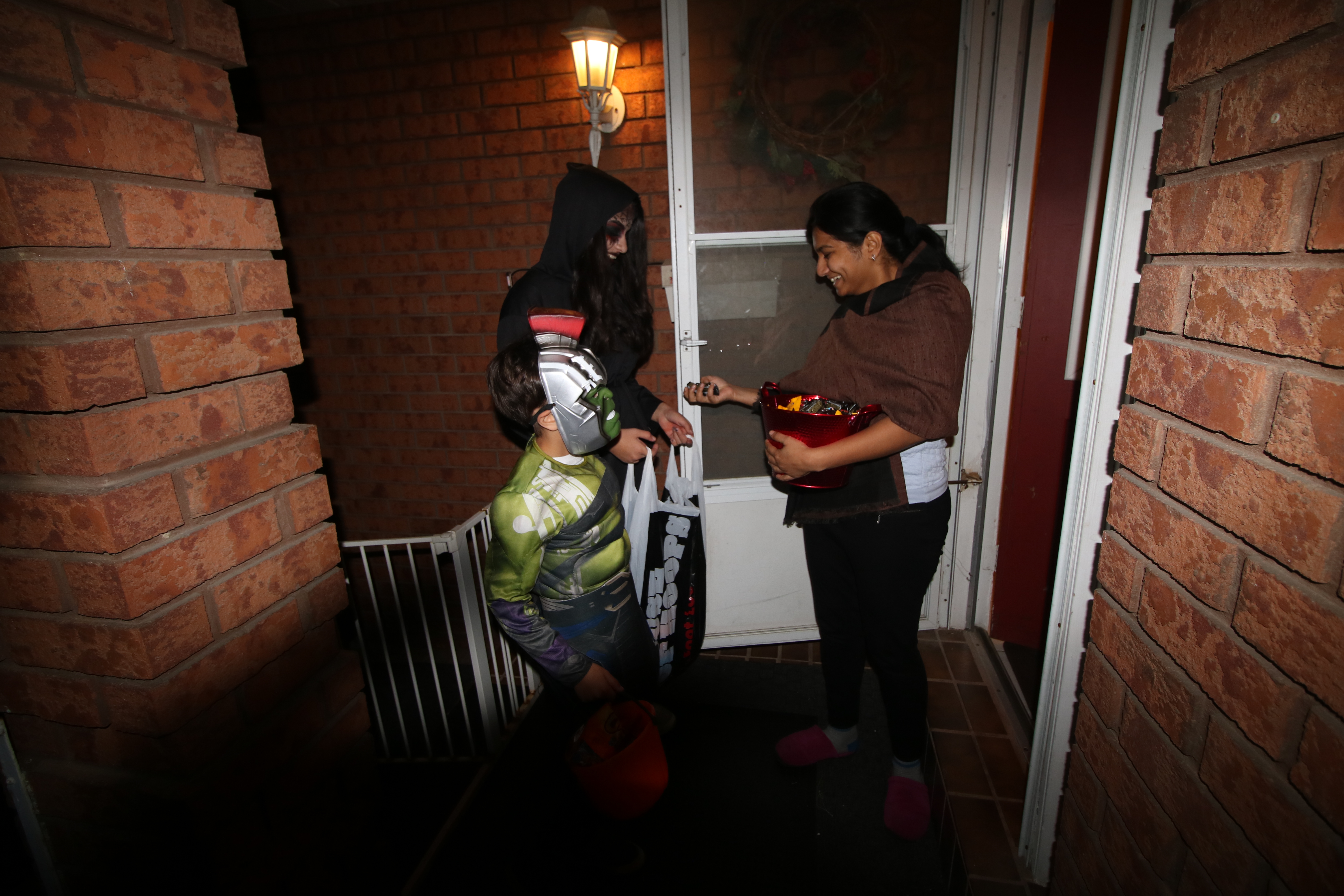
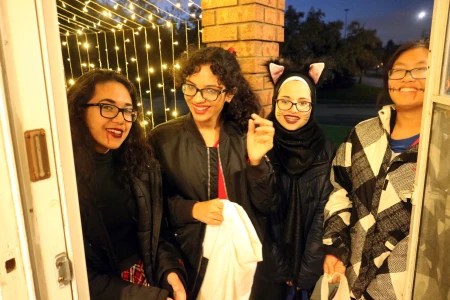
Trick-or-treating is a customary celebration for children on Halloween. Children go out in costume from house to house, asking for treats such as candy or sometimes money, with the question, Trick or treat? The word Trick refers to threat to perform mischief on the homeowners or their property if no Treat is given.

Halloween costumes are traditionally modeled after supernatural figures such as vampires, monsters, ghosts, skeletons, witches, and devils. Nowadays costumes come in the form superheroes like Batman, Spiderman, Superman, Captain America, GI Joe, etc. On Halloween day one can see most people – students, teachers, office goers, staff at the malls and the restaurants – all wearing some costume. Some offices and business houses have a particular theme for that year and everyone is expected to dress based on the theme.  It is thought that the colours, orange and black, became Halloween colors because orange is associated with harvests (Halloween marks the end of harvest) and black is associated with death.

Most homes put up Halloween decorations as what one sees in the Dracula movies with cobwebs, skeletons and various scary models. Most houses during the week carries a Haunted House facade.

The most common decoration is the Jack-O-Lanterns which originated in Ireland where children carved out potatoes or turnips and lighted them from the inside with candles. Its origin can be traced back to an Irish myth about a man nicknamed “Stingy Jack” who invited the Devil to have a drink with him and then didn’t want to pay for his drink. He tricked the Devil and drove him off by carving a cross on to a turnip and illuminating it with a lighted candle. In North America, pumpkins were cheaper and more readily available than turnips, thus carving them and making them into Jack-O-Lanterns lit by a candle inside became a North American Halloween tradition. More than 50% of the pumpkin grown in Canada gets converted into Jack-O-Lanterns to end up in landfills.

Some associate Halloween with vampires. The percentage of North Americans who believe in the existence of vampires is at a dangerously high today. Legend has it that vampires feed on human blood, and once bitten, the victim also becomes a vampire and starts feasting on the blood of others. This supposedly accounts for an exponential increase of these widely feared creatures.  The vampires are said to have come into existence from the turn of the Seventeenth Century. If one vampire would have bit a human a month, and that person and the original vampire would have bit two the next month, and so on, by the turn of the eighteenth century, the entire world population would have been bitten by a vampire.

IMG_1983.JPG

Whether Halloween is a devil’s holiday or not, the children really have a lot of fun and enjoy the evening going for Trick or Treat; the adults enjoy accompanying the children and also treating them at their homes.  People of all ages do have a lot of fun dressing up in the most grotesque way and they do not ever associate the Devil or Satan with what they do.

O Canada, We Stand on Guard for Thee


O Canada, we stand on guard for thee – goes the final line of the Canadian National Anthem. Kevin Vickers, the sergeant-at-arms of the House of Commons along with Constable Samearn Son and the entire security machinery that saved the day for Canada highlighting the essence of the national anthem. They protected the Prime Minister and Members of Parliament when gunman Michael Zehaf-Bibeau opened fire in the parliament building.

On Wednesday, October 22, 2014, after shooting Corporal Cirillo at the National War Memorial, Zehaf-Bibeau got into his car and made a U-turn in the direction of Parliament Hill, just a few hundred metres away. He abandoned the car outside the East Gate and commandeered one of those vehicles, which he drove right up to the front steps of parliament building with several RCMP vehicles in pursuit.

Zehaf-Bibeau engaged in a brief exchange of gunfire with House guards as he entered Centre Block. Inside the Centre Block, Const. Samearn Son, a 10-year veteran of the Commons security team, tried to stop him. Son immediately noticed the long rifle in Zehaf-Bibeau’s hand. and although he was unarmed, lunged at the shooter, grabbed the gun and pulled it toward the floor, screaming “Gun! Gun! Gun!”

That alerted the plainclothes officers inside the building, who carry weapons. During the ensuing struggle, Son was shot in the foot. He was taken to hospital later in the day, and released that night, but with a permanent souvenir — the bullet will stay in his foot, sources say, as it would do more damage to remove it.

Zehaf-Bibeau continued up the stairs, but by that time, the officers inside had been alerted by Son’s cries. The shooter went down the hall, at which point Sergeant-at-Arms Kevin Vickers shot him.

Kevin Vickers, the sergeant-at-arms of the House of Commons, routinely carries the ceremonial mace into the House as a symbol of authority. The kings of England and later the speakers of the House of Commons had sergeants-at-arms carrying large maces to protect them.

Vickers richly deserved the prolonged standing ovation he received in the House of Commons on 23 October, and the thanks of a long procession of MPs thereafter. Vickers issued a statement saying he was touched by the attention but gave full credit to the whole remarkable security team, which demonstrated professionalism and courage.

To Canadians he is being hailed as a hero. Despite the incident, Vickers was back at work first thing this morning as MPs returned to Parliament. Vickers, 58 years old, served the Royal Canadian Mounted Police (RCMP) for 29 years and on retirement he became the sergeant-at-arms in 2006. In his RCMP career, he rose up the ranks from a constable to chief superintendent.

OCnada
The image above showing flags flying at half-mast as a sign of respect for the fallen soldier, was taken in front of the McDonald’s outlet across the street from our home on 23 October 2014. Both the Canadian national flag and the McDonald’s flags are at half-mast. This brings out the real national character of the Canadians and exemplifies their regard for their soldiers.

Cana1
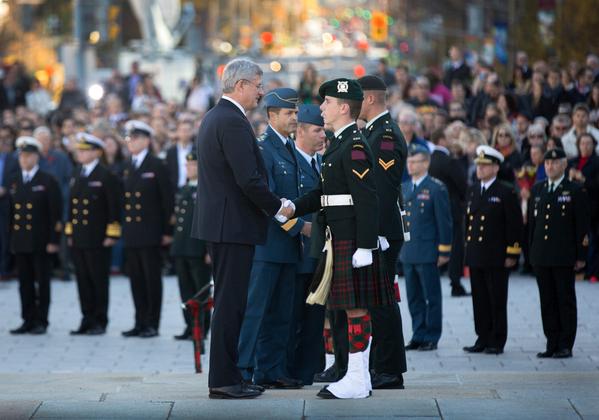
There was a special reinstatement ceremony of the Sentry Program at the National War Memorial on 24 October. Two soldiers took their posts as sentries on either side of the Tomb of the Unknown Soldier for the first time since Cirillo was shot in the same location on 22 October.   The ceremony was attended by Prime Minister Stephen Harper and he greeted the soldiers alongside General Tom Lawson, Canada’s Chief of the Defence Staff. Among those he greeted were the five passersby who tried to save Cirillo’s life after he had been shot.

can1
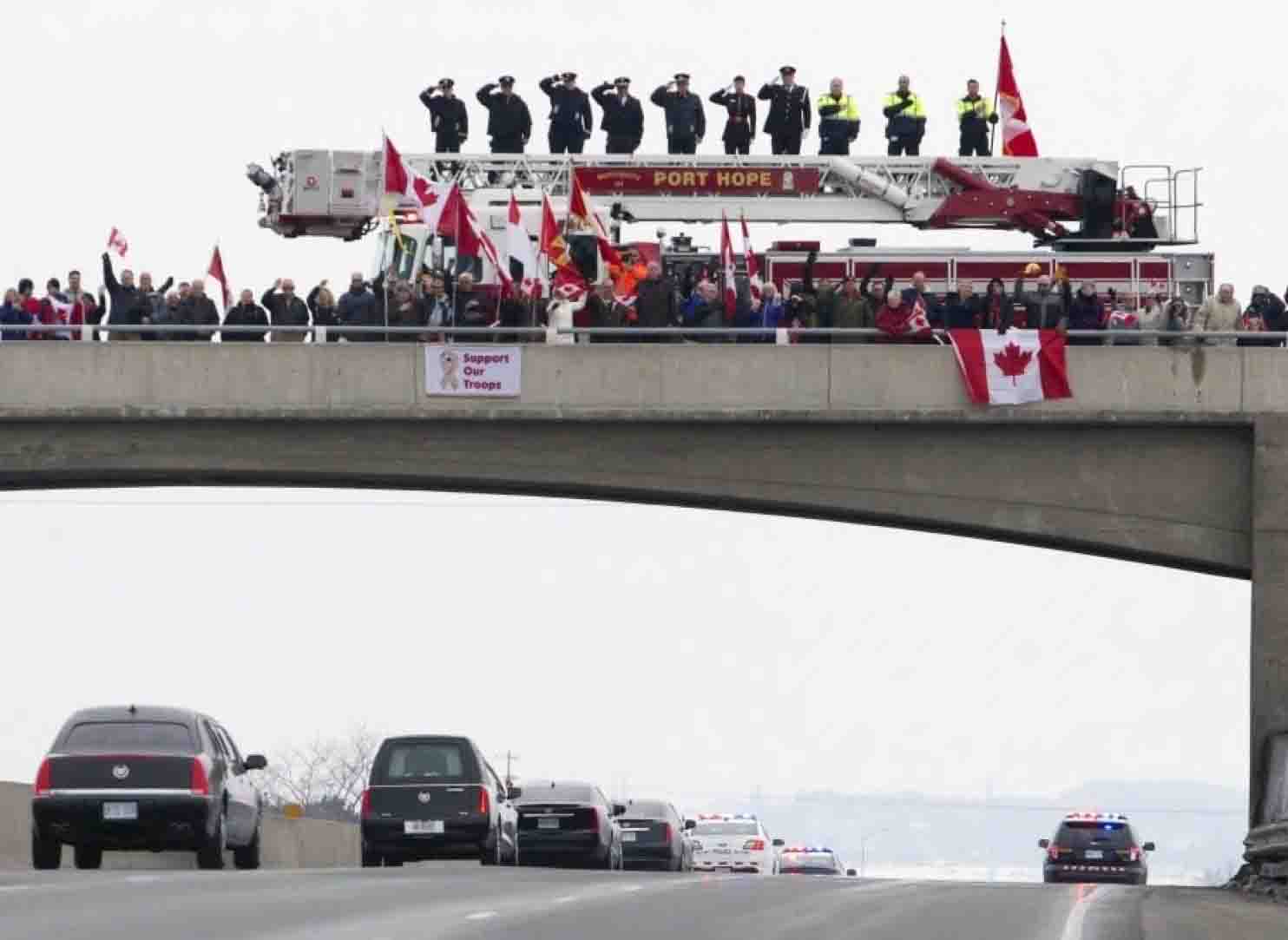
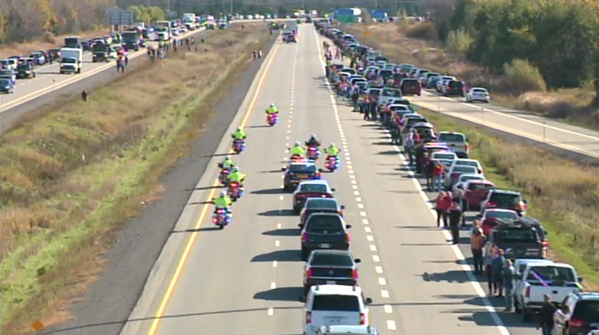
On 24 October 2014 afternoon, as Corporal Nathan Cirillo made his final journey home from Ottawa, thousands of Canadians lined the roads and highway overpasses from Ottawa to Hamilton, Ontario, to pay respect to the fallen young soldier.


As the hearse carrying Cirillo’s remains travelled along the Highway of Heroes, a stretch of Highway 401 named in honour of all the soldiers who laid down their lives.

can2
Onlookers waved Canadian flags and clapped.

can9
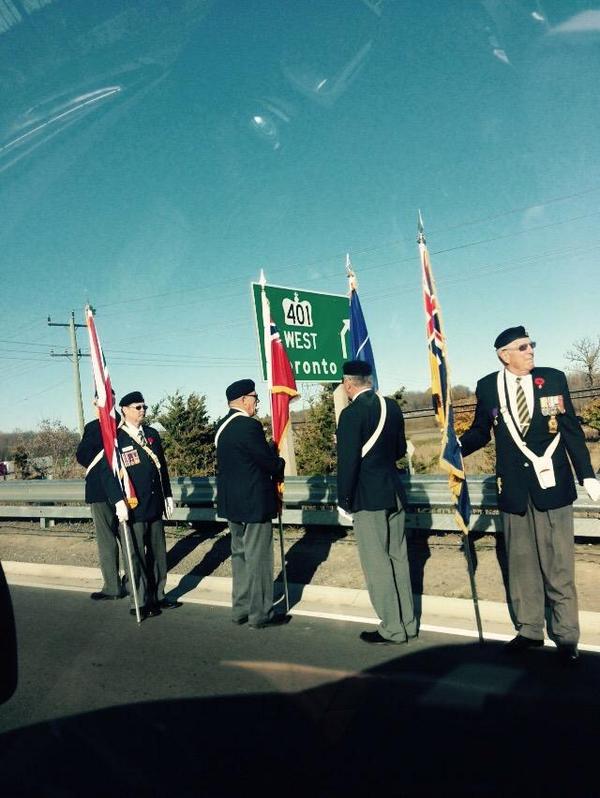
The crowds included veterans, police officers, firefighters, military families and those who wanted to pay their respects. Some sang ‘O Canada’ as the hearse passed by.

cna7
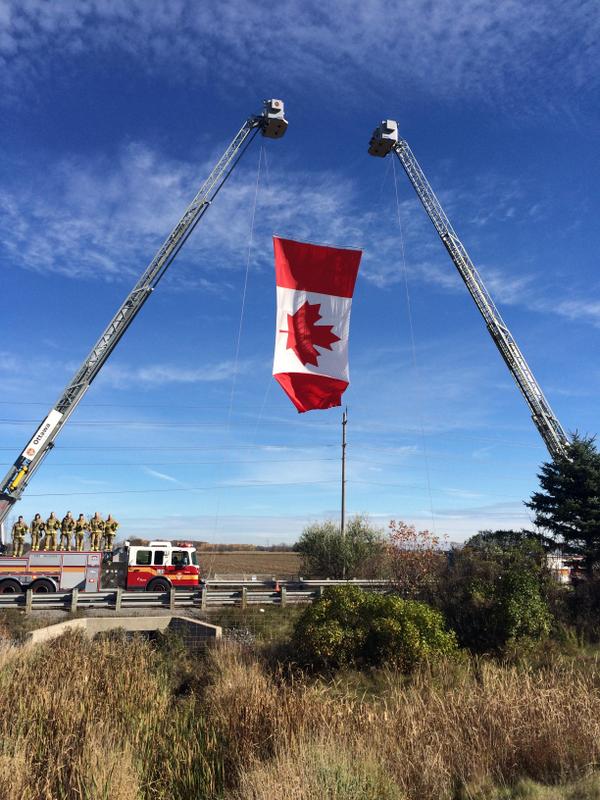
On all the overpasses, the fire fighters had raised the Canadian national flag atop the ladders of the fire trucks.

An Ottawa firefighter waves a Canadian Flag as crowds wait on an overpass at the Veterans Memorial Highway for a procession transporting the body of Cpl. Nathan Cirillo to pass by in Ottawa on Friday, October 24, 2014. THE CANADIAN PRESS/ Patrick Doyle
For more than 500 kilometers, other vehicles respectfully kept their distance from the motorcade or pulled over until the hearse was out of sight.

A Canadian Soldier salutes the hearse carrying the body of Cpl. Nathan Cirillo on the Veterans Memorial Highway in Ottawa on Friday, October 24, 2014. THE CANADIAN PRESS/ Patrick Doyle
There were no police to enforce any traffic control, the self-disciplined Canadians demonstrated the apt way to pay respect to a fallen soldier.

OTTAWA, ON - OCTOBER 24: Kathy Cirillo (center left), the mother of Cpl. Nathan Cirillo, follows the casket carrying her son, two days after he was shot dead by a gunman while he guarded the National War Memorial, during a precession from Ottawa to Cirillo's hometown of Hamilton, Ontario, on October 24, 2014 in Ottawa, Canada. After killing Cirillo the gunman stormed the main parliament building, terrorizing the public and politicians, before he was shot dead. (Photo by Andrew Burton/Getty Images)
When the procession arrived at the Hamilton funeral home around 8 PM, the large crowd that had been waiting outside for hours softly sang the national anthem and applauded.

cane
This demonstration of national pride and respect for a fallen soldier comes naturally to the Canadians. Canada does not have conscription and majority of the Canadians have not served with the military. The major contributor is the fact that Canadian military history forms a major part of the Canadian history curriculum from primary to high school level. The children learn about the heroics of Canadians in the first and the second World Wars and the role played by Canadians in various peace keeping missions across the world. It was Lester Bowles Pearson, former Canadian Prime Minister who is credited as the father of  United Nations Peace keeping when he suggested that the United Nations station a peacekeeping force in the Suez Canal during the crisis in July 1957.

To become a Canadian citizen one must pass the Canadian Citizenship Test which covers a major portion on the Canadian military history. This ensures that the naturalised citizens are well aware of the sacrifices and achievements of the Canadian soldiers.

Why can’s the Indian UPSC, various state PSCs, entrance examinations, bank staff and officers examination – all include at least 5% questions from  Indian Military History?

On the occasion of the Remembrance Day on November 11, the school children discuss about their relatives who served the military – both the past and the present. In all the schools and in many public places, ceremonies are conducted to honour the veterans and the serving soldiers. Above all, during the week running to the Remembrance Day, all Canadians wear a Red Poppy as a mark of respect to the soldiers.

Corporal Nathan Cirillo’s made his final journey home on 24 October, 18 days before the Memorial Day – 11 November.  During the Memorial Week, Canadians wear the ‘Red Poppy’ as a mark of respect to fallen soldiers.  Can you spot anyone in the images above not wearing a Red Poppy?

To read as to ‘Why we wear a red Poppy?’ please click here.

Whale Watching @ Bay of Fundi

After spending three days on the Prince Edward Island (PEI), the Eastern most province of Canada, we decided to travel to the Bay of Fundy for Whale watching.

The Bay of Fundy is a bay on the Atlantic coast between the Canadian provinces of New Brunswick and Nova Scotia. Some sources believe the name ‘Fundy’ is a corruption of the French word ‘Fendu’, meaning ‘split’, while others believe it comes from the Portuguese ‘funda’, meaning ‘deep’. The Bay of Fundy is known for having the highest tidal range in the world and is said to be best place to watch the whales in the summer.


We had entered PEI through the Confederation Bridge and decided to take ferry for exiting the island. It could have been the resultant of my military mind which prompted the decision for a different exit route and also the eagerness for the experience of traveling by the ferry.

The ferry commences its voyage from Wood Islands, PEI and takes 75 minutes crossing the Northumberland Strait to Caribou, Nova Scotia. The bottom two decks of the ferry holds about 150 vehicles, which include 60 feet trucks, cars and motor cycles. The upper two decks are for passengers and there is Wi-Fi, movies, restaurants, lounges, children play area, etc on board.   We loaded our car into the ferry at about 2 PM and moved into the upper deck to enjoy the sea breeze. We reached Caribou by around 3:30 PM and drove off to Middleton.

We spent the night in a motel at Middleton and the next morning drove to Freeport in Nova Scotia and reached an yellow building – the Lavena’s Catch Cafe which also houses the booking office for the Whale Watching Tour operated by Captain Tim. He also doubles up as a lobster fisherman, when he is not operating the Whale Watching Tour. On reaching the cafe, Nidhi our daughter was quick to come up with the fact that this place had featured in the Food Network’s series Pitchin’ In, hosted by chef Lynn Crawford.

Lavena’s Catch Cafe established in 2000 is owned and operated by Tim Crockers’ sister Lavena and her husband Stanton. It is purely a family business and has been listed in Where To Eat In Canada since 2002. All dishes are prepared daily.  The menu boasts of delicious seafood entree’s and fabulous homemade desserts. The menu is somewhat dictated by what comes off the boat that day and the seafood is as fresh as you can get. We had breakfast and placed our order for lunch, mainly scallop chowder, baked haddock and salads.

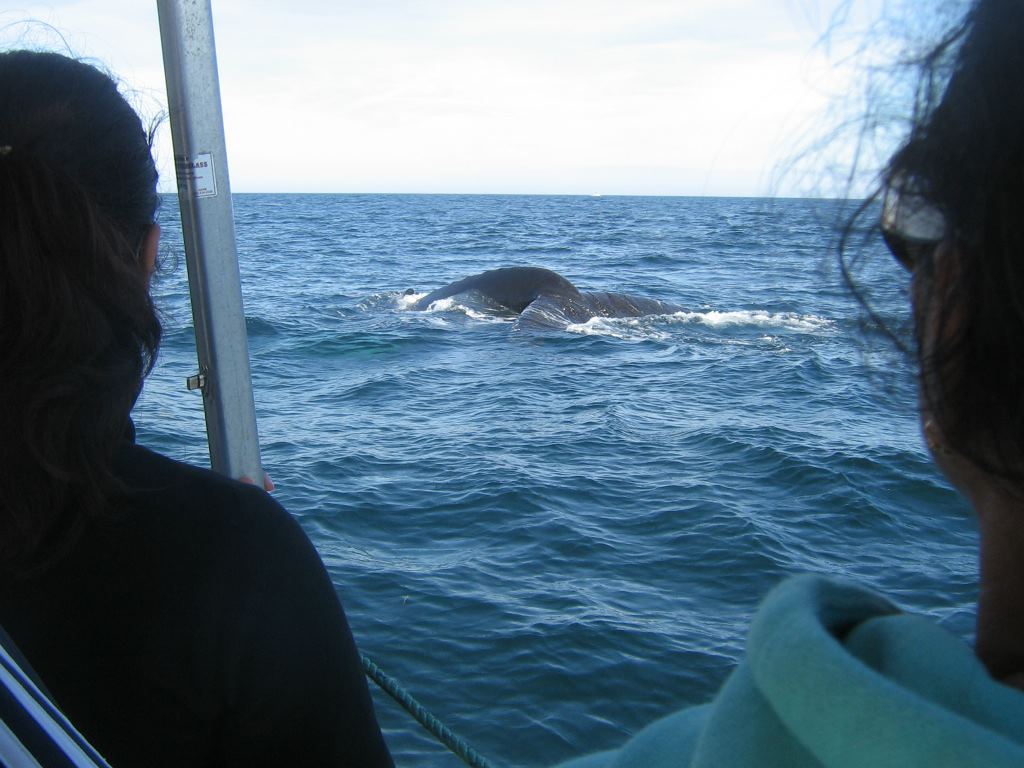
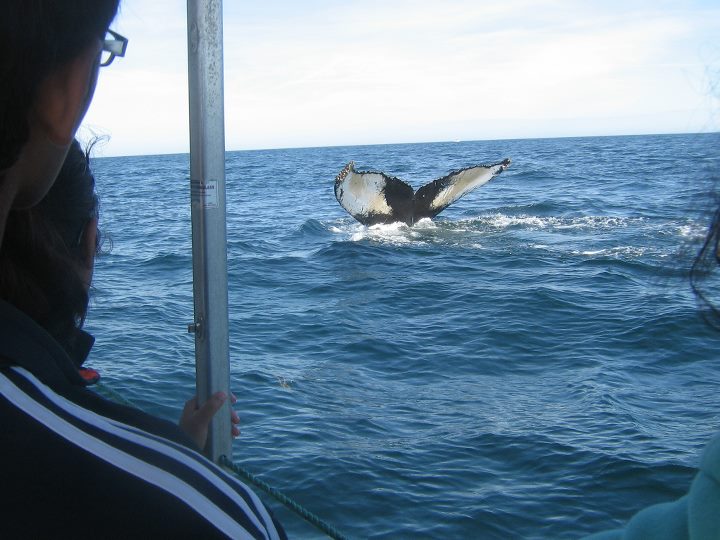
At 10 AM we embarked on Captain Tim’s boat for the Whale Watching Tour. After the mandatory safety briefing, the boat steamed off into the Bay of Fundy – a 90 minute cruise. Captain Tim kept briefing us about the seas, the whales and all his previous experiences of encounters with the whales. He claimed that he had never missed sighting the whales in any of his tours and promised us that we will all meet the biggest mammals. Suddenly the boat broke into high speed and Captain Tim called everyone to look in the front and there they were – about eight Humpback whales swimming majestically. Captain Tim positioned the boat about 30 meters from the swimming whales and moved parallel to them so that we could see the whales. These “showmen” put on some spectacular shows, literally throwing their bodies out of the water (breaching). They come into the Fundy Bay to feed on the enormous amount of capelin (small smelt fish) that come in from the sea. The humpbacks are about 12-16 metres long with black dorsal colouring and large white pectoral fins. Their top looks like a hump and hence their names and another distinctive feature of the Humpback are their fluked tail. Flukes are the two lobes of the whale tail.

Whale watching tours follow the Marine Tour Operators Code of Ethics which include no chasing, harassing or herding the whales. This is to ensure that the whales are not disturbed from their natural routine or injured.

On returning to the Lavena’s Catch Cafe by mid-day, hot chowders were waiting for us. We enjoyed the fabulous seafood lunch and set out to the Digby Port to catch the ferry to St Johns in New Brunswick. We loaded the car into the ferry and set sail at 4 PM for a three hour journey across the Bay of Fundy.

The facilities in the ferry were similar to the earlier ferry and the duration being three hours, we decided to settle down in the lounge for a game of cards. After about two hours, the Captain announced that there were some killer whales sighted on the port side. We looked out and was about four killer whales emerging out of water, doing flips, turns and somersaults before landing back on the water. These killer whales are called Orcas and is a toothed whale, the largest of the Dolphin family. They are easily distinguished by their fin and their prominent black and white markings which can be seen from far. They are natural predators but as well, they are natural showmen.

We disembarked at the St John’s port at about 7 PM and drove off to the hotel and spent the night there. Early morning we drove to Quebec City and the next day to our home in Mississauga.

RCMP and the Muskrat Hat

Mink-Rcmp

The Royal Canadian Mounted Police (RCMP) called the ‘Mounties’, adorn hats made from the muskrat fur as part of their winter uniform. The hat keeps them warm in the extreme cold winters of Canada, especially when operating outdoors and also during ceremonial occasions and parades. Each RCMP winter hat requires pelts from at least three muskrats and each year approximately 3,000 hats are issued to officers.

The animal-rights activists in Canada have been clamouring for discontinuance of the muskrat hats by the RCMP. They wanted only those officers who work in the extreme cold would be allowed to wear fur hats that had pelts supplied by humane trapping methods. For others, hat with a synthetic and/or natural alternative was recommended.

The RCMP accepted the proposal and tested a tuque made of synthetic material that works well in normal winter conditions, and decided to supply the new hats to cadets as early as the fall of 2014. The Mounties said their time-honoured muskrat hat would continue to be issued to officers working in extreme cold, stressing that the force and its garment suppliers comply with an international agreement on humane trapping standards.

To kill muskrats, leg-hold or Conibear or traps are often used. The ‘Stop Loss’ leg-hold trap was created specifically for muskrats. This trap has an extra metal spring which slams onto the muskrats body, pinning it away from its trapped limb. This prevents the muskrats from chewing off their own limb, which many will do in an effort to escape. Muskrats are caught in body-gripping traps can leave them exposed to the elements and predators, and prone to dehydration, starvation and self-inflicted injuries before they die. Often, trapped muskrats drown. Drowning muskrats are conscious and experience all of the pain and distress associated with drowning. These deaths are deemed inhumane and unacceptable by the animal-right activists.

If the animals undergo sufferings when trapped, what about the crabs and lobsters trapped using a similar method?   What about the fish in the nets or on the hook? Don’t they also undergo a similar suffering? The fur trade supporters often ask these questions.

The fur trade is vital to the economy of many remote rural communities in Canada. These communities who often have few other economic options. Majority of Canada’s fur cultivation actually takes place on factory farms where hundreds of thousands of mink and fox are kept in tiny cages and slaughtered for their skin. There are close to 70,000 trappers in Canada who harvest muskrats and other animals. Many are the aboriginal trappers who use the trapped animals for food and bait as well as the pelt.

Muskrats reproduce at a prodigious rate and would cause problems if not culled regularly as a sustainable approach. These animals are abundant and plentiful in the Canadian environment and need to be trapped to protect the ecosystems and also the fur trade.

Canada’s fur trade contributes more than $800 million annually to the Canadian economy. Canada’s most important fur markets are China, Russia and the Ukraine, Europe (Italy, Germany, UK, Greece, France, Spain), Turkey and Korea. The Canadian fur trade directly employs 70,000 Canadians. Full and part time employment in various fur trade sectors is additional to spin off employment in the supply and services sector, including feed and equipment suppliers, veterinary and research services, by product production, marketers, business services, transport, crafts and design sectors.

Fur trade has been one of Canada’s oldest and most historically significant industries. Nearly four hundred years from its start, the commercial fur trade continues to use a plentiful sustainable Canadian resource in a responsible manner and is an important contributor to Canada’s economy and ecology. The development of the fur trade had exploded in the seventeenth century once the fashion demands of Europe had acquired an insatiable desire for felt hats made from the short hairs of the Beaver. The fur trade had formed an important part of the early economies of both the English and French colonies.

The initial system was based upon some Aboriginal groups trying to control the trade by playing the middleman between the European settlers and other Aboriginal groups. This developed into a system where the colonists began to travel to the hinterland to trade directly with the native groups and eventually the French Coureurs des Bois began to lay their own trap lines and would travel thousands of miles each year by canoe.

The English decided upon a different approach when they claimed the Hudson Bay and all of the lands that had waters which flowed into the Bay. This system fell under a private company – The Hudson Bay Company (HBC) – which was granted it’s charter by King Charles II in 1670. The HBC constructed trading posts called forts, factories or houses at the mouths of rivers, along the western shore of the Hudson Bay and initially relied on the natives travelling down the rivers to trade their furs. As sources and the quality of the furs began to deteriorate, the Bay men used the natives to help them explore and establish new forts further and further away from the Hudson Bay.

The expansion of these two fur trading systems inevitably brought them into contact and conflict. There were only so many furs and the question became who was going to secure and dominate the trade. It is an interesting fact that the furs from Canada were usually considered to be more desirable due to the colder winters and hence the greater development of the fur to keep the animals warm.

The Canadian government on 30 September 2014 has ordered the Mounties to reverse the plan, even though the force has already ordered 10,000 tuques to replace the muskrat hats. The political angle to the decision is that Minister Leona Aqlukkaq, who heads the Environment ministry, also hails from the fur-trapping northern territory of Nunavut. She would always love to keep her electorate happy.

Hurricane Hazel


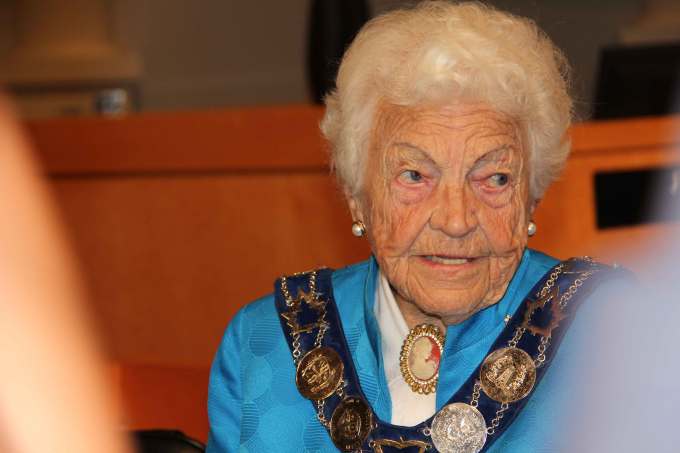
Hazel McCallion the Mayor of Mississauga, I saw her the first time when she gave the graduation address to the students when our daughter Nidhi graduated from high school in 2009. She came driving her Chevrolet Malibu car bearing the licence plate ‘MAYOR1’. The graduation address was inspiring, motivating and would make any listener think. She peppered her address with wit and humour and made everyone laugh too. Immediately after delivering the address, she dashed off to the next high school in the city to address that school’s graduates. This proved that her nickname of ‘Hurricane’ Hazel suited her to the tee.

Hazel McCallion, has won every mayoral election contested in Mississauga since 1978. She is the longest serving mayor in Canada and has kept the city debt-free since her first term of office. McCallion began her political career in 1968 on the Streetsville municipality which she served as Chairman of the Planning Board, Deputy Reeve, Reeve and then Mayor of Streetsville. In 1974, Streesville got incorporated into the City of Mississauga.

In her first mayoral election in 1978 she narrowly defeated the incumbent mayor. In 1979 she came into world news when a public health and safety crisis occurred during the 1979 Mississauga train derailment. A train carrying toxic chemicals derailed in a heavily populated area of Mississauga. A large explosion and fire ensued as hazardous chemicals spilled. McCallion, along with the Police and other governmental authorities, oversaw an orderly and peaceful evacuation of the entire city of 200,000 residents. Despite having sprained her ankle, she continued to hold press conferences and update briefings. There were no deaths or serious injuries during the week-long emergency.

Her reputation has hinged on her financial acumen and political pragmatism, with her no-nonsense style endearing her to constituents and alienating some opponents. In 1991 she became the first mayor to submit their city’s budget to public scrutiny.

Mayor McCallion is well known for her love of hockey. She played for a professional women’s team while attending school in Montreal. One of her friends and a hockey commentator Don Cherry, who joked during her 87th birthday that while 98 per cent of the city voted for her, he was looking for the remaining 2 per cent that didn’t. She never campaigned for the elections, she never put up posters, she never delivered any elections speeches, but she always got over 90% of the votes.

Mayor McCallion was born in Port Daniel of Quebec on February 14, 1921 and educated in Quebec City and Montreal. She then began her career in Montreal with Canadian Kellogg, an engineering and contracting firm, and was transferred to Toronto in 1942 to help set up the local office. Mayor McCallion remained with the company for 19 years. In 1967 she decided to leave the corporate world and devote her career to politics.

Hazel was married to Sam McCallion on September 29, 1951. Sam passed away in 1997. Hazel’s in-laws on her marriage to Sam gifted a piece of land in the village of Streetsville. She still resides in Streetsville and believes that one got to have a life filled with purpose and meaning and living her life in a Christian-like manner helped to motivate her and keep her energized. She does everything around the house herself like cleaning, grocery shopping, gardening, etc. She likes to be self sufficient and thinks that housework and gardening are great forms of exercise and keep her humble.

Her principles are grounded in the belief that a city should be run like a business; thus, she encourages the business model of governance. Her family’s business background, her education, and her prior career in a corporation prepared her to approach government with this model.

Hazel’s Hope, a campaign to fund health care for children afflicted with AIDS and HIV in southern Africa is her charity initiative. Hazel became the poster girl for longevity and good health for Trillium Health Centre. On her 90th birthday, Dr. Barbara Clive, a geriatrician, marvelled at Hazel’s good health: “At 90 her gait is perfect, her speech is totally sharp and she has the drive to still run this city. She’s the poster child for seniors”.

In December 2014, Mayor McCallion will step-down and people of the city are feeling ‘bad’ about it. What an amazing woman, who has given her life to our great city. She is never going to be replaced, she is Mississauga. What an inspiration for all women and for those of a certain age, that they aren’t done yet and can still live happy very productive active lives. To the generations coming up behind, to work hard and make a name for oneself and make a difference.

After delivering her annual State of the City speech, her last as mayor, on September 23, 2014 Mayor McCallion had some advice for anyone who wanted to fill her coveted seat in Mississauga: “Don’t make promises you can’t keep. You have got to be honest with people. You can’t make promises when you haven’t got a hope to fulfil them”.

Hazel McCallion was appointed as special adviser to the principal of the University of Toronto Mississauga.  She is engaged in her passion project is to develop a course to teach people how to participate in public office.

Hazel McCallion has been such an amazing Mayor to the wonderful city of Mississauga, and no one will ever be able to live up to her amazing work . The people of Mississauga are grateful to have had such a strong and caring women take care of our beautiful city. Now she has left some big shoes to fill and in all honesty, there will simply never be another Mayor that can make the people of Mississauga feel the way the people feel for Hazel. Every now and then a person comes around and truly leaves a legacy, you Hazel have done more for the city than most world leaders have done in their lifetime.

Thank you Hazel for all your hard work, commitment and dedication to make Mississauga the place it is today.

Library

During childhood days, our village in Kerala had a public library, housed on the upper floor of the Post Office building. The library had a good collection of books, periodicals and newspapers. The library used to be bustling with activity in the evening. Students and youth came there to borrow books, many came to read newspapers and periodicals and above all, it had a radio connected to a public address system which beamed the news from All India Radio. Those were the days when most households did not own a radio and Television had not become a reality. Our village with its literate masses needed something to read as a source of information and entertainment and the library provided it. My brothers used to borrow the books from library and our grandmother who lived with us then used to read them after everyone went to school.  Now my mother, a grandma, watches the tear-jerking serials on the TV after everyone leaves the home to school or to work.

During my recent trip home, I found the library totally deserted. The reading habit seems to have died down. How can you expect children overloaded with assignments, tuition and above all entrance coaching to find time to read? Various tear-jerking serials have occupied the free time of housewives and senior citizens, which in those days was spend reading.

Sainik School Amaravathinagar, our school, also had a well stocked library. I started using the library only from my Grade 8 onward as I was not all that proficient in English till then. At that time Mr Stephen, our librarian had taken over. Untill then the librarian was a clerk or an administrative staff member who hardly had any clue about the real duties of a librarian.

Mr Stephen with an ever smiling pleasing personality was a graduate in Library Sciences. He was the first person to encourage many of us to use the facility of the library and also explain to us the wealth of information available there. He always used to remind us as to how lucky we were to have such a library which he said many colleges and universities in India did not have.

Other than being the librarian, Mr Stephen used to actively participate in all extra-curricular activities. One could always see him in the gymnasium helping students, playing all games with the students and also participating in adventure activities like trekking and rock-climbing. This helped him develop a special rapport with the students. I spend some of my free time in the library and also whenever I was made an ‘outstanding’ student in the classes, I straight away moved into the library.  Mr Stephen exactly knew what would have happened in the class, but never asked me a question and let me into the library.

On migration to Canada, we settled down in the city of Mississauga. The City runs  Mississauga Library System. It is one of the largest public library systems in Canada with over 300,000 registered users. There are 18 locations, including a multi-floor Central Library with material allocated by subject areas. Anyone who lives, works, attends school, or owns property in Mississauga can obtain a Library Card required to borrow materials.

All the library branches I visited were always full of customers, especially students and seniors. The library system has a large collection of books, DVDs, video tapes etc in 22 languages including Hindi, Thamizh and Punjabi. The excellent catalogue system followed by the library can be accessed online from the home. One can place a hold on a material through the online system. The moment the material arrives the customer is intimated by email or over the phone. In case a desired items not in the Library’s catalogue, it may be obtained through inter-library loan.

In case the library branch one visited does not have a desired material, but is available in another branch, the same is transferred to the library if you request for a hold. All materials borrowed from any branch of the library can be returned at any branch. The catalogue system caters for it.

The Library offers access to downloadable eBooks and audio books. One can download these to a computer or a mobile device.  One can also sign up to receive sample chapters from new books and newsletters about new books and authors.

Library staff are always available to help the customer to find information and choose materials. The Library offers extensive information on occupations, educational planning, career planning, training and job search strategies.

An extensive collection of fine, old and rare materials, dealing with the history of Mississauga City is available for in-library use at the Mississauga Central Library and includes scrapbooks, local archives, and a large collection of photographs. Genealogical materials are available through Ancestry at all Library locations. The Historic Images Gallery brings together the image collections of multiple institutions providing centralized access and is searchable online.

eResources provide access to reference eBooks, newspaper and magazine articles, scholarly journals, book reviews and more. Search over 30 eResources covering a wide variety of topics including health, business, world news, literature, sports, arts, and entertainment. With a valid Mississauga Library card, you can do your research from home, school or office.

Children’s Dial-A-Story can be called as often as you want, any time of the day to listen to a new preschool story each week in the comfort of your home.

Public access to the Internet and Microsoft Office is available at all Library locations. One can book a session to use a Library computer with a valid Library card. Photocopiers are available at all Library locations at a minimal payment. Copying is subject to copyright laws.

Large Print Books are available from all library locations and rotate from library to library. In partnership with the Canadian National Institute for the Blind (CNIB) Braille Books are provided via mail.

Libraries store the energy that fuels the imagination. They open up windows to the world and inspire us to explore and achieve, and contribute to improving our quality of life.”   – Sidney Sheldon
Post Script :- My book ‘Suit, Boot and Tie‘ now finds a place with Mississauga Library System.
Search Results for suit boot (sirsidynix.net)

Fair & Lovely

Washington Post published a survey by the World Value Survey, which measured social attitudes of people in different countries. The survey asked citizens what types of people they will refuse to live next to, and counted how many chose the option ‘people of a different race’ as a percentage for each country. Jordan came out as the country with the highest proportion of ‘intolerant’ people with 51.4% and India with 43.5%.

anita

Look at the Fair & Lovely ad in India and it will prove one aspect of intolerance for the dark complexioned, especially among the fairer sex. The ad shows a miraculous change in the complexion of a girl from being dark skinned to very fair. The effect in the ad must have been achieved by the ‘digital touch-up’ and also by the effective use of light during photography.

Manufactured by Hindustan Lever, Indian arm of international giant Unilever, Fair & Lovely claims to offer dramatic change to fair complexion in just six weeks.  The packing of the cream displays one face six times, in an ever-whitening progression, and includes ‘before’ and ‘after’ photos of a woman who presumably used the product.

Do you think Unilever will ever market or package this product in US/Canada the way they do in India?

As per Indian laws, since Fair & Lovely is not categorised as a pharmaceutical product, Hindustan Lever is not bound to prove efficacy of the product. In India, litigation for not achieving advertised effect or social effect of the advertisement will take a long time and may not get the desired judgement.

Indian media is now trying to establish itself and is in the process of maturing. At this stage, to most the revenue matters and hence are ready to air ‘irresponsible’ news, discussions, advertisements, etc for ensuring better Target Rating Point (TRP) and raking in a few more bucks. Responsibility for ensuring that advertising is truthful is a shared responsibility among advertisers, agencies, and the media. The best regulation is self-regulation and one can expect it from the Indian media houses in the times to come.

Fair & Lovely is the largest selling skin whitening cream in the world, and was first launched in India in 1975. It held a commanding 50-70 % share of the skin whitening market in India. The product is marketed by Unilever in 40 countries in Asia, Africa and the Middle East, with India being the largest single market. One can see them in the shelves of many Indian grocery stores in Canada too.

Our children, both schooled in Canada, their friends with complexions ranging from the darkest to the fairest, have been dismayed with the Fair & Lovely’s television commercials aired on the Indian channels. The ad typically contains the message of a dark complexioned depressed woman, becoming fairer and getting a job or a husband. It also depicts the women becoming happier and more confident after the change of her complexion. The question from our children was as to how come no one is suing them in India for racialism.

The discussion further went on to belief in India that the skin colour is very powerful unlike in North America where the emphasis on a deep and glowing tan. The majority of Indian society still feels that a lighter color skin tone reflects a higher status and is more attractive. This gets further strengthened with the bride searching ads put up by Indian men mostly seeking out fair skinned women. Hence the target market for Fair & Lovely is predominantly young women aged 18-35.

As expected, the discussion moved on to their cousin Anita, an engineering graduate, now working with an IT firm in Trivandrum, Kerala. Anita is a dark complexioned girl and she is well aware of that. Heard her saying to her mother that it was not her fault that she was born with a darker skin.

Our daughter Nidhi always felt that Anita was trying to appear fair and hence was using all unhealthy products. This had a telling effect on her skin. Nidhi, during her visit to India in February 2014, decided to give a few tips to Anita about carrying herself confidently and beautifully with her natural complexion. She had seen many of her dark complexioned friends using cosmetic products and procedures to look beautiful.

The first lesson Nidhi gave Anita was that being dark complexioned is also beautiful and hence there is no need to look fair. Then she took Anita to the local cosmetic store and based on the ingredients, selected cosmetics which suited her skin tone and ensuring that it had no bleaching agent. It was followed by a lesson on how to apply the cosmetics and makeup tips to enhance her facial features.

In June 2014, I got a call from Anita, then a student at the Engineering College and she said that she wanted to run for the post of the Chairperson of the College Union. I felt that she had become really confident and appeared to have come out of the ‘complexion problem’. She won the students election and became  the Chairperson.

Walk for Water

toronto-73508_1280

A friend invited me to participate in a charity walk of 5 km on 29 August 2014, through a picturesque trail in the city to raise awareness about the problem of safe drinking water faced by millions worldwide and also to raise money. The Walk for Water was in support of Water Missions International’s response to the global water crisis through sustainable safe water and sanitation solutions around the world. Safe water is the source of life. It is the foundation for health, education and viable economies. The global safe water crisis is much more than just a lack of safe water. Providing those people with access to safe water gives them an opportunity  to go to school, work and play free from the stress of dirty, disease-filled water.

There were posters put up all along the path depicting the problems faced by people all over the world. There were posters saying how lucky the Canadians are as they have the Great Lakes and thousands of smaller lakes with clean potable water. Canadians are blessed with clean municipal water supply all through the day year around.

This prompted me to study the municipal water supply system in our City of Mississauga, which comes under the Peel Region.

water66aaLake Ontario is the source for the Peel Drinking Water System. As the lake water enters the intake, located about 2 km from the lake-shore, it is chlorinated. The chlorine kills bacteria and prevents mussels from growing in the intake pipe and obstructing the flow. As the water enters the treatment facility, it passes through travelling screens. The screens prevent items such as fish, sticks and aquatic plants from entering the treatment facility and damaging equipment. Water is then treated by means any one of the following treatments based on the age of the plant.

  • Conventional treatment.-
    • Alum, a coagulant is added to the water. The rapid mixer thoroughly mixes the coagulant with the water to help form sticky particles from the suspended particles in the water.
    • Slow mixing that helps the sticky particles collide with each other, forming larger and heavier particles called floc.
    • Floc particles are removed from the water by inclined plate settlers or the water is slowed down in large tanks to allow particles to settle to the bottom.
    • Removes remaining particles and chlorine-resistant bacteria and reduces the levels of compounds that can cause tastes and odours.
    • The water travels down by gravity through layers of granular activated carbon, sand and gravel.
  • Ozone Biologically Activated Carbon Contactor and Membrane Filtration (OBM) Treatment.
    • Ozone gas is bubbled through the water in the Ozone Contactors. Ozone kills bacteria and also helps to break down substances that cause tastes and odours so that they can be removed easily.
    • BACC Filters: These specially designed contactors remove the biodegradable organic matter produced by the activity of the ozone process. This removal process keeps the water stable after treatment by minimizing re-growth of bacteria in the distribution system.
    • Membrane Filters:   These are specially designed water filters with very small pores that the water is pulled through. The membrane filters remove microorganisms and producing water with very little turbidity.
  • The modern state-of-the-art Membrane Filtration, Ultraviolet Light, and Granular Activated Carbon Contactor (MUG) treatment.
    • Membrane Filtration.   Raw water is pulled through state-of-the-art Ultra Filtration Membranes with pores small enough to filter out particles and many microorganisms.
    • UV Light.   Filtered water then passes through UV Light Units, which inactivate microorganisms. These units also reduce taste and odour in the water by Advanced Oxidation. The Advanced Oxidation process uses hydrogen peroxide and a higher intensity of UV light to oxidize (break apart) compounds that cause unpleasant taste and odour. The Advanced Oxidation system is used seasonally, when taste and odour problems are at their peak due to lake and temperature conditions.
    • Granular Activated Carbon Contactor (GACC).   The water then flows down through a matrix of carbon granules into GACC. They eliminate any residual hydrogen peroxide from the Advanced Oxidation process.

Water treated by any of the three above processes is further treated prior to supply into the water supply system as under:

  • Chlorination for inactivation of bacteria/ disease causing organisms.
  • Fluoride  addition for better dental health and to protect teeth from cavities

The water is then supplied through the pipes, buried 10 feet below to prevent freezing in winter. The old ductile iron pipes (DIP) forming the water mains, running mostly below the municipal roads, are now being replaced with polyethylene encased DIP, which has a lifespan of up to 100 years.

Majority of the water main replacement projects are undertaken from March to October every year, in partnership with road and sewer renewal projects for improved cost effectiveness and minimized public inconvenience. This prompted a friend to remark that in Canada we have four seasons – winter, severe winter, winter and then construction.

How do they ensure water at the optimum pressure throughout?

A typical municipal water supply runs at between 50 and 100 psi (major appliances require at least 20 to 30 psi). Pumps at the water treatment plant pump water at about 100 psi and is connected to the main pipe lines. There are three water towers in the city which are also connected to the same pipeline. During low water usage hours, the tanks on the water towers get filled and they discharge into the pipeline when the pressure falls due to high usage during peak hours, thus maintaining the optimum pressure. There are no overhead tanks in the homes as the city guarantees 24 hours water supply at optimum pressure.

As the water in the pipelines is maintained under high pressure all throughout, there is hardly any chance of muddy water from the ground getting into the pipes. Mixing of dirty water or sewage is possible only when there is intermittent water supply and there is a crack in the pipe. The water in the pipe leaks into the soil around when under pressure. When the water supply is shut down, the pressure in the water pipes drop below the pressure of water in the soil, forcing the muddy water into the pipeline through the crack. When the water supply is restored, this muddy water in the pipes reaches the consumer.

How come the water in the water towers do not freeze in the cold Canadian winters?

They do freeze. They just don’t normally freeze solid. The central pipe that runs from ground level up into the bottom of the tank is called a riser. Many tank risers are wrapped with heat tape, covered with insulation and capped by an aluminum jacket. Ice forms on the surface of the tank, in many cases several feet thick. Normally, this ice layer floats on the surface as the water level rises and falls. Many times this ice remains stuck to the roof the tank and remains there.

This is why the City of Mississauga proclaims that the best drinking water is the municipal water.

For Want of a Nail

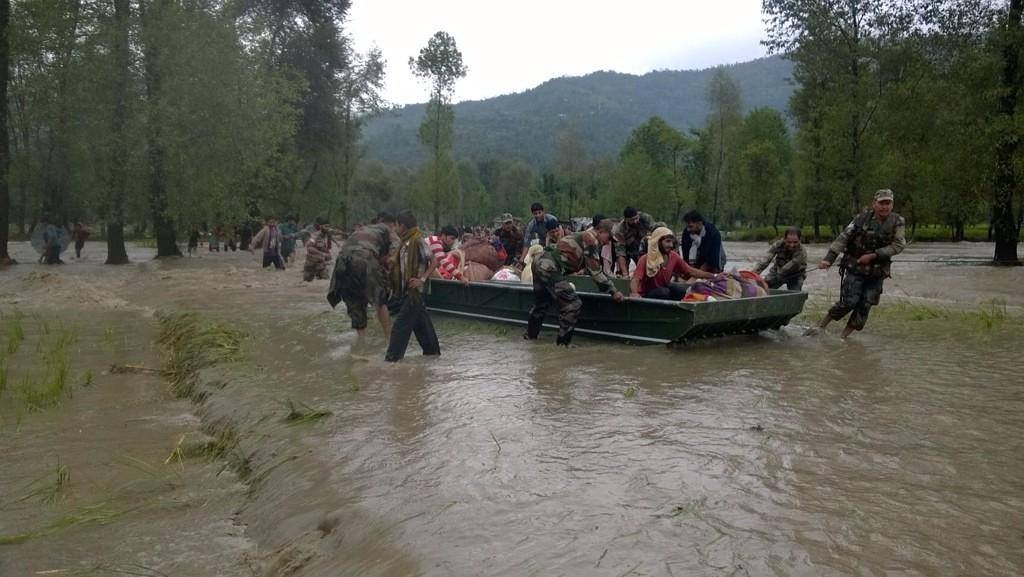
IndianSoldierFlood

Our son Nikhil wanted me to buy a whistle – Fox 40 ‘Sport & Safety’ Classic Whistle- to be used for his life-guard training at the city’s swimming pool. I went to the store and was a bit surprised when I looked at the price-tag on the whistle – it costs $5. Thinking that I may not have zoomed on to the correct product, I looked carefully at the label to reconfirm it. Out of curiosity, on reaching home I “Googled” the product to see its characteristics and why a simple looking whistle cost me so much. As per the manufacturer, this whistle is easy to use, very loud that it can be heard over a mile away, is waterproof and unbreakable. Being made of plastic one does not have to worry about rust. It works even after it is wet because it does not have a ball in it.

Aren’t such whistles required by our soldiers, especially those deployed on flood relief duties?

During my service with the Indian Army, we have been called out to help the civil administration many a times. On many occasions we were placed on high-alert for flood-relief duties. There are many standard operating procedures (SOPs) in the units for flood-relief, but there is hardly any equipment available to execute the tasks. The army heavily relies on the ingenuity of the officers and soldiers to execute the task.

Watermanship is an important aspect of military training. It comes handy while on war crossing water bodies, rivers and other obstacles. It becomes more important when dealing with natural disasters like Uttarakhand or Kashmir. There is hardly any attention paid to this aspect of training.  Many of our soldiers are non-swimmers and hence training in personal safety while dealing with fast flowing currents, floatation devices, rescue equipment, etc become very important. There is hardly any rescue equipment worth its name authorised to any army unit, but they are always called out to deal with such situations.

The biggest deficiency the army has is that there is no boats authorised to the army and our men are not trained in operating the outboard motors. Only some men from the Engineers are trained on it or those hailing from areas like the backwaters of Kerala have some experience.

The army units are not even authorised life-jackets and the risk we are forcibly putting our men to without the life-jacket is well known to all. There is no High-visibility safety apparel (HVSA) -clothing (e.g. vests, bibs or coveralls) that is worn to improve how well other people “see” them (their visibility). In any developed country, it is mandatory for anyone operating in these circumstances to wear them.

It is a pity to see our soldiers are without life-jackets and HVSA and all the personnel of the NDRF is fully geared. When will they equip all the soldiers of the Indian Army with these? Surely it does not cost much.

Hence it is suggested that all the army units (especially the Infantry, Cavalry, Artillery, Engineers and Signals) be scaled with inflatable boats, outboard motors (with about 50% as spare as the local boats will be much effective with one), ropes, winching equipment, harnesses, rope bridges, etc.

Further HVSA must be authorised as personal clothing for all ranks. This would be very useful for drivers, co-drivers and also passengers of military vehicles and also for anyone operating any plant or dozing equipment. This would also help while being deployed on aid to civil authorities for restoration of law and order.

It would be a pity that a soldier’s life is to be martyred because of our short-sightedness. No battle should ever be lost and we should never lose a soldier for want of a horseshoe nail (life-jacket).

Nikhil’s Poems

nik

Here are some poems Nikhil wrote as part of Grade 10 English Assignments.

Order and Chaos
Discipline is the greatest strength
Restraint the greatest virtue
Control is the highest aspiration
Order the only truth
Order is what everyone seeks
Order: a utopian fruit
Disorder is the natural state
Anarchy is the final end
Lawless is the nature of the world
Into chaos we all descend
Chaos is past, present and future
Chaos we can achieve

Love
I am defenseless, I must surrender
I am under your enchantments
You speak and I hear Venus’ voice
You laugh at my inept replies
The philosophers deride
Those who lose to passion
Yet my soul knows what I don’t
I cannot deny this
You are perfect as the rose is perfect
In this game I am green as grass
You are the light which kisses my world
But soon you must be gone
You will move on
Leave me incomplete
I must simply trudge on thereafter
From one heartbreak to the next
In grief to grief, from dust to dust

Time Travel
I used to serve
obeying other’s commands
Now I have tasted command
I can never obey again
I used to plan
deciding on my future
I now live in the moment
planning as i go
I used to consume knowledge
to prove achievement
I now seek wisdom
for the sake of it
I used to fear failure
and facing disappointment
I now fear obscurity
dying not remembered
I used to believe
I knew what I wanted
I now know
I must be willing to change
I used to watch TV
so I could be entertained

I now use what I saw
to entertain others
I was once blind
Stumbling for the truth
But now I see

Bottom of the Bottle
Her love so fierce she couldn’t contain it
She expected to be happy so long
Letters of love so many were writ
Her love a great flag flapping
She could not have known the a lurking
For in the shadows he works
The tiger’s name was her love’s drinking
One of life’s horrid quirks
She forgave his smelling everyday like booze
He said he was sober yet she could tell
She thought life’s game in which I can’t lose
Now she’s in a hell wet not hot
When she has a child her greatest terror
Is he’ll follow his father and commit his error

Walking Tours

Ottawa-Nights

Exploring Canada is real time consuming and over the past two summers we decided to explore Ottawa, the Capital City and Quebec City, the capital of Quebec Province. At both these places, we undertook walking tours of extremely different nature.

On 31 December 1857, Queen Victoria chose Ottawa as the Capital of Canada being midway between Toronto and Quebec City and less prone to political mobs being a small city. Ottawa is the fourth largest city in Canada and is the most educated city with minimum unemployment. Ottawa with Gatineau, Quebec, on the West together form the National Capital Region (NCR). In effect half of it French speaking and the other half mostly English speaking.

Every city in the world offers an amazingly rich history filled with scandal, scariness and intrigue. There are many a haunted buildings, places of worships, cemetery etc that one can find in any city. While in Ottawa, the capital city of Canada, we ran into The Haunted Walk, a walking tour company that conducts “The Haunted Walk Tour”, a walking tour around the city which commenced at 9 PM and ended by 10:30 PM for the reasonable rate of $15 per head.

The hostess was Margo, a middle-aged lady, cloaked in black cape and carrying a lantern, gathered all the 15 participants near the Parliament building and briefed us about the tour and the safety aspects. She began with the haunting tale of the graveyard under our feet and continued across the street, under the canal, to Lisgar High School and all around the City spinning tales of long ago ghosts and even some personal tales. The fireworks from the Parliament building provided a perfect backdrop for all her ghost stories.

Margo conducted us on the tour visiting important landmarks of Ottawa and with each place she had some hunting story to narrate, which she did perfectly, with complete “effects”. She did not use any props or any hysteric sounds as one anticipated. The tales involved the Lisgar High School, the Fairmont Chateau Laurier hotel, the Confederation Park and the Rideau Canal. It was the good old fashioned story telling with the stories apparently researched and edited beforehand. Leaving alone the ghost stories, the tour quite informative and useful in discovering the streets of Ottawa.

Then we moved to the Quebec City. The crown jewel of French Canada, Québec City is one of North America’s oldest and most magnificent settlements. Its picturesque Old Town is a UNESCO World Heritage site. There is more than a glimmer of Old Europe in its classic bistros, sidewalk cafes and manicured squares.

Québec City is 400 years old. It boasts four centuries of history marked by encounters with the First Nations, battles between the French and English, terrible epidemics, four centuries during which Québec has grown into the city forging a character of its own built around a thriving culture, economic success, urban transformation, neighborhood life, and the French language.

Quebec City’s rich cultural heritage isn’t just in its architecture and historical leanings; it is in the food too. The Walking Tour was the Culinary Tour, which lasted over two hours, walking through the historic cobblestone laneways within and just outside of the old walled city, which dates back to 1535, when Frenchman Jacques Cartier established the original fort. During the tour we sipped many samples of wine, tasted various types of cheese, savoured the pastries, tasted various chocolates made from Maple syrup, etc.

Jacques Cartier was sent on an expedition by Francis I, King of France, and he arrived at Quebec in 1534, taking possession of lands. In 1608, Samuel de Champlain made landfall on the north shore of the St. Lawrence River at a spot that the Aboriginals called Kébec.   From here the New France in Canada expanded rapidly between 1660 and 1713. During the Seven Years’ War, the army of General Wolfe laid siege to Québec, and culminated in the defeat of the French General Montcalm in 1759. Four years later, with the signing of the Treaty of Paris, the King of France ceded to the British crown “Canada and all its dependencies.” From then on the Province of Quebec has maintained its French culture and language and thus Canada has two official languages – English and French.

Robert, our tour guide explained all the details about the stories behind the dishes and also the influences of Amerindian, British and French cuisines in the Quebec cooking. The foodie stops included three restaurants, two treat shops, a liquor store and an old grocery. On the way, we passed the oldest Anglican cathedral outside Britain – built in 1804 — and still using human bell ringers every Sunday.

In all these cities there were cycling tours too, but what impresses the most is the “Bixi” (Bike Taxi). Bixi is a network of 800 bicycles and 80 stations located throughout the city, to provide residents and visitors with an additional transportation option for getting around town, making active transportation simple, fast, and fun. The system includes a fleet of specially designed, heavy-duty, durable bicycles that are locked into a network of docking stations. Bixi is available for use 24 hours a day, 365 days a year, except during inclement weather conditions that might make the system unsafe. The station network provides twice as many docking points as bicycles, assuring that an available dock to return the bicycle is always nearby. To rent a cycle, you got to purchase the tickets online or from the kiosks, unlock the cycle from the dock using the code provided, ride the cycle and return it at any station by docking it.

After undertaking these tours, I was sure that in India we can offer many such tours and even many more, in any city at any time. It may not be feasible to arrange a walking tour, but a “rickshaw” or “auto-rickshaw” tour is always feasible.

Honouring a Veteran

vets

This photograph is from an Anzac Parade for the veterans of the Indian Armed Forces in Sydney. The marching contingent of Indian Veterans was received with cheers and the applause from the enthusiastic spectators lining the streets braving the wet and cold weather. The Indian banner stood high and proud, ably and graciously carried by a scout. Joined by their families and friends, the retired officers from Army, Air Force and Navy marched in unison, their suits adorned with their service medals. While they matched step with step, ‘stomachs-in, chest-out’ as instilled during their training days, the different berets symbolised the Corps or the Arm they represented.

Will this ever happen in any Indian city? Will this remain a distant dream?

A few weeks back there was a post on the Facebook where the author was unduly perturbed that India and its Asian neighbours did not figure in the top 25 patriotic countries, across the world, listed in the study of New York-based International Social Survey Program (ISSP). The study throws up interesting points like erstwhile colonies of the British and Spanish ranking higher than both Great Britain and Spain, respectively. According to the study, the most patriotic countries were the US and Venezuela, which were tied-up for the number one slot. The author was apparently more concerned about the ” holier than thou attitude” of Uncle Sam and that the conclusion has no rational basis other than their whims and fancies and prejudices.

It is true.  We do not fly the national flag at half mast when a soldier is martyred unlike US/Canada. We do not line up the streets to pay homage to a fallen soldier as their mortal remains pass through our city/village/town. Our airlines do not even bother to show any respect to the coffins of the soldiers and handle them as ordinary cargo. The Captain of the flight never announces that the mortal remains of a soldier is being carried by them. (Latest being Major Varadarajan’s case).
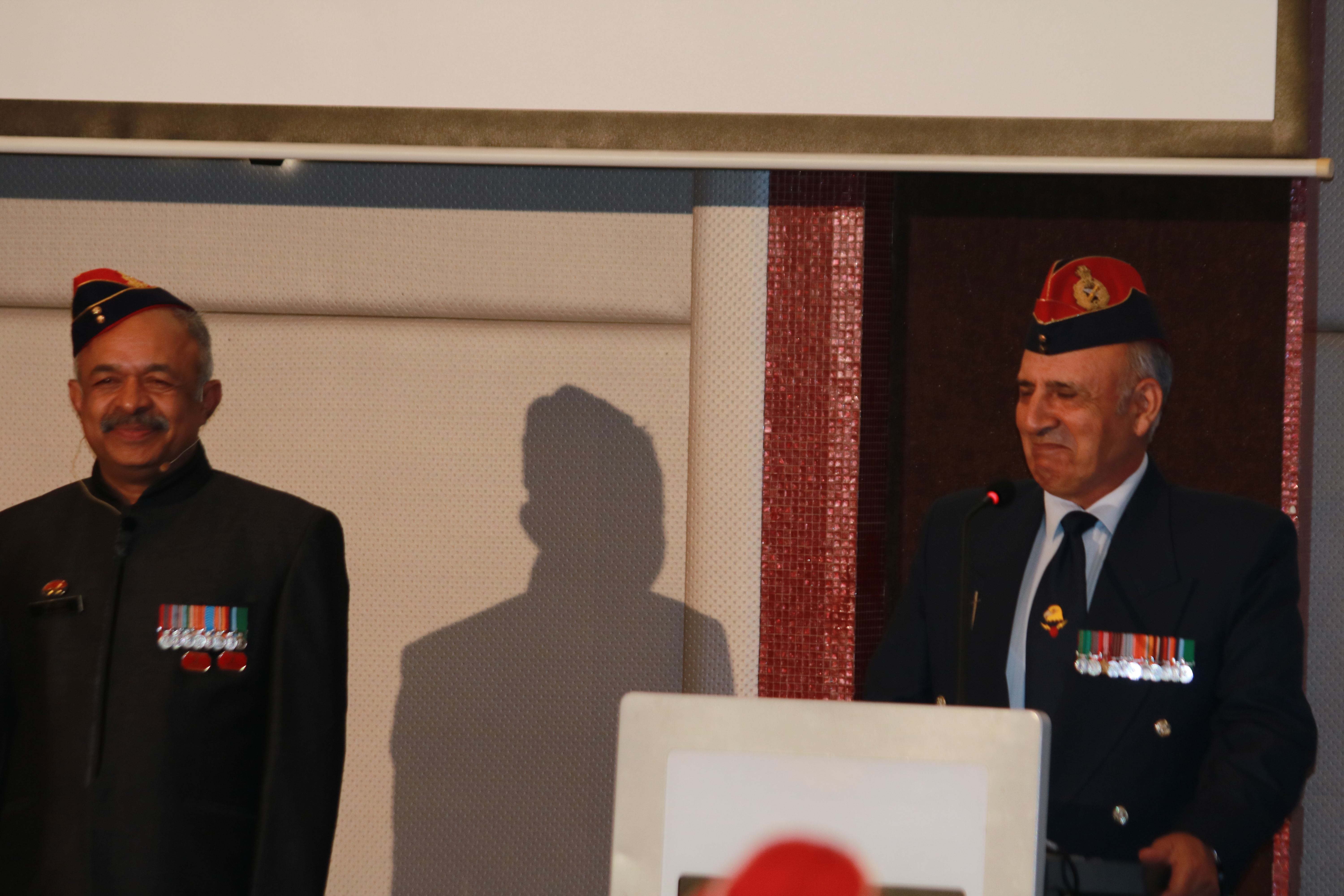
We do not commemorate any Remembrance Day to pay respect for a fallen soldier as in the case of most Commonwealth and Western Countries. Our National leaders or citizens never wear the flags pinned on them by the children on the Flag Day. How can we say that we are patriotic?

Every Indian cries when the ball hit Sachin Tendulkar’s chest, but none even stops to think about the bullets hitting our soldiers’ chests. We call out the Army every time the Indian Police Force fails, but all the promotions and pay is given to them and the Army is forgotten, especially during the pay commissions. We remember the Army only when a calamity strikes us or when a child falls into a bore well and forget about them immediately. Our Parliament passes bills to ensure better pension benefits for all its MPs – whether they did anything or not; whether they attended the sessions or not: but the same Government does not want to implement the One Rank One Pension scheme for its Soldiers. Now show me our patriotism other than during the cricket matches????

This weekend we went to watch baseball game at the Rogers Centre, Toronto between the Toronto Blue Jays and the Tampa Bay Rays. The Rogers Centre is the home-ground of the Blue Jays. The atmosphere was as electric as the cricket matches of the Indian Premier League.

The stadium was fully wheel-chair accessible and there were ramps made so as to facilitate the wheel-chair bound fans to enjoy the game. Even the latest stadium in Pune is not wheel chair accessible, so forget about the rest.  The fans at the Rogers Centre fanned across all ages – children, teens, youth, seniors. One event during the two minute interval between the first innings really stood out.

A sixty year old Veteran from the Canadian Army who was a Captain and had served in many UN assignments was called on to the centre and the Team Management of the Blue Jays presented him with a team shirt with his name printed at the back and with the team captain’s signature in the front. The entire stadium stood up to give the veteran a standing ovation – no one instructed anyone to do it, but was spontaneous. This is what is called patriotism.

Our son then said that during all the matches, a veteran from the armed forces or the police forces, who is a registered fan of the Blue Jays, is honoured this way.

Can we ever expect such a gesture at Mohali from the Kings XI Punjab or at Chennai from the Chennai Super Kings? Why one veteran, we can always honour a dozen at every match.

Will this ever happen in any Indian city? Will this remain a distant dream?

General Salute at Niagara Falls

niagara banner 3

With its incredible power and beauty, Niagara Falls stands out as one of the natural wonders of the world. It should be visited at least once before you die. Located on the Niagara River, at the Canada-US International Boundary, Niagara Falls is comprised of three gorgeous waterfalls – the huge Horseshoe Falls that are situated in Canada, the American Falls which are just across the border in America and the Bridal Veil Falls.

The Niagara Falls is a sight to behold for all your senses. The thundering roar of the falls mixes with the sight of the water and rising mist, and the smell of the fresh, crisp air cooled by the torrent of water relentlessly spilling over the edge of the falls.

Niagara Falls is the second largest falls in the world based on the width. More than 6 million cubic feet of water falls over the crest line every minute in high flow.  The waters in the river are owned partly by Canada and partly by the USA. The international border runs through the middle of the river. The verdant green colour of the water flowing over the Niagara Falls is a byproduct of the estimated 60 tonnes/minute of dissolved salts and rock flour (very finely ground rock) generated by the erosive force of the Niagara River itself.

Everyone visiting us always visit Niagara and having been there umpteen times, I have become an expert tourist guide and can take you through a thrilling experience at Niagara. Once I took acclaimed Malayalam music director Sharreth and his team of musicians to Niagara. When everyone went for a boat cruise to the falls, Sharreth stayed back and I did not know how to spend the next hour as I had no clue about music and had nothing much to discuss with him. So we strolled along the falls and suddenly I asked Sharreth to sing some Raga with the sound of the falling waters as a backdrop. A Raga uses a series of five or more musical notes upon which a melody is constructed. He stopped, paused for a few minutes and said he got a Raga and he started singing it and I captured it using his cell phone. I handed over his cell phone and said you must be the first musician to sing a Raga like this and hence must treasure it.

A few years back we came to know that General Jambusarwalla and Mrs Hufreez Jambusarwalla were coming to the Niagara Falls, US side and we all decided to meet them there as they did not have a Canadian Visa. Our children were very excited to meet him as they had heard many an anecdotes and references about a great human being and a military leader from their dad. The General kept insisting that we should not undertake such an effort, but the decision had been made and we decided to comply with it.

On that day we drove from home, crossed the Canada-US border and reached the hotel where the couple were to check-in. We received them there, and on meeting us, the General said “What better can a retired General from the Indian Army ask for at the Niagara Falls than a General Salute from a Colonel and family”. We then had dinner, spoke for about two hours, and we drove back home at midnight. The children were overwhelmed by the couple’s warmth and love and were really impressed.

While driving back, our son Nikhil said that the General was so down-to-earth and that he did not fit into the frame of a General which he had in mind. He was expecting a rigid, tall and a perfect military figure from what he had heard about him, but what he experienced was a simple human being full of energy, wit and humour, who came down to a kid’s level to converse with him. Nikhil summed up his final opinion with a statement – He is very “Napoleonic”.

Great things in your life will mostly come in short packets. One got to look for them, identify them, explore them, imbibe them and learn from them” was my reply.


It was indeed a great honour for me to have had General Jambusarwalla gracing the occasion of release of my book in Bangaluru in March 2017.


Why So Much Corruption In India?

Have you ever tried to find an answer to this question? How come that we are forced to pay bribes or approach a middle-man to get our basic government documents like a driving license or passport made? How come in Canada or US one does not have to pay a bribe for such documentation? How come these basic documents are provided to you with one visit to the office concerned in Canada or US? Why is that despite having all the necessary documents and qualifications, you still have to make many a rounds to the offices to get the job done?

CI

Our political/ social/ religious leaders always blame it on the enormity of Indian population.   Anyone with knowledge of automated computerised systems knows that if one person’s documents can be done, then a million of such documents can also be done. It appears that no one wants to correct the system. The politician fears the loss of his vote bank and all other leaders fear the loss of money the corrupt system brings.

What makes the officials corrupt? The salary the government officials receive anywhere in the world is pretty high compared to the common-man’s standard of living in that country. Salaries (and pension) paid are adequate enough to maintain a decent standard of living for a family and does cater for all the basic essentials of food, housing, education etc. Then why is the greed or need for the extra money?

Let us examine a person’s life in both India and North America and analyse as to what are the causes for less corruption in North America.

A child goes to school and that’s where they are trained to be valuable citizens. Most important role in this training is played by the teachers in developing the mind-set of these children and they imbibe good values from them. The teachers’ selection and appointment in North America has its own high standards where as in India we are all well aware of the hefty bribes paid to get the post. In most of the private schools, mostly run by the religious institutions, they sign for a monthly salary of few thousands and take home actually a fourth of it. Here merit and teaching ability are of least concern and only their paying capacity is considered. How can you ever expect such teachers to develop a good value system in their students?

In North American society, children after their high-school education tend to look after themselves and graduate by taking loans and/or doing part-time jobs. In India,  parents cater for all these needs and it continues even after their children marry. Donation/ capitation fees/ normal fees for medical and engineering graduation are pretty high in India and everyone wants their children to be either an engineer or a doctor. When I retired after 25 years of service in 2004, my total pension emoluments was about Rs 30 Lakh (3 Million) and that was the amount needed in case our daughter was to take up medical education in a private medical college at that time anywhere in India. This clearly shows that most of the parents of such students have resorted to some illegal method of getting extra money, either by corrupt practices while serving or have evaded taxes and duties while selling their properties by under-valuation etc. Everyone connected with these professional education institutions – the political leadership, the administration, the courts etc are all well aware of this reality.

Why can’t it be made mandatory for all those parents seeking admissions for their children in these medical and engineering colleges to prove their sources of income? It will never come through as most of these institutions are owned by either the political leaders or by religious groups. Neither the politician nor the God can be made uncomfortable by passing such laws. The politicians do not want to mess up with their vote banks and never antagonise the Gods.

After graduation, everyone looks to get a government job and there too a lot of money changes hand in many places. In some cases it is either recommendation or money and in many cases it’s the merit. Where is this money coming from and where is it being used? Could be to pay for someone’s medical or engineering admission and the cycle continues. The only way out is to make the selection and appointment of all government post as transparent as possible. Only problem is that the looser is still either the politician or the God. So that can never be expected.

Now comes the costliest of all events – marriage. In North America, the bride and the groom have to arrange for their marriage expenses and sometimes parents chip in. The amount of money the bride’s parents in India spend is well known, may be to make up for the money spent on the groom’s education, may be to finance the groom’s higher education, may be to finance the education of the groom’s siblings – possibilities are endless. Still the money gets back into the same system and the cycle continues. Legislation and enforcement can control this menace to a limited scale only. Despite enactment of the Anti-Dowry laws, ill gotten money still changes hands and the Gods also seem to be enjoying it.

Next comes housing – everyone seem to be building houses bigger than their neighbour’s. It is never based on family needs, but in many cases only as a status symbol to show-off one’s mostly ill-gotten wealth. In North America, old parents down-size and move to smaller homes, or to a gated community, or to an old age home once their children move out for education or jobs. In India it is always up-sizing, even when one is on his death bed. Only social awareness can eliminate this problem.

Now comes the ultimate – to get even with the Gods who has to forgive and remit all sins in getting this wealth.  Huge offerings are made in the God’s houses to please Him. Most of the offerings are of no use to humanity like golden crowns, golden crosses studded  with diamonds, chariots, elephants and even one’s hair. It is not understood as to which God is going to be pleased with these offerings. In North America, most old people donate all their wealth or part of it to charities, which could help the humanity and may be the Gods will always be better pleased with them.

Education and Punishment

STThe rape of a first class student in school premises on July 17, 2014 in Bangalore added one more to the long list of child abuse cases, many of which remains unnoticed. It has brought back light on one of the worst perils that our country is facing today – child sexual abuse. It is a pity that most of such abusers are either close relatives or teachers of the children. In this case too, it was the physical education teacher. Most Principals let loose these physical education teachers (goons) on to the children to ‘discipline’ them, especially during assemblies or sports or cultural events. These teachers mostly end up misusing the ‘authority’ vested in them by the Principal and in many cases resulting into physical, sexual and mental abuse to the children. Majority of such physical education teachers have no qualification to be one.

Joshi Philip, our family friend, invited me to attend the prize distribution ceremony at their daughter’s primary school. Ann Maria, their daughter, a Grade 2 student, that day had the annual prize distribution ceremony at the end of the academic year. I accompanied Joshi to the school and at the reception we signed-in and were given a round yellow sticker which said “A Proud Parent”. I stuck it above my shirt’s pocket, close to my heart, as anyone will feel proud of it rather than hanging a visitor badge around the neck.

We entered the gymnasium where the award ceremony was to take place. Every primary school here has at least two such gymnasiums and we used to boast about the one we had at the National Defence Academy. We did not have one in the Sainik School. The gymnasium is a hardwood floored hall which serves as a basket ball court, assembly area, an auditorium and a lunch room or a cafeteria. At the end of the gymnasium was a stage where all the award winners were seated. The students marched in class wise with their teachers leading them and the students sat on the wooden floor while the teachers occupied their positions at the end near the wall. As expected of little children from Kindergarten to Grade2, they were talking and then the Principal appeared on the stage and raised her right arm. All children became silent and she said “eyes and ears towards me please” and introduced the two Masters of the Ceremony (MC) who were Grade 5 students.

The prize distribution ceremony went on beginning with the Kindergarten and any time when the children became noisy, the Principal would appear with her right hand raised and everyone became silent. During the entire proceedings not even a single teacher moved from their positions. At the end of the ceremony the Principal came on stage to thank everyone and to congratulate the prize winners and at the end wanted the children to do their usual “Silent Cheer”. I had no clue what it was. It was all the body and face expression of a cheer but done without a sound and was impressive and unique.

On leaving the school I realised that the self-discipline inculcated in these children will make them better citizens of the country and they do not need any “policing” to implement any laws or regulations.

Looking back to my Sainik School days, we mostly had the Principal and the Headmaster from the Education branches of the three services, and most of them one felt were the least ‘educated’. This was further reconfirmed during my training at the Academies and service tenures. Most of the Education Corps officers are masters in some discipline or the other and today we have many officers from the Arms and Services holding masters degree by virtue of undergoing the Staff College or the Long Gunnery or the Engineering degree courses. Some even hold Doctorates too. Academically these officers are many times better than their Education Corps counterparts.

Then why post such officers to the Military/Sainik Schools? Many of them behave no better than the physical education teachers of the Bangalore incident. Most are incapable of moulding and motivating the students to join the defence services and are pretty ordinary in teaching. Any officer in the Indian Army can conduct a better class than these Education officers. The only qualification these Education officers boast of is their Bachelor of Education (B Ed) degree. Most of the Haviladrs (Sergeants) who have attended any courses of instruction in various military training establishments (where they are luckily not trained by the Education officers) will beat them hollow in the art of teaching. Then why not even do away with the Education Corps, considering the education standards of the present recruits into the army.

Shooting in US Gurudwara

Most of you must have followed the unfortunate shooting of some Sikhs in a Gurudwara in USA on 05 August 2012. What was most striking about the episode was the conduct of the Sikh community in USA. They conducted themselves with dignity and honour. Their conduct has shamed many Americans. I had read many American papers and watched the TV coverage of the date. All communities including Christians, Muslims, Jews etc not only condemned the killings but came out openly in support of a very mature and religious community. Even the mother of the assailant was apologizing to the Sikhs openly.

SG

In all this tragedy the conduct of our Sikh friends had been exemplary. Not one angry word, no burning of buses, no abuse, and no vulgar display of sorrow. Listening to the family members of the victims was so satisfying. No whining. I felt proud of being an Indian in sharing their sorrow.

In North America you do not protest by burning buses, abuses, vulgar display of sorrow, etc because they are all criminal offence as also the case in India. Here legal action would be initiated in case of such incidence and the court would take serious view of it, sometimes based on media video footage. Once your name is in the offenders list, finding a job, a house, a car etc would become difficult as everything is connected to your Social Security Number. May be with Aadhar, in India also things will change.

A few years back, in a protest by thousands of members of Toronto’s Thamizh community, blocked and shut down the Gardiner Expressway for five hours. They were demanding the Canadian government to impose sanctions on Sri Lanka in wake of the civil war. This mode of protest was condemned by everyone in Canada. This protest took away any sympathies the Srilankan Thamizh people had in the minds of any Canadian.

US President Barak Obama insisted that American flags in the capital and at all government buildings throughout the nation be flown at half-mast in honour of the victims of the Gurudwara massacre. May be a token gesture some may claim, will not bring back the dead or justice may not done etc.

Recently there was carnage in Assam and did the Nation ever mourn the dead or fly the National Flags at half-mast? Some sceptics may say that in that case the national flag will mostly remain at half-mast. Is it that we have become so insensitive to such happenings?

In Kerala we saw the protests by a political party when a district level leader was arrested. We saw how the state was held to ransom by a handful of misguided elements. The damage to public property was huge so was the inconvenience to the public in general. May be its true that in a Democracy we get what we deserve and not what we desire.

We need to learn from the way the US as a nation mourned the death of its citizens and how the media and the public reacted to the massacre. The media did not show the deployment of the police forces in and around the Gurudwara so that the attacker(s) if any left would not make use of it. Compare it with what happened in Mumbai (26/11) and also the media frenzy during the recent Assam carnage which may have contributed to worsening the situation. The US media did not show any dead-bodies or dear and near ones of those killed wailing, thereby reducing the pressure on others. Even though there is no media censorship or guidelines, responsible reporting is done by the media. In India, the whole incident would have been sensationalised by the irresponsible media, as was the case in Assam, resulting in worsening the crisis.

Adaptation

“In the struggle for survival, the fittest win out at the expense of their rivals because they succeed in adapting themselves best to their environment” so said Charles Darwin in his Theory of Evolution.

max11

Our dog, Maximus Koduvath, turned six this year and I thought he had mellowed down a lot in comparison to his “puppy” days. He plays and runs around in the backyard and luckily does not dig up the lawn. He only digs up area not covered with the grass.

In the backyard of the house we have a kitchen garden where we grow vegetables in summer months. We grow them organically using the compost from the city’s recycling centre as manure. The children help me in collecting the compost and spreading it and are treated with a doughnut and coffee. Thanks to Colonel Balaji, an old classmate, both at Saink School and National Defence Academy, who has taken to farming in his native village in Thamizh Nadu after hanging up his boots, who advised me to spray a mixture of Neem Oil, liquid soap, chilli powder and turmeric powder on to the plants as a pesticide/fungicide. It has really improved the yield of the vegetables and the blooms on all the flowering plants in the front garden.

I had put up a 30 inch high wire mesh to separate the vegetable cultivation from the lawn. Many friends thought that it was to keep away the raccoons, skunks and rabbits (these are the common visitors to all Canadian home gardens). I would tell our friends that we live a stone’s throw away from the City Hall where our Mayor sits (our Mayor is a 93 year old iron lady, Ms Hazel McCallion, who presides over the city with total commitment and enthusiasm) and Ms Hazel has placed the area around the city centre as “out of bounds” for all animals.

Some enquired the reason for such a low fence and my theory, based on the equestrian training at the National Defence Academy, was that any animal, unlike humans, needs a running space to run and jump over any obstacle. Hence Maximus will not be in a position to jump across with the limited space in the lawn. In case he manages to jump across, he will not be able to get out and hence will never try again to jump in. The 30 inch height of the fence facilitated my easy entry and exit into the garden.

This year I decided to apply some bone-meal to all the vegetable plants to facilitate better yield. Maximus got attracted to the smell of the bones and he jumped across the fence and licked off some of the bone-meal after digging down. Now he could not extricate himself out of the fenced area as he did not have running space to execute a jump. He started to bark and I had to lift him over the fence. I shouted at Maximus for uprooting a few plants in his search for the bone-meal and as usual he retreated into his cage in the family room. Yes, my theory was well proved.

This drill of Maximus jumping over the fence and I extricating him out from there continued for three days and every time I got angry with him, he would retreat to his cage.

A few days later I saw Maximus in the vegetable garden and on seeing me, he came up to the fence and lifted his both front legs together over the fence and before they could land on the ground, he managed to lift off the rear legs and crossed over the fence with ease. The Darwin’s theory of evolution dawned on me and I realised that Maximus had adapted to the environment and my theory lay in the dust-bin.

Next year I need to raise the height of the fence and also build a gate there – another self-help project for the year ahead.

What Do I Do Now?

This is the question everyone asks me when I call-up anyone back home in India. When I say I am enjoying my retired life, the immediate reaction has been “You just cannot sit idle and must be up to something.” Hence I decided to pen down all the activities I indulge in throughout the day.

rk

Saying good-bye to the army was very difficult, especially since one enjoyed the best of times and it’s the Army which has made you what you are this day. One could not have asked for anything better from God and the system – otherwise from being a primary school teacher’s son, I would not have retired as a Colonel. All what I am today is the result of the education of Sainik School, NDA, IMA and various Military Institutions. In sheer physical terms – from a 22 kg nine year old boy to a 78 kg 42 year old – all credit must belong to the Indian Army. So it was a painful good-bye to the arms.

Looking back, thirteen years since I hung my boots, I have no regrets or complaints. God and the Army Headquarters (MS Branch) was always kind to me that I served 10 years in Delhi (even though I had no interest in Delhi;) five years on various courses and to top it, had only two years of High-Altitude postings. Again nothing to complain.

The army made me a computer aware man despite being a BA. It made me a leader and a man. I never ended up working in the Army – as I enjoyed every part of it. Thanks to God, all my colleagues, my superiors and mainly to the men who really made me feel proud.

The journey out of the uniform had been different to what many of you experienced as I took the evening flight to Canada, the day I handed over command. I jettisoned into a new and unknown world, where my wife and children were waiting.  As promised, my wife had a nice, big home and a car waiting for me and as she was earning a good salary as a pharmacist. I had no pressures at all. My first step was to amalgamate with the Canadian society.

To my dismay, I found that all my perceptions of the Western world were totally misplaced. No racism, no shunning being a brown skin, and a very friendly lot of people who valued human aspects of life. I spent my first six months learning to speak English the way Canadians do and I found all the people whom I spoke to at the malls or coffee-shops or in the bus, very patient and friendly trying to make out what I was trying to communicate. These communications helped a lot and also corrections from our children got me into speaking Canadian-English.

After six months, I landed up with a job as a supervisor at a call-center and I enjoyed that too for a two year period until our children demanded that I be home when they were there.  They did not want to live in an empty home.   That’s it! I quit my job, to be a house husband. My wife who was doing a four-day week took to a five-day week as her 10 hours of extra work made up much more than what I earned in my 40 hour week and expenditure came down as I did not have to drive to work.

Having taken over as the house-husband, I felt I was busier than any time before as I woke up first, made tea for all, cooked breakfast, packed lunch and fresh-fruit-juice and dropped off the children to school and saw-off my wife to work. Then were the chores – washing dishes, laundry, vacuum cleaning the house, walking the dog (a very difficult aspect in Canada- especially in winters), preparing lunch, gardening, grocery and the list goes on. By afternoon, I picked up the children from school; some days in the evening  when they had any after school activities like drama club, environmental club, debating club etc. Then was dropping them off to their extra-curricular activities by 5 PM – for swimming, tennis, golf, music, dance, or voluntary service at the community old-age home. Got everyone back to home by 6 or 7 PM and helped them with their assignments and study and then cooked dinner and we waited for Marina to return to enjoy a family dinner at 9 PM.

Now with both our children moving out of home to stay in Downtown Toronto, pursuing their job and university, my busy schedule came to a near end.  That was when I found time to read more and write more.  I took to photography as a new hobby as I realised I needed quality images for my blogs.  I now get busy only on the weekends when children come home, normally preceded with a text message listing out all the groceries and other stuff they need.

The life has kept me busy and hence I presume in good health too. I never carried any baggage in my life. I never carried a brief-case to office as I did not believe in carrying office to home or vice-versa.  I recall a conversation with an NCO who met me while on vacation last year who said “You are the only Commanding Officer I’ve seen coming to command a unit with four boxes and leaving with only two.

Air-Canada only allows two pieces of baggage,” I replied.

Remembrance Day

pp

Remembrance Day is observed in Canada and most of the Commonwealth nations, (barring some countries like India), on 11 Nov (11/11).  At 11 minutes past 11 o’clock, all the buses and trains will stop, the fire engines will sound their sirens for a minute as a mark of respect to all the fallen soldiers.   Remembrance Day (also known as Red Poppy Day,) is a memorial day observed since the end of World War I to remember the members of the armed forces who have died in the line of duty.

In India we remember our soldiers only at the time of war and forget them soon after. Our governments over the time have been unfair to the Armed forces and have brought down the status of the Army Chief after every war fought by the Indian Army – . After the 1947-1948 war, the service chiefs were made junior to the Judges of the Supreme Court. They were made junior to the Cabinet Secretary after the 1962 war and junior to the Attorney-General after the 1965 war. After the 1971 war, they were made junior to the Comptroller and Auditor-General.

The red poppy has become the emblem of Remembrance Day due to the poem In Flanders Fields by Lieutenant Colonel John McCrae, a doctor of the Canadian Army during World War I.   During the war, he was treating injured men – Canadians, British, Indians, French, and .Germans. The poem was written to vent the agony felt by McCrae after he had performed the funeral ceremony in the absence of the chaplain, for his young friend and former student, Lieutenant. Alexis Helmer caused by a bomb.

In the poem McCrae describes about the poppies that bloomed across some of the worst battlefields of Flanders in World War I, their brilliant red colour an appropriate symbol for the blood spilled in the war. The poem speaks of Flanders fields, but the subject is universal – the fear of the ones who sacrificed their ‘today’ for our ‘tomorrow’, that they will be forgotten, that their death would have been in vain. Remembrance, as symbolized by the Red Poppy, is our eternal answer which belies that fear.

An American teacher, Moina Michael, in November 1918, read McCrae’s poem “In Flanders Fields”. She immediately made a personal pledge to keep the faith and vowed always to wear a red poppy of Flanders Fields as a sign of remembrance and as an emblem for keeping the faith with all who died.

Two years later in 1920, during a visit to the United States, a French woman, Madame Guerin, learned of the custom. On her return to France, she decided to use handmade Poppies to raise money for the destitute children in war-torn areas of the country.  Following the example of Madame Guerin, The Royal Canadian Legion officially adopted the Poppy as its Flower of Remembrance.

Thanks to the millions of Canadians who wear the Legion’s lapel Poppy each November, in memory of thousands of their countrymen who died in battles (except many who emigrated from the Indian sub-continent). During the Remembrance week, all the flags fly at half-mast; all the buses have “Lest We Forget” signboards, most of the shops, restaurants and malls display banners and posters to honour the soldiers and veterans.

On the Sunday of the Remembrance Week I attended the Holy Mass at the Canadian Catholic Church and the Orthodox Syrian Christian Church.  In the Catholic Church anyone and everyone including the clergy, all were wearing the Red Poppy, whereas in the Syrian Christian Church none were wearing.  You all can guess the reasons.

Mississauga, the city we reside, a notification at the Municipal Transport (MiWay) on Remembrance Day read as follows “The City of Mississauga’s MiWay Transit is offering free service for Canadian Forces veterans and a companion on Remembrance Day, Friday, November 11. To obtain a free ride on Remembrance Day veterans must wear their uniforms, medals or other items that clearly identify them as veterans to our transit operators. Veterans are respectfully asked to identify their companion to the transit operator so that he or she may also ride free. All MiWay buses will observe a minute of silence at 11 a.m. on November 11 to recognize the sacrifice made by our veterans. Transit operators will stop their buses during this tribute.”

One always passes by the veterans and cadets selling the Red Poppy in the malls, bus terminals, subway/railway stations, during the Remembrance Week.   The money collected is used for veterans’ welfare by the government. The public support for the event is always overwhelming where ever they have Remembrance Day ceremonies. People turn up in large numbers. The media support is also tremendous. All news presenters, anchors, all wear the Red Poppy for the entire week. Have you seen any Indian news presenters or any media person ever wearing the Flag on the Flag Day (Indian equivalent of Red Poppy Day)?

Canadian Prime Minister and the entire cabinet, appear on any media, wearing the Red Poppy. In India, on the Flag Day, children pin the flags on our President and the Prime Minister and Chief Minister, and for the next event you see them without the flags on their chests.

So, next time you see someone selling the Red Poppies or Flags, please pause and buy one and pin it with pride on your chest, to pay respect to those fallen soldiers all over the world who ensured your honour and safety and made sure that you live a life full of dignity.

University Vs College

In North America, the Universities offer you graduation/ post-graduation programmes, whereas colleges offer you diplomas. In order to attract Indian students, the names of these diplomas are really impressive, but their value in many cases may not even be worth the paper on which the diploma certificate is printed.

Universities in Canada are independent, though they receive government funding. Each university is self-governing and regulates its own programmes, admissions and faculty. In these universities, tuition fees for international students are generally three to five times compared to domestic students. University of Toronto charges $15,900 in the first year for the domestic students for a Bachelor’s Degree in Commerce/Business Administration, whereas an international student got to pay $68,750.

Majority of Indian students on Student Visa to Canada study in the colleges. Many have sprung up recently to entice Indian students. In January 2022, three Montreal colleges were blacklisted and shut down abruptly, leaving around 2000 Indian students in the dark. Later reports uncovered severe financial irregularities and other illegal activities which led the Canadian government to revoke these schools’ licences. Canada has a long list of blacklisted educational institutions which students must avoid.

uc

Do not Get Carried Away by the Agents.  Most sensible advice, but least taken by anyone immigrating to North America. The agents operating in India are there to make money and will promise you the moon. They force the students to go for College Diplomas in Canada as the colleges offer them huge commissions. Canadian Universities do not offer such commissions as they are oversubscribed. Please do not be carried away by their guarantees for a sure shot job – Biden or Trudeau cannot guarantee it – so how can an agent in India.

First Semester – Use it to Settle Down and Learn to Communicate.   Indian students are not familiar with the social, cultural and education system of North America. Use the first year to settle down and learn to live and talk the way the locals do. “When in Rome, do what Romans do”. Second semester onward, you can take up part time work.

Sufficient Funds.    To avoid working in the first semester and to amalgamate with the society, $75,000 for the first year is recommended for university students. This includes $50,000 for the tuition fee and the rest for living expenses.

Equip Well.  Get your entire wardrobe based on the fashions prevalent in North America. In case you wear clothes the Indian way, you may get branded as a Fresh Off the Boat (FOB.) Make sure that you develop the habit of using perfumes and deodorants – your body odour is much worse than what you perceive it to be. Heard many complaining that the person sitting next to them walked away – it’s not because of any racial bias, but because of your body odour.

English is not Your Mother Tongue.   Many (including I,) prior to immigration presumed that one’s standard of English is pretty high and one had a very impressive communication technique. In North America, written and spoken English has its own format and methodology. Letter writing follows a different format (refer to it on internet).

Communication Skills.   Written and oral communication skills are given lot of importance in the Canadian high school curriculum, compared to that of India. Most of the subjects are taught with application aspects in mind and is not cramming. An Indian student needs to compete with the local students (majority are much smarter than what you think you are.) To make a test, write a letter to the editor or a small column or a snippet and try and get it published in any newspaper or magazine. In case you fail to do it, your written English needs improvement. Try your hand at a PowerPoint presentation for five minutes and see how much you can impress your friends. The course you are going to undertake will involve a lot of written and oral presentations.

Be Punctual.   You got to be on time for the class, for your submissions etc; otherwise, you are sure to lose marks. Ensure on-time submission, even if the work may be incomplete and may not be of the standard you wished – this will fetch you some marks than getting none. Students here are trained in this aspect from high school.

Be Prepared for the Classes.    Unlike in India, the first class does not begin with introduction, but with the first chapter. Prepare and research based on the training programme given.

Master Statistics. MS Word, PowerPoint and Excel. In case one can master these, you will have a smoother learning. Improve your keyboarding skills to at least 50 words per minute.

Take all Tests.   Most universities want foreign applicants to demonstrate proficiency in English language by taking some test, such as IELTS, TOEFL, comply with the conditions. Some universities may ask for GRE, GMAT, or LSAT tests. Ensure that you qualify in them prior to leaving India – else it’s going to be pretty expensive in both time and money. These tests are an excellent opportunity for students to get a taste of the foreign universities. By demonstrating proficiency in these tests, applicants can have their candidacy established more firmly because the university will have more confidence in your abilities after learning about your good scores in these tests.

Getting Documentation Done.  Get all documentations done prior to leaving India (else you will lose time and money). Most admission committees have not heard of the university from where you have graduated. Even if one is the top student in one’s graduating class, the admission committees have no way of finding an equivalence of your performance. Most universities want the university from where you studied to send them the transcripts of your marks and sometimes the syllabus followed. You can imagine how difficult this can be (I had a tough time getting my wife’s transcripts sent.)

Personal Essays. Almost every standard university application requires the applicants to submit a personal essay of around 650 words. The essays are where you illuminate your character in words and ideas, rather than in numbers and percentages. It is your chance to show universities who you are, what makes you tick, and why you stand out from the crowd. Your essay must cover how your background relates to your university’s programme and your goals. It must provide insights as to why you are applying to that university and that programme.

Remember, Bachelors is 16 years of Education.   In North America, Europe, and Australia, a Bachelors’ degree is awarded after 16-years of formal education. You may be better off completing graduation in India (16 years of formal education) before applying for a post-graduate degree abroad.

Know the Deadlines.   Most graduate programs abroad begin in September. Often admission deadlines for foreign students are in March or April. Applicants should ensure that complete applications with reference personal essays, letters, transcripts, and other supporting materials reach the university well before the deadline. Applying sooner always increases one’s chances for admissions.

Search for the University that wants You.    While you as an aspiring student are nervously applying to universities abroad, administrators at many universities are also nervously waiting for applications to arrive. Remember not every department in every foreign university is fortunate to have thousands of applications. Sometimes some departments in very well-known universities are struggling to attract graduate students and hence are keen to greet all applicants with interest. The challenge for the applicant is to try to determine what departments or universities are eager to have additional students. Avoid applying to Ivy League universities, such as Stanford, Harvard, and other similar universities, which attract applications from the top talent in not just the United States, but from all over the world. There is no shortage of decent, not necessarily top-quality universities in the Western world. In the United States alone there are roughly 5,500 universities or institutes of higher learning where approximately 14 million students are currently enrolled. As a smart aspiring student, you should be able to use the Internet effectively to develop a list of second-tier universities that offer specialisations in your interest. From that list of prospects, you should initiate a dialogue with admission officers to determine information about acceptance rates. If the department of your interest accepts only 5% of the applicants, you may want to expand your search to other institutions where your odds have to be much higher than mere 5%.

Know whom to Contact at the University.          Never send the same letter of interest to every professor in the same department. If you send an email to every listed faculty member on the department’s website expressing your keenness to join their research team, you are most likely not to get a response at all. You should do research to determine who is the right person to receive your inquiry instead of sending mass emails.

Wishing all the aspirants of a North American Degree all the best.

ALCOHOL KERALA

ml

Every year after the Onam, the media in Kerala comes up with an area-wise score card – not of marks scored in exams by the students but is of the money raked in by the Beverages Corporation.   Kerala has overtaken traditionally hard-drinking states like Punjab and Haryana and we boast of the highest per capita consumption in India – over eight litres per person a year. Also, in a strange twist of taste, brandy is the preferred drink in Kerala in a country where brandy outsells every other liquor.   This comes from a stupid notion that the doctors prescribe brandy and is good for health. May be in little quantity it may help you, but not in the volumes Malayalees drink.

A Malayalee, whether in Canada or back home, on hearing that I retired from the Indian Army, is more interested to know about the quota (of liquor) I get, rather than appreciating me for the two decades I served the nation in the most inhospitable terrains and in the most risky situations.

The judgements by various courts and the closure of many bars by the state government has added to the chaos in Kerala.  It got further complicated with many an allegations of bribes and scandals associated with various political leaders of the state.

This has again proved that the legislature and executive never rise to the occasion to ensure that necessary laws are passed and are implemented.   Will the public cooperate with the government to ensure that alcoholism does not become a menace, not that it already has become a menace?

Let us study a few alcohol related cases and laws as applied in Canada.

  • In the case of Lum v. McLintock (1997 B.C. Supreme Court), a patron spent an afternoon at the bar of a golf club where he was a regular customer. He became very intoxicated. The server knew the patron, knew that he was driving, knew that he was intoxicated and even walked him out to his car. The patron drove off and hit a cyclist causing serious injuries. The conduct of the server was found to have been exceptionally negligent and the licensee was apportioned 30% of the blame (with the 60% to the patron and 10% to the plaintiff cyclist).
  • In the case of Francescucci v. Gilker (1996, Ontario Court of Appeal), a patron had become extremely intoxicated at a restaurant. Staff members picked him up, carried him out to his car, put him in it, and threw the keys on his lap. He drove away a short while later and injured someone in an accident. At trial, the jury apportioned 78% of the blame to the restaurant and 22% to the patron. The Court found that the restaurants conduct was deliberate and reckless.

The lesson to take from these cases is that the poorer the job a licensee does of living up to its duty to prevent harm resulting from over-service, the greater the percentage of fault that will be assigned to the licensee in the event someone is injured.

In Ontario, the province I reside, it’s a law that If you plan to work in the industry as a Bartender, Server, Manager, you must be certified by law and undergo a training program designed to educate servers, bartenders, managers and other staff members as to what their responsibilities and obligations are under the law, as well as recognize the signs of intoxication and implement intervention strategies for aggressive customers..

Most people know that it’s not wise to serve alcohol to someone who is obviously drunk. But many aren’t aware that they may be sued and held liable. Even at parties at your home and if you serve alcohol, its imperative of you to ensure that your guests who had alcohol beyond the permissible limit are seen off in a cab or the designated driver has had no alcohol. Never permit your guest to carry their drinks off for the road.

The laws regarding conveying liquor in vehicle is that no person shall drive or have the care or control of a motor vehicle, whether it is in motion or not, if it is carrying any liquor that is readily available to any person in the vehicle, even if the liquor  is packed in baggage that is fastened closed or otherwise.

It’s a proven fact that more North-Americans have died as a result of accidents caused by drunk drivers than in the First World War, Second World War, Korean War and Vietnam War combined. The case in Kerala or in India can’t be any different.

Though the Kerala government is committed to introduce prohibition in the state step by step, the liquor industry says the step would make their business nonviable, the tourism industry feels that it will drive away tourists from the state.

The government is also concerned about its loss of revenue. Liquor is contributing a major share of its tax revenue as the government has been increasing the tax on the booze as part of its policy to curb the consumption. Alcohol helps in giving Kerala’s economy a good high – shockingly, more than 40% of revenues for its annual budget come from booze.

Toddy, the traditional beverage of Malayali that even played a role in promoting tourism in Alappuzha district, has of late courted trouble. The Kerala High Court wondered why the state should not ban it, considering the complaints regarding it being mixed with intoxicants. While no one can dispute the intention behind the ruling, can a ban on toddy really halt the rising alcoholism among people in the state?

Considering this, it is absurd to expect a ban on toddy to make any significant impact on the drinking habits of Keralites, say those fighting to save the traditional occupation of the toddy tappers. It is not the tapper who adds illicit spirit to the toddy, but the contractor who operates hand in glove with the excise department.

The Kerala Agricultural University has developed a technology to extract non-alcoholic ‘Neera’ from coconut trees. The coconut inflorescence sap in its purest form is not alcoholic and contains several ingredients that are good for health, but as it quickly ferments and turns alcohol.  The method is to arrest the fermentation using organic methods. Tapping Neera could also fetch farmer bigger returns than toddy and a farmer can earn up to Rs 1500 in place of Rs 250 for every coconut tree used for toddy tapping.

The religions unknowingly also plays a part in this chaos. The gospel readings in church masses of how Jesus converted water to wine are given as a justification for many like me to consume alcohol. May be, it was the first miracle of Jesus as recorded in the Bible; it may be worthwhile to remove it from the gospel reading. The Hindu mythology speaks of Som Ras believed to have been created Lord Brahma. May be that Islam bans use of alcohol.

Recent Malayalam movies have shown the super-star heroes drinking on any occasion – sad, happy or otherwise and then they come out with a statutory warning about the dangers of alcohol. In comparison, I have hardly seen an English movie depicting the hero in an intoxicated state.

Strict enforcement and stricter punishments are only the way out. Unlike in North America, where many are afraid to take on to the wheel after a drink, mainly because of the fear of a police ticket, the fines and likely suspension of license. Life without a driving license is the most difficult for the North American barring the people who live in the metros. Further, the moment you get charged, the vehicle insurance premiums shoot up, where as in India, it remains the same even in case you are held liable for a death on the roads caused due to driving under the influence of alcohol.

Body Odour

An Indian Army colleague had opined that the Westerner may sound helpful when brown skin is alone in open, but they detest even one occupying a table next to them in a posh hotel and socially too. Well placed whites do not prefer a brownie at their residences; probably that is how we get the taste of Indian caste system universally. Another friend found no one occupying the vacant seat next to him in the bus and the Westerners were standing and traveling. It was not that every one in the bus was racial, may be a few were.

bo

Many of us fail to realise that it is our body odour that drives the Westerners away – an idea many Indian friends will never accept. Many call me a half-white for this or Whitewashed. You need to call a spade a spade. In case one takes it in a positive spirit, then read on.

It will be incorrect to say that all Indians emanate a bad body odour.   In case anyone has a body odour, then the reasons could be as given below. If you are travelling abroad or meeting with foreigners, it is prudent to take some actions as given in the tips, even if you feel that you do not have any body odour.

  • Biological Reasons.   India is a very hot country. Due to its hot climate, Indian people have been biologically evolved to have more densely concentrated sweat glands. This allows them to sweat more in order to cool down their body temperature in the midst of very hot weather. In addition, many Indians also have longer body hair, which helps to retain the sweat to help cool down their body. Typically, sweats do not have any smell. They produces odour only upon reaction with bacteria growing on the body. Essentially, the body odour is the smell of the bacteria growing on a body and the bacteria multiplies rapidly in the presence of sweat. Due to more densely concentrated sweat glands as compared to other people, Indians have a higher tendency to produce more densely concentrated sweats, which in turn causes the reaction with bacteria to increase. This increase in multiplication of bacteria causes Indians to have a higher tendency to produce a particular body odour.
  • Hygiene Reasons.   Compared to developed nations, India generally has a poorer standard of hygiene and practice. This caused bacteria to populate and multiply easily around and to grow easily in the body of many Indians. Thus, the tendency for bacteria to react with sweat increases causing many Indians to produce a particular body odour.
  • Diet Reasons.   Many Indians eat curry, many other spices, onions, salted fish etc as part of their diet . These diet practice can influence the sweat samples and its reaction with bacteria, causing the body to radiate the odour.

Home Cures and Suggestions

  • Maintain high levels of personal hygiene, to have baths more frequently using a scrubber and anti-bacterial soap to clean the skin.
  • Dry yourself well after baths and use antibacterial and anti-fungal powder.
  • Wearing clean clothes and making sure they are washed well to get rid of the odour. Never repeat unwashed clothes.
  • Use deodorants and antiperspirants but they may cause skin irritation
  • Store your clothes – especially winter clothes – in a closed closet so that they do not adsorb what the kitchen emanates.

A blind spot for smells.   Strange as it may seem, many people with bad body odour are unaware that they smell. Scientific research has shown that some people cannot detect certain molecules. Their nostrils may be able to register the smell of garlic or curry, but not the smell emanating from their armpits.

How to reduce body odour?

  • Wash with soap daily, particularly your armpits, groin and feet where there are many sweat producing glands. Washing removes sweat and reduces the numbers of bacteria that act upon it.
  • Some people have more sweat and oil producing glands than others. If you sweat a lot, you may need to shower two or three times a day.
  • The use of antiperspirants and deodorants should be routine. It’s worth trying a few because they have different active ingredients, and you’ll find some work better than others.
  • Deodorants work by masking the smell of sweat with fragrance, while antiperspirants reduce the amount of sweat your body produces. Roll-ons tend to be more effective for heavy sweating.
  • Another useful trick is to shave your armpits. Armpit hair provides a greater surface area for sweat to adhere to and gives the bacteria a fertile breeding ground.
  • It is also essential to wash clothes thoroughly, particularly clothing that comes into contact with sweaty areas such as socks, underwear and shirts.
  • Never wear previous day’s clothes. However clean your body is, the clothes will retain the smell of yesterday’s sweat.
  • Ensure that your clothes are stored well in a closet and will not adsorb the smell of masala from the kitchen.
  • Ensure that you have a separate set of clothing to be worn while cooking. Never wear these clothes outside.

How to deal with an employee or friend with body odour.   An employee, who recently migrated, joined the pharmacy and he had a severe body odour and the other staff embers (many of Indian origin) could not stand the smell. The tips I gave to the Pharmacy Manager to deal with the situation are:

  • The best approach is to think about how you’d want it handled it if it were you and have a short, to-the-point conversation with each of them (separately,) likely at the end of the day so they don’t need to sit there feeling self-conscious for hours afterward.
  • Be honest, direct, and as kind as possible. You can even admit that you’re nervous about bringing it up. Start by mentioning that their work has been good and then say something like, “I want to discuss something that’s awkward, and I hope I don’t offend you. You’ve had a noticeable body odour lately. It might be a need to use a deodorant or an antiperspirant or a perfume . This is the kind of thing that people often don’t realise about themselves, so I wanted to bring it to your attention.”
  • Likely, the employee will be embarrassed. But he is combative, explain that he needs to come to work clean because of the impact on the pharmacy. You might also suggest a visit to a doctor to find out if there might be a medical reason.
  • Be direct, be straight, be as concise as you can without sounding awkward. Most people try to add as much verbal padding as possible when they are trying to tell delivers bad news. Get to the point, make the moment only as long as it needs to be.

Importance of Music in School Curriculum

On the social media there was a post with a video of a school band performing during the interval of a basketball match. The caption said “When will we have such performances from our school bands in India”. It took my memories back to school days when we thought that music was not our cup of tea and joining the school band was a sheer waste of time as it did not provide any extra marks and did cut into one’s free time.  Mr Guddu Sahib, our Band Master tried his level best to teach me the notes of music, but they all looked to me like a few designs all coming to eat me up.  That was it, I gave up not to even look back at it.  Having realised my school folly as one grew up; it was too late to learn music at that belated stage.   Now the only option available was to ensure that our children learned music at their young age.

Why the school bands in India do not have such good standards and such good performances when compared to those in North America? The main reason could be attributed to our notion that it does not bring in marks. In North American schools, band or music is part of the curriculum and it brings marks with it.

As band/music is part of the North American school curriculum, the music teachers are graduates in music and some are post-graduates. Our son’s music teacher in Grade 10 was a post graduate in English and music and that year he taught Nikhil both the subjects. During a meeting with him I asked him as to how he got into the two.  He said music was his passion and English was his interest and hence studied both. In India, the band is trained by an ex-bandmaster from the Army or from the police and has no formal qualification in music. The qualification of music teachers back home leaves a lot desired, even though plenty of talent with graduate and post-graduate qualifications in music are available. Music does not form part of the School Board Exams and is limited to performances in Youth Festivals in most schools in India. The reality TV competitions have encouraged parents to impart music training to their children.

Unlike in North America, where the time spent for rehearsing and performing a band routine is counted towards community service hours required for graduation, in India no such advantages is accrued by the children. The most they get for a performance in India may be a T-shirt or a meal.

music

Music helps to bring out the best in young people. It nourishes self-esteem and keeps them engaged. Promoting music in schools provides students with interests that take up considerable time and energy outside the academic activities. Students become involved in extracurricular activities and by being busy with music-related activities helps to keep students away from getting involved in the kinds of negative activities that lead to serious problems, such as drugs and alcohol.

Musical training has a profound impact on other skills including speech and language, memory and attention, and even the ability to convey emotions vocally. Children who have had music lessons tend to have a larger vocabulary and better reading ability than those who haven’t had any musical training.

Music education helps in a child’s overall development intellectually, socially and emotionally. Music offers creative challenges and aesthetic appreciation as well as self-expression and self-discovery opportunities.   Music education fosters emotional maturity, as students learn to set and achieve personal goals. Time management, self-assessment, the ability to accept criticism and performance skills are all important attributes students learn through music education.

Music education plays a big part leading to personal development, such as self-discipline, dedication, teamwork, self-confidence and practice. All these values and the behaviours that demonstrate them are necessary to be a well-rounded person in all realms of life. Although these values are taught through other disciplines in various ways, the importance of learning them through music education in schools is that they translate into other disciplines so naturally. Students who enjoy music can easily transfer the habits learned to pursue their music to academic subjects.

Scientists have also discovered that learning to read music or play a musical instrument develops higher thinking skills. This means that children who learn music in schools are better problem-solvers and are better at analysis and overall critical thinking, because studying or playing music uses the same part of the brain that is used in mathematical thinking.  Music education can help promote better math students.

The importance of music in schools is that it fosters the kind of discipline that contributes to the development of personality traits and characteristics that bring one success in all of life’s endeavors. Music education helps develop overall intelligence, which translates to success in academic subjects in school. Music education also opens doors socially and culturally.  All these factors lead to success in life.

Paying Homage to A Fallen Soldier

AJ

During the Democratic National convention for the US Presidential Election of 2012, Elaine Brye, a “Military Mom” introduced the American First Lady Michelle Obama. Elaine is a “Military Mom” as of her five kids, one each is serving in the Army, the Navy, the Air Force and the Marines.. Will this ever happen in India in the near future? Many a times the President of India remains seated while the widow/parent of a posthumous recipient of Paravam Vir Chakra is standing while her husband’s/ son’s citation is read prior to presenting the award,   No secret that America is the world leader.

A few years back, after an attack on NATO troops in Afghanistan, all the national flags in Canada and US were observed flying at half-mast, paying respect to the fallen soldiers. There were announcements on the media to fly the flags at half-mast and all citizens did it out of sheer respect for that unknown fallen soldier.

Some may claim that death is part of the job in the armed forces and there is no need to go into mourning every time for a fallen soldier. Please remember what French Nobel laureate Albert Camus said “Martyrs, my friend, have to choose between being forgotten, mocked or used. As for being understood: never”.The least we can all do is to pay our respect to the fallen soldier and what better way than flying our Tri-Colour at half-mast. It does not cost anything, but surely enhance our national esteem and pride.

Field Marshal Sam Manekshaw, the General who lead the Indian Army during the 1971 Indo-Pak conflict, and a hero of the young of that time, died at Ootty in June 2008. Only the Minister of State for Defence represented the Central Government at the funeral. The reason given – Field Marshal being a new appointment created after 1971 war – did not find a place in the warrant of precedence. While Manekshaw was in the hospital in Apr 2007, the Defence Secretary handed him over a cheque of Rs11.6 million in back wages from the time he assumed the rank of Field Marshal in 1973. Even though on his death bed, Manekshaw in his usual humorous way asked the Defence Secretary whether he would have to pay taxes on this. Manekshaw being a true soldier, never made any claims to his unpaid salaries and never came on the media to make it into any issue. What a shame – this can happen only in India.

One always wondered as to why we did not see the Tri-colour on Indian streets, atop homes, in the shopping malls etc like the Red Maple Leaf flag in Canada or the Stars and Stripes in the US. Our constitution was amended to cater for flying of the National Tri-Colour by one and all – (Courtesy Sushmita Sen and Sachin Tendulkar and Naveen Jundal). Have you ever seen the Indian Tri-Color fluttering in the schools, government offices, or at homes in India? Its pertinent to point out that the Indian Army units and Indian Naval Ships always fly the Tri-Colour, all Indian Air Force aircrafts have the Tri-Colour painted on them. It is sad to note that our national carrier has the Tri-Color painted very insignificantly, compared to the logo. If we do not fly the Tri-Colour, then there is no need to fly it at half mast for the fallen soldier.

May be the Common Man is still not aware of this aspect of flying the Tri-Colour, may be schools are not educating the students about the importance of flying the Tri-Colour, may be that out text books have not been amended. The reasons may be many, but the solution is simple – educate the common man, make him aware and teach him to develop national pride.

Recently I attended a Dolphin show at Los Angeles, and behold, the show begun by paying homage to all NATO fallen soldiers. Further they made all serving soldiers and veterans and their family members to rise in their stands, so that the crowds could pay their respects. The crowd spontaneously rose on their feet with a loud applause.

Why can’t we have such acts? I am sure that the Indian common man is much more patriotic and emotionally charged towards any national issues than anyone around the world. This aspect has been demonstrated time and again by the common man– during any aggression on our borders, national calamities and during the cricket matches.

Someone needs to tap this potential of the common man. Who else other than the visual, audio and print media who can do a better job? Even if ten percent of media time and newsprint wasted to discuss the issue of the political murders could have been used to highlight the sacrifices of our soldiers; we would have achieved wonders.

Nowadays many veterans are carrying out presentations, shows and talks across the country – from corporate boardrooms to educational institutions. It’s high time at least the veterans begin by paying respect to our fallen heroes and soldiers, like the presenter at the Los Angeles Dolphin show. May be for all you know, this presenter may also be a US veteran.

The cinema industry has contributed enormously towards educating the masses about various national, social and political issues. Some movies did justice in bringing forth the sacrifices and services rendered by our soldiers.

I conclude with the patriotic song from the movie Hakeekat करचलेहमफ़िदाजान-ओ-तनसाथियों,अबतुम्हारेहवालेवतनसाथियों (Kar chale hum fida jaan-o-tan sathiyon, ab tumhare hawale watan sathiyon) (Thus did we set off friends, having sacrificed life & limb, The freedom now, of this land, Is but within your hands).

After the Argentina – Netherlands Semi-Final – FIFA World Cup 2014

Penalty shoot out decided the finalist after two hours of play that day and it was past 6 PM here in Toronto. Our dog Maximus was getting restless as this evening walk was getting delayed.  I took out a plastic bag, leashed Maximus and off we went on our regular walking trail to the city center.

The city center of Mississauga (Canada) has Celebration Square in front of the City Hall (Office of the Mayor,) where many community events like musical shows, yoga classes, aerobics, demonstration of city’s upcoming projects like the light rail etc are held in summer evenings.  All FIFA World Cup matches were projected on two huge screens on either sides of the stage and being vacation time for schools, many parents and children congregated there to enjoy the matches (stadium effect.)  In winter it gets converted into a skating rink.  The Celebration Square is about five minutes walk from our home.

I expected that the crowd must have vanished by the time we reached the Celebration Square as it was fifteen minutes after it was decided that Argentina will meet Germany in the final.  To my surprise I found a gathering of about 250 people of all ages in front of the stage.  The Sergeant from the City’s Paramedics was conducting a lecture cum demonstration on Cardiopulmonary Resuscitation (CPR).  We stood there to watch the proceedings.

mk

There were school kids and adults practicing CPR on manikins (one shared between two or three) provided by the St John’s Ambulance team.  The staff and volunteers from the St John’s Ambulance were assisting the participants to practice CPR on their manikins. There were many little kids who might have had no interest in CPR, gathered around Maximus and started petting him and playing around with him while their parents and siblings practised CPR.

My mind went back to my days as a Team Leader in the call center I worked after landing in Canada.  All team leaders are required to be certified in CPR and First Aid as per the company policy and I also had to attend the class.  I presumed I had some knowledge about it, but after the class I felt ashamed about my shallow knowledge of CPR was (after commanding a unit of the Indian Army) and that I did not know the use of a defibrillator, which are placed at all public places in the city like offices, malls, movie halls, swimming pools, etc.

Our children have undergone training on CPR and First Aid while at school.  Our son Nikhil, working as a life guard and swimming instructor with the city had to qualify the third level of CPR and First Aid.  My wife Marina, being a Pharmacist also had to qualify in CPR and First Aid.  They have to re-qualify every two years to maintain the validity of their certification.

The final match of any Regimental or Formation level tournament is attended by all ranks, their wives and children.  After the prize distribution we generally hold a High Tea.  It would be good idea to have a fifteen minute class on such subjects after the game.

Human life is very precious and a very small action or effort can save a life provided you have knowledge of how to administer CPR and First Aid.