Canada
The Power of Reading: Unlocking Mind, Language, and Leadership
A Lesson from Dr. Shashi Tharoor
Recently, I watched a video clip of Dr. Shashi Tharoor – a Member of Parliament famously known for his idiosyncratic command of the English language. In it, a high school student asked him to offer a difficult word from his vast vocabulary, one she had never heard. He paused for a moment, then replied with a single word: “READ.”
The simplicity belied the profundity. Reading, he suggested, is the gateway to everything else.
Reading: Exercise for the Mind
Reading is to the mind what exercise is to the body, observed Joseph Addison, the celebrated essayist, poet, playwright, and politician. Who among us does not wish to exercise their mind? Reading sharpens intellect, stimulates critical and analytical thinking, assimilates new information, and enhances problem-solving abilities. The benefits are, quite literally, endless.

One who does not observe cannot paint. One who does not listen cannot sing. And one who does not read can never truly write. Shashi Tharoor attributes his legendary vocabulary and impeccable spelling not to rote memorisation, but to extensive reading. He rarely consults a dictionary, instead deducing the meaning of unfamiliar words contextually as they appear across different passages and paragraphs.
The CARS Challenge
Students aspiring for professional courses worldwide—Medical College Admission Test (MCAT), Pharmacy College Admission Test (PCAT), Law School Admission Test (LSAT), and various management entrance exams – must contend with the Critical Analysis and Reasoning Skills (CARS) section. For many, this section proves to be their personal Waterloo.
CARS is essentially an advanced form of the comprehension questions that have long been staple in English language examinations. But while traditional comprehension tested language skills alone, CARS evaluates knowledge, critical analysis, and reasoning power – all compressed within stringent time constraints.
Many students struggle with this section because it demands intuition and prior knowledge of diverse subjects. One must navigate difficult words and grasp their precise contextual meanings; failure to do so inevitably consumes precious time. Students accustomed to formulas, theorems, and scientific theories find CARS particularly uncomfortable. They may have mastered the art of cramming subject matter without truly understanding conceptual aspects – but CARS cannot be crammed for. It must be cultivated over time, through extensive reading and relentless practice.
Building the Reading Muscle
To develop the skills CARS tests, one recommended approach is regular reading of editorial pages in leading English newspapers and economic dailies. Even assimilating ten percent of what one reads expands knowledge base. Ultimately, it all comes down to reading.
Becoming a better reader requires reading more—and building reading stamina begins young. Children of parents who read invariably become better readers themselves; they imitate what they observe, and the habit becomes ingrained. So put down your mobile phone. Switch off the television when in your children’s company. Pick up a book instead. Everything from books to magazines builds reading stamina.
Notably, CARS passages rarely concern natural sciences—they encompass virtually everything else.
The Right Way to Read for CARS
When practising for CARS, read passages normally. Never skim. Never skip lines. You may think you are reading faster, but you will inevitably miss essential information—”missing the woods for the trees.” With deliberate, attentive reading, you will find yourself extracting relevant information more efficiently. Prior knowledge of passage subjects helps immensely but must never become a hindrance to answering questions objectively.
Consider this simple passage:
While Nelson Mandela is the father of South Africa, Mahatma Gandhi is our grandfather,” Harris Majeke, South Africa’s ambassador to India, said. “Mandela was inspired by the Satyagraha campaign led by Gandhi. It was a compelling act of passive protest against oppression. This would later inspire the formation of the African National Congress and strengthen Mandela’s belief in our shared humanity.” It is true that there is a direct connection between Gandhi’s campaign against discrimination in South Africa and the anti-apartheid movement there. “The African National Congress, which in 1952 launched the first mass movement against apartheid under the leadership of Dr. Albert Luthuli, had been founded in 1912 on the model of the Indian National Congress, with which Gandhi had been closely associated,” writes Claude Markovits in “The Un-Gandhian Gandhi: The Life and the Afterlife of the Mahatma.
A student unfamiliar with Mahatma Gandhi, Nelson Mandela, Claude Markovits, South African history, Satyagraha as passive protest, or the evils of apartheid will struggle to comprehend, analyse, and answer questions on this passage satisfactorily.
Reading for Pleasure, Learning for Life
The ideal preparation for CARS combines reading for pleasure with utilising what I call dead time – those interstitial moments spent travelling, waiting for someone, or anticipating an event. As Shashi Tharopor’s example demonstrates, one naturally acquires new words and phrases, practices forming opinions, and learns to reason beyond the text.
Reading for pleasure differs fundamentally from reading to learn. The latter – grasping concepts, retaining them permanently – varies among individuals but represents a common denominator among successful people who rely primarily on their intellect. Fortunately, this skill can be acquired, enhanced, and fine-tuned.
Kevin Horsley’s bestseller Unlimited Memory explores advanced learning strategies for faster learning, better retention, and enhanced productivity. Yet reading for pleasure remains primary; without this habit, reading to learn becomes nearly impossible. Like swimming and cycling, reading for pleasure grows increasingly difficult to acquire with advancing years.
A Practical Lesson
Our niece, commuting four hours by train from her Kerala university each weekend, once complained about ogling and eve-teeing from fellow male travellers. Both victim and perpetrators, I observed, lacked any concept of utilising dead time. I advised her to read during journeys – it would divert attention from the ogling Romeos, many of whom would be intimidated by the sight of a girl with an English book. Meanwhile, she would gain knowledge, improve vocabulary, and enhance language skills.
Within a month, she reported success. Five years later, she still carries a book while travelling and has evolved into a young woman of considerable general awareness.
Reading vs Television
A Kingston University, London study revealed that book readers demonstrate greater empathy than television viewers. When watching a film or show based on a book, one perceives it through the director’s lens. When reading, one controls the pace, makes assumptions, and shapes perception according to personal imagination. Television viewers, the study found, exhibited more anti-social behaviour than readers. Among readers, fiction enthusiasts showed the best social skills; comedy readers excelled at relating to people; romance and drama lovers demonstrated the greatest empathy and ability to see through others’ eyes.
Readers Become Leaders

Good readers make great leaders. Abraham Lincoln had merely one year of formal education; his reading compensated for the rest. Roosevelt reportedly read two books daily. Thomas Jefferson amassed one of the most exhaustive personal libraries of his era. Bill Gates reads approximately fifty books annually – as he puts it, Reading is absolutely essential to success.
Even in the military profession, I have observed that those who rise to the highest echelons possess varied qualities of head and heart – but reading remains an invariable common denominator.
Dr. Tharoor’s single-word answer READ encapsulates a lifetime of wisdom. In that one word lies the key to vocabulary, knowledge, critical thinking, empathy, and ultimately, leadership itself. The question is not whether we can afford to read, but whether we can afford not to.
- “Coming into contact with a good book and possessing it, is indeed an everlasting enrichment.” Dr. APJ Abdul Kalam
- “Reading maketh a full man; conference a ready man; and writing an exact man” Francis Bacon
- “Books are uniquely portable magic” Stephen King
- “Time is a river and books are boats” Dan Brown
- “Any book that helps a child to form of a habit of reading, make reading one of his deep and continuing needs is good for him” Maya Angelou
- “It is what you read when you don’t have to that determines what you will be when you can’t help it” Oscar Wilde
A Cruise on the Saint Lawrence

After a sumptuous lunch, we walked down to the Vieux Port (Old Port) of Montreal to embark on our cruise boat – Le Beteau Mouche – meaning ‘The Riverboat.’ This 50 passenger boat is 37meter long and 7meter wide with two decks. The terrace on top as well as the two decks offer a panoramic view of Montreal. The Old Port stands at the very spot where the City of Montréal was founded.

The Old Port like most ancient docks around the world fell into decay, but today, thanks to the Old Port of Montréal Corporation, one can stroll, cycle, skate, rollerblade and eat along the waterfront. Today the port is the starting point for many vessels offering a cruise on the Saint Lawrence River.

Our boat cast off from the Old Port at 3 pm on its journey up North, and under the Jacques-Cartier Bridge. This steel truss cantilever bridge with a five-lane highway is 3,425.6 meter long, across the Saint Lawrence River and allows access to Saint Helena’s Island. Originally named the Montreal Harbour Bridge (pont du Havre), it was renamed in 1934 to commemorate the 400th anniversary of Jacques Cartier’s first voyage up the Saint Lawrence River.

As the boat cruised away from the port, we could see the Old Montreal’s buildings, mainly Notre-Dame Basilica, Aldred Building, etc.

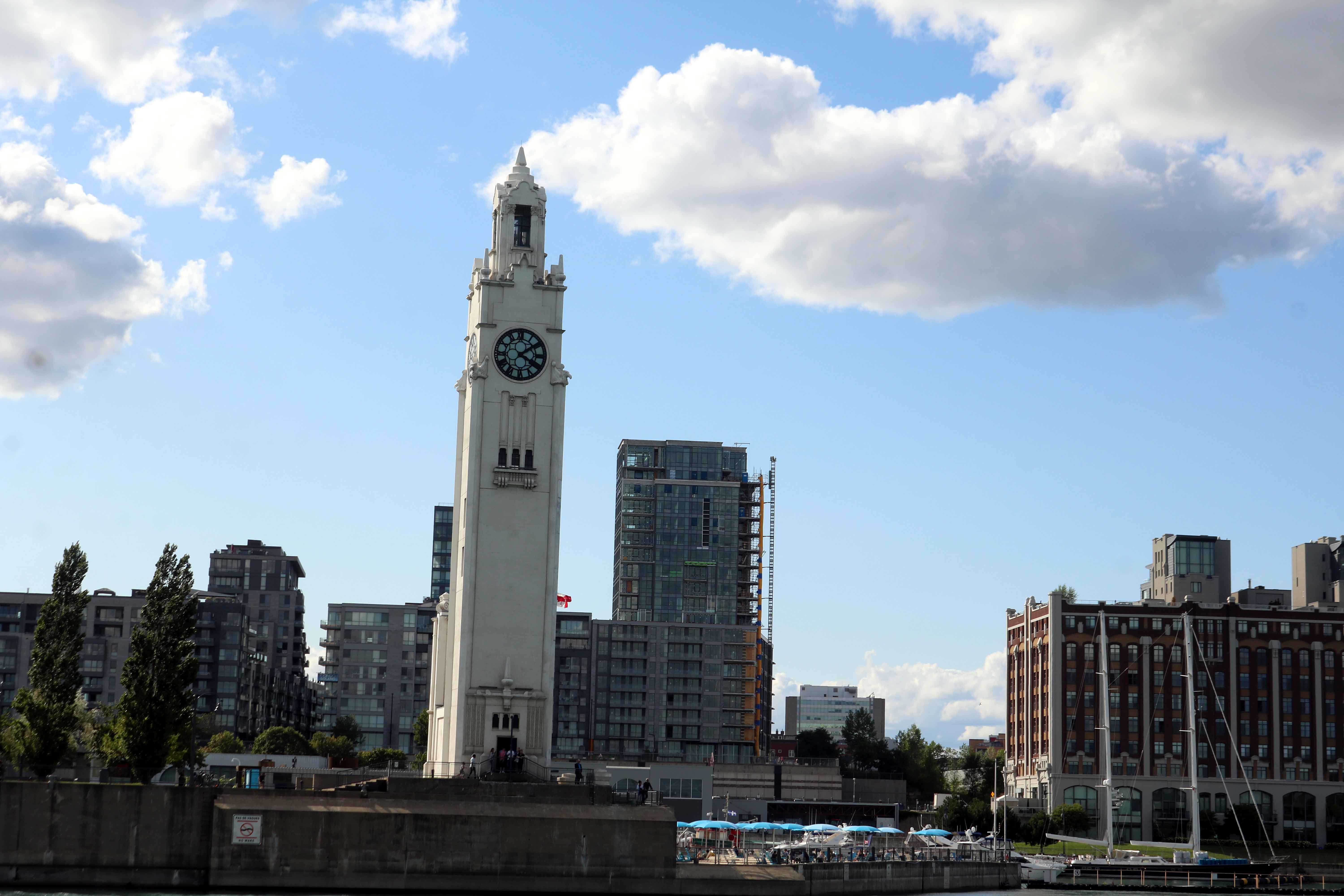
As we steamed out of the port, we came to the Clock Tower, a 45 metres tall structure. It marks the entrance to the port and is a memorial to the sailors lost at sea in wartime. The clock is still said to be extremely precise with its legendary accuracy. The clock’s mechanism was made in England by Gillett and Johnston and is a replica of Big Ben in London. The Clock Tower was the port’s time keeper in an era when wrist watches were not common.

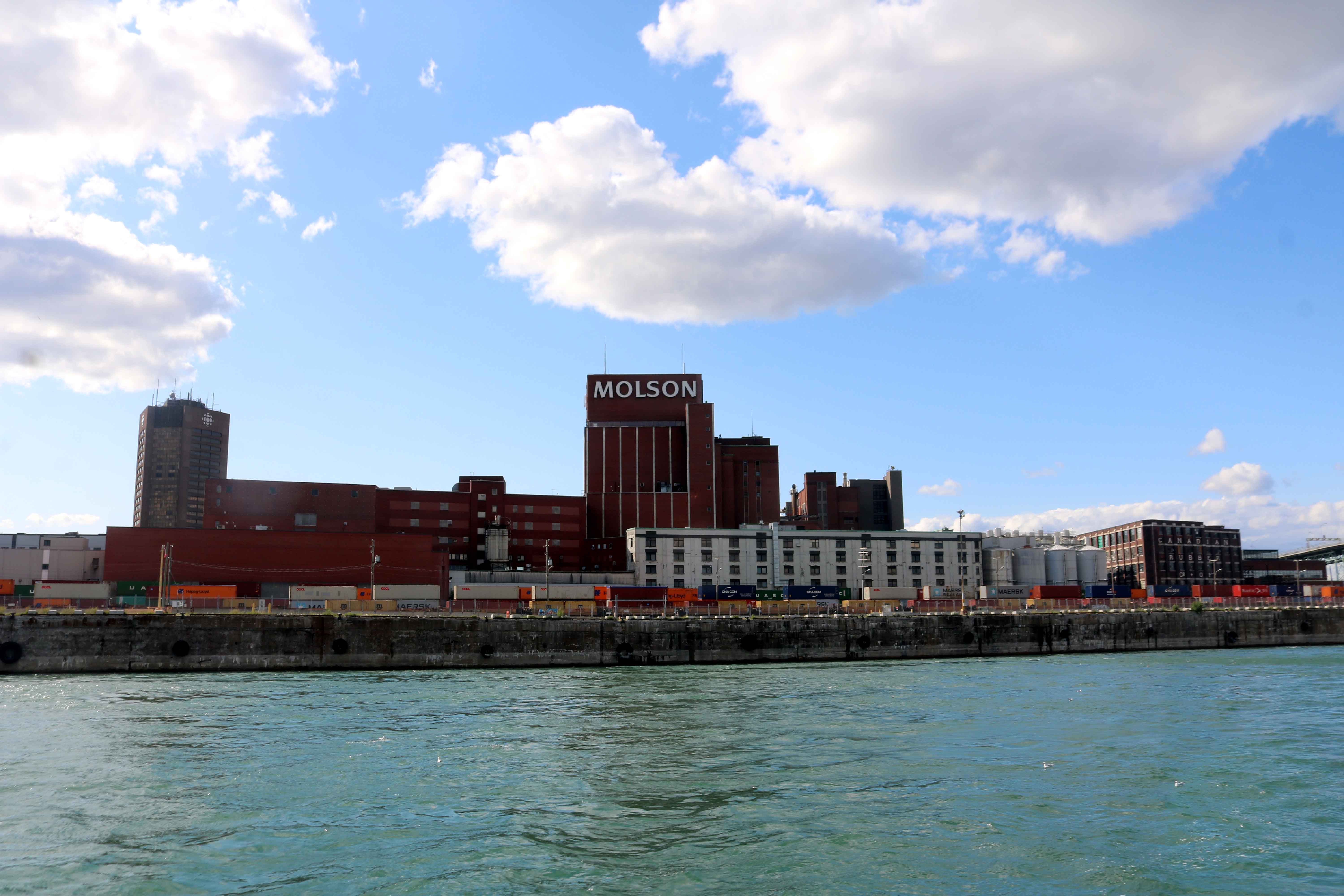
Past the Clock tower is the Molson Brewery, a relic of the glorious industrial past of Montreal. In 1782, at the age of 18, John Molson sailed on a leaking ship from England to Canada, with a thirst for a better beer in a new country. In 1786, he founded the Molson Brewery, the oldest brewery in North America, and subsequently, Canada’s second oldest company (the oldest company is Hudson’s Bay Company established in 1670). Through expansion and rebuilding after Montreal’s Great Fire of 1852, the facility still stands in its original location. John Molson who also built the first steamship and the first public railway in Canada, was a president of the Bank of Montreal, and he also established a hospital, a hotel, and a theatre in Montreal.

This is the entrance to the 306-kilometer long Saint Lawrence Seaway between Montreal and Lake Ontario, built in the 1950s. It stands as a symbol of challenging engineering feats in history. The seaway consists of seven locks – five Canadian and two US – in order to lift vessels 75 meters above sea level as they transit from Montreal to Lake Ontario. Opening of the seaway diminished the importance of the Montreal Port as ocean going ships could now traverse through the Great Lakes and there was no requirement of offloading Great Lakes going smaller vessels from ocean going larger ones.

As we touched the Northern tip of Saint Helena’s Island, we saw La Ronde (Round)- Quebec’s biggest amusement park with more than 40 rides and attractions. It was built as the entertainment complex for Expo 67. (More about Expo 67 in a subsequent post.)

We then sailed to Habitat 67, a much sought after residential complex in Montreal. It is considered an architectural landmark and one of the most recognisable and spectacular buildings in Montreal. This housing complex was designed by Israeli-Canadian architect Moshe Safdie as part of his Master’s thesis in architecture at McGill University and then built as a pavilion for Expo 67.

We then came to Silo Number 5 and the boat took a turn on its return trip. It was in 1906 that Silo Number 5, formerly known as Elevator B, came into operation. At that time Montreal Port was known as a hub of the grain trade in North America. It was built with brick and non-combustible materials to avoid the risk of explosions due to grain dust. Grain dust which is highly combustible can form explosive clouds. A fire or an explosion can happen at a large grain-handling facility if accidentally ignited. The Silo consists of three distinct parts linked together by aerial galleries. Its floating elevators allowed offloading of grain from the holds of smaller lake going ships and the simultaneous loading of trans-Atlantic vessels without ever coming into contact with the quays. Disused since 1994, the site is today plagued by vandalism and graffiti.

As the boat turned around we could see Bota Bota Spa. Located on a ship anchored in the Old Port of Montreal, Bota Bota, offers its passengers the healing benefits of a spa while being lulled by the natural movements of the St Lawrence River. Bota Bota consists of five decks, a floating terrace, restaurant, and a modern garden area which houses the various spa installations.

The Sixty-minute cruise on the Saint Lawrence River was educative and comfortable. It is surely one of the best ways to learn more about Montreal as an island. Our tour guide gave very many details of all landmarks as we cruised along. We were amused by many of her fun facts, trivia and anecdotes.

From the church we drove to Saint Helena’s Island, crossing Saint Lawrence River over Jacques-Cartier Bridge. Our exploration of Saint Helena’s Island is covered in the next post.
Exploring Montreal on a Calèche
From the Place d’Armes square, we embarked on a horse drawn chariot (Calèche) ride with our hostess Sue to explore the area of Old Montreal. The city of Montreal has decreed that Calèches will be off the city’s cobblestone paved pathways from the New Year Day of 2020. There have been cases of horses being mistreated and horses dying while drawing carriages. The lawmakers felt that the resources employed to ensure safe operations of Calèches were causing a heavy drain on its budget. The city plans to replace Calèches with electric vehicles.
Sue, an incessant chatterbox, kept us engaged throughout the tour with her commentary on the history of Montreal and the significance of each street and building, while simultaneously cursing motorists who blocked our way. Most of her ‘constant cacophony’ was historically accurate, but every now and then she came out with something outrageous which indeed needed the proverbial pinch of salt to digest

We rode through Notre-Dame street. On either side were shops selling their wares, mostly to attract tourists. This is a historic street created in 1672 that runs parallel to the Saint Lawrence River. The shops have large entry gates – these were meant for the horse-drawn carriages to pass through.

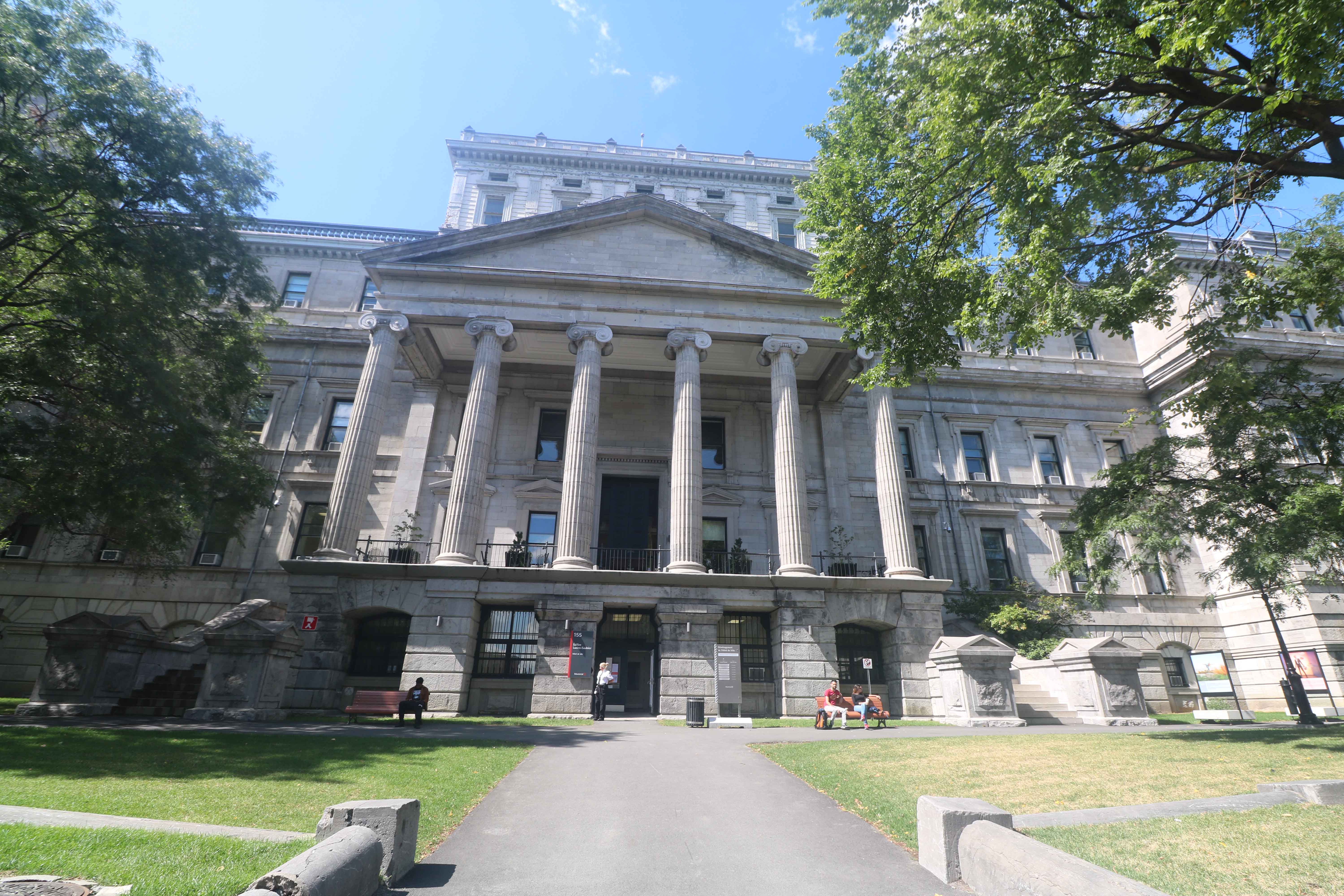
We came to the Old Courthouse, built in 1857, which today houses Montreal’s financial services.

Adjacent to it stood the modern Palais de Justice or Court House inaugurated in 1971.

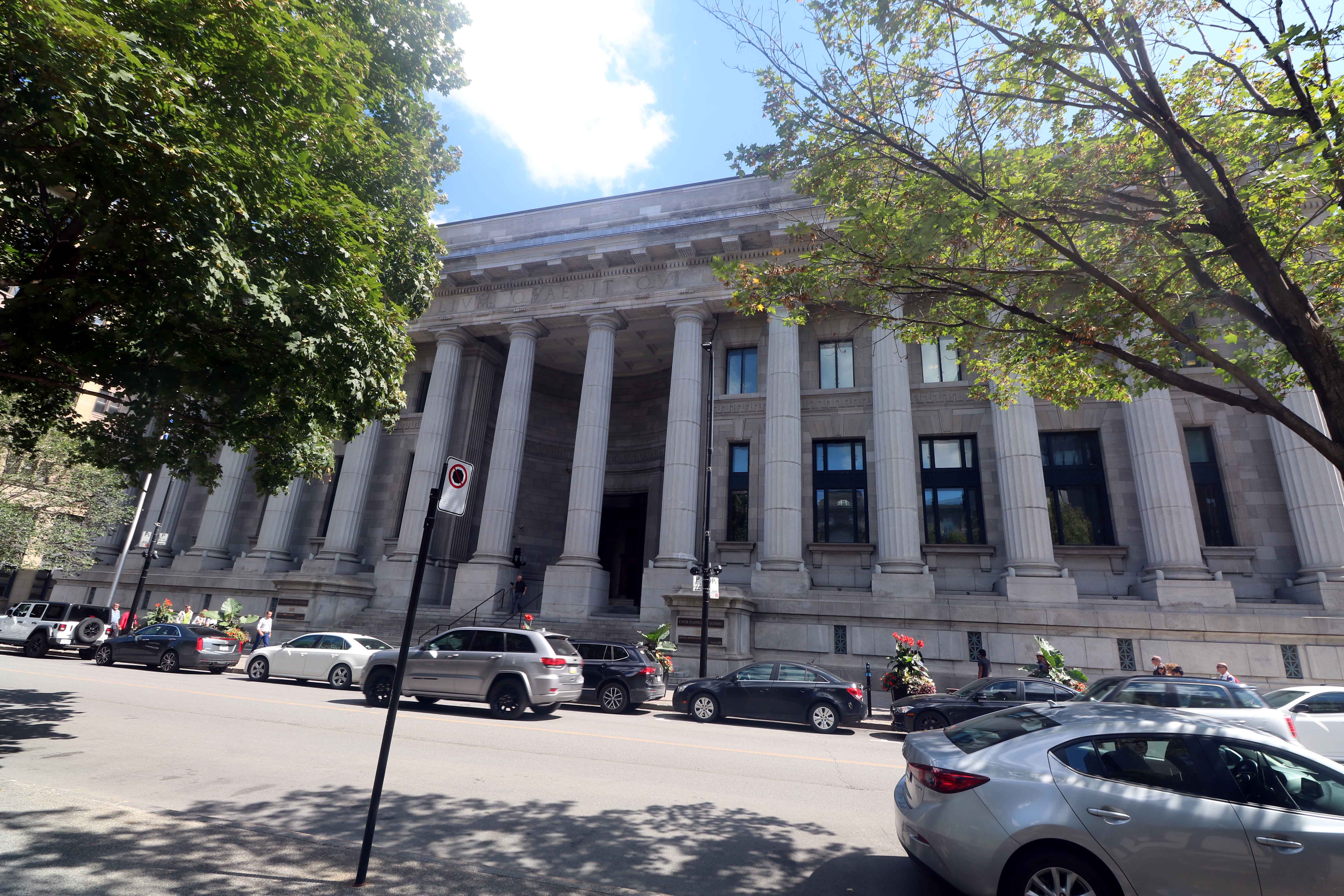
Opposite to the court houses stood the Ernest-Cormier Building of 1926, from where once the Criminal Court operated. The building features monumental granite, limestone and an imposing portico of 14 columns. The building now houses the Quebec Court of Appeal.

Next we came to the seat of Montreal’s local government, referred to as the Hôtel de Ville de Montréal – an imposing five-story building, constructed between 1872 and 1878.

We then came to Place Jacques-Cartier. By the early 1800s Montreal was expanding and it had outgrown the old market square. In 1803 a fire destroyed dozens of buildings. This newly freed-up space became a public market square, Place Jacques-Cartier. The market operated from here up until the 1950s.

At the North end of the Place Jacques-Cartier stands the Nelson’s Column, about a third of the size of the original. It was erected by Montreal’s Anglophiles to celebrate Lord Nelson’s defeat of the French at Trafalgar in 1805. It is also the city’s oldest monument and is the oldest war monument in Canada. The monument caused plenty of angst and the local government proposed moving Nelson to some far off suburb but newer generations of Anglophiles fought tooth and nail to ensure that the idea was dumped.

Opposite the Nelson Monument is the Francophiles answer to the Nelson’s column, the statue of the French Naval Commander Jean Vauquelin. He fought many battles in the mid 1750s against the British Navy. The Francophiles honoured him with a square bang opposite the Nelsons.

The next point that we saw was the Place du Marché – or market place. Prior to building of the Notre-Dame Basilica and the Place d’Armes square, this was the commercial hub of Montreal and also the gathering spot of the community.

Adjacent to the Place du Marché is the Old Customs House, now part of the Pointe-à-Callière museum. It was called Place du Vieux Marché until 1892. On the 250th anniversary of Montreal’s foundation, it was renamed Place Royale.

As we rode through the cobblestone paved streets, Sue pointed to this building and said that most buildings in Old Montreal had windows of varying shapes that decrease in size and height with each higher storey. According to her, it was to avoid the ‘Window Tax‘ being levied by the City of Montreal in those days. I could not find any reference to any ‘Window Tax’ in Canada, however, a system of window tax, based on the number of windows in a house was in vogue in England and France. In England this tax was first imposed in 1696, and was repealed in 1851 as it was more of a ‘tax on health, light and air’

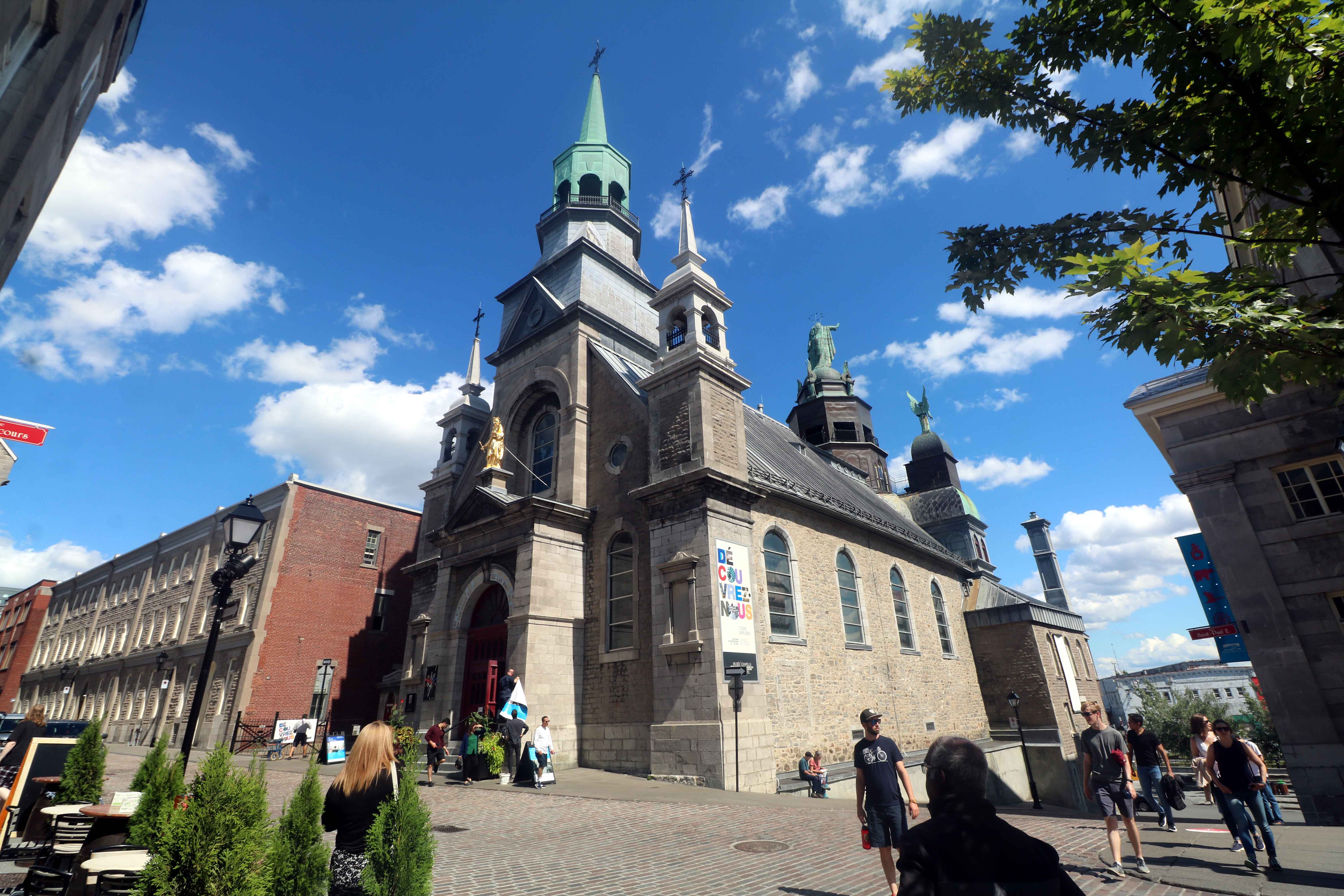
This is one of the oldest churches in Montreal, the Notre-Dame-de-Bon-Secours Chapel, also known as the Sailors’ Church, since many sailors prayed here for safe passage. In 1655, Marguerite Bourgeoys, a teacher, in return for her unpaid work, requested the construction of a new chapel dedicated to Virgin Mary. The church was completed 13 years later. This church burned to the ground in 1754 and the present church was built in 1771 over its ruins.

We then rode past one of the first fire stations in Old Montreal, now home to the Museum of Montreal History. The exhibits showcases the history of the building itself and how it transformed from a stable for horse drawn fire equipment to motorised trucks..

Next we came to the Customs House, erected in 1912, is closely associated with the growth of Canadian trade during the first decade of the 20th century. With Its responsibilities enhanced in 1916 with the introduction of direct taxation, this building gained prominence.

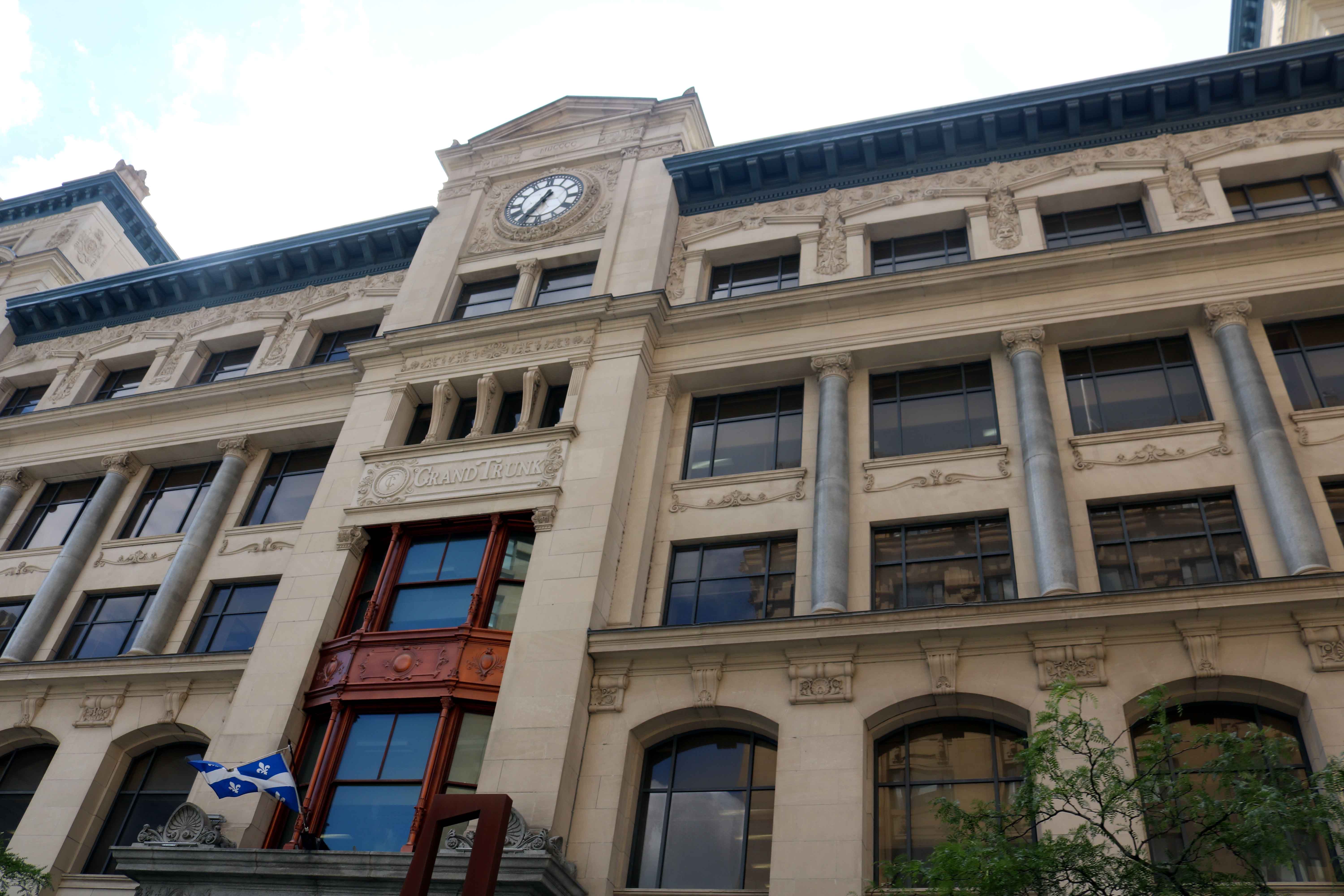
This building caught my attention, more for Sue’s commentary. The inscription ‘Grand Trunk‘ and the accompanying GT monogram on this five-storied building indicates that it belonged to the Grand Trunk Pacific Railroad Company. The building was built in 1902 by Charles Hays, the President of the company. Unfortunately, he was aboard the Titanic that sank on 15 April 1912, with his wife, Clara, daughter Orian and son-in-law Thornton Davidson. The materials used are grey granite, beige limestone and chamois sandstone from India.
Sue commented that after the Grand Trunk Company closed down its Canadian operations in 1923 after its acquisition by the Canadian Government, the company moved its operations to India. Again, I could not find any reference to this claim, but possibly the name ‘Grand Trunk’ being a proprietary trade name, could not have been used by the British-Indian Railway, unless the Grand Trunk Company had some association with it. So, Sue may have a point here. The Grant Trunk Express, the legendary train in India may provide the link if any.
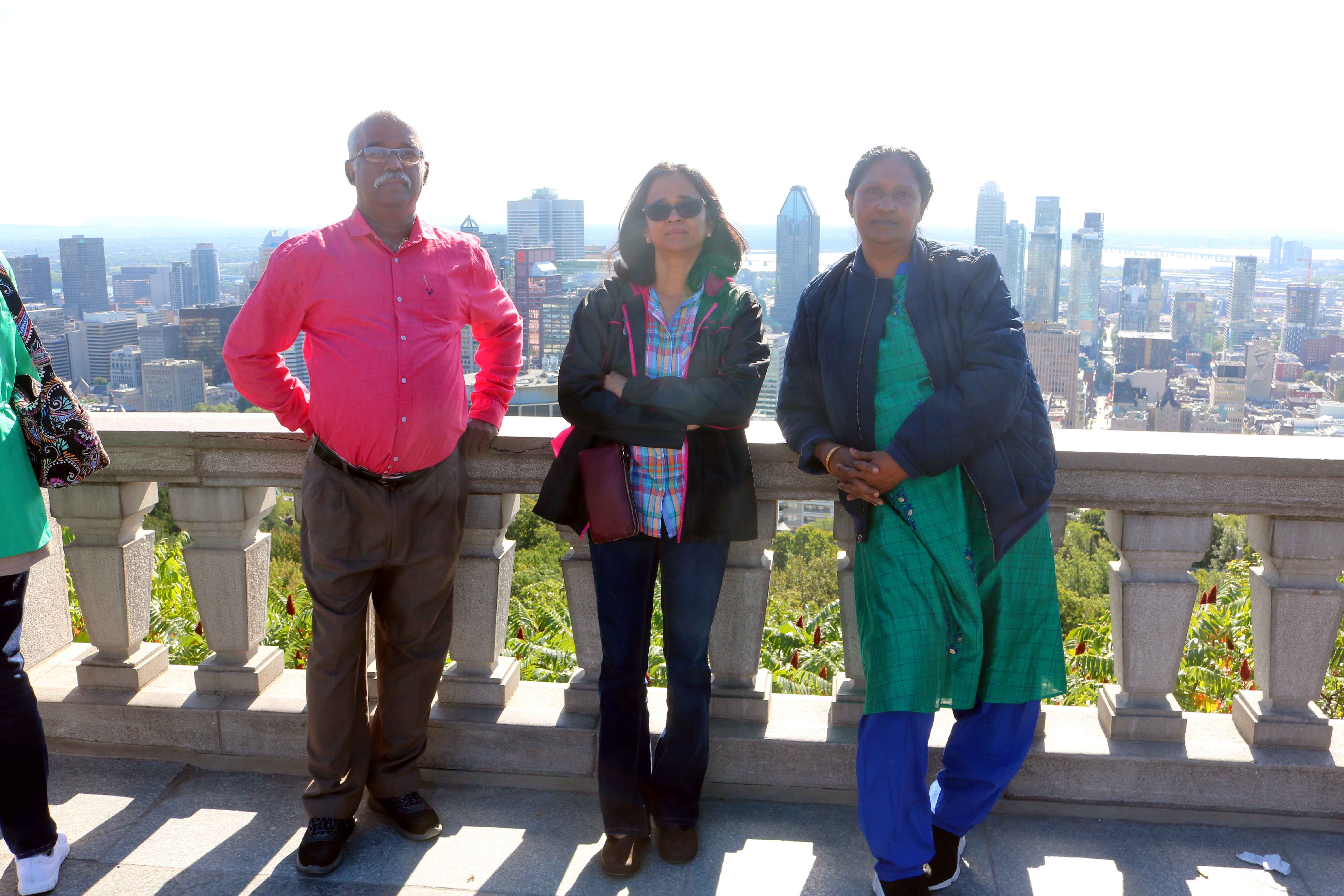
Thanking Sue and tipping her well for her ‘stories’, we alighted from her carriage and walked to Place Jacques-Cartier for lunch. While waiting for the lunch to be served, I booked tickets for a boat cruise along Saint Lawrence River, for a story that follows.
Montreal : The Canadian Paris

When my eldest brother and sister-in-law came calling, how could we miss a trip to the great city of Montreal – even though it was my third trip to the city. Montreal, a Canadian city in Quebec province is the third largest French speaking city. The first would surely be Paris, but the second, you would not guess it in your wildest dreams! It is Kinshasa, the capital city of the Democratic Republic of Congo. It seems virtually everyone speaks French in Kinshasa.

In 1603, explorer Champlain made his first of many voyages across the Atlantic to the St. Lawrence and planted the French flag here in 1603. Then the British and French fought over this land with the British victory in the 1760’s, Montreal was under British control. The French and Brits lived together but anger and warring was never far from the surface.
French was declared as Québec’s only official language in 1974 when Charter of the French Language, commonly known as Bill 101 was passed by Canadian Parliament. The primary purpose of the bill was to encourage non-French-speaking immigrants to integrate into the francophone community. For a traveller it gets trickier to read the road signs as they are only in French and most staff at hotels and restaurants tend to speak only French. These were two handicaps I suffer whenever I travel to Quebec province, but has still not managed to learn French.

We set off from Toronto early morning and after seven hours of drive reached Montreal’s old town, Vieux-Montreal. Driving through the narrow cobblestone streets with lot of pedestrians, spotted with Victorian lamp posts, accompanied by horse-drawn carriages transported us into a different world, but driving through these narrow roads was bit uncomfortable for me being used to multi-lane roads of suburban Toronto.. Once Montreal’s financial hub, Vieux-Montreal is now home to hotels, restaurants, pavement cafes and art galleries.

How did these Scottish cobblestones came to be paved on Montreal’s streets? They came over as ballast in the late 1700s in ships that returned to Montreal after unloading its cargo of fur and blubber.

We parked our car and set off on foot to explore Vieux-Montreal like most tourists. We headed straight to the Place d’Armes square -said to be the heart of the city, though it mostly consists of office buildings.

The square is always bustling with activity, with musicians playing. The monument in the center of the square is dedicated to Paul de Chomedey, founder of Montreal

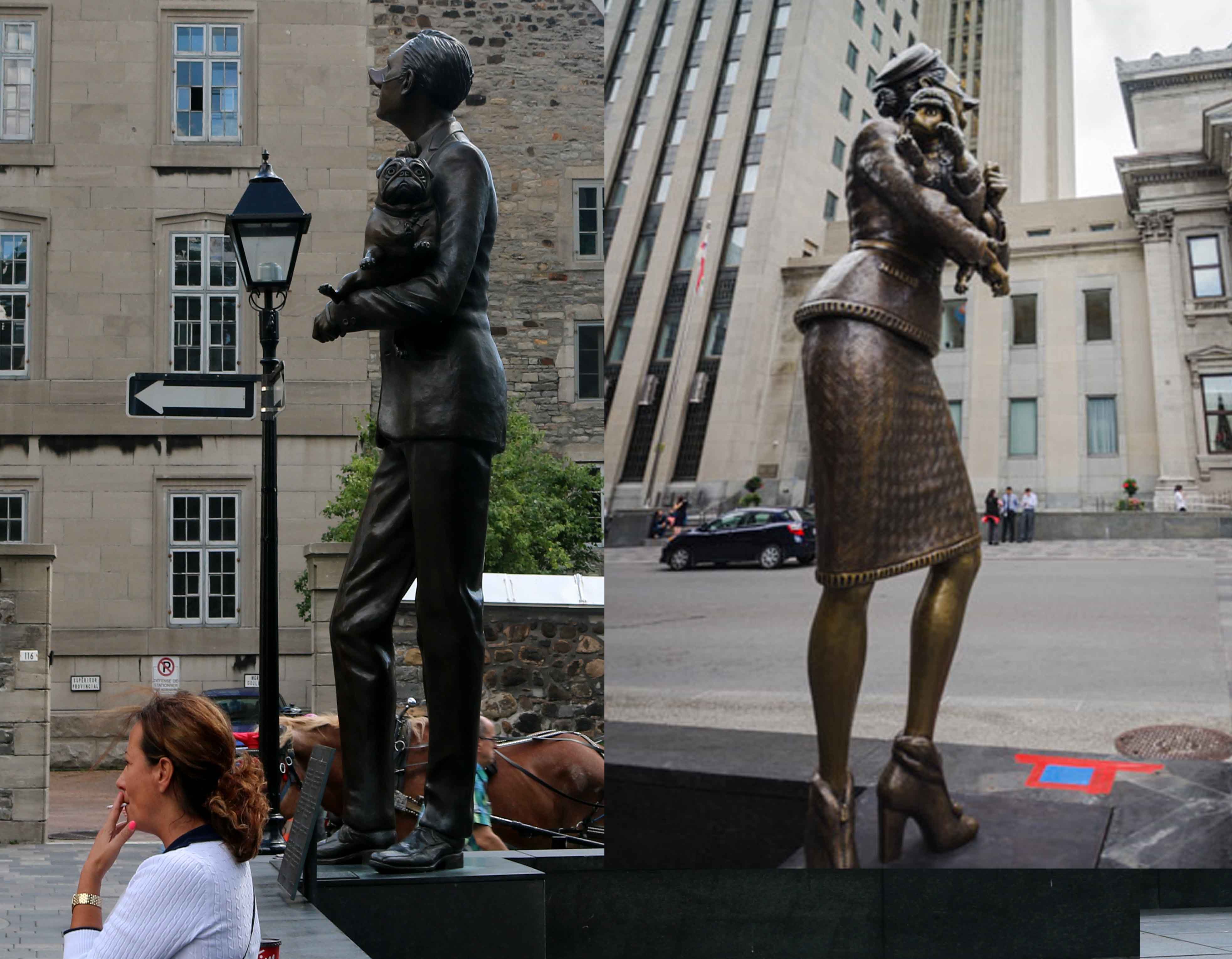
In the Place d’Armes square, two tall bronze sculptors caught my attention. These sculptors have been inspired by two snobs in the novel ‘Two Solitudes’ by Hugh Mac Lennon. The two snobs depict the cultural distance between English and Francophone Canadians. On the left is an Englishman holding his pug, staring at the Notre-Dame Basilica, a symbol of religious influence on Canadians. On the right, two hundred feet away, stands a French lady with her poodle in her hand, giving an offended look at the Head Office building of Bank of Montreal, symbol of English financial power.

On the Eastern side of the Place d’Armes is the majestic Notre-Dame Basilica – built between 1824 and 1829 with two towers reminiscent of Notre-Dame-de-Paris. At that time, the church was the largest in North America and remained so for over fifty years.

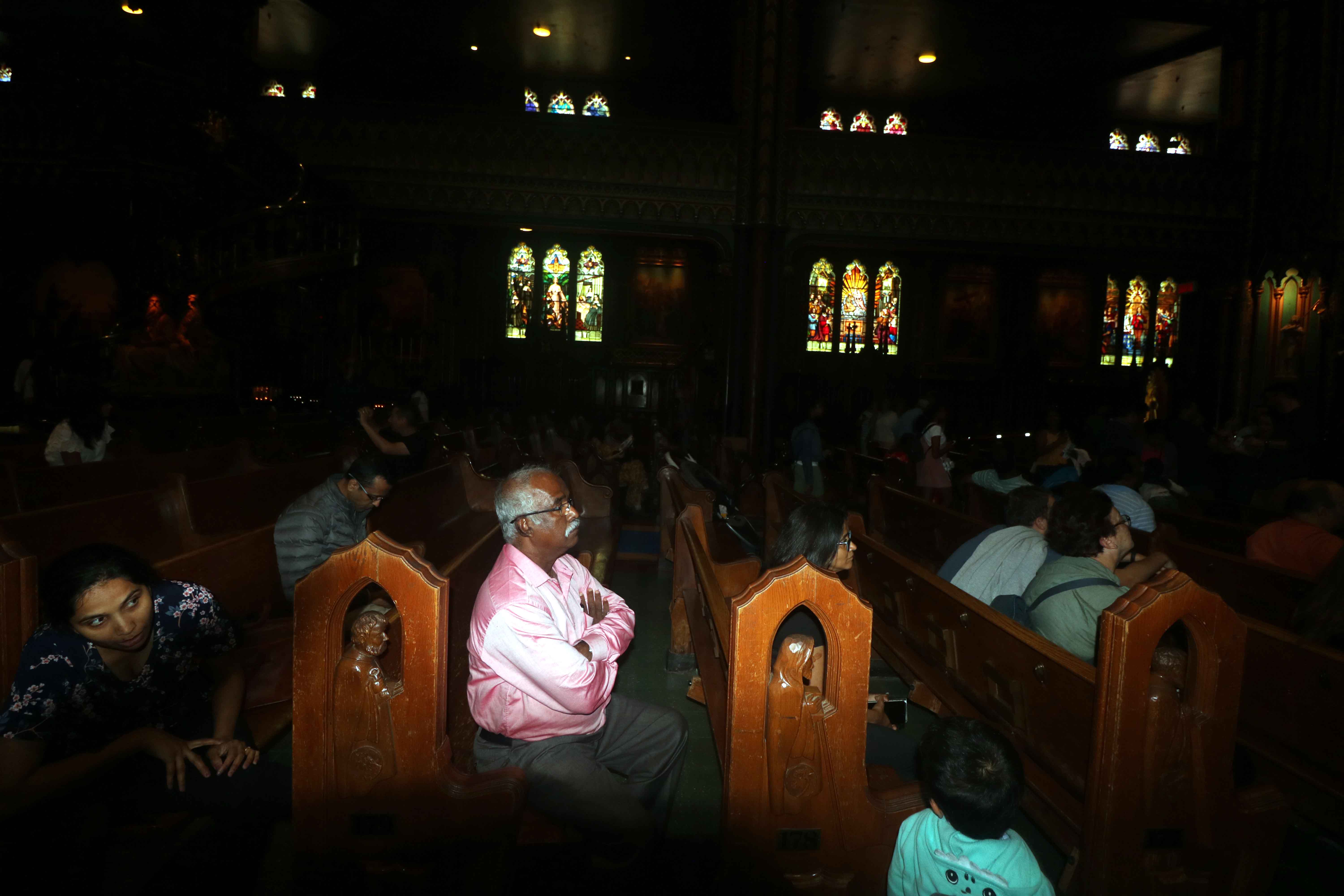
Entry into the church costs $5 – a token to help maintain the Basilica in pristine condition. You will not repent paying $5 for a glimpse inside. The interior of the church, based on Gothic Revival architecture. is decorated with golden stars, reds, purples, silver, and gold – all on a blue background. It is filled with intricate wooden carvings and several religious statues.

The stained glass windows along the walls of the sanctuary do not depict paintings from the religious history of Montreal.

Rear top of the church houses a pipe organ, built in 1891. The organ comprises four keyboards, 7000 individual pipes and a pedal board.

Adjacent to the Basalica is the Saint-Sulpice Seminary, a U-shaped building. The building was completed in 1687and the clock added in 1713.

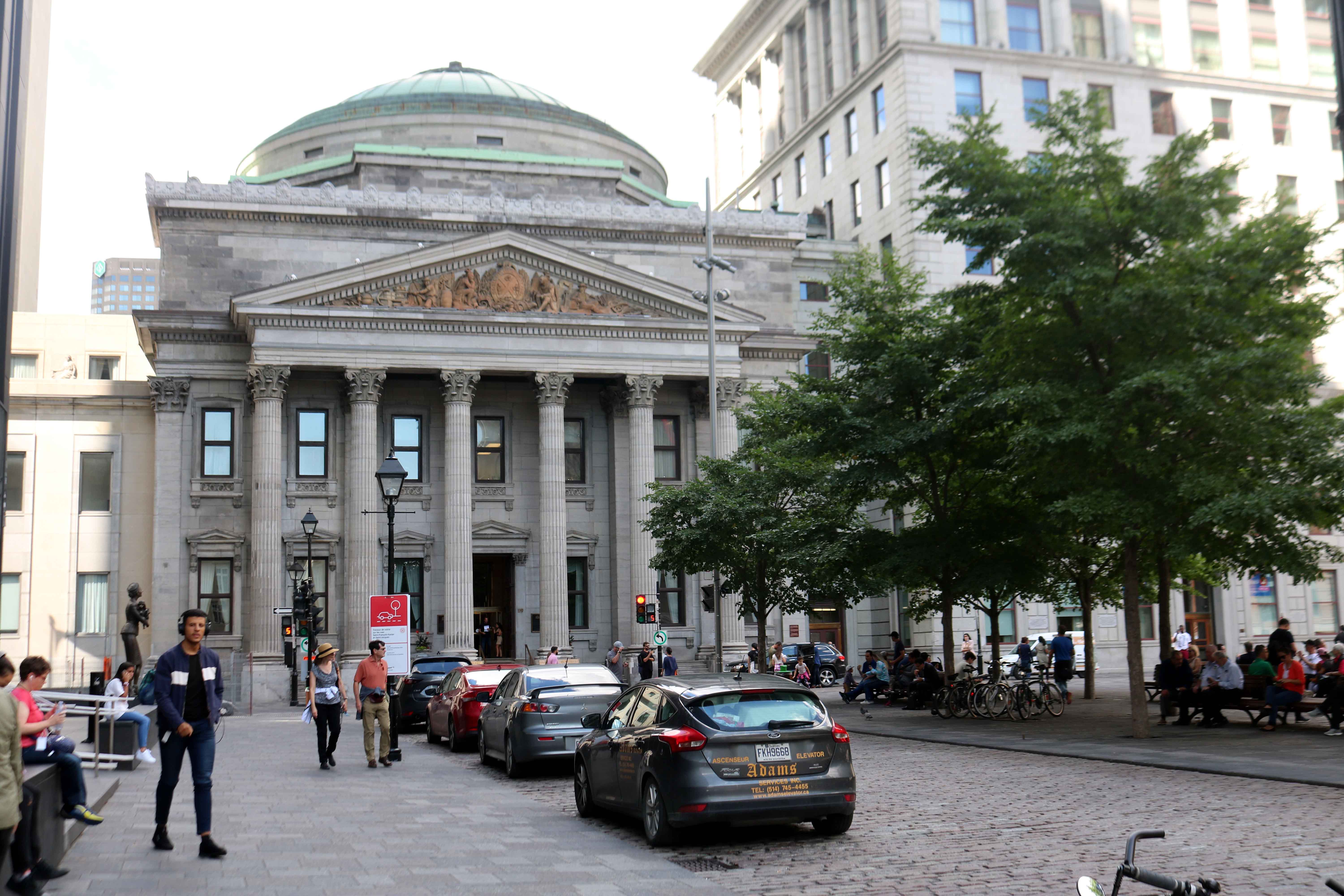
As we walked out of the Basilica, on our front left, across the Place d’Armes square, stood the Head Office building of Bank of Montreal, Canada’s first bank – Bank of Montreal was founded in 1817. This building was built in 1847, designed by British architect John Wells, resembling the Pantheon. On the bottom left,you can see the French lady with her poodle. The building is in operation today as BMO’s main Montréal branch.

On to our right stood two classical buildings. The white building called the Aldred Building built in 1931, designed by Ernest Isbell Barott, with a height of 96 metres or 23 storeys. The building’s setbacks at the 8th, 13th, and 16th floors to allow more light on the square and create a cathedral-like effect, like the adjacent Notre-Dame Basilica.
The red building with a clock tower is Montreal’s New York Life Insurance Building (also known as the Quebec Bank Building) and was built in 1887. It was the tallest commercial building in Montreal at the time.

We now set out to explore Old Montreal on a horse-drawn carriage ride (calèche). In recent years calèche has drawn the ire of animal rights activists and lobby groups. The calèche will not be there with the turn of next year as the city has banned them from 2020.
Lavender: The Flower of Purity

On August 07 we visited Terre Bleu lavender farm in Milton, Ontario with my brother and sister-in-law. Terre Bleu farm was started by Ian and Isabelle Baird who were enchanted by the spectacular fields of purple and the fragrant air that swirled all around, while vacationing in Quebec. They moved from downtown Toronto, with their young children William and Madeline, to rural Milton and began farming organic lavender.

In 2011 the Bairds planted their first 10,000 lavender plants. After years of careful planning and cultivation the farm opened to the visiting public in 2014. Today, this is the largest lavender farm in Ontario and is home to over 50,000 lavender plants and many other herbs and flowers spread over 160 acres. Thousands of visitors throng Terre Bleu every summer to share the experience of sustainable organic farming.

Lavender is believed to have originated from the Mediterranean, dating back some 2500 years. It is a flowering plant of the mint family known for its beauty, fragrance and its multiple uses. Today Lavender is cultivated across Europe, Australia, New Zealand, North and South America.
Lavender is amongst the world’s most ancient documented plants. Hieroglyphic texts from Ancient Egypt mentions the use of lavender in embalming and cosmetics. When the tomb of Tutankhamen was opened, jars filled with ointments resembling lavender were found.

The ancient Greeks called Lavender Nardus (commonly called Nard), after the Syrian city of Naarda. Nard, or ‘Spikenard,’ its Greek name, is referenced throughout the Bible.
“While the king sitteth at his table, my spikenard sendeth forth the smell thereof” (Song of Solomon 1.12)

Lavender derives its name from the Latin ‘lavare’ meaning ‘to wash’. The Romans used lavender to scent their baths, beds, clothes and even hair. They also discovered its medicinal properties. In ancient times, bundles of dried lavender were given to women in labour for squeezing during contractions as the fragrance released was known to alleviate the pain and facilitate an unencumbered birth.

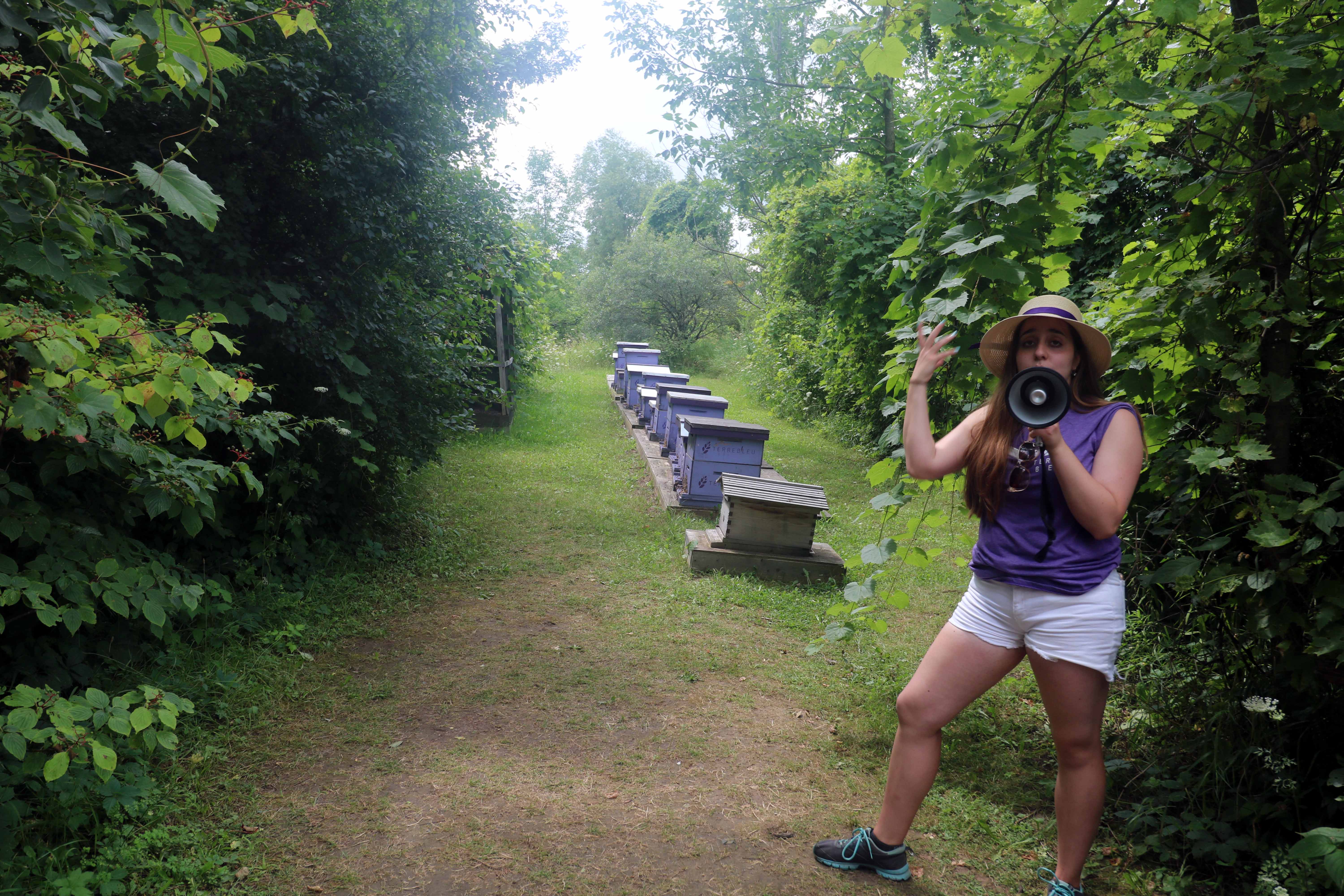
On reaching the farm we embarked on a farm tour. Our tour guide was a smart enthusiastic young lady pursuing her university degree in life sciences. She said she loved working on the lavender farm for the fresh scented air she could breathe as it rejuvenated her and also that she could put into practice what she learned at school. Obviously, it did provide her monetary benefits, especially during her summer vacation.

Walking through the farm we saw women harvesting lavender flowers. At Terre Bleu, they harvest the flowers manually. Here they grow the French and English lavenders. Both are lookalikes with the French lavenders a bit taller than their English counterparts. English lavender in comparison produces less oil, but is more in demand due to its aroma. French lavender has more camphor in its oil which has a soapy taste. Hence, English lavender oil is preferred over French lavender oil in cooking.

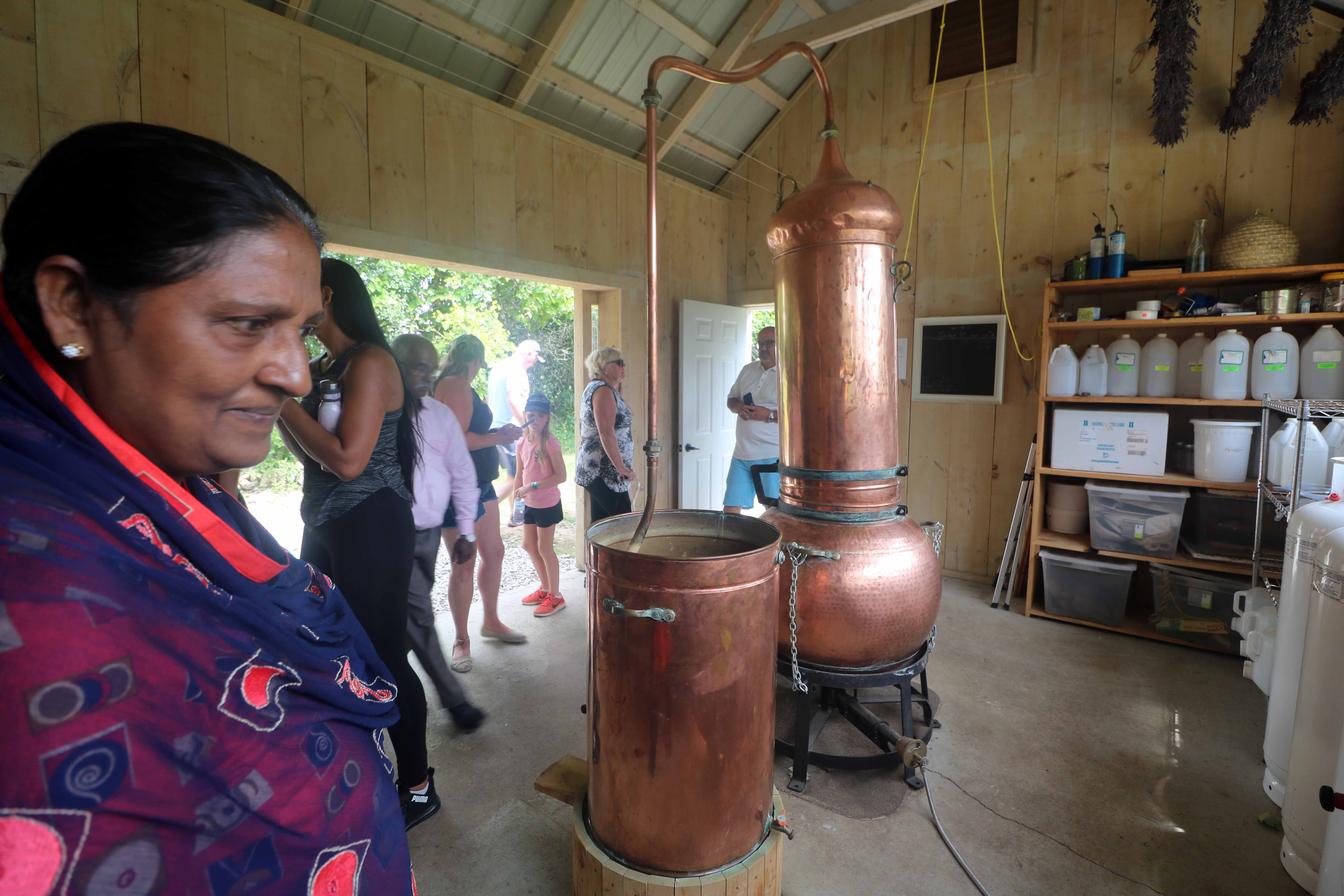
Enjoying the aroma filled air of the farm as we walked a few minutes, we entered the distillation plant. Lavender oil is distilled here by steam distillation. This copper still (pot) distillation plant was imported from Portugal to facilitate distillation through the age old European traditions. The still is packed with lavender flowers to the top avoiding air pockets between the lavender and water at the bottom. The top of the still is connected to a condenser. The still is heated and the water boils to form steam. The steam rises and passes through the still stuffed with lavender flowers. As the steam passes through the lavender, the pressure inside the sealed kettle along with the high temperature of steam causes the buds of the lavender to release its oils. The lavender buds hold most of the oil and not the actual flowers.
In the condenser, the steam gradually cools down and turns to liquid that drips out. As oil and water do not mix, oil floats on water because water is denser. Oil is drained out from the top spout of the condenser and lavender hydrosol (mixture of oil and water) is removed from the bottom spout. Hydrosol is used for removing makeup, and in the manufacture of body sprays, deodorants, linen sprays etc.

We then walked to the Apiary being maintained by the farm. The relationship between flowers and bees is only too well known. Terre Bleu promotes organic cultivation, free from pesticides that are harmful to the bees. This ensures many healthy bee colonies in the farm.

Lavender is definitely more than just a pretty purple bloom. It has many health and wellness benefits. Lavender is a good sleep aid and can calm your stress and anxiety. It is naturally anti-inflammatory, antiseptic and anti-bacterial and can cure dandruff. It fights congestion and can relieve sore muscles and headaches.
Our farm tour ended at the farm-store where we enjoyed lavender flavoured ice-cream.
The Fall Equinox

The Fall Equinox of 2019 was very special. We were honoured to host for lunch Air Marshal Manvendra Singh, AVSM, VrC, VSM, his wife Ambika and their elder son Abhijith. The Manvendras, proud grandparents, had come to Toronto to be with their newborn grandchild.

Air Marshal Manvendra is the highest decorated serving officer from our Course (61 NDA). He is presently Senior Air Staff Officer of Southern Air Command, Thiruvananthapuram. He has clocked over 6600 hours of flying and for him the glorious moment was on October 1, 2016 when he flew a MI 17 Helicopter with his younger son Flight Lieutenant Siddharth Singh as a co- pilot – a record of sorts.
After lunch as our esteemed guests left, on the social media I posted a photograph with a caption ‘Honoured to have hosted Ambika, Air Marshal AVSM, VrC, VSM and their son Abhijith for lunch on the last day of Canadian Summer – 22 Sep 2019.’ The response from our course mates was overwhelming. One read ‘The man speaks for himself. Some people need not be named. The whole world knows that.’
It was then that I noticed that I missed Manvendra’s name in my post. How did this blunder creep in? Like a good NDA course mate, I initially wrote ‘Manvendra (F/61)‘, but then some how felt that it was inadequate, as I thought that I got to honour his rank and his well deserved decorations. Finally, when I rewrote it, I missed the obvious – his name. So I was missing the proverbial woods for the trees. In Indian Army terms, my Minor Staff Duties (SD) was correct, but I missed out on the Major SD – a cardinal sin in military values.
You cannot take out the Indian Soldier in me despite 15 years of my Canadian citizenship. The virus lies inconspicuously, deep within, ready to erupt when you least expect.

The Fall (Autumnal) Equinox is when the Sun is exactly above the Equator and day and night are approximately equal all over the globe. It falls on September 22 or 23. The word ‘Equinox’ is Latin meaning ‘Equal Night.’ In reality, it isn’t exactly equal on an Equinox – for Torontonians the Sun rose at 7:04 AM and set at 7:17 PM. The spring Equinox is on March 22. Of course for those in the Southern hemisphere, the Spring/ Autumnal Equinoxes are reversed.
I love my astronomy – so let me elaborate. For most of us the Sun rises in the East and sets in the West. In reality it does so exactly in the East/ West on only two days in the year, on the two Equinoxes. The phenomenon of the apparent Southward/ Northward movement of the Sun is caused by the combined effects of the revolution of the Earth and the tilt of the Earth’s axis (the plane of the ecliptic). Ancient Indians called this apparent Northward/ Southward movement of the Sun as Uttarayanam and Dakhinayanam.
As the days progress to Winter Solstice marking the beginning of Winter on December 22 with the longest night, we lose daylight everyday. From now on every day Torontonians lose about 3½ minutes of daylight. The Sun will rise a tiny bit further South-East everyday until it reaches a maximum South-East position on the day of the Winter Solstice. Then on it will rise a tiny bit Northward everyday, commencing the Uttarayanam. On March 22 (Spring Equinox), it will again rise exactly due East and we will experience nearly equal day/night. From then on the Sun will move a tiny bit North-West everyday until it reaches its extreme North-West position on the day of the Summer Solstice on June 22, a day when we experience the longest day and shortest night of the year. Dakshinayanam commences thereafter.
There is a Chinese myth that it is easier to balance an egg vertically on its end on a flat surface on Equinox than on other days of the year. It is believed that the Moon and Earth are in exactly the right alignment on Equinox and the celestial bodies generating the perfect balance of forces needed to make it possible. In reality, it is a myth and the position of the Moon and other celestial bodies will vary from Equinox to Equinox. You can perhaps balance an egg just as well on any day of the year.

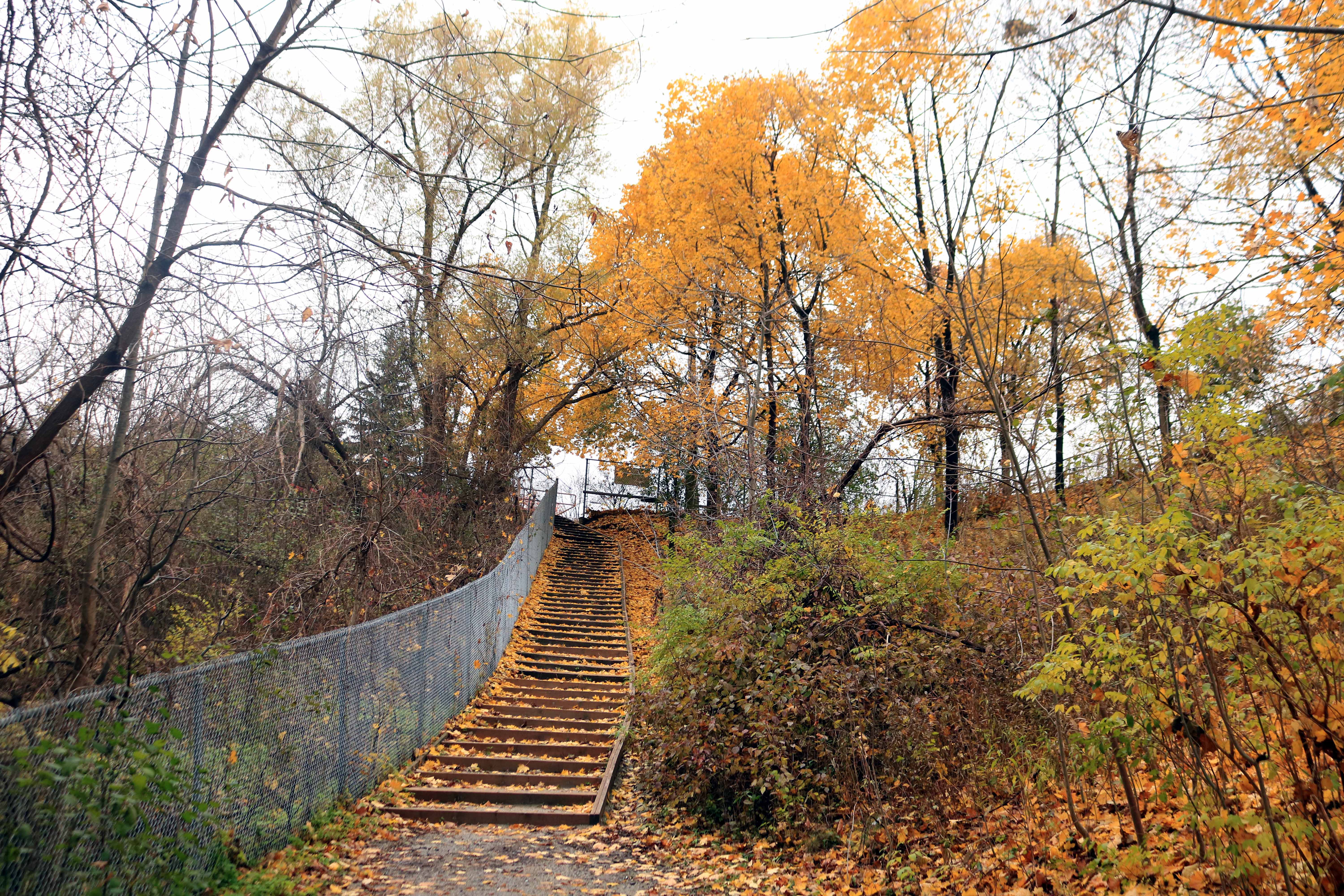
This loss/gain of daylight and the change of the seasons is less significant for those living closer to Equator like my kin from the God’s Own Country. In Canada and the extreme latitudes, the changes are very significant and results in daylight saving time setting, changing our clocks twice a year. The Autumnal Equinox marks the beginning of Fall with the leaves turning yellow, later red and falling off. In Canada the maple tree will assume different shades of yellow, orange, red and pink during the autumn as the photo depicts, before they finally fall off. This phenomenon can be experienced in Kashmir as well.
Harvest Moon

Today is September 13, 2019, Friday. You must have read in my earlier blog about ‘Triskaidekaphobia’ the fear of number 13 (from Greek tris (‘three’), kai (‘and’), and deka (‘ten’), and ‘Paraskevidekatriaphobia’ is the term used to describe the fear of ‘Friday the thirteenth’ – (Greek words paraskevi (‘Friday’) and dekatria (‘thirteen’) with –phobia as a suffix to indicate ‘fear’).
There is another astronomical significance for this Friday the 13th – it coincided with Full Moon. Last time a full moon appeared on Friday the 13th was in October of 2000. This Full Moon is also called a ‘micro-moon’ because it is at its farthest point from Earth – also known as its apogee. Being at the farthest point, the moon appeared around 14% smaller than usual and much dimmer than a normal Full Moon.
As this Full Moon fell immediately before Fall Equinox, It is called a Harvest Moon.
The term ‘Equinox’ comes from Latin meaning ‘equality of night and day.’ It occurs twice in a year – one in Spring (22 March) and one in Fall (22 September), that is when the Sun crosses the celestial equator, causing day and night to be of 12 hours each. In Canada, Fall Equinox marks the beginning of Fall season.
‘Harvest Moon’ is an old European term applied to a full moon that rises closest to the beginning of fall. In the earlier days when the farmers could not illuminate their farmland, the bright light of the moon facilitated farmers to work a little later into the night to bring in their crops well before Fall set in.
As if to facilitate harvest, the harvest moon rises 10 to 30 minutes after the sun sets, whereas most moons rise approximately 50 minutes after sunset. In Toronto, on September 13, the sun did set at 7:31 PM and the moon rose at 7:46 PM. This time gap between sunset and moon-rise was even shorter as one moved closer to the North Pole.
The next Full Moon on a Friday the 13th will appear in August 2049.
Bathing Nude
Few years ago an Indian Army Officer undergoing a course at Canadian Forces College, Toronto came over for dinner. During our conversation he said that one evening he walked into the sauna in the gym to find the Commandant, a General, sitting nude, enquiring his welfare. He said that he felt a bit embarrassed to face a nude General. I asked “That means you are surely not an ex-NDA (National Defence Academy)?” And I was dead right.
Bathrooms at the NDA are all open ones with neither any cubicles nor any shower curtains. There are only shower heads, all in a row. It is mandatory for all cadets to shower before breakfast and in the evening after games. As time is always at a premium for any military cadet, the ritual had to be as short as possible, with many waiting in queue – hence an elaborate bath was near impossible. The highlight of the bath was not its brevity, but by tradition implicitly enforced by the seniors, the cadets are not allowed to wear any clothing – it’s all nude and pretty natural. `
I cannot really say with any great emphasis that bathing nude is hygienically a huge plus as compared to bathing with a small brief on. However, it is more than a century old tradition in many military training institutions the world over. The open shower system meant that a large number of cadets could use the facility within the limited duration of time available.
To my mind, bathing nude has two distinct advantages. It helps one to overcome one’s inhibitions about being nude in the presence of others thereby developing a sort of self confidence about one’s own being and physique. When one learns to overcome this pretty strong inhibition, one automatically develops the capability overcome a lot of other inhibitions of less intensity. The second is that with everyone down to his skin it builds a sort of camaraderie with the fellow trainees.
There is no awkwardness, nobody made any stupid dick jokes and nobody stared. There was just complete utopian nonchalance about the whole thing as cadets from all regions, religions, castes and creeds bathed under the same shower. In everyone’s consciousness he was down to mother earth, a sort of nude common denominator. The act was indeed a great leveler. The common Indian mentality is that public nudity is obscene and vulgar and therefore should be abhorred. I do hope that as a nation we can learn to tolerate public nudity, no matter what our personal inclinations are in this regard.
Communal bathing and spas have been around for thousands of years, especially in the Indian context. However, the concept of modesty is a relatively recent one and was mostly dictated by the Victorian British norms. Many indigenous people still play sports without any covering and athletes in ancient Greece competed naked. In fact, the Greek word gymnasium means ‘a school for naked exercise,’ but in English it means only athletic exercise.
Men and women bathed nude in Roman baths of first century. Emperor Hardin is believed to have issued many decrees against co-ed bathing. There were baths of varying levels of luxury and also at varying levels of propriety. At one extreme were the ones for prostitutes and at the other the ones for royalty. These baths showcased Roman architectural expertise where new and innovative building styles were tested.
It was mandatory for students to swim nude in Chicago high school swimming pools till 1970’s. In those days filtration and chlorination techniques were not as advanced as of today. Nudity ensured that the swimming costumes they wore, mostly cotton or wool, did not leave any fibres that clogged the pool.
Bathing complex of Friedrichsbad Baths, Baden-Baden, Germany, opened in 1877, catering to European aristocracy. It is still open to all and visitors who indulge in a 17-step Irish-Roman bathing ritual – a sequence of hot air baths, steam rooms, showers, pools, and massages, soaking in curative mineral waters. Here on some specific days of the week and on holidays, it is co-ed nude bathing and on other days it is gender specific nude bathing.
In most gym and swimming pool locker rooms for men in Canada, the baths are all open without cubicles. Cubicles are provided in family locker rooms used by children and parents. It is natural for people to have differing standards of modesty, based on their cultural/ religious background and upbringing. Some are comfortable striding around the locker room naked and some prefer to change their clothes more discreetly. People around are neither stealing glances nor are they being judgmental. I generally go to swim in the afternoons which is the time designated for adult swimmers. I surely do not have a body to flaunt and no six-packs to flex. Everyone around me also passes the same muster with respect to their masculinity.
One has to shower before entering a swimming pool to keep dirt and germs out. Post a swim-session, it is meant to rinse off salt, chlorine and other harmful chemicals. You cannot do this well with your swimming costume on. It is said that the concept of the open bath came to Canada with soldiers returning from World War II when most able bodied Canadian men got enlisted to fight the war in Europe. The only country where it is a rule to have a nude bath prior to entering a swimming pool is Iceland. Here the bath may be in public or in a cubicle.
Nudity in public bathroom may offend some people, but most will not react to it though they may avoid it. The argument that nudity is natural may fall on deaf ears to the puritans who refuse to accept their ties to the natural world.
Sleeping without underwear is another military tradition proven to be good for one’s genitals as per many medical studies. Underwear tends to trap moisture, creating a breeding ground for bacteria. For sure, allowing that area to get some air helps to keep it dry and clean. Royal Marines tend to sleep naked for a similar reason and also to ensure they don’t hold all the juices and skin flakes emitted from their bodies in their clothes. From this came the expression ‘going commando‘ which means going without wearing any underwear.
In Western militaries where men and women serve together the bathrooms are shared. Here too there is hardly any awkwardness or sexual discrimination. In 2011, a woman soldier of the Norwegian Armed Forces complained about being asked to bathe naked with 30 men and in front of other male officers during a field exercise. The Norwegian Armed Forces initially gave the male officer who ordered the bath a harsh disciplinary warning for his behaviour and a fine of 2,500 Kroner, but cancelled the official reprimand after the officer appealed the decision. After two separate internal reviews, Norwegian Military ruled against making any changes to its bathing policies, meaning that other female soldiers could find themselves in a similar situation due to Norway’s gender-neutral military conscription policy.
I must here quote from the book ‘Immediate Action’ by Andy Mcnab. He was a member of 22 SAS Regiment and was involved in both covert and overt special operations worldwide until he retired in 1993. Teaching young infantry soldiers as an Instructor at the Regimental Training Depot how to bathe, he writes ‘We had to show them how to wash and shave, use a toothbrush… Then I had to show them how to shower, making sure they pulled their foreskin back and cleaned it.‘
To be NUDE or not to be – it is your choice – rules permitting.
Military Ethics and Politics in Canada

The House of Commons of the Canadian Parliament voted unanimously on May 14, 2019 to apologise to Vice Admiral Mark Norman, Vice Chief of Defence Staff, for his legal ordeal with a resolution that “ The House recognise Vice-Admiral Mark Norman for his decades of loyal service to Canada, express regret for the personal and professional hardships he endured as a result of his failed prosecution and apologise to him and his family for what they experienced during their legal conflict with the government.”
What was remarkable was that the resolution was moved by a member of the opposition Conservative party and passed by the house duly supported by the ruling Liberal party whose government was mainly responsible for the Admiral’s ordeals. Indeed, it was an unmistakable sign of a healthy democracy. The passage of such a resolution was a tacit admission of error on the part of the Liberal government, however, much one may argue that the investigation and subsequent procedure was carried out by independent agencies.
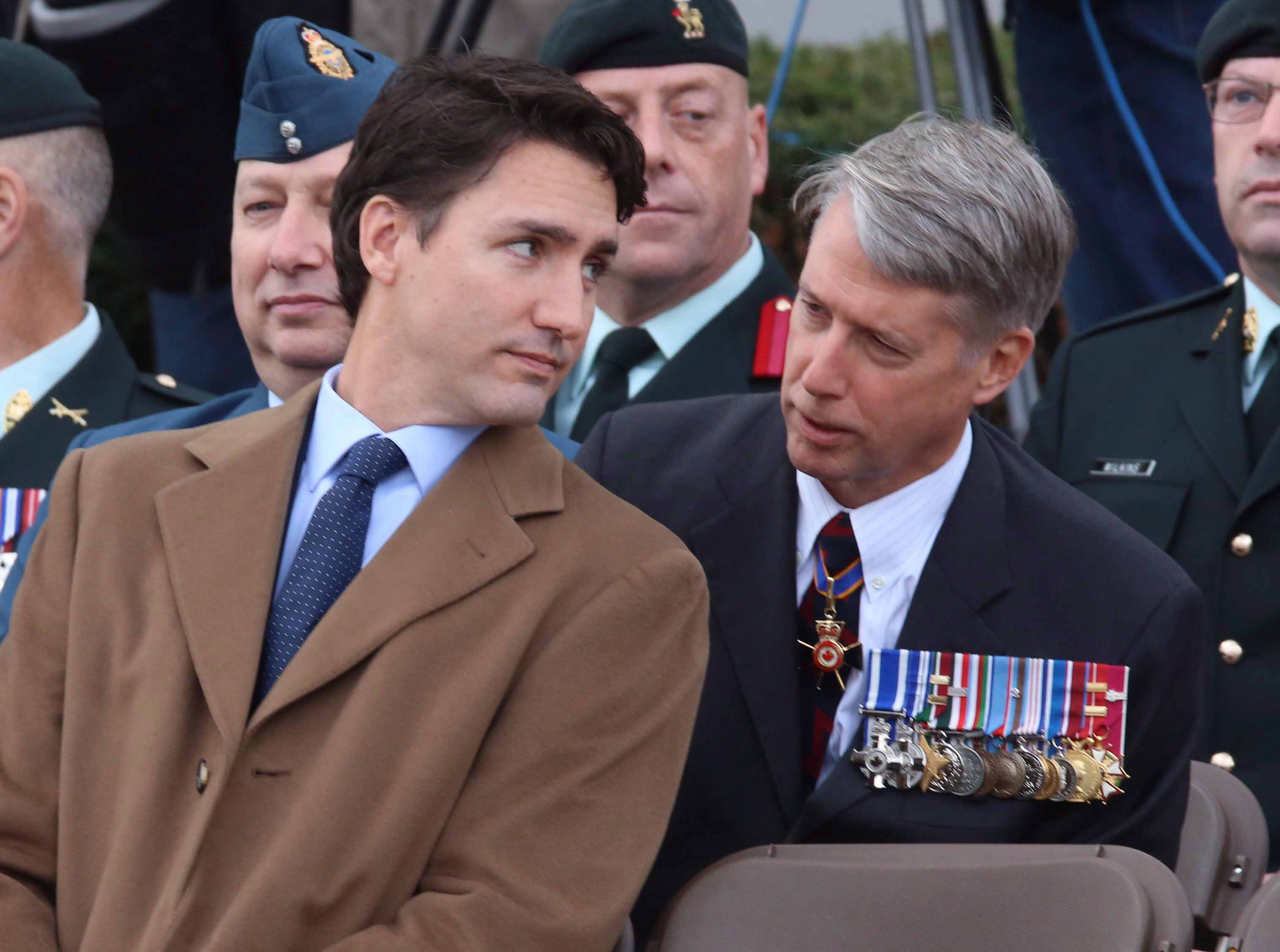
The Canadian Prime Minister Justin Trudeau had a hard time saying sorry to Vice-Admiral Mark Norman. He refused to apologise when asked directly to do so by Conservative Leader of the Opposition, Andrew Scheer. Trudeau’s response was to blame Stephen Harper, his Conservative predecessor, for awarding a defence contract, in which the admiral allegedly had an interest.
Scheer pointed out the double standard and launched a vicious attack on the Prime Minister for his willingness to spend untold millions of Canadian tax payers’ money for prosecuting a righteous public servant, Vice Admiral Norman who was a national hero.
When the resolution was put to vote, Prime Minister Justin Trudeau had already left the chamber and Defence Minister Harjit Sajjan was absent.
In stark contrast to the passage of this apology resolution, I was reminded of the several instances of senior officers of the Indian defence forces being convicted by court martial and cashiered/ dismissed from service in disgrace. In quite a few instances the higher courts of appeal have rejected the court martial verdicts and restored the lost honour of these officers. However, there was not a single case of an apology from anyone, not even the concerned service Headquarters to the individual.
At the time when charges were pressed against Vice Admiral Mark Norman, he was the Vice Chief of the Canadian Defence Forces, the Number 2 man in the military hierarchy. For a western democracy, it was perhaps a rare incident of such nature.
What was the case against Vice Admiral Mark Norman?
The Canadian Navy urgently needed a supply ship as HMCS Protecteur, Canadian Navy’s only supply ship was engulfed in a blaze in February 2014, rendering it unserviceable. The ship had to be towed by a US Naval ship to Pearl Harbour. The Conservative government in power then placed an order with Quebec-based shipbuilder Chantier Davie Canada Inc (Davie) to convert a civilian cargo ship into a military supply vessel at a cost of $668-million.
Prior to the award of the contract, the Conservative Government changed the federal procurement rules to allow a single vendor contract without competition, which was questioned by the incoming Liberals. The Conservative Defence Minister defended the decision to amend the rules to facilitate the single vendor deal, as the Canadian Navy wanted a supply ship urgently and the normal process would involve 30 to 36 months.
In November 2015, the new Liberal government apparently took a decision to pause and review the deal. The information was leaked to James Cudmore, then a CBC reporter. Following the leak, there was a public outrage in Quebec. The liberal Government then backtracked and quickly approved the deal. However, furious with the leak, the government ordered the Royal Canadian Mounted Police (RCMP) to investigate the matter.
In January 2017, Vice Admiral Mark Norman was suspended from service and more than a year later subsequent to raids at his residence, the RCMP charged Vice Admiral Mark Norman with breach of trust, alleging that he leaked cabinet secrets to an executive at Davie and a journalist. In its court brief, it was alleged that Norman ‘knowingly and deliberately‘ leaked this information and breached cabinet secrecy on 12 separate occasions between October 2014 to November 2015.
Norman vehemently denied any wrong doing pleaded not guilty to the charges and said that he acted with integrity, ethically and “in the best interests of the Royal Canadian Navy, the Canadian Forces and, ultimately, the people of Canada.”
Government’s case against Norman unexpectedly began to collapse in March 2019, partly under the weight of information from several former Conservative cabinet ministers and staffers. The new evidence, gathered by Norman’s lawyers and presented to the court on March 28 included some documents which were not uncovered during the investigation, something Norman’s lead defence lawyer blamed on government obstruction. The independence of the investigation carried out by the RCMP also came into question.

The case took a turn on its head the moment Liberal MP Andrew Leslie announced his retirement from the federal Liberal caucus and expressed his wish to testify for the defence in Vice-Admiral Mark Norman’s trial. His testimony would have been politically embarrassing for the government, coming from the ruling party MP. It was a political ‘hara-kiri’ for Leslie who said that he will not be running for re-election in 2019.
Who is Liberal MP Andrew Leslie? Why was he defending Vice-Admiral Mark Norman?

Veteran Lieutenant General Andrew Brooke Leslie served Canadian Army for over three decades. He was an artillery officer commissioned in 1981 and rose to the top of the hierarchy to be appointed as Chief of the Land Staff in Jun 2006. He retired in September 2011 and was elected MP of Liberal Party in 2015. Prior to his retirement, he was assigned the task of making a ‘transformation report‘ of the Canadian Defence Forces. On this task Admiral Mark Norman was his deputy and part of the team that submitted the report. So Admiral Mark Norman was a subordinate well known to the General.
While appearing as defence witness, Leslie would have no specific knowledge about the allegations that led to the charge against Norman, but would have insight into how the case was treated by the Liberal government, both during the investigation and throughout the pre-trial phase. The Admiral’s legal defence had often often made the accusation of political interference which may well get substantiated by the General’s testimony. Also, knowing the nuances of the procurement process and probably having faced frustrations similar to the problem of procuring a supply ship may well state in testimony that the Conservative government decision to amend the procurement rules was well justified. All these would surely have been politically embarrassing for the government.
The General acted like a General to defend the honour and well being of his subordinate, a comrade in arms, even at the cost of his political future. This is a classic case of military loyalty to the organisation and ultimately to the Canadian nation in a larger sense. Notice that there was a personal cost involved and therefore becomes all the more praiseworthy
At the end of it, the government was forced to drop all charges against Vice Admiral Mark Norman. What caused the prosecution to drop the charge is not yet known. It is obvious that for the conviction to stand, the aspect of personal gain and damage to public interest would both require to be proved. There is no indication of any available evidence towards this. In the face of mounting public statements from then Conservative cabinet ministers and staffers that the Admiral’s recommendations for single vendor deal with Davies was made only in the best interests of the Canadian Navy, the prosecution was probably left with no alternative but to drop the charges.
The Canadian public will come to know of the reasons that prompted the state to drop the charges only if Norman ever files a civil lawsuit against the government for the ordeal that he faced. Norman said he has an ‘important story’ to tell Canadians, which he will be sharing in the coming days.
On being exonerated of all charges, Vice Admiral Mark Norman said “I am confident that at all times I acted with integrity, I acted ethically and I acted in the best interests of the Royal Canadian Navy, the Canadian Forces and, ultimately, the people of Canada. The alarming and protracted bias of perceived guilt across the senior levels of government has been quite damaging and the emotional and financial impacts of the entire ordeal have taken a toll.” Like a true soldier he did not blame anyone for his ordeal and was preparing to get back to work immediately.
Meanwhile, the supply ship that Vice Admiral Norman fought for, MV Asterix (It is not christened HMCS as the ship is only leased by the Canadian Navy. It is not commissioned by the Navy and is manned by Naval and civilian crew), has been in service for more than a year, re-fuelling Royal Canadian Navy ships around the world. Many in the Canadian Navy say that conversion of the Asterix from a merchant vessel to a Naval supply ship is a rare example of a defence project that was delivered on time and on budget.
So, in the face of a decision which apparently went right all the way, pressing charges against a man who recommended the course of action probably seemed meaningless. Was it simply a case of a political squabble between the Liberals and the Conservatives into which a man in uniform was unwittingly drawn? We shall probably never know!
Banning Cell Phones in Schools

Ontario, Canada, is banning cell phones in classrooms during instructional time, starting next academic session – September 2019. Education Minister Lisa Thompson said “Ontario’s students need to be able to focus on their learning — not their cell phones. By banning cell phone use that distracts from learning, we are helping students to focus on acquiring the foundational skills they need, like reading, writing and math.”
The cell phone combined with internet technology has undoubtedly revolutionised our lives in myriad ways. Perhaps there is hardly any facet of life untouched by this revolution. Increasingly, it has become difficult to be active members of our present day societies without the use of cell phones. Like all technologies that have revolutionised human life and behaviour, the cell phone too has its pros and cons. Along with its all too obvious beneficial uses, the cell phones have a number of disruptive influences particularly on children.
Research indicates that in developed countries, a majority of middle school children own cell phones. While some children own their first cell phones when they are 11, nearly 50-60 % of all children own cell phones by the age of 13. In many cases it is the parents who are instigators of the first cell phone purchase. For many families the safety factor along with an enhanced sense of being connected is the major motivator for children being cell phone owners at a tender age. Children from higher income groups tend to own a cell phone earlier than those from lower income groups. Both parents and schools resort to various methods to regulate the use of cell phones to a greater or less degree.
In developing nations, the problem seems to be less acute as it is only a small percentage of well to do children who own cell phones in middle school and majority of children even in high schools still do not own cell phones. While parents of children who own cell phones attempt some sort of regulation on their use, most schools simply adopt a policy of banning these devices within school premises. Just as school uniforms do, such a policy serves as a great leveler between the haves and the have nots. So the dynamics in the developing world seem to be quite different from those in the developed world.
Is the ban proposal a case of resistance to change? During our schooldays too, many such scientific gadgets that enhanced learning were banned and the bans were later withdrawn. It commenced with the slide rule, then it was the calculator. During our children’s schooldays it was the turn of the scientific calculator to be followed by the laptop and then the notepad computers. While it has to be admitted that the revolutionising impact of the cell phone is far different from that of the slide rule or scientific calculator, particularly on the social and behavioural planes, the bottom line is that it is still a new technology that must be incorporated into the learning process sooner or later.
Cell phones help improve Digital literacy, a critical aspect of young students learning. It will also help them to effectively participate in the workforce. The cell phones provide a link between students and their parents, which has an important role to play in ensuring their safety. Evidence indicates parents want this type of access. Students with special needs, such as managing diabetes, and other medical and physiological conditions may be required to access various apps during school(s) hours. Rather than banning cell phones all out, we need to find ways to educate the students to use their phones effectively and efficiently. Banning cell phones will likely lead to underground and hidden use by teens. Rather than reducing cyber-bullying, banning cell phones altogether may show an increase in cyber-bullying.
We know about the 3Rs of learning – reading, writing, and arithmetic. We now need to include ‘research’, thus making it 4Rs. Schools need to educate both the teachers and students about safely negotiating the virtual environment. This means all schools need to develop policies around the use of cell phones during school hours.
A 2015 study by the London School of Economics investigated the impact of restricting Cell phone use in schools of four cities in England on student productivity. The results indicated an improvement in student performance of 6.41% in schools that have introduced a cell phone ban. These findings did not discount the possibility that cell phones could be a useful learning tool if their use is properly structured. The study found that cell phone bans have very different effects on different types of students. It improved outcomes for the low-achieving students (14.23%), and had no significant impact on high achievers. It showed that low-achieving students are more likely to be distracted by the presence of cell phones, while high achievers can focus in the classroom regardless of whether phones are present.
Another study was published in the Journal of Communication Education, Ohio University, based on impact of cell phone usage during class lecture, on student learning. Participants in three different study groups (control, low-distraction, and high- distraction) watched a video lecture, took notes on that lecture, and took two assessment tests after watching the lecture. Students who were not using their cell phones wrote down 62% more information in their notes, took more detailed notes, were able to recall more detailed information from the lecture, and scored better on a multiple choice test than those students who were actively using their cell phones.
Research published by the University of Chicago found that even if cell phones are turned off, turned face down or put away, their mere presence reduces people cognitive capacity. The paper called the phenomenon “cell phone induced brain drain”.
University of Illinois conducted a study that examined students’ cell phone and Internet use and its relationship to their mental health. The study assessed two forms of escapism amongst students: one that arises from boredom and one used as a way to avoid negative emotional situations.
What are the likely drawbacks of students using cell phones?
- It surely reduces face-to-face communication. Teenagers tend to message or text, avoiding a more challenging conversation.
- Smartphone apps, games and messages prompt dopamine release, creating addiction. Mere presence of a phone in the backpack can distract a student even though the student may not even be checking it.
- It tends to reduce working memory capacity, mental mathematical ability, logical analysis and fluid intelligence.
- It has surely reduced the students’ ability to cope with uncertainty and stress. In other words it reduces tolerance for ambiguity. Research shows being uncomfortable with uncertainty is associated with students feeling distracted and tense during difficult examinations or tests. The more uncomfortable young people are with uncertainty, the higher the number of co-occurring psychological problems they report experiencing. Smartphone use is associated with the current epidemic of anxiety and depression.
How can cell phones help in enhancing the learning process?
- Students tend to carryout research using their cell phones off-campus, later in life in their higher education, and in their professional and workplace learning.
- In case students want to investigate, collect data, receive personalised and immediate feedback, record media, create, compose, or communicate with peers, in and beyond the classroom, then using cell phones is ideal.
- Cell phones allow students to learn at a place, time and pace of their choosing, for example, on excursions, or when working on group projects or assignments with friends in more informal spaces like home, while travelling, etc.
Banning cell phones in schools is not the solution as it is important to educate children to live well in the era in which they are growing up. Students must be taught how to use technology to learn, communicate, and work with ideas. Modern technology provides new learning opportunities and the ability for students to develop skills they will need for future careers. The ability to copy what is written on the blackboard or what is dictated by the teacher into a note book is not a particularly useful skill that will help learning in the modern age nor is it what prospective employers are looking for.
An outright ban on cell phone use will hardly ever yield the results intended. Students will always find a way to smuggle it in, even if banned. That said, there is also an overarching need to perhaps severely regulate its use during classes.
Is there a need to regulate the minimum age for ownership of cell phones?
The rules formulated must be implementable at school level without hindering learning and development while at the same time minimise the disruptive effects on tender minds at the social and psychological plane.
Is it worthwhile to ban cell phones in schools? Will the ban be later overturned?
A Letter to Santa
Most children believe in the existence of Santa Claus just as our children did while growing up. Why wouldn’t they? After all, they always found the Christmas gift they prayed for under the Christmas Tree every Christmas Morning.
During the Christmas of 1994, I was posted as the Brigade Major at Binnaguri. Veteran Lieutenant General KR Rao, PVSM, AVSM, VSM was then our Colonel General Staff. Before coming to wish us ‘Merry Christmas‘ he called up and our daughter Nidhi, aged three, answered the phone and asked him as to who he was. Colonel Rao with a tinge of humour said, “I am the Santa Claus.” Nidhi was overjoyed and said “Thank you Santa, I got the Barbie which you sent across. How did you know that I really wanted it?“
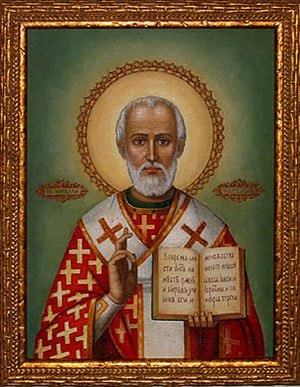
Santa Claus – it all began with St Nicholas, saint of children and sailors, a Bishop who lived in the Fourth Century in Myra, Turkey. He was a very rich and kind man with a reputation for helping the poor and giving secret gifts to people. The legend has it that a poor man who had three daughters could not get them married as he could not afford dowry. One night, Nicholas secretly dropped a bag of gold down the chimney and into the house which fell into a stocking that had been hung by the fire to dry. It was repeated for the second and third daughters. Thus commenced the tradition of hanging stocking by children expecting Santa to drop their gifts down the chimney.
St. Nicholas became popular in the Victorian era when writers and poets rediscovered the old stories. In 1823 the famous poem ‘A Visit from St Nicholas‘ was published by Dr Clement Clarke Moore. The poem describes St Nicholas with eight reindeer and gives them their names. They became famous with the song ‘Rudolph the Red nosed Reindeer’, written in 1949. The other seven reindeer are named Dasher, Dancer, Prancer, Vixen, Comet, Cupid, Donner and Blitzen.
Are these reindeer male or female? Obviously, they are females as female reindeer keep their antlers throughout winter whereas the males shed them. It’s a mystery, though, why many of them have obvious masculine names, Rudolph for instance.
Santa in England became ‘Father Christmas’ or ‘Old Man Christmas’, in France, he was called ‘Père Nöel‘, in Austria and Germany he was ‘Christ kind’ a golden-haired baby, with wings, who symbolised the newborn baby Jesus.
In North America his name was ‘Kris Kringle‘ (from Christkind). Later, Dutch settlers took the old stories of St Nicholas with them, and Kris Kringle and St Nicholas became ‘Sinterklaas‘ or as we now say ‘Santa Claus.’
Canada is home to the tradition of children writing letters to Santa. Canada Post has been helping Santa with his mail for decades. Since the national program started in 1981, Santa’s North Pole Post Office has answered more than 27.8 million letters in 39 languages, including Braille. Look at the Postal Code – it is ‘Ho Ho Ho‘ – Santa’s signature laugh.
Santa is assisted by volunteers called ‘Postal Elves‘ who help him with this monumental task. They volunteer more than 260,000 hours to make sure all the children who write to Santa get a reply before Christmas.
The first snowfall or the Santa Claus parades held in most cities and towns across Canada is a trigger for children to write their letters to Santa. Schools, daycares and homes organise Santa letter writing. One needs to include full return address for the Postal Elves to deliver a reply. Postage is free, but Santa loves stickers. Children are encouraged to write about their favourite sports, jokes, school activities or family fun with pictures and drawings.
A child normally writes two letters to Santa, one from school and the other from home. In order to prevent a child from receiving inconsistent responses from Santa, all mails from schools and daycares are replied with a generic, poster-size group letter, which will include every child’s name. A letter from home will get a personalised response from Santa.
Santa is often asked interesting questions by children – “Does Rudolph have a girlfriend?“; “How many cookies do you eat?” and so on. Some even ask for reuniting their separated parents. He also receives requests for toys, pets, dresses, etc. The advent of modern communication technology has not reduced the number of hand-written letters to Santa but has increased year to year.
Children dealing with issues write letters showing their concerns. These ‘special letters‘ are dealt with by a team of trained Postal Elves — from psychologists and social workers to police — who help Santa handle them. If they think the child is in danger, a process is set in motion to solve the issue. These Elves are trained to give a appropriate reply that will help provide some reassurance that someone is listening.
We must appreciate Canada Post, Postal Elves, teachers, parents and children for these letters and for keeping the tradition alive.
Wishing all readers a Merry Christmas and a Happy New Year.
(Images Courtesy Google)
US Exports Oil

United States has joined the elite club of major oil exporting nations with nearly $22 billion worth of oil exports. The US Congress lifted a 40-year-old ban on the export of crude oil following the 1973 OPEC oil embargo. The ban restricted crude oil exports from the US to all countries besides Canada. The last time the US exported more oil than it imported was 1953.
The International Energy Agency estimates that American oil production between 2015 and 2025 would grow at a rate unparalleled by any country in history, with far-reaching consequences for the US and the world.
Technological advancements in drilling and fracking (hydraulic fracturing) helped US to extract huge reserves of gas and oil trapped in shale rocks. Main contributor to shale oil production is from the Bakken Shale Formation in North Dakota and the Eagle Ford Shale in Texas. The oil that is being produced from these shale formations is sometimes incorrectly referred to as ‘shale oil.’
The oil in the Bakken and Eagle Ford formations actually exists as oil, but the shale does not allow the oil to flow very well. This oil is called ‘tight oil’ and advances in hydraulic fracking technology have allowed some of this oil to be economically extracted.

‘Tight oil’ refers to hydrocarbons that are trapped in formations that are not very porous. This oil and gas cannot flow out into the pipe as easily as with traditional wells. This oil is extracted by drilling horizontally across the deposit, and then fracking to open up the rock and allow the oil to flow.
The price of oil is political and is set by the big players, particularly by the Organization of Petroleum Exporting Countries (OPEC), led by Saudi Arabia. New fracking technology has resulted in flooding the oil market. Oil prices had been above $100 per barrel up to 2014 and is now about $50 per barrel, all because of US shale oil. The shale revolution has transformed oil tycoons into billionaires and the US into the world’s largest petroleum producer, surpassing Russia and Saudi Arabia.

As the oil market got flooded, Saudi Arabia initiated an economic oil war against the US by refusing to cut production in November of 2014 – an attempt to drive US shale oil producers bankrupt. The increased OPEC oil production drove oil prices down even more, eventually dropping to about $30/bbl in 2016, a price at which shale producers can’t break-even.
The oil wells used to flare out natural gas and was burned off as an unwanted by-product. Now the gas is cooled to minus 162 degrees Celsius, to be condensed into a liquid – Liquefied Natural Gas (LNG) -to be used as a clean alternative to coal. US is now a top producer of LNG, selling shiploads of the commodity to countries such as China.
Even though LNG is not a very ‘clean fuel’, US under President Trump has been exporting LNG from 2017. US is expected to overtake Qatar and become the world’s biggest LNG exporter by the mid-2020s.
US may claim today that it is energy independent, but will still be exposed to global energy prices and still be affected by the geopolitics of the Middle East. Though US sells more petroleum than it buys, American refiners continue to import more than 7 million barrels a day of crude from all over the globe to feed its refineries, which consume more than 17 million barrels each day. Thus the US has become the world’s top fuel supplier.
Why this sudden multi-fold increase in oil production? Is it the re-emergence of US under President Trump? Is it an attempt to control the world through the oil market? These questions will find answers in days to come.
It could also be that US is exploiting all its oil reserves to be sold in the world oil market as some new engine technology is in the offing with minimum dependence on fossil fuels. You may soon find such a technology emerging in the market and what it could be is anyone’s guess.
Let us wait and watch.
Women Empowerment and the Dog
A judgement by the Supreme Court of India granted equal rights to women to enter a Kerala temple, where the deity is believed to be a Brahmachari (a man with the virtue of celibacy when unmarried and fidelity when married,) hence no woman must enter the temple. The judges ruled in favour of allowing equal rights to both man in temple entry and woman as the Constitution of India ensures it.
During my morning walk with our dog Maximus on a bitterly cold Canadian winter morning, our neighbour, Mr Steve, a septuagenarian asked “If you can walk slowly, I can accompany you both.” We commenced our walk slowly along the walkway cleared of snow that had fallen that morning.
After about five minutes of walking, we came to an intersection with traffic lights. The ‘Green Man‘ signal for pedestrian crossing had just turned to flashing ‘Red Hand.’ Mr Steve said “Walk fast, we can get on to the other side before the traffic starts moving.”
“The signal has turned red, do we need to cross now?” I enquired. “Do not worry, get going,” said Mr Steve. On crossing the road, Mr Steve reminisced about his youth and said “In 1939, the Second World War commenced and I was only eleven years old then, studying in Grade 6. Our family then lived a hundred miles North of Toronto. We had a dairy farm with over two hundred cows. On the outbreak of the war, like all able men of Canada, my father and two elder brothers joined the Canadian Army and moved to Europe to fight the war. Running of our dairy farm was taken over by mother and my two elder sisters.
In those days most activities in Canada were taken over by women – from driving trucks and buses, running the banking and postal services, grocery shops and petrol pumps – anything and everything – as most men had joined the Armed Forces and had sailed off to Europe.
After the war, in 1945, my father and brothers returned home. My mother did not allow them anywhere near the diary farm as it had become ‘hers’. With the experience of digging trenches during the war and also in building roads and tracks towards the war efforts, my father and brothers started a road construction company in Toronto. On my graduation in engineering from University of Toronto, I too joined my father’s company and retired as its CEO a few years back.
What all fields Canadian women took over during the war, they have not allowed the men folk to come near them. That is why Canada is where it is today, all because of women empowerment.”
“What does this story got to do with our jay-walking across the road?” I asked.
Mr Steve commenced his justification “It appears that you are not aware of priorities in Canada. It begins with the children, then women, followed by dogs and then other pets, then is wildlife and then are the trees and plants, and last, but the least come the men. If we two were only to cross the road I would have never in my wildest dreams thought of crossing the road. Just because the dog was with us, I told you to get across.”
“Why so?” I asked.
“In case two old men like us get struck by a vehicle, the Canadian courts will only grant may be forty to fifty thousand dollars. If the dog even gets brushed by a vehicle, the driver will have hell to pay as the court will decree at least a million dollars. That fear in every Canadian driver will never allow them to crawl an inch, even if the traffic light turns green,” Mr Steve explained.
In case real women empowerment has to come into the Indian society, some major catastrophe like what happened in Canada, USA or Europe during Second World War need to occur. Supreme Court judgements, or forced entry of women to some temples is not going to give women equal rights they need to be given. The Indian males need to accept this reality and change for the betterment of the society.
A Colourful Stroll Along Lake Ontario

Port Credit located ten kilometers from our home was an old trading port till the 1800s. It is now a marina for boats. Along the lake shore is a seven kilometer trail that turns into multitude of colours every fall.

Port Credit is located at the mouth of Credit River on Lake Ontario. The ship Ridgetown was sunk here on June 21, 1974 to act as a breakwater. After her decommissioning in 1970, she was loaded with stones, towed from Toronto Port to Port Credit and sunk at the entrance to the port with her cabins and stack intact. She remains here, protecting the port from the forces of waves. In the backdrop is the City of Toronto, about 20 kilometer away with its landmark CN Tower.

On a windy day, the waves rise up over a few meters.

Canadian Fall is well known for trees with splashes of red, orange and yellow that dot tree lines across the country.

Fall is the most photographed Canadian season of the year, with colours changing very fast until the leaves fall off.

Tender thin leaves are made up of cells filled with water sap and will freeze in winter. Any plant tissue incapable of surviving the winter must be sealed off and shed to ensure the tree’s survival.

As sunlight decreases in fall, the veins that carry sap into and out of a leaf gradually close. A layer of cells called the separation layer forms at the base of the leaf stem. When this layer is complete, the leaf is separated from the tissue that connected it to the branch and it falls off.

Coniferous trees like pines, spruces, cedars and firs, don’t lose their leaves or needles in winter. The needles are covered with a heavy wax coating and the fluids inside the cells contain substances that resist freezing.

These needles can live for several years before they fall off.

Ground along the trail is all covered with leaves of varying shades of yellow, orange and red.

Some of the leaves are yet to change their colours and some have done it already.

Old cycles and other artifacts are used to decorate the walkways.

There are many children’s parks along the trail.’

Picnic spots equipped with tables, benches and barbecue stands for the revelers dot the trail.
This is the Suncorp refinery located about ten kilometer away.

These Canadian geese have not migrated down South to USA. It is neither that they have lost their passports nor have forgotten to migrate. It is because they find enough food in various parks in the city and may have developed the art of surviving through Canadian winter. May be they will fly South as soon as the temperature drops.
A Walk on a Wet Fall Evening

Every evening, I drive to the park near our home for an evening stroll.

The school buses would be returning to their depots after dropping children home. The yellow coloured bus merges with the yellow coloured trees along the Road.

After parking my car, I get on to the trail.

The trail runs along Credit River which drains into Lake Ontario.

You are sure to meet some waterfowls, ducks etc enroute.

Fall offers a kaleidoscope of colours.

Woods are really, colourful and deep

And I have miles to go before I end my walk.

The green leaf colour comes from pigments of chlorophyll, used by the trees to make food with the help of sunlight. There are other pigments namely carotenoids and anthocyanins present in the leaves, but are overshadowed by the chlorophyll in spring and summer.

Carotenoids create bright yellows and oranges like in corn, carrots, and bananas.

In fall, trees break down the green pigments and nutrients stored in the leaves. The nutrients are shuttled into the roots for reuse in spring.

Some tree leaves turn mostly brown, indicating that all pigments are gone.

Trees respond to the decreasing amount of sunlight by producing less and less chlorophyll and eventually stops producing chlorophyll.

Now the carotenoid in the leaves show through and the leaves become a bright cascade of various shades of glowing yellows.
Anthocyanins impart red colour to fruits like cranberries, red apples, cherries, strawberries, etc.

The fall season being characterised by short days and longer and cooler nights. When a number of warm, sunny autumn days and cool but not freezing nights come one after the other, Maple leaves produce lots of sugar, but the cool night temperatures prevent the sugar sap from flowing through the leaf veins and down into the branches and trunk.

Anthocyanins are now produced by the leaves for protection. They allow the plant to move down the nutrients in the leaves to the roots, before they fall off. The nutrients stored in the roots help the trees to sprout out new leaves in coming spring. During this time, anthocyanins give leaves their bright, brilliant shades of red, purple and crimson.

Information boards and garbage cans are placed all along the trail.

You are never alone on the trail.

The 5 km trail ends with a flight of stairs to the parking lot.
Halloween : Mystic Magination Night!
Wireless Electricity
We moved to Canada in 2004 and the house we purchased had telephone cables and co-axial TV cables running to all rooms. We then used a dial-up modem connected to the telephone cable for accessing the Internet. Any room which needed a telephone had an stand-alone machine.
With the availability of cheaper digital cordless telephone with four remotely connected handsets and also with multiple facilities like answering machine, call display, etc, the first set of cables to be decommissioned were the two-wire telephone cable that connected every room of the house. We still had the coaxial TV cable running to all rooms. Now the telephone handsets started communicating wirelessly and the handsets could be moved with its battery charger to any room as required.
With the introduction of cable modem, router, and Voice Over Internet Protocol (VOIP) telephone system few years later, the two-wire cable was terminated outside the house. We had to now run Cat 5 cable all through the house where ever a computer was to be connected to Internet. In an year in came a new Wi-Fi router and out went the Cat 5 cables.
Introduction of revolutionary Universal Serial Bus (USB) to connect anything and everything to a computer or a computer like device overhauled the cabling system of modern gadgets. Most cellphones and electronic devices started using USB charging. Most electrical outlets in hotels, airplanes, trains and buses came with USB ports built in to facilitate charging without an adapter. Home improvement stores started selling electrical outlets with USB connectors. Thus most of the electrical outlets at our home took a new avatar with USB port.
Introduction of Light Emitting Diode (LED) in home lighting, TV, computer monitors, displays on most home appliances has in effect reduced electricity consumption. Now most devices at home (except appliances like fridge, dishwasher, laundry systems, oven, cooking range, microwave oven, etc) use 12 Volt Direct Current (DC) as power source. Major weight and space consuming element of an LED bulb is the rectifier circuit which converts high voltage Alternating Current (AC) to 12 Volt DC.
With these 12 Volt DC appliances, mostly using USB to connect to power source, isn’t it time that we wire our home with 12 Volt DC cabling with USB ports?
At the end of the nineteenth century, ‘War of Currents’ between the American entrepreneurs Thomas Alva Edison and George Westinghouse resulted in AC being used in homes due to much reduced costs and transmission losses in comparison to DC transmission which required booster stations every 10 km. Nikola Tesla, then working with Edison, was in favour of AC and he disagreed with Edison about the use of DC current. Tesla resigned working for Edison and joined Westinghouse.
Our sun transmits energy as radiation through air without any wire. If we can build solar cell that can give near 100% or even 70% efficiency, it will usher in wireless power transmission.
Tesla dreamt of a global wireless power grid that any home, business, or vehicle could tap into. In 1934 the above drawing of a large transmitter appeared in an article on wireless power transmission. The caption read, “Nikola Tesla, electrical wizard, foresees the day when airplanes will be operated by radio-transmitted power supplied by ground stations.” The closest he ever came to realising his dream of wireless transmission was the Tesla coil, which he created in 1891.
Researchers at Stanford University have developed a wireless charging technology capable of transmitting electricity wirelessly to a moving object nearby. If the technology is upscaled, it may allow electric cars to recharge while in motion. It is nowhere near Tesla’s dream of airplanes flying on electricity.

(Image Courtesy Sid Assawaworrarit/Stanford University)
As the team described in their recently published Nature Study, the transmission achieved was much smaller than would be needed to power vehicles. However, they did reach a kind of mid-range wireless power transfer based on magnetic resonance coupling. Electricity passing through wires creates an oscillating magnetic field, and it’s this field that causes a nearby coil’s electrons to oscillate. This in turn transmits power wirelessly. However, it’s a complex process and is only efficient when the oscillating coils are tuned with respect to the moving object.
Until now, this has been one of the primary problems for wireless energy transmission, because there hasn’t been a way to get the coils to automatically tune to moving objects. The researchers solved this problem by using a feedback resistor and voltage amplifier system to detect where it should be tuned to without help from humans.
This research is part of an overall push toward safer, clean energy highways with more manageable traffic that will eventually support self-driving cars. If this dream fructifies, you’ll be able to charge your electric car while driving on the highway. A coil in the bottom of the vehicle could receive electricity from a series of coils connected to an electric current embedded in the road.
With coils embedded in the roads, we could eventually enjoy a totally automated highway system. Self-driving electric vehicles could be wirelessly charged en route, and GPS and other navigation systems would also be powered wirelessly.
Stanford research team will pave way towards achieving Tesla’s dream of wireless electricity in near future. In case they succeed in their mission, soon we will be using transmitted electricity to power our low powered DC appliances like home lighting, TV, computer monitors, etc. This will allow lot of flexibility and reduce electrification cost. LED lights will become much cheaper as they would have done away with the rectifier circuit.
“Dreams pass into the reality of action. From the actions stems the dream again; and this interdependence produces the highest form of living.” Anais Nin, French-American diarist, essayist and novelist.
Are You Prepared to Meet an Emergency for 72 Hours?
Introduction
State of Kerala, India, was battered by the rains, causing havoc, displacing humans, and above all causing irreparable damage to the environment. Having been involved with rescue missions in such natural disaster while serving with the Indian Army for over two decades and also with the experience gained in Canada for the past 15 years, I thought it appropriate to work out a survival plan for all. If you are adequately prepared to face a range of emergencies, anytime, anywhere; you have a great chance of survival, God and nature willing.
Aim
The aim of this paper is to lay down a few steps that will help you take care of yourself and your loved ones during an emergency.
Know Where You Live
A country like India, where the terrain, climate, culture and social conditions differ drastically every square kilometer, knowing the risks in your region can help you better prepare. It may be heavy rains and floods in Kerala or in the East; water logging in Mumbai, blizzards and avalanches in J&K and Sikkim; tsunamis and cyclones in coastal regions; earthquakes in the Himalayan regions – the list is endless. Along with natural disasters, there are other types of risks, such as long power outages and industrial or transportation accidents, etc. It could even be spread of a life threatening epidemic raging like the Nipah Virus epidemic which Kerala recently witnessed.
Plan for an Emergency
Every household needs an emergency plan to suit their location and area. It will surely help you and your family know what to do in case of an emergency. It is surely worth the effort. The plan once made must be discussed with every family member and clear instructions as what each member is expected to execute must be clearly defined.
Keep this document in an easy-to-find, easy-to-remember place (with your emergency kit). Photocopy this plan and keep it in your car and/or at work, and a copy close to your phone. If you completed your plan online, keep an electronic version on your computer and also store it in a cloud and must also be saved on everyone’s cell-phones.
Love Thy Neighbours
Please take your neighbours also into consideration while working out your emergency plan – they are always your first responders in case of any emergency and you are also expected to reciprocate.
Neighbourhood Safety Plan
Work with your neighbours or the Resident Welfare Associations (RWA) to identify people who may need extra help during an emergency. Like in the Army, you may also assign ‘buddies’. Assets like doctors and health professionals, military veterans, retired police and administrative officials, and above all the youth group – they are all assets of your neighbourhood. Ensure that you include them in your neighbourhood plan and allocate duties and responsibilities to them.
Revisiting the Plan
Please revisit your plan and also your neighbourhood plan at least once a year. That should be the time you must restock your kit(, change the batteries, food and bottled water. Any breaks like Onam holidays, Pooja holidays or any weekend is the most suitable time when most members are available. Write yourself a reminder to update your emergency plan one year from now.
Household Plan
- Emergency Exits. Draw up a floor plan of your home that shows all possible exits from each room. Plan a main exit route and an alternate exit route from each room. If you live in an apartment, plan to use the stairs instead of the elevators. Identify an evacuation route from your neighbourhood in case you need to leave in a hurry and always plan for more than one option.
- Meeting Places – Randevu (RV). Identify safe places where everyone should meet if you cannot go home or you need to evacuate. Specify a meeting place near home or outside immediate neighbourhood.
Make Copies of Important Documents.
Make copies of birth and marriage certificates, passports, licences, wills, land deeds and insurance. Take photos of family members in case a lost persons record is created. Keep them in a safe place, both inside and outside your home. You might want to put them in a safety deposit box or give them to friends and family who live out of town.
Workplace
Learn about the emergency evacuation plans in place and what you will need to do. You may want to have some basic supplies at work, such as water and food that do not spoil, in case you need to stay put for a while. Check with your employer about workplace emergency plans, including fire alarms, emergency exits, meeting points, and designated safety personnel or floor wardens.
Children
Ask your children’s school or daycare about their emergency policies. Find out how they will contact families during an emergency. Find out what type of authorisation the school or daycare requires to release your children to a designated person if you can’t pick them up. Make sure the school or daycare has updated contact information for parents, caregivers and designated persons.
Plan for pets
In case of an evacuation, remember that pets are not allowed in some public shelters or hotels. In case of an evacuation, prepare to take your pets with you to the home of a relative or friend, or take steps to identify pet-friendly hotels or pet boarding facilities in your area and further away from home.
Special Health Needs
- Support Network. Establish a personal support network of friends, relatives, health-care providers, co-workers and neighbours who understand your special needs and also of your family members’.
- Prepare a Health List. Make a list of all your health/ medical needs. Keep a copy of this information in your emergency kit, and give a copy to your personal support network. The list must include:-
- Accommodation needs
- Insurance information
- Allergies
- Medical conditions
- Emergency contacts
- Medication
- Family medical history
- Recent vaccinations
- Health screenings
- Surgeries
- Grab&Go Medical Bag. Talk to your doctor about preparing a grab-and-go bag, if possible, with a two-week supply of medication and medical supplies. Include prescriptions and medical documents. Remember that pharmacies may be closed for some time, even after an emergency is over.
Out-of-Town Contact
Choose an out-of-town contact who lives far enough away that he or she is unlikely to be affected by the same event. If you have recently moved to a new area, make arrangements through friends, cultural associations or community organisations. Arrange for each family member to call, e-mail or text the same out-of-town contact person in case of an emergency.
Home Safety
- Make sure you have a working carbon monoxide detector, smoke alarm, fire extinguisher and well-stocked first aid kit. If you live in an apartment, or if you are staying in a hotel, know where the fire alarms and at least two emergency exits are located.
- Make sure you have a fire extinguisher on every level of your home, including one in your kitchen. Everyone in your home should know where to find the fire extinguishers. All capable adults and older children should know how to use it. See manufacturer’s instructions regarding the lifetime of your fire extinguisher.
- Older children and adults should know how to turn off your home’s water, electricity and gas. Make large, easy-to-see signs for water and gas shut-offs as well as for the electrical panel.
- Teach children how and when to dial emergency numbers as well as how to call the designated out-of-town contact.
- Limit phone calls to urgent messages only. Keep calls short to free up the lines for others.
- When notifying emergency services of your location, provide the exact street or civic address and nearest intersection.
When an Emergency Strikes
- Follow your emergency plan.
- Get your emergency kit.
- Make sure you are safe before assisting others.
- Listen to the radio or television for information from authorities. Local officials may advise you to stay where you are. Follow their instructions.
- Stay put until all is safe or until you are ordered to evacuate.
Evacuation Orders
- Authorities will not ask you to leave your home unless they have reason to believe that you may be in danger.
- If you are ordered to evacuate, take your emergency kit, your wallet, personal identification for each family member and copies of essential family documents with you. Bring a cellular phone and spare battery or a power bank or charger with you, if you have one. Use travel routes specified by local authorities.
- If you have time, call or e-mail your out-of-town contact. Tell them where you are going and when you expect to arrive. Once you are safe, let them know. Tell them if any family members have become separated.
- If possible, leave a note telling others when you left and where you are. Shut off water and electricity if officials tell you to do so.
- Take pets with you.
- Lock your home.
- If you go to an evacuation centre, register your personal information at the registration desk. Do not return home until authorities advise that it is safe to do so.
Preparing an Emergency Kit
- In an emergency, you will need some basic supplies. You may need to get by without power or tap water. Be prepared to be self-sufficient for at least 72 hours.
- You may have some of the items already, such as food, water and a battery-operated or crank flashlight. The key is to make sure they are organised and easy to find.
- Make sure your kit is easy to carry and everyone in the household knows where it is.
- Keep it in a backpack, duffle bag or suitcase with wheels, in an easy-to-reach, accessible place, such as your front-hall closet.
- If you have many people in your household, your emergency kit could get heavy. It’s a good idea to separate some of these supplies in backpacks. That way, your kit will be more portable and each person can personalise his or her own grab-and-go emergency kit.
Basic Emergency Kit
- Water – at least two litres of water per person per day; include small bottles that can be carried easily in case of an evacuation order
- Food that won’t spoil, such as canned food, energy bars and dried foods (replace food and water once a year)
- Manual can-opener
- Crank or battery-powered flashlight (and extra batteries). Replace batteries once a year.
- Crank, battery-powered radio (and extra batteries).
- Granb&Go medical bag.
- First aid kit
- Extra keys to your car and house
- Some cash in smaller currencies. Automated bank machines and their networks may not work during an emergency. You may have difficulty using debit or credit cards.
- A copy of your emergency plan and contact information
- Recommended additional items
- Two additional litres of water per person per day for cooking and cleaning
- Candles and matches or lighter
- Change of clothing and footwear for each household member
- Sleeping bag or warm blanket for each household member
- Toiletries
- Utensils
- Garbage bags
- Water purifying tablets
- Basic tools (hammer, pliers, wrench, screwdrivers, work gloves, dust mask, pocket knife)
- A whistle (to draw prompt attention)
- If you think your water is contaminated, check with your municipality or local authorities for details. When in doubt, do not drink water you suspect may be contaminated.
Emergency Vehicle Kit
Prepare a small kit and keep it in your vehicle to include:
- Blanket
- Candle in a deep can and matches
- Extra clothing and shoes
- First aid kit with seat-belt cutter
- Flashlight (crank or battery-powered). Replace batteries once a year.
- Food that won’t spoil (such as energy bars)
- List of contact numbers
- Radio (crank or battery-powered). Replace batteries once a year.
- Small shovel
- Warning light or road flares
- Water
- Whistle
Conclusion
An emergency may occur at any time and human being over centuries have faced many such ones. In case you are adequately prepared, you are in a better position to face it and also help others to go through the ordeal. Always remember “Preparedness is the calm before, during and after any storm.”
(Based on Government of Canada Emergency Preparedness Guide)
Rose Garden 2018
For centuries, roses have inspired love and brought beauty to those who have received them. In fact, the rose’s rich heritage dates back thousands of years. People have been passionate about roses since the beginning of time. We have over fifty bushes in our garden.

Jawaharlal Nehru, the first Prime Minister of India, was fond of Red rose. He always wore a Red rose on his jacket until his last breath.

It is said that the floors of Cleopatra’s palace were carpeted with delicate rose petals. Shakespeare refers to roses more than 50 times throughout his writings. It is also New York’s state flower.

1,000 years old. That’s the age the world’s oldest living rose is thought to be. Today it continues to flourish on the wall of the Hildesheim Cathedral of Germany.

It was in seventeenth century that French explorer Samuel deChamplain brought the first cultivated roses to North America. Roses are truly ageless. Recently, archaeologists discovered the fossilized remains of wild roses over 40 million years old.

The people of ancient Greece used roses on festive occasions to adorn themselves with garlands of roses, and splash themselves with rose-scented oil. Napoleon’s wife Josephine so adored roses, she grew more than 250 varieties

The largest rose bloom ever bred was a pink rose measuring approximately 33 inches in diameter, bred by Nikita K. Rulhoksoffski from San Onofre, California.

Red roses are the traditional symbol for love, romance. It reflects beauty and perfection. Myth has it that Venus’ son Cupid accidentally shot arrows into the rose garden when a bee stung him, and it was the ‘sting’ of the arrows that caused the roses to grow thorns. When Venus walked through the garden and pricked her foot on a thorn, it was the droplets of her blood which turned the roses red.

Pink Rose depict gentleness, grace, gladness, joy and sweetness. It can also convey happiness, gracefulness and admiration.

Bright, cheerful and joyful are what come to mind when thinking of a yellow rose. Giving yellow roses can tell someone the joy they bring you and the friendship you share.

White roses, the purist of colors, represent innocence, purity and charm. White roses are traditionally used in weddings and can represent new beginnings. We believe that white roses can also express remembrance and innocence. Why white roses are so special is no mystery – it’s a myth. Perhaps it started with the Romans who believed white roses grew where the tears of Venus fell as she mourned the loss of her beloved Adonis.

Orange roses evoke energy, and enthusiasm, desire and excitement. Giving orange roses can symbolise your passionate romance and share your excitement of the relationship with your loved one.

Love at first sight or just an enchanting way to say, “I love you!” Lavender roses can offer a daily reminder of your love and eagerness to grow your relationship.

Peach-colored rose is gifted when are you grateful for someone or just want to show your appreciation. It shows appreciation and gratitude or a different way to say “Thank You!” They symbolise innocence and purity.

Cream roses are indicative of charm and thoughtfulness and goes well with pink ‘thank you’ roses. Gifting a bunch of cream roses is an ideal way to show someone that you care – but without any romantic intentions.
” How did it happen that their lips came together? How does it happen that birds sing, that snow melts, that the rose unfolds, that the dawn whitens behind the stark shapes of trees on the quivering summit of the hill? A kiss, and all was said.” Victor Hugo
” What’s in a name? That which we call a rose by any other name would smell as sweet.” William Shakespeare
Peonies – A Symbol of Honour, Fortune, and a Happy Relationship

Peonies are outrageously beautiful in bloom, with lush foliage. They bloom from late May through June in Toronto. The flowers last only two weeks.

Their stems are not strong enough to support the heavy blossoms, hence they need support. Peony cages are placed in spring around the plant as they grow.

Peony is named after Paeon (also spelled Paean), a student of Asclepius, the Greek god of medicine and healing. They are also the 12th anniversary flower – because the peony symbolises honour, fortune, and a happy relationship.. It is the state flower of Indiana.

Peonies are native to China. They are highly valued there, and are often referred to as the “king of flowers”. They were the national flower prior to 1929, when they were replaced by the plum tree. Chinese name for the peony is ‘Sho Yu’ meaning “most beautiful”.

Peonies of three types grow in our garden- Tree Peonies, Herbaceous Peonies and Itoh peonies.

Herbaceous peonies (also known as bush peonies) die to the ground in Winter. They re-emerge in March, or when the snow melts. Many find that they are deer resistant, but not always. Peonies are long lived, minimal care plants.

Tree peonies are called tree peonies for the woody stems that they have. Tree peonies have woody stems that defoliate in the fall, but the woody stems stay intact, above the ground. They tend to bloom earlier and with larger flowers than the bush peony.

Itoh or Intersectional peonies are a cross between the herbaceous (or bush) peony and the tree peony. These crosses have produced new, exciting colors. The plants have the lovely leaf form of the tree peonies, but die to the ground in the Winter. Since they are recent introductions and are still in short supply they command a high price.

Itoh Peonies derive its name from Japanese horticulturist, Dr. Toichi Itoh, who successfully created seven peony hybrids from a tree peony bred with an herbaceous peony. Dr. Itoh passed away before ever seeing his creations bloom. Years later, American horticulturist, Louis Smirnow bought some of these original Itoh peonies from Dr. Itoh’s widow and continued Itoh’s work.

Peonies like full sun, and though they can manage with half a day, they bloom best in a sunny spot. They come in every color except for blue. Pink, and white, are the most popular colours. Peonies can live upto a hundred years. In ancient times peonies were believed to relieve headaches and help with asthma.
Early Spring Tulips 2018

‘April rains bring in May flowers’ is a common saying in Canada. This year, tulips sprouted as the days warmed up in April, but we had two snowfalls thereafter. Many plants either died or did not grow properly, but we still boast of the best Tulip Garden in Town.

Tulips Originated in Persia and Turkey and were brought to Europe in the 16th century.

Cultivated varieties, referred to as ‘Dutch tulips,’ originated in the Netherlands.

They got their common name from the Turkish word for gauze (with which turbans were wrapped) – reflecting the turban-like appearance of a tulip in full bloom.

Yellow tulips symbolises cheerful thoughts.

The brightly colored, upright flowers may be single or double, and vary in shape from simple cups, bowls, and goblets to more complex forms.

Tulips typically bear cup-shaped flowers in almost every shade but true blue. They can be double or single, fringed or twisted, perfumed or non-scented.

The eleventh wedding anniversary flower is also tulip. It conveys forgiveness.
These are different shades of Red Tulips in our garden. Red tulips are most strongly associated with true love.

Tulips are spring flowers and it arrival signals the coming of a new season. Most tulips have six petals, but some can have many more.

Some of the Tulips are still blooming – may be due to the late setting in of spring.

Red tulips are the hue of choice to express that you are deeply in love. The color red evokes passion and romance.

They are gone in two weeks – and that’s the saddest part.
Gardening for Fun & Happiness
The Divine Mandate
“So God created man in his own image, in the image of God he created him. God blessed them and said to them, ‘Be fruitful and increase in number; fill the earth and subdue it. Rule over the fish in the sea and the birds in the sky and over every living creature that moves on the ground.” (Genesis 1:27–28)

God granted humanity the right to rule over everything on earth. Yet this dominion must not translate into exploitation of nature. Rather, it calls us to be fruitful – to participate in the ongoing work of creation. This is the power of creativity with which we have been blessed. One of the finest ways to honour this divine command is simply to tend to your garden. Whether a few indoor pots, a modest home garden, or a sprawling farm, the act of cultivation connects us to the sacred rhythm of growth and renewal.
Garden Meditation Day
May 3 is Garden Meditation Day—a time to step away from the noise of daily life, to relax, to reflect. If you are fortunate enough to own a garden, spend the day there. If not, visit one. It is a day for hands-on work: digging, planting seeds, pruning, weeding. These simple acts can become a form of meditation, grounding us in the present moment.
The Science of Soil and Soul
Research has shown that physical activities involving creativity, planning, problem-solving, and labour reduce stress, anxiety, and depression. Gardening can even serve as effective exercise for weight loss. The simple acts of tending plants, removing weeds, and nurturing saplings invariably lift the spirit. They make you feel better—and they connect you to the primal experience of being part of creation, close to mother nature.
Even a brief gaze at a garden or a cluster of indoor plants can trigger positive emotional changes. Studies confirm measurable effects on blood pressure, heart activity, muscle tension, and neural activity. Gardening calms the nerves, soothes emotions, and yields genuine happiness.
Going Green, Living Well
Today, we have taken God’s word of ruling over the earth to extremes – often forgetting the stewardship that dominion implies. Gardening is one of the most effective ways to go green and support the natural world. A well-kept garden – or even a few indoor plants – improves indoor air quality, helps keep the home warm in winter and cool in summer, reduces your carbon footprint, and saves you money.
A vegetable garden in your backyard provides fresh, high-quality produce. If you choose organic methods – avoiding artificial fertilisers and pesticides – you will enjoy regular, bountiful harvests of healthy, chemical-free vegetables.
A Real-Estate Perspective
One summer morning, as I tended to my roses, an octogenarian stopped his car and stepped out to compliment my garden. “Your work has increased your home’s property value by a hundred thousand dollars,” he said, “and your neighbour’s by at least fifty thousand. I retired after forty years as a real-estate agent, and I can vouch for this from experience.“
A garden or landscape is an investment in the future. A well-manicured lawn, carefully maintained flowerbeds, and properly pruned trees all enhance your home’s curb appeal. If you ever decide to sell, a beautiful garden is a surefire way to attract buyers – and a higher price.
An Art and a Lifelong Hobby
Gardening and landscaping are truly becoming art forms. Planning, planting, and watching your own garden grow fills you with satisfaction and pride. It is a lifelong hobby: the more you learn, the more proficient you become, and the possibilities are endless.
It all begins with a first step – getting your hands dirty and your shoes soiled. As time passes, you will surely enjoy it, especially after retirement.
So, What’s Stopping You?
Whether you start with a few indoor plants, a balcony container garden, or a full landscape design, the benefits are immediate and lasting. Gardening is not merely a pastime; it is a meditation, a science, an art, and a spiritual practice—all rolled into one.
So take that first step. Dig. Plant. Water. Watch.
You might just find that in tending the earth, you also tend your soul.
Vertical Bank Notes in Canada

Vertical currency is a type of currency in which the orientation has been changed from the conventional horizontal orientation to a vertical orientation. why a vertical currency?
People generally handle and deal with currency notes vertically rather than horizontally. People ‘tell’ (count) the notes, holding the bundle vertically. They tend to hold an open wallet or purse vertically while searching for notes. Most people hand over notes to one-another vertically rather than horizontally, especially when making purchases. All machines like Automated Teller Machines (ATM), vending machines, etc accept notes vertically. Thus it appears that vertical note makes more sense. Bermuda, Brazil, Cape Verde, Israel, Switzerland, and Venezuela have adopted vertically oriented currency and now Canada has also joined them by issuing a vertically oriented $10 note. Early Chinese banknotes were also vertical, due to the direction of Chinese writing.
Many countries have different colors for their notes as it is one of the best ways to distinguish one note from another. USA issues only green backs which traces its history to 1861, when US government issued paper money as a means of financing the American Civil War. The backside of these notes were printed with green ink as an anti-counterfeiting measure. Green colour was chosen to avoid photographic duplicates, since the cameras of the time could only take black and white pictures. Thus these notes came to be known as ‘Greenbacks.’ In order to cut down on manufacturing costs, US government shrunk the size of all paper money and instituted standardised designs for each denomination, which made it easier for people to tell real bills from fakes. The small-sized bills continued to be printed with green ink because green ink was plentiful and durable and green colour was associated with stability.
Various images on the notes relate to the value of each note. These images depict the history of the nation, its culture, its important personalities, historical events, national achievements, monuments etc, to be educational, for its citizens and also for the others handling the currency.
On 08 March 2018, on the International Women’s Day, Canadian Finance Minister Bill Morneau and Bank of Canada Governor Stephen S Poloz unveiled the new $10 bank note featuring Viola Desmond. It was the first time that an iconic Canadian woman is portrayed on a regularly circulating Bank of Canada note. She became the first black person and the first non-royal woman ever to appear on regularly circulating Canadian notes. Please click here to read about my earlier post ‘Canadian Woman on Banknote.’
The note also features the Canadian Museum for Human Rights—the first museum in the world solely dedicated to the evolution, celebration and future of human rights. Also depicted on the note are an eagle feather—representing the ongoing journey toward recognising rights and freedoms for Indigenous Peoples in Canada—and an excerpt from the Canadian Charter of Rights and Freedoms.
This new $10 note is the first vertically oriented bank note issued in Canada. This will allow for a more prominent image of Viola Desmond and differentiates this new $10 note from the current polymer notes.
Viola Desmond was selected for the new $10 bank note by Minister Morneau following an open call to Canadians to nominate an iconic Canadian woman for the next redesigned bank note. A successful Black Nova Scotian businesswoman, Desmond is often described as Canada’s Rosa Parks after she refused to leave her seat in the ‘whites only’ section at the Roseland Theatre in New Glasgow, Nova Scotia, in 1946.
Desmond, then aged 32, was dragged out of the theatre by police and jailed. The civil rights activist was convicted of defrauding the province of a one-penny tax — the difference in tax between a downstairs and upstairs ticket.
Segregation was legally ended in Nova Scotia in 1954, in part because of the publicity generated by Desmond’s case. Desmond died in 1965. The province of Nova Scotia apologised to her posthumously, 45 years later.
Military Lounge @ Buffalo Airport

On 04 February 2018, I traveled to Buffalo Airport, USA to pick up Reshma Sameer, daughter of Veteran Brigadier Azad Sameer. To read more about Brigadier Sameer,Please Click Here.
Buffalo Airport is 160 km from our home, about two hours of drive by car. She was scheduled to land at 2 PM. It was snowing in the morning and was foggy. Hence, I left home by 10 AM, catering adequate time for a slow drive, breaks, and crossing at the Canada-US border. We generally cater for about 30 minutes for border crossing formalities.

As I pulled up at the US Customs & Border Protection counter, there was hardly anyone waiting there to cross. I drove up to the counter and the officer manning the post came out. As I was handing over my passport he asked “Sir, aren’t you watching the Super Bowl?” “I am off to Buffalo Airport to pick up our family friend” I answered. Returning my passport he said “Drive safely, have a nice day, Sir.” This quick clearance must have been due to the ‘Veteran‘ Licence Plate of my car.
The Super Bowl is the final game of the National Football League (NFL), played on the first Sunday in February. It is one of the most watched TV event in United States with more than 100 million people from the United States alone watching it. Every year the TV commercials, known as Super Bowl ads attract a lot of interest and also money. This year it featured Hollywood stars Cardi B, Tiffany Haddish, Keanu Reeves and Morgan Freeman.
I reached the Airport at noon and was looking for a place to spend two hours at my disposal. I picked a book I had in the car and my reading glasses after parking the car in the parking lot. As I entered the arrival area, I read a sign ‘Freedom Lounge – A Courtesy Centre for Military Service Members and Veterans.’
This lounge was setup in 2016 by WNY Freedom Lounge Inc in recognition of sacrifices by the US Military Service personnel. It ensures a welcoming environment for traveling Military personnel & Veterans at the Buffalo-Niagara International Airport. The lounge is open to members of the military, veterans and their families free of charge.

WNY Freedom Lounge Inc is a private, non-profit organization, headed by Veteran Lieutenant Colonel Dan Walther of Kenmore, who raised funds and made arrangements for the lounge. The lounge provides morale and recreational services to members of the US Military and their families. The lounge offers comfortable seating, reading material, TV, phone, snacks, and internet access. It is staffed by veteran volunteers, veteran organizations and military supporters.
I was welcomed in by Veteran Chief Petty Officer Ronald of the US Navy. After exchanging usual pleasantries, he ushered me in and showed me three rooms – a reception area, a kitchenette and a small living room with sofas and chairs. He opened the fridge, well stocked with beverages and asked “What would you like to have Sir?” “Black Coffee” I replied. He brewed a cup for me in the coffee maker and we sat down and talked.
He said that this lounge has been created for transitioning Military personnel, who often have significant wait times between connecting flights. Most Military personnel often travel alone and they need a place to rest. The lounge is staffed and maintained fully by volunteers. It is generally open from 9 AM to 10 PM and during other times, the Information Desk staff would open it.
We spoke about all matters two Veterans would speak – about our service in the Forces, places served, family, children, aspirations, dreams, et al. At the end I realised that we Veterans – from US and India – why from world all over – speak the very same language. The Military is in our blood and it cannot be shed easily.