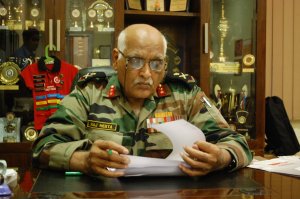
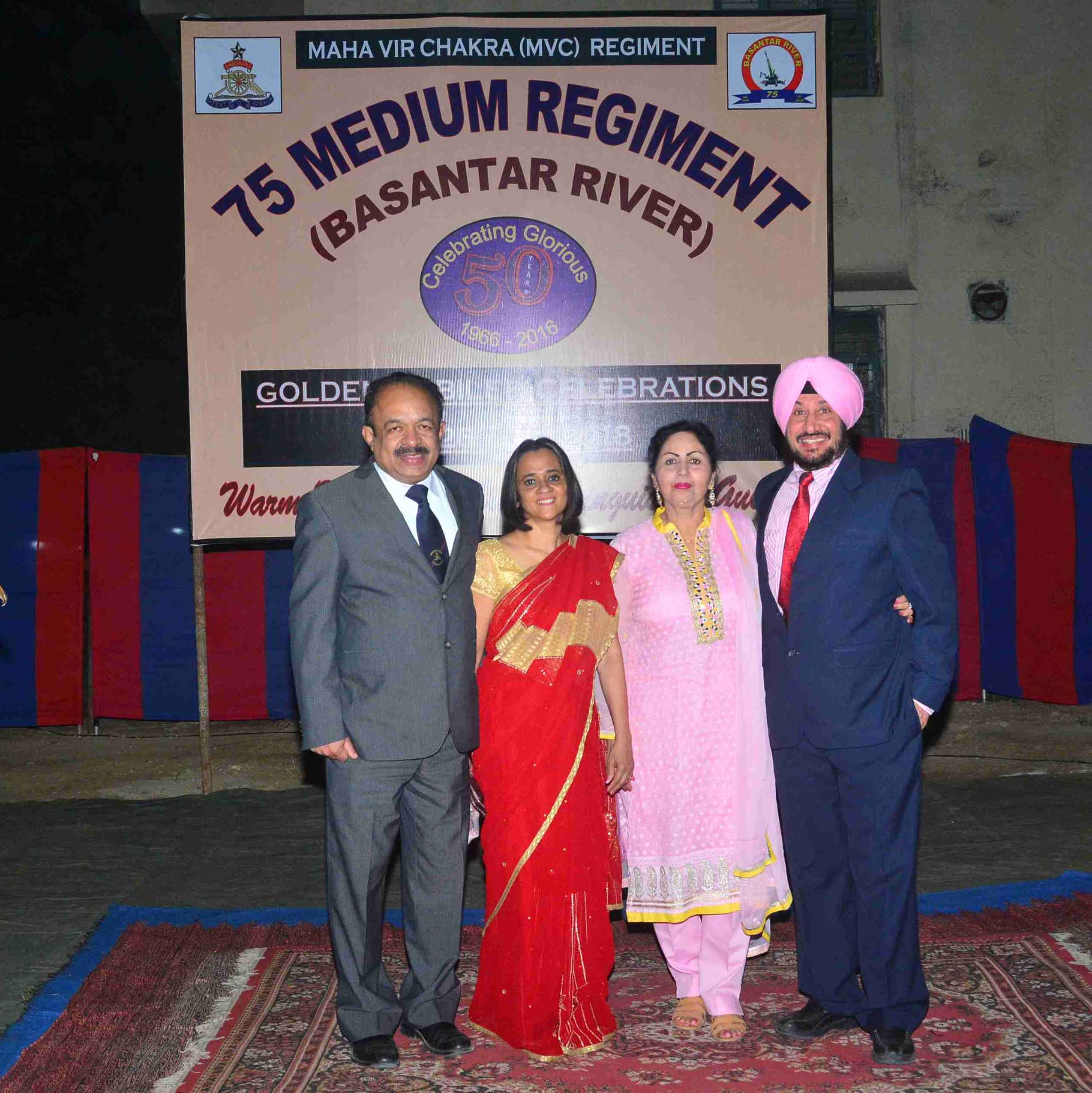
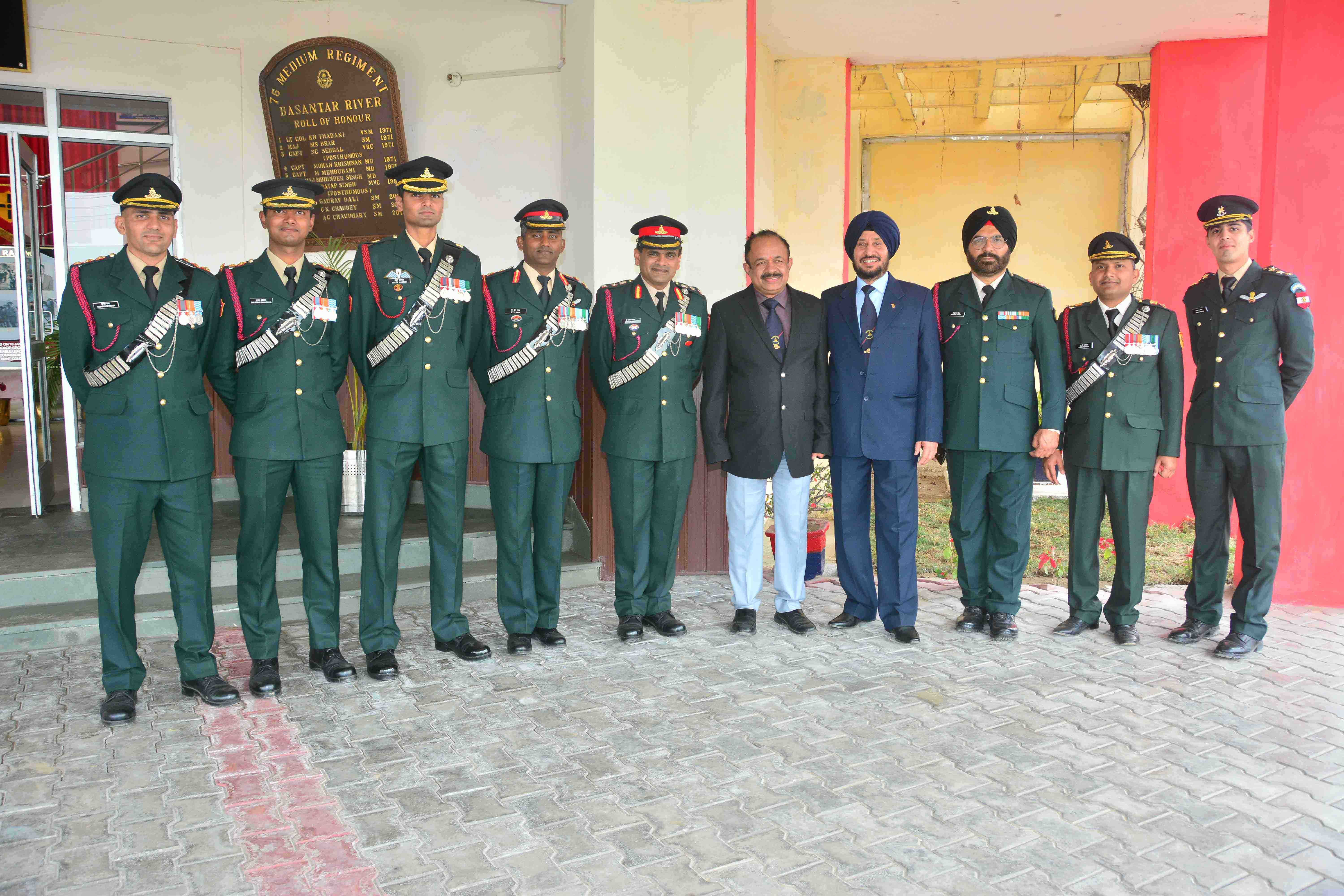
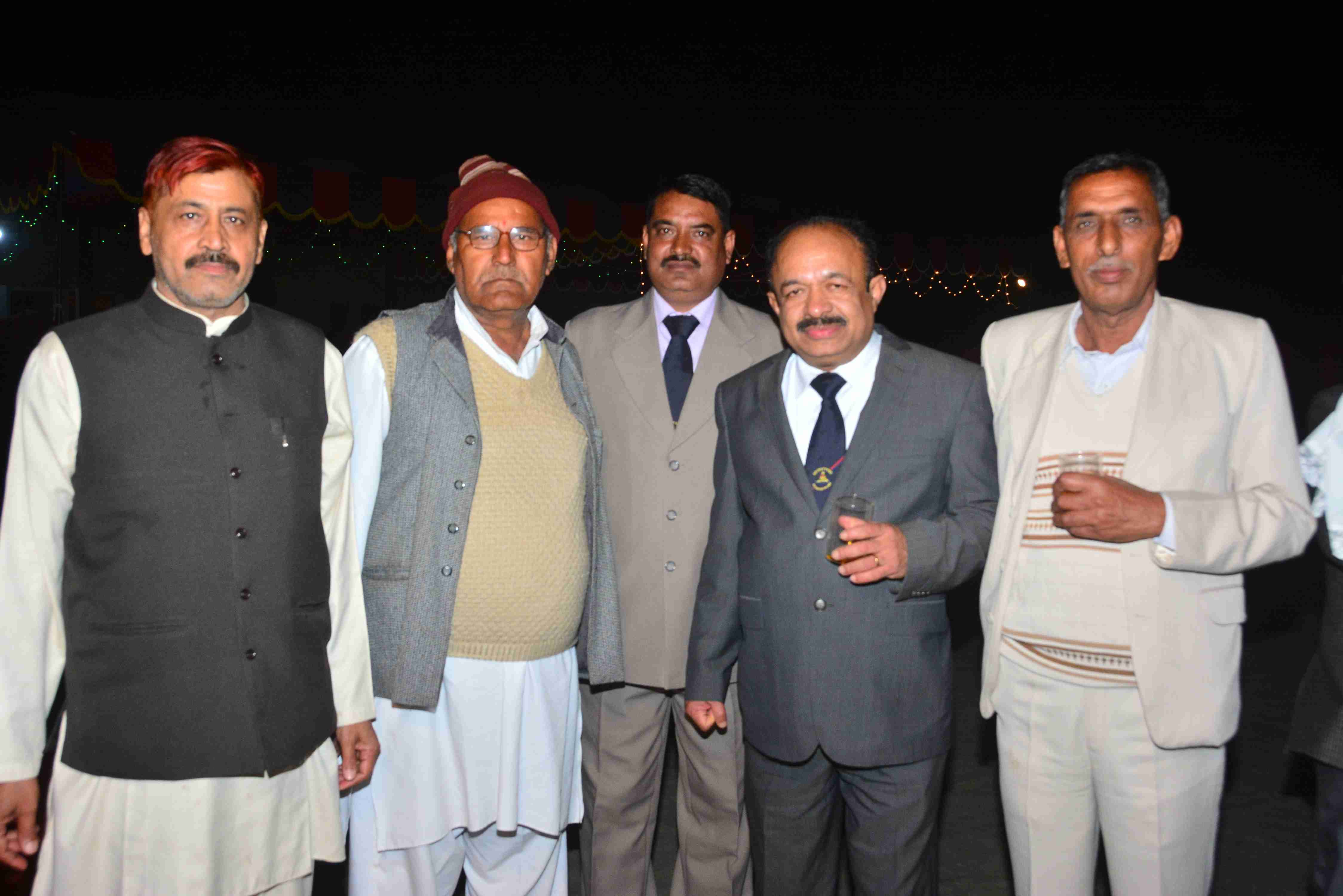
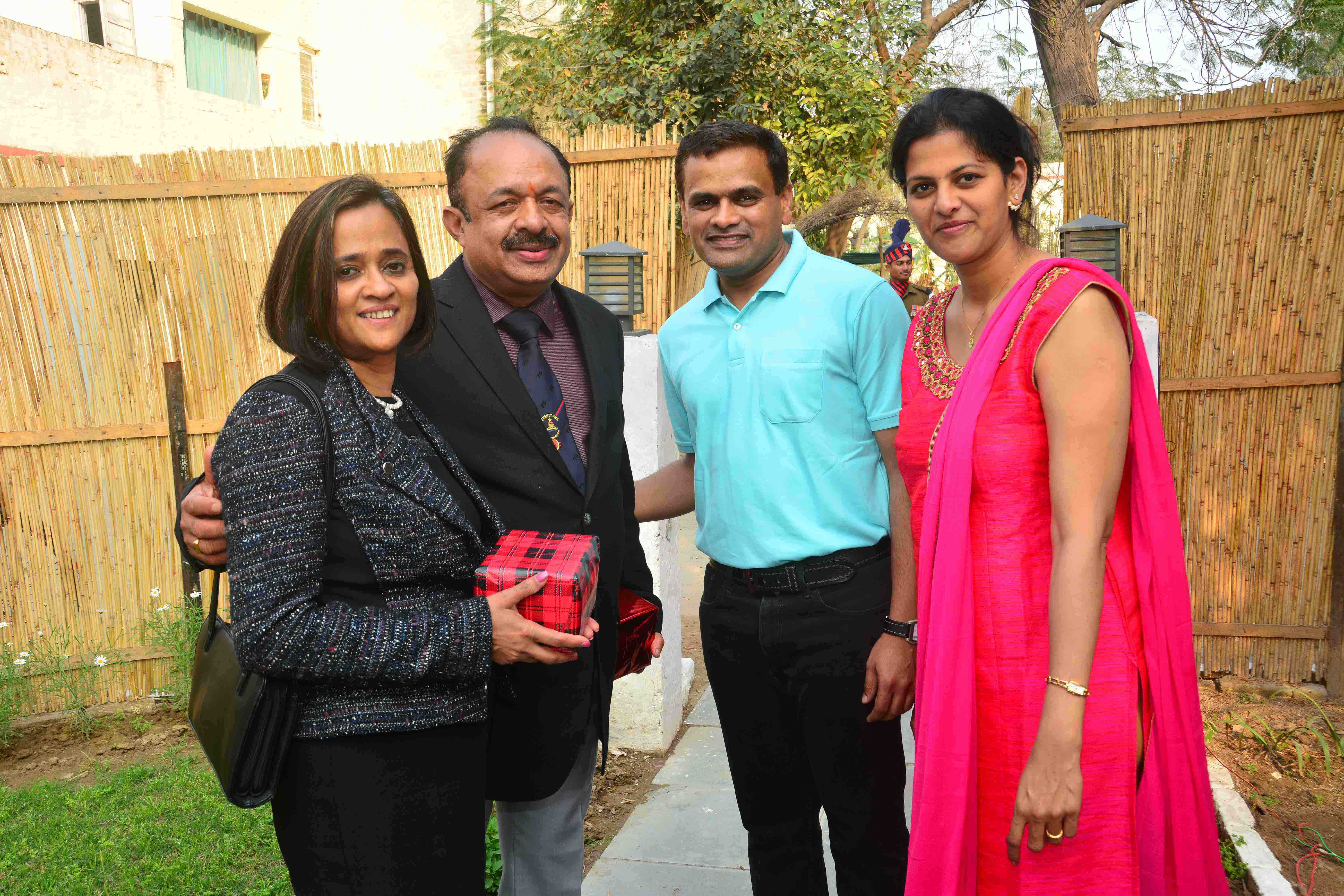
Veteran Colonel Joginder Singh, Mrs Kiranjit, Marina and I – we all travelled from Toronto, Canada to Faridkot, Punjab, India – to celebrate the Golden Jubilee of the raising of our regiment – 75 Medium Regiment (Basntar River). A reunion, is a gathering of people who have shared a past, and the joy of reuniting is to see the individuals with whom the past was shared. Here we were reuniting to share our past, the good old regimental days, with those brave officers and soldiers, who now carry the mantle, history and traditions.
Our Regiment was raised in 1966 at Delhi and was equipped with 130 mm Russian Guns. It had three batteries – one battery was of Brahmins (other than those from the Southern and Eastern States of India), the second had Jats and the third was manned by the soldiers from the four Southern States. By the turn of the century, the Regiment was reorganised with soldiers from all over India, from all castes and religions.
The Regiment was awarded Honour Title “BASANTAR RIVER” in recognition of outstanding contribution by all Officers and soldiers during the 1971 Indo-Pak War. The Regiment provided fire support for the most famous battle of Zafarwal in that the two Param Vir Chkra (Highest Gallantry Ward) winners – Second Lieutenant Arun Khetrapal of 17 Poona Horse and Major Hoshiar Singh of 3 Grenadiers – both were supported by the Regiment’s Observation Post (OP) Officers – Captain SC Sehgal and Captain Mohan Krishnan. Captain Sehgal was awarded Vir Chakra posthumously for his gallant actions and Capt Mohan Krishnan was awarded Mention-in-Despatches.
As we landed at New Delhi Railway Station – there was an impromptu get-together. We were met by Veteran Major General PK Ramachandran, Brigadier Madan Sheel Sharma, Veteran Colonel Ashok Arora and Veteran Colonel Ranjan Deb. We were received at Faridkot Railway Station with all the fanfare and were escorted to the Officers’ Mess
With the present team of officers of the Great Regiment – ably commanded by Colonel DR Jadhav – They made the event come alive and memorable. They surely left no stone unturned to make the event a grand success.
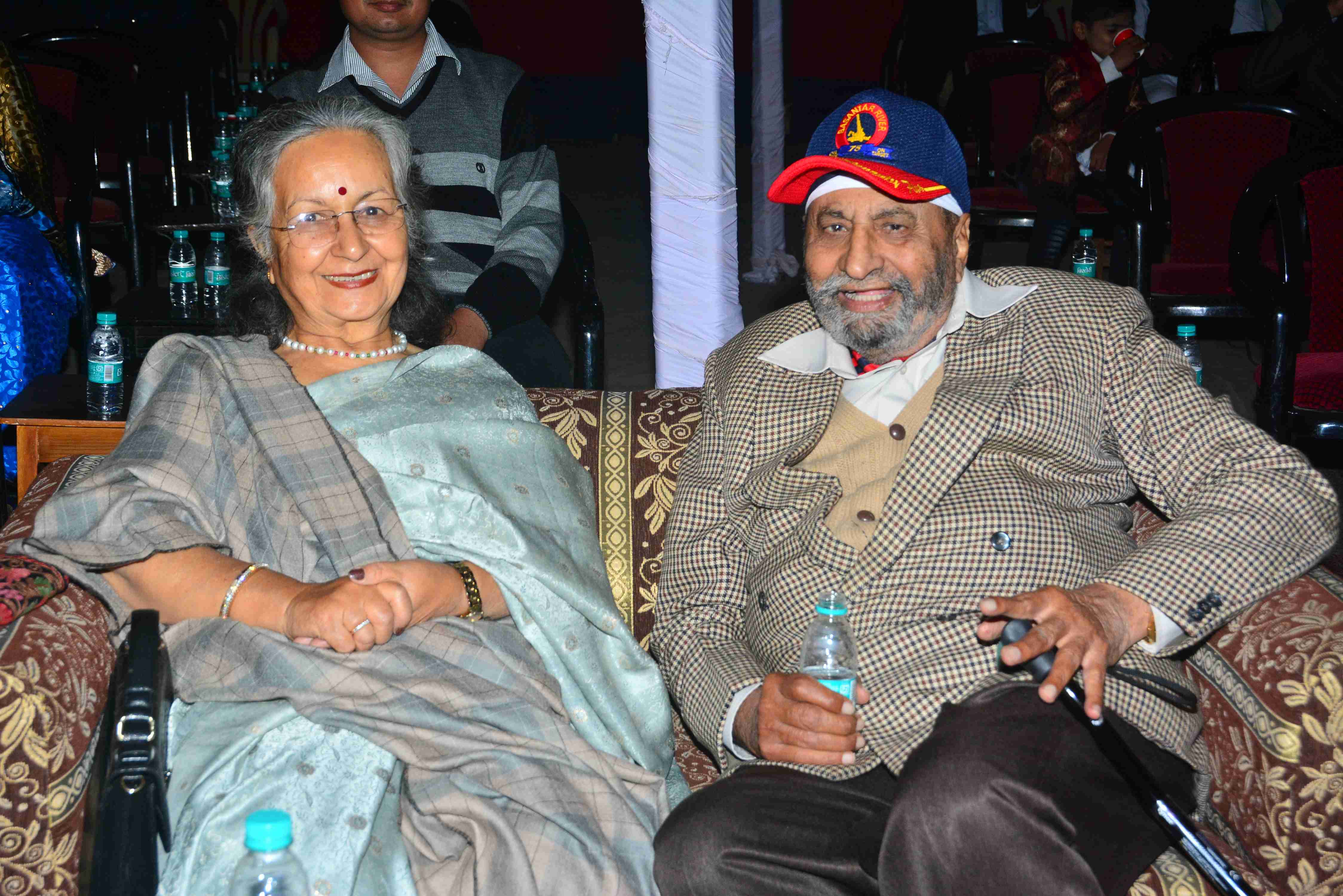
During lunch at the Officers’ Mess, we met Mrs Sneh Thadan, wife of Late Brigadier KN Thadani. Lieutenant Colonel Thadani commanded our Regiment during the 1971 Indo-Pak war and was awarded Vishisht Seva Medal for his exemplary leadership and planning. There was Veteran Brigadier MS Brar VSM, SM. He was the Battery Commander with Hudson Horse during Battle of Basantar River of the Indo-Pak conflict of 1971.
Veteran Brigadier AN Suryanarayanan – our Commanding Officer when I joined the Regiment in December 1982 – was there in his smart and erect posture with his signature mustache..
Veteran Colonel Mahaveer Singh – the Commanding Officer under whom I served the longest – 1983 to 1988 was at his cheerful best as expected.
The Stalwarts here – From Left – Veteran Brigadier JPS Ahluvalia (Commanding Officer 1990 -93), – Veteran Brigadier AK Sikka (first Battery Commander under whom I served), – Veteran Brigadier AN Suryanarayanan – Veteran Colonel Mahaveer Sing and – Veteran Brigadier Rajesh Kumar – Adjutant of our Regiment during Indo-Pak War of 1971
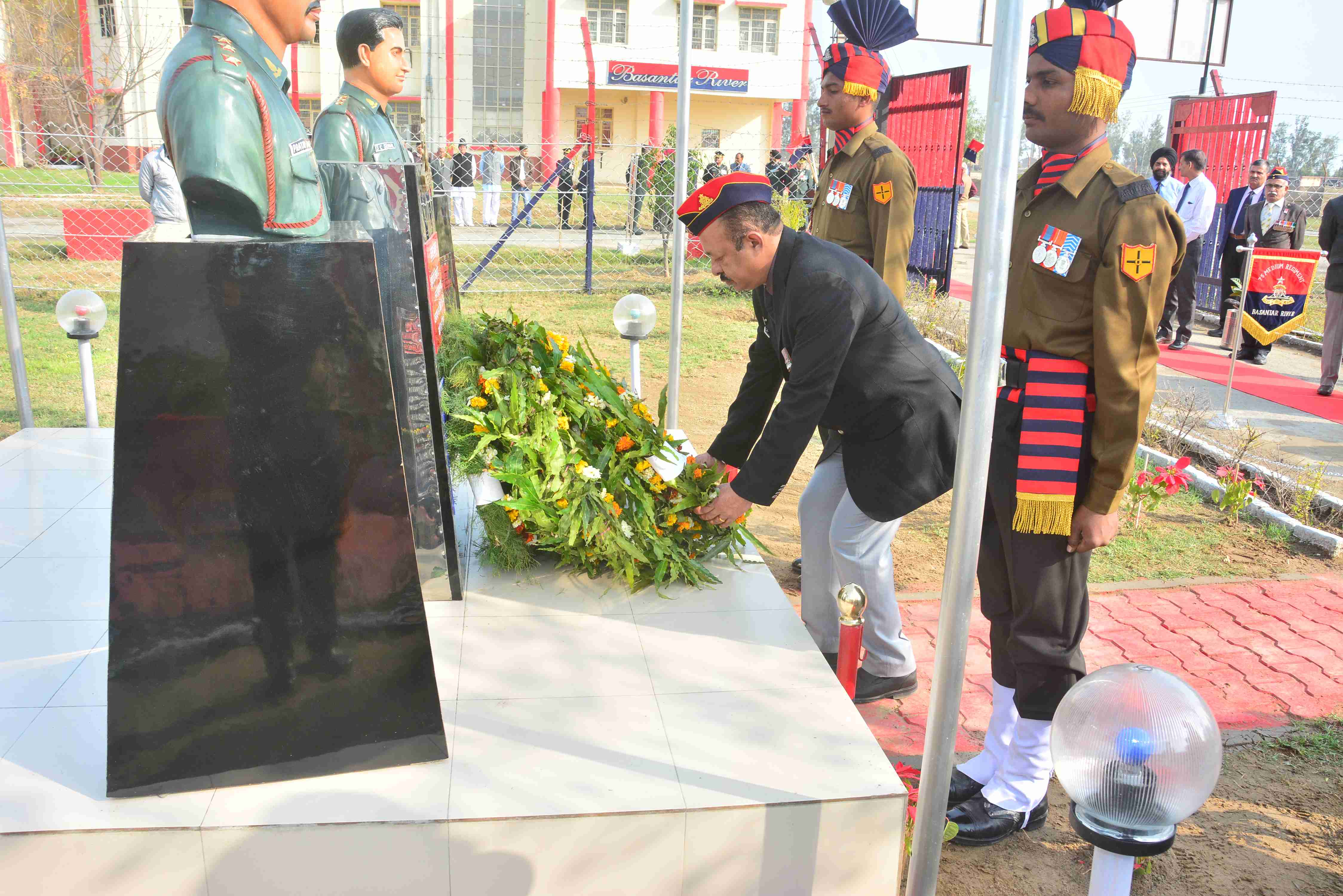
There was a Wreath Laying a wreath at the War Memorial of the Regiment, where all veterans and serving soldiers paid their respect to all those who laid down their lives, serving the motherland. The bust of Captain SC Sehgal, Vir Chakra and Captain Pratap Singh, Maha Vir Chakra aptly adorned the memorial.
Captain Pratap Singh and I served with the Regiment from 1984 to 1988. During his deployment in Siachin Glacier in 1988, Capt Pratap Singh was performing the duties of OP officer at Bana Post, the highest post in the glacier. On 26 May 1988 he volunteered to cut the ropes tied by the enemy to launch assault on Bana Post and hence prevented its capture. While he went on to accomplish this task, a booby trap laid by enemy exploded causing severe injuries, yet this brave officer, with cold courage and determination, completed his task before succumbing to injuries. For his outstanding, exemplary and gallant act in the best traditions of Indian Army he was awarded Maha Vir Chakra posthumously.
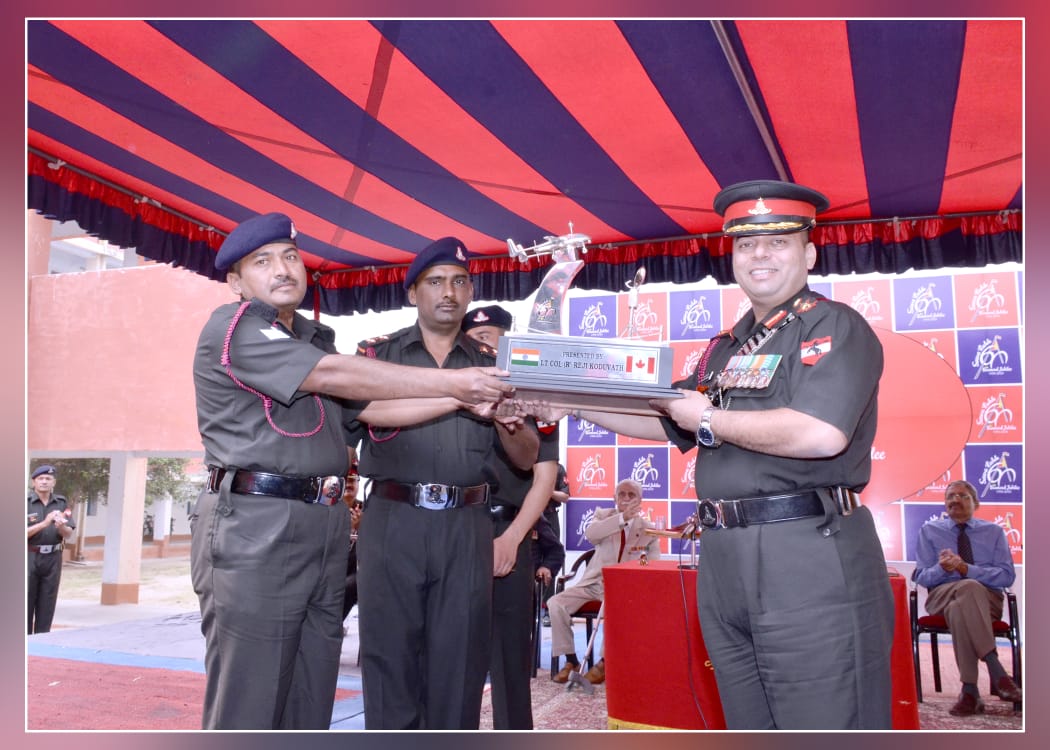
We presented a Silver Trophy to the Regiment on the occasion – replica of a Bofors Gun the Regiment is currently equipped with.
There were many occasions for us to interact with Veteran Soldiers who served under our command and it I had many a goose bumps as they recounted and reminisced various events, sports competitions, operations, etc.
I was lucky to meet and interact with Colonel PR Ravikumar and Colonel UV Rao – the smart Young Officers who served with me. Colonel Ravi commanded our Regiment and Colonel Rao is commanding a newly raised Medium Regiment.
During the Golden Jubilee party at the Officers’ Mess, Mrs Sneh Thadani cut the cake.
It was indeed a moment of pride for me as I sat down to sign the Visitors’ Book at the Officers Mess as the table on which I was signing had the photograph of Major General BK Guha, Colonel of Regiment. He was the Senior Subaltern when I joined the Regiment in December 1982.
As I bid goodbye to the Regiment, I spoke to Colonel Jadhav “The Regiment was good – that is why so many Veterans turned up; the Regiment is good – that is why you could put up such a great show; and the Regiment will surely remain good for the times to come.” , We all enjoyed every bit of the moments we shared and will ever be etched in our memory.
In 2014, Admiral William H. McRaven, the retired United States Navy Admiral who served as the ninth commander of the US Special Operations Command, delivered the commencement address at the University of Texas at Austin. His words that day resonated far beyond the graduating class: “If you make your bed every morning, you will have accomplished the first task of the day.“
For cadets at Sainik School, where I spent my formative years from nine to sixteen, the ‘making the bed’ ritual was precisely that – the first accomplishment of each morning. At the National Defence Academy (NDA), however, the first task evolved. Morning shave became the ritual that set the tone for the day ahead.
During early school years, facial hair was not a concern. Shaving was a weekly ritual accompanying the barber’s haircut. At NDA, shaving became mandatory for all cadets – a discipline that would continue through over two decades of service in the Indian Army.
A Winter Morning Lesson
One winter morning in the eighties, I was a young Lieutenant serving as Senior Subaltern of the Regiment. Word arrived that an important political leader had passed away, and the day was declared a holiday. I had already shaved and was changing into my PT whites. Stepping out of my room, I found all the other Lieutenants similarly dressed and ready for physical training.
“We have already shaved and put on our PT dress,” I said. “Let us go for a run. Once you have shaved early morning, holiday or not, it makes no difference.”
That morning run became more than exercise. It was a lesson in discipline that transcended circumstance – a reminder that self-respect and routine should not be dictated by calendar or convenience.
The Foundation of Soldierly Pride
In the Army, a uniformed service, discipline is judged partly by how a soldier wears prescribed dress, and partly by personal appearance. A well-groomed appearance is fundamental to military life, contributing to pride and esprit-de-corps. Every soldier must be self-disciplined and proud of belonging to a noble profession.
Commanders bear primary responsibility for ensuring that soldiers under their command present a smart, soldierly appearance – at all times, in or out of uniform, on or off duty. A properly shaved soldier, sporting a mustache if preferred, embodies that soldierly bearing.
The Origins of the Clean-Shaven Face
The tradition of clean-shaven soldiers traces back to Alexander the Great. Legend holds that he ordered his troops to shave so that enemy combatants could not grab them by their beards and throw them to the ground.
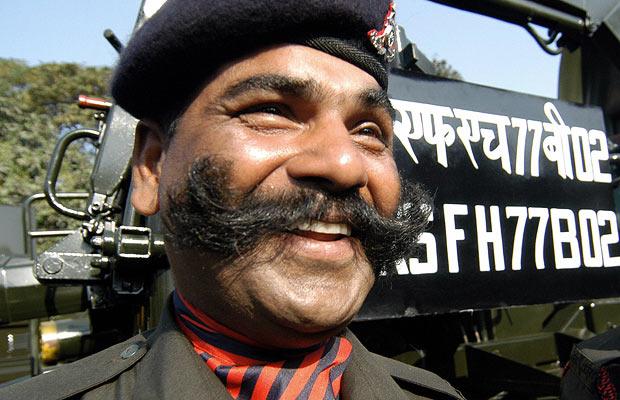
In the Indian Army today, soldiers are expected to be clean-shaven, with Sikhs as the exception, permitted to grow their beards as part of their religious practice. Mustaches, if worn, must remain above the upper lip.
Sir Douglas Haig with his army commanders and their chiefs of staff – World War I – (Image Courtesy Wikimedia)
British Military Tradition
Many of the Indian Army’s traditions and regulations derive from the British Army, whose orders regarding shaving date back to the eighteenth century. Until that time, British soldiers were clean-shaven and did not wear mustaches. Soldiers of the Hussar Cavalry Regiments adopted mustaches specifically to intimidate their enemies. The trend spread across the British Army, with the mustache serving as a distinguishing mark separating soldier from civilian.
Influence from Indian royalty and the Indian belief that mustaches signified manliness may also have played a role. By the late eighteenth century, mustaches had gained popularity among British civilians, as did sideburns.
The Great Mustache Revolt
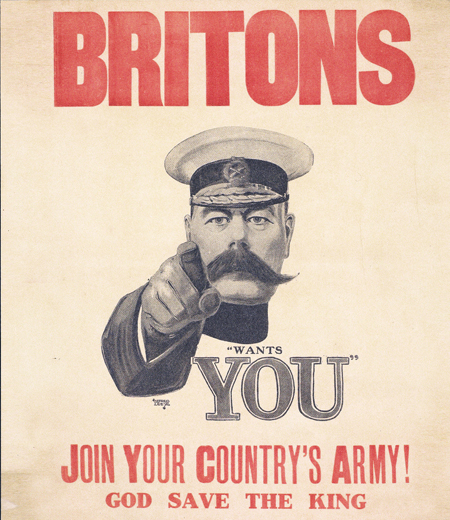
The iconic World War I poster featuring Lord Kitchener – sporting a formidable handlebar mustache – urging citizens to join the army remains an enduring image from that era
During World War I, Commonwealth soldiers found mustaches cumbersome to maintain while fighting trench warfare. Many soldiers and officers preferred to shave them off, leading to what amounted to a quiet revolt. Some soldiers faced court-martial for failing to comply with the mustache order.
In 1913, General Nevil Macready investigated the matter and submitted a report recommending that mustache orders be withdrawn. No action was taken. In 1915, King George reinforced the necessity of mustaches for soldiers. Macready resubmitted his recommendations in 1916, and on 8 October of that year, an order was finally passed abolishing the mandatory mustache requirement.
Debunking the Myth
It is a common myth that hair grows thicker and darker after shaving. Forensic anthropologist Mildred Trotter debunked this belief in 1928. She asked three college students to shave their legs, from ankle to knee, twice weekly for eight months. Using a microscope, she compared each student’s hair growth rate, colour, and thickness. Her conclusion: shaving had no impact on hair’s texture or growth.
Shaving Beyond the Military
Wrestlers are predominantly clean-shaven – Olympic rules require either a full beard or a clean-shaven face, as stubble can irritate an opponent’s skin. Swimmers often remove all body hair, believing that even minimal resistance can affect performance.
Among married Amish men, beards are worn with trimmed mustaches, substituting for wedding rings.
A Curious Footnote
For reasons still unclear, Parliament once dismissed the personal barber of Charles I of England. Famously slow to trust others, King Charles never shaved again – fearing that a new barber might attempt to kill him. History offers no evidence for the suspicion, but the king’s caution speaks to the intimate trust placed in those who hold a razor to one’s throat.
Conclusion
From Alexander’s battlefield strategy to trench warfare’s practical demands, from regimental discipline to personal pride, shaving has remained a constant thread in the fabric of military life. The morning ritual that began each day with a clean face taught lessons that extended far beyond grooming: self-discipline, attention to detail, and respect for oneself and one’s uniform. Admiral McRaven’s first task of the day may have been making the bed, but for generations of soldiers, the razor’s edge has served the same purpose – a small accomplishment that sets the stage for all that follows.
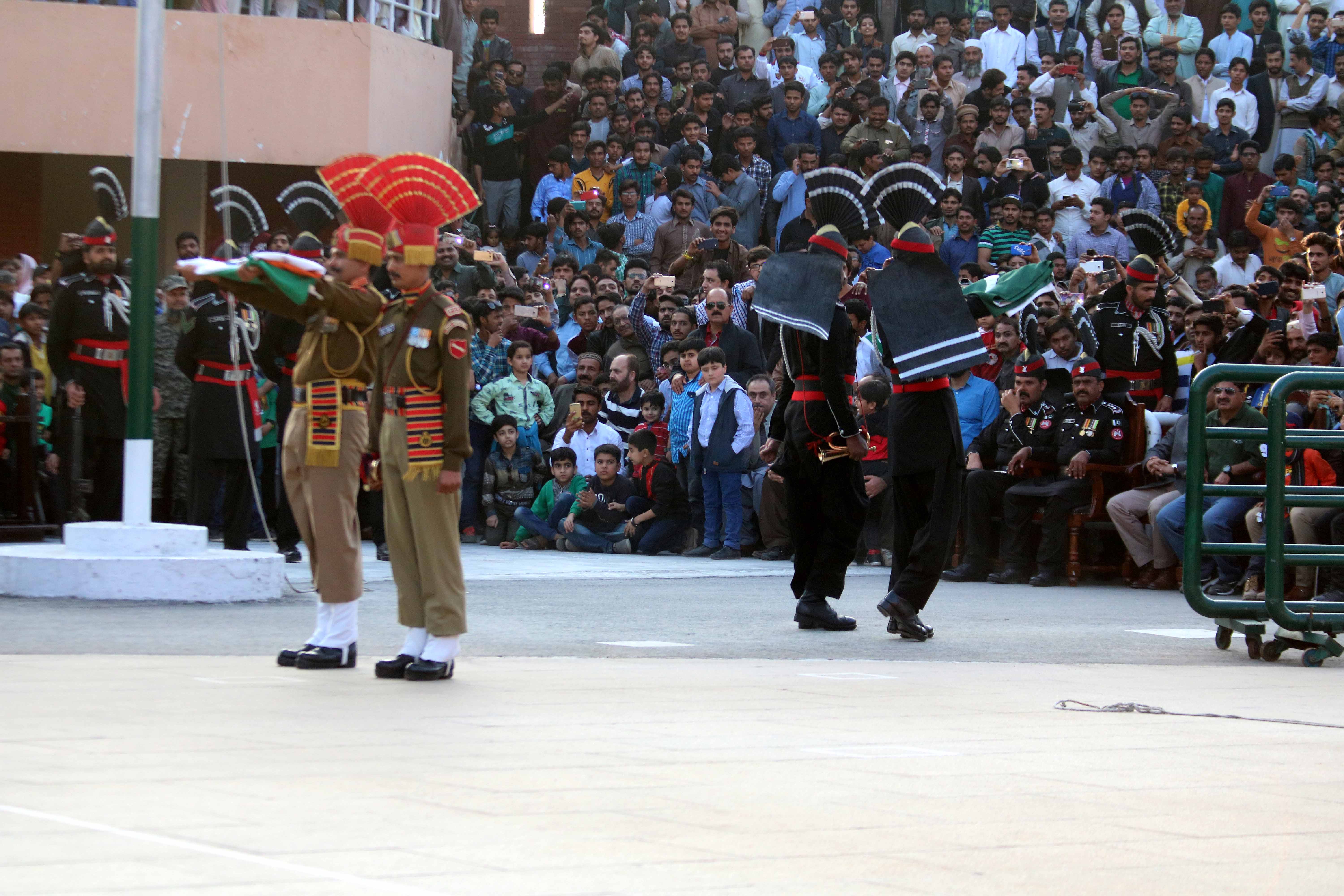
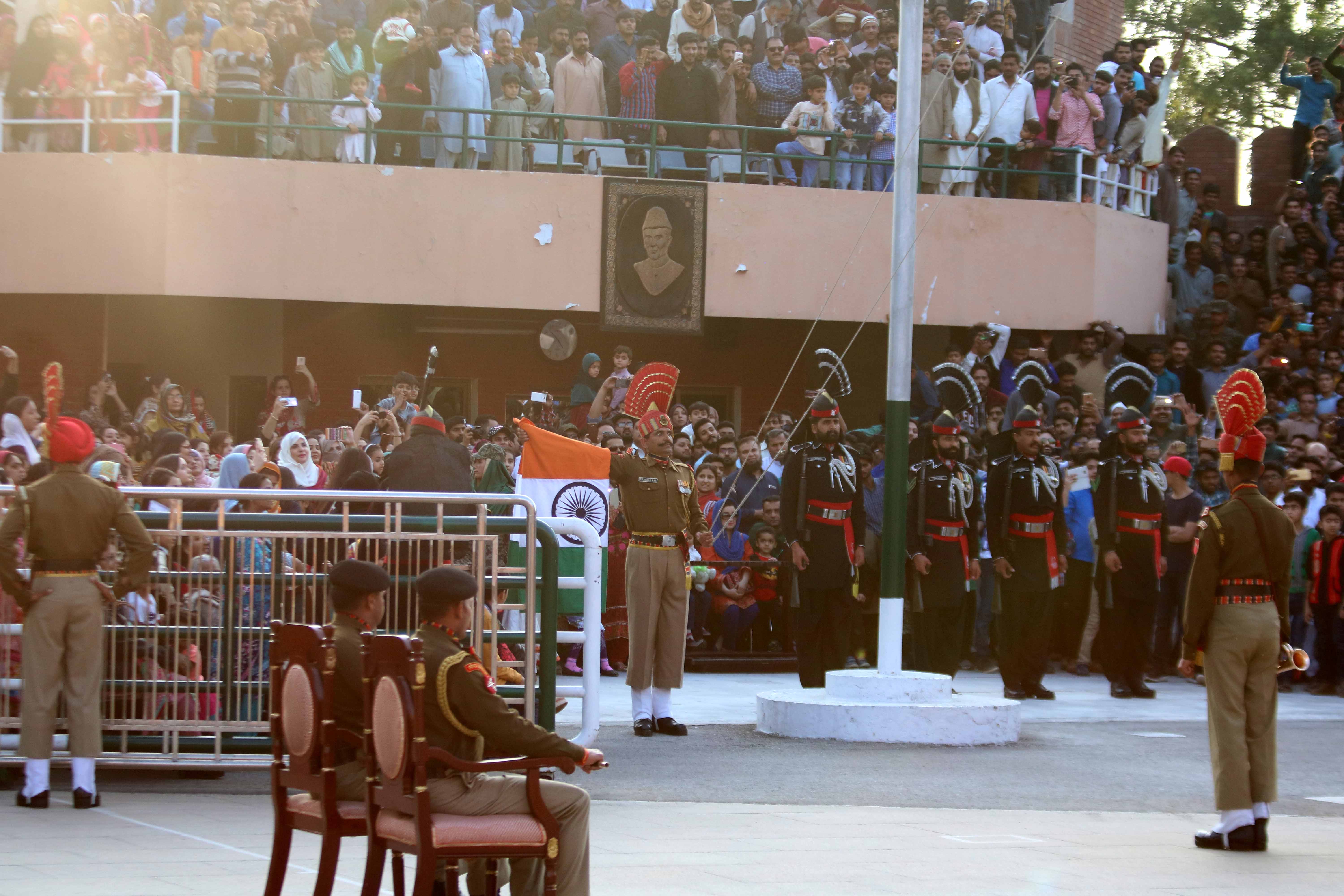
During our visit to India to attend the Golden Jubilee celebrations of raising of our regiment – 75 Medium Regiment (Basantar River) – we watched the Retreat Ceremony at Hussainiwala Border Post. Unlike most international borders, where no such daily ceremonies are held, retreat ceremonies are held on Indo-Pak border at dusk.
Canada and USA share the longest International Boundary in the world, which is mostly unmanned, except at crossing points. The border came into existence at the end of bitterly fought American Revolutionary War between Great Britain and the United States with the Treaty of Paris of 1783. In 1925, the International Boundary Commission came into being with the task of surveying and mapping the boundary, maintaining boundary pillars and buoys and keeping the boundary clear of bush and vegetation for six meters.
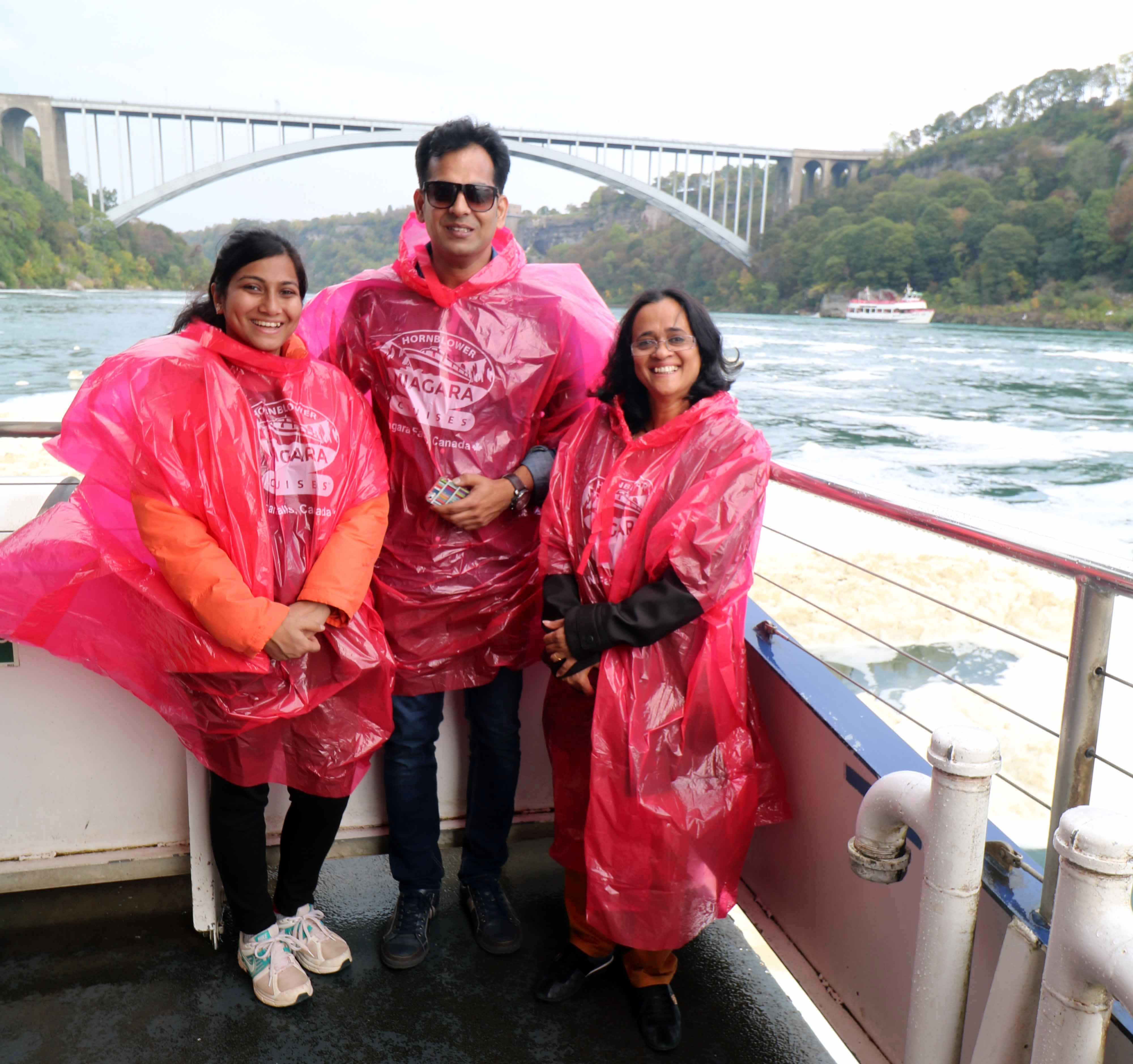
Ontario province has 14 road border crossings, one truck ferry, and four passenger ferries with the United States. The most popular crossing is the Rainbow Bridge (above) near Niagara Falls. This is a popular border crossing for pedestrians, however, trucks are not permitted to use this bridge. The boundary runs through the centre of this bridge. Surely, the two countries hardly ever hold any border ceremonies.
There are only three trading posts, Wagah (Punjab), Chakan da Bagh (Rajouri, Kashmir) and Kaman (Uri, Kashmir) on the Indo-Pak border through which people and goods move. Chakan da Bagh Post and Kaman Post is manned by Indian Army soldiers and they do not hold any ‘retreat’ ceremonies. However, they exchange sweets on important national and religious days.
A ‘retreat ceremony’ in military parlance signals the end of duty day and when the national flag is brought down. The band if present or the bugler will sound ‘retreat’. The lowering of the flag is coordinated with the playing of the music so the two are completed at the same time. It is a ritual in every military unit and often coincides with the change of guard for the night.
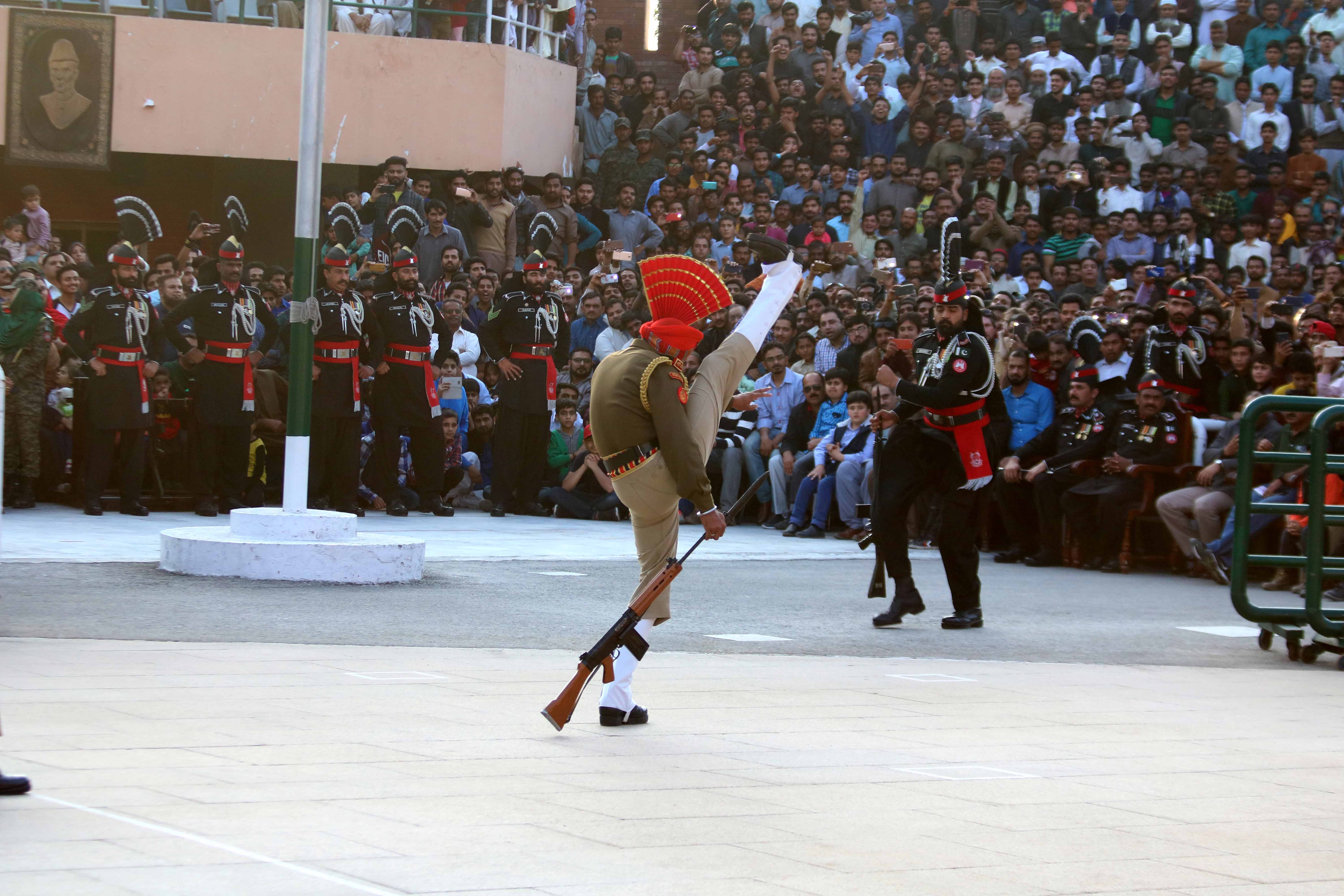
Retreat ceremonies are held on the Indo-Pak border in Punjab at Wagah (Amritsar), Hussainiwala (Firozepur and Sadiqi (Fazilka) by the Border Security Force (BSF) of India and Rangers of Pakistan. Neither the Indian Army nor the Pakistan Army is involved in this heavily choreographed flag-lowering ceremony. The drill movements are over exaggerated and at times is near ridiculous and mostly absurd. One would even wonder as to whether such ceremonies hold any value in modern civilised world. Whatever it may be, the ritual has endured through half a century despite many diplomatic upheavals, border skirmishes, economic warfare and mutual misunderstandings.
Hussainiwala Border served as the major road crossing between Indian and Pakistan till 1970. At that time, it acted as a trade route for truckers, mainly to import Kandahari Angoor (dehydrated grapes) as well as other fruits and food products from Pakistan and Afghanistan. The post was closed for trade in 1970 as tensions rose between India and Pakistan. The retreat ceremony commenced in 1972 after the Indo-Pak War.
We were all seated in the Amphitheatre to witness the ceremony. On the Indian side there was no segregation of. men and women. The only concern was the glare of the setting sun as we faced Westwards.
On the Pakistan side, there were separate enclosures for men and women. The only commonality was most women and men including the Rangers – all wore Salwar Kameez.
As the seats were getting filled up, the audio systems from both sides begun belching out ‘patriotic’ songs with as much volume they could muster. At the auspicious time of 5 PM, the soldiers from both sides ‘enacted’ their choreographed drills.
They marched ‘Goose Stepping’, throwing their legs as high as they could. This was a form of extreme marching held by German, Prussian, and Russian military to be an ultimate display of the unbreakable will and discipline of its soldiers. Most modern armies have done away with this ‘fascist’ approach to marching as being extreme. Only a few countries use it as a powerful display of military discipline.
Foot drill is a fundamental activity of the military and is practised regularly during initial military training. Foot drill involves marching with an exaggerated heel strike, and regimented manoeuvres performed while marching and standing characterised by an exaggerated stamping of one foot into the ground.
The soldiers were wearing leather soled boots with heavy metal attached to them. It made ‘metallic’ sound when they came in contact with the concrete floor every time the a soldier stamped his foot, that too much higher than needed.
The soldiers from both the sides pose showing their aggression and fearlessness. They widen their chests, twirl their mustaches, thrust open their eyeballs, and what not – all to invite applause and cheers from the audience on either side.
After enacting all these choreographed caricature of a drill, soldiers cross the white line to come to the other country and form a beautiful cross X with the flag threads. Both the flags are held together at the junction and then are brought down at speed and folded neatly. Throughout the ceremony sloganeering and clapping many a times reached frenzied levels. The only saving grace during the entire routine was the exchanges of sly smiles between the soldiers of both nations.
The question here is as whether we need such exaggerated drills to incite national passion and fervour among the citizens? How long can a country sustain such a fervour? What about the soldiers who are enacting this routine? Have you considered the unwanted physical and mental stress they undergo?
High levels of bone strain caused by such exaggerated drills will surely result in stress fracture. It may also cause micro-damage to bones. Digging down of heels, especially with the foot raised over the head may cause severe strain to the neck and spine and also brain damage. These soldiers may also end up with joint pains, migraine and headaches
During our visit to India to attend the Golden Jubilee celebrations of raising of our regiment – 75 Medium Regiment (Basantar River) – we watched the Retreat Ceremony at Hussainiwala Border Post.
Railway line connecting Peshawar to Mumbai was built in 1885, passing through Hussianiwala. During the Pre-Partition days, Punjab Mail connected the cities of Mumbai, Delhi, Ferozepur, Lahore and Peshawar. In those days, most British troops and businessmen arrived at Mumbai and made their way to their destinations in the North-West Frontier Province by train. The train track from Ferozepur to Hussainiwala was an engineering fete, with Qaiser-e-Hind bridge, which stood over several round pillars (all of them intact even today, as depicted in the image above).
When Pakistan was carved out of British India, the border was drawn along the Sutlej River in Punjab and it passed through Hussainiwala Village. Now, Sutlej River has changed its course over the years, running further East in Indian territory. This made Hussainiwala an enclave into Pakistan, with the Sutlej River behind it.
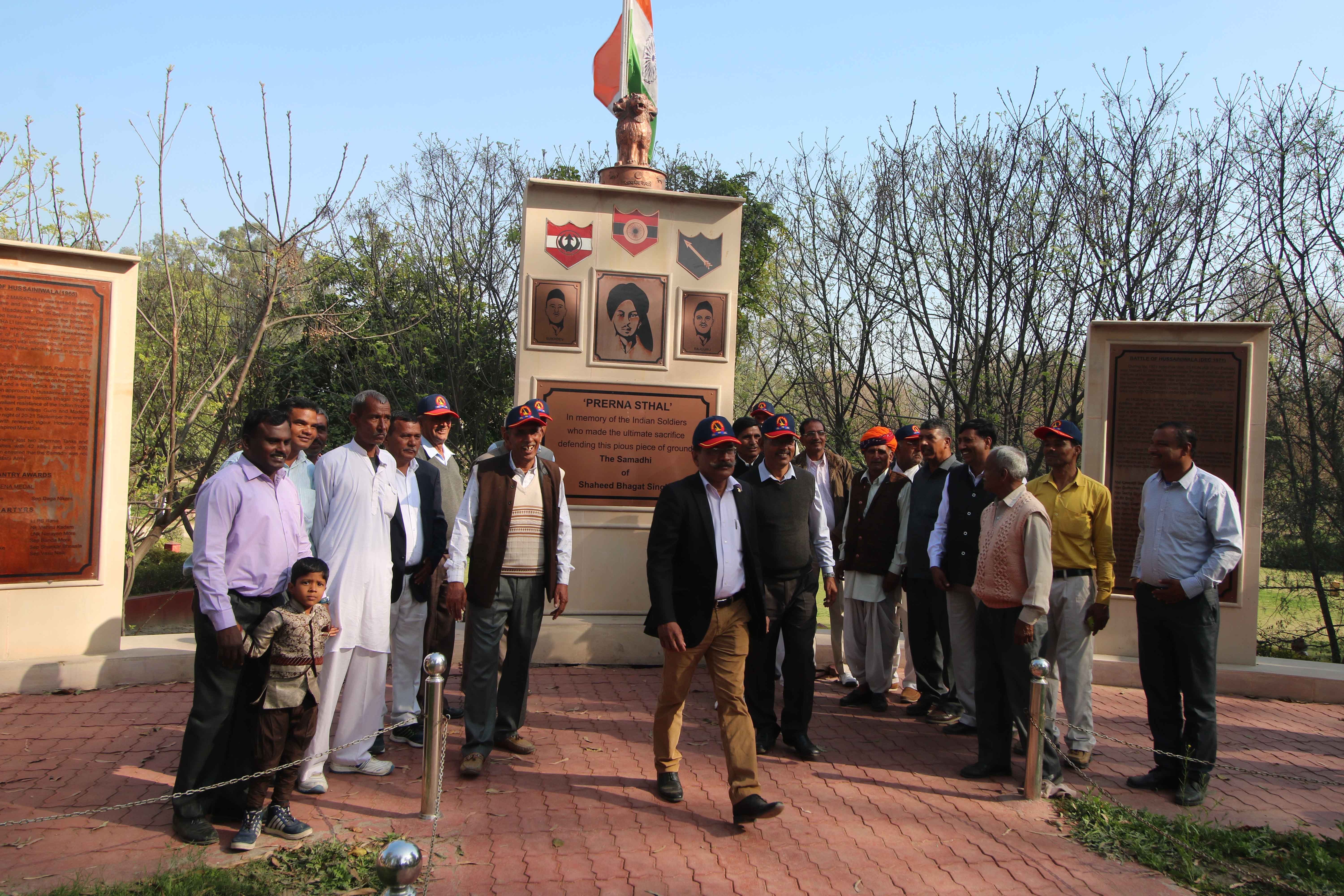
Hussainiwala is named after a Muslim Peer (Saint), Hussaini Baba, whose shrine is located at the entrance to the Border Post. This small hamlet came into prominence on the evening of 23 March 1931 when British soldiers tried to cremate the bodies of three young Indian freedom fighters – Bhagat Singh, Sukhdev and Raj Guru – who were hanged at the Lahore Central Jail. The hanging, scheduled for 24 March was rescheduled a day earlier as the British feared a revolt in Lahore as the situation had become very tense. They secretly transported their bodies to Hussainiwala and while cremating them on the banks of the Sutlej, the locals got wind of it. They assembled near the cremation site. Fearing repercussions, British soldiers fled the scene, leaving behind the dead bodies which were cremated by the villagers. This site today is a memorial – aptly called ‘Prerana Sthal‘ (Motivation Site).
Later Bhagat Singh’s mother, Vidyawati, and freedom fighter BK Dutt were cremated at this site as per their wishes. The cremation site is called ‘Shaheedi Sthal’ (Martyrs’ Place). This is where Indians from all over the country make an annual pilgrimage to honour the martyrs on March 23 as they observe ‘Shaheedi Diwas’ (Martyrs’ Day).
(Defences on the Indian side on Bund (wall) with a bunker as inset)
This enclave has witnessed three bloody battles between India and Pakistan, with the very first one fought on 18 March 1956. At that time, heavy floods had damaged Bela Bund and Sulaimanki Headworks at Hussainiwala and as the Indian engineers were repairing the damage, Pakistan Army launched an unprovoked attack at 9 PM. 4 JAK RIF was guarding the bund, and they fought gallantly causing heavy causalities on the enemy. This resulted in a hasty withdrawal by the attackers.
During partition of British India in 1947, Hussainiwala, an enclave of 12 villages went to Pakistan. The railway line no more had trains running through Hussainiwala. The railway station at Hussainiwala as it exists today is depicted in the image above. Now Punjab Mail connects Mumbai to Ferozepur via Delhi. Pakistan destroyed Qaisere- Hind Bridge leaving behind the round pillars across the river. The Shaheedi Sthal was in a dilapidated state without any maintenance. In 1961, Jawaharlal Nehru, then Prime Minister, brokered an exchange deal and Hussainiwala came to India while Sulaimanki Headworks – from where three major canals which supply irrigation water to a large area in Pakistan Punjab originate – went to Pakistan. India immediately restored Shaheedi Sthal to its due dignity and reverence.
During Indo-Pakistan War of 1965, 2 Maratha Light Infantry (Kali Panchwin) was deployed to defend Hussainiwala. The battalion fought valiantly to thwart a frontal attack resulting in two enemy tanks destroyed and two captured, with several enemy killed. The Commanding Officer Lieutenant Colonel Nolan was killed in enemy artillery shelling. The unit ensured that the Samadhi of Bhagat Singh was not desecrated by Pakistan Army. The battalion was visited by then Prime Minister Lal Bahadur Shastri, Defence Minister YB Chavan, Congress Party President K Kamraj, the Chief of Army Staff and other senior officers. Kali Panchwin was awarded the battle honour ‘Hussainiwala’ for its role in the 1965 War. The citizens of Firozpur, in honour of the Battalion’s contribution in defending the bridge and Firozpur town, presented a silver replica of the Hussaniwala Bridge.
During the 1971 War, it was 15 PUNJAB defending Hussainiwala enclave and the Memorial. On 03 December, Pakistan Army launched a heavy attack. The valiant Punjabis withstood the attack gallantly despite suffering heavy casualties until withdrawing on 04 December night.
Did the three freedom fighters, who laid down their lives for Indian independence in their wildest dreams ever visualise that post independence, there would be a partition on religious lines and it would all end up in three bloody wars at the very same site their ‘Samadhi’ stood?
Great experiences make military life marvelous – even for the family members of soldiers. It lasts a long time, much after we hang our boots and even after we migrate to another continent.
Marina emigrated to Canada in March 2002 and I took over command of the Surveillance and Target Acquisition (SATA) Battery in June 2002. For someone who served his entire regimental life in a Medium Regiment operating Bofors guns to suddenly land in a Surveillance Regiment equipped with radars, drones and survey gadgets – it was an altogether different experience. I had to learn everything from scratch and had to familiarise with the officers and soldiers.
The regiment was an excellent outfit. I set off with training on various surveillance equipment, starting with radars. I had to convert from a Medium Gunner to a Surveillance Gunner. The officers and soldiers helped me to imbibe both the art and the science of surveillance, many a times explaining the procedures and drills repeatedly. I read all the operator and training manuals of all equipment and in two weeks time, I was proficient enough to handle them.
(With Santosh the evening I hung my boots in July 2004)
My Radio Operator Santosh Kodag a Maratha, took charge of the household, but was surprised that my family had not come along. Commanding Officer living alone in a fabulous peace station like Devlali – Santosh realised something was wrong.
Devlali is one of the most relaxed military stations located near Nasik city – about 150 km from Mumbai. It has a colonial charm and is clean with fresh air and lots of greenery and open spaces. The climate is fabulous all through the year. The schools in the area are well known for their educational standard. The Cantonment offers all recreational facilities like horse riding, swimming, squash, tennis, golf, club, etc – all that goes with a good military station. The School of Artillery is located here where all Gunner officers are trained. Hence, it is always abuzz with Young Officers and also newly married young couples.
A week after landing in Devlali and when Santosh felt that I was well settled, one evening, handing over a glass of whisky to me said “I know your wife is away in Canada and your children are in Kerala. Why don’t you get the children here?“
“Our daughter is in Grade 4 and our son in LKG. I will not get adequate time to take care of them. My mother is taking care of them well in Kerala,” I replied.
To this Santhosh said “Why don’t you get your mother and your kids here. I will take care of everything. I know your mother is pretty old. You do not have to worry.”
I thought for a while and then called up my mother about my plans to shift her and children to Devlali. She said “I was also thinking about it. My duty is to take care of the children and it would always be better that you are around.“
I booked the tickets for my mother and children to travel to Devlali and Santosh went to Kottayam, Kerala to accompany them.
Santosh now took over everything – handing over the medications to my mother and also taking her for her regular medical appointments with the Military Hospital – getting our son Nikhil ready for school (Nidhi was independent by then)- serving breakfast for all, packing up lunch boxes, etc.
After two years, I relinquished command and also hung up my boots and migrated to Canada.
Now Santosh is married with two kids, serving in the regiment as a Havildar (Sergeant). Every year when we visit India, we send a parcel of gifts for him, his wife and children.
February 2018, we travelled to India to attend the Golden Jubilee celebrations of my parent unit – 75 Medium Regiment. The SATA Regiment deputed Havildar Santosh to receive us and accompany us to the Medium Regiment.
Marina was busy shopping for gifts for Santosh and his family. Marina had met Santosh only twice – when we traveled to India – and she has been ever thankful to him for taking care of the children in her absence.
I recently asked Nikhil as to whether he remembered anything of Devlali days and he said “The only person I remember is Santosh Bhaiyya – the poor guy, I gave him a difficult time – especially when he tried to feed me and get me ready for school.“
On 01 November 2018, our SATA Regiment celebrated its Diamond Jubilee. We could not travel to India for the occasion as our daughter Nidhi was expecting our grandson’s birth. I got a silver trophy made for the occasion and it was presented to our Regiment on my behalf by Havildar Santosh.
Wind can blow either way in the Indian Army. A soldier can soothe the pains of his Commanding Officer too.
Field Marshal Helmuth von Moltke the Elder of Prussia, who considered himself a disciple of Clausewitz, was posted to command a cadet school in Frankfurt called Kadettenschule. He is credited as the father of the modern concept of war games, which he adapted from chess.
Moltke was known for his dependence on decentralised style of command in the army termed ‘Auftragstaktik‘. In this concept, the junior officers were required to take crucial decisions and that necessitated a drastic change in officer training. He was of the opinion that in the war front, rapidly changing scenarios will surely make a senior commander’s decision obsolete in no time. Here, the subordinates have to take independent decisions as the situation evolved. It may sometimes result in defiance of orders, without impeding discipline.
Moltke ensured that ragging was stamped out in Kadettenschule and he stressed on the cadet’s achieving self-confidence and independent thinking. He had a promotion policy in place where he rewarded junior cadets excelling with promotions where they could overtake their seniors. The instructors were specially selected and trained to motivate and train the cadets and with their exemplary conduct could wipe out ragging. This resulted in cadets turning into officers who were decisive.
The need for ‘ragging’ in cadets‘ training is to break the cadet’s ‘individuality’ and make him ‘fall in line‘. This has in fact resulted in inability of junior commanders at various levels to act as the situation demanded, based on their judgements. What we need to do at our Academies is to encourage youngsters to speak up against cheating, stealing, etc; but the toughening aspects, including group ragadas (punishments) strengthen one mentally and physically. What we need to do is to adapt and reinvent to empower the cadets with better all-round knowledge.
Army courses conducted at various schools only teach a standard baseline aspect. In most cases, there is hardly any real soldier involved, which means only the science of warfare and military leadership is taught, but never the art. The courses are structured around ‘What to think’ than ‘How to think‘. All training must be to create critically thinking junior commanders with ability to think and execute plans well ‘outside the box’. Promoting adventure activities to be taken up by young officers in their fields of interest, unsupervised and un-assessed, duly supported by the army, will surely develop self-confidence and independence of judgment among junior leaders.
Here is a story- purely a figment of imagination – I told our officers to analyse various levels of training- regarding planning a raid by a section to capture two hidden militants – each officer to work out their individual solutions. The first group is of 10 young officers, fresh out of the academy, then 10 Junior Command (JC) Course qualified officers – Captains with about six to nine years of service, followed by 10 Staff College qualified officers – Majors with 10 to 12 years of service. Ten young officers will come out with about eight solutions, but the staff work would not be complete, out of which seven will work and one may fail. Ten JC officers will come out with five solutions, the staff work may not be all that good, of which three will work, one may work and one likely to fail. The 10 Staff college officers will all come out with one or two solutions, complete with all staff work, and the likelihood of success, you can guess. That is what the structured training (with pinks) has resulted into.
A friend asked me to suggest methodology to make the training at Staff College creative. I suggested that for one exercise, provide just a map with minimum guidelines on force levels and resources. Let the students mark the International Boundary, deploy troops including the enemy, assume additional resources, etc and come out with a complete package. Run one exercise found suitable for a group. Idea was well received and was presented to the faculty and for the most unthinkable reason, it was thrown out. One senior officer asked only one question – “How will we assess the students?” It appears that the essence of all Army courses is to assess and neither to teach nor to learn.
Coming to the physical training, the current one is archaic. All cadets want to put in their best in physical training and want to pass all the tests as early as possible. No two cadets are alike, and some will lag behind. The aim of the instructors must be to motivate them and not belittle or humiliate them, especially in front of their peers and they will surely achieve the desired results in most cases.
Modern sports medicine has developed much beyond, and the nation has adequately trained doctors in this field. In the Academies, it tends to be an overdose of unscientific physical training. The Army Physical Training Corps (APTC) has to get more Sports Medicine trained Doctors. The Physical Training Officer at the Academies got to be Sports Medicine trained.
Cadets’ training at the Academies and Officers’ training in the Army, both in the Regiments and during various courses need to be scientifically analysed, mainly to impart application-oriented education, develop decisiveness and remove ‘over standardisation.’
As per the US Department of Defense (2013) Dictionary of Military Terms, Power Projection is a term used to refer to the capacity of a state to apply all or some of its elements of national power – political, economic, informational, or military – to rapidly and effectively deploy and sustain forces in and from dispersed locations to respond to crises, to contribute to deterrence, and to enhance regional stability.
Projection of Hard Military Power paid dividends up to the end of old War era. With the breakup of USSR and change in the world order, even the US military was not successful in projecting Hard Military Power as was seen in Somalia, Afghanistan, Syria and Iraq.
Soft Power Projection can be defined as ability of a state to project its influence other than through military combat into an area that may serve as an effective diplomatic lever, influencing the decision-making process and acting as a potential deterrent on other states’ behavior. Deployment of various countries’ militaries during the humanitarian response to the 2004 Indian Ocean Tsunami is one of the best examples.
Hard Power facilitates India’s use of military, economic and political means to influence other States; Soft Power has, through our cultural or ideological means, the ability to indirectly influence the behaviour of other States. ‘Soft Power’ also enables us to distinguish the subtle effects of our culture, values, societal ideas, developmental assistance programs and other forms of influence on the behaviour of other States, from the more direct coercive measures such as, military action or economic incentives or sanctions. A potent form of soft power is ‘intellectual power’, which entails ‘the knowledge and insight of the populace and their leaders’. The strength of India’s soft power has been the power of assimilation. India’s unique ability to embrace different cultures and the philosophy of tolerance and peaceful co-existence continues to be a source of strength for our Nation and a shining example to the world community. Smart Power would be our evaluative ability to combine Hard and Soft Power resources into effective strategies. The Indian Armed Forces have been in the lead in projecting the nation’s Hard Power the soft way. The political leadership, bureaucracy and media have not played up these achievements many a times, resulting in the soft power projection not achieving its full potential.
Humanitarian Aid. Indian Armed Forces have an enviable track record in providing humanitarian aid whenever needed, within the country and also in the neighbouring countries, especially in the aftermath of a natural disaster. In many cases, the armed forces moved its troops and resources, without awaiting a formal request from the civil administration or from the higher headquarters. In the aftermath of the Tsunami that hit the Indian Ocean countries including India, the Indian Armed Forces provided assistance to Sri Lanka and Maldives and was able to reach out to Indonesia as well. India provided humanitarian aid in the aftermath of earthquake that devastated Pakistan Occupied Kashmir in 2005 providing relief materials of medicines, blankets, and food packets. When a severe-cyclonic storm, Nargis, struck Myanmar in 2008, the Indian Air Force and Navy transported more than 100 tonnes of relief material. The 2015 Nepal saw the Indian Army and Air Force commence relief operations on the first day itself, which was scaled up in the subsequent days.
Non-Combatant Evacuation Operations. The Indian Air Force has come out with flying colours in the evacuation of Indian citizens and people from other countries from a third country when they were endangered by war or civil unrest (Operation Rahat in April 2015, Yemen). During the evacuation operations during the Yemen crisis of 2015, the Indian Air Force took a lead in rescuing Indian citizens as well as foreigners trapped in Yemen, evacuating more than 550 foreigners from 32 countries, including a dozen Americans and three Pakistanis. The 1990 airlift of Indians from Kuwait post Iraqi Invasion of Kuwait by Air India, the national carrier, with support of the Indian Air Force finds a place in the Guinness Book of World Records for the most people evacuated by a civil airliner. They evacuated 175,000 people. This stands out as a prime example of the nation’s Hard Power, projected the soft way in a foreign land. The Indian Armed Forces repeated this act in Iraq (2003), Lebanon (2006) which included Sri Lankan and Nepalese nationals, Libya (2011), Nepal (after the 2015 earthquake- Indian and foreign nationals) and South Sudan (2016).
United Nations (UN) Peacekeeping. A state that wants to project itself in the international arena as a major power needs to have strong presence in UN Peacekeeping efforts. Indian Armed Forces have had a fair share in the UN’s commitments and always accredited themselves with their great deeds. India is the largest cumulative troop contributor, having provided almost 200,000 troops in nearly 50 of the 71 UN peacekeeping missions over the past six decades. India, with its demand for a permanent seat on the UN Security Council (UNSC), has to prove to the world through its Peacekeeping that our demand is fully justified. Such actions will surely ensure that India projects its hard military power the soft way, resulting in the nation having a greater say in international decision-making process.
Securing Sea Lanes of Communication (SLOC). For India, a peninsular state with a coastline of about 7500 km and with Lakshadweep and Andaman & Nicobar Islands, it is imperative to have a powerful navy. The Indian Navy is a three-dimensional force, capable of operating above, on and underwater, ensuring the safety and security of the Eastern sea board and its assets and India’s Exclusive Economic Zone (EEZ). The oceans in Indian Navy’s area of influence has witnessed an increase in maritime terrorism and piracy coupled with illegal narcotic trade, unregulated fishing, dumping of pollutants and natural disasters. Also, there must have been many SOS calls made by the ships and fishing boats.
In order to project hard naval power the soft way, the Indian Navy along with the Coast Guard should possess sufficient resources to mount round-the-clock, all-year-around maritime surveillance in the SLOC. Indian Navy has been an active part of the anti-piracy ops in the Gulf of Aden and in the Arabian Sea. There are quite a few success stories of interceptions by the Indian Navy, but they have not received adequate global publicity. The Navy and the Coast Guard got to be well equipped to respond to the distress calls of ships and got to pursue cases of illegal and unregulated fishing. They got to be vigilant enough to prevent illegal dumping of pollutants in the oceans around us.
Developmental Activities. The Indian Military has proved time and again that it can take up any task that cannot be executed by their civilian counterparts. Run-up to the Commonwealth Games in Delhi in 2010, it took seven years for a company to build a Foot Over Bridge (FOB) near the Jawaharlal Nehru Stadium, which then collapsed. The Indian Army, which was called in to salvage Delhi’s pride executed the same job in four days flat and at a fraction of the original cost. In the aftermath of the tragedy where 23 people were killed in a stampede on a bridge at Mumbai’s Elphinstone railway station, the government has turned to the army for a new bridge. This will help in projecting the Hard Power of the Indian Military in a soft way.
Parades and Pageants. The Republic Day Parade at Delhi is the best example for projecting the nation’s Hard Power the soft way. It is the culmination of synergy between all the departments of Indian Government and is telecast worldwide as a great show. There is a need to encourage military formations in other cities and towns to facilitate the general public to view such parades/ pageants and also telecast them for wider viewership.
Military Facilities. Most American airports have ‘Military Lounges’ and the signage for the same is placed everywhere in the airport. The airlines board the serving soldiers even prior to the Business class passengers. This surely projects the power of the American Military, especially to the travellers from other countries. Many Indian railway stations have ‘Movement Control Office (MCO)’ for the military with a lounge, but is not signaged so. Leave alone foreign travellers, even the Indian travellers are unaware of such facilities. By doing so, it is sure to project the Hard Power.
Home Coming Videos. The internet and social media is filled with ‘Home Coming’ videos of American soldiers. Indian soldiers also do ‘Come Home’, but there are hardly any clips on the internet. The same can be orchestrated well by incorporating various videographers available in Indian towns and villages and compensating them well for the clips they provide. Many would even execute the task without charging as most Indians are devout patriots who hold their Defence Forces in high esteem.
Recognition to Soldiers, Martyrs and Veterans. In Canada, almost every city and town has war memorials and museums. During the innings break of baseball games, the two team captains present a signed shirt of their teams to veterans and serving soldiers. During the cricket matches in India, a similar act will pay rich dividends in projecting Hard Military Power.
Military History. India has had a chequered and colourful military history, but the reality is that many Indians are unaware of it, forget about projecting it to the world. Many European countries celebrate and recognise the service of the Indian soldiers during the World Wars in grand scale, but there is hardly any such celebrations in India. This year for the Armed Forces Flag Day (07 December 2018) was observed throughout the country to honour the martyrs, veterans and the men in uniform. The media came out with clips of the political leadership urging everyone to wear the Flag on the day, but the political leadership did not wear the Flag as seen from various news clips.
In Canada, during the week prior to the Remembrance Day (11 November), almost everyone appearing on the media are seen wearing the Red Poppy.
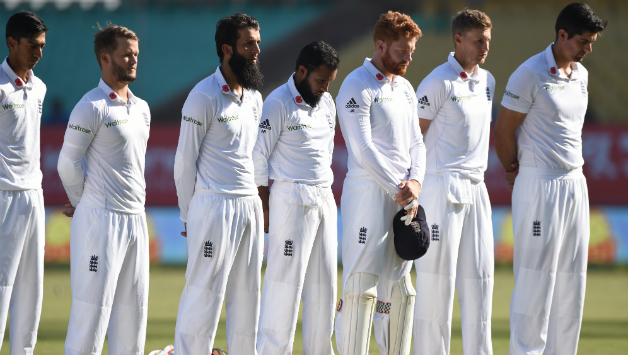
The English Cricket Team that played a test match at Rajkot (November 9-13, 2016) were seen wearing the Red Poppy. Will the Indian Cricket Team ever do so? In order to make the Indian youth aware of the great Military History, there is a need to infuse the same into the school curricula. The Union Public Service Commission (UPSC) and the state Commissions must include at least 5% questions from Indian Military History in their examinations. This will ensure that the candidates study India’s Military History in detail, to a certain extent to answer the questions.
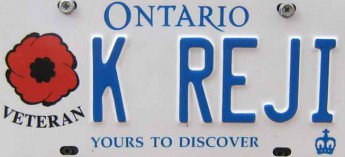
The Government of Ontario, Canada, in recognition of my service with the Indian Army has given me a new plate. My gratitude to Canada for honouring a Veteran from another county. Another example of projecting soft power.
If India is to prove that it is a major Military power and also stake its claim for permanent membership in UNSC, there is a lot to be done to project its Hard Military Power. Doing it the soft way will be cost effective and will also enthuse the nation.
It is an irony that a few veterans – surprisingly many who held senior ranks in the Indian Armed Forces – having radicalised thoughts and many times seen spewing venom on the media. The malice appears to have spread to officers who held junior ranks and also among soldiers.
There are two types of radicalised Veterans all over the world. The first category is a minuscule – the ones who have been through intense combat and have seen their comrades in arms die or maimed. They mostly suffer from Post Trauma Stress Disorder (PTSD) and there is no care or support for these cases, even from the Military Hospitals. Why, many in the Indian Armed Forces do not even accept that PTSD exists among serving soldiers who have been through intense combat. One can very well imagine the plight of the Veterans, especially those below officer rank. Some of these persons tend to recoil and spend their life mostly in solitude and hardly ever communicate, even with their dear and near. Some also have taken the spiritual path to fight PTSD. They tend to carry their emotions within them.
They generally appear well in public and say nothing to offend anyone. They are always a gentleman on the surface and treats everyone with respect. In private, they may occasionally make off-handed comments when discussing politics, or society. One feels disenchanted to hear someone of such intelligence and valour, someone who everyone respected and cared for immensely, have such a distorted view, and to speak in generalisations about an entire religion or community.
This group cannot be categorised as radical, but may well be called prejudiced. This could well be attributed to their years of dedicated service in the worst parts of the country, and having to deal with corrupt politicians and bureaucrats on a regular basis. This is bound to take a toll on anyone’s faith in humanity.
Now comes the second group – the most dangerous ones and are in majority – the so called ‘Poodle Fakers‘ of the Armed Forces. They may have been in the battlefronts, but have hardly seen intense combat. They were the arm-chair Generals who pushed their soldiers into combat situations, presuming themselves to be ‘Guderians,’ but with hardly any practical knowledge of tactics or the real ground situations.
Post retirement, they try to cover up all their shortcomings through their ‘verbal diarrhea‘ in the media or with their articles or books in print. They find everything wrong with the current setup in the Defence Forces and are ever ready with their answers for all the troubles the Defence Forces are going through. They never realise that they were the ones who laid the foundation for such troubles.
In the present Indian political environment, they have found a place to air their Gyan – the so called nationalists or patriots – who believe that to be patriot one got to believe in the party that has created an image of being the only patriotic one. They also believe that all the history of the nation are all wrong and only the ones espoused by the current bunch is the most appropriate version.
They appear to have forgotten all the ethos the Defence Forces taught them while in service. They claim that the Indian Muslims and Christians can never be nationalists and are only there to convert the poor Hindus. They never remember the sacrifices and valour of the non-Hindu soldiers who served under their own command.
They tend to paint everyone as non-nationalist in one stroke. Most of them obviously are faking it to remain relevant in the current religio-political turmoil the nation is going through. They will never miss an opportunity to cash in by giving their sermons on various television channels, which are ready to pay them for their most grotesque comment. It appears that every evening they wear their suits, armed with some venom spewing statement and await a call from a news channel.
These Veterans employ theatrics – they are ever ready to shed a few crocodile tears – and many viewers believe what they say. The viewers do not know the antecedents of the person, but they only know him as a Veteran.
Have you ever seen a General who was a professional soldier ever deliver such Gyan? Is it time that the Government come out with some regulations to quieten or soften up such diatribes?
Our son Nikhil went to the recruiting office in Toronto to collect the application form for Canadian Army. The office was manned by a very senior Sergeant Major who had seen action in Afghanistan and Iraq. He asked our son the reasons for joining Canadian Army. One of the reasons listed out by Nikhil was that his father had served the Indian Army.
The Sergeant Major asked “Did he see combat?“
“Yes he did two or three times to the best of my knowledge,” said Nikhil.
“Does he talk about it?” queried the Sergeant Major.
“Never,” replied Nikhil.
To this the Sergeant Major said “Then he has been into combat.“
On returning from his orientation programme from the city’s swimming pool, where he works as the Swimming Instructor and Life-Guard, I asked our son Nikhil, “What’s new this time?”
The Swimming Instructors have to undergo an orientation programme prior to commencement of any teaching session – a ritual once in three months. They are assessed for their swimming ability and life saving techniques. The incidents that occurred during the quarter in all the swimming pools are discussed in detail and the correct methodology to deal with them are brought out. Any changes to the existing protocols of First-Aid, CPR, Child Psychology, etc are also covered during this programme.
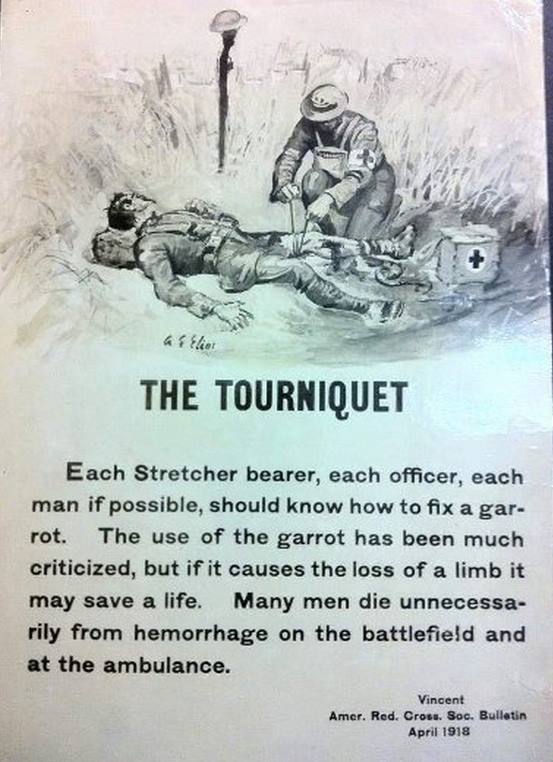
“The age old tourniquet is back in,” was his reply.
His reply made me dwell back into my memory of the Cadet days at the National Defence Academy (NDA) where the tourniquet and a blade adorned our Field Service (FS) Cap. The tourniquet was in fact two pencils, four inches long, wound neatly by a shoelace. The ends of the shoelace were neatly tied on to the two holes on the left side of the FS Cap. Luckily never heard of anyone untying the knot and using it during the Academy days.
On commissioning as a Second Lieutenant, I still carried the blade and the tourniquet as an integral part of my FS Cap. The blade was the first to go as the Indian Army found that the blade had a great chance of infecting the wound rather than saving a person from a snake bite.
By the late Eighties, Indian Army recommended doing away with tourniquets. The tourniquet meant to stop circulation of blood through the limb where a poisonous snake might have bitten was found to be more damaging than allowing the poison to spread across the victim’s body. In case a limb that had a tourniquet applied for hours, with no blood or lymph flow, caused a huge buildup of toxins in the limb. When the tourniquet was released, all those toxins spread into the victim’s entire body.
The simple tourniquets were employed as an effective means during many wars to stop serious bleeding wounds. It saved many a life that would have been lost due to blood loss. The tourniquet, in case applied over a prolonged period of over two hours, may damage tissues due to a loss of circulation. This may result in permanent nerve injury, muscle injury, vascular injury, etc.
Periodic loosening of a tourniquet in an attempt to reduce tissue damage may often lead to blood loss and death. Further, the victim suffers immense pain when a tourniquet is applied and may need heavy dose of pain killers. For the tourniquets to be effective, the person applying the tourniquets must be well trained and must be aware as to what he is doing, how to do it and why.
In today’s world where the threat of a militant attacks, industrial accidents, natural disasters, man-made disasters like stampedes, etc may result in mass civilian causalities with serious limb injuries. The first responders and medical aid, even if available, may not be sufficient enough to treat all casualties. Hence there is an urgent need for all responsible citizens to be trained in First-Aid and in use of tourniquets. A casualty with multiple injuries, including serious bleeding limb injuries may be effectively managed by the immediate application of a tourniquet as a temporary measure to stop bleeding.
In most cases there is a need to improvise a tourniquet. One must use a broad band to provide adequate compression. A shoelace is a last resort, being thin, may not provide adequate compression. The tourniquet must be applied just above the injury, onto bare skin to prevent slipping.
The first tourniquet may be applied ‘high and tight’ over clothing until a more considered assessment and reapplication may be considered. The tourniquet should be tightened until bleeding stops. Insert something rigid under the tourniquet and next to the knot to keep the tourniquet taught. In case it is ineffective, the tourniquet should be tightened or re-positioned. One may even consider applying a second tourniquet above the first if required. Always write the Time and Date on the tourniquet.
Releasing the tourniquet once the casualty has been stabilised will theoretically avoid or limit the complications of prolonged use of a tourniquet. Release the tourniquet, observing the wound and If bleeding continues, tighten the tourniquet until bleeding stops.
The tourniquet should remain in place if:-
The transit time to medical care is less than one hour.
The casualty has other life-threatening injuries.
The casualty has unstable vital signs.
Tourniquets are an effective method of controlling serious bleeding which may not otherwise be controlled by simple measures but only if applied effectively. The greatest risks of serious complications are due to inappropriate or incorrect application of tourniquets, not the tourniquet itself.
Sgt Dakota Oklesson, senior line medic with Apache Troop, 1st Squadron (Airborne), 40th Cavalry Regiment, helps an Indian Army soldier apply a tourniquet during their first day of joint training for Yudh Abhyas 2010 Nov 1 at the Battle Command Training Center and Education Center on Joint Base Elmendorf-Richardson, Alaska.
This book is authored by Major Shona George, Regiment of Artillery, Indian Army, a personal friend. Rather, his father Late Colonel Raju George, again from Artillery and I shared many hours discussing various subjects ranging from military, history, religion, faith, parenting, philosophy, etc.
The book is fast paced and gripping. It is a about 160 pages – short enough hold your interest and cover the essentials, but long enough to get into your mind with a detailed account of what an Indian Army Officer – Sam Kapoor goes through.
The language used is simple, with adequate explanations about other language words and also military terminologies. The book is as expected, divided into three sections.
The first dealing with Sam’s childhood of growing up in the Military Cantonments – a gypsy life – natured in Assam and nurtured in Gujarat, Maharashtra, Bengal, Rajasthan, Delhi, Nagaland – rather most Provinces of India Union. The life of a kid maturing to an adult through his teens is well etched. The language and narration keeps up with the innocence of a kid, with all the pranks, comical situations and activities the youngsters indulge in. This chapter depicts the growth of Sam into a leader, through his various childhood activities. Turning into adolescence – a university student in Delhi – and the hiccups everyone faces, interaction with friends, crushes, infatuations and ultimate love for a girl has been essayed out with its essence intact. Ultimate dilemma of Sam to choose between his dream of becoming an Army officer like his dad and his love gives a cinematic twist to the narration.
Sam as a newly commissioned Lieutenant serving in Siachen Glacier – the highest and coldest battlefield in the world – forms the second part. It is real fast paced, fascinating and will surely touch your inner cord. What goes through Sam’s mind, without any dilution has been well explained, especially what Sam goes through losing the soldiers under his command. The irony every Army Officer faces while breaking the news of loss of a soldier to his parent, carrying out the last rites of an officer whom he met briefly, digging out a soldier trapped under an avalanche – could not have been explained better. At least I can vouch for it having been through similar situations.
Third part of the book deals with the operations in Kashmir Valley, dealing with terrorists. Here again the author has done justice bringing out what goes through Sam’s mind as a military leader. This I am sure is an experience most Officers of the Indian Army in the last three decades would have been through.
This book is a must read for all those who follow the Indian Army, its Officers and Soldiers. The reader will surely end up with a feeling of patriotism and leave you with a hair-raising and spine-chilling sensation.
A prescription for sure of all those self-claimed Desh-Bhakths.
The book is available on Amazon.in, eBay and Flipkart. The ebook version is available on readwhere.com and the international edition is available on Amazon.com.
For me, undoubtedly most comfortable evening home wear has always been the down to earth ‘Lungi’. It is extremely comfortable and is an all season wear. It is unisex – wearable by both men and women. It is easy to wear without any hassles of zips, buttons or laces. One got to just tie at the waist. Tying a Lungi at the waist is surely not any rocket science, but to ensure that it remains there is surely an art by itself. Lungi provides free movement for the lower limbs and also air circulation, especially ideal for the hot and humid climate of Kerala.
A Lungi is a cotton sheet about 2 meter in length and over a meter in breadth and is characterised by its plain, checkered, floral or window-curtain patterns. By design, one-size-fits-all, both males and females and surely does not have any caste, creed or religion. The only variation is that Muslims of Kerala wear it right to left, whereas others wear it left to right. It is very difficult for a normal eye to make out this subtle difference. Lungi is worn in India, Sri Lanka, Bangladesh, Pakistan, Nepal, Cambodia, Ethiopia, Myanmar and Thailand. ‘Mundu’ is its white cousin and is worn mostly outdoors in Kerala- to church, family functions and even to office.
While serving in the Indian Army, I wore a Lungi to bed, even in remote border posts – at altitudes above 10,000 feet when the mercury dipped to nearly 30 degrees below the freezing mark. I wore it while serving in the North in Kashmir, in the West in the deserts of Rajasthan and in the humid jungles of Eastern India. It had no combat or camouflaged design or pattern as it was not an Army ‘issue’ item and did not figure in the ‘Dress Regulations for the Army.’
Once on my trip home on vacation from Sikkim, I called on Colonel Baby Mathew who was commanding an Artillery Regiment located near the airport from where I was to board the flight home. On reaching the main gate of his regiment, the sentry on guard saluted me smartly and said, “Our CO (Commanding Officer) is waiting at his residence for your arrival” and he then gave directions to the driver about the route. On entering Colonel Mathew’s residence, I heard his voice saying, “Head straight to my bedroom.” There was Colonel Mathew, sitting on his bed, adorned in his favourite Lungi. He ordered me to change into my Lungi and join him for a hot lunch of Kappa (Kasava or Tapioca) and fish curry – a Kerala Christian favourite. While partaking the meal, Colonel Mathew said “I have placed my residence out of bounds for all ranks for the next 24 hours” – meaning no one to come near his house until I was there. Obviously, the Commanding Officer did not want his command to see him and his friend in their Lungi.
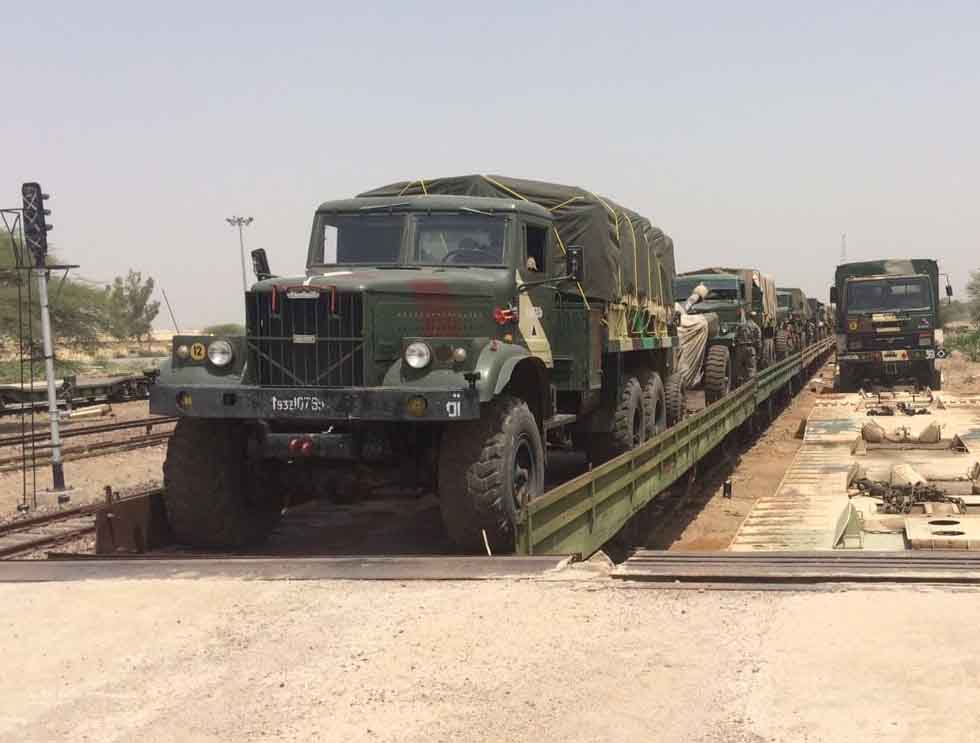
In June 2002, I took over command of our Regiment in its operational location on the India-Pakistan border in Rajasthan. The Regiment was mobilised from its peace location in Devlali (Maharashtra, near Mumbai) on that year’s New Year Eve. The entire Indian Army had moved into their operational locations after the attack on the Indian Parliament building by terrorists believed to have come in from Pakistan. The Indian Railways ensured that our Regiment, like all the other units of the Indian Army, were transported to their operational locations at super-high priority in two days. The Military Special trains moved at speeds greater than that of many express trains and were accorded the highest priority.
The move back to Devlali from Rajasthan was the opposite. An Army which did not even fire a single bullet, an army which did not fight a war surely had no priorities in anyone’s mind. The Military Special trains stopped at every possible station, even to give way to the freight trains. Now we were the lowest priority in the eyes of the Indian Railways. The onward move executed in less than two days now was sure to take a week.
On the day of our train’s move from Jodhpur (Rajasthan,) the soldiers loaded all the vehicles and equipment on the train. After accomplishing the task, the Subedar Major (Master Warrant Officer) Thangaswamy had a rollcall to ensure everyone was present and also to brief the soldiers about the return journey. As I looked out of my railway coach’s window, I saw the entire regiment standing. I had a brain wave – Why carry all the soldiers on the train? About a hundred of them is all what I require, mainly to ensure the security and safety of the train and the equipment. Why not the rest of the soldiers be sent on leave as many had not met their families for a prolonged time due to the operational commitments? Also, less of a trouble for the chefs to cook meals on a running train and less of administrative issues.
I stepped out of my coach wearing my Lungi and ordered Subedar Major Thangaswamy to only keep about a hundred soldiers and disperse the rest on leave for a week to rejoin at Devlali. Everyone’s face suddenly brightened up but with that I was christened ‘Lungi CO.’
After moving to Canada, on a warm and sunny summer morning, I was watering the garden wearing my all time favourite Lungi. There appeared our neighbour, Mr Win of Chinese descent and on seeing me wearing a colourful and comfortable costume enquired “Reji, what skirt are you wearing- looks really colourful. Sometimes it is a full-skirt, sometimes half-skirt and sometimes mini-skirt.” –That was it! I discarded my favourite Lungi forever.
Hindi Minimum Test, a test to assess the linguistic ability of cadets, used to be conducted at the National Defence Academy (NDA) for all cadets in their second semester. It was a well known fact that for most cadets who graduated from Sainik School Amaravathinagar (Thamizh Nadu) – known as Amaravians, it was a hurdle too high to clear. So, we all had extra classes on Thursday evenings and all those Hindi Pundits at the Academy tried their level best to make us imbibe the national language. Thus Thursday evenings became more of a school social at the NDA. At the Indian Military Academy (IMA) the very same test was called Compulsory Hindi Test.
The move by the Congress government at the Centre in 1965 to impose Hindi on Thamizh population was the root cause of Congress being wiped out of Thamizh Nadu. Rise of Dravida Munnettra Kazhakam (DMK) was also due to this imposition of Hindi.
Many argue that the agitations against Hindi have had an impact on the Thamizh psyche. It is often claimed by the political commentators that the people from other Southern States learn Hindi along with their native language, but the Thamizh are fanatical about their language, cultivated by the Dravidian political parties.
It was bit easier for Mallus as the language Malayalam has nearly all the alphabets as the Devanagari script of Hindi Language. Malayalam language is closer to Thamizh, but has borrowed its vocabulary and grammar from Sanskrit. For a Thamizhan it is a nightmare to learn Hindi as Thamizh, being the oldest Indian language has limited consonants – only one ‘ka’ (க) in place of ka (क), kha (ख), ga (ग), gha (घ) and similarly for all other sets of consonants. The Hindi Pundits never understood this very basic issue (and till date they do not seem to understand this fact or try and gloss over this fact) – else they would have to accept that Thamizh is older and more sacred than Sanskrit. Where would the ‘Indian Nationalists’ hide their faces then?
Hindi propagated in the seventies and eighties by various governmental organisations also had its effect. Hindi terms coined by them to replace commonly spoken English words were so confusing that even Hindi speaking population of North India would have had a run for their money. National Television – Doordarshan – and All India Radio spewed out those tough Hindi words with venom. This resulted in many homes in South India switching off their TV sets at 8:45 PM – on commencement of Hindi national telecast.
In the eighties, opening up of media space for private players resulted in new channels using a medium – a mix of Hindi and English – which was better understood by everyone.
With globalisation and advancement of IT, the luck Indians rode on, mainly for maintaining English as a national language, was that many found jobs in the world market. India ended up having a reservoir of English speaking educated mass, which attracted global players to establish business, especially in the IT field.
I do not even remember how I managed to pass the Hindi minimum test. For using idioms in sentences for पानी पानी होना I wrote – जब मैं स्विमिंग पूल में गया, वहां पानी पानी हो गया and for पांचों उंगली घी में होना I wrote – जलेबी खाते वक़्त मेरा पांचों उंगली घी में था and the list of bloopers went on. This was done knowing well that they were howlers, but it resulted in annoying the Pundits who tried their level best to ram Hindi down my throat and I really derived some sadistic pleasures from it. With vengeance, (more than the keepers of the Thamizh culture, language etc as displayed during the Jallikattu demonstration) I coined new sentences and helped the Hindi Pundits in coining new words to enhance their vocabulary. I was even successful to a great extend in creating new rules for Hindi grammar -the least it did was to put some doubt in the minds of the Hindi Pundits at NDA.
Whatever it was, I managed to pass the Hindi Minimum Test in my Fifth Semester. Some of the Amaravians struggled with it during their entire three year stay at the NDA and did not pass until their Final Sixth Term and special tests were conducted for them. After three years of NDA and a year of training at the Indian Military Academy (IMA), I was commissioned to 75 Medium Regiment of Artillery. The Regiment then had three sub-units -Batteries – manned by Jats, South Indians and North Indian Brahmins (Pundits). For all the ‘fun‘ I had with the Hindi Pundits at the NDA, Gods must have been very unhappy with me or was it that Lieutenant Colonel AN Suryanarayanan, our then Commanding Officer (now a Veteran Brigadier) decided it wisely that I must go to the Brahmin Battery. I ended up at the right place, I thought. This resulted in me learning to speak proper Hindi for the first time in my life. I learned Hindi from our soldiers and many spoke chaste Hindi.
In the Indian Army, the official publications and forms were bilingual – with English and Hindi. It did not achieve much other than making the publications double their weight and increasing production cost. I used to advice young officers in the Regiment to read the publication – Glossary of Military Terms – because of the need to use and understand military terminologies is very important for a young officer, especially during training courses and also during tactical discussions. This book was bilingual – with Hindi on the left pages and English on the right pages. I would often suggest to the officers to read the Hindi side when they got bored of reading the English pages as they would find many of them totally out of place and some really humorous.
Nowadays, the Indian Army has done away with the Officer’s Hindi Minimum Examinations – to the delight of all Amaravians joining the NDA.
This video is a beautiful tribute to our soldiers – well worth watching, especially on Valentine’s Day. Do not be surprised that it comes from Malabar Gold, a jewellery chain in Kerala. The animation is exceptional, the script apt. It depicts how a senior army officer might counsel a young officer in such a situation. It celebrates the bonding and camaraderie among officers of the Indian Army. In truth, it is a real motivational video.
A Memory from 2002
Watching this television commercial, I was transported back to my Commanding Officer days in 2002. Our Regiment was deployed in the Rajasthan sector for operations since January. After I took over command in June, I noticed that most young officers – especially the newly married ones – had not been home to see their wives. Leave for everyone in the army at that time was severely curtailed, sanctioned only in extreme emergencies.
A Fortuitous Journey
After assuming command, I needed to travel to Devlali, our permanent peacetime location, to complete documentation procedures. Higher headquarters granted me permission to move out of the sector for a week. I seized this opportunity – perhaps wilfully misinterpreting the orders – and took two young Captains with me as my staff officers: the Adjutant and the Quartermaster. Their presence would facilitate the various documentation tasks.
We three booked train tickets from Jodhpur. Captain Subhash was bound for Devlali, where his wife was stationed. Captain Mitra’s destination was Ahmedabad, Gujarat, which fell en route; his wife was living with her parents there. I was headed for Devlali, as Marina had by then migrated to Canada.
The Plan Unfolds
Our train was scheduled to stop at Ahmedabad at daybreak. Subhash called Mrs Mitra with careful instructions: prepare breakfast for the Commanding Officer and himself, and bring it along. He added an advisory note – the Commanding Officer was a connoisseur of good food, so it got to be good.
Half an hour before the train was to pull into Ahmedabad station, Mitra woke us with a cup of hot tea and the brightest smile he could muster. That was when the devil in me began working overtime.
I instructed Mitra to step off the train – not onto the platform side, but the opposite. Subhash was to meet Mrs Mitra on the platform and break the sad news: her husband’s leave had been cancelled by the Commanding Officer at the eleventh hour due to unforeseen operational requirements. I would then walk in to meet Mrs Mitra for the first time.
The Moment of Truth
The train came to a halt. Everything proceeded as planned. Mrs Mitra waited on the platform next to our coach with her father, both smiling, eager to meet her husband who had been away for six months.
The moment Subhash broke the sad news, I walked in. I watched as dark clouds of sadness layered over her smiling face. Her expression shifted from radiant to dull, as if an arc light had suddenly fused. Her father comforted her with gentle reasoning: her husband was on important national duty and would be with her shortly.
I apologised sincerely for cancelling Mitra’s leave and assured her he would be sent home in two months. Mrs Mitra barely heard me. She stared with a dazed, blank expression.
Subhash reached for the breakfast hamper. “He hasn’t come, but we can have the breakfast. Haven’t you brought it for us?“
The train whistle blew. We thanked them, climbed aboard, and stood in the doorway, waving goodbye.
Epilogue
Wishing all couples a Happy Valentine’s Day.
Falling in love is like looking at the stars. If you pick one among the billions and stare at it long enough, all the others will melt away.
For the soldier, love is measured in stolen moments, postponed reunions, and the quiet understanding that duty and devotion are not opposites – they are two sides of the same coin.
Colonel Mahaveer Singh was the Commanding Officer (CO) under whose guidance I spent my five years as a young officer. He was a real father figure who believed that the Regiment was his family and insisted on all officers getting together for tea at 10:30 AM. All officers, especially the young officers, really enjoyed these meetings as the first five to ten minutes was official stuff where in the CO gave out a few directions and it was for us to act on them and execute them. The next 20 to 30 minutes used to be ‘story telling‘ time and we all could narrate anything and everything and all officers listened and participated in the discussion. This instilled a lot of confidence in all the young officers and they all are doing well today. Colonel Rajan Anand (now a retired Brigadier) and Colonel PK Ramachandran (now a retired Major General) were two COs who never ever held a conference or meeting. They gave their directions on the run and everybody executed them and for sure executed them really well.
All three of the above mentioned COs never ever seemed to supervise our work and believed in all of us and in delegation. They had trust in us and hence we always went an extra mile to ensure that the results were the best. The performance of the unit in all spheres spoke for itself and each and everyone, to the last soldier, took pride in being from a great Regiment and put in that extra effort to keep the Regimental flag flying high.
I have had my share of pathetic experiences also which led me to ensure that I never held a conference or meeting during the command of the Regiment, mainly because I hated them. Based on the lessons I had learnt from the above three COs, I put into practice the ethos of trust in all my subordinates and also provide them enough elbow space to execute the task with minimum directions. The performance of the Regiment at that time was there for everyone to see and the men were confident of what they did.
Why do I hate conferences / meetings?
During a short stint with our Regiment, I was called in for a conference regarding a task. Normally every soldier got into their drills and procedures, while the officers got their briefings and directions from the CO. This meeting was attended by nearly all up to the Havildars (Sergeants) and the CO’s office was overflowing and also nauseating. The meeting went on for two hours, with nothing new other than a few finger pointing by the CO and on returning to where the men were, I found no activity at all.
On inquiry I found that all the soldiers generally have their lunch and sleep off the moment this CO called for a conference as they knew how to make full use of this valuable ‘dead-time.’ The soldiers never did anything much even after the conference as they were pretty sure that this CO made them re-do or change what they did. So they felt ‘why waste effort and time.‘
A well oiled Regiment was now waiting for the CO for everything and the soldiers felt most miserable about it as they were not used to such ridiculing and lack of trust ever before. When I returned to the unit after two years, luckily the new CO had turned the clock back and I found the soldiers happier and proud of being part of a great Regiment.
What Makes these Conferences/Meetings so Resentful?
The conferences are held to show that the boss has done his job of briefing anybody and everybody, many not even remotely connected with the task in hand, thus making him ‘safe’. The boss is mostly unsure about the task in hand and who will execute it and has normally not done enough homework. Most of these conferences tend to be confrontational instead of being collaborational, especially in a hierarchical organisation like the army.
The boss tend not to get to the point quickly enough and often are with the bad attitude that the people sitting in front ‘just will not understand it.’
The listeners are mostly not the right people in the right meeting. Some do not even know as to why they were called for the conference, wondering what the meeting is all about. Even if they knew what it is about, they were not prepared to contribute to the discussion or their inputs were never asked for.
The boss holding the conference tends to lose focus and gets off track. These monologues do not to add value, but the boss feels that there have been value additions, but mostly are time wasters. These bosses do not realise that most of the attendees already know that most of what is discussed and what their jobs are and the part they got to play.
Exhaustion spreads like wild-fire. All it takes is a couple people to start squirming and a few yawns and it spreads. This is compounded by the feeling as to why they were attending the meeting – to get ready for the next meeting.
Suggestions for a Good Conference/Meeting
Never Hold One. It is very apparent that many meetings serve no purpose. The best methodology is to consider two to three days in advance whether there is any way at all of avoiding the meeting.
Keep Attendees the Least. Fewer the people who attend the meeting the more effective it will be. Many bosses love to hear their own voices and the bigger the audience the greater the need to pontificate.
Direct the Meeting. It is much easier to control a meeting that is about specific topics rather than merely held for the sake of the meeting itself. Allow all participants to give their opinions while at the same time stopping them from talking unnecessarily.
Know the Job in Hand. If you knew exactly what the job was, you would have never called for the conference; instead you would have given out clear cut instructions to your subordinates. If you know what you are trying to achieve, then it is far easier to do so.
Start on Time and End on Time. One of the most frustrating things about meetings is the long wait for a few stragglers who cannot be bothered to turn up on time. Avoid demonstrating Parkinson’s Law that work will always fill the time available to it.
Wishing you all the very best for your next conference/meeting.
On joining Sainik School, Amaravathi Nagar in 1971 at the age of nine, I underwent my first run of drill classes. The Drill Sergeant with his order for Tez Chal (Quick March) always followed it up with “Shoot your Left foot.” This Left foot first continued through the training at the Academies and during my military service.
Please identify me in this picture – Photo of our class – Grade 5 in 1971 @ Sainik School Amaravathinagar, Thamizh Nadu
While travelling on a train during my vacation from school in 1978, my co-passenger was a Veteran Sergeant who had seen action with the Royal Air Force during World War II in Burma. He spoke of a Black & White English movie, ‘The Tie.’ He described a scene where a detective and a constable are tracking a fugitive through the city roads on a foggy winter night. Only the silhouette of the fugitive is seen and suddenly it stops walking and then walks ahead. The detective says that it is a woman. The question of the Veteran was as to how the detective made out that it was a woman.
I had no clue and he explained that women generally commence walking with their Right foot first and men with their Left. That is why when we march, we are drilled to shoot our Left foot first. After this meeting, I started observing men and women and the first Right foot applied to women in about 80% cases. Perhaps the remaining 20% were taught drill by some Sergeant Majors.
Shooting the Left foot first in the military was mainly because the soldiers were mostly right-handed, and they carried their weapons the right side. So when a soldier stepped forward with a Left foot, they were in a better-balanced fighting posture, with Right foot planted and weapon up, ready for action. It was also to keep everyone on the same foot for advancing in a line. In the olden day battles, soldiers advanced together ahead in formation, so that the enemy could not break the lines. In order to do this, they used drums to keep everyone in line and together and commenced the march on the Left foot. Every time the drum struck, their Left foot hit the ground. Modern Armies across the globe follow this to keep everyone in step while marching, more to instill discipline and teamwork and for a ‘Soldierly‘ look while moving in a group.
In the military, one always walked on the left side of a superior officer. In other words, one always kept his superior on his ‘Right’ side. This was to facilitate him to return a salute with his Right arm without poking his arm into someone on his Right.
We are all familiar with the famous first words of Neil Armstrong as he stepped foot onto the moon in 1969, ‘That is one small step for man and one giant leap for mankind.’ No one was there to photograph this one small step. The second human to set foot on the moon was Buzz Aldrin and the instant was captured by Neil Armstrong. In this image (courtesy NASA,) Aldrin is seen landing on the lunar surface with his Left foot, that too in rearward motion. Perhaps, a mere coincidence or the sheer logic of the number of rungs in the ladder!
In this connection, a bit of mythology may interest the reader. Nataraja, the Hindu God Shiva as a cosmic dancer, is depicted in idol form in most temples of Kerala and Thamizh Nadu, balancing on his Right foot with his Left foot up. The only exception being the Nataraja idol at Meenakshi temple, Madurai. It is believed that the Pandya King who commissioned the temple wanted to give some relief to Natarajan’s Right leg, at least in the temple he constructed.
God Shiva with his consort Parvathi is mostly depicted sitting and in most cases, Shiva has his Left foot folded up and Parvathi her Right. As per Hindu mythology, Shiva represents the Purusha (male) and Parvathi the Prakrithi (nature or female.) Some Hindu mythological art portrays gods with both feet on together on the ground and this may be the depiction of combination of Purusha and Pakrithi.
When an Indian Bride enters the home, she is advised by her mother-in-law to enter with her Right foot first, but no such instruction is ever passed to the groom. During many Hindu marriages, the groom ritually places the Right foot of the bride on a grinding stone. The mantras recited during this time advise the bride to lead a firm life like the grinding stone, to be as firm as a rock, so that the family can depend on her.
Most Hindu Goddesses are often depicted with their Right leg folded up, depicting Prakrithi.
This may explain as to why women commence their walk with their Right foot.
There are many soldier Gods in different border areas where the Indian Army operates. Most of the shrines dedicated to these Gods are situated in inhospitable terrain and mostly placed out of bounds to the civilians. There are no hymns or keertans sang on behalf of these Gods, they do not have ashrams, they do not ride in luxurious sedans, they do not hug devotees, they do not run charitable institutions, and they do not give darshans, and so on. They are soldiers who sacrificed their lives in service of their motherland and now regarded as patron saints guarding the areas where they achieved Martyrdom.
On my first assignment to the Kashmir Valley as a young Captain in 1987, my belief in God Almighty was rekindled mainly because of the inhospitable terrain, sub-zero temperatures, heavy snow-falls, avalanches, thin air with deficiency of Oxygen, high-altitudes above 10,000 feet, and the drive through the mountain roads where one could slip off the road, down the gorges, and no trace would be left of the vehicle or the passengers.
I was attached to a Punjab Battalion as Artillery Observer. The Battalion had soldiers mainly from Punjab, Himachal and Jammu, consisting of Hindus and Sikhs. As per the norms of the Army, the battalion had a Mandir with a Hindu Pundit and a Gurudwara with a Sikh Granthi. On Sundays or on important religious days we attended both Mandir Parade and Gurudwara Parade. These being Parades, it was mandatory for all officers and soldiers to attend.
On the way to the battalion headquarters, there was a Muslim Peer Baba and every man, irrespective of their rank or position, used to stop and pay their respects to the Peer Baba before proceeding to the battalion. The belief among the soldiers, passed down over many decades of army deployment was that the Peer Baba took care of the soldiers and in case anyone failed to stop and pay respect, he will meet with some tragedy. Being a Christian by birth, I said the Lord’s prayer in the mornings and evenings, a ritual embedded in me by our father.
This was the place I understood the meaning of secularism and realised that all Gods were the same. I was never sure as to who saw me through my first Kashmir tenure, the Gods in the Temple, the Gurudwara, Peer Baba or Jesus. During my later years of field service in Sikkim and in Siachen Glacier, I came across two Soldier Gods.
OP Baba, Siachen Glacier, c/o 56 APO
Siachen Glacier, a disputed territory between India and Pakistan, highest battlefield of the world, is well known for its inhospitable and treacherous terrain, freezing cold at minus 40 degrees Celsius, crevasses and avalanches and lastly enemy action. Statistics reveal that more lives have been lost to the weather than to the enemy action since 1984, when Indian Army first occupied Siachen glacier. Hypoxia, High Altitude Pulmonary Edema (‘high-altitude sickness’ or HAPE), bone-chilling winds, sun burns, chill blains, frost bites, the thin air and sub-zero temperatures inducing acute depression, are some of the weather factors affecting our soldiers. Most of the soldiers serving in such areas become very religious and the trust in their Gods really multiplies.
There are many a myths and legends about the Siachen Glacier like any other battlefields. Legend has it that OP (Om Prakash) Baba, deeply revered by troops posted in these glacial heights, was an army soldier who fought valiantly to preserve Indian frontiers from Pakistani intruders in most adverse situations. Belief in the Soldier Saint is so strong that a formal report is given to OP Baba before induction of a soldier party on the glacier and after successful accomplishment of any mission. Any officer moving into the area reports his arrival to the Baba by visiting the shrine and paying his respects.
Faith in the legend of OP Baba is so strong that all troops give up consumption of alcohol and tobacco during their stay on the glacier as the Baba is believed to have been a strict disciplinarian and expects the same from fellow soldiers who come here to guard the frontier. Every battalion or company before taking position begins with a prayer at Baba’s shrine. The company commander gives a detailed briefing to Baba before tying a brass bell in the complex, taking a vow to keep away from cigarettes and intoxicants and fight the enemy till the last breath. Soldiers keep this promise till the last day of their tenure in the glacier and is strongly believed that any deviation is met with instant punishment from the legend himself.
It is believed that a night before any imminent danger, Baba comes in the dreams of soldiers and warns them of such eventuality. Baba has always been with the soldiers and protects every soldier and warns them of any impending danger in the Glacier.
Baba Harbhajan Singh, Sikkim, c/o 99 APO
Baba Harbhajan Singh has defeated death. Believe it or not but it is true, one of its kind of story in the world- a man from an Indian Army in Nathula border in Sikkim, is still doing his duty even after his death some three decades ago. 60km from Gangtok towards the Nathula Pass lies the valley of Kupup. Here is the shrine of Baba Harbhajan popularly known as Baba Mandir. Baba Harbhajan has been guarding the international boundary of the two Asian giants, China and India over the last three decades. But believe me he does it alone. The Baba warns about the dangerous activities on the border through the dreams of fellow soldiers. Legend has it that even the Chinese soldiers confirm sighting a man riding a horse all alone, patrolling the border.
Born in Brondal village of Kapurthala, Punjab, Harbhajan Singh joined the 23rd Punjab Battalion on February 1966 as a Sepoy. On October 4, 1968 Sepoy Harbhajan Singh was escorting a mule caravan from his battalion headquarters and he fell into a fast flowing stream and was drowned. Search for Sepoy Harbhajan was made with no results it was on the fifth day of his missing, his Commanding Officer had a dream of Sepoy Harbhajan Singh informing him of his tragic incident and his personnel weapon being under the heap of snow. Sepoy Harbhajan Singh desired to have a Samadhi (memorial) made after him. The Commanding Officer ignored the dream as an imagination but later when the personnel weapon of Sepoy Harbhajan Singh was found at the spot where he had informed, the Commanding Officer was taken aback and to mark respect and towards his wish a samadhi was constructed there.
Here too, the belief in the soldier saint is so strong that any officer or soldiers moving into the area report their arrival to the Baba by visiting the shrine and paying his respects. On my arrival at Sikkim, Colonel PK Ramachandran, our Commanding Officer, realising my rational stands on such issues had advised me to visit the Baba Mandir. He said that my visit to the Baba Mandir may mean nothing to me, but will go a long way in upholding the faith of the men under my command. I did as ordered without realising the implications of his words until I read a research paper by a US Army Doctor on Post-Traumatic Stress Disorder (PTSD) suffered by operationally deployed US Army troops. I realised that cases of PTSD were the least in the Indian Army despite all the operational commitments and I can attribute it only to the faith in God by our troops and the role played by the myths and legends and patron saints of different areas. This may also be the reason for increased evangelistic activities reported among the US Military personnel deployed in operational zones.
St George and the British Army St George is patron of soldiers, cavalry and chivalry and he is the patron saint of England, Georgia, Lithuania, Portugal, Germany and Greece. He has no biblical significance. He held the rank of a tribune in the Roman army and was beheaded by Diocletian for protesting against the Emperor’s persecution of Christians. St George was adopted as the patron saint of soldiers after he was said to have appeared to the Crusader army at the Battle of Antioch in 1098.
He is usually represented on horseback in the act of spearing the monster which is vomiting fire. It is based on a myth that in Sylene, a city of Libya, a lake was infested by a huge dragon, whose poisonous breath would kill anyone. The citizens could never draw water from the lake and in order to keep the dragon away, every day a virgin was sacrificed to it. One day the turn came for Sabra, the king’s daughter, to become its victim. She was tied to the stake, and left to be devoured, when St. George appeared mounted on his charger and is believed to have killed the dragon. Many similar stories were transmitted to the West by Crusaders who had heard them from Byzantine soldiers.
The banner of St George, the red cross of a martyr on a white background, was adopted for the uniform of English soldiers possibly during the reign of Richard I, and later became the flag of England and the White Ensign of the Royal Navy.
In 1940, when the civilian population of Britain was subjected to mass bombing by the Luftwaffe, King George VI instituted the George Cross for ‘acts of the greatest heroism or of the most conspicuous courage in circumstances of extreme danger’. The award, which is second only to the Victoria Cross, is usually given to civilians. The award consists of a silver cross. On one side of the cross is St George slaying the dragon, with the inscription, ‘For Gallantry’; on the other appear the name of the holder and the date of the award.
After setting foot in India, British Army built its first fort in Madras (now Chennai) in 1644 and christened it Fort St George after their patron saint.
Working in any hierarchical and structured organisation, one always had a boss, someone to whom one is answerable and someone who always gauged your performance and guided you to achieve the best. I too had my bosses and one always had subordinates, for whom one was the boss. After retirement, I realised that I was not my own boss as one had to be answerable for the actions to someone or the other.
Bosses under whom I worked can be classified as :-
Category 1. I know most of it and I know that I know most of it. The best boss to work under, who will only give you a few directions and believes in delegation. The boss knows the team well and capability of each one in the team and assigns tasks accordingly.
Category 2. I know bit of it and I know that I know only a bit of it. Depends heavily on the subordinates and accepts inputs from them. The subordinates while providing inputs need to be well aware that it may be implemented at times in full.
Category 3. Knows nothing, but presumes knows everything. Most difficult to work with as a subordinate and does not seem to have any faith in the subordinates. You will always keep getting orders and not directions as to how to execute a task and for sure, it will keep changing from hour to hour and at times from minute to minute.
One can never select one’s boss, especially in the army and one got to accept them As Is. I had been lucky during my service that I got a good lot of the Category 1 bosses, The distribution of the bosses were:-
Category 1. 52%
Category 2. 8%
Category 3. 40%
How they will perform in a given scenario is an interesting study. Let us take the case of a senior executive (a General or a CEO) flying in from the head office or the higher headquarters and need to be briefed for about 10 minutes by the boss under consideration.
Category 1. Will call the subordinates concerned, give out clear directions as to the slides to be made (at times makes it himself) and ask for any inputs from others. The slides only if must, may undergo a few changes. He may conduct one rehearsal and accept most inputs from the subordinates.
Category 2. Will call the immediate subordinates and explain to them the task in hand and accept inputs from them. The subordinates will have to provide the slides and the script and at times explain all that is written too. The boss puts in extra effort to understand the contents. There will be a few rehearsals and hardly any changes except for those where the boss finds difficulty in explaining.
Category 3. You and the entire sundry in the organisation, whether connected with the briefing or not, will be summoned for a conference, which will last for at least an hour. Some orders will be given out regarding the number of slides to be made, who will provide the data, etc. The most important aspect covered will be the tea and snacks to be served to the executive and at times even the flower arrangements to be placed in the office. The number of slides to be made would be around 40 and everyone knows that there would not be sufficient time, even to flash all the slides. The slides will undergo umpteen changes and will never be finalised till the eleventh hour. There may be many a rehearsals, but the number of changes the slides undergo will make them meaningless.
NEVER forget to save your initial draft. At the end of the day, with all the modifications and corrections, you will find the end product almost similar to your initial draft.
The final result you all can guess, but ultimately it is the subordinates who suffer, with all the unproductive work.
Late Colonel Avinash Chandra and I joined the Regiment in January 1983. He was a Captain then and was returning to the Regiment after a staff tenure and I was joining on commissioning as a Second Lieutenant. He, on promotion to the rank of Major was appointed the Battery Commander of the Jat Battery – 752 Medium Battery.
All the officers – both seniors and juniors – addressed him as Guruji. He was indeed a Guru on all matters, especially for us, the young officers of the Regiment. For us, he was the go-to man for all our problems – military, administrative, personal, promotion examination – and all the activities we young officers indulged in. He was always ready to help, but the only catch was that it came with a liberal dose of advice, anecdotes and stories.
It appeared to us from all his sermons that there was nothing under the sun which Guruji was unaware of and there was no activity Guruji had not indulged in. As expected, in all his adventurous stories, he was the pivotal character. We knew the percentage of truth in all his stories, but we all looked forward to listening to them. Whatever may it be, he had a solution in hand for all our problems and we all did enjoy his sermons.
During the Winter of 1985, the Regiment went through a training exercise conducted by the Brigade Commander. Next day, during the officers’ tea, Colonel Mahaveer Singh, our then Commanding Officer ordered that henceforth Major Avinash Chandra will not be addressed as Guruji, especially by his junior officers. It was all because our Brigade Commander during the exercise was peeved at a senior Major of the Regiment being addressed by his nickname. Guruji immediately said that he loved everyone addressing him as Guruji and if need be, he was ready to meet the Brigade Commander with this special request. That was our Guruji for all readers.
Guruji would take on any task everyone would find uncomfortable with. He would make such tasks appear simple and easy and conveyed an impression that he did enjoy executing it. His body language and mannerisms always added colour to such occasions.
One such task was engaging a target with Artillery fire using the infamous Range Finder DS1, The equipment is now obsolete and in my view should have been declared so even in those days. Everyone was literally scared of the invisible floating diamonds and no one wanted to touch it with a barge pole. Here now appears Guruji, full of confidence, to execute the arduous task. I always failed to understand as to how he would have executed the task with a failing eye-sight, corrected with glasses. Did he ever catch a glimpse of the five diamonds, mostly invisible to people with perfect eyesight?
The aim of engaging a target with artillery fire is make the shells fall on or as close to the target as possible to destroy it. The guns are placed well behind at about 10 km or more and the Observation Officer is located with the attacking or defending infantry unit. The Observation Post Officer (OP officer) is responsible to direct Artillery fire on to the targets, keeping in mind the safety of own troops. The Gun Position Officer at his Command Post near the guns would calculate the bearing, distance and other technical parameters to the target, based on the coordinates passed to him by the OP Officer and apply corrections to compensate for the prevailing metrological conditions like wind speed and direction, temperature, etc and fire a single shell called a ranging round. If the initial shell is not ‘on target’, corrections to move the fall of shot is ordered and is applied on the guns. This procedure called Ranging is continued until the shell lands within 50 meters of the target. He then calls for ‘fire for effect’ by ordering six or more guns to fire in unison until the target is destroyed.
During all the Artillery firing practices, Guruji would setup the monstrous looking Range Finder well before the commencement of the practice. When his turn to engage the target came, he would wipe his glasses clean, wear them and move to his trusted Range Finder. He would then instruct his radio operator to pass the target coordinates and other details to the guns with an order for a single gun to fire a shell. The use of the rangefinder, supposedly, was to eliminate the ranging process to the extent possible, and directly order ‘fire for effect’, to improve what in gunnery terms is called ‘First Salvo Effectiveness’. But the problem was that the range Finder DS1 was infamously unreliable and everyone other than a handful of personnel specially trained on it, kept a safe distance from the instrument.
Five seconds before the shell was about to land, his technical assistant would cry “Stand by” and Guruji would place his spectacled eyes on to the eyepiece of the Range Finder. After the shell exploded, he would look at it over the Range Finder and then through it. He would then pickup his pad and write down a few calculations and would order a correction to bring the shell to fall on the target – Right 275, Add 375- with an order for six guns to fire in unison.
Captain Desh Raj, the senior most among us Captains at that time would order us to summon all our Gods to ensure that the shells landed on the target. Believe it not, in almost all cases the shells did land on the specified target. Was it because of Guru’s gunnery skills or our prayers? Whatever it may be, the entire act did impress everyone present, especially the senior commanders.
After about two or three such experiences, I confronted Guruji to explain as to how he managed the show. He explained that he neither saw the floating diamonds nor the target through the Range Finder. He was mostly successful as he knew the firing ranges like the back of his palm. He knew the lie of the ground and could predict accurately how the shell would move with each correction. The most critical moment for him was when he looked over the Range Finder to catch the glimpse where the shell exploded. He would then assess the deviation from the target and order the necessary corrections to the guns.
My question now was that even though the entire procedure was based on shear guess work, how come it succeeded every time. Guruji with his characteristic smile on his lips replied “All because of your prayers.”
Our Regiment was equipped with the Russian made 130 mm M46 Guns when I was commissioned to the Regiment in 1982. 130 mm Gun was manufactured in erstwhile Soviet Union in 1950 and entered service with the Indian Army in 1965. The gun boasts of having achieved longest range of 27.5 km with conventional munitions. It traces its origin back to its predecessors used in ships and coastal defence by Russians during World War II. The gun was in the equipment list of many countries and some even produced their variants. The gun saw action during many conflicts across the globe – from Vietnam War to the recent civil war in Syria and Iraq.
To be fair to the Russians, it must be said that indeed the gun was good and extensively used in the 1965 and 1971 Indo-Pak Wars.The problem however was with the accessories that came with the gun. When Indian Army procured the 130 mm Guns, a plethora of accessories were supplied by the Russians. Most appeared to be tried, tested and failed – hence the Russians wanted to somehow palm them off to others. India must have paid a hefty sum for these accessories. Most of them found their due place in the technical stores of the regiments, and hardly ever used.
The biggest of them was the PPL Periscope – the wooden box for storage of the periscope looked more like a coffin. The periscope must have had its origin from the gun being used as a Naval Gun. Thankfully, no one in the regiment appeared to have even unpacked them or set them up for training or operations. No Observation Officer would have bothered to carry it to war as it needed at least six men to lift. On a ship, the carriage problem would not have been there and a need for a high periscope to observe the horizon was the requirement for any Observation Officer deployed on a ship in the high-seas.
The next biggest was the Range Finder DS1. From its looks and make, it also appeared to have its origin from the days of the gun being used in its naval version. It seems that someone in the Indian Artillery hierarchy of the 60s took a liking for this cumbersome piece that a chapter for observing and engaging targets with this monster was incorporated in the Gunnery Technical Hand Book (fortunately it has been removed from the recent editions).
The technique of employment was that the observation post officer measured the distance to the spot where a round fell and ordered the required correction in terms of ‘ Left/Right or Add/Drop’, having already made a similar measurement to the target, to make the round hit the target.
For measuring the distance with the DS1, one needs to manipulate a knob and make five ‘diamonds’ that appeared on the viewfinder so as to position the center one on the object to which distance is to be measured and two each equidistant in front and behind it. This needed a high degree of practice and skill.
Whenever I tried to operate the DS1, I could either see the object or the diamonds and never both, however hard I tried. I requested our Technical Section Commander – Subedar Bidappa – for help and he excused himself from the task owing to his poor vision. He suggested Havildar (Sergeant) Nahar Singh of the Survey Section as he had undergone a four-week long course at School of Artillery in operating the Range Finder. Havildar Nahar Singh agreed to transfer some of his skills and the art of manipulating the diamonds.
On the set day, I got the Range Finder set up at the training area next to the Survey Section and Havildar Nahar Singh commenced his lessons. We got struck at the stage where the elusive diamonds are to be manipulated – as usual I could either see the diamonds or the object and not both. Havildar Nahar Singh demonstrated his skill with the range Finder and measured distances to many objects around the training area. He read out the distances nearest to a meter and to verify it, he read the distance to a telephone pole to be 376 meters and asked me to pace it. Great! it was indeed about 375 meters.
I felt very small about my inability and kept trying to catch the elusive diamonds. Now came a warning from Havildar Nahar Singh – in case one operates the DS1 for a long period, one’s eyesight will deteriorate. He padded his comment with a line that soldiers operating the DS1 in the earlier days were authorised an extra egg in their rations to compensate for the struggle their eyes went through.
Never to accept a failure in front of the soldiers, I tried with all my efforts to catch the elusive diamonds for the next two hours despite Havildar Nahar Singh’s warning. Seeing my resolve Havildar Nahar Singh must have felt bad and he came to me and requested me to pack up the DS1. He now gave me his piece of wisdom.
He said that he too had never seen the elusive diamonds ever in his life. How the hell on earth did he measure the distances to various objects so accurately? He disclosed the secret that in the training area he knew the distance to all the visible objects as he had been conducting training for his section there. Whenever he measured the range to an object, he would focus the Range Finder on the object and set the distance on the scale.
How did he manage it during the training at the School of Artillery? There too all the students carried a small notebook with the accurate distances to various objects from various training areas. He claimed that hardly any student ever caught the glimpse of the elusive diamonds.
Our family friend took part in this year’s Tour De Mississauga, a 30/60/100 KM cycling event. This year it attracted over 1600 cyclists of all abilities from all around the Toronto Area. Cyclists of every age or ability, on every kind of bike (including electric assist), participated. The aim of the event is to familiarise cyclist with the various cycling trails and lanes available in the city, to develop a spirit of adventure and also to encourage cycling, both as a sport and as a physical activity. The event was well organized and truly lived up to its motto ‘THIS IS NOT A RACE – THE JOURNEY IS THE DESTINATION!’
As is the case with all such community activities in Toronto area like marathons, climbing the CN Tower, parades, etc, in this activity too there were hardly any participation by immigrants from the Indian subcontinent. When will we learn to amalgamate with the Canadian society? Participating in such events will not only develop community spirit in the participants, but will also raise money for some charity. It develops leadership qualities in children and encourages the spirit of adventure in them. Preparing for the event and participation will keep everyone healthy and improve one’s confidence level. Completion of the event will give you immense pride and sense of achievement. It will prove to you that you are physically healthy to undertake such difficult ordeals.
The local governments are doing their best to encourage cycling as a daily activity. Most of the roads in the Toronto Area have either a bicycle lane or off-road cycling paths. Bicycle Lanes are typically 1.5 m to 2 m wide, and designate a space on the roadway exclusively for the use of cyclists. Motor vehicles are not allowed to drive, park or stand in the bike lane. Off-Road Paths include trails through parks and along the arterial roads. Cyclists, skaters and pedestrians often share these paths.
On arrival in Canada, I saw a something like a crash-guard which we have on the front bumpers of the cars back home on the buses in the Toronto Area. On inquiry I learnt that it is a cycle carrier to carry two cycles. Many commuters feel that cycling or taking the bus just doesn’t compete with the convenience of a car. But in Toronto Area, “biking and bussing” is easy. You can cycle to a bus stop or station and then bring your bike on the bus. By biking and bussing you’ll not only improve your health, but also help reduce gas emissions.
In Toronto, bicycles are permitted on buses, trains and subways at all times except weekdays during peak hours. Bicycle transportation is a growing activity in Toronto and throughout North America, due in part because of the many benefits cycling offers. Transportation by bicycle is the most energy efficient mode of transportation, and generates no pollution, except in its manufacture. Cycling is often the fastest mode of transportation from door to door for distances up to 10 km in urban cores. Ten bicycles can be parked in the space required for a single automobile. Short distance motor-vehicle trips are the least fuel-efficient and generate the most pollution per kilometer. These trips have the greatest potential for being replaced by cycling and walking.
BIXI – Bike Share Toronto – is designed to be a convenient way to get around the city, and is ideal for short rides and one-way trips. The members get access to 2,000 bikes across the city. They can pick up a bike at one of 200 stations, and drop it off at any other station when done. One need to become an Annual Member or buy a Day Pass to be able to use Bixi. An Annual Member can insert a bike key into a dock to unlock a bike. Day Pass holders will get a ride code, which when typed into the keypad on the dock, unlocks a bike. The first 30 minutes of each ride are included in the membership or pass price. One can keep a bike out for longer, but additional usage fees will apply.
Reducing auto trips will mitigate ozone depletion, the greenhouse effect, ground level air pollution, photochemical smog, acid rain and noise pollution. Cycling contributes to personal health by enhancing fitness and providing an enjoyable, convenient and affordable means of exercise and recreation. Increased physical activity, such as walking and cycling, can reduce the risk of coronary heart disease and the cost of medical care, decrease workplace absenteeism, and maintain the independence of older adults. Cycling benefits one’s health regardless of the age at which one takes up cycling.
During our training at the National Defence Academy, Pune, cycling was the only mode of transportation for the cadets, else one had to run. The Academy campus is spread over 7000 acres and to reach various training event sites, a cadet had to cycle an average of 20 km per day. While cycling, one had to maintain proper squad discipline and pay proper respects to passing senior officers.
Any minor infringement ensured that the cycle was on you rather than you being on the cycle. Every semester begun with the cycle issue and always ended with the cycle return, after which was a month’s vacation. We used to have a weekly cycle maintenance parade to wash and repair the cycles. Thus even today, the cycle is the most ardent companion of every cadet at the academy, without which life would have been much more difficult.
During our childhood, we recited Psalm 91 as part of the evening Family Prayer (Click Here to Read More about it). In those days I never realised the meaning of the words we recited and did not visualise that it will impact my life. During my first stint at the Kashmir Border, sleeping alone in my bunker, the very same words rang in my ears. These words I realised helped me tide over the difficulties and uncertainties that lie ahead for any soldier in high-altitude terrain, mostly snow covered icy heights, prone to avalanches and blizzards and bone chilling cold. I recited Psalm 91 every evening, (in Malayalam, the language in which our father taught us the Psalm,) before I retired to bed. Psalm 91 has for ever been one of my inspirations and a prayer.
There is a story in circulation by the modern evangelists that during World War I, 91 Infantry Brigade of the American Expeditionary Force (AEF) was preparing to enter combat in Europe. Because their commander was a devout Christian, he assembled his men and gave each of them a little card on which was printed the Psalm 91, the same number Psalm as their brigade. They agreed to recite that Psalm daily. After they had begun praying the Psalm, 91 Brigade was engaged in three of the bloodiest battles of World War I – Chateau Thierry, Belle Wood and the Argonne. Other American units that fought in the same battles had up to 90 percent casualties, but 91 Brigade did not suffer a single combat-related casualty.
The truth about this story of 91 Infantry Brigade and the Psalm 91 has been cleared By Mary Jane Holt in an article ‘The truth about the 91st Psalm.‘ The article refers to a communication the author received from Mike Hanlon, Research Editor of Relevance, the Quarterly Journal of The Great War Society: “There was no 91 Brigade with the AEF in World War I. The Brigades’ highest number was 84.” This story appears to have been churned out by an evangelist with a view to cash in on the sympathy the soldiers world over enjoy.
The Bible historians believe that Psalm 91 might have been written by Moses, even though most Psalms are authored by King David. Moses might have written it to inspire the enslaved Israelite soldiers to fight against their Egyptian masters. Hence, Psalm 91 is known as the Soldiers’ Psalmand is also referred to as the Psalm of Protection.
There are many testimonies of NATO soldiers keeping a card size print of Psalm 91 in their pockets and also reciting it during their deployment in Iraq and Afghanistan. The Psalm as is, will be applicable to all soldiers irrespective of their faith or religion.
The Psalm begins by stating that there is no need to fear because of who He is. Then is a more personal relationship to God as the Almighty is referred to as ‘My refuge, My fortress, My God in whom I trust.’ Thus the personal relationship we have with our God enables us not to fear at all. It follows with an affirmation that He will come to your rescue in case of any difficulties and that He will protect you as He will cover you under His wings like a mother bird.
Then is the declaration of guarantee by God that He will protect you from all that a soldier may confront in a battlefield like ‘the terror of night‘, ‘arrow that flies by day,’ ‘the pestilence that stalks in the darkness,’ and ‘the plague that destroys at midday.’ He also provides you the protection while you rest that no disaster would come near your tent. The God vows to protect the soldier even though thousands may fall on either side. God has commanded the angels to guard you so that you will not strike your foot against a stone.
The Psalm further says that you will tread upon the lion and the cobra; you will trample the great lion and the serpent. This act can only be done by a soldier in a battlefield and the soldier has to move ahead facing the enemy’s bullets and nothing can stop him from carrying out his divine duty. For God’s sake, don’t even let the thought about these actions come to anyone else’s mind or even in the mind of a soldier in peacetime, as the wild life protection laws of no nation will ever spare you and please do not expect God to come to your rescue!!
The Psalm concludes with a God’s promise to a soldier ‘He will call upon Me, and I will answer him; I will be with him in trouble; I will rescue him, and honour him. With a long life I will satisfy him, and let him behold My salvation.’
In Bhagawad Gita, Lord Krishna exhorts Arjuna to fight by saying “O son of Kuntī, either you will be killed on the battlefield and attain the heavenly planets, or you will conquer and enjoy the earthly kingdom. Therefore get up and fight with determination.” Here again the Lord guarantees a soldier the grand honour of the right to heaven.
In 1997 after the Technical Staff Course of 18 months, I was posted back to my parent unit 75 Medium Regiment. In those days the unit had three batteries, each with different class composition of soldiers. Now it has men from all over India, comprising of all classes. A battery is a sub-unit of an Artillery Regiment consisting of six Guns and about 125 soldiers to operate them along with vehicles, radio sets and other technical equipment.
The Regiment then had an interesting class composition. One battery was of Brahmins (other than those from the Southern and Eastern States of India), the second had Jats and the third was manned by the soldiers from the four Southern States. Management of soldiers in all the batteries differed as their reactions to various situations, their needs, their languages etc were different.
In those days, any Young Officer posted to the Regiment served with each of the batteries for one or two years in order to familiarise them with the soldiers. I too went through this rotation until I moved out for the Long Gunnery Course for 13 months. On my return from the course in 1990, I was appointed the Battery Commander (BC) of the Brahmin Battery. After two years I moved on posting to a staff appointment and returned after two years, again I was handed over the reins of the Brahmin Battery until I moved out for the Technical Staff Course.
On my return to the Regiment in 1997 after the Technical Staff Course, the unit was located in the high-altitude area (10,000 feet above Sea Level) of Sikkim, where families were not permitted to live with the soldiers or officers. After the customary ‘Dining-in’ in the evening at the Officers’ Mess, our Commanding Officer (CO) Colonel PK Ramachandran spoke welcoming me back into the fold and ordered me to be the BC of the Brahmin Battery. “Oh! Not again,” was my instant reply and the CO was a bit puzzled. He later spoke to me in person and I requested that I need a change and I wanted to have the experience of commanding another battery. Our CO had his own logical reasoning for his decision and I did accept the same without any remorse as I too was convinced. Col Ramachandran had earlier served throughout his army career with a Regiment which had only Brahmin soldiers and I realised the he exactly knew the horse for the course.
The first week I spent at the Regimental Headquarters, carrying out the acclimatisation drills laid down for any soldier on arrival in high-altitude area. Our Battery was located about three km from the Regimental Headquarters. I luckily had two energetic and hardworking officers – Captain Samya Saurav, the Second-in-Command and Lieutenant Manish Wahi, the Gun Position Officer – both are presently Colonels, who effectively commanded their units. I delegated all my duties to the two and they did an excellent job that I hardly ever visited the battery. Our CO wanted me to stay with the Regimental Headquarters to assist him, hence I had to delegate most duties to my junior officers.
After the week long acclimatisation, I decided to pay a visit to the Battery in the morning. When I reached the kitchen area, I found six sheep grazing there. In high-altitude area live sheep are supplied as rations in place of dressed meat. These sheep are called Meat on Hoof (MOH) but are mostly Meat on Knees as these sheep are nearly dead after traversing through the difficult mountain roads from the plains. The soldiers fed them well for a week to bring them back to life before they are slaughtered.
On inquiry I realised the problem of the sheep – the Brahmins did not want to slaughter the animals, but like good soldiers, wanted to partake the meat. I ordered the Havildar Major (Sergeant Major) Kanti Prasad to assemble the entire battery at 12 Noon in front of the kitchen and the BC will slaughter the animal in their presence. After that I went back to my room in the Regimental Headquarters.
In my youth, our household had fowls and animals and whenever I went on vacation, my brothers entrusted me the task of slaughtering. I think I did a good job of it as Amma, a stickler regarding the way the meat is cut, was pretty happy about my job. That was why I was sure that I will do a smart job of slaughtering the animal – if my mother could not find anything wrong – I was damn sure no one on earth could.
By 11 AM, our Havildar Major knocked at my door and reported that the sheep was stewing in the pressure cooker and I need not return to the battery at 12 Noon.
While at school, I used to marvel at the honour boards placed at the entrance of the Academic block. It had the names of the School Captains, Best Result for National Defence Academy (NDA) and Academics and the Sportsman of the year. These boards in effect displayed all what the school stood for- to train the cadets as all-rounders and to motivate them to join the NDA.
On the School Captains board, the name of Victor Duraisamy of 1965 batch stood out for me. It could be because the name was secular – Christian sounding first-name and a Hindu last-name. Or was it because it was the longest one on the board?
I joined the school in 1971, six years after Colonel Victor Duraisamy left the school and by that time he was already a Lieutenant in the Indian Army.
I remember Mrs Sheela Cherian saying during one of her classes about the Duraisamy brothers who were all-rounders in all aspects- academic, sports, extra-curricular activities and also music. The family was indeed gifted with music running in their blood.
After joining NDA and about seven years of army life, I heard that Victor Duraisamy and his younger brother were also commissioned to the very same Regiment – Artillery – that I was also commissioned. I always knew that I would meet them somewhere in my military career.
In 1989, I was attending the Long Gunnery Staff Course at School of Artillery Devlali. After a few months we had a new neighbour moving in – it was Colonel Victor Duraisamy. As the course was very intensive, we had only limited opportunity to interact. He was then responsible for training the Regiment of Artillery Band.
During the Artillery reunion, we were all invited to a symphony orchestra performance by the Regimental Band, It was conducted by none other than Colonel Victor Duraisamy. The poise of the movements of Victor and his baton really mesmerised me. It would have surely given Zubin Mehta a run for his money. At the end of the performance I complimented him for performing such complex symphonies – that too with military musicians – most hardly matriculates.
After the symphony, we were invited to his home for dinner and that was where I met Colonel Fredric Duraisamy, his younger brother. He was then with the Air Defence Artillery. Both the brothers and their children kept us all entertained with their musical talent for over two hours.
In 1997 while serving with the Army Headquarters at Delhi, Colonel Victor Duraisamy was also posted at the Military Training Directorate (MT Dte) of Army Headquarters. He was then responsible for charting out the musical training for all the Regimental Bands of the Indian Army. He was also responsible for the conduct of the massed band display during the Beating the Retreat Ceremony at Vijay Chowk to mark the culmination of India’s Republic Day Celebrations.
The schools reopen for the new session in Kerala after the summer vacation in June every year. The school opening is marked by the commencement of the monsoon rains and in the low-lying areas of Kottayam, there would invariably be floods and the schools are often closed at least for a fortnight thereafter.
Our father was the headmaster of a school in thithereafter.qs area near Kumarakom and once I asked him “Why can’t you have an extended school session till April end and have summer vacation in May and June?”
“This idea was tried out unsuccessfully as the combination of extremely hot summer days and scarcity of drinking water posed major difficulties and hence the proposal was shelved,” he replied.
The low-lying areas of Kottayam are a part of the North Kuttanad, known as the rice bowl of Kerala. This is perhaps the only region in the world where rice farming is done at about 2.5 meter below sea level. The paddy fields are reclaimed land from the backwaters. In case one embarks on a boat ride through the backwaters, one can observe that the paddy fields are at a much lower level than the water level of the backwaters. If you carefully observe the images above or below, you can differentiate the two levels.
Kuttanad meaning ‘low lying lands’ is one of the most fertile regions of Kerala, spread over the districts of Alappuzha and Kottayam, crisscrossed by rivers, canals and waterways. The region contains the low-lying lands measuring about 25 kilometers East-West and 60 kilometers North-South on the West coast of Kerala. A major portion of this area lies 1 to 2.5 meters below the sea level. Kuttanad has 1,10,000 hectare area, of which 50 % is reclaimed and 88 % is under agriculture. The area is characterised by Dyke building in deep waters, land reclamation and maintenance and Rice-Fish rotation farming.
The dykes (bund) construction and maintenance are intricate tasks, for which an array of long and stout coconut poles are hammered deep enough into the lakebed in two rows, about two meters in width enveloping the entire area. It is then fenced with bamboo mats on either side. The channels of the bund are now filled to the desired height, first with sand, followed by twigs, interspersed with high quality clay dug from the bottom of the lake. Then water is pumped out and the land is prepared for rice cultivation.
The dykes are now mostly permanent ones built with granites and concrete. Only a few gaps are left to facilitate flowing in of water after the harvest. The gaps are filled prior to cultivation as mentioned above. In the earlier days, water was pushed out from the low lying areas manually using a waterwheel. Nowadays, the manual labour has been replaced by electric pumps.
During heavy monsoons, the flood waters may breach the bunds and inundate the paddy fields, causing heavy losses to the farmers.
The freshwater environment close to rice fields and the canals provide abundance of Pearl spots (Karimeen for which Kerala is well known for), fresh water giant prawns (Attukonju) and freshwater catfish.
So much for the geography of Kuttanad and its peculiarities.
Let me now relate to a monsoon related necessity. It was customary for our father to gift all four of us with an umbrella, with our name inscribed on it, at the beginning of every school year. One either lost them or damaged them as the school year passed by. In the autumn of his life, he resumed the old habit and continued with the same gift to all his grandchildren.
In China, gifting your friend an umbrella means you want to end the relationship because umbrella sounds like San in Chinese, which means to separate. Giving a married couple an umbrella as a gift should be avoided in all cases, at least in China. The Chinese believe that if it is raining and you are worried, he or she will get wet, it’s better for both of you to huddle under one umbrella until you reach your partner’s destination.
That brings me to a personal anecdote related to the gifting of umbrellas. A few weeks after assuming command of the unit in the operational area in Rajasthan, our Second-in-Command (2IC) Late Col Suresh Babu approached me and said “There are about 100 umbrellas lying unsold in the Regimental Canteen at Devlali, Maharashtra. I propose a 50% reduction sale for them.”
I realised with the unit in the operational area, it may not be feasible to execute the sale.
After analysing the loss being incurred by the canteen and the overall cost of the umbrellas, and taking a cue from my father, I said “Let the Regiment buy all the umbrellas from the Regimental fund and let them be gifted to all children of the unit at the beginning of the academic session.”
As in Kerala, in Devlali too, the monsoons pour down heavily coinciding with the school opening, but luckily there are no floods. The gift must have impressed all the families and children, back in Devlali as they had not yet met the new Commanding Officer.
In 2009, five years after handing over command, I received a call from Subedar Ravinder Singh. His son came online and said “Sir, the umbrella you gifted to me at the time of taking over command of the unit has been preserved by me and was always a sign of encouragement for me. Thank you very much Sir and also for training all the children of our unit on computers. The introductory training to technology I received at that early age made me explore the world further and it has helped me immensely in my career. Thank you, Sir.“
Most of your deeds and actions may not matter much to you, but it matters to the one who is in the receiving end. The resultant effect will always be as to how the receiver perceives it. And, if the recipient perceives it well, he or she will replicate it in later life, in one form or the other.
Good deeds generally have a chain reaction as do bad deeds. But in case of good deeds the chain is generally much longer than in the case of bad deeds.