Caring for the Old and Differently-Abled

old

Our  son attended a training capsule regarding social service, especially dealing with the old and infirm. He showed me a pamphlet and it described how the old and the infirm need to be looked after and it concludes by saying that its more important to serve a person than looking for their disabilities. This is a lesson to be taught to the coming generations.

Amir Khan through his TV Programme ‘Sathyameva Jayathe‘ tried his best to portray the struggles of the differently-abled in India. Did you observe that the stage from where he was preaching all these was not wheel-chair accessible? There was no ramp! I am sure it would not have cost them much compared to the money the programme generated. Another TV presentation of a retirement home shown on a Malayalm channel, it was observed that the houses in the retirement home neither had a ramp nor were wheel-chair accessible. An old lady was shown climbing the steps with the support of a walker assisted by a girl.

Many buildings in India are not wheel-chair accessible; why even that; many of the Indian homes with old people are not differently-abled-friendly. Our own ancestral home; where my 82 year old mother lives, does not have a ramp for entry from the courtyard into the house. She suffers from arthritis and finds it extremely difficult to step in and out of the house.

During trip home in 2013, I had to take my mother to the Government Treasury, Kottayam, the City of Letters, to muster her pension roll. There were two options – one to drop her by car at the lower level and make her climb 14 steps, the other, to drop her by car at the upper level and make her walk 200 meter. After consulting my mother, I opted for the first option. The powers that be at Kottayam are well aware that most of the pensioners are old and infirm and to make the place for mustering be made easily accessible to them would is not a very difficult.

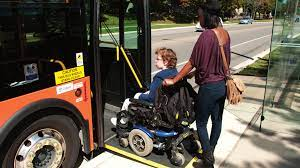
Public transport buses in many countries are the least differently-abled-friendly. One in the best of health needs some effort to board these buses. Many a times, the conductor/ cleaner would push the old and differently-abled into the bus; could be the next bus is close at his heels and does not want to get delayed.

Seniors in these countries are restricted to their homes –  we respect them too much to be send out for a haircut, for manicure or pedicure, for drinking coffee from the nearby coffee shop, buying vegetables, haggling with the vendors etc. We claim that the children are there to do these for them.

Wait a minute, they also have their feelings too and would love to feel the tomatoes they buy, haggle with vendors to save a few rupees, exchange a few gossip, look pretty and smart.

In most homes, the seniors are confined to a corner of a house and have limited movement or accessibility. To say the least, many are swept under the carpet/ bed. Now days a home nurse is provided to take care of them. Some of our friends here in Canada want to admit their old parents to the available old-age homes. This involves paying a hefty amount as admission fees and monthly payments, which will surprise many. Even though one is ready to pay these, many fear for the social and family stigma that the son has pushed the old parents into an old-age home and is enjoying in Canada/America. All these critics will never do anything to mitigate the problem of the seniors, but will be the first ones to raise shackles of family and social values.

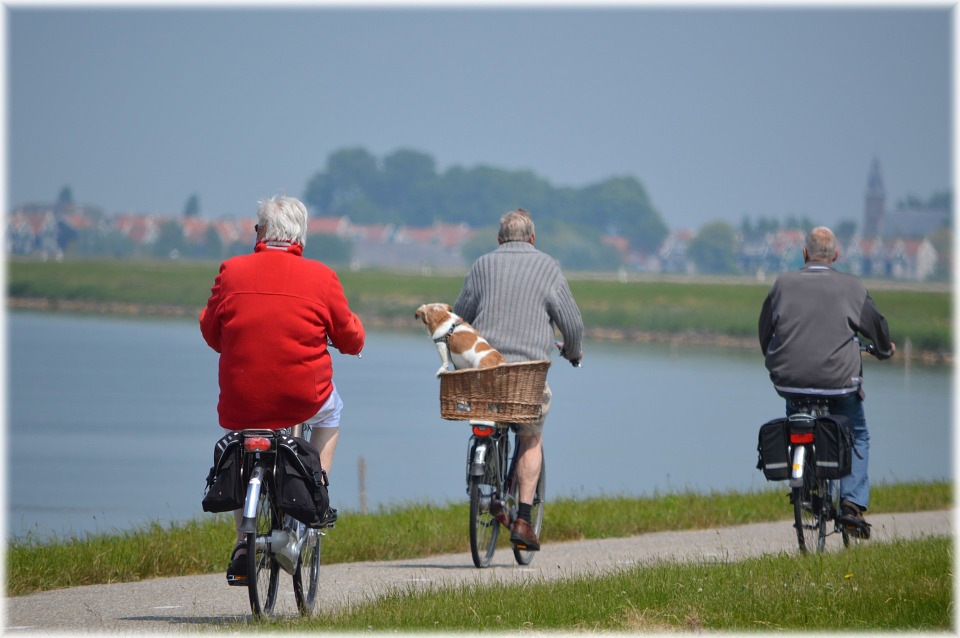
During the three-week vacation in India, I realised that there is no one at home on weekdays as the adults go to work and children to schools. Spending time was the most difficult as there is none to talk to. Only way to pass time was to see those TV serials or listen to music. There is no worthwhile bookstall in Kottayam which sells English novels – most available were old – which I had read before. Then I realised the plight of my mother and I saw that she had read the day’s newspaper from first to last page and had watched four serials by the time her grandchildren were back from school. There are no activities available for the seniors to indulge in and the infrastructure does not permit them to travel around.

OldDisabled

I generally do my chores like groceries, go for a haircut, go to bank etc on weekday mornings – less busy in the Canadian Malls at this time. One sees old couples, dressed in their best, enjoying a cup of tea/coffee, window shopping, talking to other seniors, etc. Some of these seniors are wheel-chair bound. Most of the wheel-chairs are battery powered so that they can move around freely through the Malls.

In case you go for a haircut on a weekday morning, you will find only seniors, waiting for a haircut, a new hair-makeover, pedicure, manicure etc. They would be non-stop chatting with their hairdresser /beautician about their last outing for a movie, holiday, their dog, their children, grandchildren, and the list goes on. The hairdresser would be listening, nodding, at times replying to all those small talks. May be the seniors did spend some time, may be his/ her day was spent very fruitfully. At the end of it, the hairdresser/ beautician gets a decent tip for putting up with all the small talk the seniors did. In India if a senior lady goes to a hairdresser or a spa, she is surely bound to invite comments that the lady is now trying to become a beauty queen. The irony is that many a times these comments originate from their own children and grandchildren.

82-Hazel-McCallion-LR

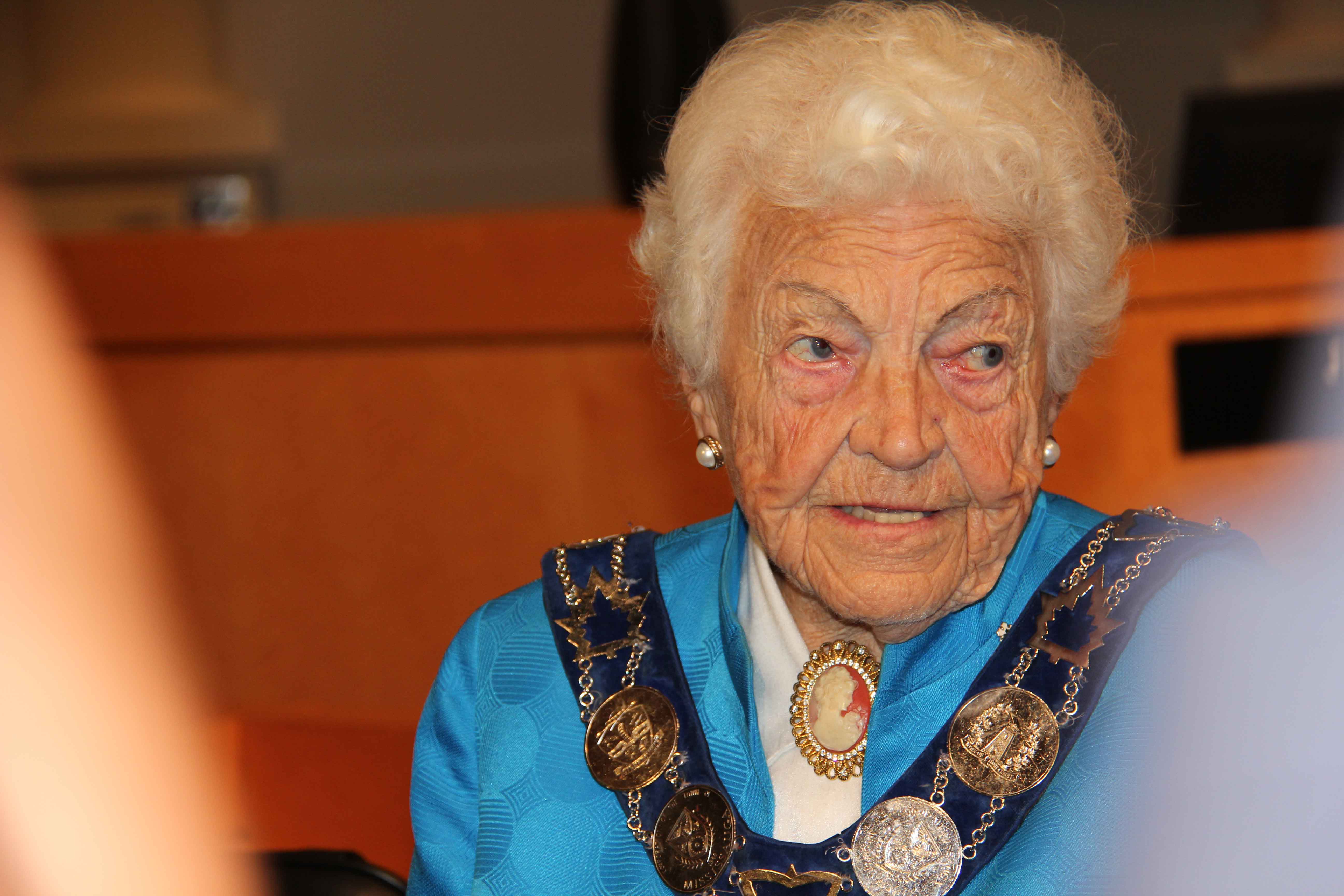
We live in Mississauga, a city adjacent to Toronto. We had Mayor Hazel McCallion until 2014 and she was  was over 92 years old then.  To read more about her, Please Click Here.  A real charismatic lady, who ran the city with an iron hand, drove around in her car etc. Mississauga is the only city in Canada to have a surplus budget and the city boasts of a very high standard of amenities, social life and infrastructure.  Obviously, the real-estate prices are pretty high in comparison to the neighbouring cities.  She spoke at our daughter’s High School Graduation in 2010; what a powerful speaker she is. I wish we also had such powerful seniors back home too.

The public transit in Canada, the public buildings, the malls – all got to be wheelchair accessible by law. Further the Senior Citizens get a good discount on many City Transit systems. Many cannot drive or their licenses have been revoked by the Transport Department due to their medical conditions. These seniors travel on their own without any assistance and do most chores on their own.

Joe’s Canadian Sojourn – Casa Loma

Joe110

Air Vice Marshal TD Joseph (Joe), our course-mate from the National Defence Academy (NDA) and Sophie Joseph visited us during the last week of May 2016.  Joe and I hail from the same village -Ayarkkunnam – in Kerala, India.  Joe was surprised to be invited to many homes of people who had migrated to Canada from the very same village.

Prior to leaving India, everyone wanted to know as to why he was only visiting Canada and not the US.  Most sub-continental travellers presume that Canada has nothing much to offer and a journey to the North American continent essentially was limited to a handful of US destinations.  Joe was however convinced after reading many of my travelogues on my blog that Canada has many fascinating unexplored areas, unknown to even many who have settled here for decades.

The weather was good, adequately warm to undertake long journeys and for trekking.    We travelled well and made use of every minute at our disposal.  The itinerary included Mennonites of St Jacobs, Niagara Gorge, Niagara Falls, Welland Canal, Wine Country, Flower Pot Island, and CN Tower.  (Please click on each one to read about them on my earlier Blog Posts).    We also visited the African Lion Safari and Casa Loma.

Joe111

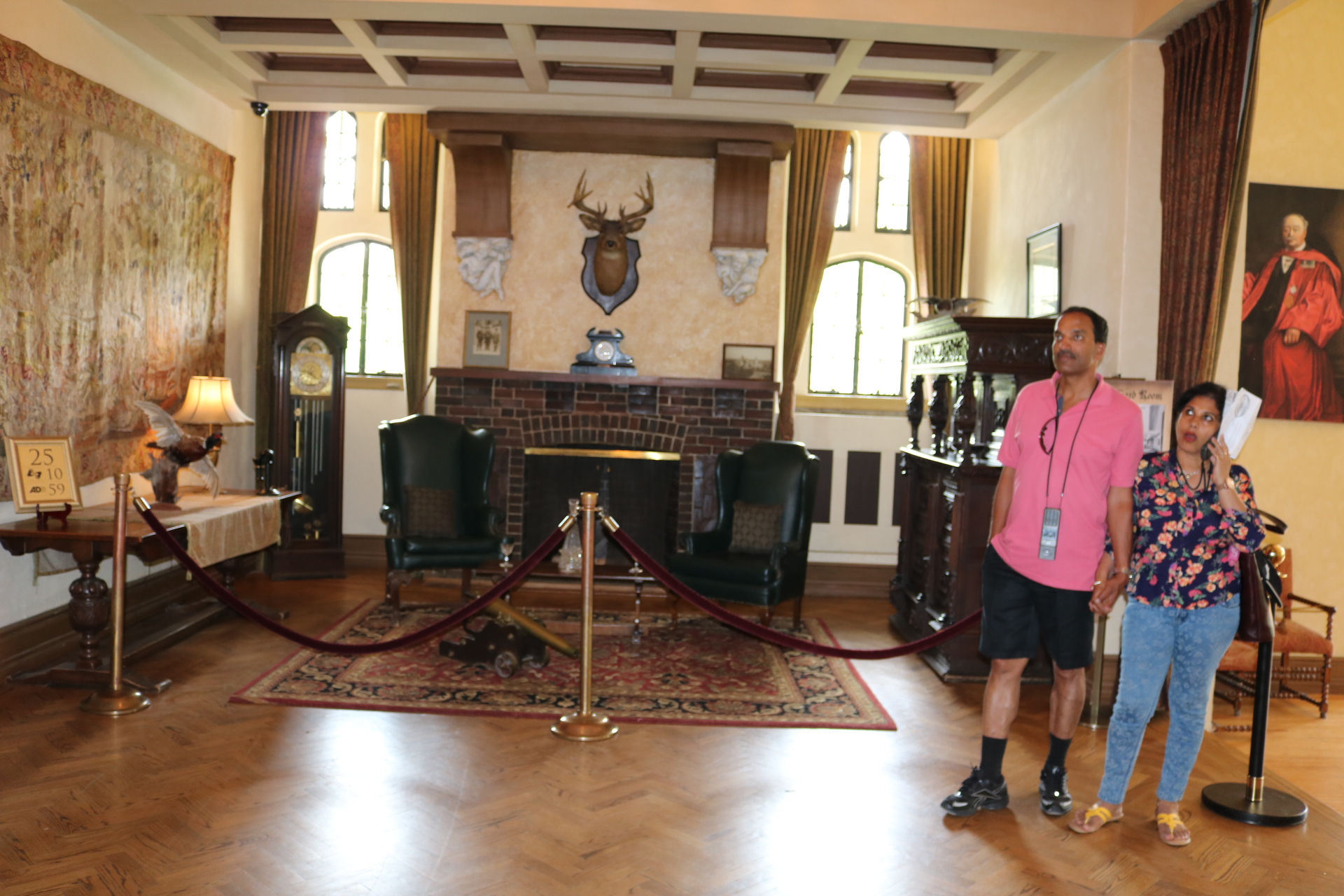
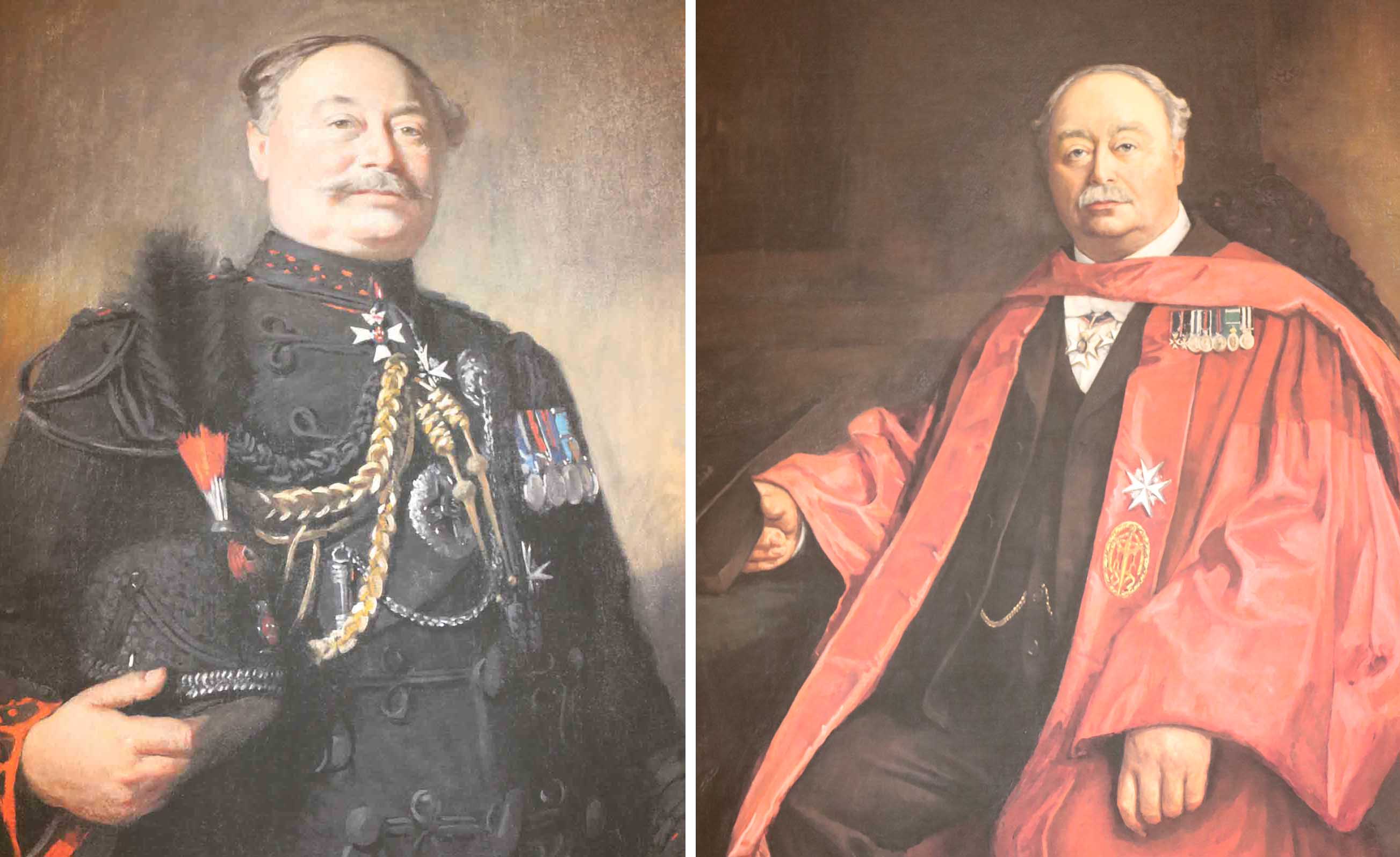
Casa Loma (Spanish for Hill House), was a dream house Major General Sir Henry Pellatt built.  It still stands out as the biggest residential place ever built in Canada.  It was General Pellat’s  dream castle.

Casa Loma took three years and $3.5 million to build (today’s worth about $75 million). General  Pellatt filled Casa Loma with artwork from Canada and around the world. With soaring towers, tunnels and secret passageways, it was a  castle than a private residence.

Casa Loma has 98 rooms, 30 bathrooms, three bowling alleys, an indoor swimming pool, and a rifle range. The original internal telephone system is preserved till date.  Casa Loma had 50 telephones, one in each room, when the whole of Toronto had only 250.  It served as a location for many movies such as X-Men, Strange Brew, Chicago, The Tuxedo,  Love Guru and The Pacifier.

Joe112

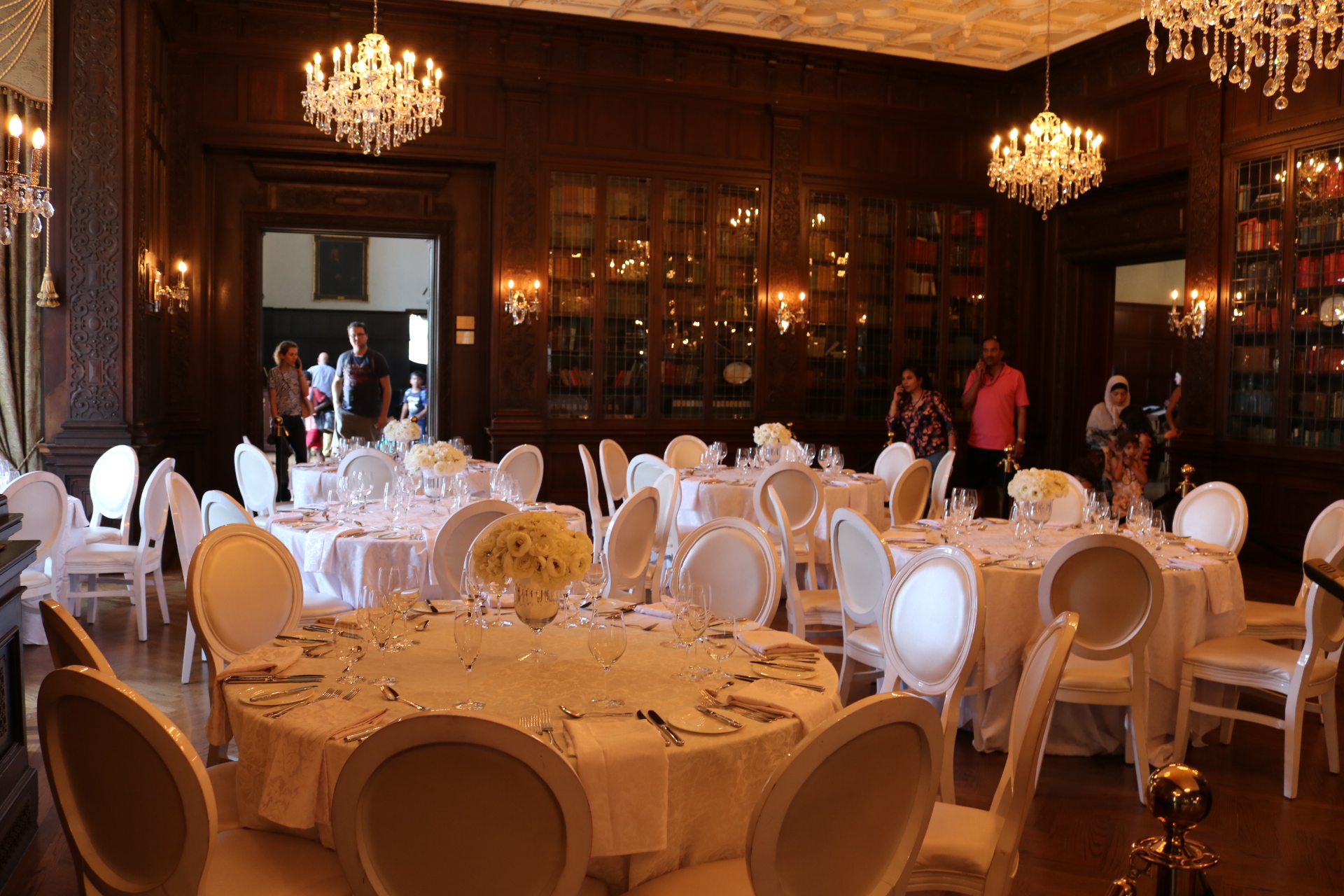
The main floor opens with the Great Hall which leads into a library and the main dining room.  In the main dining room, the Pellatts hosted many formal dinner parties. The 10,000-book library had the Pellatt family coat of arms carved into the ceiling, with herringbone oak floor pattern creating an optical illusion of different shades from each end of the room.

Joe113

Pellatts had a Serving Room which was also used as a breakfast room.  The room was inspired by Roman carvings.  This room was the staging area into which the kitchen staff brought the cooked food for the waiters to carry to the dining room.

Joe114

General Pellat’s Study on the main floor had a marble fireplace with carvings of Hercules on the mantle.  The walls had walnut panels which concealed a secret door on either side of the fireplace – the left one leading to the Pellatts’ bed rooms and the right one to the basement.  The room also boasted of a desk that was the exact replica of Napoleon’s writing desk.

Joe115

This floor also had a  Smoking Room for a game of chess or cards.  Adjacent to it was the Billiard Room where General Pellatt and EJ  Lennox, the architect of Casa Loma and his neighbour,  often played in the evenings.

Joe116

The second floor housed Genral Pellatt’s Suite, separate from Mary’s.  The walls are of mahogany and walnut.  The tiger skin on the floor was imported from India in 1920.  The bathroom has a  shower structured to completely surround the body with spray by using 6 taps that controlled 3 levels of pipes.

Joe117

Lady Pellatt’s suite adjacent to her husband’s suit had walls painted in her favourite colour: Wedgwood blue.  Lady Pellatt’s bathroom was smaller than General Pellatt’s.  It had a bidet, a rare feature in Canadian homes at the time.

Joe118

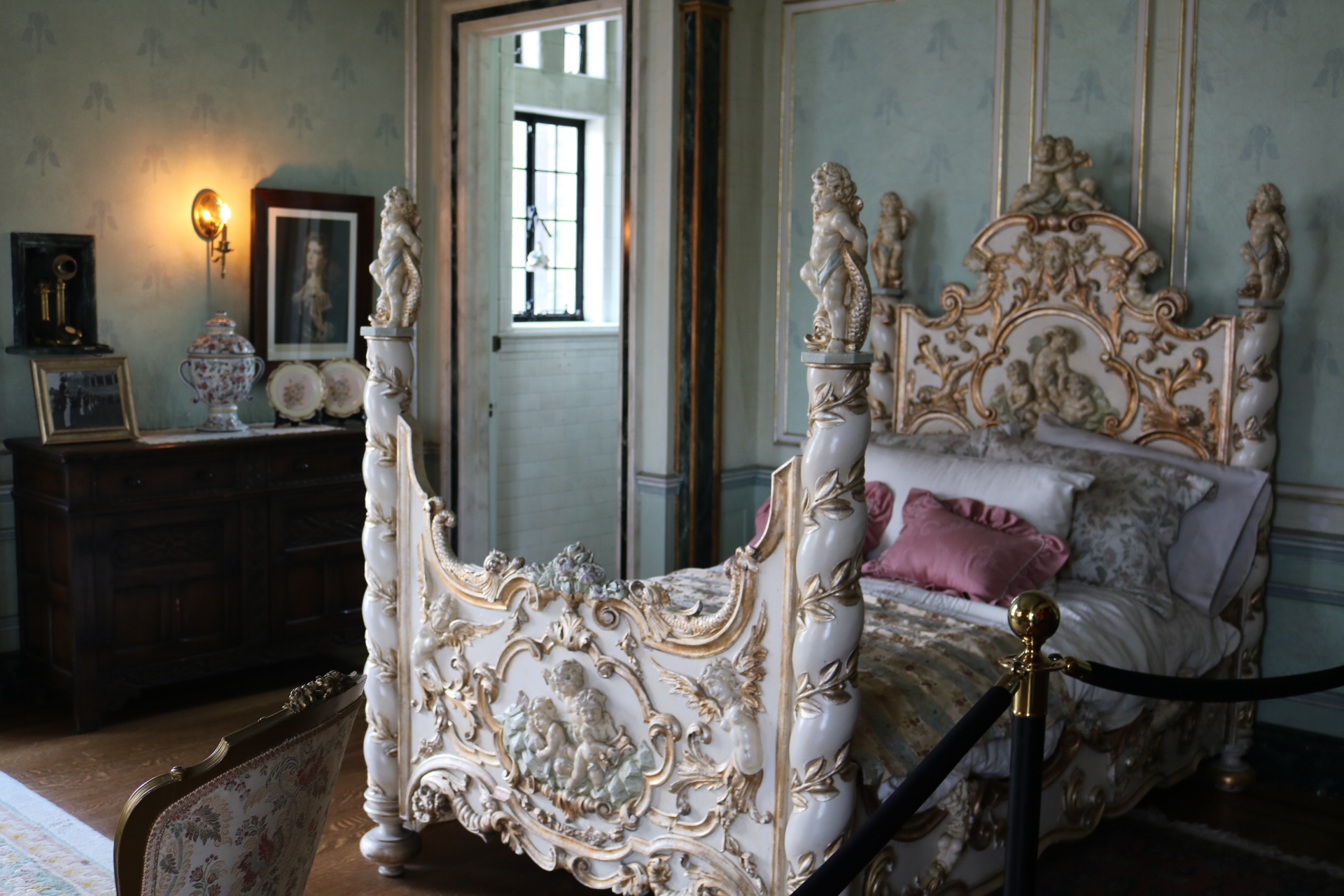
General Pellatt had five guest rooms, all suited for the royalty.  He dreamt of having the Royal Family as guests at Casa Loma.  This room was named Windsor Room after the Royal Family in England.  It has a nineteenth century walnut bed with dolphins carved on to the posts representing Venus.

Joe119

This suite for guests is decorated in Chinoiserie style with a large red lacquered dresser imported from China.  The walls are covered with Chinese inspired patterns of phoenixes and foo dogs.  It also has a Chinese screen with carvings of flowers and trees and a mother-of-pearl peacock.

Joe120

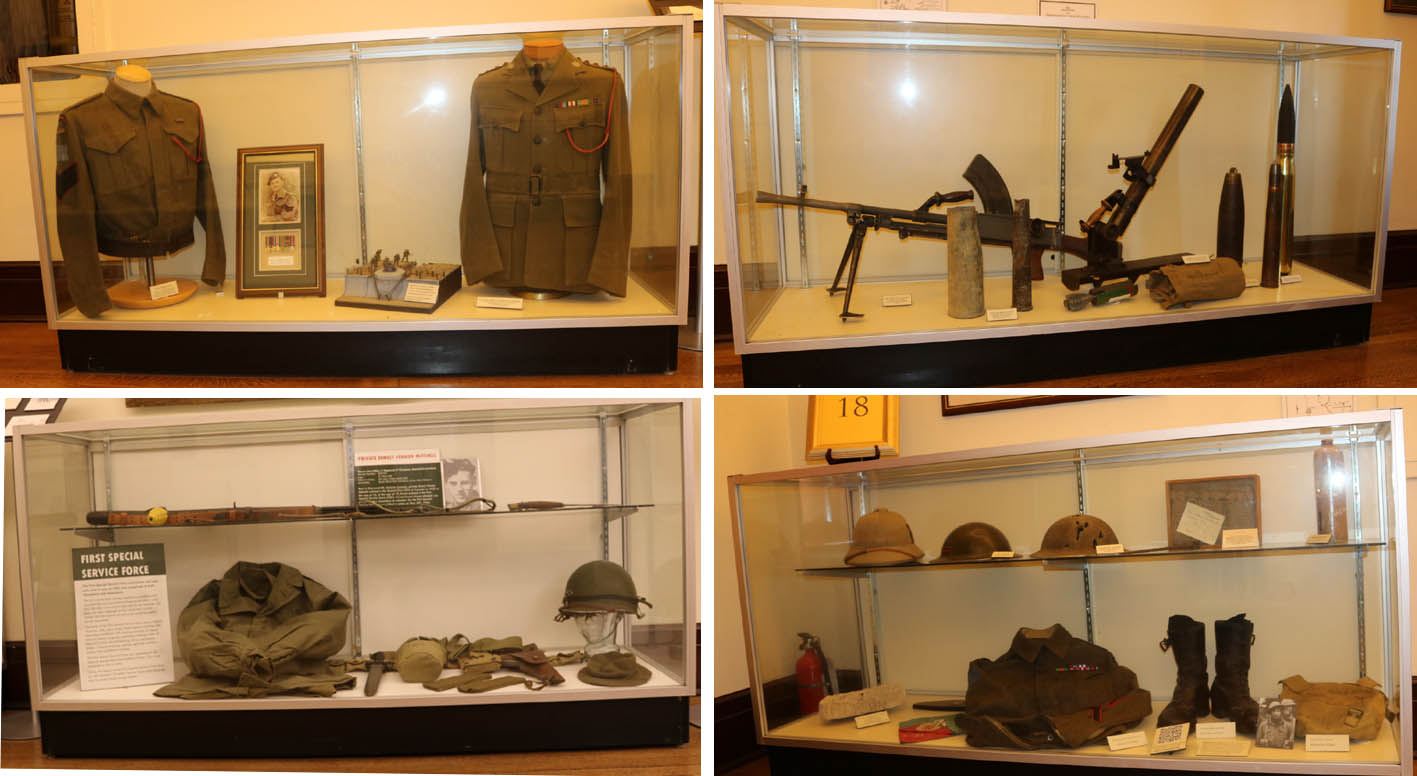
The Third Floor housed the servants’ rooms and the Queen’s Own Rifles Museum.  General Pellatt enlisted as a rifleman with The Queen’s Own Rifles on November 2, 1876.  He rose through the ranks and eventually became the Commanding Officer. In 1905.  In recognition of his services, he was appointed a Knight Bachelor by King Edward VII.

In 1910, Pellatt took the entire 600-men regiment (including its horses) to England for military training at his expense, to mark the Regiment’s fiftieth anniversary from 13 August to 03 October 1910.  General Pellatt later served as the regiment’s Honorary Colonel and was promoted to the rank of Major-General upon retirement.  When Queen Victoria celebrated her Diamond Jubilee, General Pellatt went to England with some men and officers of the Queen’s Own Rifles to be part of the honour guard.

Joe121

In the basement was a Wine Cellar.  Ammonia and brine-filled pipes chilled the collection of nearly 1800 bottles of exotic wine and champagne.

Joe122

The Stables are connected to Casa Loma by an 800-ft tunnel.  The tunnel also housed a coal based heating system to heat the entire building.  Canadian army used the tunnel as a secret base to build a new SONAR system during World War II.

Joe123

The tunnel ended at the stables and garage.  The stalls for the horses are constructed of mahogany and the floors covered with Spanish tiles so that the horses did not slip.  Each horse’s name was inscribed on the wall in 18 Carat Gold.

Joe124

Major General Sir Henry Pellatt was born to British parents in Kingston, Ontario on January 6, 1859.  General Pellatt left his studies when he was seventeen to pursue a career in commerce in the family business. By the age of 23, he became a full partner in his father’s stock brokerage firm Pellatt and Pellatt.  He married Mary Dodgeson whom he met when he was twenty.

He achieved fame in 1879 for beating the US  amateur champion in one mile.  As a partner in Pellatt and Pellatt, he founded the Toronto Electric Light Company in 1883. By the time he was 30, the Toronto Electric Light Company enjoyed a monopoly on street lighting of the city of Toronto.

In 1892 his father retired, enabling General Pellatt to invest with more risk.  By 1901, he was chairman of 21 companies with interests in mining, insurance, land and electricity. In 1902, he won the rights to build the first Canadian hydro-electric  plant at Niagara Falls.  All these he achieved while serving with the Queen’s Own Rifles.  After retirement, in 1911, he began building his  dream castle – Casa Loma.

Unfortunately, General Pellatt’s fortunes nosedived and he went into debt. The one sure source of income from the monopoly of electrical power vanished when the government took over the company without any compensation.  He then invested into the airline business, to be taken over again by the government towards the war efforts for World War I.

Post World War I economy of Canada slumped.  So did General Pellatt’s fortunes.  He owed the Home Bank of Canada $1.7 million and City of Toronto a heavy tax bill.  He had no choice but to auction off his prized possessions for a fraction of their worth and to abandon his dream home – Casa Loma.  After moving into many smaller homes, he last lived with his trusted chauffeur.

Though he lost a great fortune, General Pellatt never lost his spirit of philanthropy, a character trait for which he was honoured late in life. His service of fifty years with the Queen’s Own Rifles was celebrated on June 27, 1926 with a march past of 500 men complete with the fly-past of three military planes.   A dinner was hosted at the Royal York Hotel, a reunion of the Queen’s Own Rifles, for his 80th birthday, including a telegram of congratulations from King George’s wife Queen Mary.  General Pellat was moved to tears.

He died two months later, in his chauffeur’s arms.  Thousands lined Toronto streets to witness his funeral procession. He was buried with full military honours befitting a soldier who gave so much to his country.

Visit to African Lion Safari follows.

Whom Will You Marry?

During lunch, on his return from classes while in Grade 12, our son Nikhil asked me “Why did you marry Mom?  You never dated her, you did not go to school with her, you did not know her from before.  Your parents selected her, you saw and spoke to her for five minutes and agreed to marry her.  What prompted you to take that decision?”

Marry

I said to him that once my parents selected her, they must have seen something good in her and her family.  Her parents and siblings were well educated and she was in her third year of Pharmacy graduation.  Her academic record till then was outstanding, from her high school days until her graduation.  Further, during her high school days, she was the Kerala State champion in 400 meters run.

Now Nikhil wanted to know how it made any difference to me  or to my family.  I explained to him that  by virtue of me  serving as a Major in the Indian Army then, I needed a partner who could cope up with the pressures of being an ‘Army Wife’.  Marina was doing her Pharmacy Graduation at Gulburga in Karnataka State (about 600 km from her home) and hence she had to be independent and ought to have travelled a lot on her own.  She had to be intelligent and hardworking, else she would not have done so well in her Pharmacy course.  Further, she ought to have been physically fit, else she would not have won those laurels in athletics.   She being bit adventurous (I realised after marriage that she was much more adventurous,) would be an ideal life partner  for me.

Now he wanted to know as to whether it has had any effect on the children.  I explained to him that both of us being physically fit and intelligent, the God has blessed us with two kids, intelligent, smart and physically fit.  The kids have no physical deformities like flat foot, knock knees, bow legs, etc, which has enabled them to do well in sports, music and dance. 

WhomWillMarry

With the volley of questions being fired at me, I realised that there had to something more to it.  I prodded him a bit and he said that Ms Kent, the English teacher, was holding a discussion the next day as to “Whom will you marry? A beautiful woman, a rich woman or an intelligent woman.”  The boys in the class had to present their cases and the girls would cross-examine them. 

I now asked Nikhil as to what his take was.  As expected he said he would marry an intelligent woman.  Now we discussed the pros and cons for each case and at the end I said to him not  to be surprised to find that he might be the only one supporting his case.  I advised him to be well prepared to take on the girls and use all his charms, wit, language skills and oratory skills to manage the situation.  

Next evening, at the family dinner, Marina asked Nikhil as to how the discussion in the class went.  Nikhil said that he was the only one supporting the case for an intelligent woman and the rest of the boys were mostly for a beautiful woman.  After everyone presented their cases, most of the questions from the girls were directed at Nikhil.  One girl asked as to whether he would accept a woman if her father offered him a million dollars.  Nikhil countered it by saying that in case the girl is intelligent, he would not stop at a million but would make billions.

Another girl asked him “If the woman is so ugly, then how can you move around with her.”  Nikhil’s point was that he wanted a woman who does neither hitch on to him nor he wanted to hitch on to her.  He was marrying her for companionship and not to show her off as a booty.  Also, he would not have to protect her from gazers.

The boldest among the girls asked “If the woman is so ugly, then how can you have sex with her.”  Nikhil explained that the pleasure of sex is mostly from the mind and hardly from the body.  Most animals during their intercourse do not look at their partners.  Most humans have sex either in the darkness or they mostly close their eyes during an intercourse.  Hence beauty  did not matter to him.

Ms Kent wanted to know the source of this piece of information and Nikhil said “It’s from my Dad”

Now Ms Kent said that she wanted to meet me.  After Nikhil said this, I found Nidhi walking away from the dinner table.  She came back after a few minutes, and I asked as to where she had been.  She said she was chatting with Ms Kent of the Facebook as to why she wanted to meet up with her Dad.  Ms Kent was Nidhi’s English teacher too and were friends after she graduated from high school.  That was when Ms Kent realised that Nikhil was Nidhi’s sibling.

Sitting Position

Walking down our city’s (Mississauga, Canada) streets, one can see many Yoga studios that have sprung up in all the malls.  Anyone will be fascinated by some of the names the studios had – Moksha Yoga, Power Yoga. Parivartan Yoga. Bikram Yoga (named after Bikram Choudhury, the India-born, Beverly Hills-based Yogi,) Infinite Yoga, Hot Yoga, Organic Yoga, etc.  It seems the city has now got into a Yoga craze.  Most gyms in the city offer Yoga classes as part of their fitness regimes.  Our children regularly attended them and are most amused by the Yoga instructors speaking out Sanskrit Yoga terms with their accents.   Most Yogis who teach are non-Indians and the students also cuts across the class divide, with hardly any Indians, as is seen in any outdoor, voluntary, adventure or physical activity in the city.

yyy

Are you familiar with this sign?  Seen it anywhere?  This is the new sign for a Yoga Room, mostly at airports, hotels, gymnasiums across Canada and US.

Think of any busy international airport and you probably think of delays, long lines, hectic and noisy. San Francisco International Airport, however, hopes that those will be replaced by Om and chill because of its new addition: A yoga room, in January 2012.  The facility is open 24-hours a day and is free of charge.  Dallas Fort Worth International Airport opened their Yoga Room in 2012 with Chicago International airport following suit and opened a Yoga Room in 2013.


On a recent trip to India, our connecting flight was delayed by two hours at the Brussels Airport due to inclement weather. As usual the airport lounges were overflowing with stranded passengers. All possible seating were  occupied. There were passengers all over the floor, young and old, some reading, some listening to music, some surfing the Internet on their laptops and some chatting. My attention immediately caught a few children in their early teens from Canada, sitting on the floor with their legs crossed (Chaukadi/ Chamram – Lotus Position) and talking.

I thought with the limited space available, I should take up that position and continue to read the novel I had, to spent the next two hours. My attempt to sit like the children failed miserably in half a minute. I just couldn’t sit like those children. My legs and back were paining and I thought all my muscles had cramped in unison. Then I moved my position next to the wall and with the support of the wall and with my legs stretched out, I could sit and read for five minutes and then I felt I did not have any control over my legs. My attempt to stand took a miserable half minute.

This led me to ponder as to why I had such a problem sitting in Chaukadi position. I travelled through the time graph back to my childhood. I remembered that I could sit like that in the kitchen floor with our father and siblings and we used to eat the meals our mother served. As the economic situation of the family improved over the years, we added a dining room and with it came a dining table and the habit of eating our meals sitting on the floor in lotus position went out of the window.

The only place where I sat on the floor was during the few minutes of sitting interludes we had during the Kurbana (Holy Mass) at the Orthodox Syrian Christian Church. Most of the Mass was offered in our church standing (unlike the catholic churches) and we never had any seating arrangements other than for the old and infirm. The only other time we sat in the church was during the sermon by the priest – I always thought why it had to be that long and mostly repetitive.

In the school we always had a bench and a desk and our father used to tell us as to how privileged we were and that during his school days they always had to sit on the floor, even in high school. Was it a privilege? I started to ponder?

yoga11

On return to Canada, I had to visit our son Nikhil’s Primary school to meet the teacher. As I walked through the aisle, I observed that in all the classrooms, the children and the teachers were sitting on the carpeted floor. Only half the classroom was filled desks and chairs. On enquiring from Nikhil, he said that most of the class time were spent on the carpet.  The children always removed their shoes and placed them in the cupboard outside before entering their classes.  In case someone wanted to wear shoes in the class, the student had to get an ‘indoor’ shoes and had to be kept inside the classroom.  Now I found the answer to my question at the Brussels Airport – as to how the Canadian teens could manage to sit in lotus position for such a long time.

In the school cafeteria, fast-food is banned and pop/ beverages are strict ‘No Go.’  Students are mostly casually dressed and there are no ties and coats/blazers, in most schools there is no uniform.  There is a lot of stress to educate children about the ill-effects of these junk food and pop and the results are showing in the fall of business for these stores.  In India one sees long queues in front of the franchises of American Fast Food Chains.

Later I called up a friend of mine, who is a principal at a private school in Kerala and tried to explain to him the importance of making the children sit on the floor – at least in primary classes. I reasoned with him our old traditions of ‘Ashan Kalari‘ and ‘Gurukulam‘ and as to how children learned to write and read sitting on the floor. The principal said that he could see the advantages of it, but to convince the parents about it would be next to impossible.  In case he implemented my idea, he is sure that his school will face closure as no parent would like to send their children to a school where the students sat on the floor in lotus position.

May be Indians’ loss is Canadians’ gain and Indians are picking up all that the Western World is now rejecting.

Crossing the Highway

On a summer afternoon of 2008, I drove to a town about 250 km away to meet a friend.   I started off on the Expressway and after driving for about an hour at 100 kmph, the eight-lane road narrowed down to a four lane road, two lanes each on either side, uptown and downtown, separated by a 10 meter wide grass covered mound.  The urban concrete jungle I left behind had given way for the cultivated countryside dotted with a few farmhouses, stud farms and dairy farms.

(Illustration by Thomas Graham)

While on a long drive, especially when driving alone, I listen to the news channel on the radio.  It gives me company ensuring that I do not doze off, keeps me informed of what is happening around the world.  The channel updates me every ten minutes with the traffic and weather report.  Suddenly I saw the car 200 m ahead of me and the 70 feet long truck in the right lane, coming to a screeching halt.  I immediately applied the brakes and halted behind the car with the truck on my right.

I looked out in front and saw two geese and about a dozen goslings crossing the road from the grass on the left to the farm on the right, must be in search of food.   Seeing the sizes of the goslings, it became evident that they belonged to two different mothers.  The ganders must have flown out in search of food, leaving the mothers to look after the goslings.

After about two minutes of halting, the radio was reporting the hold-up on the highway caused by the goslings.  The channel was giving a running commentary, giving out every detail of the event.  Looking to my right I saw the news reporter who was responsible for the live broadcast – it was the truck driver on his cell-phone; he must  have called up the news channel.  The news channel as usual must have been hungry for news, especially in a country where there is hardly any political rallies or hartals or bomb-blasts or scams or rail/ road accidents to report.

gc

It took the crossing operation about ten minutes and there was a mile long lineup of vehicles on the highway.  Once the geese and the goslings had crossed the road, the traffic started to roll.

I returned home by about 11 PM and as I steered the car into the driveway of our home, I found our daughter walking in.  She generally is home by 10:30 PM after her classes in the university getting over by 10 PM followed by a 20 minute bus ride.  I inquired about the delayed arrival and she had her story to narrate.

The bus she took from the university, while traveling on the highway, the driver noticed a crack on the windscreen.  He pulled the vehicle off the road to the apron on the right and parked it with the flashers on.  The driver briefed the passengers about the situation and advised everyone to remain calm and remain seated until the replacement bus arrived.

gooslings111

The highways have two aprons on either side.  The one on the left is marked with a continuous yellow line and is meant for the emergency services like police, ambulance or firefighters.  The one on the right is marked with a continuous white line and can be used to stop the vehicles in an emergency like this or may be used by the emergency services.

After about three minutes of halting the bus, two police cruisers pulled up behind the halted bus with their lights flashing.  One parked about 10 meters behind and the other about 400 meters behind the halted bus. The policeman in the second cruiser closed off the right most lane with flares.

After about 15 minutes, the replacement bus arrived which was parked in front of the halted bus.  The police gave an all clear signal after ensuring the safety and the bus driver briefed all passengers to alight from the bus and move into the replacement bus.  That was the time when the driver opened the door.  The two police men were guiding the passengers to the replacement bus.  After everyone boarded the bus, the policemen signaled the bus to go.

One evening I was crossing a busy traffic signal in the city center while walking our dog Maximus. The collar came off the neck of Maximus, who was following me and without realising that Maximus was not there at the other end of the leash. I crossed over. Maximus kept standing in the middle of the road and when I reached the other end of the road and turned back, the signal at the intersection had changed.

No traffic moved and no one honked. I ran to Maximus and held him by his ear and ran to the other end of the road. Lucky for Maximus that no one honked, otherwise he would have ran in panic causing major chaos.

In Canada, the Criminal Code of Canada controls human behavior in relation to animals.  As per the Canadian laws,  animals are considered property. Property rights include the rights of possession, the rights of use, and the enjoyment of property. The original animal cruelty sections of the Criminal Code were enacted in 1892 with only minor amendments made in the mid-1950’s.  It is an offence to wilfully cause or, being the owner, wilfully permits to be cause unnecessary pain, suffering or injury to an animal or a bird.

All lives are precious – whether it is of humans, animals or birds.

Beast – The Wildfire

BEASTAA
(Illustration by Thomas Graham)

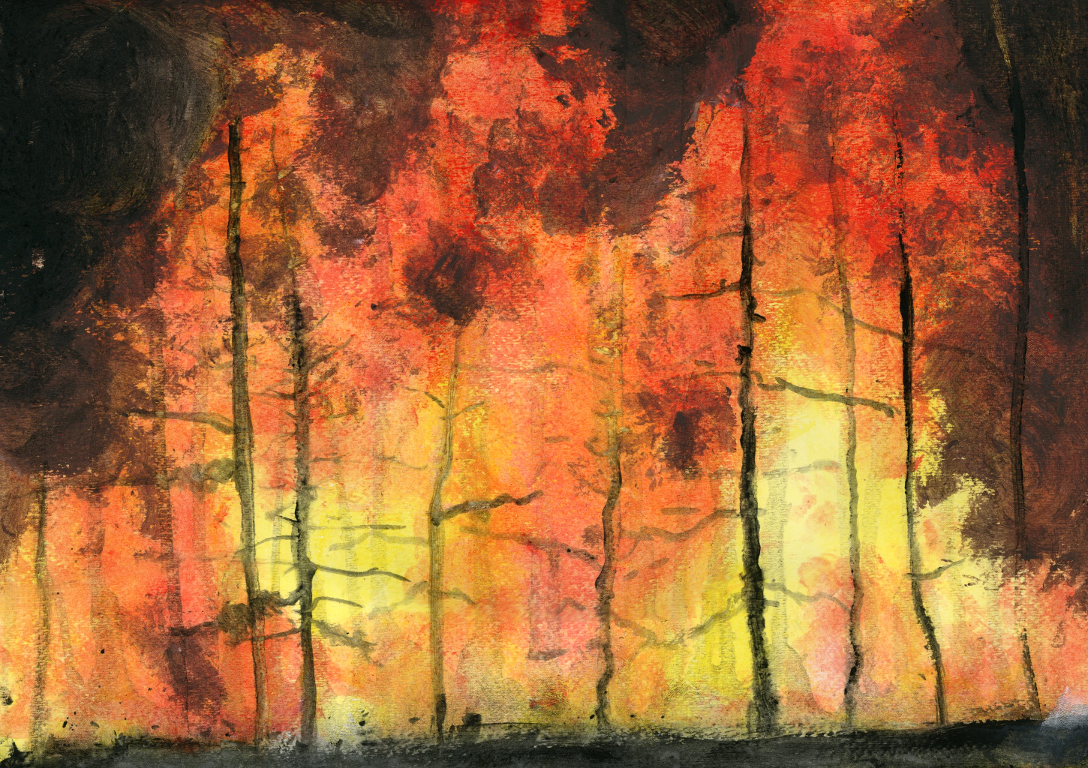
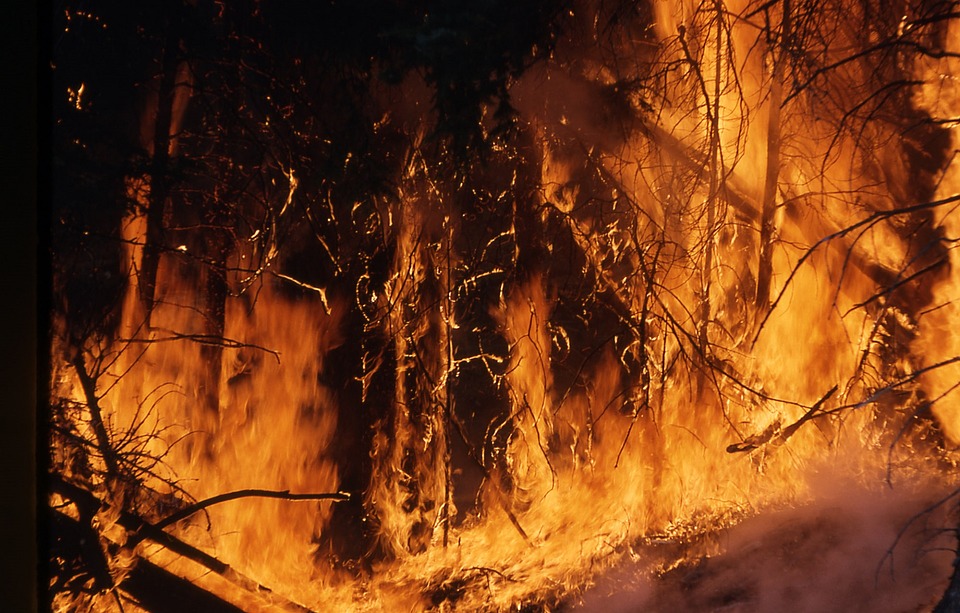
Enormous flames are no longer consuming the city of Fort McMurray, but the wildfire is still active and classified as ‘out of control’ by the Alberta government.  The wildfire travelled 25 to 30 km East and as of 03 May afternoon, it covered about 2300 square kilometres of boreal coniferous forests.  The wildfire of Fort McMurray was christened ‘Beast’ by the firefighters.

The main reason the fire got bigger is that the main Fort McMurray fire merged with a much smaller, separate fire that had been burning to the North-East.  The fire grew due to the favourable weather conditions of heat, dryness and wind.  The firefighters were in the lookout for less windy days, rain, cooler temperatures and more humidity in the air in order to bring the wildfire under control.

Beast2

Flames were only visible at the front of the large active wildfire, and he rest was ‘fields of just black ash’ left behind.  That huge burnt area is extremely dangerous and firefighters have months of work ahead of them.  They are carrying out infrared scans from the air to find ‘hot spots’ where smoke continues to smoulder underground.

About 700 firefighters were working on the Fort McMurray wildfire.  Twenty-six helicopters were being used to transport crews and to pick up and drop water.  13 air tanker planes (water bombers) were carrying water or fire retardant.  It is estimated that there is a total of 1,547 firefighters, 121 helicopters and 28 water bombers battling 25 wildfires across Alberta right now.

Most of those fires are classified as ‘under control.’  Only the Fort McMurray wildfire remained ‘out of control.’

Displaced Fort McMurray residents are getting more resources to help ease their predicament. The Canadian government says it will work to speed up employment insurance claims; Canada Post has announced a mail forwarding program free of charge for Fort McMurray and area residents; and Western Union is waiving money-transfer fees so Canadians can send money to Alberta more easily. Many retailers, pharmacists and others are offering services for those in need.

The evacuation of over 80,000 residents was carried out in an orderly manner.  Police officers helped re-fuel vehicles and generous residents offered these families a place to stay for the night.  The bright lights of RCMP cruisers helped the drivers to remain on road, while above, Canadian Forces helicopters searched for any signs of danger to the fleeing traffic.  There was also a massive airlift of more than 16,000 people.  Wildfire evacuees were mainly accommodated at the University of Alberta residences.

The hospital in Fort McMurray was evacuated – 73 acute care patients and 32 continuing care patients – were flown to Edmonton health care facilities to receive care.

Beast3

Cooler temperatures, higher moisture in the air and lighter winds helped efforts to suppress the fire.   The fire was moving away from Fort McMurray in a South-East direction and unlikely to be a threat as the area is mainly wild land and away from habitation.

An average of 1,200 wildfires are reported in Alberta each year, and half of those fires are caused by humans, according to the National Fire Database.  Lightning is the second-leading cause with 47 per cent.  The fire’s proximity to the city, as well as data that shows that there were no lightning strikes in the area, directly leads to the inference that the cause of the fire was most likely human.

Weather is a crucial enabler of wildfires.  In the days before the wildfire, the weather in Fort McMurray was unseasonably warm, with strong winds and lack of rains.  All combined, it was the ideal scenario for a small fire to grow and spread.  The high temperatures were part of a year-long pattern attributed to El Nino, a periodic warming of waters in the East-Central Pacific Ocean that was at its strongest in recent months since 1997-98.

With summer-like temperatures and continuing tinder-dry conditions, the Alberta Province has banned the use of off-highway vehicles on public lands and provincial parks.  Flying of helicams and drones is banned as it may cause hindrance to the many fire-fighting aircrafts operating in the area.  A province-wide fire ban is in effect.  All open fires, including campfires and charcoal briquettes are prohibited.

In the fight against climate change, forests play a critical role — drawing more greenhouse gases out of the atmosphere than they emit.  But when they burn, much of those stored gases are released back into the atmosphere.  For 6,000 years boreal forests have operated on a cycle of growth, fire, and re-growth.  It will take at least a decade before the forests destroyed by the fires in Fort McMurray are storing more carbon than they are releasing.

Such big wildfires affect plant succession and result in rejuvenation of the process of the maturation of plant systems.  Plant succession refers to changes in vegetation in a specific area over a period of time and is dependent on factors like disasters, changing conditions or human activity. While area of wildlife will adjust to these changes over time, the fire would have been catastrophic to most animals in the area.  The bears and the wolves are going to be destroyed in the first instance but it won’t be long for them to be back in the system

Within one to three years, bears are actually likely to benefit from the fires as there will be a good chance of massive berry crops like blueberries emerging, allowing bears to return and do quite well. Wolves’ success would depend on species like moose and deer that are found in the early stages of the evolution of the forest.

Beast1
Forest fires are a natural phenomenon, and are beneficial ecologically, returning valuable nutrients to the soil that helps a natural rebirth.  Such fires naturally occur in forests every 150 to 250 years.  With changing global weather patterns, the scientist fear that the frequency of wildfires occurring may even reduce to 50 years.

At least nine major oil companies, including Syncrude and Suncor, suspended operations after the wildfire broke out, leaving Alberta’s oil production down by more than a million barrels per day – half of the province’s daily output and one third of Canada’s.  8,000 oilsands workers were evacuated on 16 May as the fire was approaching the oil production facilities.  The fire is not expected to create much havoc as these facilities have some fire treatment in place that will hopefully prevent them seeing too much impact from the fire.

The Russian President Vladimir Putin offered the services of IL-76 water bombers, capable of dumping 42 tons of fire retardant into fire spots.  Canada, however, turned down the offer.  The most difficult part of fighting a forest fire is coordinating smoky skies filled with low-flying helicopters and water bombers.  It is why, over the past few years often the only fatalities in major fires have been due to air crashes.  It would be difficult for the Russian pilots to communicate with the Canadian English speaking firefighters on ground, pilots operating in the area and air effort coordinators.

A pilot died in 2011 when his firefighting helicopter crashed, and another pilot died in 2015 in a water-bomber crash while fighting a wildfires in Alberta. However, there have been no civilian fatalities because of a forest fire since 1938.

Fort McMurray has been sealed off for days, for other than those involved in the firefighting efforts.  Media persons accompanied the Alberta Premier Rachel Notley on her first visit to the area on 09 May; six days after the area was evacuated.  The Canadian Prime Minister Justin Trudeau, visited the area to compliment the firefighters for their efforts to combat the fire only on 13 May.  The PM was of the opinion that when firefighters were busy trying to contain a massive raging wildfire, it is not a helpful thing for him to pay a visit.  Such visits would cause a drain on the firefighting resources and would only prove to be a hindrance.  Are other world leaders listening?

There were many rumours taking round about the wildfire.  A post in Facebook claimed “Eco-Terrorism suspected in Fort McMurray fire.”  The next was of an arsonist setting the fire.   This rumour actually attracted RCMP attention and asked firefighters in the area to keep on guard for lone wanderers. The mysterious fires that prompted the rumour were later found to be flaring up hotspots, a common phenomenon in forest fires.  Also, Fort McMurray is a remote city now populated almost exclusively by police, utility workers and firefighters just waiting to get their hands on a suspected arsonist.  The website ConservativeFans.com ran with the recklessly unsourced allegation that a man with purported ISIL connections had taken responsibility for the fire.

While the full extent of the damage isn’t yet known, we certainly do know that, for those who have been affected by this fire, it is absolutely devastating. It is a loss on a scale that is hard for many of us to imagine.  The biggest lesson learned for any community in preparing for disaster, is to have connections and know the people.  There is a need for everyone to be familiar with the disaster plan in their area and have an emergency bag packed.  The stronger the community is beforehand the better they are going to do after in the recovery.

More than 80,000 residents of Fort McMurray, its entire population, are now entering their third week away from home with no word on when they may be able to return.

4472 Missing Girls

A study report published on 11 April 2016 in the Canadian Medical Association Journal (CMAJ) by a team of doctors lead by Dr Marcelo Urquia, from St Michael’s Hospital, Toronto about variations in male-female infant ratios among births to Canadian and Indian-born mothers, has caught the eye of many and raised a few eye brows.  Dr. Marcelo Urquia is an epidemiologist with a special interest in improving perinatal health, particularly for immigrant mothers and their children.

(Illustration by Thomas Graham)

The study examined birth certificate data of 5.8 million singleton live births to Canadian-born women and 1,77,990 similar births to Indian-born women. The data pertained to births between 1990 and 2011.  The study did not examine the cases of abortions or feticides.  The results of the study are indeed quite alarming.  The study reports that women who emigrated from India and already had two children gave birth to 138 boys for every 100 girls. If they already had three children, they gave birth to 166 males for every 100 females. That ratio rises to 326 boys per 100 girls for those with two daughters who had an abortion preceding her third birth. In some cases, the number of abortions these mothers have undergone would surprise many.  Among Canadian-born mothers, male-female ratios were about 105 males for every 100 females, with negligible fluctuations by birth order, year and province.

The study also noted that children born to an Indian-born fathers skewed the ratio towards more boys per 100 girls at the second and higher birth orders immaterial of whether the mother was  of Indian origin or otherwise.

In Canada, it is a woman’s right to undergo an abortion and is legal and government funded.  No questions are asked regarding the reasons.  It appears that this option has been unduly exploited by the group under study.  Abortion of female fetuses after prenatal ultrasonography, is the most commonly cited explanation in settings where son preference and strong patriarchal cultures are prevalent.  Indians in Canada celebrate the birth of a boy and the celebrations begin from the birthing room.  In contrast, birth of a girl spreads a pall of gloom among family members.

Until 1988, Canada’s Criminal Code required women who wished to have an abortion to satisfy a therapeutic abortion committee, established by a hospital, that the continuation of her pregnancy would be likely to endanger her life or health.  However, in the case of Dr. Henry Morgentaler, Dr. Leslie Frank Smoling and Dr. Robert Scott Vs Her Majesty The Queen, the Supreme Court held that this provision violated the Canadian Charter of Rights and Freedoms.  The Charter provides that “everyone has the right to life, liberty and security of the person and the right not to be deprived thereof except in accordance with the principles of fundamental justice.”

Since 1988, Canada has not had a law prohibiting any type of abortions including abortions for the purpose of sex selection.  Physicians in Canada normally do not perform abortions after the twenty-fourth week of a pregnancy, unless the health of the woman is in serious jeopardy even though they cannot be prosecuted for doing so.

4472 Missing Girls

As per the study, the skewed sex ratio among Indian immigrants in Canada has resulted in about 4,472 missing girls. The actual number of missing girls may be much higher in case repeated induced abortions of female foetuses by this group are taken into account.  These missing girls translate into a deficit in the number of newborn girls to Indian immigrants in Canada to around 200 per year.

Sex Ratio is a term used to define number of females per 1000 males. In most developed countries, the ratio is about 1001 to 1007.  Europe has the best ratio, mostly among the erstwhile Soviet Bloc countries.  The Asian countries, Qatar, United Arab Emirates, Oman, Bahrain, Kuwait, Saudi Arabia, Bhutan, China and India have more male population compared to females.

A study of the Census of India 2011 would throw some light into this skewed sex ratio which stands at 940.  Among the States, Kerala has the highest sex‐ratio of 1084 and Haryana has the lowest of 877.  Considering various religious groups, Sikhs have the lowest sex ratio (786) followed by Jains.  It is interesting to note that the sex ratio is much higher among the tribal groups (976,) although they have the lowest literacy rate (47%) among all ethnic groups.  On the other hand, Jains have the highest literacy rate (94.1%), yet they have the second lowest sex ratio (870,) next only to Sikhs.

This should be a pointer enough to gauge the reasons for the skewed sex ratio among Indo-Canadian children with the highest single ethnic group being Sikhs followed by Gujaratis.  The Indian ethnic groups that contribute to the skewed ratio are obviously more in Canada when compared to the Indians in USA. Also the abortion laws in many of the states in USA are not as liberal as in Canada.

Let me cite a personnel anecdote in this connection. Sitting outside the operation theatre during the C-Section for Nikhil’s birth, the Gynecologist wanted a final confirmation whether to conduct the tubectomy operation too.  I signed the document to confirm the same and handed it over to the Gynecologist.  My mother who was with me asked me whether I would feel bad in case it is a daughter this time too, to which I replied “Never.”  I asked her as to how she had four sons and she said that my father very much wanted a daughter after two sons and when my mother was pregnant with me, they all thought it would be girl.  After I was born and my mother was pregnant the fourth time, my father still held hope that it would be a girl, but my mother said that she always knew it would be another boy.  After my younger brother’s birth, my mother called it a day and got her tubes tied.

During my service with the Indian Army, I always perceived that the girls in the cantonments always outnumbered the boys.  Among the Gunners (Artillery), the saying was that good Gunners always had a daughter as their first child and the better Gunners had two daughters.    It is obviously the girls who are in the forefront among the Indian Army kids.  Please Click Here to read my earlier blog about their achievements and reasons for the military girls in the forefront.

Doughnut & Coffee

CofeeDoghnut11
(Illustration by Thomas Graham)

In 2006 my mother expressed her desire to spend a few months with us in Canada.  Nidhi and Nikhil were thrilled about the arrival of Granny, but Marina and I were a bit apprehensive.  My mother is a diabetic patient and also has complications with her heart.  My brothers were also a bit apprehensive, keeping in mind her medical conditions and her age (72 years then).  My mother, a strong lady that she is, was totally determined to undertake the journey across the seven seas and told everyone in the family that she would be back for Christmas.

She had stayed with us for over two months at almost all our stations of posting, Jammu & Kashmir, Sikkim, Assam, Bengal. Delhi, Pune and Devlali (Maharashtra).  While commanding the unit at Devlali, with Marina away in Canada, my mother  effectively and efficiently discharged the duties of the ‘First Lady’ and chief hostess at home.

Come what may, we decided to get Granny across to Canada and we got her Visa formalities completed.  On 30 June 2006, Marina and kids took off to Kerala and stayed there for two weeks and on their return trip, they were accompanied by Granny.  Both the children took extra care of the Granny throughout the 20 hours of the flight to Toronto from Kochi and also during her stay here.  Nidhi, a fifteen year old teen, accompanied her Granny umpteen times to the washroom, held her hand and walked with her in the malls, while visiting places of interest, calling on friends etc.  At night Nidhi had Granny sleeping with her and she got up at the middle of the night or whenever Granny wanted to visit the washroom.

My mother was a middle school  teacher who taught English and Maths.  The school being Malayalam medium, English lessons would commence from Grade 5.  My mother had done two years Teacher Training Course (TTC) after passing Grade 10.  She started teaching when she was seventeen (1949) and she then had many students much elder to her, some married and some even with children.  Most of the teachers belonged to our village and many were distantly related to our family.

A week after her arrival in Canada, we decided to visit Montreal and take a boat cruise through the St Lawrence River to see various places where pitched battles were fought between the English and French and also historic buildings in Old Montreal.  Montreal is about 550 km (about 6 hours by car) from Toronto and is located in Quebec Province with French as the main language.

We set off for Montreal on a Saturday morning and after two hours of drive, we decided to have a break and drove into a restaurant.  I ordered coffee and doughnut and my mother too wanted the same.  I advised her that doughnut is pretty high in sugar and would do no good to her diabetics.  My mother was very adamant (once she becomes adamant, there is no way out) and Nidhi picked up a dozen assorted varieties of doughnuts and coffee for everyone.  Nidhi explained to her Granny as to what each doughnut was and what they contained (I cannot name more than a couple).  Granny had a look, felt her fingers over a few doughnuts and started sipping her black coffee.  I asked her as to why she was not eating the doughnut she replied that she only wanted to see what a doughnut was and then burst out laughing.

The children became curious about Granny’s laughter and immediately wanted to know the reason for such an unexpected outburst.  My mother started off with her narrative.

One day at school, the high school English teachers asked her as to what a doughnut was.  Such queries always came to her being the senior-most in the middle school and also being better read and travelled than most teachers in the school.  That was the first time she heard the word doughnut and she did not have any clue.  She asked for the context where it appeared and she was told that the line in the text book read “He had doughnut with coffee.”  Now she thought for a while and applying her logical mind said that it may be a nut as it was being taken with coffee.  It was now that she realised what an actual doughnut was.

After exploring the area around and visiting Niagara Falls, it was time for her to get back to Kerala as the severe Canadian winter was fast approaching.  By first week of November, I accompanied her on her return journey.  That was when I realised how difficult it would have been for Marina and Nidhi to manage her during the 20 hour flight.

On reaching Kochi airport all the grand children were there to receive their Granny, whom they missed for five months.  One of them remarked “Till date Granny was National, now she has become International”.

Thomas  Thomas Graham is a young artist from Mississauga, Canada.  He after graduating from Grade 12 in June 2015, is selected to join the prestigious Ontario College of Art and Design (OCAD) University, Toronto, to pursue a degree in illustration and is looking to become an illustrator by profession. 

Volunteer – To Give Back to the Society

Volunteering

“Service to Mankind is service to God” is the proverb highly prevalent all over the world.

“The best way to find yourself is to lose yourself in the service of others” – Mahatma Gandhi

“One should perform karma for the benefit of humanity.” – Rig Veda

“Truly I tell you, just as you did not do it to one of the least of these, you did not do it to me.” Bible – (Mathew 25: 45)

A friend was admitted in the Intensive Cardiac unit of a hospital in Toronto and I had gone there to give moral support and a few soothing words to the members of the patient’s family. I went there with the pretext that the ICU will be as neat, clean and well looked after like the Military hospitals in India. To my unfathomable surprise what I saw made realize how the Canada government cared for its citizens. In Canada, health-care is all government and there are hardly any private medical services.

The patient had suffered a cardiac arrest and his wife called the Emergency Services, who dispatched an ambulance, a police cruiser and a fire engine. Meanwhile, the person attending the call was giving out instructions to help the wife perform CPR. First to arrive on site was the police cruiser and the police officer immediately took on the task of CPR. The ambulance arrived and the patient was immediately moved to the hospital.

In the ICU, the patient was in a coma and in order to control his metabolic activities, his body temperature was reduced by a degree or two. All modern hi-tech medical instruments were employed to monitor the body parameters – many instruments I had neither seen nor heard of. There was one dedicated nurse manning the station 24 hours, each doing 8 hour shifts. (there were eight other beds in the vicinity and each bed had a dedicated nurse). He briefed me in detail about the patient’s medical condition and the parameters being monitored by him.

While leaving the hospital, I noticed that the person who controlled traffic at the entrance, the old lady on a wheel-chair guiding visitors to various wards, the veteran manning the reception at the ICU – all were volunteers. Then I remembered as to the tough procedure our daughter and son had to undergo to get a volunteer position at the local hospital – medical check-up, police verification and recommendations from two high-school teachers. In Canada 40 hours of community service is mandatory to graduate from high school.  It  is sure to carry you miles when applying for university admissions and also would always look much better on one’s resume.

On my next visit to the hospital, I was greeted by a cheerful man in his late seventies, controlling traffic. I was forced to stop and chat with him as to why he is so cheerful and doing a voluntary service. He said that he had to give back to the society what the society had given him. He further added that he commutes by the subway and bus for an hour each way and does a four hour stint at the gate.These six hours is spent fruitfully by him rather than lying on the bed and cursing the world, the people around him and the God. What a great philosophy?

Many of the volunteers I spoke to had similar explanations for their drive to volunteer. One can see senior citizens volunteering at crossings in front of the schools. They ensure safe passage of children for about an hour in the morning, during lunch-break and when the school session ends. In India such services are available to only political leaders and VIPs, both in civil and the military. The points-men lining up the roads to ensure safe passage of the VIP can effectively be utilized to ensure safety of the children, who are a better investment than the VIP.

These volunteers manning these crossings also had a similar point of view regarding volunteering. One retired police officer manning such a crossing said that the city would have to pay heavily in case the city took up task of manning these crossings and the police force will never be available at the peak hours for ‘real’ policing duties.

During field-trips and outdoor visits by the school children, along with the consent form comes a volunteering sheet, which the parents may fill-up in case they are available to help the teachers in smooth conduct of the event. Visualize one teacher handling 30 children on a field-trip? Generally one found about five to six parents accompanying the kids.

As usual people from our sub-continent are hardly seen volunteering. During one of my hospital visits, I met a senior citizen who had immigrated from India at the coffee shop. I inquired as to why our children and seniors do not engage in such volunteer services. He said that our people also do volunteer services – at religious places of worship where they clean the shoes, sweep the floor, cook food, clean utensils etc. To my surprise and disgust he had his philosophy and justification in place – “there we do service to God directly”.

People volunteer their time to an organization because they want to support their community. As per Statistics Canada, in 2010, almost all (93%) volunteers said that making a contribution to the community was a key motivating factor in their decision. Although most volunteers get involved with a charitable or non-profit organization for altruistic reasons, most also believe that they receive substantial benefits themselves. Many stated that their volunteer activities had given them a chance to develop new skills; for example, about two-thirds said their interpersonal skills had improved. Volunteers also thought their volunteer experience had given them better skills in communications (44%), organizing (39%), fundraising (33%) and technical or office work (27%). One-third (34%) also reported that working as a volunteer had increased their knowledge of such subjects as health, women’s or political issues, criminal justice or the environment.

Now think of the vast pool of human resource available in any community in India, who can contribute back to the society. In India, most people retire from their active employment by the age of 60 unlike in Canada where retirement is generally after 70.

Whether you donate money or time, giving back is beneficial–and not just for the recipients. It’s better to give than to receive. Besides feeling good about yourself for doing something for others, giving back is also good for your physical health. Canadian study found 85% of Ontario volunteers rated their health as “good,” compared to 79% of non-volunteers.

Studies have shown a relationship between volunteering and increased self- esteem, with volunteers reporting both greater personal empowerment and better health. Doing for others may stimulate release of endorphins, which has been linked to improved nervous and immune system functions, too.

Helping others can help take your mind off your own problems and enable you to see the bigger picture. Once you see the difference you can make in another person’s life, your own problems can seem smaller and more manageable.

If you wait until you can do everything for everybody, instead of something for somebody, you’ll end up not doing nothing for nobody.” ~ Malcom Bane

Self Help – The Best Help

Deck

यात्री अपने सामान केलिये ख़ुद जिम्मेवार है” (Passengers are themselves responsible for their belongings) is the line written on most state transport buses in India, but this was the first sentence spoken to me when I joined the Military Intelligence Directorate at Army Headquarters by our team leader Major Jawahar Lal Malik.  I never fathomed the depth of the advice at that moment, but was always thankful to Major Malik as I carried it with me for the rest of life – during the days when I commanded the regiment and especially after landing in Canada.

In the Army Headquarters, there is only just adequate resources for doing your official job.  Your  clerk will also have to come in and leave with you; else he will miss his bus back home.  All personal and private tasks have to be done by everyone themselves – making various pay & allowances claims, leave certificates, various applications, etc.  Official noting and letters need to be written by the officer at most times.  Neither there will be anyone to receive you in front of the office, nor to see you off in the evening.  If you intend to sit late, you got to switch off all lights, lock the door and deposit the key with the security and then leave.  All these are thrown out of the window the moment the officer steps out of the Army Headquarters and everything is back to normal when they take up command of the units or formations.  The only reason I could attribute to this behaviour is that most are unsure of their status as commanders and need self assurance at all times – in terms of someone receiving in front of the office, someone to carry the brief case, etc.

Each and every officer posted at the Army Headquarters carried a brief case and since I never had one, the first addition to my personal inventory was the brief case.  The only thing I had in it was the lunch box, another never used before addition.  I had never carried a brief case as I never believed in carrying home to office or vice versa, and I never knew what to carry in it.  During one of the courses I really made an effort to carry a brief case (to give the look of a serious student) and I stuffed it with pens of different shades, shapes and purpose and a notebook.  I never found any use for the contents of the brief case and discarded it forever.

Carrying a pad with me as expected by the seniors, to note down anything and everything that was being said, was one I hated most.  I went through all my Army courses like the Technical Staff Course, Long Gunnery Staff Course, etc all without a pad or a notebook.   As a Brigade Major, the Brigade Commander was always peeved at me not carrying a pad to the morning ritual of staff conference.  Once he ticked me off and asked me where my pad was.  I had to politely say that only cricket players used pads.

On assuming command, I had banned the use of pads in Sainik Sammelans ( I had banned conferences too) – mainly due to the fear that everyone sitting before me would be making my caricatures on their pads – the same way I used to do.  I always believed that what is said must be perceived, understood and acted upon by the soldiers and not to be confined to the pages of a pad.  As a young officer, I realised that long Sainik Sammelans (I have gone through the torture for three hours) resulted in cramped legs and sore bottoms for the soldiers and a few caricatures for the officer.   Could be that some Commanding Officers liked listening to their voices or they thought they could pass down all the wisdom to their men in one go.

Major Malik’s advice came really handy on reaching Canada.  Here everyone does everything themselves –gardening, cleaning the cars, all household chores, plumbing/ masonry/ carpentry, maintenance tasks of the house and the list goes on.  In case you want help, you got to pay through your nose.  The material cost of any household project will only be a third of what a contractor would charge you, rest is all labour.

The greatest advantage one enjoys to practice self help here is the benefits of standardisation in everything you put your hands on.  The doors and windows all come in standard sizes and even the hinges are placed to the standard.  In case you need to change a door, you buy a new one of the correct size and the hinges would be so placed that they will always match with the one already drilled on the frame.  The only standardisation I found in India was for the light bulb and holder – even the electric sockets are never to a standard as you realise that you really need to push it in with all your might or modify the distance between its legs to pass into the socket, when you buy any new appliance.

The do-it-yourself videos on YouTube on repairing a leaking flush tank or a tap, building a deck, paving the drive way etc – are a real boon.  Most of them are well made and demonstrates all steps involved in an easy to understand format.  It also gives out the materials required, tools needed and the time required to execute the project.

We buy most of our home hardware from the Home Depot – a North American retail chain.  The staff there are really helpful, especially the experienced ones.   They will happily explain you everything and help you select the required material from the store’s aisles.  There is no fear of ‘over purchase’ as they have a very convenient return policy – anything unused – other than paint and cut lumber – would be taken back without winking an eyelid and full reimbursement is done without a penny being deducted.

The store also has a tool rental section, where in you can rent any tool at nominal rates.  You got to ensure that is clean when you return it (else they will charge you cleaning charges). They rent you a cargo van also in case you got to transport material that cannot fit into your van/car.

My wife suggested that we build a deck at the back of the house to facilitate sitting outside during the summer evenings for barbeque.  There were two options – call in a contractor or remembering Major Malik – do it yourself.  We took the second option – to reduce the cost to a third and also have fun as we took up the project as a family activity.  Children made the plans, duly approved by their mother, the materials  and tools needed list was prepared.  We marked the layout on the ground and dug the holes on the ground for the poles to set in.  Hired a cargo van from the store and purchased the necessary materials and brought them home.  In the next two days was laborious effort by the entire family and we completed the deck, less painting.  That was the time I realised why we were taught carpentry, tin-smithy, turning, milling etc at the National Defence Academy (NDA).

Thank you Major Malik and thank you NDA.

Silencing the Roar of the Niagara Falls

NiagaraScilence11(Image Courtesy Google Maps)

Niagara Falls is the aggregate name for three waterfalls that structure the Southern end of the Niagara Gorge; the Horseshoe Falls on the Canadian side and the American Falls which includes the Bridal Veil Falls, on the American side.

Niagara Falls is over 12,000 years old and were formed at the end of the last Ice Age, when the melting glaciers formed the Great Lakes. Water from Lake Erie at an elevation of 175m above sea level, flowed downhill towards Lake Ontario which is at an elevation of 75m. While the water rushed from one lake to another, the Niagara River, about 58 km in length; was carved out. At one point, the river had to rush over a large cliff (the Niagara Escarpment). As the falls eroded over time, the Niagara Gorge of about 11 km from where the falls were initially formed.

About 800 years ago, only one fall existed. Due to erosion, Goat Island got carved out, separating the flow of the Niagara River into two channels. The larger channel formed the Horseshoe Falls and carried 90% of the water and the smaller channel, now known as the American channel carried 10%. Please click here to read more about the Niagara Falls.

The New York State Parks have now proposed to shutdown the American Falls for nine months to replace the two 115-year-old pedestrian stone bridges that connect the mainland to Green Island and Green Island to Goat Island and also to repair a concrete bridge that connect the mainland to Goat Island. The State has placed two proposals for the impending task.

The first is a two-year construction which would divert water from the American Falls for five months in the first year, from August to December. The bridges would be demolished and new piers would be anchored to the bedrock and the water flow would be restored in late December. Construction would continue in the second year with the water flowing over the Falls.

The second option is an accelerated one year construction, where in water would be diverted from the American Falls for nine months, April through December. It would affect the entire summer tourism season and require 24-hour-a-day construction.

NiagaraScilence22

Earlier from 12 June 1969, The flow over the American Falls was stopped completely by the US Army Corp of Engineers. It was to remove the large amount of loose rock from the base of the falls to enhance its appearance. When the Falls were shut off, it attracted a drove of tourists. In case the event repeats, tourists from the world over are sure to congregate at the Niagara Falls and the social media would be filled with images and videos of the spectacle.

The erosion of the American Falls resulted in major rock falls in 1931 and 1954 had dumped heavy boulders at the base of the Falls. It was felt that further erosion of the American Falls would result in more rock falls and ultimate death of the American Falls. The Horseshoe Falls is yet to experience such major rock falls.

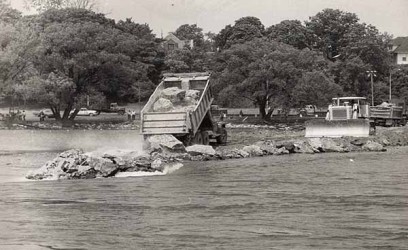
With a view to save the American Falls, the Army Engineers contracted Albert Elia Construction Company to construct and remove a cofferdam to stop the water flow in the American Channel. In addition, they were required to clean the surface of the river bed and remove loose rock from the face of the Falls. A cofferdam is a temporary barrage built within across a body of water to divert the water or to allow the enclosed area to be pumped out, creating a dry work environment for the major work to proceed.

NiagaraScilence33

Construction of the cofferdam began at midnight of 09-10 June 1969 and was completed by 2:40 AM on 12 June. It took 1,264 truckloads, consisting of 27,800 tons of rock and earth, to stop the flow. As the water flow sopped, a fence was erected to prevent onlooker from falling into the gorge.

As the Falls dried, the Niagara Police recovered the remains of a man, a woman and the carcass of a deer amongst the rocks. Closing of the American Channel resulted in heavier flow into the Horseshoe Falls. The boulders deposited at the base of the American Falls was estimated by Army Engineers at 358,000 tons, reaching 41m high in places, reducing the water fall from 30m to a mere 14m.

After studying the rock-falls at the American Falls, the International Joint Commission of the US and Canada came to five conclusions:-

  1. While it is technically feasible to remove the boulders collected at the base of the American Falls, it is not desirable to do so at the present time.
  2. While structural solutions are available to arrest erosion at the crest of the American Falls, the Falls should not be stabilized by artificial means.
  3. A broad environmental study should be jointly carried out by Canada and the US to identify and give priority to those measures which best enhance the total setting and beauty of the Niagara Falls area.
  4. The two flanks of the American Falls and the Goat Island flank of the Horseshoe Falls are sufficiently stable to warrant remedial action.
  5. A statistically minor element of risk from unpredictable rock movement will remain and must be accepted by the viewing public.

On 25 November, 1969 at 10:05 AM a drag-line lifted out the first scoops of earth and rock from the 180m long cofferdam that had been in place since 12 June. There was a little ceremony to mark the beginning of the return to normalcy. David Kennis, age 11, symbolising the next generation, pulled a cord which operated a horn. The blast from the horn signaled the drag-line operator to begin work. By 10:43 AM, the first trickle of water flowed through the dam. The first gush of muddy water spurted through the dam at 11:05 AM, but it was mid afternoon before water once again plunged over the falls. About 2,650 people watched from various vantage points with cameras and newsreels as workers began removing the dam. By the evening of 25 November 1969, the roar of Niagara returned to normal.

In case the water flow of the American Falls is stopped, it would be a breathtaking sight and a spectacle not to be missed, likely to be in 2019 if federal, state or private funding is found right away.

Canadian Woman on Banknotes

Canwomen111

Canadian Prime Minister Trudeau, on the Women’s Day –  08 March 2016 – announced that the image of an iconic Canadian woman will appear on the next issue of banknotes, on the very first of the next series of bills expected in 2018.

The Bank of Canada is taking the first step by launching public consultations to select an iconic Canadian woman to be featured on this new bill.  The government and the Bank of Canada did not indicate which denomination would showcase the iconic female Canadian.

Over the next several weeks, up to 15 April 2016, the public can nominate possible female candidates to be the newest face of a banknote, but there are a few stipulations: The individual must be a Canadian citizen who has demonstrated outstanding leadership, achievement in any field, benefiting the people of Canada, or in the service of Canada; the individual cannot be fictional; and the individual must have been deceased for at least 25 years, that is, prior to April 15, 1991.  An Advisory Council comprised of Canadian academic, cultural, and thought leaders will review the submissions and create a short list of qualified candidates for the Bank of Canada to choose from.

Banknotes are cultural touchstones, and are being used to celebrate and reflect the diversity of the Canadian society. With this proposed note, Canadians can honour the achievements of Canadian women and inspire future generations to learn more about the significant contributions women have made to Canada.

In 2011, the Bank of Canada began releasing a new series of polymer bills. In these banknotes, portraits of five former Prime Ministers are featured in the following denominations: $100 (Robert Borden), $50 (William Lyon Mackenzie King), $10 (John A. Macdonald), and $5 (Wilfred Laurier). Queen Elizabeth II appears on the $20 note.

When the new polymer notes were issued, the popular $50 bill featuring five women from Canadian history was replaced by a new polymer depicting a coast guard icebreaker. The old $50 bills were the only ones depicting women other than $20 bills Queen Elizabeth II.

On October 13, 2004, the Bank of Canada unveiled a new $50 banknote on the theme of nation building. For the first time in Canadian history, Canadian women were featured on the note. The bill featured images of the Alberta women known as the Famous 5, as well as the renowned activist Thérèse Casgrain.  The Famous 5 were petitioners in the groundbreaking Persons Case, a case brought before the Supreme Court of Canada in 1927 and later decided by the Judicial Council of Britain’s Privy Council (1929), Canada’s highest court at that time. Led by judge Emily Murphy, the group included Henrietta Muir Edwards, Nellie McClung, Louise Crummy McKinney and Irene Parlby. Together, the five women had many years of active work in various campaigns for women’s rights dating back to the 1880s and 90s.

The Persons Case was a constitutional ruling that established the right of women to be appointed to the Senate.   In 1928, the Supreme Court of Canada ruled that women were not ‘persons’ according to the British North America Act and therefore were ineligible for appointment to the Senate. However, the Famous 5 appealed to the Privy Council of England, which in 1929 reversed the Court’s decision. The Persons Case opened the Senate to women. Moreover, the legal recognition of women as ‘persons’ meant that women could no longer be denied rights based on a narrow interpretation of the law.

At the time of their victory, the media dubbed the group the ‘Alberta Five’ as they hailed from the Province of Alberta.  Over time, as the case took on a privileged position in Canadian women’s history, the group became popularly known as the ‘Famous 5.’ They have come to represent an entire generation’s political activism, including an earlier, nationwide campaign for women’s voting rights.

Canadian women, aged 21 and over, obtained the right to vote in the  Federal elections in 1918, more than two years after the women of Manitoba became the first to vote at the provincial level in 1916.  Other Provinces then followed suit.  Saskatchewan on 14 March and Alberta on 19 April 1916 gave voting rights to women. British Columbia approved women’s suffrage on 5 April 1917 and Ontario a week later on 12 April 1917.

The provincial franchise for Nova Scotian women came on 26 April 1918.  New Brunswick  approved women’s suffrage on 17 April 1919. Prince Edward Island (PEI) amended its Election Act to include women on 3 May 1922, and Newfoundland women gained the vote on 13 April 1925. In Nova Scotia, PEI and Newfoundland, the right to stand for provincial office accompanied voting rights, but New Brunswick avoided that radical step until 9 March 1934. In Québec, under the courageous leadership of Thérèse Casgrain, the struggle continued until 25 April 1940, when women finally achieved the provincial counterpart to the federal vote they had been exercising for over 20 years.

Reactions to the Famous 5 have varied widely, but the significance of their contribution to the development of women’s rights in Canada was underscored in 2000 with the dedication of a bronze statue called “Women Are Persons!” by Edmonton artist Barbara Paterson in Ottawa and Calgary (1999). The Famous 5 Foundation was established in 1996.

As on the Women’s Day of 2016, as a testimony to women power in Canada, the country boasts of 26% of elected women members of the House of Commons – 88 women out of a 338 total members.  For the first time the greatest number (15 out of 30) of women have been appointed as Cabinet ministers, 50 per cent of Cabinet. On the very Women’s Day,  three provincial premiers are  women –  Kathleen Wynne of Ontario, Rachel Notley of Alberta and Christy Clark of British Columbia. 

In Canada’s nearly 150 year history, women, with the notable exception of the Queen, have largely been unrepresented on the banknotes.  2018 will usher in real change to a new generation of women who will carry with them constant reminders that they are not only Canada’s future, but a celebrated part of history.

Helping Teens to Overcome Profanity

rrr

The Ride Home

Picking up our son Nikhil from school one afternoon—he was in Grade 12—I noticed that he did not look his normal self. After driving for a few minutes, I asked what had gone wrong at school. Slightly surprised by my question and clearly in no mood to answer, he said, “It’s OK.” That response itself was evidence enough that things were not all that good.

After a few minutes, he finally revealed his agony. That morning, his group had delivered a presentation – and two of the four students had come completely unprepared. The result had been a disaster. He was not feeling good about the entire incident.

Watching the Fallout

During the lunch break after the presentation, the student who had put in serious effort tore into the unprepared two. Nikhil admitted that he enjoyed the show—but said not a single word. He wanted to see how silence is golden played out. He also wanted to accept the failure (even though it was not his fault) with humility, while still enjoying the spectacle of the other student castigating the unprepared pair.

He explained all this using a generous helping of North American teen adjectives and prepositions – all those spicy words that most sons would never throw at their fathers. I listened patiently. I did not utter a word. I was not happy about the coarseness of his language, but I decided not to react.

I try to avoid immediate reactions. Children at that stage are never ready to listen or see any logic in what we say. Reacting only pushes up your blood pressure and leaves a bad aftertaste.

Lunchtime Reflection

While having lunch after reaching home, I said to him: yes, you did not have a good day at school, and you were wise enough to accept the failure. But the language you used to explain it should be avoided as much as possible. Bad language, I explained, is never a problem solver – it only ends up as a frustration enhancer.

To this he replied, “Dad, the hormones are kicking in. As a teen, I have no control over it.”

My mind flashed back to my National Defence Academy (NDA) days, where we used the same expressions with our friends to vent frustrations after a horrible event or a bad day.

Why Teens Swear

As children grow up, they tend to experiment with inappropriate language and dirty jokes. In most cases, it is imitation – of adults they have seen at home, in movies, in television shows, or in the community. The need of the hour is to make children realise the appropriateness of the language they use and its impact on listeners.

Many teens resort to inappropriate language to demonstrate that they have become mature adults. Parents must explain that inappropriate language is never an impressive trait; it earns no credit, only disrespect.

It is very easy to preach. But when a careless driver cuts you off, or a heavy object falls on your foot, some profanity is sure to slip out. As a mature parent, acknowledging that you used an inappropriate word—and that you should have avoided it—is in itself a good learning experience for any child.

The Parent Trap

Overbearing, over-controlling parents often drive teenagers to break rules and release parental pressure. Also, to prove they are “cool” in front of their peers, many children end up using swearwords.

It is the parent’s duty to train their children in appropriate and correct language use. Some tips that I used effectively:

Listen, Listen, and Listen. Always make it a point to give patient listening to your children. Show keen interest in what they are saying and provide feedback. If you do not listen to your children, do not expect them to listen to you when they become teens or young adults.

Never Laugh It Off. Most children would take laughter as approval and will repeat the behaviour when they want to steal the spotlight.

Do Not Overreact. Overreaction only reinforces the behaviour. The child is most likely to use it again to gain attention or to irritate you.

Do Not Confront. Anything said to an angry person will only upset them further. Explain alternatives to inappropriate language at a calmer time.

Watch Your Words. At home or while going out with children, use the most dignified language you can muster. Always remember: your child will pick up one swearword a thousand times faster than a hundred good words you utter.

Beginners Do Not Realise. A child just learning to talk often does not understand the meaning or inappropriateness of a swearword. Scolding or punishing serves no purpose. Ignoring it generally works – they do not repeat it.

Explain to a Grownup. For a middle or high school child, a simple explanation about the inappropriateness of the word often yields good results.

Punish Only When Needed. A timeout, suspension of certain privileges, or grounding for profanity will reduce the use of swearwords, especially by teens.

Create Expressions. Encourage teens to develop a collection of effective expressions to use in place of swearwords—to deploy in inescapable situations.

A Final Word

Parents must set examples at home and help children overcome the need to use swearwords.

Mark Twain once said: “Under certain circumstances, profanity provides a relief denied even to prayer.”

Perhaps he was right. But relief is temporary. Respect, once lost, takes far longer to restore. The question is not whether teenagers will swear – they will. The question is whether we can teach them that words have weight, and that silence, sometimes, is not empty. It is full of answers that shouting can never reach.

PRIDE Parade of Toronto

Trudeu1

Indian Parliament, on 10 March 2016, voted against the introduction of Shashi Thraoor’s  private member’s bill to decriminalise homosexuality.  The Parliament thwarted Thraoor’s  second attempt in three months to introduce the measure. Tharoor said it was ‘religious bigotry’ of the ruling party that had disallowed discussion on his private bill to amend the ‘colonial era’ section 377 of the IPC which criminalises homosexuality, marking ‘a low in the proud annals of Indian democracy.’

Now, Toronto City is all set to celebrate its annual ‘PRIDE Week’ in July 2016.  PRIDE is the acronym for People Recognising Individual Difference Equally.  Toronto’s Pride Week is an arts and culture festival that celebrates diverse sexual and gender identities, and the lives of Toronto’s Lesbian, Gay, Bisexual, Transsexual, Transgender, Queer and Questioning (LGBTQ) communities. The theme of the 2016 Pride Parade, to be held on July 03, is ‘belonging and inclusion’. Along with the Canadian Prime Minister Justin Trudeau, Finance Minister Bill Morneau, Ontario Premier Kathleen Wynne (who is openly gay) and Toronto Mayor John Tory are also expected to participate in the festivities.

Since the late 1960s, the LGBTQ community in Canada have seen steady gains in their rights/status. While discrimination against LGBTQ people persists in many places, major strides toward mainstream social acceptance and formal legal equality have nonetheless been made in recent decades.

Canada is internationally regarded as a leader in granting rights to the LGBTQ community. Today, the LGBTQ community have government health care, right to adopt, equality for employment (including military service), and enjoy all rights as applicable to opposite-sex married couples and common-law couples. In 2005, Canada became the fourth country in the world to legalise same-sex marriage.  Thousands of LGBTQ couples, who could not marry in the country where they live, have travelled to Canada seeking a legal marriage.

That was the Canadian side of the story. The Indian Law (Section 377 of the Indian Penal Code [IPC]) is a study in contrast. Unfortunately, it does not guarantee individual choice in matters of sexual preferences, sexuality, and sexual partners. This Section gives the state the authority to even investigate what is happening in your bedroom. It also makes any sex apart from penile-vaginal intercourse between a man and a woman, an illegal act. This severely impacts the LGBTQ community; why, it may also impact married heterosexual couples.

Section 377 of the IPC is a British relic, drafted in 1860 and based on outdated Victorian morals. It has no place in a modern nation like India. It is not even followed by the British today. The British laws now grant equal rights in all aspects to the LGBTQ community and have legalised same sex marriages from 2013.

Section 377 of the IPC is a law that was and can be used to oppress and harass the minority that have different sexual pereferences. The Indian Parliament is reluctant to amend the law. MP Shashi Tharoors’s Private Member’s Bill to decriminalise homosexuality and consensual sex between consenting adults was defeated in Parliament in December 2015. Tharoor’s bill was rejected at the introductory stage itself with 71 ‘Noes’ against 24 ‘yes’. There was one abstention. Tharoor, the lone fighter in this regard, appears to be in no mood of giving up and has promised that he will continue with his fight.

As per Tharoor, Section 377 of the IPC should be amended so that all consensual sex between consenting adults irrespective of gender and sexuality is made legal. It should ensure that forced sex, pedophilia or pederasty is not legalised and is dealt with in a severe manner.

There is an urgent need to amend Section 377 of the IPC as the Constitution of India guarantees Right to Privacy and Dignity under Article 21, Right to Equality under Article 14, and the Right against Discrimination under Article 15. Then why not the right to privacy, dignity and equality and also right against discrimination be guaranteed to LGBTQ people.

Now let us examine as to why there is so much of opposition from the Members of Parliament in making any changes to Section 377 of IPC.

Erotic desire or Kama in Hinduism was deemed as one of the most legitimate pleasures on earth. Premarital sex in Hinduism is frowned upon and extramarital sex is prohibited. Sex was promoted within the context of a loving couple – usually heterosexual. Marriage in Hinduism is said to fulfill three functions: Prajaa, Dharma, and Rati. In marriage, Prajaa is progeny for perpetuation of one’s family, Dharma is fulfillment of responsibilities, and Rati is companionship as friends and mutual pleasure as lovers. There are some references to the ‘Third Gender’ (Trtiya prakrti) in Hindu mythology. The term is loosely defined, referring in general to hetero-sexually dysfunctional men or women, who may be, according to the context, impotent, homosexual or transvestite or even having abnormal genitalia.

Attitude towards homosexuality in Western culture derives from the Biblical teaching on the subject. The Bible claims that homosexuality as a chosen sexual behaviour, is unnatural, sinful, amoral, and against God. Hence, most laws in Western countries, dealing with the LGBTQ community were codified based on it.

“Do not lie with a male as one lies with a woman; it is an abomination.” (Leviticus 18:22)
“Do you not know that the wicked will not inherit the kingdom of God? Do not be deceived: Neither the sexually immoral nor idolaters nor adulterers nor male prostitutes nor homosexual offenders.” (1 Corinthians 6:9)

The New York Times is the first major publication to use the word “homosexuality” in 1926. In 1933, when the Nazis came to power in Germany, they rounded up homosexuals and send them to the concentration camps along with Jews. Gay men had to wear a pink triangle on their camp clothes. Switzerland in 1942 became the first country to decriminalise homosexuality, with the age of consent set at 20. In 1954, Mathematical and computer genius Alan Turing, one of the World War II code-breakers, committed suicide by cyanide poisoning, 18 months after being given a choice between two years in prison or libido-reducing hormone treatment for a year as a punishment for homosexuality. Tennis player Billie Jean King in 1961, became the first prominent professional sports-person to come out as a lesbian.

Sexuality is a very complex issue with many theories but very little verifiable evidence. It has been demonstrated by research that everyone is found somewhere along a bell-curve. To one side there are the resolute heterosexuals and on the other side the resolute homosexuals. The vast majority of men and women are found somewhere along the bell curve in the grey area. When deprived of female company some men will engage in homosexual acts, while others will not. Research has proved that women are more likely to experiment with homosexuality than are men.

British-American Neuroscientist. Simon LeVay said “Yes, we have a choice in life, to be ourselves or to conform to someone else’s idea of normality, but being straight, bisexual or gay, or none of these, is a central part of who we are, thanks in part to the DNA we were born with.”

I wish MP Shashi Tharoor all the best in his drive to cleanse the inequalities in our laws.

An Emergency Travel to India

Emergencytraaa

On 03 March 2016, at about 4 PM, I received a telephone call from my friend Jose. He is generally at work at in the evenings and would never called me this time. My question to Jose was “Anything wrong?”  He said “I lost my Dad about an hour ago.” I asked him as to where he was and he said he was back home from his work place. I said that I would be there in the next ten minutes.

Jose hails from my village in Kerala and was my mother’s student in the village high school. The first time I met Jose was after landing in Canada. There was no occasion to meet him in India as I joined Sainik School at the age of nine, then moved on to the National Defence Academy and then 25 years service with the Indian Army. Jose knew my three brothers very well. Jose, being a lawyer, was a colleague of my elder brother at the Kottayam District Court. He until then was of the impression that my mother, his teacher, had three sons and not four.

During my annual visits to Kerala, Jose would always send some gift for his Dad and Mr Abraham would come home on my arrival to pick it up. He would also visit us on my return to hand over some gift for his grandson Kevin in Canada. Hence, it became a ritual for me to meet him during all my Kerala trips.

I reached Jose’s home and obviously he was heartbroken. I consoled him with a few words and in a minute I was off to coordinating his travel to Kerala. I immediately asked for the travel plans. Jose’s son Kevin, a Grade 10 student, was having his semester examinations and the feasibility of him accompanying his Dad was ruled out. Jose’s wife Pauline now had no option other than to stay back and take care of Kevin. Thus it was finalised that only Jose will travel to Kerala for the last rites of his father.

Jose was advised by me to call up his workplace and request for three weeks off. It was granted promptly by his supervisor. I now asked for Jose’s Canadian Passport and got on to the internet to fill up the Indian Visa application online. There is a need to upload a passport size photograph along with the application. I shot a photo of Jose on my Iphone, edited it and uploaded it.

Meanwhile, I requested Pauline to call up two travel agents to arrange the flight tickets. The options for travel zeroed down to travel by Air Canada – Air India via London and by Ethihad via Chicago. The option of a return trip from India through USA to Canada was rejected as one has to pick up the luggage at Chicago, go through the customs and immigration process, move to a different terminal with all the bag and baggage, recheck in with Air Canada, go through security and then board the flight. The rule in North America is that any passenger landing at any North American port has to get the customs and immigration check done there and then only proceed to their destination, even if it is in a different country. Considering all these factors, we finalised the travel by Air Canada – Air India, leaving Toronto at 6 PM on 04 March and bought the tickets.

When applying for an emergency Visa with the Indian Consulate, there is a need to prove the emergency. For that a booked air ticket for the journey to India and a letter from the hospital or local government authorities regarding the demise of a person is required. Now we called up Jose’s cousin in Kerala to obtain a letter from the hospital regarding the demise of Mr Abraham, indicating him as the father of Jose.

The online Visa application, the eticket from the airline, the letter showing the demise of Mr Abraham and a copy of a passport size photo were all printed and we were ready to proceed to the Indian Consulate at Toronto. Meanwhile, I rang up our neighbour and a close family friend Mr Thomas K Thomas for his help with the Visa application. Mr Thomas is our community leader and is well known to the Indian Consulate staff. He did the liaison with them and instructed us to meet Mr Sharma at the reception and he would do the needful. He also advised me to call him in case of any difficulties or delay.

Meanwhile there were many well wishers calling up Jose to express their condolences. They seem not to realise what was going on at the other end and kept the telephone line busy with their sympathetic conversation. Most wanted to know ‘How did he die? Which vehicle hit him? Have they filed an insurance claim? Are you going to Kerala? When are you going?, etc.’ Obviously, everyone wanted to know everything, but hardly anyone offered any assistance. Everyone wanted to be sympathetic rather than being empathetic and helpful at a time of need. In effect they were only tying down the telephone line, the most wanted resource at that time to arrange for Jose’s travel.

On 04 March morning we reached the Indian Consulate at Toronto by 10 AM. We obtained a Postal Order for $119 from the Canada Post Office located at the ground floor of the building. One got to have either a Bank Draft or a Postal Order as the Indian Consulate does not accept cash or debit/credit cards.   We met Mr Sharma at the reception and then handed over the Visa Application at the counter. After half an hour, Jose was called and his Passport with the Visa was handed over. The entire process was real fast and efficient.

We reached Jose’s home by midday. I now contacted our family friend Mr Johnson, who works as a supervisor with Air Canada. He advised me to drop off Jose at the airport by 3:30 PM as he would be off duty by 4 PM.   We drove off to the Toronto airport and were received by Johnson, who in no time completed all the ticketing formalities and checked in the luggage and I saw off Jose at the security gate.


Emergencytravel

Dogs and the Fire Hydrants

While walking our dog Maximus, a black Labrador, every morning and evening on a 5 km route through the City of Mississauga, Canada, it was intriguing to see him stop at nearly all fire hydrants (non-existent in India) and expel a part of the contents in his bladder.  Maximus it seems has developed an art of dispensing a small quantity each time so that he can cover all the fire hydrants dotting the entire route.  I observed other dogs also doing the similar act and hence concluded it as a canine act.

ddff

Why do dogs get attracted to the fire hydrants?  As the fire hydrants are located is most likely closer to the sidewalk, all it takes is one dog peeing on it to get it to be a popular spot.  Once one dog marks it, the rest follow.   Dogs like something that extends above the ground level to mark their scent on.

Male dogs are attracted to pretty much anything they can lift their leg up and pee on. Urine is a dog’s visiting card. They will mark their territory on pretty much anything. A fire hydrant is no different than a telephone pole, light pole, or a sign pole. That is how they tell the other dogs who has been there and who is the boss.

Females aren’t much different except they are less dominant and obviously don’t lift their leg to pee, making it harder to aim.   Dogs urine-mark in a number of situations, including while on walks, when in their own homes and yards, and during visits to other locations. A dog must be at least three months of age to urine-mark.

What makes fire hydrants so special?  It cannot be the bright red colour as like all other animals, the canines see in different shades of grey and not in colour.  Height! The three feet high fire hydrant appears ideal for the canine act.  The higher a dog can lift his leg to urinate, the bigger the dog they must be, and the stronger probability they have in making their mark last. A small dog is no match when it comes to masking the smell of urination from a bigger dog.  The shape of the fire hydrants and they being placed at a near constant interval of about 50 meters may also be the cause of attraction.  The association between the dogs and the fire hydrants are more a media creation and also a marketing gimmick by dog toy and treat manufacturers, who make these in the shape of a fire hydrant.

A fire hydrant is an active fire protection measure, and a source of water provided in most urban, suburban and rural areas with municipal water service.  This enables firefighters to tap into the municipal water supply to assist in extinguishing a fire.

In areas subject to freezing temperatures like Canada, only a portion of the hydrant is above ground. The valve is located below the frost line (about 10 feet deep) and connected by a riser to the above-ground portion. A valve rod extends at the top of the hydrant, where it can be operated with the proper wrench. This design is known as a ‘dry barrel’ hydrant.  In this model, the barrel, or vertical body of the hydrant, is normally dry.   It is only in movies you see the fire hydrants spewing out water when hit by a car in a chase.  It is unlikely to happen as the control valve and the water is at least 10 feet below and it would be difficult for any known car of the day to break the cast iron column.

The invention of a post or pillar-type fire hydrant is generally credited to Frederick Graff Sr, Chief Engineer of the Philadelphia Water Works around the year 1801. It had a combination hose/faucet outlet and was of ‘wet barrel’ design with the valve on top. It is said that Graff held the first patent for a fire hydrant, but this cannot be verified because the patent office in Washington DC caught fire in 1836 destroying many patent records from that period.

In the earlier days, at least the 17th century, when firefighters responding to a call would dig down to the wooden water mains and hastily bore a hole to secure water to fight fires. The water filled the hole creating a temporary well, and be transported from the well to the fire by bucket brigades, or later, by hand-pumped fire engines. The holes were then plugged with stoppers, normally redwood, which over time came to be known as fire plugs. The location of the plug was recorded or marked so that it could be reused in future fires. This is the source of the colloquial term ‘fire plug’ used for fire hydrants today. After the Great Fire of London in 1666, the city installed water mains with holes drilled at intervals, equipped with risers, allowing an access point to the wooden fire plugs from street level.

FireHyd11

In most jurisdictions it is illegal to park a car within a certain distance of a fire hydrant. In North America the distance is commonly 3 meters or 10 ft. In the UK, yellow lines are used to keep cars from parking over underground hydrants. The rationale behind these laws is that hydrants need to be visible and accessible to the fire engines in an emergency.  The fine for breaking the rule can be anything from $25 upwards in Canada.

In India we have no fire hydrants and hence no such laws and so no fear of fines.

Canadian Report Card

Competition we faced back home always prompted us to cross-examine our children when they came home with a report card or a test result.  We always wanted to know as to who got the maximum marks, where does our child stand in the class, etc.  At the end of Grade 3 of Nikhil, when he came home with the report card, he declared “Do not ask me how others did as I have no clue as I did not ask anyone about it.”

repc

It is indecent to ask someone their marks in Canada and the marks are confidential and is never announced in public.   The report cards are handed over to the students in a sealed envelope, obviously to ensure confidentiality.

The aim of a progress report in Canada is to enable the students to reach their potential, and to succeed. It is a real challenge for the school as every student is unique and they got to ensure each student gets adequate opportunities to achieve success according to his/her interests, abilities, and goals. The reporting is fair, transparent, and equitable for all students. It supports all students, including those with special education needs and all those learning the language of instruction (English or French). The curriculum is carefully planned to relate to the expectations, learning goals and cater to the interests, learning styles and preferences, needs, and experiences of all students.

All aspects of learning are communicated clearly to students and parents at the beginning of the school year and at other appropriate points throughout the school year or course.   The reporting provides a descriptive feedback that is clear, specific, meaningful, and timely to support improved learning and achievement. It also develops students’ self-assessment skills to enable them to assess their own learning, set specific goals, and plan next steps for their learning.

The high school report card looks more like the Annual Confidential Report (ACR) in the army – it appears as if it leaves no aspects of learning skills and work habit of the child uncovered.  The aspects covered in the report are Responsibility, Organization, Independent Work, Collaboration, Initiative and Self-Regulation.  Strengths and Steps for Improvement are listed out for each subject separately.

RepotCard33

My mind raced back to our Sainik School days and even our army course days, where no marks were ever kept confidential and were mostly put up on a notice board.  I always looked at the mark list on the notice board to make sure that I was not the last.  What an injustice, especially to those who did not fare well!

Once I perused his report card in Grade 11, I asked him a few questions to find out some details about the steps for improvement and we discussed in detail as to how he is going to prepare for his Grade 12.   After discussing the same, I casually asked our son as to how his friends did.  Our son theorised that students want to either show off their marks or feel a bit good when they have really done well or in case they haven’t, they are looking for someone who did worse.  He was not in either and hence did not find out how others did.  I realised that what he said was what I had been doing all throughout my life, either blow the trumpet, or look for someone who did worse to feel happy that you are not the worst.

Our son had done exceptionally well in French and the teacher rewarded him with a recommendation for a cultural and educational exchange program in France.  He went to  Paris (01 July 2014) and returned  on 31 Jul with a French Grade 11 Student, Guillaume Le Floch.  Nikhil stayed with the Le Floch family for a month in France.  Guillaume stayed with us and returned to France on 31 Aug.

While Nikhil was away for a month, I felt a vacuum, both in my mind and at home.  Our dog Maximus seemed pretty depressed and had been running all over the house looking for Nikhil.

We all got to get used to such absence of the kids and this will prepare us to learn to live without them in times to come.

Billy is Right With His Weather Prediction

Billy

Wiarton Willie, the groundhog who lives in Wiarton, Ontario is the primary groundhog predictor of Ontario Province, who has been making his predictions since 1956. On 02 February 2016, the Groundhog Day, Billie predicted six more weeks of Winter, whereas Nova Scotia’s groundhog, Shubenacadie Sam called for an early spring.

On 03 February 2016, the Toronto area recorded the highest ever temperature of 15.5oC. Normally, at this time of the year, there would be about six to 12 inches of snow with the mercury around the freezing mark. The warmest temperature ever recorded on the day was 9.3oC in 1991.

Everyone presumed that Billy may be proved wrong this time, but not Weather-Canada. They also predicted that the winter season would continue for another six weeks.

The above image of our home was shot on 09 February 2016 morning, with about 10 cm of snow and the temperature at 0oC. This indicates the weakening of the El Niño effect. The temperatures in the coming few days is expected to be well below minus 15oC as per Weather-Canada.

The unusual warm temperatures in the first week of February had its effect on the tulip bulbs in our garden. The bulbs were reacting to the warm weather around them and sprouted. Now with the snowfall, they got buried under the snow cover. The foliage that sprouted will turn yellow and die back, returning the bulb to its ‘dormancy’ period. This way, the nature takes care of itself and in Spring (April), these same bulbs will sprout again and bloom.

“When spring came, even the false spring, there were no problems except where to be happiest. The only thing that could spoil a day was people and if you could keep from making engagements, each day had no limits. People were always the limiters of happiness except for the very few that were as good as spring itself.”  ― Ernest Hemingway, A Moveable Feast

Groundhogs and Canadian Weather Prediction

Grndhgday1

What has groundhogs to do with Canadian weather predictions? It is believed that the groundhogs can predict the arrival of Spring on 02 February and is celebrated as the Groundhog Day in Canada and the US. According to legend, the groundhog emerges from its burrow at noon on that day to look for its shadow. If it is a sunny day and the groundhog sees its shadow, according to folklore it gets frightened and returns to its hole to sleep, and winter continues for six more weeks. If it does not see its shadow, it remains outside because the worst of winter is over and the spring is on its way.

The origins of Groundhog Day lie in medieval Europe, where the day was known as Candlemas Day, a Christian festival named for the custom of lighting candles on that day. In case the day was bright and sunny, the Europeans believed that the winter would stay for another six weeks, else they predicted an early arrival of spring. Europeans had hedgehogs also predicting the beginning of spring on Candlemas Day. When European settlers came to North America, they brought the February 2nd legend with them. There being no hedgehogs in North America, they made the groundhogs do the prediction. For the early settlers, the onset of an early spring meant they could begin planting and and hence early harvest, especially with winter provisions dwindling. The major flaw with the groundhog prediction was that unlike in Europe, the long Canadian winters made the exit of the groundhogs from their burrows difficult on 02 February as the burrows were still buried in snow.

There is some truth to the shadow aspect of the legend. Sunny days in winter are generally associated with colder, drier arctic air and cloudy days with milder, moist maritime air. Given the tendency for weather conditions to persist for several days before changing, the weather on any 02 February may continue for a few days, but not necessarily any longer. Since seasons tend to follow a pattern, six more weeks of winter, rather than an early spring, is a statistically better option in Canada.

The North American tradition groundhogs predicting came from Europe with the German settlers. The first reported groundhog prediction is from Pennsylvania, USA in 1887.

Wiarton Willie, an albino groundhog who lives in Wiarton, Ontario is the primary groundhog predictor of Ontario Province, who has been making his predictions since 1956. The role of Willie has been played by several groundhogs over the years as their average life span is 4 to 6 years. Unlike the other groundhogs, Wiarton Willie does not live in a burrow in the wild; he lives in a special house, safe from predators. Other provinces have their own groundhogs to carry out the prediction on 02 February.

A study of weather data over several decades for 13 cities across Canada reveals that the groundhogs’ predictions were correct only 37% of the time and this also may be by mere chance. On 02 February 2016, two of Canada’s groundhogs have made clashing weather predictions. Nova Scotia’s Shubenacadie Sam is calling for an early spring while Ontario’s Wiarton Willie expects six more weeks of winter.

This year’s winters have not only left the groundhogs confused, but also has sent the meteorologists of Weather Canada on a leather-hunt; all courtesy the El Niño effect. This effect, in the first week of December 2015, swamped Chennai (India) with the heaviest rainfall in a century. The deluge resulted in about 250 people dead, several hundred critically injured, many houses and buildings destroyed or damaged, and thousands displaced.

Grndhgday2

This is the image of our home on 03 February 2016 and the temperature 15.5oC. Normally, at this time of the year, there would be about six to 12 inches of snow with the mercury around the freezing mark.   The warmest temperature recorded on the day was 9.3oC in 1991.

Where has the snow gone? Is it global warming? Is it the climate change in action? Is it the effect of El Niño phenomenon?

El Niño has a reputation of bringing mild winters across Southern Canada. It is associated with warmer than normal sea surface temperatures in the Pacific Ocean near the Equator, to the West of South America. During the two strongest El Niño events of the past (1982-83 & 1997-98), the warmest water was right next to the coast of South America. This year the warmest water has shifted to the West of Canada and during the winter it will continue to shift further to the East.

A unique feature of this year’s El Niño is the warmer than normal ocean water temperatures that are widespread throughout the North Pacific (to the West of Canada). Another key to upcoming winter is that it appears that El Niño is peaking at the beginning of winter and a steady weakening during winter. During the winter of 1997-98, El Niño remained very strong through the winter. A weakening El Niño has a different impact on the weather pattern than does a strengthening El Niño. However, if El Niño surprises us and continues to strengthen, then the mild temperatures would persist throughout the winter.

While the strength of this year’s El Niño is comparable to 1997-98, the numerous differences in the global pattern are why a repeat of the mild winter across all of Southern Canada cannot be predicted. It is expected that there would be some snow in the next two months, prior to the Spring in April.

Grndhgday3

The unusual warm temperature has had its effect on the tulip bulbs in our garden. The bulbs are reacting to the warm weather around them and have sprouted as seen in the image above. With the next snowfall, expected in a few days, the foliage will yellow and die back, returning the bulbs to their ‘dormancy’ period. This way, the nature takes care of itself and in Spring these same bulbs will sprout again and bloom.

“When all is said and done, the weather and love are the two elements about which one can never be sure.” – Alice Hoffman, Here on Earth

Canada : New Immigration Regulations – New Challenges

Recently, I have been receiving many a queries regarding immigration to Canada and also regarding the Student Visas.  Hence I am posting the very same article I posted on 15 February 2015.  There has been no major change in the Canadian immigration policies despite the new Liberal Party government taking office.

ImmigCan

Canada has the most educated and qualified truck and cab drivers and security guards in the world. Many of them are immigrants who hold postgraduate degrees in Medicine, Pharmacy, Engineering, Management and Law.  These are the ones who could not qualify through the strict licensing regimes of Canada in their disciplines. They are well qualified and many held important job positions back home, but are less conversant with the demands of their profession in Canada. Many who qualified through the licensing procedure had either succeeded in erasing their (bad or wrong) experiences back home or have worked hard and learnt the Canadian requirements of their profession.

Canada’s education system produces enough highly educated and trained professionals to fill the entry level positions in engineering and applied sciences. There are some openings available in the Healthcare field like doctors, pharmacists and nurses, but the effort required to obtain a license is pretty herculean. The Canadian labour markets demand skilled trades (plumbers, electricians, and truck drivers), retail sector workers, and obviously caregivers to look after the very young and the very old. The engineers and doctors who immigrated in the past 20 years learned this bitter lesson after they landed in Canada.

Over the past 20 years, there are many cases of Canadian immigrants from Africa, Eastern Europe, and South Asia who claim to have been duped into immigrating to Canada. They found it extremely hard to find a job in any field, let alone pursue careers in which they were qualified back home. In fact, recent immigrants are the new face of urban poverty in Canada.

These immigrants themselves are to be blamed for their present status. Most of them applied for immigration to Canada without adequate research about their job prospects, licensing procedures, requirement of tests like IELTS, TOFEL, etc.  Many in the healthcare field landed without exploring the licensing requirements to practice in Canada. They are the most vocal group among the disgruntled immigrants.

The Canadian government also shares the blame for the archaic point system it used to qualify applicants for immigration. Even when Canada faced serious shortages for truck drivers (the most common profession among immigrant Canadian males), the government was busy admitting doctors and engineers. Instead of prioritising younger applicants, the system brought in middle-aged workers, who were educated, but not necessarily skilled for Canadian needs. In addition, they were set in their ways and found it hard to change habits and work ethics.

For many students who arrived in Canada, it was a sure-shot thing for foreign student to graduate with a degree or a diploma, obtain a job and apply for permanent residency. The new immigration regulations have changed this sure-shot occurrence into a game of chance.

Today, most immigrant students take huge loans to finance their studies in Canada in hope for a permanent residency later. Most of them were lured by the big promises their agents made and also paid a hefty sum as commission to these agents.  The catch here is that a student can only apply for residency and for those jobs for which no Canadian worker is available.  The employer has to prove this by advertising in two local newspapers and then certify that no suitable Canadian is available for the job.

Many of these students were carried away by the often heard statement by these agents that Americans and Canadians do not study, they do not attend universities. etc.  To add to this, in many countries there is a false propaganda that their people are doing real well in US and Canada. Please refer my earlier blog https://rejinces.net/2014/07/15/real-propaganda/

The parents of these students spread the ‘news’ around about the successful immigration of their wards to Canada and then about the job they are in and also claim that they did send a lot of money back. All these could be to improve their ward’s value in the marriage market. There are many students in Canada who married while being a student on a student visa and have brought in their partners too on a student visa. They make up a story that their residency application is nearly through and the only way to get their partner in is through student visa.

While the new regulations have added new challenges for foreign students in Canada, they have also improved the odds for highly-skilled professionals and trades.  Instead of a ‘first come, first serve’ basis, the new immigration regulations fast-tracks those prospects whose skills are more in demand in Canada.

As per the new system, prospective immigrants can file an online application and the Canadian government will draw names from this pool, based on the current needs of the labour market. This ensures that only those prospects who meet a certain criteria will be invited to submit a formal application for permanent residency, thus cutting the processing time and overload of applications. By prioritising those applicants whose skills are more in demand, the system improves the odds for new immigrants to succeed in Canada and not be a burden on the state.

Candidates applying for permanent residency would have a higher chance in case they can provide a job offer letter from a prospective employer in Canada.  Finding a job in Canada can take time and may be different from finding a job in one’s home country. Most employers look for Canadian experience and that can be achieved only by volunteering in a position in one’s field.  The students in Canada do so during their education by volunteering and also in the coop opportunity the university offers in conjunction with the businesses around.

Acceptance by the Canadian Government  for permanent residency in no way guarantees employment in one’s preferred profession or any other profession.  Most got to start all over by volunteering in their field, attending courses to upgrade their skills to be at par with the Canadian requirement and passing various regulatory and licensing examinations.

Even if one has the language skills in English or French needed to immigrate to Canada, those skills may not be strong enough to work in the preferred profession. Most professions and trades require one to be fluent in English or French and to have a strong knowledge of all work-related languages.

Canadian employers often do not know how to assess education and work experience from other countries. They might prefer one with experience working in Canada. Getting that experience is one of the biggest challenges for newcomers.

Life in Canada of an immigrant will be different than in their home country. They may have to take a job with lower pay while one upgrades their skills or get experience working in Canada. This may result in change of financial status and life-style. Even if one earns a higher salary in Canada than one was earning in one’s home country, the cost of living in Canada may be higher than one is used to. All immigrants to Canada as a skilled worker, investor, entrepreneur or as a self-employed person, will have to provide proof that of sufficient funds to support the family after arrival in Canada.

Police Brutality Against an Indian Grandfather

policebrutality

On 16 Jan 2016, A federal judge in the US acquitted Eric Parker, the policeman charged for assault on an Indian man.  The judge threw out the case against Eric Parker after his two previous trials ended in hung juries.  In the judge’s opinion,  evidence presented during the two trials did not eliminate the reasonable doubt that the policeman was guilty of a crime. Mr Parker had told jurors that Mr Patel’s actions and appearance were ‘in sequence’ with those of a burglar.  He added that Mr Patel tried walking away and wouldn’t answer questions when officers approached him, and that he was suspicious when the man reached for his pockets and when he pulled one of his hands free during a pat-down.

After President Barack Obama made two rather unfortunate speeches alleging religious discrimination in India, a Madison police officer seriously injured an Indian grandfather during a police stop on 06 February 2015. The incidents showed that the emperor is the one now without his clothes.

Sureshbhai Patel’s story is the reality of many South Asian immigrant families living in North America. His son Chirag Patel, immigrated from a small farming town in India and worked his way through and settled down and started a family in the suburbs of Madison, Alabama. Owning a home in the upscale area is the “American dream” most immigrants from India look to accomplish. After settling down in his new home, he invited his father to come to the US to look after his young son, hoping to mutually benefit from his stay. Thus Sureshbhai Patel began his life in the US.

On that morning, Sureshbhai Patel went out on a stroll in the locality of his son’s home. He was dressed in Indian clothes and as per reports, someone in the area called the police and informed that a skinny black man was walking on the street near his home, close to the garage. The caller said that he saw him yesterday too, walking very close to their home and that he lived in the area for the past four years and had never seen this man before. The caller added that he was about to go to work and was nervous to leave his wife alone while the man walked around outside. The caller said the Patel was acting suspiciously by looking into windows and going through the trash.

Two Police officers on patrol duty, trainer Parker and his trainee Andrew Slaughter, were immediately alerted. The officers reached the spot 8 AM. They approached Sureshbhai Patel, who walking and stopped him for questioning. As the officers were questioning Sureshbhai Patel, he repeatedly said “no English,” “walking,” and “India” as he pointed to his son’s house by repeating the house number. The officers claimed Patel put his hands in his pockets, which escalated into slamming him to the ground. The incident left Patel with a bloody face, and in need of cervical fusion surgery to fuse two vertebrae. Sureshbhai is on his way to recovery and regained feeling in his arms and legs.

This was obviously a case of police using excessive force. Some argued that the police officer had no cause to stop Patel on a public sidewalk and search him, which may be a bit farfetched, especially considering the security scenario around the world.

As usual the Indian media went full blast, criticising the American President and its police forces. Arnab Goswami (most vociferous Indian News anchor) was at his day’s best and his strained vocal cords and as if to pacify him, Alabama’s Governor Robert Bentley, apologized to the government of India for the actions of the Madison police officers. The Governor Bentley also ordered the Alabama Law Enforcement Agency to launch a parallel investigation — the Federal Bureau of Investigation had already begun its own probe — into the ‘excessive force’ that left Sureshbhai Patel, 57, partially paralyzed.

“I deeply regret the unfortunate use of excessive force by the Madison Police Department on Sureshbhai Patel and for the injuries sustained by Mr. Patel. I sincerely hope that Mr. Patel continues to improve and that he will regain full use of his legs,” Bentley said in a letter to India’s general consul in Atlanta, Ajit Kumar. “Finally, and most important, please accept our sincere apology for this tragic incident to your government, Mr. Patel, and the citizens of India who reside and work in our state,” the letter went on.

What are the lessons for the people visiting on staying with their children and grandchildren in US or Canada?

During the morning hours, especially in the summer, there are many such grandparents taking a stroll in the area. The children by then would have left for their work and the grandchildren to the school. One of the best use of this free time is to take a walk, enjoying the nature’s beauty and breathing fresh air, on a sidewalk, that too without the fear of dirt or garbage on the path and feeling safe that there would be no vehicle to hit you or dogs to bite or bark at you.

While walking our dog in the morning, one has observed some newly arrived folks with a tendency to look deep into the houses in the neighbourhood, with an inquisitiveness to record the proceedings. Some stare at the women, especially at those women who are dressed to beat the summer heat. Some inspect the garbage cans placed outside the homes, as they see many articles which would have never been thrown back home (most would have been sold to the scavenger for a few bucks).

These actions are sure to set some alarm bells ringing and also some uncivilised reactions. This is mostly so as people value their privacy and are sensitive about any breaches of their privacy. These reactions are immediately labelled ‘racial’ and claims are made that these reactions were because of the skin colour.

This is where the children or grandchildren have a role to play in educating the parents or grandparents about the society and culture of US/Canada. They need to be briefed in detail about the behaviour expected, especially when on a stroll on the road or the park or while visiting the malls or shopping centres. The educated folks must do a detailed study about it (the Internet is the best source), prior to their arrival in US/Canada.

Writing Skills

For the Canadian youth, armed with Cell phones, Blackberries and Ipods, texting has become the order of the day. The language skills have been relegated and new acronyms, shortcuts and smilies have taken over. Children are also not learning and enjoying social niceties like please, thank you, or it is a pleasure meeting you. They enjoy the anonymity of communicating through technology and tend to say things in text that they would never say face to face.

This phenomenon is not unique to our children. The parents are almost as guilty. They communicate with their children through text messaging. Parents mistakenly think that they are in better contact with their children when the children respond to their messages.

The use of shortcuts while texting hinders a child’s ability to switch between techspeak and the normal rules of grammar. Free flow while writing is hampered, adversely affecting a child’s ability to write a paper, prepare a presentation or write an examination, resulting in poor grades.

The children are not confident enough to speak face-to-face, especially with adults. In many Indo-Canadian homes, I have observed that the children shy away and retreat to their rooms at home when someone comes calling on. The parents need to educate the children the need to come down and meet the guests and exchange a few pleasantries and then retreat to their rooms in case they have any work.

Hence there is an urgent need to go back to the drawing board – that is to write. May be letters to grand-parents and relatives back home or their friends. Another methodology to improve the writing skills is to encourage the child to maintain a journal. In the journal, they can write about anything and everything, like any incidence at school, about a TV programme they watched and so on. Encouraging the child to maintain a diary will surely improve writing skills.

When we joined Sainik School, Amaravathinagar (Thamizh Nadu) at the age of nine (Grade 5) in 1971, the only medium of communication with the parents was the most trusted Post-Card. So we started writing letters at that young age. It was a great fete I thought for a nine year old to write a short letter to his parents and siblings, describing as to how good he felt for being enrolled in a premier school and how good the food was. This was my first attempt at creative writing, not being guided as to what to write, not being corrected and marked by teachers. At the end of each letter writing session, I thought I did accomplish something. The language was Malayalam to start with, but gradually converted to English as I became better at it and could express ideas and thoughts properly. To begin with, the lines I scribbled on the postcard would go up and come down; how good I tried I could never make the letters follow a straight line.

Once we left home and returned to the school after the vacations, we used to write our status reports of our safe arrivals and post it on Monday and would reach home may be following Monday. That was the only time our parents would know that we reached the school safe. They had the trust and confidence in us that we would reach safely, despite change of three trains and bussing to Amaravathinagar. Compare it with today’s children in Canada– not of Grade 5, but even university students – the number of times the cell-phones would have gone-off, even for a trip of an hour. Has the technology made us to lose confidence in our children?  Is it that our parents, with the technology available then, could have only prayed to their Gods and may be that gave then the power not to panic or get pressurised?

fl

Still remember the days I spent at a remote post in Kashmir, cut-off from rest of the world and the only link to civilization was radio and the letters. We used to get a lot of those “Forces Letter” which did not need any postage and that’s when I wrote letters to anyone and everyone, whose postal address I had. Some addresses were wrong and was dutifully returned by the Postal Department.

From our base, one could see the road winding down from the pass and the convoy used to take about two hours to reach the base camp. The convoy was always lead by the mail vehicle, could be that the driver was very experienced with the curves and dangers of the route, or could be that everyone wanted the mail to be the first to reach the base camp. Memories linger of our Soldiers and Officers literally “tracking” the convoy with an expectant gaze, until the convoy reached the base camp. Our Dispatch Rider who used to collect the Dispatches (letters), would be waiting outside the Field Post Office (FPO). Once the Dispatch Rider returned to the post and distributed the letters, the expressions of those who did and did not receive any Dispatches can well be guessed. The next half hour was an undeclared Private time for everyone. Mood of each Soldier who received their Dispatches would depend on the content of each Dispatch. This mood continued to be hidden under their smiles sometimes until he received his next Dispatch; sometimes until he went home on leave, sometimes for months to come. During the snow covered winter months (we used to get 10 to 15 feet of standing snow and the roads were closed), the truck was replaced by a helicopter which used to come once or twice a week carrying the same Dispatches. Rest of the story remained the same but for the difference that the tracking period reduced drastically to less than five minutes.

The art of letter writing may be dead and buried and with it the writing skills of our young generation. Many cannot sit and write a page, with logical thoughts and cannot describe on paper a situation, an event or an experience. Leave alone spelling and grammatical mistakes, even the main idea does not reach the target person. With this reluctance to write, many do not maintain any journals or diaries. Letters, journals and diaries are one of best and cost effective method to develop creative writing skills and you will feel the same sense of achievement what I felt when I wrote those letters at the age of nine.

Challenges in Parenting Faced by Indian Immigrants In North America

Background
A nursing student, 22-year-old daughter of parents who had immigrated to the US from Kerala, was reported missing by her parents on February 24, 2014. She was last heard from by her mother who talked to her, on the phone.  The daughter claimed to be in the library at the university campus, whereas the police investigation revealed that she made the call from a fitness center.

The parents were in for a rude shock when they learned from police that their daughter, who was a nursing student, had not attended classes since May 2013.  All along, her parents believed that she was going to school, and her mother who was under the impression that her daughter was on track to follow in her footsteps. She had been living at home and telling her parents she was attending school all through the fall and winter. The father’s credit card was even charged $6,072 for the Fall 2013 semester. I had heard from our daughter about of a few students who enroll in courses using the parent’s credit card and later cancelling their enrollment and taking the money.

The parents had not been seeing their daughter’s progress card and when her father asked to see the report card, she said there was something wrong with the computer. The mother had noticed that that her daughter wasn’t bringing home college text books. On inquiry, she said that she was doing online reading. In hindsight, how could a mother, who is also a nurse by profession ever accept such an excuse.

On March 11, 2014, the police found her dead body in her car and as per the police, the cause of death appeared to be suicide, due to inhalation of a noxious substance.

Reality Check

This case study reveals the challenges in parenting faced especially by parents emigrating from India. This brings out the need for positive parent-child interactions, especially at teen and adolescence levels. Each age and stage of growth presents unique joys and challenges, and the teen and adolescence years are certainly no exception. In fact, parenting during these years will always present unique situations as a result of the physical, social and emotional changes taking place in your child’s life. The parents have a great deal of influence on the behaviour of their adolescents.

Majority of Indian immigrant parents’ relationships with their children are formal and vertical with regard to age and gender. Communication and authority flow downward consistent with a hierarchical order. Indian parents accept as their duty the care of their children and children’s reciprocated duty is to unquestionably respect and honour their parents. In this context, parents expect children to accede to parental wishes and to behave in ways that reflect well upon the family, and many times the community. Many Indian immigrant parents rely on the inculcation of guilt and shame to keep children, regardless of age, focused on the importance of family obligations and to behave in ways that do not ‘bring shame’ to the family. Anything and everything the child do is castigated with the often-heard remark that ‘it‘s against our culture.

For a majority of Indian immigrant parents in America, the desire for children to succeed educationally and economically is a very high (only doctors and engineers please.) Accordingly, children’s exceptional academic performance is often viewed by parents as an honour to them.

This also forces children to hide their actual performance/ report cards.  Parents are also culprits as they brag about their children’s academic achievements.  It is very significant at high school level and when the child does not secure admission in a worthwhile university, next lot of stories are spun out by the parents.  This further degrades the child’s confidence, and they end up feeling out of place – trying to live in a castle of lies.

Lives of many Indian immigrant children, especially those at high school and university level can well be compared to the Hindi movie ‘Ram Aur Shyam.‘ The children often end up leading a life of double role – one for university and one for home.  It is akin to maintaining two girlfriends at the same time – one should not meet the other.

Concerns of Indian Immigrant Parents in North America

https://rejinces.net/wp-content/uploads/2015/07/prom1.jpg
  • Fear of Losing Children to the American Culture.     Most Indian parents migrate with the hope of making it good with many opportunities North America offers to them and their children. However, they fear that their children, especially those who entered adolescence or young adulthood subsequent to emigrating and those born in North America, are becoming more ‘Americans’ and abandoning the family’s cultural values.  Most of these parents fail to realise that the present young Indian society has changed and have adapted to the American culture of dating, live-in relationships, drugs, pubs, etc, (mostly kept under wraps.)  Some Indian parents often demand that children minimise their activities like dating based on personal choice, partying, using contraceptives, marrying for love vs accepting an arranged marriage, or reject the culture outright. Indian children often perceive their identification with the parental native culture to be a disadvantage to making it big in the American society.
  • Loss of Authority Over Children.           Indian parents become aware of two very painful post-immigration facts of life: that there are vastly different rules for parenting children, and the new rules significantly lessen their general authority over their children. Many parents complain that the children do not listen to them, and some are even scared of saying anything to their children. Parents also lament the ‘permissiveness‘ of the American society that condones children’s rights to challenge parental values and authority and often observe that raising children in North America is same as ‘living with strangers.’
  • Disciplining Children.       Many Indian parents feel restrained in their authority to discipline their children ‘appropriately‘ consistent with the usual and acceptable modes of disciplining children back in India. Many Indian parents used disciplinary practices that by American standards, are considered harsh and even abusive. For these parents, parenting in North America requires accommodation to new value systems, rules, and expectations.  As a result, Indian parents overwhelmingly tend to be cautious in disciplining their children because of their unfamiliarity with other disciplinary methods and fear of breaking the law
  • Loss of Authority to Select Children’s Mate.  Indian immigrant families represent a kaleidoscope of religions and cultures and consider it their right to select and to decide whom the children will (date and) eventually marry. They do not accept the fact that arranged marriages among Indians is on the wane. Notwithstanding the decline in the practice, however, many Indian immigrant parents continue to endorse arranged marriages. Some parents do not hesitate to send marriageable children home to seek a spouse in case there are few or no eligible candidates. Some parents may even ‘import‘ a potential spouse from India.  Some parents do permit culturally exogamous dating and marriages and most children prefer selecting, dating and eventually marrying someone of their own choosing, based on the North American criterion of romantic love. Parents complain that children’s refusal to accept an arranged marriage as a rejection of them and their values and negatively reflect upon them as parents within the community. They also reference the progressively increasing divorce rate among younger Indian immigrants and worry about their children’s ability to ‘make a good marriage.’
  • Loss of Face Within the Community.    Within the Indian community, parents are held responsible for their children’s behaviour and are criticised for their failing as parents, because children’s behaviour reflect negatively upon parents. They believe that it is the paramount duty of their children to enhance family pride by honouring their parents through their culturally appropriate behaviour and outstanding accomplishments. Consequently, when children behave out-of-culture, parents invariably complain that such behaviour dishonour them as ‘Indian Parents‘ and devalue their standing as ‘Indians‘ within the community.
  • Religious Institutions.       Indian parents seem to prove the adage of ‘being more loyal to the king than the king himself’ when it comes to their religious matters. They force their children to attend religious ceremonies, mostly without explaining the details of the ceremony and its significance in real life.  Religious teachers employed by these institutions are ‘fresh off the boat (FOB)‘ from India and do not connect to the North American society and the stresses the children undergo here.   They ensure to instill a feeling of ‘guilt and shame‘ in the Indian parents for not strictly adhering to the religious practices and the ‘sin‘ they are committing by not protecting their children from the ‘hazards‘ of the ‘evil‘ North American society. Their sermons are mostly archaic and have no place in the modern society. Luckily these sermons are in their dialects or in ‘Hinglish/ Punglish/ Manglish,‘ which these children do not understand. These religious heads will talk non-stop on the evils of the North American society but wants you to part with your dollars liberally at any instant.

The Way Ahead

  • Monitor and Supervise your Child.       Children want parents who listen and try to understand, set good examples, and offer guidance. A delicate balance of allowing your child freedom while still exercising a level of parental control is key to your child achieving independence.
  • Monitor Your Child’s Activities.  Show a constant and genuine interest in your child’s life.  Know where your child is at all times. Ask where they are going after school, when they will be home, and which friends they will be with. Parents who actively monitor and guide their children tend to have adolescents who experience positive relationships with peers and who are less likely to use drugs.
  • Check-in Regularly.           Talk to your child after school to ask about their day. If your child is scheduled to be at a friend’s house, call the friend’s parent to confirm the arrangement. Be involved without being overbearing. Your child may protest your monitoring behaviour, but setting boundaries and sticking to them will show your child that you love them.
  • Parent in an Authoritative Style.     Parent with warmth and respect, avoiding being overly controlling or overly lenient. Authoritative parents are warm but firm. They encourage their children to be independent, but as parents, they manage to keep limits and controls on their child’s actions. Authoritative parents openly discuss family rules with their children, which allows the children to express their views. Authoritative parents are nurturing, while providing the rules, guidelines, and standards that children need.

  • Encourage Your Children to Bring Home their Friends.     This will ensure that you meet your child’s friends and know the company he/ she keeps. Interact with your child to find out the activities and conversations that took place during their outing. This is easier said than done as you have to earn the confidence of your child, especially by not reacting to those uncomfortable issues that may crop up. This will provide some insight into the activity pattern of your child outside the school hours
    .
  • Eat Dinner Together.      Eating dinner or at least a meal together as a family provides an ideal opportunity to interact with your children. Talk to your child about their day, their friends, and current events. It also shows that you care enough to take time to listen and learn about their interests. Research finds that teens who eat dinner with a parent five or more times during the week are less likely to smoke, drink, use drugs, get into fights and engage in sexual activity.
  • College and University Students to Study with Education Loan.    The children must utilise the facility of the liberal educational loans, especially those funded by the governments. It not only satisfies the financial need to proceed with higher education but helps in saving income tax also while repayment. Tax benefits on education loan end up reducing overall cost of the loan. Most student loans offer lower interest rates, deferred payment options and a repayment grace period following graduation. This will ensure that the children are better focused on their education. It can also act as a monitoring tool for the parents as the next tranche of the loan would not be released unless the student has scored adequate marks and have the requisite attendance. In case the parents are financially sound, they can assist the child to repay the loan in full or in part upon graduation.

Wishing all parents ‘Great Parenting.’  Remember what Mayim Chaya Bialik, American actress, author, and neuroscientist said, “I came to parenting the way most of us do – knowing nothing and trying to learn everything.

(Photographs are of our daughter Nidhi and our son Nikhil)

To Post or Not To

In a judgement by Chennai High Court (India,) Justice S Ramathilagam ruled: “What is said is important but who has said it is very important in a society because people respect persons for the social status. When a celebrity forwards a message like this, the common people will start to believe it.”

ToPost

Social media is a collection of online communication channels dedicated to community-based input, interaction, content-sharing and collaboration. Some of the prominent examples are Facebook,  Twitter, Whatsapp, LinkedIn, and the list is endless.  There are many blogs, chat groups, email groups, etc, which add to the blogosphere.  A number of militant groups around the world are using social media for intelligence gathering, propaganda, recruiting, and also for communicating with other militant groups.

Social media platforms have become part and parcel of our everyday life and also play a crucial role in our society. Every day, thousands share photographs, videos, information, documents, etc through them.  Obviously, they have become an effective tool in the hands of cyber criminals, militant groups and intelligence agencies.

What are the norms to be followed while posting on the social media, making any comments or forwarding emails?  Some suggested tips  are:-

Ensure Your Children and Spouse are Security Conscious.  Always go through the contact list of your spouse and children with them and delete all contacts they and you do not know personally.  Advise them that in case they receive a Friend Request on any social media site from anyone they do not know, never to accept it.  There have been many instances all over the world where in terrorist groups and enemy agents have used social media to harass the family and friends.   Similarly, do not add strangers as your Friends.  It is also a good habit to cull down your Friends list, at least twice in a year.  You may also delete those friends who did not respond to your posts and also those whom you think are a nuisance.

Trust Factor.   The most important aspect regarding communication is the credibility and trust your friends and the society bestows on you.  While forwarding any mail or making any posts or comments, ensure that this trust is never betrayed.

Accountability and Responsibility.   In this is an age of unparalleled transparency, with the social media providing an open window into individual’s personal lives and minds, it is nearly impossible for anyone to disown a statement or opinion expressed on these public forums. Every netizen is both accountable and responsible for all their actions on the social media.  Any post once made, becomes the ‘property’ of the social media.  Even if you delete or edit the original post, the original still remains somewhere.  The new generation in Canada do not want any of their photographs posted or tagged showing them smoking, drinking or partying as they feel that their prospective employers might dig into the social media.  Some political leaders are now haunted by some ‘innocent’ photos of their youth their friends posted on the social media.

Uploading Photographs.  Post only those photographs that you feel are a must and always give a comment as to why you are posting the photograph.  In case you cannot write a line or a few words as to why you are posting it, it is better to avoid posting that photo.  Posting too many photos is never worth the effort.

Disable Geotagging or Location Based Posts.  In case not disabled, it would provide adequate fodder for the snoopers to gain information about the user’s exact geographical location, thereby revealing much more than one can even imagine.

Awareness About What You Post.   There are hundreds of your friends, their friends and acquaintances, reading your posts.  They may come from different backgrounds, beliefs, religions, customs, etc.   In case your post is likely to hurt the sentiments of any individual, group or a community; it is always better to avoid such posts.  Whenever you post anything against any religion, group or community, always think of your colleagues and friends, then decide for yourself about the respect they may have for you after they read it.   Always think before you post.

Respect Privacy.  The Indian media does not respect privacy and that does not mean that everyone should follow suit.  During the funeral of martyred Colonel MN Rai, Yudh Seva Medal at Delhi, the media and the netizens went berserk with the video clippings and images of the daughter of Colonel Rai saluting the mortal remains of her brave father.  That was a private moment for a daughter and everyone got to respect it.  The Chief of the Army Staff consoling the daughter was also a very private moment for the Chief and hence need to be respected.

Chain eMails and Chain Status Updates.   One often gets these chain e-mails or posts which says that to receive the blessings of a particular God or Saint, forward it to ten of your friends.  Some demand you to forward to ten of your friends else  you will die a horrible death and the list goes on.  By tracking these emails or posts, intelligence agencies, marketing agencies and cyber-crooks  collect information about you, your friends and their interests, beliefs and political leanings, etc.

eRumours.   Next time you receive an email or a post which sounds it might be an eRumour – when in doubt -check it out. Here are some quick ways to check the facts before forwarding or sharing it:-

  • Contact a reliable source, such as a government agency, a professional society, a company or an organisation with expertise on the subject. Many would have already given clarifications about these rumors on their websites.
  • Verify the source and if you cannot easily verify the original source of an e-mail – either the original sender or the alleged source of the information – it is likely to be an eRumour. The perpetrators of such eRumours often falsely attribute misinformation to a seemingly legitimate source.
  • Some eRumours claim to be based on television news stories or are written to sound like news articles. Most news outlets post recent stories, so you can check them out on the TV’s website, even though many news the media channels put up may have their colour.
  • Visit a myth-busting website that lets you search by key words or phrases. If your topic turns up, you will have more information in seconds. If it does not, you can always submit a new rumor for review. These myth-busting sites have searchable archives. You may even bookmark them for future reference.

Share or Forward Only if You Must.  Many times one receives a post or email about a social cause, encouraging those who read it to share it with their friends.  This sharing or forwarding goes on in the network and the chain help spread awareness about the cause.   The intention of the originator was right, but one gets annoyed to see everyone sharing or sending you the very same message.  Sometimes one may notice something of value worth sharing. Hold your horses for a few hours (minutes)  and you will in all probability see someone else sharing it.  During this ‘hold’ time, analyse as to what part of the post has value and write it while you share or forward the information.  Any sharing or forwarding without this value addition is mere ‘post officing’.  Most forwards or shares is accompanied by statements like ‘Amazing Photo’, ‘Stunning Video’. ‘Excellent Article’ and so on.  Always mention as to what you found amazing, stunning or excellent so that the recipient may be benefited from it.  It may be pertinent to ask oneself these questions prior to making any posts:-

  • What is the purpose of the post I am about to share? Is it to draw attention to myself or lift me up in some way? Am I trying to make myself feel better or get compliments?
  • Is what I am sharing genuine and honest? Am I sharing it for the sake of sharing?
  • Would this post be an encouragement to others or would it tear someone down?

Email Forwarding and Plagiarism.   Forward only if you must and in case you have a line or two to write about it to give it some value addition. When forwarding, trim all unwanted ‘fat’ like forwarding history, unwanted blank spaces, etc. Ensure that the ‘meat’ is intact. Always try and use the ‘BCC’ option for multiple addresses. In case you are copying and pasting someone’s email into yours, always credit the source, else it is plagiarism and infringement of the copyright and intellectual property.

Tone.   The social media is based mostly on textual communication.  There is neither any body language for the receiver to perceive, nor is there any visual contact.   Thus the tone of your written expression conveys a lot more than you think.  It is very easy for someone to misunderstand you and presume that you are being sarcastic when you are not.  Further, everyone has their own style of writing and the reader has every right to perceive it in the way they think.  Use of emoticons can reduce suck risks to a great extent.   Putting a simple smiley face at the end of a sentence can do wonders by relieving the tension.

Use Messaging for Private and Personal Matters.   Avoid posting any private or personal matters in the public domains like the Facebook walls or photo sharing sites.  Many aspects are meant to be private among family members or your co-workers or friends.  No one is eager to hear about such matters from a public forum.  If you need to inform your friends or your family about some important and personal news  like a demise of a family member, do not declare it out in the public domain.  It is better to make a telephone call or send an email  or a message about it.

Putting Down Others.   In the blogosphere, every netizen is entitled to their opinion and are always free to express it.  Hence there is no need to put anyone down just because you disagree with that person or you dislike the person or his ideologies.  At times people criticise their friend’s friend who replied to a post, whom they don’t even know. It is embarrassing both to you and your friend.  It is always preferable to execute communication in the correct spirit.

When in Doubt, Do Not Post It, Always Throw it Out.

First, Middle and Last Name

In school and during my service in the Indian Army, my name was recorded as Koduvath RejiKoduvath being our family name. (Please click here to read more about Koduvath family).

Names

 Among the Syrian Christians of Kerala, names traditionally consist of three parts: the family name, the father’s name, and the christened (given) name. However, my siblings and I had only two—the family name and our christened names. As a curious teenager, I once asked my father why our names were so short. Being a headmaster, he gave a characteristically practical reply: the most common question in primary language classes is “What is your name?” He didn’t want his children struggling with lengthy responses, so he kept our names simple. I often wonder how I’d have managed with a typical Syrian Christian name like KuruvillaPhiliposePunnoose, or Zachariah!

The Many Reasons for Name Changes

In Kerala’s Malayala Manorama newspaper, classified columns frequently feature name-change advertisements—mostly women altering their surnames post-marriage. Some adjust the order of their names, while others cite astrological or numerological reasons.

But motivations for name changes vary widely. Some dislike the name their parents gave them. Couples may hyphenate surnames, creating a double-barrel identity. Others anglicize their names to avoid mispronunciation or unintended meanings in foreign languages. Occasionally, a name becomes a professional liability, or a change is needed to counter identity theft.

A Family Tradition: Keeping One’s Name

My mother, Pallathettu Kurian Sosamma, married my father, Koduvath Varkey George, in 1956. Both were teachers, and neither changed their names. My father believed marriage shouldn’t demand the sacrifice of one’s identity. He also considered the bureaucratic hassle unnecessary. This principle extended to his daughters-in-law—my wife, Marina Mani, retained her name, derived from her father’s.

In the Indian Army, it’s common for officers to change their wives’ surnames post-marriage through Part II Orders (official documentation). Many were surprised when I insisted Marina keep her maiden name. Most officers didn’t realize that marriage alone doesn’t legally authorize a name change—proper legal procedures must be followed. Soldiers, too, often bypassed the process, relying on uninformed officers to approve their paperwork.

Naming Our Children: A Deliberate Choice

After marriage, Marina was often addressed as Mrs. Reji – a natural assumption in the Army, where Reji was mistaken for my surname. She disliked it but eventually accepted it. When we named our daughter Nidhi, Marina felt a single name seemed incomplete. I argued against adding my name to hers, avoiding future change of name complications.

Eventually, Marina named her Nidhi SusanSusan being the anglicized form of my mother’s name, Sosamma. Today, she goes by Nidhi Parkinson-Watson, adopting a hyphenated surname. When our son was born, Marina chose Nikhil George Koduvath, giving him a complete name.

The Passport Predicament: Two Identities

While emigrating to Canada, I swapped my first and last names for the passport, becoming Reji Koduvath instead of Koduvath Reji. This left me with dual identities—Indian and Canadian. Our daughter faced minor issues in Canada, where Susan (her last name) is typically a first name, often prompting double-checks during documentation.

Correcting Documentation in the Army

As a commanding officer, I noticed gaps in soldiers’ documentation, especially regarding marriage and children’s birth records. During a Sainik Sammelan (monthly address), I explained the legal name-change process in India (similar to many developed countries):

  1. Affidavit: File before a District Court or Magistrate.
  2. Newspaper Advertisements: Publish in two local newspapers.
  3. Gazette Notification: Finalize in the state’s Official Gazette.

One soldier from Rajasthan raised a concern: in his community, unmarried women used Kumari (virgin) as their second name, which changed to Devi post-marriage (e.g., Ritu Kumari → Ritu Devi). I quipped, “Until legally changed, she remains ‘Kumari’ for life!” I instructed all personnel to regularize any unofficial name changes.

The Canadian Quirk: Searching by Last Name

In Canada, medical searches often use last names. Since Nikhil and I share Koduvath, while Nidhi and Marina have different surnames, I ask clinics to search by our home phone number instead.

Once, a pharmacy technician pulled up five names under our number and remarked, “All three males share a last name, and the two females have different ones.” Puzzled, she asked who the third male was. The answer? Maximus Koduvath—our dog, who also gets his meds under our family file!

Names2