Training Two Levels Up & Down

During most military training and courses, the philosophy of training was to train every soldier and officer two levels up with every soldier and officer capable of functioning at a level higher and aware of the functioning two levels up.  A Section Commander was expected to function as a Platoon Commander and was to be aware of the functioning of a Company Commander.

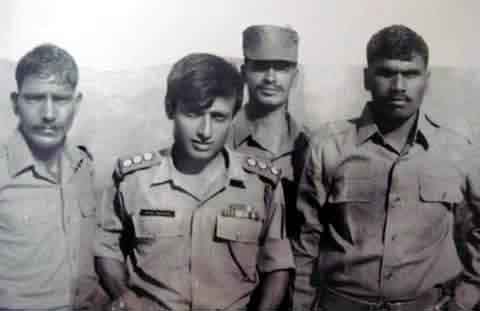
As a Lieutenant, I was the Gun Position Officer (GPO) responsible for deployment of the six guns of the Battery, calculating the technical parameters for engaging targets at about 25 km, ammunition management, administration of the soldiers, maintenance of weapons, vehicles, radio equipment etc.  During our annual training exercise with live firing, our Brigade Commander declared me a ‘casualty.’  Our Technical Subedar took over the duties of GPO and did a commendable job which surely impressed our Brigade Commander.  Four years later, as the Forward  Observation Officer (Captain) during  a similar training exercise, our Brigade Commander declared our Battery Commander a casualty and I carried out the fire planning and engagement of target in support of an Infantry Battalion attack.  We were trained and tested to function a level up.

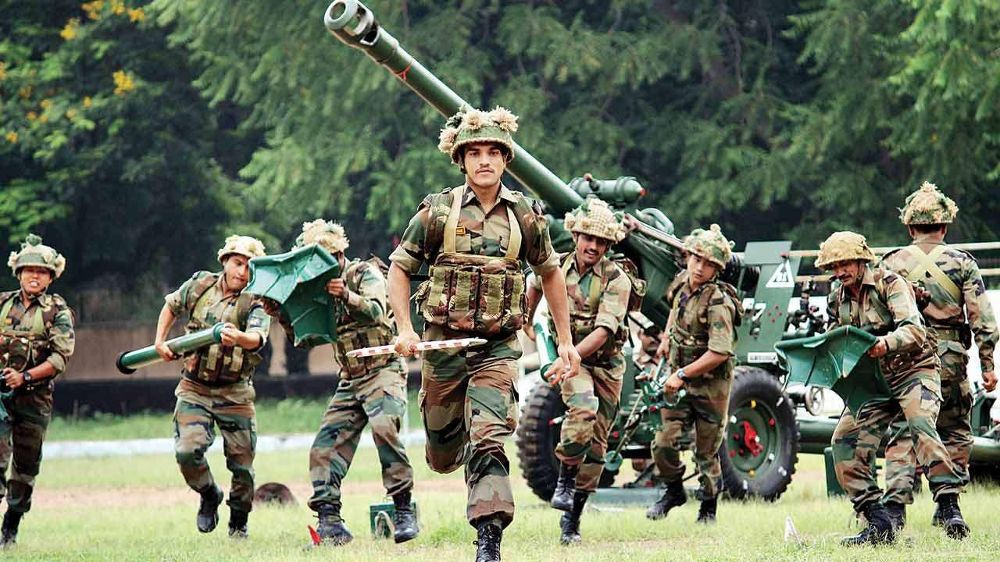
For the annual inspection when I joined our Regiment as a Second Lieutenant in 1983, our Brigade Commander wanted the officers to form a gun detachment of the medium gun and bring the gun into action and carry out various target engagement drills.  The senior most Battery Commander was the detachment commander with rest eight of us – Captains and Lieutenants – formed the detachment.  We trained for a week with our Gunner Subedar Amarjit, a Punjabi Brahmin who spoke chaste Punjabi interspersed with taunting comments as our instructor.  It was a great learning for all of us and it was fun, especially Subedar Amarjit’s commentary and exalting Punjabi punch lines.

Curious to see our Battery Commander training on the gun, I asked him as what could be the intention of our Brigade Commander in making us go through this drill.  He said that it was to build camaraderie among officers and make them well versed with the handling and functioning of the gun.  I wasn’t fully convinced.

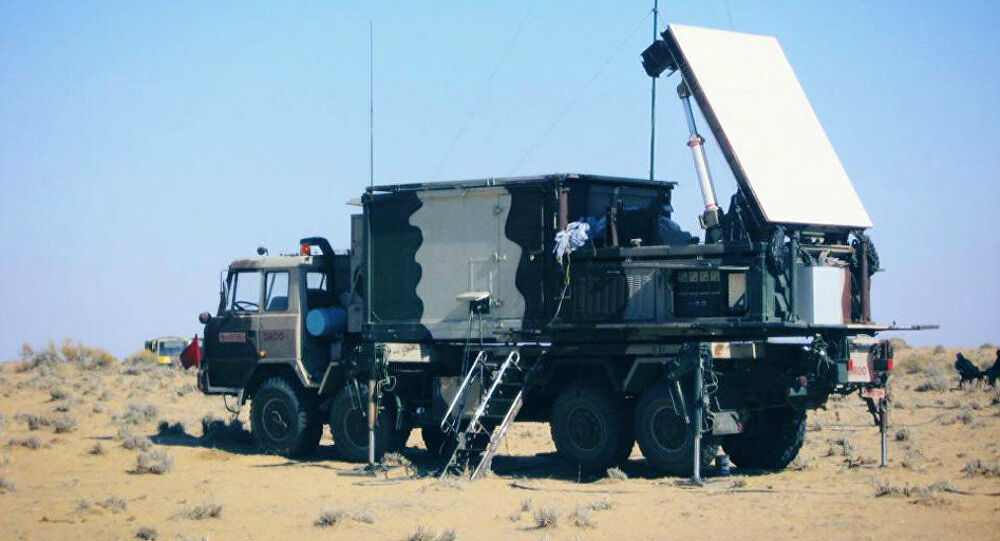
Come June 2002 and I took over command of a Surveillance and Target Acquisition (SATA) Regiment.  The unit was under the process of being equipped with modern radars, surveillance and survey equipment.  Military technology develops by leaps and bounds in the modern day and what knowledge I had of the equipment were outdated.  I began earnestly training on the equipment with our soldiers with our Subedars as instructors.

It was learning of a different kind.  the soldiers were enthused by their Commanding Officer training as the detachment member and commander of the radar; carrying the theodlite, setting it up and taking observations; operating the long range optical surveillance system; handling the Global Positioning System (GPS) etc.  I enjoyed the training the same way I did as a Second Lieutenant and learned a lot, especially the short-cuts the soldiers adopted.

It helped me know more about our soldiers and my confidence in them increased manifold.  They too must have had a similar experience.  I learned a lot and enjoyed the three morning hours I spent on training and it appeared that our soldiers too enjoyed training with their Commanding Officer.  My computer knowledge – both in hardware and software – helped me assimilate the training fast. Our soldiers were amazed with my speed of learning and were impressed by my finesse in handling the equipment.

That was when the answer to the question I had as a Second Lieutenant propped up in my mind.  Why can’t Commanders at all levels train for a day or two to function two levels down?

I suggest that all commanders – Brigade Commanders and below – must train two levels down.  It will be a  great learning, especially in view of the ever changing military technology.  When I joined our Regiment in 1983, the soldier’s personal weapon was 7.64mm Self loading Rifle.  Over the years we were equipped with the 5.56 Rifles and the AK 47.  Our Regiment was equipped with Bofors Gun in 1989 – a quantum jump in using the computing power in the field of gunnery.  We were till then used to the cumbersome manual procedures involving logarithmic tables, range tables, various graphical instruments and the calculator to calculate various gunnery parameters.  Similar was the case with the Infantry and Armoured Regiments.

Training two levels down – if done with a positive intent to learn – will go a long way in camaraderie and the soldiers knowing their Commanders better.

Regimental Training & Myths

‘When he has brought out all his own, he goes on ahead of them, and his sheep follow him because they know his voice.  But they will never follow a stranger; in fact, they will run away from him because they do not recognise a stranger’s voice.(Gospel According to St John, Chapter 10, Verses 4 & 5)

This was my guiding light as I trained myself along with our soldiers on assuming command of a Surveillance and Target Acquisition (SATA) Battery. Being new to the outfit, it was imperative that I ‘recognise their voices’ and for the soldiers to know the ‘voice’ of their Commanding Officer (CO.)

My mornings were well spent on training with our officers and soldiers on the equipment, as my first priority was to achieve a good level of proficiency in handling and operational functioning of the radars, surveillance and survey equipment.

The deficiency in our posted strength of personnel was made up by the influx of about 20 recruits, whose training had been truncated in view of the mobilisation.  They had to be trained further to become effective soldiers.  Drill and Weapon Training Instructors were requested from the neighbouring Infantry Battalion.  All young soldiers with less than five years of service were trained separately, commencing with 45 minutes of Physical Training, followed by a breakfast break of 45 minutes.  This was followed by 45 minutes of Drill after which there was a 15 minute ‘hydration break’ with liberal amounts of lemonade and water being served.  This was followed by a 45-minute Weapon Training class under the trees. The technical and tactical training sessions were conducted thereafter.

For the next four weeks, all Officers and Soldiers trained sincerely and hard.  At the end of our training schedule, we had well turned out soldiers moving about with a smart military bearing.  They all proved to be an asset to the Battery as they were ready to execute any task. A strong feeling of ‘espirit de corps’ and Regimental Pride developed due to which, we had zero disciplinary violations. .

Training of JCOs and NCOs to become effective junior leaders was a bit difficult on account of systemic inertia caused due to decades of centralised functioning.  Though their duties and responsibilities were explained in detail and all JCOs were granted the financial power to purchase anything up to Rs 100 without prior approval, they were rather hesitant to assert themselves.

On the third day of my training with the Radar teams, I tasked a JCO to drive in a vehicle along the road, for a distance of about 15 km from our location, with a radio-set and a GPS.  He was required to stop after every km and report his location while those of us at the radar-end tried and locate him and compare the map coordinates worked out by us with his GPS coordinates reported.  After about five reports, the JCO stopped reporting his coordinates because the batteries powering his GPS had drained off.  “Why couldn’t   he use his initiative and purchase the standard AA batteries from any local shop?” I asked.  Though the cost of the batteries was well within his financial powers, the thought of procuring them himself, did not occur to him.  “March him up to me tomorrow!” I ordered.  In the evening Major Suresh, our Second-in-Command, came to my office and said “At this rate you will end up marching up half the Battery.  Please give them time to get used to your style of functioning.”

There were many myths prevailing which had to be broken.  This needed persistent efforts as it is rather difficult to introduce new ideas and practices without uprooting deeply entrenched beliefs and practices that drive the functioning of any military unit.

As the Battery was all set to move into battle, all soldiers wore their Identity Discs with the oval disc on their left wrists and the round one around their necks. The myth prevalent was that this was to ensure that identification of the body parts would be easier if blown apart due to an explosion.  The correct method of wearing the two discs was explained to all soldiers.  The oval disc, through one hole of which, a cord 24 inches long is passed through, is worn around the neck like a chain.   The round disc is required to be attached to the bottom hole of the oval disc using a smaller cord, about four inches in length. Both the discs, attached to each other, were required to be worn around the neck of each soldier! In case of death during war, the round disc is required to be removed by the soldier’s comrades or at the field hospital and deposited with his unit as proof of his death in action. The oval disc is left on the body for identifying it and conducting the last rites.  The round disc, along with the soldier’s personal belongings are despatched to the Depot Regiment/ Company of the Regimental Centre of the soldier and the oval disc is removed at the time of cremation/ burial or despatch of the dead body to the soldier’s home and kept for records.

An aspect that hindered the effective functioning of JCOs was the non-availability of transport, especially when they had to travel outside the Regimental area.  Three 100 cc light motorcycles with six helmets were handed over to our Subedar Major, for use by the JCOs. The Subedar Major was directed to issue military driving licences to all JCOs and to those Havildars who had qualified for promotion to be a JCO.  One JCO was brought to me with the excuse that he could not drive a motorcycle and hence, did not want any driving license to be issued to him.  I cleared his doubts by making him aware that, “All JCOs were required to clear Mechanical Transport Level 3 Test (MT3) prior to attending the promotion cadre. Anyone with MT3 is qualified to drive a motorcycle and other vehicles.  In case any JCO is unwilling to drive, he would be marched up to the General Officer for dismissal from service on grounds of inefficiency.”  There were no complaints after that.

During our Young Officer days, one has been hearing about training JCOs to be effective junior leaders, capable of taking over duties of Young Officers and executing them.  It mostly remained on paper, confined to theoretical realms.  Barring a few JCOs, most were not trained or empowered to be junior leaders at regimental level.  It could well be attributed to the selection and training of JCOs.  One often heard “A good Havildar will often prove to be a bad JCO.”

JCOs are Gazetted Officers meaning that their appointment is published in the Gazette of Government of India.  By definition, a Gazetted Officer is a person who is an officer in the Indian Government service, the signature and official seal of which is necessary for verifying and attesting important documents certified copies and/or photographs of the person for the central and state government. He needs to be evaluated as a reasonably high-level public employee. The gazetted officer’s acts are considered as an authorised witness for document verification.

To verify and to attest any document, the first need was a seal. To put this into practice, I ordered that all JCOs be given a seal with their Personal Number, Rank, Name and Appointment.  They were to carry the seal with them and had to affix it wherever they signed.  All attestation/ verification tasks were given to them.

The next task was to educate our JCOs about being a Gazetted Officer and the responsibilities accompanying this status. This is a little-known facet. I am not surprised that even today, many COs will be unaware of this fact that our JCOs as gazetted officers receive this power and authority to use their seal directly from the President of India.

The JCOs were appointed in-charge of various stores, equipment and Regimental institutions.  All Havildars were accordingly relieved of such charges.  The JCOs now had to carry out all documentations, prepare work orders, pay & allowances documentation, leave planning of soldiers under command, leave certificates, railway warrants, etc and sign them with their seal. In many ways they were doing the task of both officers and NCOs and with a quiet efficiency.

The Battle Physical Efficiency Test (BPET) and Small Arms Annual Classification Firing results of the Battery did not follow a bell curve.  That meant that either the standards set by the Army Physical Training Corps or the Infantry School were too easy (which, obviously was not the case) or the soldiers of our Battery were exceptional in their marksmanship and physical fitness!!  I impressed upon all the need to be truthful in reporting test results and it must follow the bell curve.  The case of Havildar Shivnath Singh who represented India twice in the Asian games and twice at the Summer Olympics and who wilted due to unscientific over training was discussed.  I summed it saying, “Failing in any test is not a sin and the soldier has to be trained systematically to achieve the desired results.

Another retrograde convention among all ranks concerned the use of the telephone or intercom to communicate with the CO. This was considered by most as sacrilege. Our officers felt that calling the CO over the intercom or telephone appeared discourteous and they were not comfortable with it. They felt that they must physically appear in front of the CO to pass on any information. I explained to them, “The exchequer has spent a considerable sum to provide the Battery with a telephone network and an intercom system.  Please use them. Calling the CO over the phone is not being discourteous.”  It still took them over a month to shed this inhibition.

Did it continue like that for ever in the Battery?  I did what I could, and I cannot ensure its continuity, but I succeeded to a great extent in dispelling many myths and retrograde conventions.

Regimental Fund

On taking over command of our Regiment in June 2002, we were deployed in our operational area in Rajasthan, ready to be launched into battle any time.  The mercury tipped many days over 40°C and the Regiment had been there since the dawn of the New Year.

The entire Regiment was living in tents with the Commanding Officer (CO) provided with a much more spacious and larger tent.  The other luxury the CO enjoyed was a desert cooler in the tent and the Second-in-Command (2IC) too had this luxury.  A 5kW generator meant for the workshop powered the lights, fans and desert coolers from 9 AM to 2 PM and then from 7 PM to 10 PM.

My first day in command was spent on familiarisation of the Regiment and the area around.  It ended with my first command order.  Please click here to read https://rejinces.net/2016/04/01/first-comd-order/.

That was when I realised that the dreams and plans I had in mind to be executed on taking over command had to be kept in abeyance as there weren’t adequate funds.  The only money at my disposal was Rs 200000 from a fixed deposit that had matured.  That wasn’t my money and if I used it, I had to make it up.

After working out the power requirement, it was decided to procure three 15kW generators and fifty desert coolers to equip every tent in the Regiment.  Two Young Officers with a team of soldiers were deputed to purchase the same from Jodhpur, the nearest town.  From that evening we had a well lit and well cooled township.  My only worry was that I had spent most of the Regimental Fund.

That evening at the Officers’ Mess, I gave out my command policy.  Anything that does not have a utility value to the Regiment in our operational area or for the families of our officers and soldiers at our permanent location must be disposed offAll funds, Regimental and others must be utilised towards the war efforts.

All Officers and soldiers were asked to propose anything they needed and I found they were too contented with what I gave them the very first day and wanted no more.

We procured two desktop computers to support my automation endeavours. Now I had to conserve all that was left with our Regimental Fund.  The first step was to reduce stationary usage by automation and we succeeded to a great extent.

In November we were ordered to return to our permanent location at Devlali. I ordered that only one of the three generators to be carried along and the rest two and all fifty coolers to be sold off at 60% of their cost with the first priority for our soldiers.  The coolers and generators were of no use to the Regiment at Devlali and would have turned into junk later.  Our soldiers from Rajasthan picked up the entire lot and I recouped half the Regimental Fund I had spent.
The first project we executed was a washroom cleaning device based on the mobile cleaning unit employed by the Indian Railways to clean the toilets of the trains on the platform.  Our soldiers designed and built it.  Now every soldier could carry out janitorial duties and the Safaiwalas (Janitors) were available to accompany radar detachments, survey teams and also operate radio sets.  They turned up smartly in their combat uniforms every morning walking with a swag with the radio set on their back and the operators pad in their hand.

Most of my time in the Regiment was spent at the Computer Cell.  Whenever needed, I relieved at the soldiers’ washroom rather than using the washroom at my office. This ensured that all soldiers kept their washrooms spic and span.

Two weeks after landing at Devlali, Major General RS Jambusarwalla, our Divisional Commander visited us.  I received him at the Regiment and he walked to the rear end of his car and ordered his driver to open the boot.  There it was – a computer, a printer and a multimedia projector.  That was the only time in my military career a visit by a senior officer began with a gift to the Regiment.

Two weeks later was the inspection by Lieutenant General GS Sihota, PVSM, AVSM, VrC, VM,   the Army Commander, Southern Command and his proposal for other units to procure the software we had developed for Rs 10000 was a great boon.  Now I had all the money at my disposal to implement all my ‘wild ideas.’

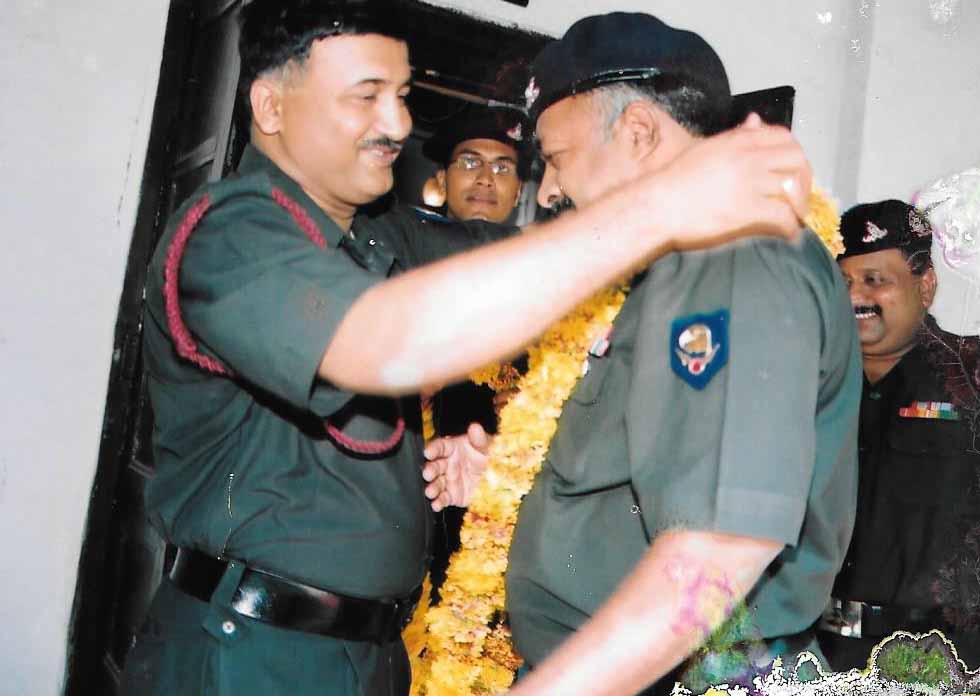
We were a SATA Battery being converted to a SATA Regiment.  We did not have a JCOs’ Club, an important Regimental institution.  Fighting many a battle with the Station Headquarters, we managed to get a near dilapidated building allotted as our JCOs’ Club. I summoned our SM and tasked him to get the building done up, procure furniture, crockery, cutlery, etc.  I gave him a month’s time for executing the task with my final advice “It’s got to be better than our Officers’ Mess.”  After a month our SM invited all officers for a cocktail at the JCOs’ Club for inauguration.  The above image is the testimony to that day.

The next project was to create a high-end barber shop.  Please read https://rejinces.net/2016/04/29/acgo/.

Our soldiers came up with a request for a multi-gym.  SM Thangaswamy was tasked to execute the project with the assistance of other JCOs.  They suggested procuring the equipment  from Ambala as it would a cheaper option.  I advised them to procure it locally from Nashik to ensure installation and warranty services.

Two weeks later SM Thnagswamy asked me about my availability to inaugurate the gym.  I asked him to inaugurate immediately and make it available to our soldiers.

We automated our kitchen with flour kneader, freezers and coolers for storage of milk, meat and vegetables.  We were allotted a ‘Steam Jacketed Cooking System’ for the soldiers’ kitchen procured from special funds under the Army Commander’s Special Financial Power. I did not want it to turn into an elephant’s teeth for show alone.  How we extracted its full value, please read https://rejinces.net/2019/03/31/elephantteeth/.

I was lucky that I had a great lot of officers and soldiers who accepted me, supported my ideas and worked wholeheartedly to ensure fulfilment of all my dreams.  I must sincerely thank all Officers, JCOs, NCOs and soldiers and a special high-five for our Subedar Major (SM) Thangaswamy who kept me in high spirits with his sense of humour.


Did I realise all the dreams I came with to command?  It’s an emphatic Yes and much more; all because of a great Regiment that I was lucky to command.

Love Thy Soldiers Than Thyself

Listening to an interview of Brigadier General Ross Coffman of the US Army on military leadership, I was fascinated by his revelation that it was his father who too served the US Army who instilled in him a duty to serve the nation, and to love the men and women who fought alongside. General Coffman narrated an incident with his father.

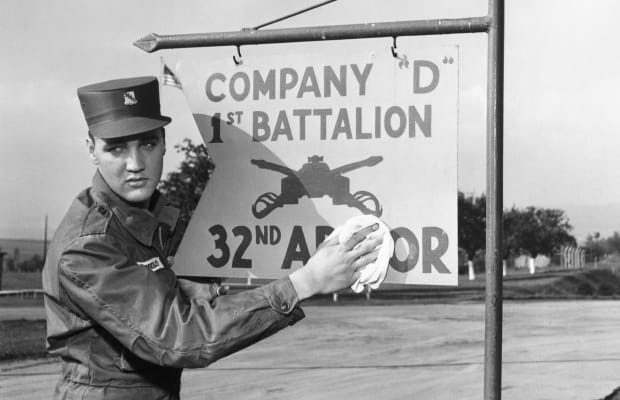
A close relative was skimming through the pages of his father’s album and came across some photographs of his father as the Platoon Commander with Sergeant Elvis Presley.  He said, “If you sell these photographs, you will earn huge money.”

When Elvis Presley turned 18 on January 8, 1953, he fulfilled his patriotic duty and legal obligation by registering for the US Army draft.  At that time, he was a rock and roll music sensation.  Though the US Army offered Presley an option to enlist in Special Services to entertain the troops, he decided to serve as a regular soldier. This earned him the respect of his fellow soldiers and countrymen.  Thus, Presley became US Army Serial Number 53310761 and after his basic training was assigned to D Company of the Third Armored Division’s 1st Medium Tank Battalion.  This took him to Germany on October 1, 1958, and he served with the Regiment until March 2, 1960.  On January 20, 1960, Presley was promoted to the rank of Sergeant.

What impressed young Ross the most was his dad’s reply.  “I love all the soldiers who served with me.  My love for them will never be on sale.

On assuming command of a Surveillance and Target Acquisition (SATA) Battery at our operational area in Rajasthan during June 2002, where we were deployed to go into battle at any moment, I walked into our office and asked for the ‘Last Will and Testament’ of all soldiers.  I realised that most were incomplete or inaccurate with respect to the name of the next of kin, spouse and children. When I inspected the documents of the clerks who were responsible for their preparation, I found the same glaring errors and omissions.  Realising the gravity of the situation at the juncture when war clouds were looming, I decided to automate the personal documentation of our personnel, starting with the generation of the Last Will.

Having served throughout with a Medium Artillery Regiment, and on staff assignments, I had a very basic, broad based knowledge and exposure to the equipment and operational functioning of my new unit which was all about radars, surveillance equipment and survey. Achieving thorough proficiency in these subjects became my foremost priority. Therefore, my mornings were well spent on training with our soldiers on the equipment.  By noon it was too warm for any worthwhile learning, and I used the rest of the day to familiarise with the soldiers by interviewing them at my office.  Please read https://rejinces.net/2015/12/28/firstmlname/

When I moved in to command, I had four boxes – two for my personal belongings and two housing my desktop computer, printer, scanner and various other accessories.  My personal computer was the only functional computer in our Regiment then.

I began my automation project by creating a basic database comprised of  the soldiers’ personal number, rank, name, next of kin, spouse and children. With each interview, the database expanded to include other relevant aspects.  By the time I completed the first round of interviews, I had to conduct another round as I had more data to collect.

With the assistance of three soldiers, we captured most of the required data and I programmed it to ease various documentation aspects – Part II Orders, pay & allowances, promotions, qualifications, training schedules, nominations for Insurance & Provident Fund, leave availed and printing of relevant forms and certificates concerning every aspect of documentation pertaining to soldiers.

The interviews went on to the third round and our soldiers appeared to enjoy the experience.  During one of the breaks while on a reconnaissance mission, my radio operator, Naik Ranjith, a good mimic, enacted a soldier’s expression on being summoned to the Commanding Officer’s (CO) tent for an interview.  It commenced with the discomfiture of the soldier seated on a chair in front of the CO.  Until then, soldiers always stood at attention in the CO’s office unless ordered to stand ‘at ease’.  On being seated, he was served a cup of tea and to complicate the matter further, he was offered a biscuit!  The soldier’s dilemma was,  how he could drink the tea and eat the biscuit while answering the volley of questions fired at him by his CO.  The seat in front of the CO’s table came to be named as the ‘hot seat’.

The ‘hot seat’ helped me to learn a lot about our soldiers and also to break the ice with them. Rather, it melted the ice altogether. At the end of this process, we had a robust database which could execute most documentation tasks at the click of a mouse. Our biggest achievement was that we could print all documents that were required to process the grant of pension to soldiers who were due to retire, running into over sixty pages, accurately, without errors, with the click of a mouse.  It made the clerks redundant.

By the end of November 2002, we returned to our permanent location at Devlali as a cooperating unit of the School of Artillery.  The news about automated functioning and other welfare measures instituted in our Regiment reached the ears of Commandant, School of Artillery. Two weeks later, the Commandant directed me to be prepared to conduct Lieutenant General GS Sihota, PVSM, AVSM, VrC, VM,   the Army Commander, Southern Command, during the administrative inspection of the School of Artillery.  I was tasked to conduct the General in our Regiment for thirty minutes after the briefing by the Commandant at his office.

General Sihota accompanied by the Commandant reached our Regiment and I straight away demonstrated the software and the automated office functioning.  We also discussed various welfare measures that we had initiated in our Regiment.  At the end of the discussion, the General asked me “If other Units of the Army would like to procure this software from you, how much would you expect?

“Ten thousand rupees,” I replied.

Why ten thousand?”

“This software has been designed for our Regiment. I need to work to customise it for others.  I can provide it free of cost, but then, no CO would value it.  Only those COs who sincerely value the importance of documentation of their personnel will spend money to procure the software.”

The Army Commander was convinced with my reply, and he gave me the go ahead.  We all left from our Regiment for lunch and the Commandant was happy that the administrative inspection of School of Artillery was concluded with the GOC-in-C’s visit to our Regiment.  About a hundred units, mostly Artillery Regiments and a few Infantry Battalions procured the software from us.

The money from the software accumulated in our Regimental Fund Account.  Our Second-in-Command, Maj Suresh approached me to say that it was my money as it was the fruit of my hard work.  I refused to accept a penny though Suresh was adamant that I take at least 25%.  I said: –

“I developed this software for our soldiers.  I love our soldiers from the bottom of my heart.  I cannot sell my love for our soldiers.  All the money we earn from this software must go to them.”

The evening I handed over command at Devlali, I flew to Toronto from Mumbai.  Having joined our Regiment with four boxes, I left the Regiment after a very fulfilling command tenure with two boxes, leaving behind my desktop computer which had dutifully served me for seven years.

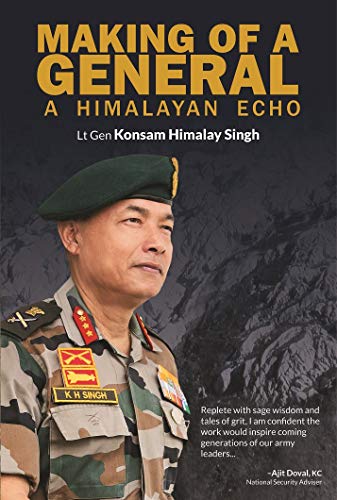
Making of a General : A Himalayan Echo by Lieutenant General Konsam Himalay Singh

Congratulations to the author for a well written book with the aim of motivating our youth – an aspect that very few military leaders have  attempted.  The journey of life of a young lad from Charangpat (Lake of the Dragonflies)- a remote hamlet in Manipur – ‘the Switzerland of India’,  to becoming a General in the Indian Army and on hanging his uniform.  His choice to return to his roots to serve  the society instead of enjoying a well-earned retirement at any place of his choosing, is well etched.  He was, in his own words, was a child who was physically weak, shy, scared of heights and the darkness.

Manipur has the highest per-capita number of officers in India’s armed forces.  Now, being the Chairman of the Manipur State Public Service Commission, I have a suggestion.  While appearing for Canadian citizenship, we were required to clear an examination which had 20% questions from Canada’s military history, mostly covering Canada’s contribution during the two World Wars.  India has a very eventful military history, especially post independence.  Through my various blogposts I have been suggesting that the Union Public Service Commission and State Public Service Commissions must have least five percent questions from Independent India’s military history.    This will enthuse the coming generation and will make them aware of the role and sacrifices of India’s Armed Forces. It is sure to make them feel proud.

All through the book, the author’s love for nature has been vividly painted, taking the reader through a visual fete. The description of the author’s grandfather ‘Even the horses kept silent when he coughed,’ kept me thinking for a while. The author’s initiative to recover plastic junk accumulated over the years of army deployment in the Siachen glacier is another example.

The impact of seeing a ten year old handle a weapon by; the need to have a dream in life – to dream big and how to pursue it; participating in family activities and chores; care  for his mother by buying her salt with all his pocket money; overcoming stage fear; moral fibre, by choosing to throw away that ‘chit’ carried by him to the examination hall; listening to the English news to enlarge his vocabulary; the importance of reading (even if not comprehended at that age;) the need to remain focused;   the power of pardon and  courage to be truthful; his adventurous train journey;  the importance of education in the development of any society; the need for hobby – great life lessons that any child will value and benefit from during his growing years.

13th Manipur Polo International 2019 underway

It was a revelation to me that the game of polo originated in Manipur.  His requesting for half a mark to make it to 60 – brought back memories of many of my class mates and also, officers during various courses, begging for a  mark or two to make a better grade.

Team spirit and camaraderie instilled in cadets at the National Defence Academy,  the lack of facilities and time to enhance individual skills; modification of curricula to incorporate leadership skill development;  have been well brought out.

The initial grooming and training  of a Young Officer in his Regiment; the need and role of a mentor; the impact of his carrying the additional load of a soldier during a gruelling professional competition; the importance of participating in adventure activities – provide an interesting peek into the development and growth of a military leader.

The need for re-orienting training and educating the soldiers in dealing with the local population – through the eyes of the author – recipient of the adverse effects of lack of empathy  by soldiers; the adverse effect of Armed Forces Special Powers Act; effect of movies to turn the youth to violence – have been well explained.

The author has given a first-hand information about the plight of the Bangladeshi Chakma refugees; peace-loving Mizos; the clashes between  Meiteis, Naga, Kuki tribes, Manipuri Muslims; religio-communal  divide and its present day implications; present cultural and socio-economic situation   – the voice of a true son of the soil.

Submitting Kanchejunga rolls out like a movie as one reads, especially the fall of the author into a crevasse, coming out of the jaws of death and the felicitation by the Prime Minister of India that followed.

The conviction of the author to stand up against an unsavoury remark against Manipuris by a General at the Defence Services Staff College and the methodology adopted to make the General retract his words shows the maturity of the author and his adeptness in dealing with ‘difficult ‘situations.

A tinge of well appreciated  subtle  humour – panic is fear at highest level of military; the golden epaulettes;   gifting of a telephone by a Pakistani soldier.

The first hand details of the attack on Point 5770, mostly unsung,  gives the reader goose bumps with each activity explained with brevity.  It showcases the leadership traits of the author.  My salute to you Sir for the respect you showed to the fallen enemy soldiers in keeping with the highest military values. Not being awarded the Battle Honour – I hope the Indian Army will make amends for the oversight even at this stage.  It needed an American author, Marcus P Acosta to bestow the honour the author’s Battalion 27 RAJPUT deserved.

The Siachen Glacier experience, the after effects on both the body and mind of the author is well expressed.  The dogs Pista and Pisti and the author pinning his commendation on Pisti, concern against  euthanasia of  aged mules shows the author’s love for all God’s creations.  His wish to command a brigade in the glacier – that too for a rupee – proves his military leadership traits.

The causes that led to the Ind-Chinese recent stand-off as viewed through the author’s eyes is worth a read.

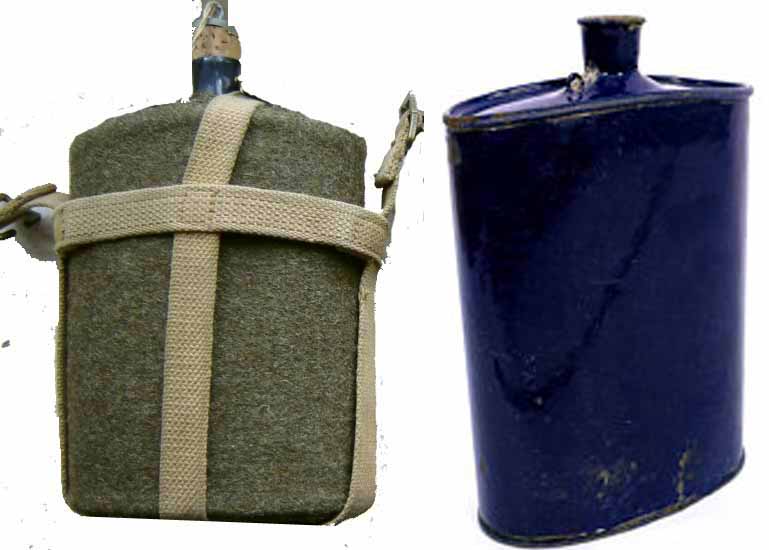
As suggested by the author, the need for a test to assess the psychological and emotional condition of the officers prior to assuming command of units is of utmost importance. If implemented, it will prove to be extremely beneficial to the Army.  Also, the case of boots for soldiers – why every piece of the soldier’s uniform – were privately bought.  There is no worthwhile water-bottle for a soldier since 2000.  The author’s concern for the soldiers’ needs and his moral fibre  to convey it to none other than the Defence Minister in the presence of the Chief of the Army Staff shows the author’s convictions.

The author has fulfilled his childhood dream – he did not stop there – but went on to become a Lieutenant General of the  Indian Army.  He has rightfully credited his achievements to his family, his teachers, his superior and subordinate officers of the Indian Army; above all to the soldiers who served under him.

After writing this review, I felt that I missed a great deal in never getting an opportunity to meet or serve under our first General from the North-East – a true soldier and a gentleman. I sign off with a quote from this book:-

Meeting and interacting with thousands of officers and men under my command gave me more faith in the inner strength and capability of our officers to win any situation.  Only the Generals have to live up to it.

Book Review : Float My Boat by Anil Gonsalves

Statutory Warning :  Do not blame the author for gelastic syncope. 

Compliments to Captain Anil Gonsalves for an excellent biographical book.  The book begins with a well composed poem, which I wasn’t expecting in such a book, that too about our alma-mater, the National Defence Academy (NDA.)  Many pages have been written about NDA over and over and the ‘snake killed many times,  still being beaten harder.‘  Is the tail still moving??

This was a welcome change; something different. The narration, all humorously radiant with an infectious enthusiasm.  It is a collection of  hilarious, stimulating, and thoughtful set of events as they unfold.

When I read the anecdotes about life at the NDA, I relived it with a smile at the corner of my mouth though the real life experience was far too terrible.  The readers who have been through this type of training will enjoy reading  it with a smile, both in their hearts and on their face.  The author has captured all the important and landmark events in a Cadet’s life at the NDA.

The habits acquired at the NDA continue with us like the ‘never used, starched handkerchief.’  Measurements of distance and time during the reunion, I thought it was only my mind’s creation during our reunion.  Now I realise that I have company.  Returning to NDA, I too felt that I must not have grown up so quickly.

The author has effectively brought out nostalgic moments of his Naval life with a tinge of humour, beginning with the last sailing of the beautiful INS Mysore, the cadets’ training ship. Various life lessons the author has hilariously unwrapped are :-

  • Taking care of the sailors or soldiers or airmen, acceding to their request for leave even if it was fake, is sure to make any young officer feel like the Captain of the Titanic.
  • Life as a young officer was always about setting up a classic rattrap and ringing the bell, but every time the rattrap by itself and the tone of the bell had to be different.
  • The weatherman is always right on a wrong day and is the only one to keep his job or not get kicked even if he is wrong 75% of the time.
  • It’s the Commanding Officer who is responsible for every action of his ship and he is the ship.
  • Triskaidekaphobia‘ the fear of number 13 (from Greek tris (‘three’), kai (‘and’), and deka (‘ten’). Hence look intelligent, talk with technical terms, but always check one’ facts before blurting out.
  • English may not be you mother tongue – ‘working hardly’ on your language skills may not be beneficial always.
  • Beware of un-mastered Indian languages – they will land you in a soup.
  • Bathing nude at the NDA did has its advantages.
  • Bull-shit is Indian Army’s prerogative, never knew that it was Buffalo-shit in the Navy.
  • Gunners – the Naval and Army versions – are well known for their stiffness and pranks.
  • You can’t be thrice lucky – especially with a DRDO scientist – that too with a hammer.
  • You must salute the Armed Forces chopper pilots twice.
  • The hard service lesson to follow the Chetwode credo will remain etched in all Armed Forces officers’ minds even after retirement :-“The safety, honour and welfare of your country come first, always and every time. The honour, welfare and comfort of the men you command come next. Your own ease, comfort and safety come last, always and every time.”
  • Travel the world – you will realise how much you missed of the God’s beautiful creations and how much is left for you to see. The travelogues are excellent – I can vouch for the Canadian part of it – and provide excellent tips and a peek into places of interests.
  • The 16 hour flight from India to Toronto is as comfortable as the Taliban therapy.
  • Canadian side offers the best view of the Niagara Falls.
  • Canadians take courtesies to the extremes. They will say ‘sorry’ even if you stamp on their feet.  The magical words like ‘hi,’ ‘please,’ ‘thank you’ – you have to punctuate every phrase you utter with least one of it. Racism or any racial comment or gesture is not liked – especially with young school going children around. (I have had it many a times from our children.)

A Glossary of NDA and Naval terms at the beginning or explanation of the terms would have benefited the reader.  If the reader finds difficulty in getting the meaning of those terms, always remember –It means the same as the first that came to your mind – else Google it up.

If you believe that ‘Laughter is the best Medicine,’ then this book is for you.

Buy Float My Boat Book Online at Low Prices in India | Float My Boat Reviews & Ratings – Amazon.in

Amazon.com: Float my Boat (Anil Gonsalves) (9798675829514): Gonsalves, Capt Anil Trevor: Books

The Final Journey of a Fallen Soldier


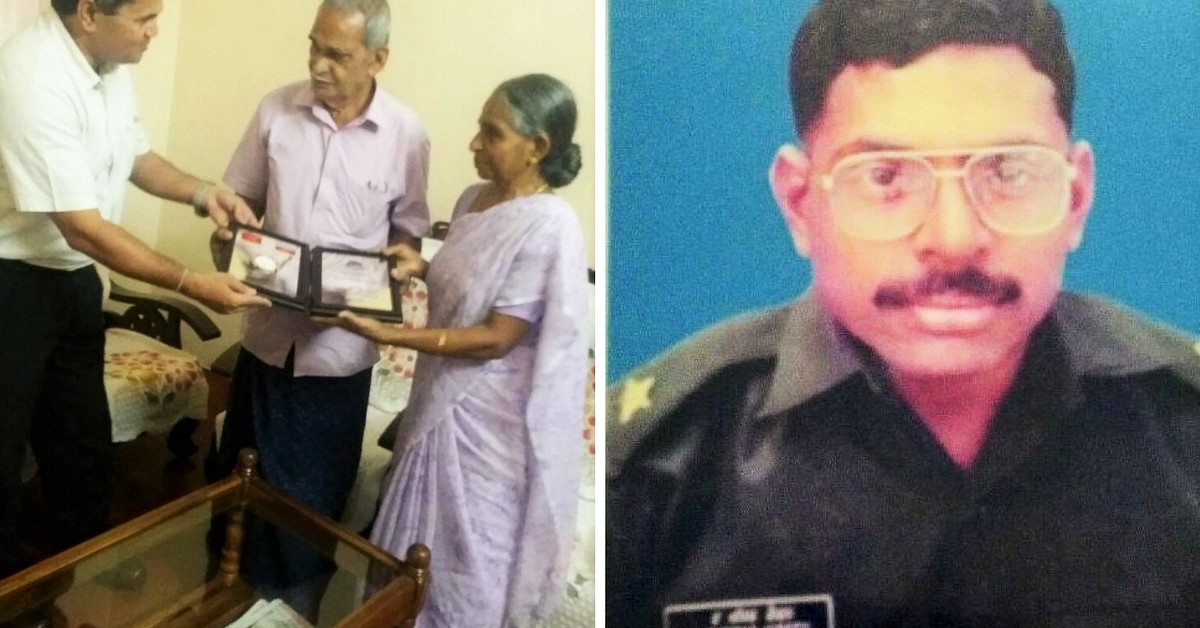
My book ‘Son of a Gunner’ is partly inspired by this hero – Late Lieutenant ET Joseph.

June 1992 in Nagaland, Lieutenant E Thomas Joseph had finished packing for his trip home for a two-month-long leave to his hometown – Kanjiramattom near  Kottayam, Kerala. Commissioned in June 1991 in the Corps of Military Intelligence, this young officer had finished his year-long attachment with the First Battalion of the Fifth Gorkhas (1/5 GR.)

Suddenly reports of some movement from insurgents in the area began to come in. The Commanding Officer got his Quick Reaction Team together. No one suggested that Joseph go along because the young officer had already got his posting orders and had been dined out from the Unit the previous day. Since he knew the terrain well, he volunteered to go with the team for the operation at night. The other officers tried to dissuade him, but he insisted on going- never to return.

By the next day, his father, Subedar Major A T Joseph, received the news of his son’s death. He immediately left for Nagaland where he laid the mortal remains of his only son to rest.

Col Sajan Moideen, one of Joseph’s coursemates from IMA days, wrote about this tragedy in his blog years later: ‘Deep down, both Joseph and his wife Thressiamma tried their best to overcome their grief. But a sadness that had no closure couldn’t be overcome. The mother in Thressiamma longed to visit the burial place. But they were unable to afford the long journey. Where would they gather that kind of money? How would they travel thousands of miles? Who would know the place? Who would help them? With old age catching up, the hope just faded away. They hoped to meet their son at God’s abode one day.’


June 2016, Lieutenant Joseph’s IMA coursemates from the 88th Regular and 71st Technical Course celebrated their 25th year of service to the nation.  They remembered their fallen comrades.    Eight spouses, brothers and sisters of the Martyrs travelled from far and wide including Australia to participate in the three day celebrations where over 140 officers, 100 ladies and 100 children attended. To remember and honour the fallen amongst them and  to make their families proud, they were presented an apt memento.

But Joseph’s parents were not there. AT Joseph and Thressiamma could not be contacted as they had settled down in Kottayam, Kerala.

With great difficulty, an officer posted in Kerala traced out Joseph’s parents and the mother, Thressiamma expressed her wish to visit her son’s grave as she was not present for the funeral. She also requested that her son’s grave be shifted from the remote region of the North East to his home town at Kanjiramattom.

Determined to fulfil a mother’s only wish, Joseph’s coursemates swung into action.  There were many hurdles on the way to get Thressiamma Joseph to her son’s grave – the old age of the parents, the finances, the long travel, and most of all to locate the grave.

The search for the tomb of the fallen soldier led them to the grave in Chakabama, 30 km from Kohima.  Though the grave was inside a military garrison, no one knew about it.

Thanks to the efforts of the coursemates of  Joseph to find the finances and the magnanimity of Indigo Airlines, his parents and sisters were flown from Kochi to Bangalore to Kolkata to Dimapur.

08 October 2016, Indigo Airlines with Joseph’s parents took off from Kochi airport.


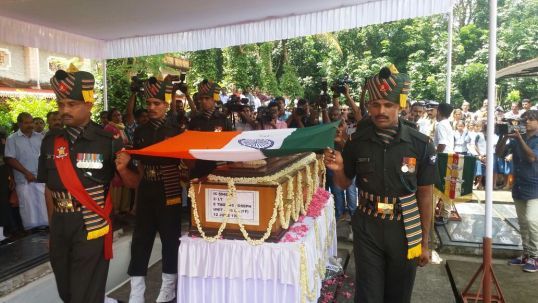
11 October 2016, the parents reached the grave of their son.  Then  commenced the religious rites for exhuming the body. The tombstone was removed and all the mortal remains gathered and placed in an ornate coffin. Full military honours were observed, the Tricolor draped and the casket was transported to Dimapur.


13 October 2016, Courtesy Indigo Airlines, an airline that always honoured the defence forces – the coffin in the company of  the parents and many of his coursemates – landed at Kochi.  A Guard of Honour was presented as the mortal remains touched Kerala. A decked up cortege led by police escorts transported the remains to Kanjarimattom. The Ex- CM of Kerala, Mr Oomen Chandy and Late Mr KM Mani paid a visit to the parents and conveyed their  condolences. After all their boy had come home, after 8890 days of Martyrdom.


14 October 2016, Lieutenant ET Joseph was finally laid to rest close to his house at Holy Cross Church, Kanjiramattom with full Military and State honours.


Now  the mother can visit her son whenever she wishes and place flowers on the day of his martyrdom. Some of the tears in her weary eyes have been wiped. Her dream, fulfilled by her son’s coursemates.


To order my book Son of a Gunner in India, Please CLICK HERE.

For US customers, please visit Amazon.com by clicking here.

Canadians can buy it at Amazon.ca by clicking here.

(Image courtesy A Mothers Dream – The Final Journey – SajanSpeaks)

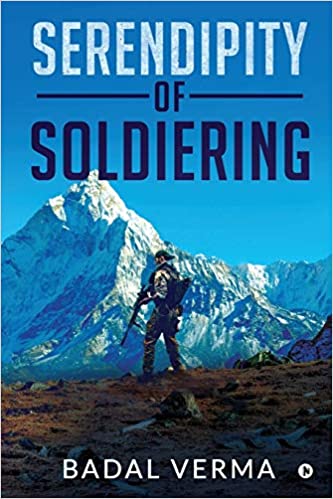
Book Review : Serendipity of Soldiering by Colonel (R) Badal Varma

The first word of title of the biographical book ‘ Serendipity’ made me scratch the vocabulary storage of my brain and the obvious way out was to ‘google’ it.  Serendip is the Old Persian name for Sri Lanka.Parts of Sri Lanka were under the rule of Chera kings of Kerala in the fourth and the fifth century.  Dweep in Malayalam, Kerala’s native language means island and hence they called the island Cherandweep.  The Arab traders engaged in spice trade with the Cheras called the island Serendip. The word ‘serendipity’ first appeared in a letter written by Horace Walpole (1717–1797) to his distant relative Sir Horace Mann dated 28  January 1754. Walpole  formed the word from the Persian fairy tale The Three Princes of Serendip, whose heroes ‘were always making discoveries, by accidents and sagacity, of things they were not in quest of.’

Serendipity could be defined as an act of finding valuable or agreeable things not sought for. There are many scientific inventions as a result of serendipity.  Microwave oven, penicillin, x-ray, pacemaker and most importantly and recently Viagra are a few examples.

Kudos to the author, Colonel Badal Verma for essaying the journey of a soldier.  He has given due credit to everyone who helped him traverse through this journey – his soldiers, instructors at various Academies and institutions, his subordinated officers and his seniors.  Shri Bachu Singh, his civilian attendant at the academy too gets a deserving mention. He has brought out the role his parents, wife and children played in this tough and thrilling journey.

In Chapter 9, the author has summarised his relationships with the humans around him and also  brought out the need to respect women, empower them and give them the needed space, both in the society and at home.

Importance of conditioning a soldier’s mind to accomplish the most difficult tasks and how the mind is conditioned for it is explained in detail.  Life of soldiers on a lonely far flung post and his travails, his moments of pleasure and despair, his need to communicate with his family miles away – gives an insight to the reader into the mind of a soldier.

Soldiers’ bond with nature, especially in North-East India, has been captured very well by the author.  The social life of the beautiful people who live in this part of India, their culture, beliefs have been painted well.  I must salute the conviction of the author in pointing out the fault line of the people of mainland India towards these minorities of the North Eastern states and Kashmir, especially the women.

The author has explained what goes through a soldier’s mind when he faces death, that too sure death, having taken two bullets at close range.  The psychology of a soldier and his will to survive and live another day is very well chronicled, especially as the author had a close shave with death not once, but six times.  I haven’t read such a beautiful explanation of the sequence of events and the beautiful line that was ‘The most expensive liquid in the world is a tear. It’s made up of 1% water and 99 % feelings.’

The ultimate sense of soldiering is in forgiving one’s enemy – the man who would have potentially taken his life – by not identifying him in a court.  It proves ‘To forgive is divine’ : from a poem An Essay on Criticism, Part II by poet Alexander Pope.

The author’s encounter with snakes is detailed, but it tends to encourage killing snakes which is unlawful.  The chapter reinforces the prevalent myth that most snakes are poisonous and they got to be killed.  A paragraph or two as to how to deal with snakes, their capture and release in the wild would have been useful.

The journey out of one’s uniform is very difficult for any soldier and even worse is the life in the world outside the army. The experiences of the author in this regard – his candid acceptance of his failures and short comings – and how he faced them must be lauded.

Buy Serendipity of Soldiering Book Online at Low Prices in India | Serendipity of Soldiering Reviews & Ratings – Amazon.in

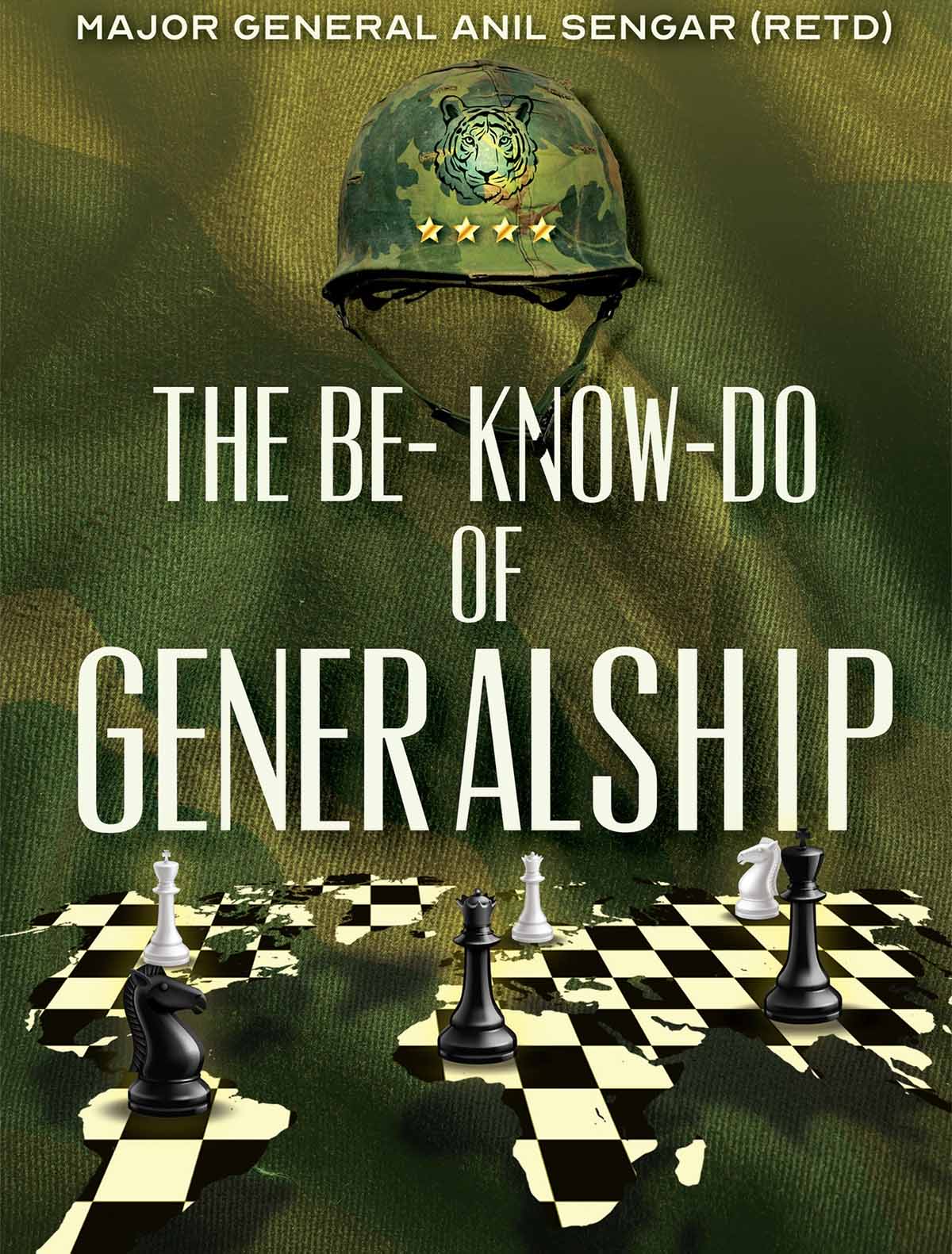
Book Review : The Be – Know Do – of Generalship by Major General Anil Sengar (Retd)

A well written book – it takes a lot of courage to come out with the truth – and the author has successfully done it.  One could feel the conviction in the writing – not like the utterances of most veteran generals of today – as if the problems did not exist during their times.  My heartfelt compliments to the author.  I have neither served with the author nor interacted with him before and I consider it as my misfortune.

The language is simple and easy flowing.  The book contains worthwhile anecdotes and quotes, mostly from American and German Army and a few anecdotes about Sam Manekshaw.

Our Generals were Colonels and Commanding Officers before becoming a General.  The last place where one is in direct command of soldiers is as a Commanding Officer.

In the book, the word ‘General’  if replaced by ‘Colonel’ and if it is read by Lieutenant Colonels before being promoted to be a Commanding Officer, it  is sure to help them.  The contents are least likely to be of any value to the Generals as most may not accept what is written and their minds are already ‘hardwired.’ A Colonel’s mind can still be influenced.

The chapters 1 to 3 speaks about listening skills in details, but hardly about reading – ‘The Generals who command against me will never read it and the young men who read it will never command.’

The Conference syndrome begins at Battalion/ Regiment levels.  If a Commanding Officer needs to hold a conference, I feel there is something wrong with him – he surely does not know his job and is not clear about the way the task is to be executed.  It is more for finger pointing and to save his ass.  Conferences must be avoided at all costs and must be held only if inescapable.

The author speaks of thirty percent of Infantry Brigadiers being incompetent – thanks to the pro-rata system – in fact only 30 percent are fit.

Lack of moral courage is surely the cause of downfall of many Generals of the Indian Army and it did not happen because they got promoted beyond a Colonel, it was inherent in them during the Academy days itself. Moral values and the lack of it begin to be expressed in command – from battery/ company/ squadron commander days.

It is high time the Indian Army goes in for an objective performance assessment of officers and it got to begin with the Commanding Officers.  Peer evaluation by officers and Junior Commissioned Officers – selected at random, maintaining confidentiality – as suggested by the author will prove credible in the long run – though there may be a few aberrations, but would end more objective and accurate than the present appraisal system.

A must read for all officers of the Indian Army.

Stress Levels : Indian Army Officers

During a recent discussion with a Veteran Brigadier Azad Sameer of the Indian Army who was my mentor while I commanded our regiment, he was concerned about the spate of sudden deaths by heart attacks among number of middle level Indian Army officers (Majors / Lieutenant Colonels.) He attributed it to the increased stress level caused due to heavy operational commitments of the Indian Army.

Is it so?

I took my mind back to my Indian Army days – as a Second Lieutenant in 1982 to being a Commanding Officer  (Lieutenant Colonel) in 2004.  As the years rolled by, operational commitments did increase, but with it improved the availability of resources, life styles and more open interaction among officers at least at Battalion/ Regiment level.

The reasons for increased stress levels among Indian Army officers have been attributed by many to:-

  • Lack of freedom among junior officers to give free feedback about work concerns.
  • Incompetent senior officers.
  • Lack of avenues to express domestic and marital concerns.
  • Lack of support from senior level especially when situations went out of control.
  • Difficult and emotionally demanding work,
  • Uncomfortable management/leadership style of senior officers.
  • Non-recognition of efforts.
  • Complexity of performance review system – Annual Confidential Reports.
  • Lack of mutual trust and unsupportive culture, especially while one is in command of a Company/ Battery/ Squadron – where the Annual Confidential Reports become critical for promotion to the rank of Colonel.

It was so when I joined in 1982 as a Second Lieutenant, but it did improve leaps and bounds as years passed by. To cite an example, when I was a Major, our General Officer Commanding (GOC) of the Division passed an order that the entire Mechanical Transport of the Battalion/ Regiment to be jacked-up for a week in case of any vehicle accident.  Our neighbouring Regiment did have an accident and the Commanding Officer had to walk to the Divisional Headquarters for a dressing down by the GOC.  I always wondered as to whether that GOC knew how a Battalion/ Regiment functioned, especially its transport section.  Such Generals became a rarity as years went by and might even be extinct by now.

Another bugbear was the availability of married accommodation for officers and soldiers.  It improved tremendously over the years and Separated Family (SF) accommodation for those deployed in field areas too more than doubled. More married officers’ accommodation was available at training institutions where officers underwent various military courses.  During our young officer days, it was an anathema for any student officer to bring their spouse for a training course, but a lot had changed while I was in command at Devlali, co-located with School of Artillery.

Resources needed for executing operational tasks improved manifold with better weapon systems, equipment, vehicles, etc.  Grants and funds available at the disposal of the Commanding Officers multiplied  with each passing year, which tremendously improved operational efficiency.  There were marked improvements in the living condition of soldiers and officers in field areas, especially along the border and Line of Control.  The road communication network improved with time.  Soldiers and officers mostly travel today by air while proceeding on vacations – an unheard of luxury during my service days.

Improved communication with the advent of cellular phones have revolutionised the communication aspects of officers and soldiers.  Even the remotest posts have reliable communication systems and soldiers easily keep in touch with their family, spouse and children.  Gone are the days of the snail paced ‘Forces Letter.’

The better financial status of officers and soldiers coupled with modern banking facilities like credit/ debit cards, online banking, easy credit and advances have made life much more comfortable.  Gone are the days of ‘installments’ and being perpetually indebted to the Regimental Wet Canteen Contractor.  I remember buying Marina a Fashion Maker Sewing Machine, my first wedding anniversary gift to her on six monthly installments.

The lifestyles of today’s Indian army Officers and soldiers have gone up many a rung.  It was a rarity to find a Regimental officer other than the Commanding Officer owning a car during my young officer days.  While I commanded our Regiment, many soldiers were driving to the Regiment in their cars.

During our young officer days the common saying was “No one ever died because of work, but by the lack of it.”  It was also said that “It is better to be in a field area and carryout professional work than be in a peace station and carry out more administrative tasks.”

Taking into account the above two dictum to be true even today in the Indian Army, increased operational commitment should not result in over-stressed officers and soldiers.

Why there is increased stress among Officers and Soldiers?

Today’s military spouses – of both officers and soldiers – are better qualified with equal or greater aspirations than their spouses.  Many spouses prior to their marriage were working in managerial or high-end jobs and some had to leave their jobs to be with their spouses for a better family life. Those spouses continuing with their jobs remained separated, maintaining a long-distance relationship.

These factors causes work-family conflict which results in exhaustion, both physical and emotional.  Many a times this leads to depression, anxiety, frustration, anger and increased levels of psychological strain.  This work-family conflict adversely affects the quality of the officer’s/ soldier’s relationship with the spouse as well as the quality of time spent with children, family and friends.

Here I would again cite my personal example.  The evening the result of my promotion to the rank of Colonel was announced, Marina invited all our friends for a party at home.  Everyone trooped in and complimented me.  After everyone assembled, Marina said “This party is to celebrate my husband  not making it to a Colonel.  Now I can have my plans rolling and he can take a back seat.”  Marina emigrated to Canada and after two years the children followed and then I landed in Canada.  By then Marina was a licensed pharmacist and earning handsomely.  Thus, I became a house-husband taking care of our children and the household.  The turn of events may not be so for many Indian Army officers, especially those who do not make it in the deep selection to the rank of Colonel and then even deeper selection upwards.

Another major cause of concern for Indian Army is Post-Traumatic Stress Disorder (PTSD).  A study in Canadian Armed Forces showed that among those invalidated out or those who sought voluntary retirement due to medical disabilities, about 40 percent  were for mental health issues, about half of those were diagnosed as PTSD.  The Treasury Board of Canada Secretariat (TBCS) noted that military service meant moving often and spending time on duty far from family and was a major source of mental health risks – a standard practise for most Indian Army officers and soldiers.

Most Indian Army officers and soldiers suffer from PTSD due to the intense combat situations they face – Canadian Armed Forces hardly face any such situations. Luckily the military echelons never accepted the existence of PTSD in the Indian Army!  I had never even heard of PTSD while in service with the Indian Army until I read a paper by a US Military Doctor on the subject.  Now think of the PTSD suffered by the driver of the vehicle that met with an accident wherein the GOC jacked-up the entire Regimental fleet.  Did anyone address the PTSD suffered by that soldier driver?

Was I prepared to command the soldiers on being appointed the Commanding Officer?

I will emphatically say “NO.”  It was merely by observation of one’s Commanding Officers and analysis.  The Senior Command Course every officer underwent prior to taking over command was nothing but re-frying of what one learnt during Junior Command Course as a Major and also Staff College Course.

Our son when in Grade 12 worked at the city’s swimming pool as a swimming instructor and lifeguard.  One day he said “I teach the kids for thirty minute class and to become an instructor and lifeguard I had to undergo ten levels of swimming, three courses on leadership and swimming instructorship, first aid, Cardio-Pulmonary Resuscitation (CPR), child psychology and obtain a life saving certificate. What qualifications did you  have to parent?”

I did not have any qualifications to be a parent.  It was all by trial and error and also by the knowledge gained through reading and interactions.  Now I asked myself – “What qualifications did I have to be a Commanding Officer? Was I trained for it?  Did I have any formal qualifications like first aid, CPR or soldier psychology?”

There was a suggestion to employ more psychiatrists and psychologists to help soldiers tide over the pressure situations they face.  Where will these psychiatrists and psychologists be located? Will they be available to the officers and soldiers in the field?

It would be prudent to train the officers during Junior/ Senior Command Courses in the psychological aspects of command and HR management to be effective Company/Squadron/ Battery Commanders and Commanding Officers.

Soldiers’ Pensions and Disability


Recently the social media was abuzz with the news of Indian soldiers’ pension being cut by 50% for those seeking voluntary retirement after 20 years of service.  One suggested methodology is to follow the Canadian Armed Forces Pension scheme.  Canadian Armed Forces Pay scales are second only to the Australian.

It is a well established fact that the Armed Forces have a steep pyramidcal structure – more at the officers level – and also at the soldiers level.  The need is to have a young and large base – Lieutenants, Captains and Majors  for officers and Privates for soldiers.

Canadian Armed Forces offers 50% pension on completion of 10 years of service.  Officers who continue further are only put through command and staff courses and they rise up to command battalions/ regiments. This results in:-

  • Those wishing to retire after 10 years of service are generally about 35 years old and many even get married and raise their families on retirement.
  • The 50% pension assures them a constant income and facilitate them to embark on a new career.
  • The pyramidical structure of the Forces is considerably reduced.
  • Those wishing to serve beyond 10 years receive their pension on a sliding scale to be 100% with 20 years of service.

Among those invalidated out or those who sought voluntary retirement due to medical disabilities, about 40 per cent  were for mental health, about half of those were diagnosed as  post-traumatic stress disorder (PTSD).

Most Indian Army soldiers and officers do suffer from PTSD due to intense combat situations they face – Canadian Armed Forces hardly face any such situation. Luckily the military echelons never accepted the existence of PTSD in the Indian Army – hence no claimants for disability pension.

Canadian Veterans who qualify for disability benefits receive up to 75 per cent of the salary they were earning when they left the Forces. They are guaranteed benefits for 24 months initially, or until age 65 for those completely disabled, after which the Canadian Pension Plan (CPP) kicks in.

The rise of mental health claims is often chalked up to Canada’s difficult 2002-11 combat mission in Afghanistan.  The Treasury Board of Canada Secretariat (TBCS) noted that the Afghanistan mission was  far from the only source of mental health risks. Even at home in Canada, military service means moving often and spending time on duty far from family – a standard practise for most Indian soldiers.

Common disability among Canadian soldiers  for Fiscal Year 2018–19 were:-

  • TINNITUS                              6,726
  • HEARING LOSS                     6,139
  • PTSD                                    2,440
  • ARTHROSIS OF KNEE             842
  • OSTEOARTHRITIS KNEE         781
  • DEPRESSIVE DISORDERS       721
  • LUMBAR DISC DISEASE         629
  • OSTEOARTHRITIS HIP            617
  • CERVICAL DISC DISEASE       578
  • FACET JOINT SYNDROME       50

Tinnitus is defined as the perception of a sound in one or both ears or in the head when it does not arise from a stimulus in the environment.  A single indication or complaint of tinnitus is not sufficient for diagnostic purposes. The condition must be present for at least 6 months.  Individuals who experience tinnitus have provided many different descriptions of what the tinnitus sounds like to them. Descriptions include high-pitched sound, ringing sound, whistle, squealing sound, hum, pulse-like sound, etc

There are two general types of Hearing Loss – sensorineural (sometimes called perceptive) and conductive hearing loss.  Sensorineural hearing loss is hearing loss due to a defect in the cochlea or the auditory nerve whereby nerve impulses from the cochlea to the brain are attenuated. Conductive hearing loss means the partial or complete loss of hearing due to defective sound conduction of the external auditory canal or of the middle ear. A mixed hearing loss is a combination of sensorineural and conductive.  A hearing loss disability exists when there is a Decibel Sum Hearing Loss (DSHL) of 100 dB or greater at frequencies of 500,1000, 2000 and 3000 Hz in either ear, or 50 dB or more in both ears at 4000 Hz.

Most Indian Soldiers and Veterans will vouch that a great chunk of them are suffering from  Tinnitus or Hearing Loss and also that most soldiers under their command suffered from it – especially those from the Armoured Corps, Regiment of  Artillery, Aviation  and also Mechanised Infantry.

Will the Indian Military hierarchy ever be willing to accept the existence of Tinnitus, Hearing Loss or PTSD?

Over Structured Training in the Indian Army

The Draft That Never Came

While commanding the Regiment, I tasked our young officers with drafting a letter in reply to a query from higher headquarters on the deployment of Unmanned Aerial Vehicles (drones). Two days later, I asked about the status of the draft.

One of them replied, “Sir, why don’t you write it yourself? You write much better than all of us.

I did not like it one bit. But instead of my usual response, I curbed my irritation and took a different approach. I sat down with them to analyse the root of the problem.

Where Did Our Creativity Go?

We all came through the Services Selection Board (SSB),” I began. “We were shown nine caricature images – each impossible to make head or tail of – and we wrote nine convincing stories. The tenth was a blank card, and still we wrote a story. We were flashed a hundred words at the rate of two words per minute, and we wrote a hundred sentences. Had what we written not made sense or lacked creativity, none of us would be here today.

I paused, letting the weight of the words settle.

Where did we lose all that critical thinking, analytical power, and creative thinking?

A Case Study in Creative Decline

To illustrate my point, I presented them with a case study: an infantry section capturing two militants in a hideout.

The same situation was posed to four groups:

  • Ten Gentleman Cadets (GCs)
  • Ten Young Officers (YO) Course qualified officers
  • Ten Junior Command (JC) Course qualified officers
  • Ten Staff College qualified officers

The results, I explained, followed a predictable pattern:

  • The ten GCs would generate nine solutions, of which eight would work.
  • The ten YOs would generate seven solutions, of which five would work.
  • The ten JC officers would generate four solutions, of which two would work.
  • The ten Staff College qualified officers would generate one solution – which would fail at its very first step.

The Culprit: Over-Structured Training

This decline, I told them, is the direct result of over-structured training in the Army. With each stage of professional development, the level of structuring increases, and creative thinking diminishes correspondingly.

It begins with the first document most of us created as young officers in our regiments: a Court of Inquiry, usually to regularise an injury suffered by a soldier while playing. The Adjutant would hand down the task with a caveat: “Refer to a previous Court of Inquiry and do the needful.”

From that moment onward, we learn to look backward and copy forward. Original thought becomes an anomaly.

A Failed Attempt at Reform

A decade ago, a friend of mine – Brigadier Azad Sameer, who served as Colonel General Staff at the Defence Services Staff College (DSSC) – was tasked with suggesting methodologies to make tactical exercises more creative. I offered him a suggestion drawn from my experience in Canada with the Gifted Children Programme which our children went through.

In Canada, gifted children – who constitute about two percent of the student population – possess an advanced degree of general intellectual ability that requires differentiated learning experiences beyond what is normally provided. They are identified through a written examination in Grade 4 and placed in self-contained programmes designed to meet their unique needs, characteristics, and interests.

These programmes, run by teachers with additional qualifications in special education, offer:

  • Learning content more relevant to their interests and abilities
  • The opportunity to work with intellectual peers of similar or higher aptitude
  • The ability to collaborate with like-minded individuals who share creative and complex ways of thinking
  • A space to relate with others who have similar interests

Applying the Model to DSSC

I noted the parallel between gifted children and the student officers at DSSC. Both groups, I argued, thrive on intellectual stimulation beyond the conventional.

My suggestion was simple: for one tactical exercise, give the students a blank map sheet with minimal inputs – force levels, weapons, logistics – and let them begin by marking the International Boundary themselves. Let them create the exercise and devise its solution.

In this approach, no pre-made solutions would be available. Each map sheet would be unique, requiring original thought. Instructors would need to work overtime to correct and assess each solution. Perhaps one or two of the resulting exercises could be conducted for the entire course.

The Faculty’s Response

The idea was presented to the DSSC Commandant, who asked Brigadier Sameer to share it with the entire faculty. At the end of the presentation, a senior faculty member posed the question that sealed its fate:

How will we assess the students?”

The Baby Thrown Out

The proposal was rejected. Not gently, but decisively – the baby thrown out with the bathwater, loofah, and soap.

It became painfully clear that in military training, the ultimate aim is not to teach or to nurture creativity, but to assess. To measure. To fit every solution into a predetermined mould.

And in that process, somewhere along the journey from Gentleman Cadet to Staff College graduate, the creative thinking that got us through the SSB is systematically extinguished.

The young officers who asked me to write their draft for them were not lazy. They were products of a system that had trained them, over years, to look backward for answers rather than forward for possibilities.

That, I realised, was the greatest tragedy of all.

The Good Old Days


On my blog on Z – The Commanding Officer’s Jeep,  was a comment by Veteran Colonel BIS Cheema as appended below.

‘How things have Changed with use of Public Property? I was commissioned in 1948, and joined 1 DOGRA, at Jalandhar. No one including the Commanding officer ever used any public transport for any private or personal use, unless, it was specifically hired, on payment of 8 Ana, equal to 50 Paisa, per mile. The duty slip was made out in Red Ink. All offers, including the Commanding Officer, used to come from the residence to Office/ Unit lines in their personal transport, that was mostly cycles. Sahayaks were allowed only in field units, and on payment of Rs. 30/- per Month. The same was deducted by CDA from pay. Ladies and Children were not allowed access to Officers Mess, except a specially dedicated room, that was marked as Ladies Room.

Officers never used any Government item, of clothing and equipment. we purchased cloth from Officer’s Shop, got our uniforms stitched to fit each individual at his own cost. One never saw an officer using regular Government issued Shoes for Other Ranks. We got our Service Pattern Boots made by cobblers under own arrangements. There were no free rations for officers at peace stations. Officers Messes were run on the basis of No-Profit-No-Loss. Daily Messing costs were equally shared by all dining members. Such was concern shown by officers towards use of Public property, to be able to earn the respect of the all ranks under their Command.’

How did these aspects change?  When did these change?

Has any officer ever paid for using government vehicle? I never paid for it during my service (1982-2004).

When was the practise of allowing ladies and children into officers’ mess commence?  When I joined our Regiment, the practise was in vogue. Ladies and children had access to ante-room, dining room and even the bar.

When was a Sahayak/ helper/ buddy/ orderly authorised for officers? When was the system of payment for the same discontinued? I was never charged a penny for the same.

Who was that Doctor?

In December 1992 I attended the three month long Junior Command Course at the College of Combat (now Army War College), Mhow, India.  The Army War College is a tactical training and research institution of the Indian Army. It develops and evaluates concepts and doctrines for tactics and logistics for the army. The college trains about 1,200 officers of the Indian Army, and also from friendly foreign countries as well as paramilitary forces each year.

The Junior Command (JC) Course aims to train Army officers who have gained theoretical knowledge of warfare and practical skills necessary to lead company-size units in various war situations and terrain.

I went to attend the course with Marina and our little daughter Nidhi was about 20 months old.  As a student officer I was busy attending classes, outdoor exercises, working on solutions for the tactical discussion on the next day or reading.  Marina found that she had lot of time at hand after I left for classes by 7:45 AM.

That was when Marina with the assistance of our neighbour’s wife, a Masters degree holder in music, tried her hand at honing her singing skills.  As a child she had a passion for music and did attend a few classes in preliminary Carnatic music.  Later she joined a boarding school and her musical interests perhaps gave way to athletic ones!

Marina learned to sing a few Hindi songs and Urdu Ghazals.  On return to our Regiment after the course, at a party she sang two Hindi songs and an Urdu Ghazal.  It was a real surprise package for our Regimental officers.  A lady from Kerala who could barely manage to communicate in Hindi until then was now singing classical Urdu Ghazals.  At the end of her singing, our then Commanding Officer Colonel Rajan Anand in appreciation remarked   “Even if Reji hasn’t learnt much during the JC Course, Marina has learnt to sing pretty well.

We had a Regimental Jaaz Band, led by Major Gulshan Kaushik and Marina became part of the band.  Her Hindi and Urdu diction was polished up with the help of both Major Kaushik and Mrs. Ritu Kaushik.

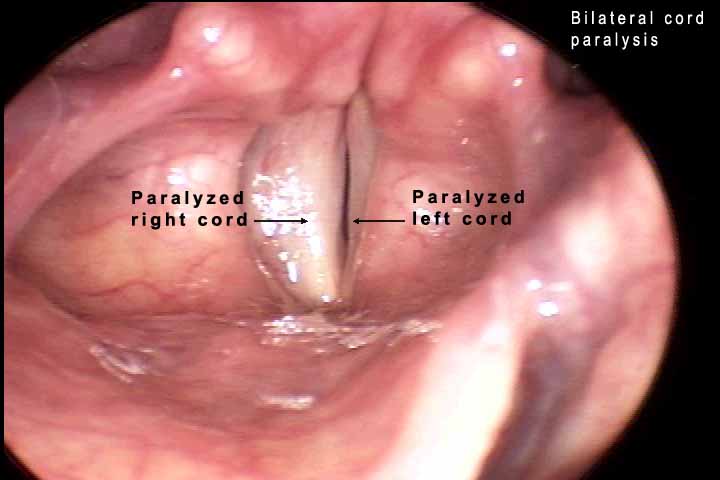
Later, in 2001, while I was posted at Delhi, Marina sang a high pitched song during the Christmas party at home.  Next morning, she was in serious trouble with her vocal cords, so much so that she just could not speak.  She went to the ENT Specialist at the Base Hospital Delhi.  The specialist, a Major from the Army Medical Corps, inserting a scope through her mouth (video-stroboscopy) and showing her the lacerated condition of her vocal cords said “You must have tried to sing at a very high pitch and you are not trained in classical singing.  This is what happens when you suddenly strain your vocal cords.”  He diagnosed it as a case of ‘vocal cord hemorrhage.’

Our larynx, or ‘voice box’ houses the vocal cords and has several groups of muscles that raise or lower it when we sing, swallow or yawn.  Many singers raise their larynx unconsciously when they sing high notes. If the larynx is too high on high notes, it can actually strain the vocal cords.  Vocal trauma, such as excessive use of the voice when singing, talking, yelling, or inhaling irritants can cause damage to the tiny blood vessels of the vocal cords. These may then rupture and bleed.

We are familiar with players or other athletes moving into the injured reserve list.  Similarly, many singers too move into the injured list, resulting in cancellation of many of their performances.  This often happens primarily due to vocal cord hemorrhage.

Diagnosis done, but the most interesting was the treatment – complete voice rest – मौन व्रत  (Mauna Vrat).  That meant she should not strain her vocal cords at all.  She was advised not to speak for a week, else she may even end up losing her speech all together. She had to communicate with the children and me through writing and often through a comic sign language.

The news spreads fast – even in those days before the advent of cell-phones and social media – it spreads faster in the Army circles when an officer’s wife is sick.  By evening there were many visitors calling on to enquire Marina’s health, especially those who were guests at the Christmas party the previous evening.

Every officer who came over had only one serious question “Who was the doctor? May be, I need to take my wife to him for consultation

The lesson I learnt after the ordeal was that children must be put through vocal music training and I ensured that both our children attended vocal music training.  To read more about it, please click here.

Carrying a Burden of Guilt

Our Regiment was deployed in our operational area in  Rajasthan deserts for Op PARAKRAM when I assumed command.

In the first week I passed directions regarding day-to-day administration of the Regiment.  For sure, a Havildar (Sergeant) Clerk was the first one to flout one of my directions.

I instructed the Adjutant, Capt Subhash, that  the Havildar Clerk  be chargesheeted.

Subhash came to my office in the CO’s Caravan with the charge sheet which I approved.  He asked me ” Sir,Can I march him up tomorrow morning?  It’s already 8 PM now.”

No.  March him up now,” I replied.

Now Sir? At night Sir?” He asked.

Yes. Now. Remember we are in our operational area, ready for a war any minute,” I affirmed.

On taking over command, I realised that there were lots of gaps in the documentation of our soldiers.  Most data was either outdated or was missing.  I got into designing and coding a software for capture and analysis of soldiers’ information, soon after I took over command.  My initial two weeks were fully devoted to automating the entire system.

During the designing and coding stage, I used to work day and night, mostly sitting in my comfortable Lungi.  That evening too I was dressed in my Lungi and vest.

Subhash looked at me and said “Sir, if you want him to be marched up now,  you need to change into uniform.

Give me five minutes and I will be back,” I said, and walked into the bedroom space of the Caravan and changed into uniform.

The Havildar was duly reprimanded for his minor offence.  It had a great impact on the soldiers – not because it was the first punishment I awarded, but more because the recipient was a Havildar Clerk.

After two years in command, I hung up my boots, to migrate to Canada.  During my dining out, Subhash narrated what happened in the five minutes I took to change into uniform that day.

“After you said ‘Give me five minutes,’ I went out of your office and realised the gravity of what I said to you.  I rushed to Major Suresh, our Second-in-Command and narrated what happened. 

Major Suresh gave a smile and said ‘Don’t worry. The old man will never take you wrong.  I know him very well from our Academy days.‘”

Now Subhash’s question to me was “Why did you not admonish me for what I said?  Before coming to this Regiment, I served in a Field Regiment for four years.  There if I had said so, you can well imagine my plight.  Even Major Suresh didn’t seem perturbed over my conduct with our CO.  That hurt me even more and I have been carrying this guilt with me for the past two years.”

Looking at Subhash I said “If you felt guilty for something you did in good faith, you should have confided in me then and there.  You would not have had to carry the burden this far.”

But that day why did you act the way I told you to, and not admonish me,” was his next question.

If I had said anything to you or admonished you for an act done in good faith, you would have lost your self-confidence and self-esteem.  Later, you would not have had the courage and conviction to advise the Commanding Officer and point out any error or folly in my decisions or directions,” I philosophised.

Z – The Commanding Officer’s Jeep

The Sacred Vehicle

Commanding Officers (CO) of all Artillery Regiments travel in a Jeep – a light vehicle identified by the alphabet Z painted prominently on all sides. Most other arms and services have COMMANDING OFFICER written on the front of the CO’s vehicle. Needless to say, it is the most decked-up and mechanically fit vehicle in any unit, driven by the most competent and disciplined driver. It carries with it an air of sacred and infallible exclusivity – an object of reverence bordering on mythology.

A Single Parent CO

Our unit was a cooperating unit of the School of Artillery, Devlali. We provided equipment and soldiers to ensure the smooth conduct of training for students of various courses. This was at a time when I was a single parent CO – Marina had already migrated to Canada. The responsibility of bringing up our children rested solely on me.
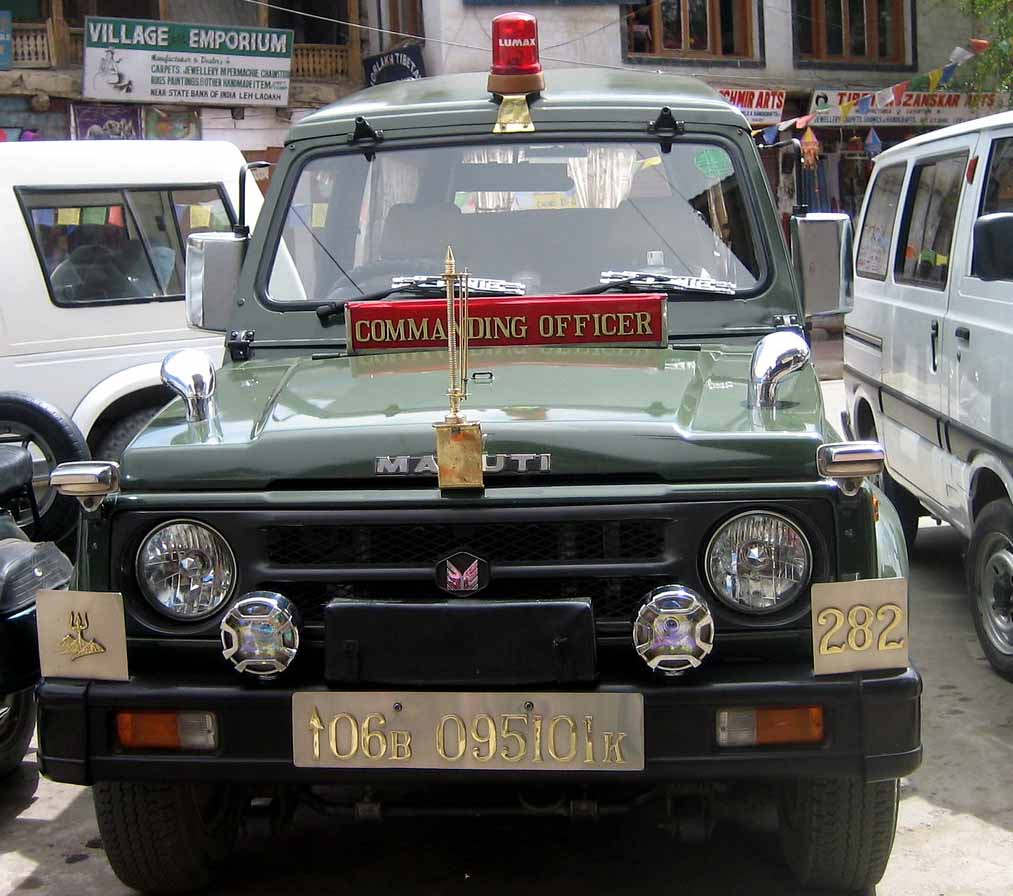
My residence was about 400 metre behind the unit, with the Officers’ Mess in between. I could walk to the unit or the Mess at any time, and hardly ever used the Z.

A Daughter’s Doubt

One day, our daughter Nidhi, a Grade 6 student, returned from school with a question. “Dad, are you a CO?

Yes,” I replied. “What’s the matter?

Everyone in my class tells me that you cannot be a CO,” she said.

But why?” I queried, genuinely curious.

Her reason left me taken aback. “They say that if I am a CO’s daughter, I would be dropped at school on a Z, and not cycling down to school,” she replied, with the innocence only a child can possess.

OK. I am not a CO, then. You continue to cycle to school,” I said, offering a justification that satisfied her young mind.

A Call from the School of Artillery

One morning, I received a call from a senior Staff Officer at the School of Artillery Headquarters. His concern was delicate but pointed: our Regimental officers were travelling in jeeps while Colonels of the Tactical and Field Wings – many approved for Brigadier rank – were travelling on their scooters. It was not just the officers; even their ladies used the vehicles. This was evidently an eyesore for those Colonels who had commanded their regiments well – else they would not have been posted to the School of Artillery.

I did not mince words in my response. “When some of these Colonels were commanding their regiments, they had five jeeps – one for the CO, one for his wife, one for his daughter, one for his son, and one for his dog. I have only one, and the rest are shared by other officers. This is my command, and I will decide what to do with my jeeps. Henceforth, please keep away from my command functions.

The matter was not raised again.

A New Officer’s Dilemma

On a Saturday, our Adjutant informed me that the in-laws of Captain Vikrant – who had joined us just a week earlier – were in station.

Then let us have a get-together in the evening at the Officers’ Mess. Please invite them too,” I suggested. The CO’s mild suggestions are invariably directions to be implicitly followed.

During the evening gathering, I asked Captain Vikrant, “What are you doing tomorrow? It’s a Sunday.”

My in-laws want to visit Shirdi,” he replied.

How are you going?” I enquired.

I have booked seats on the School of Artillery bus leaving from the Club tomorrow morning.

I paused, then said, “When our officers’ parents or in-laws visit Shirdi, they take the Z. Havildar Suresh, my driver, will report to you tomorrow morning.”

Hearing this, our Quartermaster, Captain Subhash, passed the customary instructions to Havildar Suresh: carry adequate water, soft drinks, sandwiches, and a spare jerrycan of petrol.

The Call Before Dawn

Sunday morning at five, I was quite rudely awakened by the telephone ringing. It hardly ever rang unless there was some very, very important information to be conveyed to the CO – which was indeed a rarity.

It was Captain Vikrant on the other end. “Good morning, Sir. Sorry to disturb you at this hour. Your vehicle is standing in front of my residence.”

It’s there to take you all to Shirdi,” I confirmed.

I thought you were not serious when you told me that,” he said, his voice a mixture of embarrassment and apology.

I shot off a volley of the choicest profanities in my vocabulary, ending with, “Now you take the vehicle to Shirdi, and on Monday morning, see me in my office.”

The Explanation

On Monday morning, Major Suresh Babu, our Second-in-Command, escorted Captain Vikrant to my office. “Sir, please don’t get angry with him,” he said. “He is only a week old in our unit. He is yet to know you.”

I looked at Captain Vikrant, and he spoke. “This is my second unit. Before this, I served only in a Field Regiment for five years. There, the Z was regarded as something holy—something of an institution. I have never travelled in a Z till now. That is why I called you early in the morning to reconfirm.”

I dismissed them both with words that summed up my philosophy: “The Z did not come as a dowry to me when I got married to the Regiment.”

Building a UAV Base


In 2002, our SATA Regiment was designated to be equipped with Unarmed Aerial Vehicles  (UAV).  Having experienced as to how our Medium Regiment was equipped with Bofors Gun, I realised that there is a critical need for complete infrastructure to house and operate the UAV and the crew.

In 1987, our Regiment received Bofors Gun while located in the Kashmir Valley.  The Guns and the Gun Towing Vehicles were parked in the open, with these costly and high-tech equipment wizening in the vagaries of weather.  It was in true sense proving an old Malayalam adage ആനയെ മേടിക്കുവാൻ കാശുണ്ട്, തോട്ടിമേടിക്കുവാൻ കാശില്ല  meaning ‘You have enough money to buy an elephant, but not enough to buy a hook (ankus) to control the elephant.’  It was a similar case – Indian Army had spent crores for procuring the equipment, but did not have a few lakh to build the sheds to house them.

Copy of THE ELEPHANT AT WORK !. HD...avi - YouTube
Whatever it was, I got down to working out the infrastructure requirement as specified by the manufacturer- that too by someone who had hardly any clue of aircraft operation and avionics.  The UAV Base was to come up in Rajasthan, which already had an Aviation Squadron operating from a small airbase.  The UAV infrastructure was to be created there which involved extending the existing runway – both in length and in width and also reinforcing it to facilitate UAV operation.

Luckily for me, the Commanding Officer of the Aviation Base was our course mate from NDA – Colonel Kesar Shekhawat.  He provided all technical and aviation inputs and extended all out cooperation in planning the UAV base.  I made many trips to his Base and he always provided me transport and accommodation and also looked after me very well.

I visited many UAV Bases in all corners of the country – operated both by Indian Army and Air Force – interacted with the crew operating the UAVs and learnt their needs and the deficiencies they had.  They suggested many modifications to the existing infrastructure they had and also provided lot of valuable inputs.  Most of these bases operated UAVs with existing infrastructure the base had and they had very few of the infrastructure as specified by the equipment manufacturer. 

After two months of detailed planning, we came out with an extensive document regarding the layout of the augmented Base, buildings, accommodation for crew, housing for all technical equipment, hangars for UAVs, and so on.  The entire project cost ran over ten Crore.

Project report did raise shackles of the higher Headquarters who wanted me to scale down the project so that the project could be sanctioned by the Army Headquarters.  With this high-cost project, sanction of Ministry of Defence was needed.  I refused to budge and held on and advised them to scale it down if they felt so.  The other option offered was to phase out the entire project, which I again refused and advised the higher Headquarters  to do so if they deemed so.

No one wanted to bell the proverbial cat.   The file moved at a snail’s pace through the corridors of power to be ultimately sanctioned.  Now Indian Army had enough money to buy the hook for the elephant.

Immediately on sanctioning of the project, work commenced in full swing.  Every month I had to fly to Jodhpur from Devlali for a day or two to oversee the progress of the  work.  

Why did the Commanding Officer had to travel every month for a task that could have been executed by any Major in the Regiment?  It was all because in those good old days, Majors were not allowed to fly even on Temporary Duties.  The backchat (apparently emanated from our Second-in-Command) among the junior officers were that in case someone displayed a sad face early in the morning, the Commanding Officer will send him to Agolai to oversee the progress of the work.   The officer detailed will end up spending at least three days on the train – from Devlali in Maharashtra to Jodhpur in Rajasthan.

I took a cue from it and during a Regimental Officers’ Mess event declared that in case I see any officer with a long face, I will despatch him to Agolai.  Our Regimental Ladies understood what it meant.  After that the mere mention of the word Agolai by me to any officer of the Regiment  would be followed by the officer’s reply “Sir, She is really taking care of me.  There is no problem.
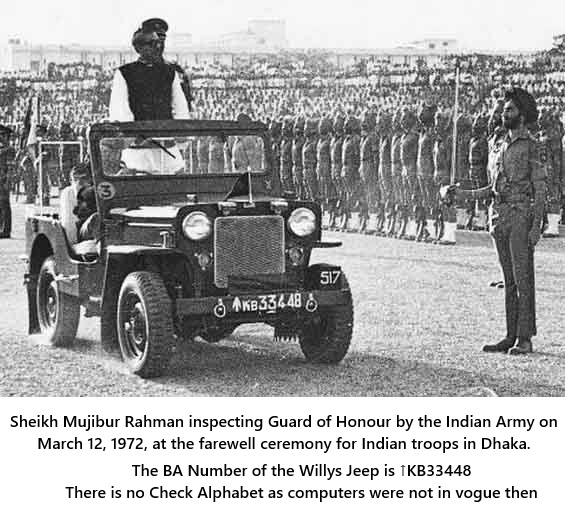
I hung my boots a year after the project commenced in full swing, duly supervised by Colonel Kesar Shekhawat.  A complete UAV Base as envisaged in my project report was completed in two years.   Then only our Regiment took over the UAVs and made them operational. 

This must be the first time in the history of the Indian Army that the complete infrastructure as specified by the equipment manufacturer,  including air-conditioned living accommodation for the crew came up well before the induction of high-tech UAVs. I am told that this base is the best UAV Base of the Indian Army today.

The Broad Arrow: Decoding India’s Military Vehicle Markings

A Symbol That Commands Attention

Everyone must have noticed military vehicles plying across Commonwealth countries bearing a distinctive marking – a number beginning with a vertically upright Broad Arrow (↑). This marking, officially termed the Broad Arrow Number or BA Number, is used by the Army, Navy, Air Force, and various civilian establishments functioning under the Ministry of Defence.

Many, including those in military service, have humorously misinterpreted this ↑ symbol as This Side Up – akin to the markings on packing cartons. Does it exist so that no one erroneously parks the vehicle upside down? Is it meant to indicate the right side up in case the vehicle topples? The humour, while entertaining, misses the mark entirely.

The Historical Origins

The Broad Arrow was employed by the British to denote military property. It was also referred to as the Crow’s Foot or the Pheon. When combined with other symbols, numbers, and letters, the Broad Arrow number conveys various details about equipment – manufacturer, year of entry into service, ownership, inspection, alteration, repair, and more.

The precise origin of the Broad Arrow remains somewhat unclear, though historians generally attribute its adoption to Henry Sidney, Earl of Romney, who served as Master of Ordnance to William and Mary (1689-1694 AD). Tasked with reducing theft of British government property, Sidney was asked to imprint a mark on all official stores. He chose his family emblem – the Broad Arrow. Interestingly, prisoner’s uniforms were also stenciled with this symbol for a time, though the practice was later discontinued.

In his authoritative work A Complete Guide to Heraldry, A.C. Fox-Davies offers this illuminating commentary:

Perhaps the case which is most familiar is the broad arrow which is used to mark Government stores. It is a curious commentary upon heraldic officialdom and its ways, that though this is the only badge which has really any extensive use, it is not a Crown badge in any degree. Although this origin has been disputed it is said to have originated in the fact that one of the Sydney family, when Master of the Ordnance, to prevent disputes as to the stores for which he was responsible, marked everything with his private badge of the broad arrow, and this private badge has since remained in constant use. One wonders at what date the officers of His Majesty will observe that this has become one of His Majesty’s recognised badges, and will include it with the other Royal badges in the warrants in which they are recited. Already more than two centuries have passed since it first came into use, and either they should represent to the Government that the pheon is not a Crown mark, and that some recognised Royal badge should be used in its place, or else they should place its status upon a definite footing.

Early British military equipment was often marked B↑O, signifying that it fell under the purview of the Board of Ordnance. Later, W↑D denoted War Department ownership. By World War II, a standalone ↑ simply indicated British military equipment.

Decoding the Indian Broad Arrow Number

Now that we understand the historical context, let us decipher the Broad Arrow number on an Indian military vehicle, which begins with the symbol ↑.

The Broad Arrow is followed by two digits indicating the year the vehicle entered service. Prior to 1972, however, a single letter denoted the year of entry. The letter ‘Z’ represented 1971. From 1972 onward, with only 26 letters available in the alphabet, the system logically shifted to using the last two digits of the year of entry.

A Case Study: The Jeep of a Legend

Consider a Jeep displayed at the Grenadiers Regimental Centre in Jabalpur. It is reputed to be the very vehicle used by Company Quartermaster Havildar (CQMH) Abdul Hamid, Param Vir Chakra (Posthumous), of 4 Grenadiers, who famously destroyed eight Pakistani Patton tanks during the 1965 Indo-Pak War using the Recoilless Rifle mounted on it.

Examine the Broad Arrow number on this historic Jeep. It bears the letter Y, which would indicate a year of entry as 1970. This presents an obvious discrepancy – the vehicle was NOT in service during the 1965 war.

The repainting error becomes evident: if the year of entry into service is indeed 1968, the correct marking should have been the letter ↑W, not ↑68, according to the policy prevalent at that time.

Similarly, a Jeep marked ↑64B should properly have been ↑SB. The body of this particular vehicle does not justify its claimed vintage – suggesting questionable craftsmanship by the military workshop responsible for its restoration.

The Full Code Explained

Following the year indicator, a letter denotes the vehicle’s class. During my military service, I encountered various classifications:

  • A: Motorcycle
  • B: Car or Jeep
  • C: Light Truck
  • D: Heavy Truck
  • E: Towing Vehicle
  • F: Specialist Light Vehicle
  • H: High Mobility Vehicle (with material handling)
  • J: Snow-cut / Snow-clearing vehicle
  • K: Ambulance
  • P: Buses, Tankers & Support Vehicles
  • Q: Engineering Vehicle
  • R: Missile / Special Role Vehicles
  • X: Armoured Vehicles

This classification letter is followed by the vehicle’s serial number, assigned by the Ministry of Defence. Finally, a check alphabet appears – calculated using the Modulus 11 formula. This check digit serves as a form of redundancy check, enabling error detection in identification numbers.

Conclusion

The Broad Arrow number is far more than a whimsical marking. It represents a carefully designed system of identification, classification, and error detection that has evolved over centuries. Next time you encounter a military vehicle bearing the ↑ symbol, you will know that it carries not just equipment, but a legacy of heraldry, history, and meticulous record-keeping. It most certainly does not indicate This Side Up.

Where’s Creativity?

The Evening Before the Olive Green World : A Dinner with Gentleman Cadets

For the Passing Out Parade of our nephew, I landed at the Officers’ Training Academy (OTA), Chennai, two days in advance, to be a guest of Major Subash, our regimental officer. That evening, Major Subash’s Company Commander had invited all passing-out Gentleman Cadets (GCs) for a customary dinner. Despite my best efforts to wriggle out of it, Major Subash – a Platoon Commander – insisted that I accompany him. He wanted me to interact with the soon-to-be-commissioned officers.

Throughout the event, I remained fairly reticent, keeping to myself. I had hung up my boots some sixteen years ago and had been living in Canada ever since. What could I possibly share with these youngsters? Yet, some of the GCs persisted, prodding me for advice.

Five Pages and a Page

The advice I finally offered was simple: “Every day, ensure that you read five pages and write one page.

A GC immediately asked, “What should we read?”

Anything and everything – newspapers, magazines, military pamphlets, user manuals, or even porn. Just ensure you read every day.

The cadets seemed a bit bewildered by my unexpected answer. One of them then asked, “What about saving money? Many have been advising us about it.” This, I suspected, came from senior veterans now employed by banks as Defence Accounts Specialists – catching them young, indeed.

When they persisted, I elaborated: “On joining your regiments, learn to be part of them. Be a soldier first. Learn about your soldiers, your equipment, and so on. Remember to enjoy your life. Pursue your passions, hobbies, and interests. Participate in adventure activities. Use your vacations to travel around the country – and around the world.

But what about savings?” persisted some who might have joined the service for a few dollars more.

The financial genius in me surfaced. “You don’t need to worry much about savings for the first three years of your service. Contribute to your Provident Fund – it will save you some taxes.”

Gifted, but Diminishing

Reflecting on that conversation, I can state confidently that every officer of the Indian Armed Forces can be classified as Gifted. Most of us came through Sainik or Military Schools, where admission required a test in Grade 4 or 5 similar to the one used in Canada to identify gifted children. If I recall correctly, ours was tougher.

After school, we all faced a fiercely competitive entrance examination for the Academy, where the qualifying percentage was a fraction of one percent. Then came the five-day ordeal of the Services Selection Board (SSB) interview – far more rigorous than anything before. Anyone who qualified through that process is genuinely super-gifted. Training at the Academies was no easy feat, especially the need to qualify in academic subjects alongside strenuous physical activities and tests.

And yet, on commissioning, the problem begins. Creativity starts to diminish.

Studying vs Learning

Officers tend not to learn – they study. Let me define the difference: what you study, you forget soon after the exam; what you learn, you retain for life. The tendency to study can be attributed largely to the grading system in most courses.

I recall an incident from my command days. We were tasked to write a paper on the tactical employment of modern surveillance devices for Army Headquarters. I asked the junior officers to produce a draft. One of them replied, “Sir, you write well. This paper is for Army Headquarters – why don’t you write it? Our efforts may not be good or creative enough.

I pointed out how they had closed their minds to creativity. “You all went through the SSB,” I reminded them. “You were shown nine caricature images – head or tail impossible to make out – yet each of you wrote nine good, creative stories. The tenth was a blank card, but you still wrote a credible story. One hundred words were flashed at you with thirty-second intervals, and you wrote one hundred sensible sentences. Now you say you’re incapable of writing a creative paper?”

The Death of Creativity

The death of creativity begins when a young officer is given a task and told to go through an old file, paper, or Standard Operating Procedure (SOP) to see how it was done previously – and then accomplish the new task in a similar manner. Many military units have SOPs even for the most mundane activities, like organising an Officers’ Mess function. These SOPs, while efficient, are also creativity killers.

One of the first documentation tasks for a young officer is usually a Court of Inquiry (C of I), most often pertaining to a severe injury suffered by a soldier. The Adjutant invariably says, “Refer to a previous one. Carry out the C of I in a similar manner.”

If you want a young officer to be creative, you must first help him understand the purpose of the C of I: what evidence is, how to adduce it, and how to reach a finding based on evidence – not precedent. The manner in which proceedings are recorded on paper is perhaps the only thing an old court of inquiry might reveal.

The Blind Copy Syndrome

The trend of  blind copying, cut and paste begins here. It continues throughout service, steadily culling all the creativity one possessed at the time of the SSB.

Reading five pages and writing one page every day are the very first baby steps toward professional creativity and competence. As the youngsters anxiously awaited their entry into the mysterious olive-green world, what better piece of advice could I have given them?

The question is not whether they will remember my words. The question is whether they will have the courage to resist the system that slowly, steadily, silently extinguishes the creative spark that brought them there in the first place.

Military Special Trains

The story of my romance with the Indian Railways is never complete without the story of the military special. Indian Railways and the military have a close and intimate bonding. The military refer to the special coaches as ‘rolling stock’ and the engine simply as ‘power’.  The Military has its own ‘Movement Control Organisation’ (MCO) with its personnel closely integrated with the railways and located at important railway stations/ headquarters.

This special relationship goes back to the very formation of Indian Railways. One of the main reasons for establishing the railway network was to provide an effective and trustworthy method of transporting large number of troops from one part of the country to another. The colonial masters found this as an imperative requirement, which enabled the government of the day to maintain control over the vast lands it governed.

Indian Railways run these Military Special trains all the time. These trains move both in peace and in times war. Some of these trains are freighters only, while others have accommodation for personnel as well. Some military specials carry armed forces personnel for aid to civil authorities, such as earthquake or flood-relief work. Some Military Special trains have rakes formed totally by special ‘Military’ coaches in their own distinctive greens while others have rakes formed by ‘normal’ Indian Railway coaches. Some movements get decided suddenly (such as due to natural or man-made disasters), while other movements are planned well in advance – as per the strategic relocations of operational units of Indian armed forces. The mobilisation plan of military units and formations are made in close coordination with Indian Railways.

I had my first experience of travelling with our Regiment by a military special in 1983, a move from Delhi  by a meter gauge military special for firing practice of 130mm medium guns at Pokhran Ranges in Rajasthan.  We had to move to Pokharan as that was the only Field Firing Range with the Indian Army that offered 30 square km of uninhabited area to fire the guns over 27 km.  Railway lines in Rajasthan then were all meter gauge.  Indian Railways today operate mostly on broad gauge.  The gauge of the railway track is the distance between the inner sides of two tracks.   For broad gauge it is 1676 mm (5 ft 6 in) and for meter gauge it is one meter.

A 24 wagon rake for loading of the medium guns – MBFU – (M – Meter Gauge, B – Bogie Wagon, FU – Well Wagon) was placed at the military siding ramp at Delhi Cantonment Railway Station -12 for loading guns and 12 for Russian Kraz towing vehicle. The gun weighs over 8 tonnes and the wheelbase just about narrowly fits on to the meter gauge rake.  Today with broad gauge rakes, the wagons offer sufficient width to maneuver the guns.

The most crucial part of loading is to mount these guns and Krazes on to the MBFU.  I watched in fascination how the most experienced driver, Havildar Kuriakose, drove the leading Kraz towing the gun.   He drove on to the ramp and then straight through, over the wagons to the last-but-one wagon and halted in such a way that the gun was exactly adjusted in the well of the MBFU.  The gun was unhooked and he drove his Kraz in to the well of the last MBFU.  A slight wavering or error in judgement could have caused the unthinkable. It was a critical operation which only best of the specialist drivers can accomplish.

Tank drivers of Armoured Regiments too face similar predicaments driving onto the MBFU and sometimes end up in mishaps.

By nightfall, the train was formed with 24 MBFU, one first class coach, four sleeper coaches, a military kitchen car and seven wagons for carriage of ammunition and stores.  Now it was an eternal wait at the station for ‘power’- a diesel engine – to tow the train.  They had the crew – loco pilot, his assistant and guard ready, but no ‘power’.  By midnight, an engine was made available after it had towed a passenger train.  There were three halts enroute, each over six hours, all waiting for ‘power’ and after 36 hours, we were at Pokharan railway station.

The last military special train I travelled was while commanding the Regiment in 2002.  Our Regiment was mobilised from its peace location in Devlali (Maharashtra, near Mumbai) on that year’s New Year Eve.  The entire Indian Army had moved into their operational locations after the attack on the Indian Parliament building by terrorists believed to have come in from Pakistan.  The Indian Railways ensured that our Regiment, like all the other units of the Indian Army, were mobilised to their operational locations at super-high priority in two days.  The Military Special trains moved at speeds greater than that of many express trains and were accorded the highest priority.

After ten months, the move back to Devlali from Rajasthan was the opposite. An Army which did not even fire a single bullet, an army which did not fight a war had no priorities in anyone’s mind.  Our Divisional Headquarters had entrusted me with an important and critical task two days prior to the move back of our Regiment.  I was given a week to complete the task and fly back to Devlali on completion.  I did not want to miss travelling in the Military Special, that too as the Commanding Officer.  I burnt the midnight oil for the next two days, completed the task, handed it over to the Divisional Headquarters.

On the day of our train’s move from Jodhpur (Rajasthan), our soldiers loaded all the vehicles and equipment on the train.  A diesel engine was connected but now the Railways had the ‘power’, but no crew.  As many Military Special trains were run from Jodhpur taking the army back home, adequately rested crew was at premium.  We waited for 24 hours for the train to commence its journey. Our train stopped at every possible station, even to give way to freight trains.  Now we were the lowest priority in the eyes of the Indian Railways.  The onward move executed in less than two days now took five days on the return leg.

After my premature retirement and move to Canada, I very much miss my passionate association with the Indian Railways. Now, even when I travel in India, it is mostly by air, due to time pressures. Gone are the days of those never ending train journeys. I can only recollect those days with a sense of loss and nostalgia.

My Romance with the Indian Railways

My journey with the Indian Railway commenced with my first travel way back in 1966 when I was in Grade 1. 

In the Malayalam text book there was a small verse on the ‘Steam Engine’ – (കൂ കൂ കൂകും തീവണ്ടി, കൂകി പായും തീവണ്ടി) Koo koo kookum theevandi, kooki payum theevandi.  I was fascinated by the poem and insisted on travelling on a train.   My dad took me on my first train journey – an eight kilometer one from Kottayam to Chingavanam on a steam engine powered passenger.  Little did I realise as a toddler then that I will serve in the Indian Army and travel the length and breadth of the country on trains. It was the beginning of a long and cherished association with the Indian Railways.

My father first took me to the steam engine as the poem was more about the steam throwing coal eating monster.  He showed me three persons working on the engine.  The Engine Driver (Pilot or Engineer) was the overall commander of the engine.  He was responsible for ensuring punctuality, watch the signals, the track ahead and the train behind, see that the locomotive is running safely and efficiently, blow the whistle when required and plan ahead for stops.

The engineer was assisted by two Firemen who stoked the fire, maintained steam pressure in the boiler, watched the track and signals ahead, and relayed signals from Guard.  They took turns with one stoking the fire and the other watching the signal and blowing the whistle. Firemen were also apprentice engine drivers, allowed to run the train under the engine driver’s supervision and expected to learn enough to be ready for eventual promotion.  Even today, the Indian Railways recruit only Assistant Loco Pilots for their Diesel and Electric Engines, who over a period of service are promoted to be Loco Pilots. I am told that the Assistant Loco Pilots of today earn a salary more than that of the average software engineer!

Steam engines of yesteryear may have been slower and ‘dirtier‘ than diesel/ electric ones, but they were much safer.   As per records, out of every 100 accidents on Indian Railways, only two involved steam engines as the steam engine staff had to be on their feet, busy stoking the fire, adjusting gauges, tightening gears and releasing excessive steam pressure, polish gleaming brass fittings and gauges, filling the water tender and so on.

The train was controlled by a Guard who impressed me with his well starched and ironed cotton white trousers and coat as white as snow.  I could never figure out as to how these Guards on the trains pulled by steam engines, maintained their white uniform so well.  A short journey on such a train always invariably resulted in my dress and hair getting covered with coaldust.

I might add here an interesting aside. The Indian Railways currently runs a luxury heritage train from Delhi to Alwar, renamed The Palace On Wheels, (earlier Fairy Queen, since 1855) powered by a 70-year-old renovated steam engine, named ‘Azad‘- engine number WP 7200, built in 1947 in USA.

Indian Railways is still maintaining its oldest working steam locomotive named Fairy Queen at New Delhi. I wonder whether the Railways still have the drivers to operate it.

When I joined Fifth Grade at Sainik School Amaravathi Nagar (Thamizh Nadu) in June 1971, travelling from Kerala to the School was the longest train journey one undertook until then.  It commenced by boarding a Meter-Gauge train at Kottayam, hauled by a steam engine to Ernakulum.  From there in the afternoon, it was on to famous No 20 Madras Mail – a Broad-Gauge train – which ran between Cochin and Madras to alight at Coimbatore.  The only reprieve was that the train was hauled by a diesel engine, and therefore no coaldust.

The advantage in a diesel or electric engine is that it can run at same speed whether forward or backward. Steam engines were to run at lesser speed when running with its water tank in the front side. To avoid this there were engine turn tables at major loco sheds for turning the engine to keep engine side in the front.

We got off at Coimbatore by 9 PM and at 10 PM there was a train to Rameshwaram, again a steam engine train on Meter Gauge.  This train dropped us at a tiny station called Udumalaipettai at 2 AM.  Then there was the agonising wait in the small waiting room at the railway station for it to dawn so that the restaurants in town opened their shutters. Early in the morning it was a walk of about a km to the bus-stand, lugging our bags.  Near the bus-stand there was a restaurant which served vegetarian breakfast and we enjoyed the last civilian meal of the semester before joining the Military School. From then on it was going to be the much loved ‘bill of fare.’

After breakfast it was a bus ride of 24 km on the No 10 Bus which plied between Udumalaipettai and Amaravathinagar – about an hour of a bumpy ride, but it ensured that the heavy breakfast we had consumed was well truly digested without any hiccups.

By the time I was commissioned in the Indian Army in 1982 the railways had evolved a great deal; the steam engines had given way to diesel ones which were much faster and did not deposit coal dust in our hair and clothes. With the army life came some really long and memorable train journeys. For a Mallu posted to most military stations in North India, 72 hours was par for the course.  If your unit was in the North East, it was 96 hours and beyond. A colleague of mine used to travel from Trivandrum, then the southernmost station of the Indian railways to Ledo, in Assam, almost on the then Burma border, where his unit was located. It was small matter of some 4000km, 3970km to be precise, taking seven days.  It involved travel by five different trains, with changes at Ernakulum, Madras Central, Howrah Junction, and Tinsukia. The journey from Trivandrum began with a meter-gauge train and ended at Ledo on a meter gauge train. But the bulk of the journey in the middle was by broad gauge. In some ways, the experience of a journey such as this is as exhilarating as that of a mountaineering expedition

Once or twice a year it was a journey homeward to avail the much-awaited leave. Also, the initial years in the army one had to undergo a lot of training courses at various institutions widely dispersed all over the country. This resulted in at least one more long train journey. Very often one had to travel at short notice and therefore without reservation. It was nothing short of high adventure.

As the trains rumbled across the length and breadth of the country, I was able to directly imbibe the diversity of our ancient land. As they crossed the many rivers flowing West to East, East to West and North to South (Only the Son River in India flows from south to North), and climbed the many hill ranges and plateaus, I came face to face with school geography. The vastness of the Indo-Gangetic plains, the stunning beauty of the Konkan tract, tenuous criticality of Siliguri Corridor, mesmerising  beauty of the plains of Punjab engulfed in endless fields of wheat, mustard and sunflower, and the endless barren expanse of the Thar desert all lay bare before me.   I couldn’t help but notice the gradual change in climate, topography, flora, demography, culture, architecture and so on. It was an ever-changing landscape of every facet of human existence. There is no better way to learn about this vast country than to simply travel by train. No wonder, the Mahatma, loved to travel by train.

When I am at Kottayam the Pole Star is not visible as it is always hidden behind coconut trees. As the train takes me northward from Kottayam, on the first night I begin to see it quite high above the horizon. On the second night it is much higher in the sky than the previous night. It was much later, during a training course that I theoretically learned that the latitude of a place is the vertical angle between the horizon and the pole star (altitude of the Polaris.) But the railways had made me understand the phenomenon much earlier. Latitude until then was just a line on a map.

Over the many years of train travel I also realised that the Indian railways is a truly humongous organisation any which way you look at it. It is one of the largest rail networks in the world with over 68500 km of track network and nearly 7200 railway stations. It is one of the world’s largest employers, employing some 1.4 million people. Every day it transports 25 million people. It is simply mind-boggling to think in terms of the likes of the entire population of a country like Australia or Taiwan being transported by the Indian railways on a daily basis. Of the worlds 230 odd nations only 55 odd have a population more than 25 million.  The railways also move some 1200 million tons of freight every year.

One got to fully subscribe to Michael Portillo, British journalist, broadcaster, and former Conservative politician- “The two biggest legacies of the Raj are the unification of India and the English language. Moreover, without the railways, India would not have been connected and could not have become one country.” 

Next : Military Special Trains

Regimental Training for a Young Officer

On commissioning I joined 75 Medium Regiment in January 1983.  The Regiment then had an interesting class composition – one battery of Brahmins (other than those from the Southern and Eastern States of India), the second had Jats and the third was manned by the soldiers from the four Southern States. Management of soldiers in all the batteries differed as their reactions to various situations, their needs, their languages etc were different.  Today the Regiment consists of soldiers from all classes from the entire nation.

I was allotted the Brahmin Battery commanded by Late Major Daulat Bhardwaj.   He was a Brahmin and his first advice was “To command Brahmin soldiers, you got to be a Brahmin yourself, beat them in all aspects – physical, mental and spiritual. You got to be mentally alert and morally straight, else they will never respect you. Once you earn their respect and confidence, they will blindly follow you.

You got to be a better Brahmin than your soldiers.  You are a Christian from Kerala and you got to beat the Brahmins in spiritual aspects too.  You attend Mandir Parades with the soldiers every evening; learn by-heart all the aratis, slokas, mantras and hymns; understand their meaning and apply them to your everyday life.”

Within a month, I could sing the arati and recite the slokas fluently and thus became a ‘Brahmin.’  Even though the first of the Ten Commandments the Christians follow say ‘You shall have no other Gods before Me‘, for any officer of the Indian Army, the religion or Gods of the soldiers they command come before their own. While praying to the Hindu Gods during Mandir Parades, in my heart I was praying to my Lord and Saviour Christ.  In fact, now I was praying to a God I did not believe in for the soldiers who believed in me.

The soldiers, especially the ones who manned the guns called Medium Gunners were all well-built and nearly six feet tall.  They were selected keeping in mind that they had to handle the eight-ton 130mm Russian gun, the toughest being bringing the gun into action mode from travelling mode and vice versa.  The shells the guns fired being heavier also dictated this.

Training for the gunners involved bringing the gun into action, laying the gun at the specified bearing and elevation to engage targets far away, loading the shell into the gun and firing. This training on the gun is called Gun Drill in artillery terms.  Among these giant gunners, I stood as a Lilliput.  I had to look up to meet their eyes when I spoke to them. Rather than they are looking up to me, now I was looking up to them.

The first place I lived in the Regiment was the soldiers’ barracks.  My bed was placed next to Havildar Brij Bhushan Mishra’s, who was better known among the soldiers as BB Major. Soldiers address Havildars as Majors, short for Havildar Majors.  He was then the senior most Gun Detachment Commander and was well known for his gunnery training abilities. BB Major spoke in a soft and low voice and the soldiers had to strain their ears to listen to him. He did not believe in talking much, but the soldiers of the Battery respected him, and many were scared of him; all because he knew his job well and he had a reputation of being a tough detachment commander and also, he sported a ferocious looking handlebar moustache. He believed in the doctrine that soldiers and brass – they shine well when rubbed hard and polished well.

I commenced gunnery training as any other recruit soldier on joining the Regiment would do – to be the Number 9 of the detachment. I attended Gun Drill classes with the soldiers under the watchful eyes of BB Major. As days passed by, I was ‘promoted’ until I became the Gun Detachment Commander in two weeks.

I was pretty impressed with my ‘promotions‘ until the day I goofed up while bringing the gun into action. My omission at that time could have jeopardised the safety of the crew, but timely intervention by BB Major saved the day for me.  He ordered “Stand Fast” – meaning everyone to freeze as they were. This command is used when a commander or a trainer feels that safety of the soldiers is at risk. BB Major pulled me out, shook me hard and said “Saheb, you have got to take care of the soldiers under your command. You got to be alert at all times. You cannot risk injury to your soldiers because of your callousness.” Major Daulat Bhardwaj who was witnessing the training called out “BB, तेरे  मूछों  में  दम  है  [therey moochon mein dum hai] (there is strength in your moustache).”

I did not speak a word, for I was shaken up and also feeling guilty of committing a major goof-up. After this incident BB Major and I developed mutual respect. While conducting gunnery training later on, BB Major often quoted the incident to the young soldiers and how well I took it in a positive stride. He also added “If I could do it to the Lieutenant Saheb, you guys better watch out.

Identity Discs

As I watched the movie 1917, I made a mental note to write a post on the identity discs worn by the soldiers.

In Canada and USA, some military spouses and fiances wear their partner’s Identity Discs as a symbol of love towards their partner deployed in a far away land. Some Veterans post retirement continue to wear their Discs.

The movie 1917, based on the First World War, tells the story of two young British soldiers, Lance Corporals William Schofield and Tom Blake who are ordered by General Erinmore to carry a message to Colonel Mackenzie on the war-front, calling off a scheduled attack that could jeopardise the lives of 1,600 men, including Blake’s brother Lieutenant Joseph Blake.

Schofield and Blake cross no man’s land to reach an abandoned farmhouse, where they witness a German plane being shot down.  They drag the burned pilot from the plane. However, the pilot stabs Blake and Schofield shoots the German pilot dead. Schofield promises Blake as he dies that he would complete the mission and to write to Blake’s mother.  He removes two rings from  Blake’s fingers  along with the round Identity Disc worn around his  neck.

Schofield succeeds in reaching Colonel Mackenzie, who reads the message and reluctantly calls off the attack. He meets Lieutenant Joseph who is upset to hear about his brother’s death, but thanks Schofield for his efforts. Schofield gives Joseph his brother’s rings and Identity Disc and requests him to write to their mother about Blake’s heroics.

On a philosophical note the Discs remind every soldier that martyrdom is just around the corner. However, at the practical level, it has a specific purpose. They bear the personal number, name, regiment, religion and blood group of the soldier and serve the twin purpose as both a recorded evidence of a soldier’s death in action as well as for the eventual recognition of the body, in case there is a need. When there are a large number of fatal casualties over a short duration, it serves a purpose of keeping a record of death.

It must be sounding a bit eerie to the uninitiated.

These discs hanging close to the soldiers’ chests, remind them as to who they are. It gives the soldier facing death, ready to make the ultimate sacrifice, the confidence that He will not be forgotten. Some spouses of US soldiers deployed in Afghanistan and Iraq wore their soldier-spouse’s disc as a a reminder of their true love and commitment.

In the Indian Army we had to wear these Identity Discs while on operations and during various training exercises.  Actually there are two discs – an oval disc with holes punched on either ends and a round one with a single hole.  Our soldiers wore the oval disc on their left wrist and the round one around their neck.  On inquiry they said that it is to ensure that one disc will remain with the body even if the hand shears off.  The logic did not appeal to me at all, but I could not find any instructions regarding the proper way of wearing the discs. Surely we were not fighting a battle with swords to have either our heads or hands to shear off. I had no difficulty wearing the round disc around my neck, but the oval disc around my wrist was always a worry.  I lost them during most training exercises and had to get a new one made every time.  Obviously there was something amiss – I thought.

In 1988, I had to appear for a promotion examination in which ‘Military Administration’ was a subject.  Disposal of the mortal remains of a soldier killed in action was an issue on which I often had many questions.  Our Battery Commander was Major VN Singh, a 1971 Indo-Pak War veteran.  He was well known for his knowledge and meticulous military administration skills and had just been posted to our Regiment after a stint as an administration and logistics staff officer of an infantry brigade.  I approached him and he clarified the mystery and explained to me the procedure and the proper way of wearing Identity Discs.

The oval disc, through one hole a cord 24 inches long  is passed through and the chain is worn around the neck.  Using a small cord of about six inches, the round disc is attached to the bottom hole of the oval disc.  In case of death in war, the round disc is removed to identify the dead and the oval disc is left on the body for identifying it whenever the body is recovered.  The round disc along with the soldier’s personal belongings is despatched to the Depot Regiment of the Regimental Centre of the soldier and the oval disc is removed at the time of cremation/ burial or despatch of the dead body to the soldier’s home and kept for records.

Identity Discs of Indian Army owe its origin to the British Army.  The first British ‘Disc Identity’ was introduced in 1907.  It was a single identity disc, fitted with a cord to be worn around the neck underneath the clothing.  The single-disc led to many postmortem problems in identification of the dead in that the disc was being removed for administrative purposes, leaving the body devoid of identification.

In May 1916 the second disc was introduced – octagonal in shape – known as “Disc, Identity, No.1, Green,” with the original disc becoming “Disc, Identity, No.2, Red.” The No.1 disc was to be attached to the long cord around the neck, with the No.2 being threaded on a 6 inch cord from this disc. No.1 Disc was intended to remain on the body whereas No.2 Disc was to be removed for administration.In the movie 1917, Lance Corporal Schofield is shown removing the Red Disc, leaving the Green Disc on  Lance Corporal Blake’s body. During World War II, British Army soldiers were issued with aluminum Identity Discs – oval and round.

US Army Identity Discs consist of two discs. One disc is on a 24 inch chain and the other is attached to the main chain by a four inch chain.

There is an interesting history to the US Army Discs. During WWII the discs were rectangular shaped with round ends and a notch at one end with name and details stamped by a machine. It was rumoured that the notch was put on the disc so that the disc could be placed in a dead soldier’s mouth and would hold it open so that the gasses would escape and prevent the body from bloating. In reality, the stamping machine required a notch to hold the blank disc in place while it was stamped. During the Vietnam War, new stamping machines were used and the notch was eliminated. Soldiers realised that the clinging of the metal discs gave away their location. Hence rubber covers were provided to keep the discs silent.

During the Vietnam War, some American soldiers tied one disc to their bootlaces. They believed that it could facilitate identification in case their body was dismembered.


Canadian soldiers’ Identity Disc is scored by a horizontal groove so that the lower portion may be detached. If the wearer becomes a fatal casualty, the lower portion of the disc shall be detached and returned to the Headquarters with the soldier’s personal documents. The chain and upper section of the disc shall not be removed from the body.

Identity Discs may become more symbolic in future as technology advances in the days of DNA sampling to identify deceased soldiers.

Soldiers can sometimes make decisions that are smarter than the orders they’ve been given.”   ― Orson Scott Card, Ender’s Game

Public Address (PA) System

Can you hear me at the back?”  Queried the Reviewing Officer at the Passing Out Parade of our nephew, prior to commencing his address to the Cadets.  There was a seven second utter silence that followed – as if those seven seconds did not exist in this world for everyone gathered out there.

Did the Reviewing Officer not trust the Commandant of the Academy, a General Officer, who invited him to be the Reviewing Officer?  Would everyone at the Academy have not put their best foot forward to ensure successful conduct of the most important and venerated event at the Academy?  As Cadets during our own Passing out Parade in the past, haven’t we all seen the Herculean efforts put in by everyone, especially the team responsible for the PA system, to ensure that each word spoken is audible at every nook and corner of the Parade Ground and beyond?

Was the Reviewing Officer expecting a reply?  Was he expecting a Cadet lined up in front to acknowledge his query?  Did he expect the Adjutant mounted on his charger, with a sword in his right hand and reins of the horse in the other to raise his sword as an answer?  Did he expect the buglers standing on the ramparts of the fort behind to play a note in acknowledgement?

What if the address was not audible to the Cadets? Would it make a huge difference? No. They would have already been bored to death with the surfeit of advices from all and sundry.  I do not remember a single word of the address by the Reviewing Officer at our Passing Out Parade, though the Reviewing Officer was the most charismatic of them all, Field Marshal Sam Manekshaw.  So would be the fate of any lesser mortal here and now. Senior military officers could sometimes do well without recourse to ‘out of place clichés’.

My mind flashed back to my military service days.  Once a month in military service, it was the day of the ‘Sainik Sammelan’ (Address to Soldiers of the Regiment by the Commanding Officer (CO)), a monthly ritual, mostly held on the last Saturday of the month.  During my Regimental service, I observed that a Sergeant responsible for the PA System set it up well before everyone assembled, tested it by tapping his fingers on the microphone and saying “Testing, Testing, Testing.”

Once the Regimental Sergeant Major assembled all the soldiers, he also tested the PA System by tapping his fingers on the microphone and saying “Testing, Testing, Testing.”  After that the Sergeant Major gave his report to the Subedar Major (Master Warrant Officer.)  The Adjutant then received the report from the Subedar Major who then handed over the parade to the Second-in-Command (2IC.)  At every stage of reporting, no one seemed to trust the poor PA system and everyone tested its functionality.

Now came the auspicious moment of the arrival of the CO.  The 2IC gave  the report to the CO and the CO settled down on the dais.  As the CO was about to commence his speech, the PA system sabotaged itself and gave out a most shrill and unholy tone “Koooooooooooo  Thap” and refused to do its job. Pure and simple system generated retribution for the lack of faith!!

The CO now looked at the 2IC, who in turn gave a frowning look at the Adjutant, who gave a dirty look at the Subedar Major, who now gave a dirtier look at the Sergeant Major, who finally gave the dirtiest look at the hapless Sergeant who set up the PA system.  Obvious display of lack of trust at every level of command.

Sainik Sammelans have been an event for the CO to demonstrate his oratory skills.  Some COs believed that they could communicate all their ‘accumulated wisdom’ on to their captive audience during the Sainik Sammelan and often in such cases, it extended to several hours.  In effect there was no transmission/reception of wisdom, but it ended up with sore bottoms, numb feet and a few caricatures of the CO by the officers.

Captain Desh Raj was the self appointed commander for all young officers (Lieutenants and Captains) of our Regiment. One day, after the CO’s Regimental Sainik Sammelan, Captain Desh Raj summoned all of us, five young officers of the Regiment, and directed us to show him our note pads where we had noted down the points briefed by our Commanding Officer.  All of us, except one, were reluctant to display our pads.  We were all trying to hide our note pads, but Captain Desh Raj successfully managed to snatch them from us and glanced through them.  Soon thereafter he declared “None of you can make a good caricature of our CO.  Your artistic skills need to be toned up.  Look at my note pad and the next time I want to see a better caricature of our Commanding Officer from you all than this masterpiece of mine.

That was when I realised that all those serious note taking by all young officers were much the same and on similar lines to what Captain Desh Raj did!  When I became a Battery Commander and later a CO, I ensured that all my Sainik Sammelans were of less than ten-minute duration. Possibly, I was mortally scared of my subordinates drawing my caricature! So I resolved not to give them time for the act.

Whether the PA system is working or not, there is no need to raise the question “Can you hear me at the back?”  Every speaker must realise that nothing much can be done at the nick of time other than the speaker straining his vocal cords to make the speech audible to all.  It only shows lack of trust in the organisation or the person who invited you to speak. Above all, a routine and meaningless cliché that is best avoided!!

Abiding Faith

While commanding the Surveillance and Target Acquisition (SATA) Battery at Devlali in 2003, I received a call from the Colonel General Staff (Col GS) of the Artillery Division, our higher HQ, that he wanted our soccer team to represent the Division in the Corps level soccer tournament. The tournament was to commence in a week’s time and our Col GS knew that we had a very good soccer team.

The Col GS is in charge of the General Staff branch, responsible for training, intelligence, planning and conduct of operations, beside a host of other less important subjects. Most orders from the General Officer Commanding (GOC), pertaining to these issues are actually drafted and signed by him.

Our Col GS was Colonel Azad Sameer (now a Veteran Brigadier) and he was my friend, philosopher, mentor and guru while I was in command. Our relationship had started off on a strictly official level and evolved into a personal one of mutual respect and friendship at an emotional level. The entire Regiment knew this for sure, such that one day our Adjutant (the officer who acts as an administrative assistant to the Commanding Officer) came to me and said “We implicitly respond positively to all orders and instructions passed by the Col GS as we all know that you would always want them to be executed without a question.  Rather, there is no appeal against it even in the Supreme Court of India.” Now these words coming from an Adjutant who was fully aware that his Commanding Officer was no ‘yes man’ and invariably had issues with unfair/ incorrect orders or those that were either complicated or made no sense; these words quite simply summed up our professional and personal equation.

Colonel Sameer and I had never met before during our military career and our first meeting was when our Regiment became part of the newly raised Artillery Division.  We developed an instant liking for each other from our first meeting, a continuing equation as on date.

Our Regiment was then a cooperating unit of the School of Artillery, and as such we were not administratively under the Artillery Division.  The request for sending the soccer team came from the Col GS (who was also a soccer enthusiast and a very good player) and I had to take a decision whether to send the team, or politely tell him why it was not possible.  I was not obliged to do so, rather it was against the norms of the Indian Army. Also I was aware that if my response was negative, he would well understand.  But somewhere deep down I wanted to be positive in keeping with the ethos of our relationship. If I were to ask for approval from the School of Artillery, it would surely have been turned down.  The Regiment had immense training and administrative duties under the School of Artillery and manpower was always at a premium. The question was ‘will we be able to spare 14 soldiers for three weeks?  That too without proper military authority?‘ It’s also a case in point regarding some tough decision making that a Commanding Officer is required to do in a peacetime army.

Our Regiment Football Team at Elora Caves – Havildar Dharambir standing second from Left

I summoned Major Suresh Babu, our Second-in-Command to discuss the issue.  He led our soccer team to victory in the Station Tournament.  The most critical game of this tournament was with the team of officers attending Young Officers’ Course at School of Artillery for they were fresh out of the Military Academy and were fit as a fiddle.

After hearing me out, Major Suresh said “We got to send the team; it’s obvious from your words.  We can cover the soldiers’ move as a training event, but to send an officer we need explicit permission from School of Artillery which is near impossible.”

A decision was made – we will send 14 soldiers comprising the football team and the Col GS was to find an officer to lead the team from any of the other regiments of the Artillery Division and the same was conveyed to Col GS. Well, that was that.

It also meant that I will be without the services of my Radio-Operator-cum-Buddie – Naik Ranjith. He played as the Right Winger of the team and was also the reserve goalkeeper.

In the normal course, a divisional sports team would be drawn from the talent of all its dozen or so units, after a competition or trials and would have trained together for a while. So it is very seldom that a regimental team gets to represent a division. Sometimes in the Army, the Command and Control Hierarchy can be a strange animal. Here in this case while our Regiment was operationally under the Artillery Division, we were not under them for administration, sports or training. To that extent the orders to send the football team may even be viewed as illegal!! But having made the decision, more with my heart than with my mind, I got the team around, explained the overall situation and simply told them that they ought to do well. Being a Regimental team, we maybe a little short of talent, but that was well compensated by the ‘espirit de corps’.

After three weeks I got a call from Colonel Sameer – his voice brimming with excitement and pure elation.  He said “Reji, Congratulations!  Our team came runner-up in the Corps soccer tournament!  I never ever dreamt that this experiment would work the way it did and your boys would do so well!” Well I was a bit surprised too at the progress they made and thought to myself that although the orders were not entirely correct, I was happy with the decision I made and its outcome, both for the formation as well as the Regiment.

A few days later, we had a long chat over the phone about the soccer tournament.  Colonel Sameer was really thankful for our Regiment sending the team and said “Only you could have done it!”  I too was bit surprised about the laurels our team brought for the Artillery Division.

It turned out that a young subaltern from another regiment was appointed the team captain and as per his report it was very clear they would not have progressed to the finals of the tournament without the dedication and commitment of the soldiers from our Regiment.  He said that rather than he leading the team, they were forcing him to lead them.  They used to be up early morning and reached the ground for practise and he too had to follow them.  They devised strategies for each game and he only had to lead and implement them.

He reported that the senior Havildar (Sergeant) of the team, Havildar Dharambir had said to him “Our Commanding Officer has sent us on a mission having complete faith and confidence in us.  He spared us to play this tournament despite the heavy commitment of our Regiment.  Other soldiers in the Regiment had to put in extra hours to cover our absence.  We got to do our best as we cannot let down our Commanding Officer and the Regiment.  I am sure you will surely lead us to our aim.

Keep abiding faith in the men under your command. Laurels will surprise you. 

Trusting your soldiers will not diminish or vanquish the anguish, but will enable you to endure it.